THE FOUR QUESTIONS
THAT DEFINE AGENCY
POSITIONING
Presented by Tim Williams
Ignition Consulting Group
We desperately want
to appeal to everyone.
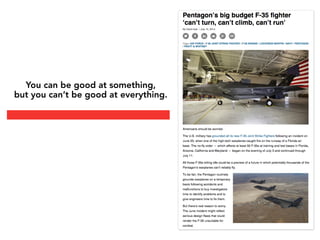
You can be good at something,
but you can’t be good at everything.
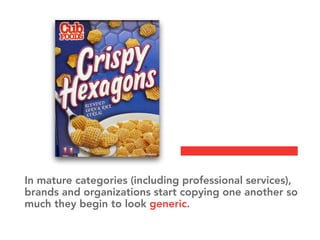
In mature categories (including professional services),
brands and organizations start copying one another so
much they begin to look generic.
Legendary Economist Adam Smith
“In mature markets, profits
don’t come from increased
efficiency, but rather from
increased innovation and
differentiation.”
We’re collaborative
We customize solutions for every client
We’re team players
We’re your trusted business partner
We deliver excellence
We’re experienced professionals
Etc.
Etc.
Etc.
Etc.
Etc.
Etc.
Etc.
Etc.
Etc.
Etc.
Etc.
Etc.
Etc.
Etc.
JUST TABLE STAKES
What qualifies
as a positioning
strategy?
SIZEIS NOT A STRATEGY
WIDE RANGE
IS NOT A STRATEGY
INTEGRATION
IS NOT A STRATEGY
FULL SERVICE
IS NOT A STRATEGY
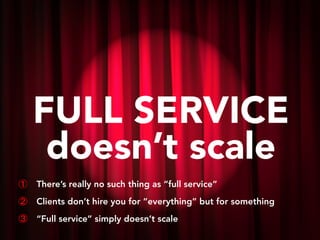
FULL SERVICE
doesn’t scale
① There’s really no such thing as “full service”
② Clients don’t hire you for “everything” but for something
③ “Full service” simply doesn’t scale
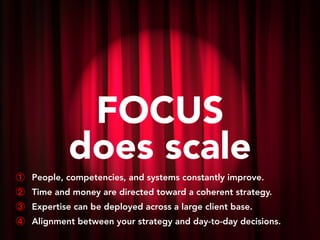
FOCUS
does scale
① People, competencies, and systems constantly improve.
② Time and money are directed toward a coherent strategy.
③ Expertise can be deployed across a large client base.
④ Alignment between your strategy and day-to-day decisions.
Positioning = ?
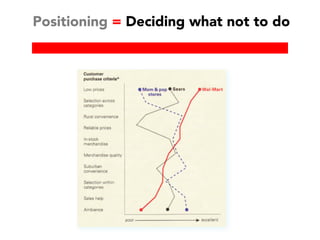
Positioning = Deciding what not to do
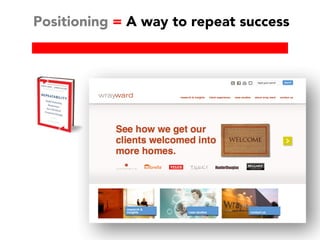
Positioning = A way to repeat success
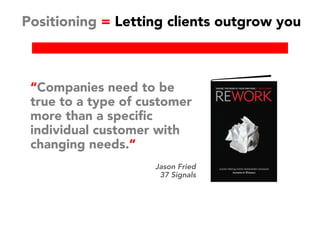
Positioning = Letting clients outgrow you
“Companies need to be
true to a type of customer
more than a specific
individual customer with
changing needs.”
Jason Fried
37 Signals
Positioning = Curating
“What makes a great museum is
the stuff that’s not on the walls.”
Seth Godin
Positioning = A business strategy
Michael Porter
Harvard Business School
“The essence of strategy is
choosing what not to do.”
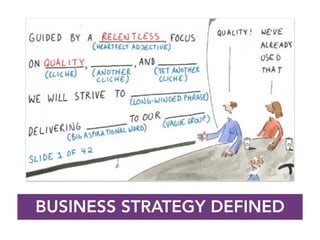
MARKETOONIST.COM
BUSINESS STRATEGY DEFINED
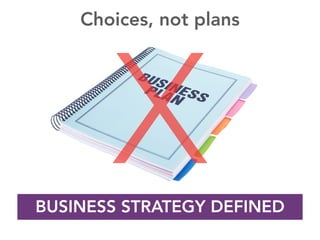
X
Choices, not plans
BUSINESS STRATEGY DEFINED
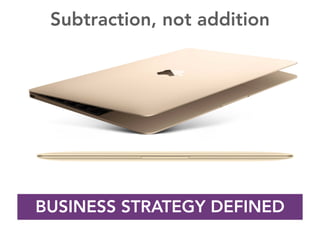
Subtraction, not addition
BUSINESS STRATEGY DEFINED
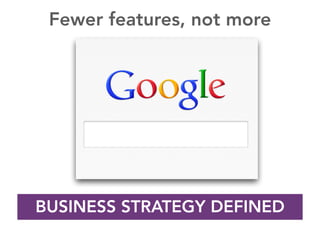
Fewer features, not more
BUSINESS STRATEGY DEFINED
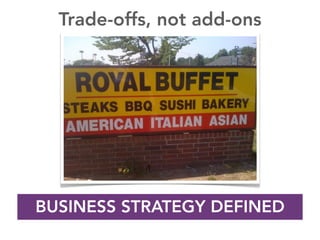
Trade-offs, not add-ons
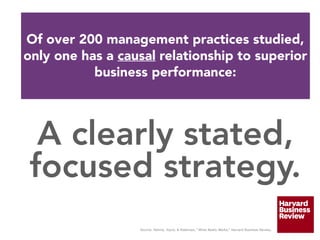
Of over 200 management practices studied,
only one has a causal relationship to superior
business performance:
A clearly stated,
focused strategy.
Source: Nohria, Joyce, & Roberson, “What Really Works,” Harvard Business Review,
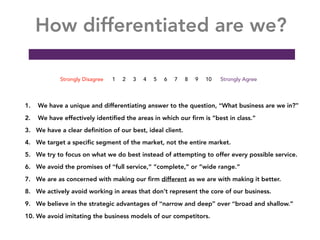
1. We have a unique and differentiating answer to the question, “What business are we in?”
2. We have effectively identified the areas in which our firm is “best in class.”
3. We have a clear definition of our best, ideal client.
4. We target a specific segment of the market, not the entire market.
5. We try to focus on what we do best instead of attempting to offer every possible service.
6. We avoid the promises of “full service,” “complete,” or “wide range.”
7. We are as concerned with making our firm different as we are with making it better.
8. We actively avoid working in areas that don’t represent the core of our business.
9. We believe in the strategic advantages of “narrow and deep” over “broad and shallow.”
10. We avoid imitating the business models of our competitors.
How differentiated are we?
Strongly Disagree 1 2 3 4 5 6 7 8 9 10 Strongly Agree
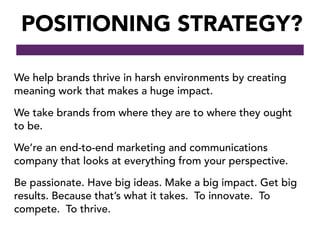
POSITIONING STRATEGY?
We help brands thrive in harsh environments by creating
meaning work that makes a huge impact.
We take brands from where they are to where they ought
to be.
We’re an end-to-end marketing and communications
company that looks at everything from your perspective.
Be passionate. Have big ideas. Make a big impact. Get big
results. Because that’s what it takes. To innovate. To
compete. To thrive.
To arrive at an effective positioning
strategy, you must interrogate your
firm until it confesses its strengths.
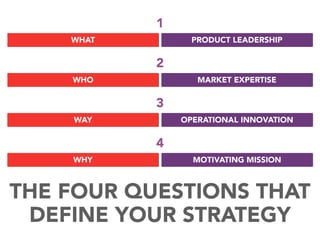
WHAT PRODUCT LEADERSHIP
THE FOUR QUESTIONS THAT
DEFINE YOUR STRATEGY
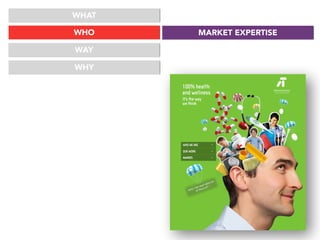
WHO MARKET EXPERTISE
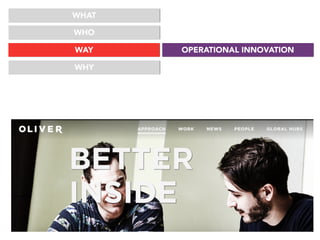
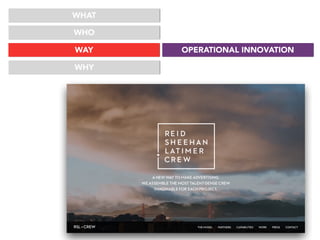
WAY OPERATIONAL INNOVATION
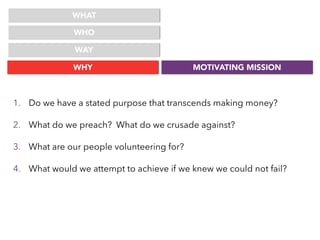
WHY MOTIVATING MISSION
1
2
3
4
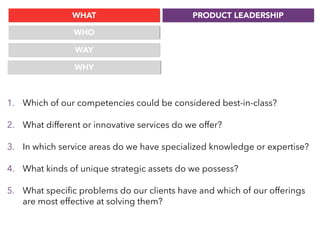
WHAT
WHO
WAY
PRODUCT LEADERSHIP
WHY
1. Which of our competencies could be considered best-in-class?
2. What different or innovative services do we offer?
3. In which service areas do we have specialized knowledge or expertise?
4. What kinds of unique strategic assets do we possess?
5. What specific problems do our clients have and which of our offerings
are most effective at solving them?
WHAT
WHO
WAY
PRODUCT LEADERSHIP
WHY
WHAT
WHO
WAY
PRODUCT LEADERSHIP
WHY
WHAT
WHO
WAY
PRODUCT LEADERSHIP
WHY
WHAT
WHO
WAY
PRODUCT LEADERSHIP
WHY
WHAT
WHO
WAY
MARKET EXPERTISE
WHY
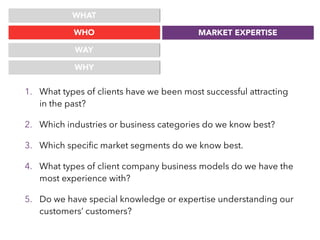
1. What types of clients have we been most successful attracting
in the past?
2. Which industries or business categories do we know best?
3. Which specific market segments do we know best.
4. What types of client company business models do we have the
most experience with?
5. Do we have special knowledge or expertise understanding our
customers’ customers?
WHAT
WHO
WAY
MARKET EXPERTISE
WHY
WHAT
WHO
WAY
MARKET EXPERTISE
WHY
WHAT
WHO
WAY
MARKET EXPERTISE
WHY
WHAT
WHO
WAY OPERATIONAL INNOVATION
WHY
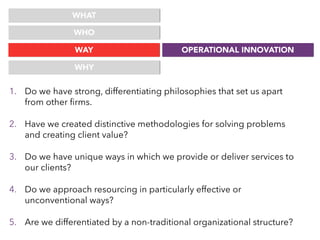
1. Do we have strong, differentiating philosophies that set us apart
from other firms.
2. Have we created distinctive methodologies for solving problems
and creating client value?
3. Do we have unique ways in which we provide or deliver services to
our clients?
4. Do we approach resourcing in particularly effective or
unconventional ways?
5. Are we differentiated by a non-traditional organizational structure?
WHAT
WHO
WAY OPERATIONAL INNOVATION
WHY
WHAT
WHO
WAY OPERATIONAL INNOVATION
WHY
WHAT
WHO
WAY OPERATIONAL INNOVATION
WHY
WHAT
WHO
WHY MOTIVATING MISSION
WAY
1. Do we have a stated purpose that transcends making money?
2. What do we preach? What do we crusade against?
3. What are our people volunteering for?
4. What would we attempt to achieve if we knew we could not fail?
WHAT
WHO
WHY MOTIVATING MISSION
WAY
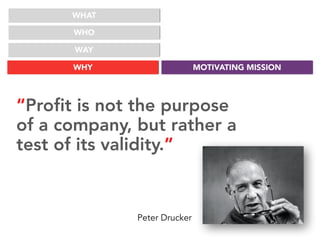
“Profit is not the purpose
of a company, but rather a
test of its validity.”
Peter Drucker
WHAT
WHO
WHY MOTIVATING MISSION
WAY
WHAT
WHO
WHY MOTIVATING MISSION
WAY
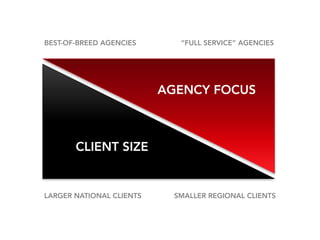
CLIENT SIZE
BEST-OF-BREED AGENCIES
LARGER NATIONAL CLIENTS
AGENCY FOCUS
“FULL SERVICE” AGENCIES
SMALLER REGIONAL CLIENTS
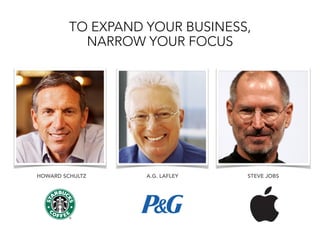
HOWARD SCHULTZ A.G. LAFLEY STEVE JOBS
TO EXPAND YOUR BUSINESS,
NARROW YOUR FOCUS
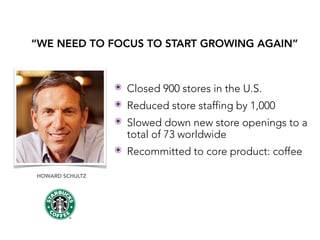
HOWARD SCHULTZ
“WE NEED TO FOCUS TO START GROWING AGAIN”
๏ Closed 900 stores in the U.S.
๏ Reduced store staffing by 1,000
๏ Slowed down new store openings to a
total of 73 worldwide
๏ Recommitted to core product: coffee
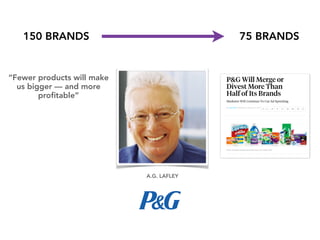
A.G. LAFLEY
150 BRANDS 75 BRANDS
“Fewer products will make
us bigger — and more
profitable”
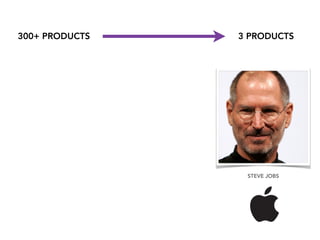
STEVE JOBS
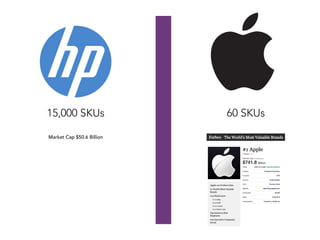
300+ PRODUCTS 3 PRODUCTS
15,000 SKUs 60 SKUs
Market Cap $50.6 Billion
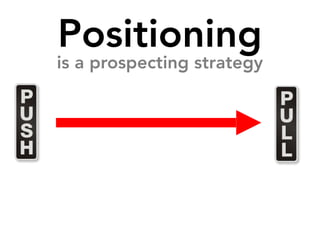
Positioning
is a prospecting strategy
THE FOUR QUESTIONS
THAT DEFINE AGENCY
POSITIONING

Four Questions That Define Agency Positioning Strategy