Positioning
Principles of Marketing
Positioning
Positioning is a strategic process that marketers use to
determine the place or “niche” an offering should occupy
in a given market, relative to other customer alternatives
When you position a product or service, you need to
understand
• Place
• Rank
• Attitude
• Outcomes
Differentiation
To make a product or service stand out from its
competitors in ways that provide unique value to the
customer
Identifies a set of characteristics and benefits that make
a product different and better for a target audience that:
1. Customers value when they are evaluating choices
2. Competitors cannot easily copy
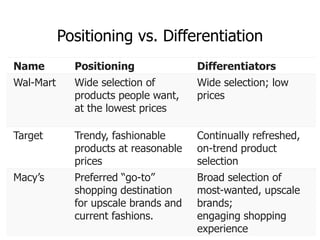
Positioning vs. Differentiation
Name Positioning Differentiators
Wal-Mart Wide selection of
products people want,
at the lowest prices
Wide selection; low
prices
Target Trendy, fashionable
products at reasonable
prices
Continually refreshed,
on-trend product
selection
Macy’s Preferred “go-to”
shopping destination
for upscale brands and
current fashions.
Broad selection of
most-wanted, upscale
brands;
engaging shopping
experience
Steps of the Positioning Process
1. Confirm your understanding of market dynamics
2. Identify your competitive advantages
3. Choose competitive advantages that define your
market “niche”
4. Define your positioning strategy
5. Communicate and deliver on the positioning strategy
Step 1: Confirm Your Understanding
of Market Dynamics
A firm understanding of your target market and answers
to the following questions:
• In which product, service, or market category (also
called the “frame of reference”) do you plan to use this
positioning?
• Which target segment is your focus for the positioning
you are developing?
• What factors do these buyers evaluate when they
make a purchasing decision?
• How do these buyers view your competitors in the
category?
Step 2: Identify Your Competitive
Advantages
A trait, quality, or capability that allows you to
outperform the competition
Gives your product, service, or brand an advantage over
others in purchasing decisions
Comes from any or all of the following:
• Price
• Features
• Benefits
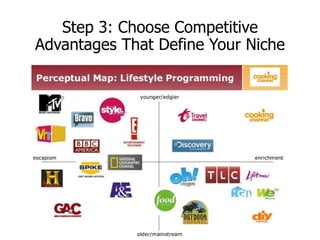
Step 3: Choose Competitive
Advantages That Define Your Niche
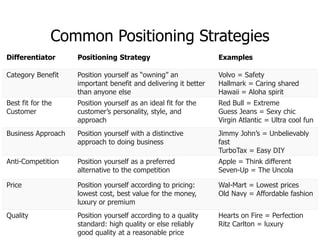
Common Positioning Strategies
Differentiator Positioning Strategy Examples
Category Benefit Position yourself as “owning” an
important benefit and delivering it better
than anyone else
Volvo = Safety
Hallmark = Caring shared
Hawaii = Aloha spirit
Best fit for the
Customer
Position yourself as an ideal fit for the
customer’s personality, style, and
approach
Red Bull = Extreme
Guess Jeans = Sexy chic
Virgin Atlantic = Ultra cool fun
Business Approach Position yourself with a distinctive
approach to doing business
Jimmy John’s = Unbelievably
fast
TurboTax = Easy DIY
Anti-Competition Position yourself as a preferred
alternative to the competition
Apple = Think different
Seven-Up = The Uncola
Price Position yourself according to pricing:
lowest cost, best value for the money,
luxury or premium
Wal-Mart = Lowest prices
Old Navy = Affordable fashion
Quality Position yourself according to a quality
standard: high quality or else reliably
good quality at a reasonable price
Hearts on Fire = Perfection
Ritz Carlton = luxury
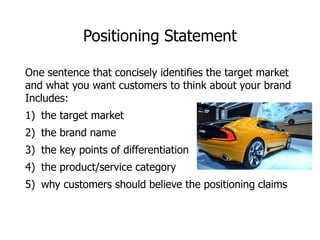
Positioning Statement
One sentence that concisely identifies the target market
and what you want customers to think about your brand
Includes:
1) the target market
2) the brand name
3) the key points of differentiation
4) the product/service category
5) why customers should believe the positioning claims
Formula for Positioning Statement
To [target audience], Product X is the only [category or
frame of reference] that [points of
differentiation/benefits delivered] because [reasons to
believe].
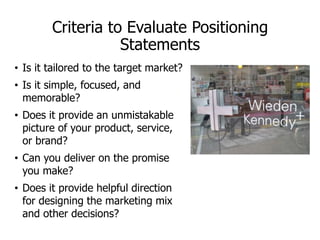
Criteria to Evaluate Positioning
Statements
• Is it tailored to the target market?
• Is it simple, focused, and
memorable?
• Does it provide an unmistakable
picture of your product, service,
or brand?
• Can you deliver on the promise
you make?
• Does it provide helpful direction
for designing the marketing mix
and other decisions?
Repositioning
Reasons to Consider Repositioning
Competition
• New competitors entering or leaving the market;
competitors joining forces
• Competitor’s innovation that threatens to make your
offering obsolete; competitive pricing strategies
Market environment
• Economic slow-down or recovery
• Changes in consumer confidence, the political climate,
or social forces like the movement around social
responsibility and sustainability
More Reasons to Consider
Repositioning
Consumer trends
• Changing tastes and preferences
• Evolving attitudes and behaviors
• New segments emerging as targets
Internal environment
• Changes in organizational leadership and strategy
• Acquisition or development of new technology
• Introduction of innovation that offers new competitive
advantages and differentiators
Repositioning
and Market
Perceptions
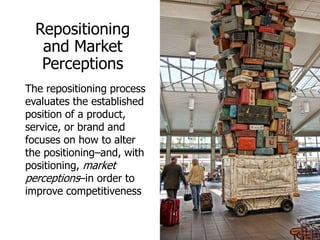
The repositioning process
evaluates the established
position of a product,
service, or brand and
focuses on how to alter
the positioning–and, with
positioning, market
perceptions–in order to
improve competitiveness
Pitfalls of Repositioning
• Insufficient research
• A bridge too far: If brands go too far in a new
direction, customers may no longer believe the claims
• Underestimating “back to basics”
• Overpromising
• Confusing positioning
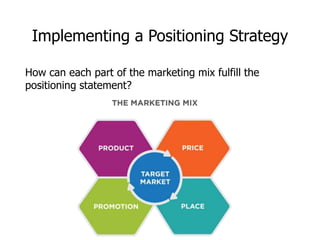
Implementing a Positioning Strategy
How can each part of the marketing mix fulfill the
positioning statement?
Product
• Is your product, service, or brand capable of delivering
everything your positioning statement claims?
• Are any competitors doing it better than you?
• How should you adjust your offering to ensure that it
lives up to the promises?
Price
• When it comes to pricing, how are you positioning your
offering relative to competitors?
• If pricing is part of your positioning strategy, is your
offering well aligned with the price you’re asking
customers to pay?
• What pricing strategies should you consider in order to
compete more effectively?
Place
• Are any distribution-related themes like convenience
or availability part of your positioning strategy or
competitive advantage?
• If so, what are you doing to ensure that you can live
up to what you promise?
• How are you communicating your new positioning
approach to distribution and channel partners, and
how does it impact them?
Promotions
• How are you translating your positioning strategy into
communications with your target audiences?
• What behavioral shift are you trying to create as you
launch your new positioning?
• What types of campaigns will you use to introduce the
new positioning?
• Which communication tools will be most effective at
reaching target audiences?
• What are you doing to coordinate marketing messages
and activities across different channels?
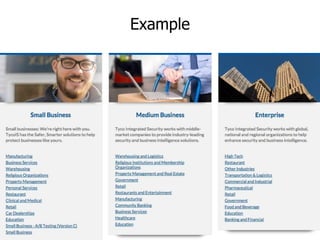
Example
Measuring Implementation
• Sales/revenue
• Number of new/returning customers
• Average spending per transaction
• Brand/product awareness or perceptions
• Favorability toward product/service/brand
• New leads or inquiries from inside and outside your target
segments
• Web site traffic or social media “buzz”
• Media attention
• Customer Satisfaction
• Return on investment for marketing campaigns and other
activities
Practice Questions
What is the difference between a feature and a benefit?
Quick Review
• What are positioning and differentiation, and why are
they important to marketing a product or service?
• What is the process of selecting a positioning and
differentiation strategy?
• How do marketers develop and evaluate positioning
statements based on defined criteria?
• How do marketers reposition products or services?
What are the associated risks and complexities?
• What is the process of implementing a positioning
strategy?

PrinciplesofMarketing_08_Positioning2.pptx

  • 1.
  • 2.
    Positioning Positioning is astrategic process that marketers use to determine the place or “niche” an offering should occupy in a given market, relative to other customer alternatives When you position a product or service, you need to understand • Place • Rank • Attitude • Outcomes
  • 3.
    Differentiation To make aproduct or service stand out from its competitors in ways that provide unique value to the customer Identifies a set of characteristics and benefits that make a product different and better for a target audience that: 1. Customers value when they are evaluating choices 2. Competitors cannot easily copy
  • 4.
    Positioning vs. Differentiation NamePositioning Differentiators Wal-Mart Wide selection of products people want, at the lowest prices Wide selection; low prices Target Trendy, fashionable products at reasonable prices Continually refreshed, on-trend product selection Macy’s Preferred “go-to” shopping destination for upscale brands and current fashions. Broad selection of most-wanted, upscale brands; engaging shopping experience
  • 5.
    Steps of thePositioning Process 1. Confirm your understanding of market dynamics 2. Identify your competitive advantages 3. Choose competitive advantages that define your market “niche” 4. Define your positioning strategy 5. Communicate and deliver on the positioning strategy
  • 6.
    Step 1: ConfirmYour Understanding of Market Dynamics A firm understanding of your target market and answers to the following questions: • In which product, service, or market category (also called the “frame of reference”) do you plan to use this positioning? • Which target segment is your focus for the positioning you are developing? • What factors do these buyers evaluate when they make a purchasing decision? • How do these buyers view your competitors in the category?
  • 7.
    Step 2: IdentifyYour Competitive Advantages A trait, quality, or capability that allows you to outperform the competition Gives your product, service, or brand an advantage over others in purchasing decisions Comes from any or all of the following: • Price • Features • Benefits
  • 8.
    Step 3: ChooseCompetitive Advantages That Define Your Niche
  • 9.
    Common Positioning Strategies DifferentiatorPositioning Strategy Examples Category Benefit Position yourself as “owning” an important benefit and delivering it better than anyone else Volvo = Safety Hallmark = Caring shared Hawaii = Aloha spirit Best fit for the Customer Position yourself as an ideal fit for the customer’s personality, style, and approach Red Bull = Extreme Guess Jeans = Sexy chic Virgin Atlantic = Ultra cool fun Business Approach Position yourself with a distinctive approach to doing business Jimmy John’s = Unbelievably fast TurboTax = Easy DIY Anti-Competition Position yourself as a preferred alternative to the competition Apple = Think different Seven-Up = The Uncola Price Position yourself according to pricing: lowest cost, best value for the money, luxury or premium Wal-Mart = Lowest prices Old Navy = Affordable fashion Quality Position yourself according to a quality standard: high quality or else reliably good quality at a reasonable price Hearts on Fire = Perfection Ritz Carlton = luxury
  • 10.
    Positioning Statement One sentencethat concisely identifies the target market and what you want customers to think about your brand Includes: 1) the target market 2) the brand name 3) the key points of differentiation 4) the product/service category 5) why customers should believe the positioning claims
  • 11.
    Formula for PositioningStatement To [target audience], Product X is the only [category or frame of reference] that [points of differentiation/benefits delivered] because [reasons to believe].
  • 12.
    Criteria to EvaluatePositioning Statements • Is it tailored to the target market? • Is it simple, focused, and memorable? • Does it provide an unmistakable picture of your product, service, or brand? • Can you deliver on the promise you make? • Does it provide helpful direction for designing the marketing mix and other decisions?
  • 13.
  • 14.
    Reasons to ConsiderRepositioning Competition • New competitors entering or leaving the market; competitors joining forces • Competitor’s innovation that threatens to make your offering obsolete; competitive pricing strategies Market environment • Economic slow-down or recovery • Changes in consumer confidence, the political climate, or social forces like the movement around social responsibility and sustainability
  • 15.
    More Reasons toConsider Repositioning Consumer trends • Changing tastes and preferences • Evolving attitudes and behaviors • New segments emerging as targets Internal environment • Changes in organizational leadership and strategy • Acquisition or development of new technology • Introduction of innovation that offers new competitive advantages and differentiators
  • 16.
    Repositioning and Market Perceptions The repositioningprocess evaluates the established position of a product, service, or brand and focuses on how to alter the positioning–and, with positioning, market perceptions–in order to improve competitiveness
  • 17.
    Pitfalls of Repositioning •Insufficient research • A bridge too far: If brands go too far in a new direction, customers may no longer believe the claims • Underestimating “back to basics” • Overpromising • Confusing positioning
  • 18.
    Implementing a PositioningStrategy How can each part of the marketing mix fulfill the positioning statement?
  • 19.
    Product • Is yourproduct, service, or brand capable of delivering everything your positioning statement claims? • Are any competitors doing it better than you? • How should you adjust your offering to ensure that it lives up to the promises?
  • 20.
    Price • When itcomes to pricing, how are you positioning your offering relative to competitors? • If pricing is part of your positioning strategy, is your offering well aligned with the price you’re asking customers to pay? • What pricing strategies should you consider in order to compete more effectively?
  • 21.
    Place • Are anydistribution-related themes like convenience or availability part of your positioning strategy or competitive advantage? • If so, what are you doing to ensure that you can live up to what you promise? • How are you communicating your new positioning approach to distribution and channel partners, and how does it impact them?
  • 22.
    Promotions • How areyou translating your positioning strategy into communications with your target audiences? • What behavioral shift are you trying to create as you launch your new positioning? • What types of campaigns will you use to introduce the new positioning? • Which communication tools will be most effective at reaching target audiences? • What are you doing to coordinate marketing messages and activities across different channels?
  • 23.
  • 24.
    Measuring Implementation • Sales/revenue •Number of new/returning customers • Average spending per transaction • Brand/product awareness or perceptions • Favorability toward product/service/brand • New leads or inquiries from inside and outside your target segments • Web site traffic or social media “buzz” • Media attention • Customer Satisfaction • Return on investment for marketing campaigns and other activities
  • 25.
    Practice Questions What isthe difference between a feature and a benefit?
  • 26.
    Quick Review • Whatare positioning and differentiation, and why are they important to marketing a product or service? • What is the process of selecting a positioning and differentiation strategy? • How do marketers develop and evaluate positioning statements based on defined criteria? • How do marketers reposition products or services? What are the associated risks and complexities? • What is the process of implementing a positioning strategy?

Editor's Notes

  • #2 All text in these slides is taken from https://courses.lumenlearning.com/waymakerintromarketingxmasterfall2016/, where it is published under one or more open licenses. All images in these slides are attributed in the notes of the slide on which they appear and licensed as indicated. Cover Image: No title Authored by: Nicolai Berntsen Located at: https://unsplash.com/photos/F3uyey6ours License: Creative Commons Zero
  • #4 Macy's Flower Show. Authored by: Stephen Rees. Located at: https://www.flickr.com/photos/stephen_rees/4499802916/. License: CC BY-NC-ND: Attribution-NonCommercial-NoDerivatives
  • #5 Revision and Adaptation. Authored by: Lumen Learning. License: CC BY: Attribution
  • #6 Lightbulbs. Provided by: Pixabay. Located at: https://pixabay.com/en/light-bulbs-light-bulb-light-energy-1125016/. License: CC0: No Rights Reserved
  • #9 Screenshot Perceptual Map: Lifestyle Programming. Provided by: Lumen Learning. License: CC BY: Attribution Source: Cooking Channel Marketing Project, http://www.slideshare.net/JenniferHoffmann/cooking-channel-marketing-project, Slide #60
  • #10 Provided by: Lumen Learning. License: CC BY: Attribution
  • #11 Kia GT4 Stinger. Authored by: Chad Horwedel. Located at: https://www.flickr.com/photos/chorwedel/12613017214/. License: CC BY-NC-ND: Attribution-NonCommercial-NoDerivatives
  • #13 Wieden+Kennedy door. Authored by: Sebastian Oehme. Located at: https://www.flickr.com/photos/iamseb/1581319503. License: CC BY-SA: Attribution-ShareAlike
  • #14 Compass Study. Authored by: Calsidyrose. Located at: https://www.flickr.com/photos/calsidyrose/4925267732/. License: CC BY: Attribution
  • #17 Suitcases Stacked to the Ceiling. Authored by: Laura Gilmore. Located at: https://www.flickr.com/photos/genbug/3529776320/. License: CC BY-NC-ND: Attribution-NonCommercial-NoDerivatives
  • #19 Implementing Positioning Strategy. Authored by: Lumen Learning. License: CC BY: Attribution
  • #24 Screenshot of Tyco Solutions by Industry. Provided by: Lumen Learning. License: CC BY: Attribution
  • #26 A feature is a quality of the product. A benefit is how it affects the consumer. Air bags are a feature. Feeling safe is a benefit.