PREFORMULATION
NEHA BHAMBOO
ASU2019010200056
MODERN
PHARMACEUTICS
SUBMITTED TO:
MR NAUSAD JAVED
CONTENT
 HYGROSCOPICITY
 MICROMERITIC PROPERTIES
 PARTICLE CHARACTERIATION
 DENSITY
 POROSITY
 POWDER FLOW PROPERTIES
 ANGLE OF REPOSE
 HAUSNER RATIO
 COMPRESSIBILITY INDEX
 STABILITY ANALYSIS
PREFORMULATION
 Creams are those emulsions which are either oil in
water(O/W) or water in oil (W/O) type
e.g.:-O/W- shaving cream & hand cream
W/O- cold cream & emollient cream
Type of CREAMS
Make up creams(O/W)
- Vanishing cream
- Foundation cream
Cleansing cream(W/O)
Creams for
winter(W/O)
Creams for dry
skin
-moisturising
cream
All purpose
creamNight creams
Skin protective &
Hand cream
Purpose of Creams
 The skin acts as barrier between the body and its
environment maintaining a controlled dynamic
equilibrium.
 Various stresses imposed by the environment can
cause changes in the skin and the major purpose of
the creams under consideration is to help to reverse
these changes and it maintain a normal healthy skin.
FOUNDATION CREAM
 These are applied to the skin to unify the color of the skin,
improves a dull and tired complexion, give a matte finish ,
and mask possible imperfections like dark spots , small
wrinkles , and the pores of the skin surface.
 Their application must be easy and give coverage for a
natural complexion.
 They must have a pleasure texture , a good adhesive
property.
 They must be comfortable , and have a consistent color
and smooth finish.
FOUNDATION CREAMS
INGREDIENTS
 Pigments: e.g. Titanium dioxide and various colors.
 Moisturizing agents: like glycerin and hyaluronic acid,
vegetable oils, which improve the hydration and flexibility of the
skin.
 Vitamins e.g. Thiamine hydrochloride, ascorbic acid,
cyanocobalamine, folic acid, riboflavin.
 Perfumes & Preservatives e.g. Rose, Lavender, Mixture of
parabens(methyl, butyl-parahydroxy benzoic acid, propyl).
 Ceramides ,to strengthen the skin barrier.
 UV filters : (UVA-UVB),giving makeup products a sun protection
index (SPF5-30).
 Polysolixane as antifoaming agent ( emollient , skin
conditioning).
 Fluoro compounds are used as water and oil repellent.
 Silica is a multi-porous ingredient, which absorbs the oil and
sebum.
FOUNDATION
FORMULATION
 When choosing the foundation , it is important that it is
suitable for the client skin type otherwise an infective
result will be achieved i.e. the dryness of the skin may be
accentuated or an oily skin would look more shinier than
normal.
Foundations are available in many formulations:
 Cream
 Liquid
 Cake/compact
 Gel
 Mousse
CREAM FOUNDATION
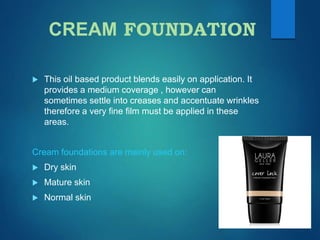
 This oil based product blends easily on application. It
provides a medium coverage , however can
sometimes settle into creases and accentuate wrinkles
therefore a very fine film must be applied in these
areas.
Cream foundations are mainly used on:
 Dry skin
 Mature skin
 Normal skin
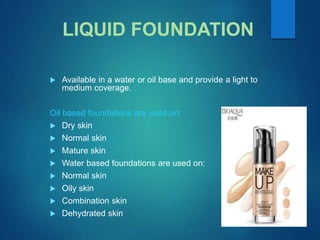
LIQUID FOUNDATION
 Available in a water or oil base and provide a light to
medium coverage.
Oil based foundations are used on:
 Dry skin
 Normal skin
 Mature skin
 Water based foundations are used on:
 Normal skin
 Oily skin
 Combination skin
 Dehydrated skin
CAKE/COMPACT
FOUNDATION
 These may have an oil, wax or powder base.
They give a heavy coverage and are suitable for:
 Dry or mature skin (oil base).
 Oily or combination skin (powder base).
 Normal skin
 Badly blemished or scarred skin
GEL FOUNDATION
 Gels provide a sheer , non greasy coverage, which is
excellent in summertime.
 Black ,unblemished skin
 Tanned skin
 Skin on which a natural effect is required.
MOUSSE FOUNDATION
 This is usually has a base made from mineral oils or
herbal extracts and can therefore be slightly more
expensive.
It will normally provide a light to medium coverage and is
suitable for use on:
 Combination skin : A greasy and blemished skin may
be require a medicated foundation.
 Normal skin
 Dehydrated skin
Foundation cream
formulation
INGREDIENTS PERCENTAGE
Myristyl myristale 3.5
Sorbiton monosterate 2.5
POE 20 sorbiton monophosphate 3.5
Isopropyl myristate 4.0
Isopropyl stearate 5.0
Derivatized beeswax 6.0
Isostearyl isostearate 4.0
PPG2 Myristyl ether propionate 10.0
Water 53.0
Pigments 8.0
Preservatives Q.S
Fragrance Q.s
METHOD
 Disperse the pigments at 75° C in the mixture of
beeswax , isopropyl myristate and isopropyl stearate .
 Add to this mixture at 55° C , the other ingredients
from the oil phase and emulsify a 55° C.
 While continuously mixing at 200 r.p.m ,add the
perfume at 35° C.
 This foundation cream is expected to spread easily on
the skin.
Liquid Foundation
Formulation
INGREDIENTS PERCENTAGE
PART A
Stearic acid 3
Octyl dodecanol 6
Squalene 4.5
Cetyl alchohol 1
Butyl paraben 0.10
Pigments Q.S
Lauryl lysine 2
PART B
Triethanolamine 1.5
Water 25
PART C
1,3-butylene glycol 5
Preservatives Q.S
Water Q.S
PART D
Betonite,1% aq.soln. 15
Method
 Dissolve or mix part a, b and c at 80 ° C separately.
 Add part b to part a and mix well.
 Then add part c to the mixture with mixing.
 Add part d to the mixture and cool down to 40° C .
Gradually.
 Agitate the mixture with homomixer and cool down to
30° C.
 This formula is a liquid foundation and should produce
good spread ability due to the lauroyl lysine.
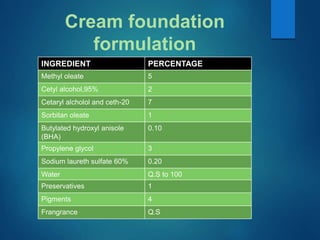
Cream foundation
formulation
INGREDIENT PERCENTAGE
Methyl oleate 5
Cetyl alcohol,95% 2
Cetaryl alcholol and ceth-20 7
Sorbitan oleate 1
Butylated hydroxyl anisole
(BHA)
0.10
Propylene glycol 3
Sodium laureth sulfate 60% 0.20
Water Q.S to 100
Preservatives 1
Pigments 4
Frangrance Q.S
Method
 In a batch tank, add the first five ingredients and stir
continuously at about 65° C
 Warm the rest of the ingredients except perfume to
about 65° C and mix well.
 Add this mixture to the batch tank , with stirring.
 Make up the volume with the water at about 40° C ,
add perfume and mix well.
 Either store the bulk or fill them in appropriate
container.
Evaluation
The cream is evaluated for following parameters:
 Appearance – Elegant/ Non elegant
 Grittiness – Rub a pinch of cream between the
fingers and thumb & observe for rashes
and eruption.
 Spreadibility - Evenly spread on skin / Unevenly
 Sensitivity – Apply patch on the skin. Keep for 15
min under the sun, then test its
sensitivity.
Choosing a foundation for
the clients skin color
 It is important that the correct color of the foundation
chosen to match the client skin tone.
 Test the color choice on the client cheek or jaw line to
achieve the most accurate color match.
 If the foundation look darker / more orange than the
skin then you need to select a different color.
 Remember that you can always blend color to achieve
the perfect match.
Foundation application
techniques
 After selecting the correct color of foundation you should
remove the required amount from the container using your
sterile spatula and lace it onto the make-up palette.
 Start on the cheek or jaw line and apply using a sterile cosmetic
make-up wedge in small upward strokes, blending each area
before you move on to the next.
 If you apply by dotting small patches to the face the foundation
will start to dry before you have finished blending , resulting in a
streaky application.
 The foundation should be applied to the whole face up to the
jaw line, including the eyelids and the lips as this encourages
the eye make-up and lipstick to stay on for longer.
Benefits of using
foundation
Foundation is thought to be the canvas for the paint and is
a very important part of the make-up procedure as it :
 Gives a base for the rest of the make-up to be applied
onto.
 Reduces the appearance of blemishes or uneven
pigmentation.
 Enhances the natural skin tones.
 Protects the skin as many foundation now contains
SPF factors.
Reference
1. Nanda Sanju, Nanda Arun, Khar Roop K, In “Cosmetic Technology”
Published by Birla Publications Pvt. Ltd. 1st edition 2006-2007. Pg
no-253-255, 259,267.
2. Sharma P.P, In “Cosmetics- Formulation, Manufacturing & Quality
Control” Published by Vandana Publications Pvt. Ltd. Delhi 3rd
edition. Pg no-155-159.
3. Dr. Talegaonkar Sushama , Prof. Khar Roop K, Khan Zeenak I, De,
Ahmad Farhan Jalees, In “Pharmaceutical Technology” Vol.1
Published by Birla Publications Pvt. Ltd. 3rd edition. Pg no-139,140
Thank you

preformulation

  • 1.
  • 2.
    CONTENT  HYGROSCOPICITY  MICROMERITICPROPERTIES  PARTICLE CHARACTERIATION  DENSITY  POROSITY  POWDER FLOW PROPERTIES  ANGLE OF REPOSE  HAUSNER RATIO  COMPRESSIBILITY INDEX  STABILITY ANALYSIS
  • 3.
    PREFORMULATION  Creams arethose emulsions which are either oil in water(O/W) or water in oil (W/O) type e.g.:-O/W- shaving cream & hand cream W/O- cold cream & emollient cream
  • 4.
    Type of CREAMS Makeup creams(O/W) - Vanishing cream - Foundation cream Cleansing cream(W/O) Creams for winter(W/O) Creams for dry skin -moisturising cream All purpose creamNight creams Skin protective & Hand cream
  • 5.
    Purpose of Creams The skin acts as barrier between the body and its environment maintaining a controlled dynamic equilibrium.  Various stresses imposed by the environment can cause changes in the skin and the major purpose of the creams under consideration is to help to reverse these changes and it maintain a normal healthy skin.
  • 6.
    FOUNDATION CREAM  Theseare applied to the skin to unify the color of the skin, improves a dull and tired complexion, give a matte finish , and mask possible imperfections like dark spots , small wrinkles , and the pores of the skin surface.  Their application must be easy and give coverage for a natural complexion.  They must have a pleasure texture , a good adhesive property.  They must be comfortable , and have a consistent color and smooth finish.
  • 7.
    FOUNDATION CREAMS INGREDIENTS  Pigments:e.g. Titanium dioxide and various colors.  Moisturizing agents: like glycerin and hyaluronic acid, vegetable oils, which improve the hydration and flexibility of the skin.  Vitamins e.g. Thiamine hydrochloride, ascorbic acid, cyanocobalamine, folic acid, riboflavin.  Perfumes & Preservatives e.g. Rose, Lavender, Mixture of parabens(methyl, butyl-parahydroxy benzoic acid, propyl).  Ceramides ,to strengthen the skin barrier.  UV filters : (UVA-UVB),giving makeup products a sun protection index (SPF5-30).  Polysolixane as antifoaming agent ( emollient , skin conditioning).  Fluoro compounds are used as water and oil repellent.  Silica is a multi-porous ingredient, which absorbs the oil and sebum.
  • 8.
    FOUNDATION FORMULATION  When choosingthe foundation , it is important that it is suitable for the client skin type otherwise an infective result will be achieved i.e. the dryness of the skin may be accentuated or an oily skin would look more shinier than normal. Foundations are available in many formulations:  Cream  Liquid  Cake/compact  Gel  Mousse
  • 9.
    CREAM FOUNDATION  Thisoil based product blends easily on application. It provides a medium coverage , however can sometimes settle into creases and accentuate wrinkles therefore a very fine film must be applied in these areas. Cream foundations are mainly used on:  Dry skin  Mature skin  Normal skin
  • 10.
    LIQUID FOUNDATION  Availablein a water or oil base and provide a light to medium coverage. Oil based foundations are used on:  Dry skin  Normal skin  Mature skin  Water based foundations are used on:  Normal skin  Oily skin  Combination skin  Dehydrated skin
  • 11.
    CAKE/COMPACT FOUNDATION  These mayhave an oil, wax or powder base. They give a heavy coverage and are suitable for:  Dry or mature skin (oil base).  Oily or combination skin (powder base).  Normal skin  Badly blemished or scarred skin
  • 12.
    GEL FOUNDATION  Gelsprovide a sheer , non greasy coverage, which is excellent in summertime.  Black ,unblemished skin  Tanned skin  Skin on which a natural effect is required.
  • 13.
    MOUSSE FOUNDATION  Thisis usually has a base made from mineral oils or herbal extracts and can therefore be slightly more expensive. It will normally provide a light to medium coverage and is suitable for use on:  Combination skin : A greasy and blemished skin may be require a medicated foundation.  Normal skin  Dehydrated skin
  • 14.
    Foundation cream formulation INGREDIENTS PERCENTAGE Myristylmyristale 3.5 Sorbiton monosterate 2.5 POE 20 sorbiton monophosphate 3.5 Isopropyl myristate 4.0 Isopropyl stearate 5.0 Derivatized beeswax 6.0 Isostearyl isostearate 4.0 PPG2 Myristyl ether propionate 10.0 Water 53.0 Pigments 8.0 Preservatives Q.S Fragrance Q.s
  • 15.
    METHOD  Disperse thepigments at 75° C in the mixture of beeswax , isopropyl myristate and isopropyl stearate .  Add to this mixture at 55° C , the other ingredients from the oil phase and emulsify a 55° C.  While continuously mixing at 200 r.p.m ,add the perfume at 35° C.  This foundation cream is expected to spread easily on the skin.
  • 16.
    Liquid Foundation Formulation INGREDIENTS PERCENTAGE PARTA Stearic acid 3 Octyl dodecanol 6 Squalene 4.5 Cetyl alchohol 1 Butyl paraben 0.10 Pigments Q.S Lauryl lysine 2 PART B Triethanolamine 1.5 Water 25 PART C 1,3-butylene glycol 5 Preservatives Q.S Water Q.S PART D Betonite,1% aq.soln. 15
  • 17.
    Method  Dissolve ormix part a, b and c at 80 ° C separately.  Add part b to part a and mix well.  Then add part c to the mixture with mixing.  Add part d to the mixture and cool down to 40° C . Gradually.  Agitate the mixture with homomixer and cool down to 30° C.  This formula is a liquid foundation and should produce good spread ability due to the lauroyl lysine.
  • 18.
    Cream foundation formulation INGREDIENT PERCENTAGE Methyloleate 5 Cetyl alcohol,95% 2 Cetaryl alcholol and ceth-20 7 Sorbitan oleate 1 Butylated hydroxyl anisole (BHA) 0.10 Propylene glycol 3 Sodium laureth sulfate 60% 0.20 Water Q.S to 100 Preservatives 1 Pigments 4 Frangrance Q.S
  • 19.
    Method  In abatch tank, add the first five ingredients and stir continuously at about 65° C  Warm the rest of the ingredients except perfume to about 65° C and mix well.  Add this mixture to the batch tank , with stirring.  Make up the volume with the water at about 40° C , add perfume and mix well.  Either store the bulk or fill them in appropriate container.
  • 20.
    Evaluation The cream isevaluated for following parameters:  Appearance – Elegant/ Non elegant  Grittiness – Rub a pinch of cream between the fingers and thumb & observe for rashes and eruption.  Spreadibility - Evenly spread on skin / Unevenly  Sensitivity – Apply patch on the skin. Keep for 15 min under the sun, then test its sensitivity.
  • 21.
    Choosing a foundationfor the clients skin color  It is important that the correct color of the foundation chosen to match the client skin tone.  Test the color choice on the client cheek or jaw line to achieve the most accurate color match.  If the foundation look darker / more orange than the skin then you need to select a different color.  Remember that you can always blend color to achieve the perfect match.
  • 22.
    Foundation application techniques  Afterselecting the correct color of foundation you should remove the required amount from the container using your sterile spatula and lace it onto the make-up palette.  Start on the cheek or jaw line and apply using a sterile cosmetic make-up wedge in small upward strokes, blending each area before you move on to the next.  If you apply by dotting small patches to the face the foundation will start to dry before you have finished blending , resulting in a streaky application.  The foundation should be applied to the whole face up to the jaw line, including the eyelids and the lips as this encourages the eye make-up and lipstick to stay on for longer.
  • 23.
    Benefits of using foundation Foundationis thought to be the canvas for the paint and is a very important part of the make-up procedure as it :  Gives a base for the rest of the make-up to be applied onto.  Reduces the appearance of blemishes or uneven pigmentation.  Enhances the natural skin tones.  Protects the skin as many foundation now contains SPF factors.
  • 24.
    Reference 1. Nanda Sanju,Nanda Arun, Khar Roop K, In “Cosmetic Technology” Published by Birla Publications Pvt. Ltd. 1st edition 2006-2007. Pg no-253-255, 259,267. 2. Sharma P.P, In “Cosmetics- Formulation, Manufacturing & Quality Control” Published by Vandana Publications Pvt. Ltd. Delhi 3rd edition. Pg no-155-159. 3. Dr. Talegaonkar Sushama , Prof. Khar Roop K, Khan Zeenak I, De, Ahmad Farhan Jalees, In “Pharmaceutical Technology” Vol.1 Published by Birla Publications Pvt. Ltd. 3rd edition. Pg no-139,140
  • 25.