Fossils and Their
Types
Uswa Hasna
BS_4
Department of botany
Lahore college for women university
•Fossils
•The remains of plants and
•Fossil record:
•The data recorded in fossils,
the fossil record.
How Fossil formed?
Fossilization
Decomposition
Formation of sediments
Fossil
Factors effecting fossilization process
The nature of plant or animal material
The kind of entombing material.
The rapidity with which the plant was covered and
thus prevented from exposure to organism of decay.
The condition of plant material at the time of
fossilization
Compressions:
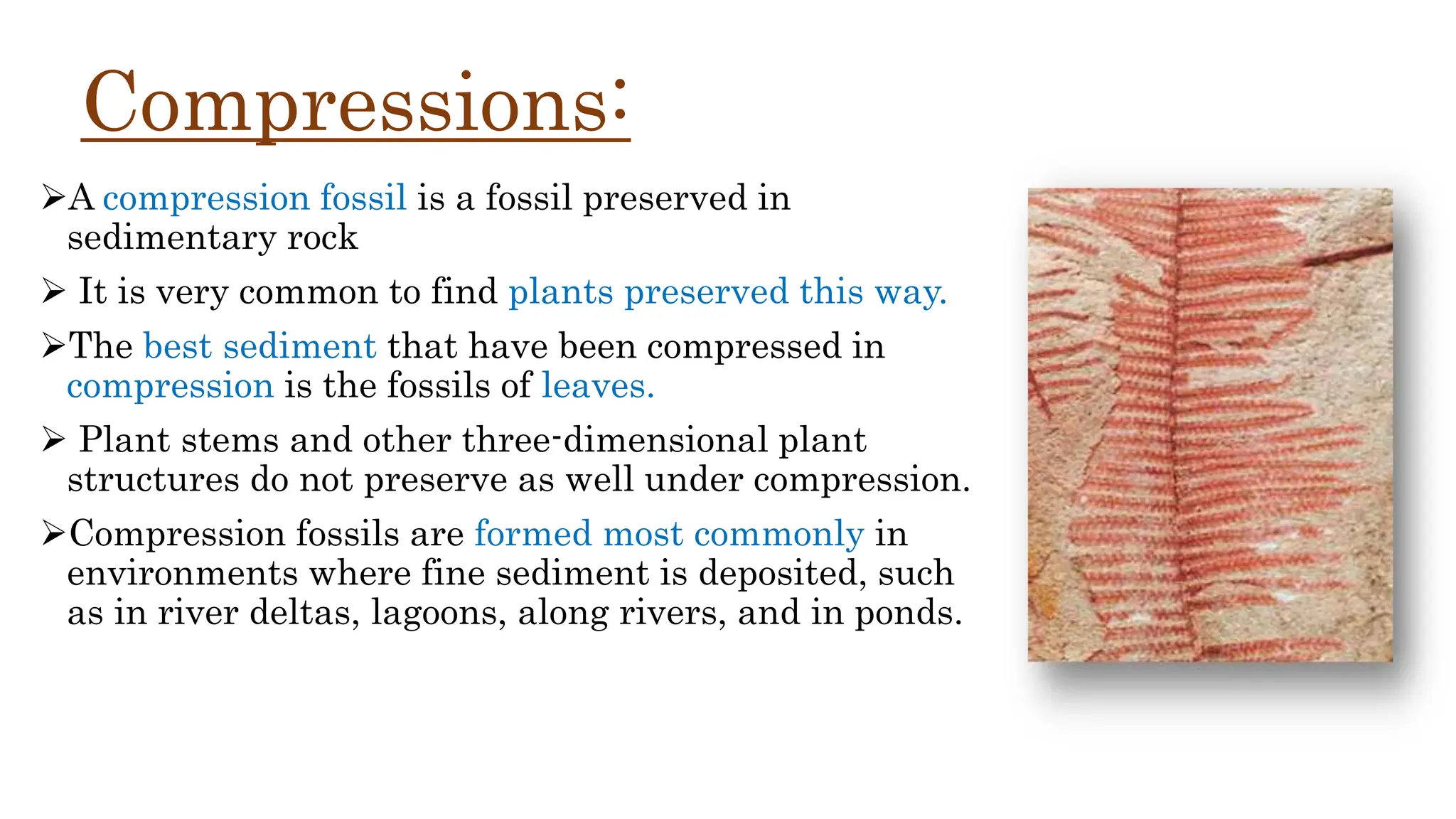
A compression fossil is a fossil preserved in
sedimentary rock
 It is very common to find plants preserved this way.
The best sediment that have been compressed in
compression is the fossils of leaves.
 Plant stems and other three-dimensional plant
structures do not preserve as well under compression.
Compression fossils are formed most commonly in
environments where fine sediment is deposited, such
as in river deltas, lagoons, along rivers, and in ponds.
Impressions or imprints:
The sediments around the compressed
plants or plant part become hardened and
form a three-dimensional mold.
They only reveal the outline of the plant
and its parts. The cellular details are not
preserved.
They are regarded as the negatives of the
compressions.
Impression fossils form when a leaf, shell,
skin, or foot. leaves an imprint in soft
earth.
Petrifactions:
• The replacement of the original
material and the filling of the original
pore spaces with minerals.
• Petrifaction takes place by two
processes
I. Permineralization
II. replacement.
• They are the best type of fossils.
• They reveal the internal structure of
the part of the plant which is petrify.
Types of fossils
•Following are different kinds of fossils.
Dead and preserved Bodies:
The actual dead and preserved bodies of
plants and animals or parts of bodies are
preserved in rock or ice.
The original tissues remain intact in the
fossilized material.
Encrustation fossils:
• They found in hot springs whose water
contain abundant mineral matter.
• The fallen twigs, leaves, spores, algae
and bacteria live in such hot springs
become coated with carbonates and are
encapsuled.
• These carbonates become precipitated
on cooling.
Calcification:
• This process is used by some
algae.
• They secrete a heavy coat of
calcium carbonate around
them.
• Coral reef found in the oceans
are built more by secretion of
calcium carbonate by marine
algae rather than by corals.
Diatomaceous earth:
• These regions were earlies inundated by the
oceans that were inhabited by countless
members Diatoms
• Diatoms are a silicon-based algae.
• After the death of these diatoms, their
siliceous shell sank to the bottom of the sea.
• The mass of these shells went on
accumulating at the bottom for million of
years and formed the diatomaceous earth.
Actual remains:
 These are young age fossils which don’t
decompose due to low temperature or
vacuum.
 All materials are preserved e.g., cuticle,
cutin, walls of pollen grains and spores.
Chemical remains:
 Chemical materials like amino acid and
hydrocarbons may be obtained in a natural
state from the rocks.
 Organ of plant has been incorporated in this
chemical material.
How do fossils help geologists?
Some key origins and changes in fossil organisms through
geological time; these changes help geologists determine the
ages of rocks.
Biostratigraphy:
This use of fossils to help understand the age of rocks is called
biostratigraphy.
Thank You

Fossils and their types.pptx

  • 1.
    Fossils and Their Types UswaHasna BS_4 Department of botany Lahore college for women university
  • 2.
    •Fossils •The remains ofplants and •Fossil record: •The data recorded in fossils, the fossil record.
  • 3.
  • 4.
    Factors effecting fossilizationprocess The nature of plant or animal material The kind of entombing material. The rapidity with which the plant was covered and thus prevented from exposure to organism of decay. The condition of plant material at the time of fossilization
  • 5.
    Compressions: A compression fossilis a fossil preserved in sedimentary rock  It is very common to find plants preserved this way. The best sediment that have been compressed in compression is the fossils of leaves.  Plant stems and other three-dimensional plant structures do not preserve as well under compression. Compression fossils are formed most commonly in environments where fine sediment is deposited, such as in river deltas, lagoons, along rivers, and in ponds.
  • 6.
    Impressions or imprints: Thesediments around the compressed plants or plant part become hardened and form a three-dimensional mold. They only reveal the outline of the plant and its parts. The cellular details are not preserved. They are regarded as the negatives of the compressions. Impression fossils form when a leaf, shell, skin, or foot. leaves an imprint in soft earth.
  • 7.
    Petrifactions: • The replacementof the original material and the filling of the original pore spaces with minerals. • Petrifaction takes place by two processes I. Permineralization II. replacement. • They are the best type of fossils. • They reveal the internal structure of the part of the plant which is petrify.
  • 8.
    Types of fossils •Followingare different kinds of fossils. Dead and preserved Bodies: The actual dead and preserved bodies of plants and animals or parts of bodies are preserved in rock or ice. The original tissues remain intact in the fossilized material.
  • 9.
    Encrustation fossils: • Theyfound in hot springs whose water contain abundant mineral matter. • The fallen twigs, leaves, spores, algae and bacteria live in such hot springs become coated with carbonates and are encapsuled. • These carbonates become precipitated on cooling.
  • 10.
    Calcification: • This processis used by some algae. • They secrete a heavy coat of calcium carbonate around them. • Coral reef found in the oceans are built more by secretion of calcium carbonate by marine algae rather than by corals.
  • 11.
    Diatomaceous earth: • Theseregions were earlies inundated by the oceans that were inhabited by countless members Diatoms • Diatoms are a silicon-based algae. • After the death of these diatoms, their siliceous shell sank to the bottom of the sea. • The mass of these shells went on accumulating at the bottom for million of years and formed the diatomaceous earth.
  • 12.
    Actual remains:  Theseare young age fossils which don’t decompose due to low temperature or vacuum.  All materials are preserved e.g., cuticle, cutin, walls of pollen grains and spores. Chemical remains:  Chemical materials like amino acid and hydrocarbons may be obtained in a natural state from the rocks.  Organ of plant has been incorporated in this chemical material.
  • 13.
    How do fossilshelp geologists? Some key origins and changes in fossil organisms through geological time; these changes help geologists determine the ages of rocks. Biostratigraphy: This use of fossils to help understand the age of rocks is called biostratigraphy.
  • 14.