Formulating
Learning
Objectives
Angela Camille Uka
Principles of Teaching 1
Guiding Principles in Determining and Formulating Objectives
1.
2. Three Types of Objectives and their Domains of Learning
3. Four Tips for Writing an Effective Learning Objective
4Parts
4. Analysis Sample of a Learning Objective
Guiding Principles in
Determining and
Formulating Objectives
Part1
"Beginwiththeendinthemind"
This implies that we need to have clearly
defined objectives in our lesson.
These objectives give our lesson a purpose, a
goal in which we need to aim at the end of a
class period.
The objectives are like our destination in a long
and winding road. If we know where our
destination is, then all we need to do is to think
and perform ways to reach it.
Guiding Principles in Determining and Formulating Objectives
Sharelessonobjectivewith
students
If we teachers inform our students about
today’s lesson objectives, it gives students the
idea the “we are all in this together”.
Learning becomes collaborative and is not solely
controlled by the teacher.
It gives the students as well the opportunity to
embrace the objectives both as their personal or
even class target. That at the end of the period,
they are expected to achieve these targets
making them more motivated to learn.
Guiding Principles in Determining and Formulating Objectives
Objectivesmustbeholistic.
These must include the three domains namely
cognitive (knowledge skills), psychomotor
(skills objectives) and affective (attitudinal
objectives).
For our students to become well-rounded
individuals, we need to address each domain,
most especially the affective domain, for them
to make learning more meaningful.
Learning, without embracing it, just becomes
repetition of facts, thus no significant change
happened to the learners.
Guiding Principles in Determining and Formulating Objectives
Makethelessonobjectivesrelevant
tostudents’ lives.
As teachers, we need to explain to our students that
the lesson objectives are applicable in our lives, that
what we teach are useful in their homes, in school or
in their future work.
With our lesson objective becoming our students’
lesson objective, too, our students will be self-
propelled as we teach.
Guiding Principles in Determining and Formulating Objectives
Ourlessonobjectivemustcoincidewith
thegeneralaimsoftheConstitutionas
wellasthevisionandmissionofthe
DepartmentofEducationandthe
educationalinstitution
The objectives, even in the classroom level, still
must contribute to the realization of the vision
and mission statement of the school, the
department and the general aim as a whole
based on the Constitution.
Guiding Principles in Determining and Formulating Objectives
Lessonobjectivesmustaimfor
higher-orderedthinkingskills.
Our objectives should not be settled on merely
repetition of facts.
To make our students life-long learners, we
need them to develop critical and creative skills
so that they will not just receive existing
knowledge rather generate new knowledge and
ideas.
We need to teach students not what to learn,
but how to learn. Metacognition should be also
developed.
Guiding Principles in Determining and Formulating Objectives
Foraccountabilityoflearning,
lessonobjectivesmustbe
SMART
Specific, Measurable, Achievable, Relevant,
Time-bounded.
Guiding Principles in Determining and Formulating Objectives
Three Types of Objectives
and their Domains of
Learning
Part2
KnowledgeObjectives(Cognitive
Domain)
Refers to facts and terms, concepts,
generalizations and theories.
Example sentence: At the end of this session,
learners will be able to describe the key features
of hypertension in adults.
Three Domains of Learning
Example Action verbs: List, Identify Select, Give
example, Describe, Name, Tell, Outline, Explain,
State, Summarize, Distinguish
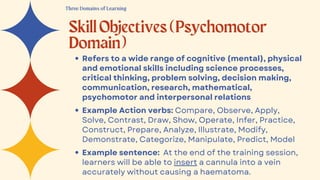
SkillObjectives(Psychomotor
Domain)
Refers to a wide range of cognitive (mental), physical
and emotional skills including science processes,
critical thinking, problem solving, decision making,
communication, research, mathematical,
psychomotor and interpersonal relations
Example Action verbs: Compare, Observe, Apply,
Solve, Contrast, Draw, Show, Operate, Infer, Practice,
Construct, Prepare, Analyze, Illustrate, Modify,
Demonstrate, Categorize, Manipulate, Predict, Model
Three Domains of Learning
Example sentence: At the end of the training session,
learners will be able to insert a cannula into a vein
accurately without causing a haematoma.
AttitudinalObjectives(Affective
Domain)
Refers to feelings, beliefs, dispositions, opinions,
and values.
Three Domains of Learning
Example Action verbs: Express, Clarify, Support,
Interpret, Evaluate, Appraise, Conclude, Criticize,
Judge, Debate, Justify, Feel
Example sentence: At the end of the
communications skills course, learners will be
able to demonstrate awareness of cultural
Four Tips for Writing an
Effective Learning
Objective
Part3
Itshoulddescribethe
student'sperformance.
1.
Guidelines for Writing Effective Learning Objectives
2.Itshoulddecribewhatthe
studentshouldbeabletodoor
produce.
Guidelines for Writing Effective Learning Objectives
3.Itshoulddescribetheconditions
inwhichtheperformancesshould
occur.
Extools, environment,
circumstances.
Guidelines for Writing Effective Learning Objectives
4.Itshouldcontainindicatorsof
howwellthestudentmust
performtobeconsidered
successful.
Guidelines for Writing Effective Learning Objectives
Analyzing a Sample
Learning Objective
Part4
Puttingtogetherfourtips...
Sample lesson objective:
Given a Model 12 keyboard and standard tool
kit, the student is able to disassemble the
keyboard down to the frame within ten
minutes.
Guidelines for Writing Effective Learning Objectives
Angpagtataposngdiskusyon.
MaramingSalamat!
https://fyi.extension.wisc.edu/wateroutreach/water-outreach-education/bep-web-
site-resources/use-education-resources/tools-for-teaching/teaching-presentation-
skills/teaching-skills-goals-and-objectives/
http://jaylordlosabia.blogspot.com/2015/03/principles-in-determining-and.html
https://www.scribd.com/document/378141729/Guiding-Principles-in-Determining-and-
Formulating-Learning-Objectives

Formulating Learning Objectives.pdf