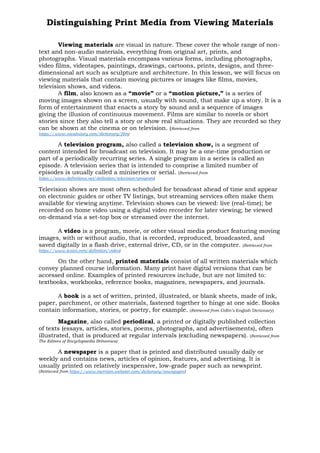
Distinguishing Print Media from Viewing Materials
Viewing materials are visual in nature. These cover the whole range of non-
text and non-audio materials, everything from original art, prints, and
photographs. Visual materials encompass various forms, including photographs,
video films, videotapes, paintings, drawings, cartoons, prints, designs, and three-
dimensional art such as sculpture and architecture. In this lesson, we will focus on
viewing materials that contain moving pictures or images like films, movies,
television shows, and videos.
A film, also known as a “movie” or a “motion picture,” is a series of
moving images shown on a screen, usually with sound, that make up a story. It is a
form of entertainment that enacts a story by sound and a sequence of images
giving the illusion of continuous movement. Films are similar to novels or short
stories since they also tell a story or show real situations. They are recorded so they
can be shown at the cinema or on television. (Retrieved from
https://www.vocabulary.com/dictionary/film)
A television program, also called a television show, is a segment of
content intended for broadcast on television. It may be a one-time production or
part of a periodically recurring series. A single program in a series is called an
episode. A television series that is intended to comprise a limited number of
episodes is usually called a miniseries or serial. (Retrieved from
https://www.definitions.net/definition/television+program)
Television shows are most often scheduled for broadcast ahead of time and appear
on electronic guides or other TV listings, but streaming services often make them
available for viewing anytime. Television shows can be viewed: live (real-time); be
recorded on home video using a digital video recorder for later viewing; be viewed
on-demand via a set-top box or streamed over the internet.
A video is a program, movie, or other visual media product featuring moving
images, with or without audio, that is recorded, reproduced, broadcasted, and
saved digitally in a flash drive, external drive, CD, or in the computer. (Retrieved from
https://www.lexico.com/definition/video)
On the other hand, printed materials consist of all written materials which
convey planned course information. Many print have digital versions that can be
accessed online. Examples of printed resources include, but are not limited to:
textbooks, workbooks, reference books, magazines, newspapers, and journals.
A book is a set of written, printed, illustrated, or blank sheets, made of ink,
paper, parchment, or other materials, fastened together to hinge at one side. Books
contain information, stories, or poetry, for example. (Retrieved from Collin’s English Dictionary)
Magazine, also called periodical, a printed or digitally published collection
of texts (essays, articles, stories, poems, photographs, and advertisements), often
illustrated, that is produced at regular intervals (excluding newspapers). (Retrieved from
The Editors of Encyclopaedia Britannica)
A newspaper is a paper that is printed and distributed usually daily or
weekly and contains news, articles of opinion, features, and advertising. It is
usually printed on relatively inexpensive, low-grade paper such as newsprint.
(Retrieved from https://www.merriam-webster.com/dictionary/newspaper)
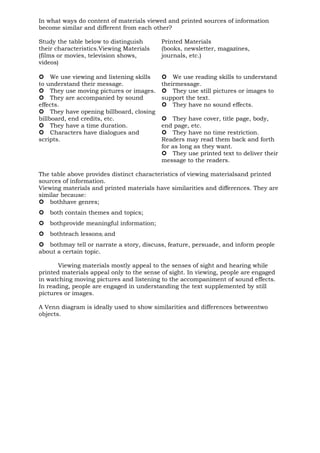
In what ways do content of materials viewed and printed sources of information
become similar and different from each other?
Study the table below to distinguish
their characteristics.Viewing Materials
(films or movies, television shows,
videos)
Printed Materials
(books, newsletter, magazines,
journals, etc.)
We use viewing and listening skills
to understand their message.
They use moving pictures or images.
They are accompanied by sound
effects.
They have opening billboard, closing
billboard, end credits, etc.
They have a time duration.
Characters have dialogues and
scripts.
We use reading skills to understand
theirmessage.
They use still pictures or images to
support the text.
They have no sound effects.
They have cover, title page, body,
end page, etc.
They have no time restriction.
Readers may read them back and forth
for as long as they want.
They use printed text to deliver their
message to the readers.
The table above provides distinct characteristics of viewing materialsand printed
sources of information.
Viewing materials and printed materials have similarities and differences. They are
similar because:
bothhave genres;
both contain themes and topics;
bothprovide meaningful information;
bothteach lessons; and
bothmay tell or narrate a story, discuss, feature, persuade, and inform people
about a certain topic.
Viewing materials mostly appeal to the senses of sight and hearing while
printed materials appeal only to the sense of sight. In viewing, people are engaged
in watching moving pictures and listening to the accompaniment of sound effects.
In reading, people are engaged in understanding the text supplemented by still
pictures or images.
A Venn diagram is ideally used to show similarities and differences betweentwo
objects.

DISTINGUISHING PRINT MEDIA.docx

  • 1.
    Distinguishing Print Mediafrom Viewing Materials Viewing materials are visual in nature. These cover the whole range of non- text and non-audio materials, everything from original art, prints, and photographs. Visual materials encompass various forms, including photographs, video films, videotapes, paintings, drawings, cartoons, prints, designs, and three- dimensional art such as sculpture and architecture. In this lesson, we will focus on viewing materials that contain moving pictures or images like films, movies, television shows, and videos. A film, also known as a “movie” or a “motion picture,” is a series of moving images shown on a screen, usually with sound, that make up a story. It is a form of entertainment that enacts a story by sound and a sequence of images giving the illusion of continuous movement. Films are similar to novels or short stories since they also tell a story or show real situations. They are recorded so they can be shown at the cinema or on television. (Retrieved from https://www.vocabulary.com/dictionary/film) A television program, also called a television show, is a segment of content intended for broadcast on television. It may be a one-time production or part of a periodically recurring series. A single program in a series is called an episode. A television series that is intended to comprise a limited number of episodes is usually called a miniseries or serial. (Retrieved from https://www.definitions.net/definition/television+program) Television shows are most often scheduled for broadcast ahead of time and appear on electronic guides or other TV listings, but streaming services often make them available for viewing anytime. Television shows can be viewed: live (real-time); be recorded on home video using a digital video recorder for later viewing; be viewed on-demand via a set-top box or streamed over the internet. A video is a program, movie, or other visual media product featuring moving images, with or without audio, that is recorded, reproduced, broadcasted, and saved digitally in a flash drive, external drive, CD, or in the computer. (Retrieved from https://www.lexico.com/definition/video) On the other hand, printed materials consist of all written materials which convey planned course information. Many print have digital versions that can be accessed online. Examples of printed resources include, but are not limited to: textbooks, workbooks, reference books, magazines, newspapers, and journals. A book is a set of written, printed, illustrated, or blank sheets, made of ink, paper, parchment, or other materials, fastened together to hinge at one side. Books contain information, stories, or poetry, for example. (Retrieved from Collin’s English Dictionary) Magazine, also called periodical, a printed or digitally published collection of texts (essays, articles, stories, poems, photographs, and advertisements), often illustrated, that is produced at regular intervals (excluding newspapers). (Retrieved from The Editors of Encyclopaedia Britannica) A newspaper is a paper that is printed and distributed usually daily or weekly and contains news, articles of opinion, features, and advertising. It is usually printed on relatively inexpensive, low-grade paper such as newsprint. (Retrieved from https://www.merriam-webster.com/dictionary/newspaper)
  • 2.
    In what waysdo content of materials viewed and printed sources of information become similar and different from each other? Study the table below to distinguish their characteristics.Viewing Materials (films or movies, television shows, videos) Printed Materials (books, newsletter, magazines, journals, etc.) We use viewing and listening skills to understand their message. They use moving pictures or images. They are accompanied by sound effects. They have opening billboard, closing billboard, end credits, etc. They have a time duration. Characters have dialogues and scripts. We use reading skills to understand theirmessage. They use still pictures or images to support the text. They have no sound effects. They have cover, title page, body, end page, etc. They have no time restriction. Readers may read them back and forth for as long as they want. They use printed text to deliver their message to the readers. The table above provides distinct characteristics of viewing materialsand printed sources of information. Viewing materials and printed materials have similarities and differences. They are similar because: bothhave genres; both contain themes and topics; bothprovide meaningful information; bothteach lessons; and bothmay tell or narrate a story, discuss, feature, persuade, and inform people about a certain topic. Viewing materials mostly appeal to the senses of sight and hearing while printed materials appeal only to the sense of sight. In viewing, people are engaged in watching moving pictures and listening to the accompaniment of sound effects. In reading, people are engaged in understanding the text supplemented by still pictures or images. A Venn diagram is ideally used to show similarities and differences betweentwo objects.