Questions, anyone?


                Nancy McKeand
                    June, 2009
How do we form questions?
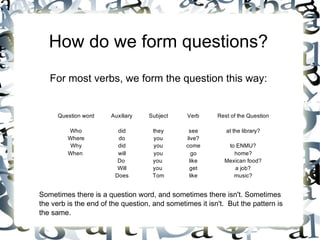
   For most verbs, we form the question this way:


      Question word    Auxiliary   Subject      Verb     Rest of the Question

         Who             did        they        see         at the library?
         Where           do         you        live?
         Why             did        you        come          to ENMU?
         When            will       you          go            home?
                         Do         you         like        Mexican food?
                         Will       you          get           a job?
                        Does        Tom         like           music?


Sometimes there is a question word, and sometimes there isn't. Sometimes
the verb is the end of the question, and sometimes it isn't. But the pattern is
the same.
How do we form questions?
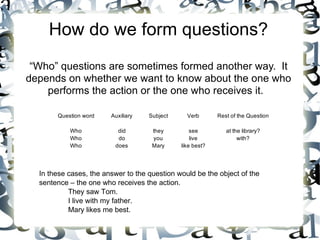
 “Who” questions are sometimes formed another way. It
depends on whether we want to know about the one who
    performs the action or the one who receives it.

       Question word    Auxiliary   Subject     Verb       Rest of the Question

           Who            did        they         see         at the library?
           Who            do         you          live             with?
           Who           does        Mary     like best?


  In these cases, the answer to the question would be the object of the
  sentence – the one who receives the action.
           They saw Tom.
           I live with my father.
           Mary likes me best.
How do we form questions?
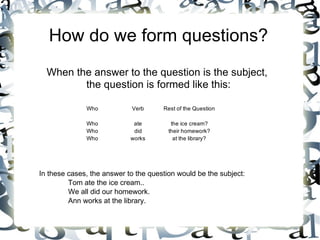
  When the answer to the question is the subject,
         the question is formed like this:

              Who           Verb      Rest of the Question

              Who            ate         the ice cream?
              Who            did        their homework?
              Who           works         at the library?


In these cases, the answer to the question would be the subject:
         Tom ate the ice cream..
         We all did our homework.
         Ann works at the library.
How do we form questions?
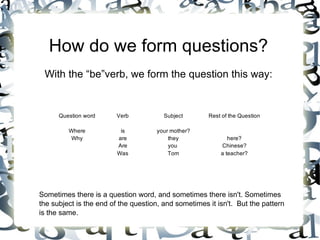
 With the “be”verb, we form the question this way:


      Question word     Verb            Subject       Rest of the Question

         Where            is         your mother?
         Why             are             they                here?
                         Are             you              Chinese?
                         Was             Tom              a teacher?


Sometimes there is a question word, and sometimes there isn't. Sometimes
the subject is the end of the question, and sometimes it isn't. But the pattern
is the same.
How do we form questions?
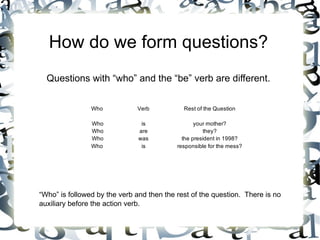
  Questions with “who” and the “be” verb are different.


                Who           Verb           Rest of the Question

                Who             is                your mother?
                Who            are                    they?
                Who            was           the president in 1998?
                Who             is         responsible for the mess?


“Who” is followed by the verb and then the rest of the question. There is no
auxiliary before the action verb.
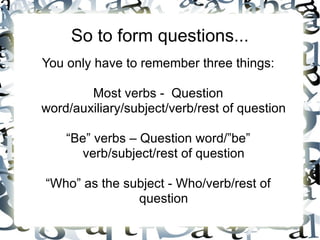
So to form questions...
You only have to remember three things:

        Most verbs - Question
word/auxiliary/subject/verb/rest of question

    “Be” verbs – Question word/”be”
       verb/subject/rest of question

“Who” as the subject - Who/verb/rest of
               question

Question Formation

  • 1.
    Questions, anyone? Nancy McKeand June, 2009
  • 2.
    How do weform questions? For most verbs, we form the question this way: Question word Auxiliary Subject Verb Rest of the Question Who did they see at the library? Where do you live? Why did you come to ENMU? When will you go home? Do you like Mexican food? Will you get a job? Does Tom like music? Sometimes there is a question word, and sometimes there isn't. Sometimes the verb is the end of the question, and sometimes it isn't. But the pattern is the same.
  • 3.
    How do weform questions? “Who” questions are sometimes formed another way. It depends on whether we want to know about the one who performs the action or the one who receives it. Question word Auxiliary Subject Verb Rest of the Question Who did they see at the library? Who do you live with? Who does Mary like best? In these cases, the answer to the question would be the object of the sentence – the one who receives the action. They saw Tom. I live with my father. Mary likes me best.
  • 4.
    How do weform questions? When the answer to the question is the subject, the question is formed like this: Who Verb Rest of the Question Who ate the ice cream? Who did their homework? Who works at the library? In these cases, the answer to the question would be the subject: Tom ate the ice cream.. We all did our homework. Ann works at the library.
  • 5.
    How do weform questions? With the “be”verb, we form the question this way: Question word Verb Subject Rest of the Question Where is your mother? Why are they here? Are you Chinese? Was Tom a teacher? Sometimes there is a question word, and sometimes there isn't. Sometimes the subject is the end of the question, and sometimes it isn't. But the pattern is the same.
  • 6.
    How do weform questions? Questions with “who” and the “be” verb are different. Who Verb Rest of the Question Who is your mother? Who are they? Who was the president in 1998? Who is responsible for the mess? “Who” is followed by the verb and then the rest of the question. There is no auxiliary before the action verb.
  • 7.
    So to formquestions... You only have to remember three things: Most verbs - Question word/auxiliary/subject/verb/rest of question “Be” verbs – Question word/”be” verb/subject/rest of question “Who” as the subject - Who/verb/rest of question