Percentage error 100%
mean
a
a
MOTION IN A STRAIGHT LINE
Average speed, Vav
1 2 3
s +s + s
=
t + t + t
1 2 3
Average acceleration, aav
1 1 2
1 2
a t +a t
=
t + t
2
The area under the velocity-time curve is equal to the
displacement and slope gives acceleration.
If a body falls freely, the distance covered by it in each
subsequent second starting from first second will bein
the ratio 1 : 3 : 5 : 7 etc.
If a body is thrown vertically up with an initial velocity
u, it takes u/g second to reach maximum height and
u/g second to return, if air resistance is negligible.
If air resistance acting ona body is considered, the time
takenby thebodytoreach maximum heightis lessthan
the time to fall back the same height.
For a particle having zero initial velocity if s t ,
where 2 ,thenparticle’saccelerationincreases with
time.
For a particle having zero initial velocity if s t ,
where 0,thenparticle’s accelerationdecreaseswith
time.
Kinematic equations :
v = u + at (t) ; v2 = u2 + 2at (s)
S = ut +
1
2
at (t)2; Sn
u (2n 1)
2
a
applicable only when t t
| a | a is constant.
at = magnitude of tangential acceleration, S = distance
If acceleration is variable use calculus approach.
Relative velocity : BA B A
v v v
MOTION IN A PLANE
IfT isthetimeof flight, hmaximumheight, R horizontal
range of a projectile, its angle of projection, then the
relations among these quantities.
2
gT
h
8
...... (1);
gT2 = 2R tan ....... (2);
R tan = 4h .......(3)
UNITS AND MEASUREMENTS
The SI system : It is the international system of units.
At present internationally accepted for measurement.
In this system there are seven fundamental and two
supplementary quantities and their corresponding
units are:
Quantity Unit Symbol
1. Length metre m
2. Mass kilogram kg
3. Time second s
4. Electric current ampere A
5. Temperature kelvin K
6. Luminous intensity candela cd
7. Amount of substance mole mol
Supplementary
1. Plane angle radian rad
2. Solid angle steradian sr
Dimensions : These are the powers to which the
fundamental units are raised to get the unit of a
physical quantity.
Uses of dimensions
(i) To check the correctness of a physical relation.
(ii) To derive relationship between different physical
quantities.
(iii) To convert one system of unit into another.
n1u1 = n2u2
1 1 1 1
[M L T ]
a b c
n = 2 2 2 2
[M L T ]
a b c
n
Significant figures : In any measurement, the reliable
digits plus the first uncertain digit are known as
significant figures.
Error : It is the difference between the measured value
and true value of aphysical quantity or the uncertainty
in the measurements.
Absolute error : The magnitude of the difference
between the true value and the measured value is
called absolute error.
1 1
a a
a , 2 2
a a
a , n n
a a
a
Mean absolute error
1 2
| | | | ..... | |
n
a a a
n
a =
1
1
| |
n
i
i
a
n
Relative error : It is the ratio of the mean absolute error
to its true value or relative error =
a
a
Percentage error : It is the relative error in per cent.
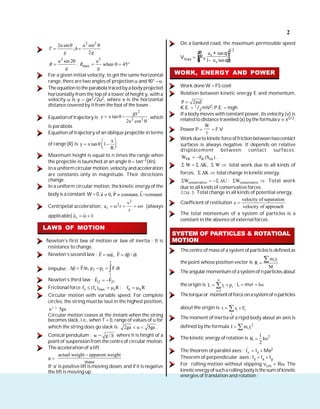
2
2 2
2usin u sin
;
2
T h
g g
2
u sin 2
R
g
;
2
max
u
when 45
R
g
For a given initial velocity, to get the same horizontal
range, there are two angles of projection and 90° – .
The equationto the parabola traced byabodyprojected
horizontally from the top of a tower of height y, with a
velocity u is y = gx2/2u2, where x is the horizontal
distance covered by it from the foot of the tower.
Equationoftrajectory is
2
2 2
gx
y x tan
2u cos
, which
is parabola.
Equation of trajectory of an oblique projectile in terms
of range (R) is
x
y x tan 1
R
Maximum height is equal to n times the range when
the projectile is launched at an angle = tan–1(4n).
In a uniform circular motion, velocity and acceleration
are constants only in magnitude. Their directions
change.
In a uniform circular motion, the kinetic energy of the
body is a constant. W =0, a 0, P constant, L=constant
Centripetal acceleration,
2
2
r
v
a r v
r
(always
applicable) r
a v
LAWS OF MOTION
Newton’s first law of motion or law of inertia : It is
resistance to change.
Newton’s second law : F ma, F dp / dt
Impulse :
2
2 1
1
p F t, p p F dt
Newton’s third law : 12 21
F F
Frictional force s s max s
f (f ) R ; k k
f R
Circular motion with variable speed. For complete
circles, the string must be taut in the highest position,
2
u 5ga
³ .
Circular motion ceases at the instant when the string
becomes slack, i.e., when T = 0, range of values of u for
which the string does go slack is 2ga u 5ga .
Conical pendulum : g / h
w = where h is height of a
point of suspension from the centre of circular motion.
The acceleration of a lift
a =
actual weight apparent weight
mass
If ‘a’ is positive liftis moving down, and if it is negative
the lift is moving up.
On a banked road, the maximum permissible speed
Vmax =
1/2
s
g
s
u tan
R
1 u tan
æ ö
+ q÷
ç ÷
ç ÷
ç ÷
ç - q
è ø
WORK, ENERGY AND POWER
Work done W = FS cos
Relation between kinetic energy E and momentum,
P 2mE
K.E. = 1/2 mV2; P.E. = mgh
If a body moves with constant power, its velocity (v) is
related to distance travelled (x) bythe formulav x3/2.
Power P =
W
t
= F.V
Workdueto kinetic forceoffriction betweentwocontact
surfaces is always negative. It depends on relative
displacement between contact surfaces.
FK K rel
W F (S ) .
W K, W total work due to all kinds of
forces, K total change in kinetic energy.
conservative
W U ; conservative
W Total work
due to allkinds of conservative forces.
SDu Þ Total change in all kinds of potential energy.
Coefficient of restitution
velocity of separation
e
velocity of approach
The total momentum of a system of particles is a
constant in the absence of external forces.
SYSTEM OF PARTICLES & ROTATIOAL
MOTION
The centre of mass of a system of particles is defined as
the point whose position vector is i i
m r
R
M
Theangular momentum ofasystemof nparticles about
the origin is
n
i i
i 1
L r p ; L = mvr = I
Thetorqueor momentofforce onasystemof nparticles
about the origin is i i
i
r F
The moment of inertia of a rigid body about an axis is
defined by the formula 2
i i
I m r
The kinetic energy of rotation is 2
1
K I
2
The theorem of parallel axes : '
z
I = Iz + Ma2
Theorem of perpendicular axes : Iz = Ix + Iy
For rolling motion without slipping vcm = R . The
kineticenergy ofsucharolling bodyisthesum ofkinetic
energies of translation and rotation :
3
2 2
cm
1 1
K mv I
2 2
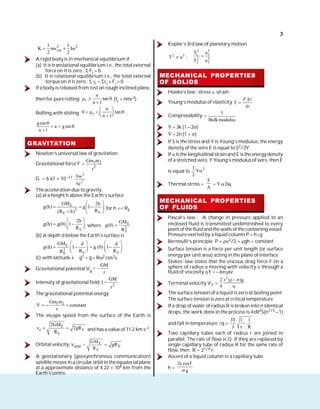
A rigid body is in mechanical equilibrium if
(a) It is translational equilibrium i.e., the total external
force on it is zero : Fi = 0.
(b) It is rotational equilibrium i.e., the total external
torque on it is zero : i = ri × Fi = 0.
If a body is released from rest on rough inclined plane,
then for pure rolling r
n
tan
n 1
(Ic = nmr2)
Rolling with sliding s
n
0 tan
n 1
;
gsin
a gsin
n 1
GRAVITATION
Newton’s universal law of gravitation
Gravitational force F 1 2
2
Gm m
=
r
G = 6.67 × 10 –11
2
2
Nm
kg
The acceleration due to gravity.
(a) at a height h above the Earth’s surface
E
2
E
E
GM 2h
g(h) g 1
R
(R h)
for h << RE
E
2h
g(h) g(0) 1
R where E
2
E
GM
g(0)
R
(b) at depth d below the Earth’s surface is
E
2
E E
E
GM d d
g(d) 1 g (0) 1
R R
R
(c) with latitude g1 = g – R 2 cos2
Gravitational potential Vg
GM
= –
r
Intensity of gravitational field 2
GM
I =
r
The gravitational potential energy
1 2
Gm m
V constant
r
The escape speed from the surface of the Earth is
E
e E
E
2GM
v 2gR
R and has a value of 11.2 km s–1.
Orbital velocity, vorbi
E
E
GM
=
R
E
gR
A geostationary (geosynchronous communication)
satellite moves in a circular orbit in the equatorial plane
at a approximate distance of 4.22 × 10⁴ km from the
Earth’s centre.
Kepler’s 3rd law of planetary motion.
2 3
T a ;
2 3
1 1
2 3
2 2
T a
T a
MECHANICAL PROPERTIES
OF SOLIDS
Hooke’s law : stress strain
Young’s modulus of elasticity
F
Y
A
Compressibility
1
=
Bulkmodulus
Y = 3k (1 – 2 )
Y = 2n (1 + )
If S is the stress and Y is Young’s modulus, the energy
density of the wire E is equal to S2/2Y.
If isthe longitudinalstrainandE is theenergydensity
of a stretched wire, Y Young’s modulus of wire, then E
is equal to
2
1
Y
2
Thermal stress =
F
A
= Y Dq
MECHANICAL PROPERTIES
OF FLUIDS
Pascal’s law : A change in pressure applied to an
enclosed fluid is transmitted undiminished to every
pointof the fluidand the walls of the containing vessel.
Pressure exerted by a liquid column P = hrg
Bernoulli’s principle P + v2/2 + gh = constant
Surface tension is a force per unit length (or surface
energy per unit area) acting in the plane of interface.
Stokes’ law states that the viscous drag force F on a
sphere of radius a moving with velocity v through a
fluid of viscosity F = – 6 av.
Terminal velocity VT =
2
2 r ( – )g
9
The surface tension of a liquid is zero at boiling point.
The surface tension is zero at critical temperature.
If a drop of water of radius R is broken into n identical
drops, the work done in the process is 4 R2S(n1/3 –1)
and fall in temperature Dq =
3T 1 1
J r R
-
Two capillary tubes each of radius r are joined in
parallel. The rate of flow is Q. If they are replaced by
single capillary tube of radius R for the same rate of
flow, then R = 21/4 r.
Ascent of a liquid column in a capillary tube
h =
2s cos
r g
f
r
4
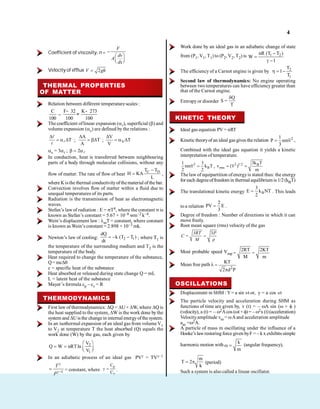
Coefficient of viscosity, n =
F
dv
A
dx
Velocity of efflux 2
V gh
THERMAL PROPERTIES
OF MATTER
Relation between different temperature scales :
C
100
=
F 32 K 273
100 100
- -
=
The coefficient oflinear expansion ( ), superficial ( ) and
volume expansion ( v) are defined by the relations :
T ;
A
T
A
; V
V
T
V
v = 3 ; 2
In conduction, heat is transferred between neighbouring
parts of a body through molecular collisions, without any
flow of matter. The rate of flow of heat
C D
T T
H KA
L
,
where K isthe thermal conductivityofthematerial of the bar.
Convection involves flow of matter within a fluid due to
unequal temperatures of its parts.
Radiation is the transmission of heat as electromagnetic
waves.
Stefan’s lawof radiation : E = T4, where the constant is
known as Stefan’s constant = 5.67 × 10⁻⁸ wm–2 k–4.
Wein’s displacement law : mT = constant, where constant
is known as Wein’s constant = 2.898 × 10⁻³ mk.
Newton’s law of cooling: 2 1
dQ
k (T T )
dt
; where T
T1 is
the temperature of the surrounding medium and T2 is the
temperature of the body.
Heat required to change the temperature of the substance,
Q= mc
c = specific heat of the substance
Heat absorbed or released during state change Q = mL
L = latent heat of the substance
Mayer’s formula cp – cv = R
THERMODYNAMICS
First law of thermodynamics: Q = U + W, where Q is
the heat supplied to the system, W is the work done by the
system and Uis the changein internal energyofthe system.
In an isothermal expansion of an ideal gas from volume V1
to V2 at temperature T the heat absorbed (Q) equals the
work done (W) by the gas, each given by
2
1
V
Q W nRTln
V
In an adiabatic process of an ideal gas PV = TV –1
1
T
P
= constant, where
p
v
C
C
.
Work done by an ideal gas in an adiabatic change of state
from (P1, V1, T1) to (P2, V2, T2) is 1 2
nR (T T )
W
1
The efficiency of a Carnot engine is given by 2
1
T
1
T
Second law of thermodynamics: No engine operating
between two temperatures can have efficiencygreater than
that of the Carnot engine.
Entropy or disorder
Q
S =
T
KINETIC THEORY
Ideal gas equation PV = nRT
Kinetic theoryof an ideal gas gives the relation 2
1
P nmv
3
,
Combined with the ideal gas equation it yields a kinetic
interpretation of temperature.
2
B
1 3
nmv k T
2 2
, 2 1/2 B
rms
3k T
v (v )
m
The law of equipartition ofenergyis stated thus: the energy
for each degreeoffreedom in thermal equilibriumis 1/2(kBT)
The translational kinetic energy B
3
E k NT
2
. This leads
to a relation
2
PV E
3
.
Degree of freedom : Number of directions in which it can
move freely.
Root mean square (rms) velocity of the gas
3
3RT P
C =
M
Most probable speed Vmp
2RT 2KT
= =
M m
Mean free path
2
KT
=
2 d P
OSCILLATIONS
Displacement in SHM : Y= a sin wt or, y = a cos wt
The particle velocity and acceleration during SHM as
functions of time are given by, v (t) = – A sin ( + )
(velocity), a (t) = – 2Acos ( t + ) = – 2x(t)(acceleration)
Velocityamplitude vm = Aand acceleration amplitude
am = 2A.
A particle of mass m oscillating under the influence of a
Hooke’s lawrestoring force given byF = – k x exhibits simple
harmonic motion with
k
m
(angular frequency),
m
T 2
k
(period)
Such a system is also called a linear oscillator.
5
Timeperiod for conical pendulum
cos
T 2
g
where
angle between string & vertical.
Energyof the particle 2 2
1
E = k + u = m A
2
WAVES
The displacement in a sinusoidal wave y (x, t) = a sin
(kx – t + ) where is the phase constant or phase angle.
Equation of plane progressive wave :
t x
a sin 2
T V
Equation of stationarywave : Y = 2a sin
2 t 2 x
cos
T
The speed of a transverse wave on a stretched string
v T / .
Sound waves are longitudinal mechanical waves that can
travel through solids, liquids, or gases. The speed v of sound
wave in a fluid having bulk modulus B and density µ is
v B / .
The speed of longitudinal waves in a metallic bar is
v Y /
For gases, since B = P, the speed of sound is v P /
The interference of twoidentical waves moving in opposite
directions produces standing waves. For a string with fixed
ends, standing wave y (x, t) = [2a sin kx ] cos t
The separation between twoconsecutivenodes or antinodes
is /2.
A stretched string oflength L fixed at both the ends vibrates
with frequencies
1 v
f
2 2L
.
The oscillation mode with lowest frequency is called the
fundamental mode or the first harmonic.
A pipe of length L with one end closed and other end open
(such as air columns) vibrates with frequencies given by
1 v
f n
2 2L
, n = 0, 1, 2, 3, .... The lowest frequency
given byv/4L isthefundamental modeor the first harmonic.
Open organ pipe n1 : n2 : n3 ....... 1, 2, 3.......,
V
n
2l
Beats arise when two waves having slightly different
frequencies, f1 and f2 and comparable amplitudes, are
superposed. The beat frequency fbeat = f1 – f2
The Doppler effect is a change in the observed frequencyof
a wave when the source S and the observer O moves relative
tothe medium. 0
0
s
v v
f f
v v
ELECTROSTATICS
Coulomb’s Law : 21
F = force on q2 due toq1 =
1 2
21
2
21
k (q q )
r̂
r
where
0
1
k
4
= 9 × 10⁹ Nm2 C–2
Electric field due to a point charge q has a magnitude
| q |/4 0r2
Field of an electric dipole in its equatorial plane
2 2 3/2
0
p 1
E
4 (a r )
3
0
p
4 r
, for r >> a
Dipoleelectricfield on theaxisat a distance r from thecentre:
2 2 2 3
0 0
2pr 2p
E
4 (r a ) 4 r
for r >> a
Dipole moment 2
p q a
In a uniform electric field E , a dipole experiences a torque
given by p E but experiences no net force.
The flux of electric field E through a small area element
S is given by E. S
Gauss’s law: The flux of electric field through any closed
surface S is 1/ 0 times the total charge enclosed i.e., Q
Thin infinitely long straight wire of uniform linear charge
density
0
ˆ
E n
2 r
Infinite thin plane sheet ofuniform surface charge density
0
ˆ
E n
2
Thin spherical shell ofuniform surface charge density
2
0
ˆ
E r
4 r
(r R) E 0 (r < R)
Electric Potential :
0
1 Q
V(r)
4 r
.
An equipotential surface is a surface over which potential
has a constant value.
Potential energy of two charges q1, q2 at 1 2
r , r is given by
1 2
0 12
q q
1
U
4 r
, where r12 is distance between q1 and q2.
Capacitance C = Q/V, where Q = charge and V = potential
difference
For a parallel plate capacitor (with vacuum between the
plates), 0
A
C
d
.
The energy U stored in a capacitor of capacitance C, with
charge Q and voltage V is
2
2
1 1 1 Q
U QV CV
2 2 2 C
For capacitors in the series combination,
eq 1 2 3
1 1 1 1
.........
C C C C
In the parallel combination, Ceq =C1 + C2 + C3 + ...
where C1, C2, C3... are individual capacitances.
CURRENT ELECTRICITY
Electriccurrent,
q
I
t
Current density j gives the amount of charge flowing per
second per unit area normal to the flow, d
J nqv
6
Mobility,
d
d
V I
µ and V
E Ane
Resistance R =
A
, = resistivity of the material
Equation E J another statement of Ohm’s law,
,
= resistivityof the material.
Ohm’s lawI Vor V= RI
(a) Total resistance R of n resistors connected in series
R= R1 + R2 +..... + Rn
(b) Total resistance R of n resistors connected in parallel
1 2 n
1 1 1 1
......
R R R R .
Kirchhoff’s Rules – (a) Junction rule: At any junction of
circuit elements, the sum of currents entering the junction
must equal the sum of currents leaving it.
(b) Loop rule: The algebraic sum of changes in potential
around any closed loop must be zero.
The Wheatstonebridge is an arrangement of four resistances
R1, R2, R3, R4. The null-point condition is given by
3
1
2 4
R
R
R R
The potentiometer is a device to compare potential
differences. The device can be used to measure potential
difference; internal resistance of a cell and compare emf’s of
two sources. Internal resistance 1
2
r R 1
RC circuit : During charging : q = CE (1 – e–t/RC)
During discharging : q = q0e–t/RC
According ‘to Joule’s Heating law, H = I2Rt
MAGNETISM
The total force on a charge q moving with velocity v i.e.,
Lorentz force. F q (v B E) .
A straight conductor oflength andcarrying a steadycurrent
I experiences a force F in a uniform external magnetic field
B, F I B , the direction of is given by the direction of
the current.
Biot-Savart law 0
3
d r
dB I
4 r
.
The magnitude ofthe magnetic field due to a circular coil of
radius R carrying a current I at an axial distance x from the
centre is
2
0
2 2 3/2
IR
B
2 (x R )
.
The magnitude of the field B inside a long solenoid carrying
a current Iis: B= µ0nI. For a toroidoneobtains,
0NI
B
2 r
.
Ampere’sCircuital Law: 0
C
B.d I , where I referstothe
current passing through S.
Force between two long parallel wires 1
0 1 2
I I
F Nm
2 a
.
The force is attractive if currents are in the same direction
and repulsive currents are in the opposite direction.
For current carrying coil M NIA ; torque = M B
Conversion of(i)galvanometer intoammeter,
g
g
I
S G
I I
(ii) galvanometer into voltmeter,
g
V
S G
I
The magnetic intensity, 0
0
B
H .
The magnetisation M of the material is its dipole moment
per unit volume. The magnetic field B in the material is,
0
B (H M)
For a linear material M H . So that B H and is
called the magnetic susceptibilityof the material.
0 r ; r 1 .
ELECTROMAGNETIC INDUCTION
Themagnetic flux
B B.A BA cos , where is the angle between B & A .
Faraday’s laws of induction :
B
d
N
dt
Lenz’s law states that the polarity of the induced emf is such
that it tends to produce a current which opposes the change
in magnetic flux that produces it.
Theinduced emf(motionalemf)across endsofa rod B v
The self-induced emf is given by,
dI
L
dt
L is the self-inductance of the coil.
2
0 N A
L =
A changing current in a coil (coil 2) can induce an emf in a
nearbycoil (coil 1).
2
1 12
dI
M
dt
, M12 = mutual inductance of coil 1 w.r.t coil
2.
0 1 2
N N
M =
A
Growth of current in an inductor, Rt/L
0
i i [1 e ]
For decay of current, Rt/L
0
i i e
ALTERNATING CURRENT
For an alternating current i = im sin t passing through a
resistor R, the average power loss P (averaged over a cycle)
due to joule heating is (1/2)i2
mR.
E.m.f, E = E0 sin wt
7
Root mean square (rms) current m
m
i
I 0.707 i
2
.
Erms =
0
E
2
The average power loss over a complete cycle
P=V I cos . The term cos is called the power factor.
An ac voltage v = vm sin t applied to a pure inductor L,
drives a current in the inductor i = im sin ( t – /2), where
im = vm/XL. XL = L is called inductive reactance.
An ac voltage v = vm sin t applied to a capacitor drives a
current in the capacitor: i = im sin ( t + /2). Here,
m
m C
C
v 1
i , X
X C
is called capacitive reactance.
An interesting characteristic of a series RLC circuit is the
phenomenon of resonance. The circuit exhibits resonance,
i.e., the amplitude ofthe current is maximum at the resonant
frequency, 0 L C
1
(X X )
LC
.
Impedance 2 2
L C
z = R + (x – x )
Transformation ratio, K S S P
P P S
N E I
= = =
N E I
Step up transformer : NS > NP; ES > EP; IP > IS
Step down transformer NP > NS; EP > ES and IP < IS
The quality factor Q defined by 0
0
L 1
Q
R CR
is an
indicator of the sharpness ofthe resonance, the higher value
of Q indicating sharper peak in the current.
RAY OPTICS
Reflection is governed by the equation i = r' and
refraction bytheSnell’s law, sini/sinr = n, where the incident
ray, reflected ray, refracted ray and normal lie in the same
plane.
Mirror equation:
1 1 1
v u f
+ =
Magnification M =
V I
u O
Prism Formula 2 m
21
1
n sin [(A D ) / 2)]
n
n sin (A / 2)
+
= = , where Dm is
the angle of minimum deviation.
Dispersion is the splittingoflight into its constituent colours.
Thedeviation is maximum for violet and minimum for red.
Scattering µ
1
4
l
Dispersive power
v r
d - d
w =
d
, where v, r are deviation of
violet and red and the deviation of mean ray (usually
yellow).
For refraction through a spherical interface (from medium 1
to 2 of refractive index n1 and n2, respectively)
2 1 2 1
n n n n
v v R
-
- =
Refractive index ofa medium m =
C
V
(C = 3 × 10⁸ m/s)
r =
1
sinC
(C = Critical angle)
Condition for TIR : 1. Rayof light must travel from denser to
rarermedium2.Angleofincidenceindenser medium>critical
angle.
Lens formula
1 1 1
v u f
- =
Lensmaker’sformula :
2 1
1 1 2
(n n )
1 1 1
f n R R
æ ö
-
= -
ç ÷
è ø
The power of a lens P = 1/f. The SI unit for power ofa lens is
dioptre (D): 1 D = 1 m–1.
Ifseveral thin lenses of focal length f1, f2, f3,.. are in contact,
the effective focal
1 2 3
1 1 1 1
= + + +.....
f f f f
The total power of a combination of several lenses
P = P1 + P2 + P3 +.......
Chromatic aberration if satisfying the equation
1 2
1 2
0
f f
w w
+ = or in terms of powers 1 1 2 2
P P 0
w +w = .
For compound microscope M =
0
0 e
V D
1
u f
æ ö
+
ç ÷
è ø
when final image at D
M =
0
0 e
V D
.
u f
when final image at infinity.
.
WAVE OPTICS
Wavefront : It is the locus of all the particles vibrating in the
same phase.
The resultant intensity of two waves of intensity I0/4 of
phase difference at any points 2
0
I I cos
2
,
where I0 is the maximum density.
IntensityI µ (amplitude)2
Condition for dark band : (2n 1)
2
, for bright band :
= m
Fringe width
D
d
A thin film ofthickness t and refractive index µ appears dark
by reflection when viewed at an angle of refraction r if
2µt cos r = n (n = 1, 2, 3, etc.)
A single slit of width a gives a diffraction pattern with a
central maximum. The intensity falls to zero at angles of
2
,
a a
l l
± ± , etc.
8
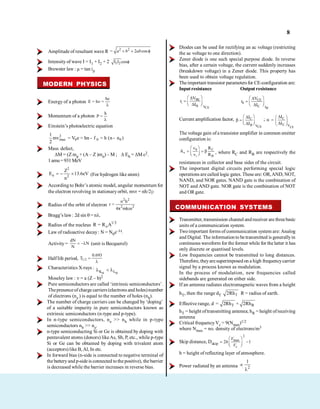
Amplitude of resultant wave R
2 2
= 2 cos
a b ab
Intensity of wave I = I1 + I2 + 2 1 2
I I cos
Brewster law : µ = tan ip
MODERN PHYSICS
Energy of a photon
hc
E = h =
Momentum of a photon
h
P =
Einstein’s photoelectric equation
2
max 0 0 0
1
mv V e h h ( )
2
= = n - f = n - n
Mass defect,
M = (Z mp + (A – Z )mn) – M ; Eb = M c2.
1amu=931MeV
2
n 2
Z
E 13.6eV
n
(For hydrogen like atom)
According to Bohr’s atomic model, angular momentum for
the electron revolving in stationaryorbit, mvr = nh/2p
Radius of the orbit of electron
2 2
2 2
n h
r =
4 mkze
Bragg’s law : 2d sin = n .
Radius of the nucleus 1/3
o
R = R A
Law of radioactive decay: N = N0e– t.
Activity=
dN
N
N
(unit is Becquerel)
Halflife period, 1/2
0.693
T
Characteristics X-rays :
K L
Moseley law : = a (Z – b)2
Pure semiconductors are called ‘intrinsic semiconductors’.
Thepresenceofcharge carriers (electrons and holes)number
of electrons (ne ) is equal to the number of holes (nh).
The number of charge carriers can be changed by ‘doping’
of a suitable impurity in pure semiconductors known as
extrinsic semiconductors (n-type and p-type).
In n-type semiconductors, ne >> nh while in p-type
semiconductors nh >> ne.
n-type semiconducting Si or Ge is obtained by doping with
pentavalent atoms (donors) likeAs, Sb, P, etc., while p-type
Si or Ge can be obtained by doping with trivalent atom
(acceptors) like B, Al, In etc.
In forward bias (n-side is connected to negative terminal of
the batteryand p-sideis connected tothe positive), the barrier
is decreased while the barrier increases in reverse bias.
Diodes can be used for rectifying an ac voltage (restricting
the ac voltage to one direction).
Zener diode is one such special purpose diode. In reverse
bias, after a certain voltage, the current suddenly increases
(breakdown voltage) in a Zener diode. This property has
been used to obtain voltage regulation.
Theimportant transistor parametersfor CE-configuration are:
Inputresistance Output resistance
BE
i
B VCE
V
r
I
CE
0
C IB
V
r
I
Current amplification factor, C
B VCE
I
I
;
CE
C
E V
I
I
The voltage gain ofa transistor amplifier in common emitter
configuration is:
0 C
v
i B
v R
A
v R , where RC and RB are respectively the
resistances in collector and base sides of the circuit.
The important digital circuits performing special logic
operations are called logic gates. These are: OR,AND, NOT,
NAND, and NOR gates. NAND gate is the combination of
NOT and AND gate. NOR gate is the combination of NOT
and OR gate.
COMMUNICATION SYSTEMS
Transmitter, transmission channel andreceiver are threebasic
units of a communication system.
Twoimportant forms of communication system are: Analog
and Digital. The information to be transmitted is generallyin
continuous waveform for the former while for the latter it has
only discrete or quantised levels.
Low frequencies cannot be transmitted to long distances.
Therefore, theyaresuperimposed on a high frequencycarrier
signal by a process known as modulation.
In the process of modulation, new frequencies called
sidebands are generated on either side.
If an antenna radiates electromagnetic waves from a height
hT, then the range dT T
2Rh R = radius of earth.
Effective range, d T R
= 2Rh + 2Rh
hT = height oftransmitting antenna; hR = height ofreceiving
antenna
Critical frequencyVc = 9(Nmax)1/2
where Nmax = no. density of electrons/m3
Skip distance, Dskip
2
max
2 1
c
V
h
V
h = height of reflecting layer of atmosphere.
Power radiated by an antenna 2
1
SOME BASIC CONCEPTS OF
CHEMISTRY
Volume of gas (in L) at STP
22.4 L
Mol
Number
of
entities
Amount of a
substance
(in gram)
M
ultiplied by D
ivided
by
Multiplied by Multiplied by
Molar mass
Divided by
Divided by
N
(6.023 × 10 )
A 23
Molecular mass
Average relative mass of one molecule
1
mass of C-12 atom
12
Molecular mass = 2 × VD
Eq. wt. ofmetal
2
wt. of metal
1.008
wt. of H displaced
Eq. wt. of metal
wt. of metal
8
wt. of oxygen combined
wt. of metal
35.5
wt. of chlorine combined
Molecular formula = (Empirical formula)n
ATOMIC STRUCTURE
Energy of electron in species with one electron.
En =
2 4 2
2 2
2 me Z
n h
For energy in SI system, En =
2 4 2
2 2 2
0
2 me Z
n h (4 )
En =
2
1
2
1312Z
kJ mol
n
nh
mvr
2
r =
2 2
2 2
n h
4 mZe
= 0.529
2
n
Z
Å
Total energy of electron in the nth shell
= K.E. + P.E.
2 2 2
n n n
e kZe kZe
kZ
2r r 2r
1
= RZ2
2 2
1 2
1 1
n n
, [R= 1.0968 × 10⁷ m–1]
hc
E hv ,
h
2m K.E.
No. of spectral lines produced when an electron drops from
nth level to ground level =
n(n 1)
2
Heisenberg's UncertaintyPrinciple ( x) ( p) h/4
Nodes (n – 1) = total nodes, = angular nodes,
(n – – 1) = Radial nodes
Orbital angular momentum : h
( 1) ( 1)h
2
CHEMICAL BONDING
(i) % ionic character =
Actual dipole moment
100
Calculated dipole moment
(ii) Dipole moment is helpful in predicting geometry and
polarityof molecule.
Fajan’s Rule : Following factors are helpful in increasing
covalent character in ionic compounds
(i) Small cation
(ii) Big anion
(iii) High charge on cation/anion
(iv) Cation having pseudo inert gas configuration
(ns2p6d10) e.g. Cu+, Ag+, Zn+2, Cd+2
M.O.theory:
(i) Bond order = ½(Nb–Na)
(ii) Higher the bond order, higher is the bond dissociation
energy, greater is thestability, shorter is thebond length.
Formal charge (F.C.) on an atom in a Lewis structure
= [total number of valence electrons in the free atoms]
– [total number of non-binding (lone pair) electrons]
–
1
2
[total number of bonding (shared) electrons]
Relative bond strength : sp3d2 >dsp2 >sp3 >sp2 >sp >p-p
(Co-axial) > s - p > s - s > p - p (Co-lateral)
VSEPRtheory
(i) (LP-LP)repulsion > (LP-BP)>(BP-BP)
(ii) NH3 BondAngle106° 45’because(LP-BP)repulsion
>(BP-BP) H2O 104° 27’because (LP-LP)repulsion >
(LP-LB)>(BP-BP)
PHYSICALCHEMISTRY
10
Hybridisation:
number of valence electrons of central atom
1
number of monovalent atoms attached to it
2
negative charge if any positive charge if any
CHEMICAL EQUILIBRIUM
g
n
p c
K = K (RT) where ng = nP – nR
Free EnergyChange( G)
(a) If G = 0 then reversible reaction would be in
equilibrium, Kc =0
(b) If G = (+) ve then equilibrium will be displaced in
backward direction; Kc < 1
(c) If G = (–) ve then equilibrium will shift in forward
direction; Kc > 1
(a) Kc unit (moles/lit) n,
(b) Kp unit (atm) n
ReactionQuotientand EquilibriumConstant
Consider the following reversible reaction A + B C + D
Qc =
[C][D]
[A][B]
Case I : If Qc < Kc then : [Reactants] > [Products]
then the system is not at equilibrium
Case II : If Qc = Kc then : The system is at equilibrium.
Case III : If Qc > Kc then: [Products] > [Reactants]
The system is not at equilibrium.
A relationship between the equilibrium constant KC, reaction
quotient and Gibb's energy.
G= G°+RT ln Q
At equilibrium G = 0 and Q = K then G° = –RTln Kc
G° = –RT ln Kp
Le-Chatelier’sprinciple
(i) Increase of reactant conc. (Shift reaction forward)
(ii) Decrease of reactant conc. (Shift reaction backward)
(iii) Increase of pressure (from more moles to less moles)
(iv) Decrease of pressure (from less moles to more moles)
(v) For exothermic reaction decrease in temp. (Shift
forward)
(vi) For endothermic increase in temp. (Shift backward)
IONIC EQUILIBRIUM
(i) LewisAcid (e– pair acceptor) CO2, BF3,AlCl3, ZnCl2,
normal cation
(ii) Lewis Base (e– pair donor) NH3, ROH, ROR, H2O,
RNH2, normal anions
Dissociation of Weak Acid and Weak Base
(i) WeakAcid, Ka = Cx2/(1 – x)or Ka = Cx2 ; x << 1
(ii) Weak Base, Kb = Cx2/(1 – x) or Kb = Cx2 ; x << 1
Buffer solution {Henderson equation} :
(i) Acidic, pH = pKa + log {Salt/Acid}.
For maximum buffer action pH= pKa
Range of buffer pH = pKa ± 1
(ii) Alkaline pOH=pKb +log {Salt/Base} for max. buffer
action pH= 14 – pKb
Range pH= 14 – pKb ± 1
(iii) Buffer Capacity =
Moles / lit of Acid or Base Mixed
Change in pH
Relation between ionisation constant (Ki) and degree of
ionisation( ) : –
2 2
i
C
K
(1 )V (1 )
= (Ostwald’s
s
dilution law)
It is applicable to weak electrolytes for which <<1 then
= i
K V =
i
K
C
or V C
Common ion effect : Byaddition of X mole/L ofa common
ion, to a weak acid (or weak base) becomes equal to
a b
K K
or
X X
[where = degree of dissociation]
(i) If solubilityproduct > ionic product then the solution is
unsaturated and more ofthe substancecan be dissolved
init.
(ii) If ionic product > solubility product the solution is
super saturated (principle of precipitation).
Salt of weak acid and strong base :
pH = 0.5 (pKw + pKa + log c); h = h
K
c
; Kh =
w
a
K
K
(h = degree of hydrolysis)
Salt of weak base and strong acid :
pH = 0.5 (pKw – pKb – log c); h =
w
b
K
K c
Salt of weak acid and weak base :
pH = 0.5 (pKw + pKa – pKb ); h = w
a b
K
K K
CHEMICAL KINETICS
Unit of rate constant : k = mol1–n litn–1 sec–1
OrderofreactionItcan be fraction,zerooranywholenumber.
Molecularityofreactionisalwaysawholenumber. It is never
more than three. It cannot be zero.
First Order Reactions :
k =
2.303
t
log10
a
(a x)
& t1/12 =
0.693
k
[A]t = [A]0e–kt
Second Order Reactions : When concentration ofAand B
taking same. k2 =
1
t
x
a(a x)
When concentration ofAand B are taking different -
k2 =
2.303
t(a b)
log
b(a x)
a(b x)
ZeroOrder Reaction : x = kt and t1/2 =
a
2k
The rate of reaction is independent of the concentration of
the reacting substance.
11
Time of nth fraction of first order process,
t1/n =
1
2 303
log 1
1
k
n
Amount of substance left after 'n' half lives =
o
n
A
2
Arrhenius equation : k = Ae–Ea/RT, slope =
a
E
2.303R
andTemperature Coefficient log
2
1
k
k =
a
E
2.303
2 1
1 2
T T
T T
It has been found that for a chemical reaction with rise in
temperature by10 °C, the rate constant gets nearlydoubled.
a
E /RT
AB
k PZ e
REDOX REACTIONS
Oxidant itself is reduced (gives O2)
Or Oxidant e– (s)Acceptor
Reductant itself is oxidised (gives H2)
Or reductant e– (s) Donor
(i) Strength of acid O.N
(ii) Strength of base O.N
(i) Electrochemical Series:- Li, K, Ba, Sr, Ca, Na, Mg, Al,
Mn, Zn, Cr, Fe, Cd, Co, Ni, Sn, Pb, H2, Cu,Ag, Pt,Au.
(ii) As we move from top to bottom in this series
(a) Standard Reduction Potential
(b) Standard Oxidation Potential
(c) Reducing Capacity
(d) IP
(e) Reactivity
THERMODYNAMICS
First Law of Thermodynamics : E = Q + W
Expression for pressure volume work W = –P V
Maximum work in a reversible expansion :
W= –2.303n RT log
2
1
V
V
= –2.303 nRT log
1
2
P
P
Wrev Wirr
qv = cv T = U, qp = cp T = H
Enthapy changesduring phase transformation
(i) Enthalpy of Fusion
(ii) Heat of Vapourisation
(iii) Heat of Sublimation
Enthalpy : H= E +P V= E + ngRT
Kirchoff’s equation :
2 1
T T V
E E C (T2 – T1) [constant V]
2 1
T T P
H H C (T2 – T1) [constant P]
Entropy(s) : Measure of disorder or randomness
S = Sp– SR
S = rev
q
T
= 2.303 nRlog
2
1
V
V
= 2.303n Rlog
1
2
P
P
Free energychange : G = H – T S, Gº = –nFEºcell
– G = W(maximum) – P V, Gsystem = –T Stotal
H S G Reaction characteristics
– + Always negative Reaction is spontaneous at
all temperature.
+ – Always positive Reaction is nonspontaneous
at all temperature
– – Negative at low Spontaneous at low temp. &
temperature but non spontaneous at high
positive at high temperature
temperature
+ + Positive at low Non spontaneous at low
temp. but temp. & spontaneous at high
negative at high temp.
temperature
ELECTROCHEMISTRY
m= Z.I.t
Degree of dissociation : =
eq
0
eq
Specific conductance
1
G G cell constant (G*)
R.a a
;
m eq
1000 1000
,
N
M
Kohlrausch’s law: 0 0 0
m A B
x y
Nernst Equation E = Eº –
0.0591
n
log10
[Products]
[Reactants]
& EºCell = Eºright + Eºleft & Keq. = antilog
nEº
0.0591
G = – nFEcell & Gº = –nFEºcell= –2.303 RTlogKc
& Wmax= +nFEº & G = H+ T
P
G
T
Calculation of pH of an electrolyte by using a calomel
electrode :
cell
E 0.2415
pH
0.0591
Thermodynamic efficiency of fuel cells :
o
cell
nFE
G
H
For H2–O2 fuel cells it is 95%.
P= KH . x
Normality(N) =
number of equivalents
volume of the solution in litres
Molarity(M) =
number of moles
volume of the solution in litres
SOLUTIONS
Raoult’s law
P = pA + pB = p°AXA + p°BXB
Characteristics of an ideal solution:
(i) solV= 0 (ii) solH=0
12
Relative lowering of vapour pressure =
–
o
A A
o
A
P P
P
–
o
A A B
B
o
A A B
P P n
X
P n n
Colligative Number of particles/ ions/ moles of solute
properties
Depression of freezing point, Tf = Kfm
Elevation in boiling point with relative lowering of vapour
pressure
o
b
b o
1
1000K p p
T
M p
(M1 = mol. wt. of
solvent)
Osmotic pressure (P) with depression in freezing point Tf
f
f
dRT
P T
1000K
Relation between Osmotic pressure and other colligative
properties:
(i)
B
o
A
A
o
A
M
dRT
p
p
p
Relativeloweringofvapourpressure
(ii)
b
b
K
1000
dRT
T Elevation in boiling point
(iii)
f
f
K
1000
dRT
T Depression in freezing point
i =
Normal molar mass
Observed molar mass
=
Observed colligative property
Normal colligative property
Degree of association a = (1 – i)
n
n 1
& degree of dissociation ( ) =
i 1
n 1
GASEOUS STATE
Ideal gas equation : PV = nRT
(i) R= 0.0821 liter atm. deg–1 mole–1
(ii) R = 2 cals. deg.–1 mole–
(iii) R= 8.314 JK–1 mole–1
Velocities related to gaseous state
RMS velocity=
3PV
M
=
3RT
M
=
3P
d
Average speed =
8RT
M
& Most probable speed =
2RT
M
Average speed = 0.9213 × RMS speed
RMS speed = 1.085 × Average speed
MPS = .816 × RMS; RMS = 1.224 MPS
MPS :A.V. speed :RMS =1 :1.128 :1.224
Rate of diffusion
1
density of gas
van der Waal’s equation
2
2
n a
P (V nb) nRT
V
for n moles
Z (compressibility factor) =
PV
nRT
; Z = 1 for ideal gas
C C C b
2
8a a a
T , P , V 3b, T
27Rb bR
27b
SOLID STATE
Available spacefilled up byhard spheres (packing fraction):
Simple cubic=
6
=0.52
bcc =
3
8
= 0.68 fcc =
2
6
= 0.74 hcp =
2
6
= 0.74
diamond=
3
6
= 0.34
Radius ratio and co-ordination number (CN)
Limiting radius ratio CN Geometry
[0.155–0.225] 3 [Plane triangle]
[0.255–0.414] 4 [Tetrahedral]
[0.414–0.732] 6 [Octahedral]
[0.732–1] 8 [bcc]
Atomic radius r and the edge of the unit cell:
Pure elements :
Simple cubic = r =
2
a
; bcc r =
3
4
a
; fcc =
2
4
a
Relationship between radius of void (r) and the radius
of the sphere (R) : r (tetrahedral) = 0.225 R ; r (octahedral)
=0.414R
Paramagnetic : Presence ofunpaired electrons [attracted by
magnetic field]
Ferromagnetic : Permanent magnetism [ ]
Antiferromagnetic : Net magnetic moment is zero[ ]
SURFACE CHEMISTRY
Ferrimagnetic : Net magnetic moment is three [
Emulsion : Colloidal soln. of two immiscible liquids [O/W
emulsion, W/O emulsion]
Emulsifier : Long chain hydrocarbons are added tostabilize
emulsion.
Lyophilic colloid : Starchygum, gelatin have greater affinity
for solvent.
Lyophobic colloid : Noaffinityfor solvent, special methods
are used to prepare sol. [e.g. As2S3, Fe(OH)3 sol]
Preparation of colloidal solution :
(i) Dispersion methods (ii) Condensation method.
Coagulatingpower
1
Flecculating value
Properties of colloidal solution :
(i)Tyndall effect (ii) Brownian movement
(iii)Coagulation (iv)Filtrability.
13
INORGANICCHEMISTRY
PERIODIC TABLE
General electronic configuration (ofouter orbits)
s-block ns1–2
p-block ns2np1–6
d-block (n–1)d1–10 ns1–2
f-block (n–2)f1–14s2p6d10
(n–1)s2p6d0 or 1 ns2
Property Pr (LToR) Gr(TtoB)
(i) Atomic radius
(ii) Ionisation potential
(iii) Electron affinity
(iv) Electronegativity
(v) Metallic character or
electropositive character
(vi) Alkaline character
of hydroxides
(vii) Acidic character
(viii) Reducing property
(ix) Oxidising property
(x) Non metallic character
IP
1
Metallic character
1
Reducing character
EA
1
size
nuclear charge.
Second electron affinity is always negative.
Electron affinity of chlorine is greater than fluorine (small
atomicsize).
The first element of a group has similar properties with the
second element of the next group. This is called diagonal
relationship. The diagonal relationship disappears after IV
group.
s-BLOCK ELEMENTS
Atomic radii : Li < Na <K < Rb < Cs
Electronegativity: Li > Na > K > Rb > Cs
First ionization potential : Li > Na > K > Rb> Cs
Melting point Li > Na > K > Rb > Cs
Colour of the flame Li - Red, Na - Golden, K -Violet, Rb-
Red, Cs- Blue, Ca - Brickred, Sr - Blood red, Ba-Applegreen
Rb and Cs show photoelectric effect.
Stabilityofhydrides : LiH > NaH > KH> RbH > CsH
Basic nature of hydroxides :
LiOH< NaOH< KOH< RbOH< CsOH
Hydrationenergy :Li> Na>K>Rb>Cs
Reducing character :Li > Cs > Rb > K > Na
BORON FAMILY
Stabilityof +3 oxidation state : B >Al > Ga > In > Tl
Stabilityof +1 oxidation state : Ga < In < Tl
Basicnatureoftheoxidesandhydroxides:B<Al < Ga < In <Tl
Relative strength of Lewis acid : BF3 < BCl3 < BBr3 < BI3
Ionisation energy : B >Al < Ga > In <Tl
Electronegativity : Electronegativityfirst decreases from B
toAl and then increases marginally.
CARBON FAMILY
Reactivity: C < Si < Ge < Sn < Pb
Metallic character : C < Si < Ge < Sn < Pb
Acidic character of the oxides :
CO2 > SiO2 > GeO2 > SnO2 > PbO2
Weaker acidic (amphoteric)
Reducing nature of hydrides
CH4 < SiH4 < GeH4 < SnH4 < PbH4
Thermal stabilityof tetrahalides
CCl4 > SiCl4 > GeCl4 > SnCl4 > PbCl4
Oxidising character of M+4 species
GeCl4 < SnCl4 < PbCl4
Ease of hydrolysis of tetrahalides
SiCl4 < GeCl4 < SnCl4 < PbCl4
NITROGEN FAMILY
Acidic strength of trioxides : N2O3 > P2O3 > As2O3
Acidic strength of pentoxides
N2O5 > P2O5 > As2O5 > Sb2O5 > Bi2O5
Acidic strength of oxides of nitrogen
N2O < NO < N2O3 < N2O4 < N2O5
Basicnature,bond angle, thermal stabilityand dipolemoment
of hydrides NH3 > PH3 > AsH3 > SbH3 > BiH3
Stabilityof trihalides of nitrogen : NF3 > NCl3 > NBr3
Lewis base strength : NF3 < NCl3> NBr3 < NI3
Ease of hydrolysis of trichlorides
NCl3 > PCl3 >AsCl3 > SbCl3 > BiCl3
Lewis acid strength of trihalides of P, As and Sb
PCl3 > AsCl3 > SbCl3
Lewis acid strength among phosphorus trihalides
PF3 > PCl3 > PBr3 > PI3
Nitrogen displays a great tendencyto form p – p multiple
bonds with itself as well as with carbon and oxygen.
The basic strength of the hydrides
NH3 > PH3 > AsH3 > SbH3
The thermal stabilityofthe hydrides decreases asthe atomic
size increases.
OXYGEN FAMILY
Melting and boiling point of hydrides :
H2O > H2Te > H2Se > H2S
Volatilityof hydrides:H2O < H2Te < H2Se < H2S
Reducing nature of hydrides : H2S < H2Se < H2Te
Covalent character of hydrides : H2O < H2S < H2Se < H2Te
Theacidiccharacter ofoxides (elementsin thesameoxidation
state) SO2 > SeO2 > TeO2 > PoO2 ; SO3 > SeO3 > TeO3
Acidic character of oxide of a particular element (e.g. S)
SO < SO2 < SO3 ; SO2 > TeO2 > SeO2 > PoO2
14
HALOGEN FAMILY
Bond energy of halogens : Cl2 > Br2 > F2 > I2
Solubilityof halogen in water : F2 > Cl2 > Br2 > I2
Oxidising power : F2 > Cl2 > Br2 > I2
Enthalpyof hydration of X– ion : F– > Cl– > Br– > I–
Reactivityof halogens : F > Cl > Br > I
Ionic character of M - X bond in halides
M – F > M – Cl > M – Br > M – I
Reducing character of X– ion : I– > Br– > Cl– > F–
Acidic strength of halogen acids : HI > HBr > HCl > HF
Conjugate base strength of halogen acids: I– < Br– < Cl– < F–
Reducing propertyof hydrogen halides: HF< HCl< HBr < HI
Oxidising power of oxides of chlorine
Cl2O> ClO2 > Cl2O6 > Cl2O7
acidic character of oxyacids of chlorine
HClO< HClO2 < HClO3 < HClO4
Oxidising power of oxyacids of chlorine
NOBLE GASES
HClO> HClO2 > HClO3 > HClO4
2 5 6
XeF PF [XeF] [PF ]
4 5 3 6
XeF SbF [XeF ] [Sb F ]
6 2 4
XeF H O XeOF 2HF
6 2 2 2
XeF 2H O XeO F 4HF
4 2
2XeF 3H O 3 2
Xe XeO 4HF F
6 2 3
XeF 3H O XeO 6HF
6 2 4 4
2XeF SiO 2XeOF SiF
4 2 2 2 4
2XeOF SiO 2XeO F SiF
2 4 2 3 4
2XeO F SiO 2XeO SiF
TRANSITION ELEMENTS (d- and f-
BLOCK ELEMENTS
The element with exceptional configuration are
Cr24[Ar] 3d54s1, Cu29[Ar] 3d104s1
Mo42[Kr] 4d55s1, Pd46[Kr] 4d105s0 Ag47[Kr] 4d105s1,
Pt78[Xe] 4f145d106s0
InnerTransition Elements
(i) ElectronicConfiguration-
0 1
0 14 2
Xe 4f 5d 6s
(ii) Magnetic properties - Magnetic moment is given by the
formula 1
1
4 L
L
S
S whereL=Orbitalquantum
number,S= Spinquantumnumber
COORDINATION COMPOUNDS
Coordination number is the number of the nearest atoms or
groups in the coordination sphere.
Ligand is a Lewis base donor of electrons that bonds to a
central metal atom in a coordination compound.
Paramagnetic substance is one that is attracted to the
magnetic field, this results on account of unpaired electrons
present in the atom/molecule/ion.
Effectiveatomic number EAN
= (Z– Oxidation number) + (2 × Coordination number)
Factors affecting stability of complex
(i) Greater the charge on the central metal ion, greater is
the stability.
(ii) Greater the ability of the ligand to donate electron pair
(basic strength) greater is the stability.
(iii) Formation of chelate rings increases the stability.
Isomerism in coordination compounds :
(i) Structural Isomerism (ii) IonizationIsomerism
(iii) Hydration Isomerism (iv) Linkage Isomerism
(v) Polymerisation Isomerism (vi)Valence Isomerism
(vii) Coordination Position Isomerism
(viii) Stereo Isomerism
(a) Geometrical Isomerism
(1) Square planar complexes of the type
MA2X2 ; MABX2 ; MABXY
(2) Octahedral of the type : MA4XY, MA4X2 MA3X3
MA2X2Y2. M(AA)2X2 and M(ABCDEF).
(b) Optical isomerism
GENERAL ORGANIC CHEMISTRY
The order of decreasing electronegativityof hybrid orbitals
is sp > sp2 > sp3.
Conformational isomers are those isomers which arise due
to rotation around a single bond.
A meso compound is optically inactive, even though it has
asymmetric centres (due tointernal compensation ofrotation
of plane polarised light)
An equimolar mixture of enantiomers is called racemic
mixture, which is opticallyinactive.
Reaction intermediates and reagents :
Homolytic fission Freeradicals
Heterolyticfission Ions(Carbonium ions, carbanionsetc.)
Nucleophiles – Electron rich
Two types : (i)Anions (ii) Neutral molecules
with lone pair of electrons (Lewis bases)
Electrophiles : Electron deficient.
Two types : (i) Cations (ii) Neutral molecules with vacant
orbitals (Lewis acids).
Inductive effect is due to electron displacement along a
chain and is permanent effect.
+I (inductive effect) increases basicity, – I effect increases
acidity of compounds.
Resonanceis a phenomenon in which twoor more structures
can be written for the same compound but none of them
actuallyexists.
ORGANICCHEMISTRY
15
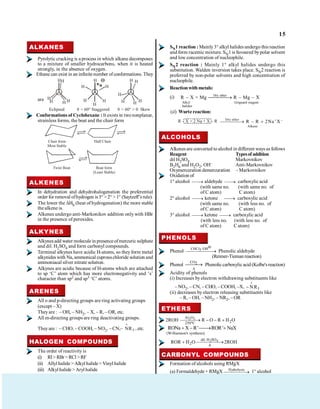
ALKANES
Pyrolytic cracking is a process in which alkane decomposes
to a mixture of smaller hydrocarbons, when it is heated
strongly, in the absence of oxygen.
Ethane can exist in an infinite number ofconformations. They
are H
H
H
H H
H
H H
H
H H
H
H H
H
H H
H
Eclipsed < 60° > 0 Skew
= 60° Staggered
Conformations of Cyclohexane : It exists in twononplanar,
strainless forms, the boat and the chair form
Chair form
Most Stable
Half Chair
Twist Boat Boat form
(Least Stable)
ALKENES
In dehydration and dehydrohalogenation the preferential
order for removal ofhydrogen is3° >2° >1° (Saytzeff’srule).
The lower the Hh (heat of hydrogenation) the more stable
the alkene is.
Alkenes undergo anti-Markonikov addition only with HBr
in the presence of peroxides.
ALKYNES
Alkynesadd water molecule in presenceofmercuric sulphate
and dil. H2SO4 and form carbonyl compounds.
Terminal alkynes have acidic H-atoms, so they form metal
alkynides with Na, ammonical cuprouschloride solution and
ammoniacal silver nitrate solution.
Alkynes are acidic because of H-atoms which are attached
to sp ‘C’ atom which has more electronegativity and ‘s’
character than sp2 and sp3 ‘C’ atoms.
ARENES
All o and p-directing groups are ring activating groups
(except – X)
Theyare : – OH, – NH2, – X, – R, – OR, etc.
All m-directing groups are ring deactivating groups.
Theyare : – CHO, – COOH, – NO2, – CN,– 3
NR , etc.
HALOGEN COMPOUNDS
The order of reactivity is
(i) RI> RBr>RCl>RF
(ii) Allyl halide >Alkyl halide> Vinyl halide
(iii) Alkyl halide > Aryl halide
SN1 reaction : Mainly3° alkyl halides undergo this reaction
and form racemic mixture. SN1 is favoured bypolar solvent
and low concentration of nucleophile.
SN2 reaction : Mainly 1° alkyl halides undergo this
substitution. Walden inversion takes place. SN2 reaction is
preferred by non-polar solvents and high concentration of
nucleophile.
Reactionwith metals:
(i) Dry ether
Alkyl Grignard reagent
halides
R – X + Mg R – Mg – X
(ii) Wurtz reaction:
R – X + 2 Na + X – R Dry ether –
Alkane
R R 2Na X
ALCOHOLS
Alkenes are converted to alcohol in different ways as follows
Reagent Typesof addition
dil H2SO4 Markovnikov
B2H6 and H2O2, OH– Anti-Markovnikov
Oxymercuration demercuration – Markovnikov
Oxidation of
1° alcohol aldehyde carboxylic acid
(with same no. (with same no. of
of C atom) C atom)
2° alcohol ketone carboxylic acid
(with same no. (with less no. of
of C atom) C atom)
3° alcohol ketone carboxylic acid
(with less no. (with less no. of
of C atom) C atom)
PHENOLS
Phenol
CHCl /OH
3 Phenolic aldehyde
(Reimer-Tieman reaction)
Phenol
CO2
Phenoliccarboxylic acid (Kolbe'sreaction)
Acidity of phenols
(i) Increases by electron withdrawing substituents like
– NO2, – CN, – CHO, – COOH, –X, 3
NR
(ii) decreases by electron releasing substituents like
– R, – OH, – NH2, – NR2, – OR
ETHERS
2 3
Al O
2
250ºC
2ROH R O R H O
RONa X R' ROR' NaX
(Williamson's synthesis)
2 4
dil. H SO
2
ROR H O 2ROH
CARBONYL COMPOUNDS
Formation of alcohols using RMgX
(a) Formaldehyde + RMgX Hydrolysis
1° alcohol
16
(b)Aldehyde + RMgX Hydrolysis
2° alcohol
(other than HCHO)
(c) Ketone + RMgX Hydrolysis
3° alcohol
Cannizzaroreaction (Disproportionation)
Aldehyde
Hot conc.
alkali
Alcohol + Salt of acid
(no H-atom)
Aldol condensation :
Carbonyl compound + dil. alkali –– -hydroxycarbonyl
(with H-atom) compound
Benzoin condensation Benzaldehyde ethanolic
NaCN
Benzoin
The relative reactivities ofdifferent acid derivatives towards
nucleophilic acyl substitution reaction follow the order:
2
Acid chloride Anhydride Ester Amide
O O O O O
|| || || || ||
R – C – Cl R – C – O – C – R' R – C – OR ' R – C – NH
CARBOXYLIC ACIDS
The rate of esterfication decreases when alcohol, acid or
both have branched substituents.
Ortho effect : All ortho substituted benzoic acids
(irrespective oftype ofsubstituent) are stronger than benzoic
acid.
NITROGEN COMPOUNDS
Order of basicity:
(R= – CH3 or – C2H5) 2° > 1° > 3° > NH3
Hofmann degradation
Amides Br /KOH
2 1°amine
The basicityof amines is (i) decreased by electron with
drawing groups (ii) increased byelectron releasing groups
Reduction of nitrobenzene in different media gives different
products
Medium Product
Acidic Aniline
Basic Azoxy, Azo and finallyhydrazobenzene
Neutral Phenyl hydroxylamine
BIOMOLECULES
Carbohydrates are polyhydroxy aldehydes or ketones.
Monosaccharides are simple sugars, containing three to nine
carbon atoms.
Characteristic reactions :
Homologous series Type of reactions
(i) Alkanes Substitution
Mostly free radical
(ii) Alkenes and alkynes Electrophillic addition
(iii) Arenes Electrophillic substitution
(iv) Alkyl halides Nucleophillic substitution
(v) Aldehyde and ketones Nucleophillic addition
Tests to differentiate :
1°, 2° and 3° alcohols (i) Lucas test
(ii) Victor meyer’s test
1°, 2° and 3° amines Hinsberg test
1°, 2° and 3° nitro compounds Test with HNO2 and KOH
Aryl halides and alkyl halides Test with AgNO3 solution
Aldehydes and ketones Tollen’s test/Fehling’s test
Aromatic aldehydes and Fehling’s test
Aliphatic aldehydes
IMPORTANT REAGENTS
Dil. H2SO4 [or Conc. H2SO4 + H2O]
Use Hydrating agent (+HOH)
Alc. KOH or NaNH2(Use -HX)
CH3CH2Cl alc.KOH CH2=CH2
Lucas Reagent ZnCl2 + Conc. HCl
Use For distinction between 1º, 2º
& 3º alc.
Tilden Reagent NOCl (Nitrosyl chloride)
C2H5NH2
NOCl C2H5Cl
Alkaline KMnO4(Strong oxidant)
Toluene Benzoic acid
Bayer’s Reagent : 1% alkaline KMnO4(Weak oxidant)
Use: For test of > C = C < or –C = C –
CH2=CH2+H2O+[O] BR CH2OH–CH2OH
Acidic K2Cr2O7 (Strong oxidant) : RCH2OH [O] RCHO
SnCl2/HCl or Sn/HCl used for reduction of nitrobenzene in
acidic medium. C6H5NO2
SnCl / HCl
2
6H
C6H5NH2
Lindlar’s Catalyst = Pd/CaCO3 + in small quantity
(CH3COO)2Pb 2 – butye + H2
"
Cis-2-butene
(main product)
Ziegler –Natta Catalyst (C2H5)3Al + TiCl4
Use In Addition polymerisation
IDENTIFICATION TESTS
Unsaturated compound (Bayer’s reagent)
Decolourising the reagent
Alcohols (Ceric ammonium nitrate solution)
Red colouration
Phenols (Neutral FeCl3 solution)
Violet/deep blue colouration
Aldehydes and ketones (2, 4-D.N.P.)
Orange precipitate
Acids (NaHCO3 solution)
Brisk effervescence (CO2 is evolved)
1° amine (CHCl3 + KOH)
Foul smell (isocyanide)
2° amine (NaNO2 + HCl)
Yellow oily liquid (Nitrosoamine)
RELATIONS AND FUNCTIONS
Arelation R from a setAtoa set B is a subset of the cartesian
productA× Bobtained bydescribing a relationship between
the first element x and the second element y of the ordered
pairs inA× B.
Function : A function f from a set A to a set B is a specific
type of relation for which every element x of set A has one
and onlyone image yin set B.We writef: A B, wheref(x)
= y.
A function f : X Y is one-one (or injective) if
f (x1) =f(x2) x1 = x2 x1, x2 X.
A function f : X Y is onto (or surjective) if given any
y Y, x X such that f (x) = y.
Many-OneFunction:
A function f : A B is called many- one, if two or more
different elements ofAhave the same f- image in B.
Intofunction :
Afunction f :A Bis intoif thereexist at least oneelement
in B which is not the f - image of any element in A.
ManyOne-Ontofunction:
Afunction f: A R is said to be manyone- onto iff is onto
but not one-one.
ManyOne-Intofunction:
A function is said tobe manyone-intoifit is neither one-one
nor onto.
A function f : X Y is invertible if and onlyif f is one-one
and onto.
TRIGONOMETRIC FUNCTIONS AND
EQUATIONS
General Solution of the equation sin = 0:
when sin = 0
= n : n I i.e. n = 0,± 1,±2...........
General solution of the equation cos = 0 :
when cos = 0
=(2n+1) /2,n .i.e.n= 0,±1,+2.......
General solution of the equation tan = 0:
General solution of tan = 0 is = n ; n
General solutionof the equation
(a) sin = sin : = n + (–1)n ; n
(b) sin = k, where –1 < k < 1.
= n + (–1)n , where n and = sin–1k
(c) cos = cos : = 2n ± n
(d) cos = k, where –1 < k < 1.
= 2n ± , where n and = cos–1k
(e) tan = tan : = n + ; n
(f) tan =k, = n + , where n and = tan–1k
(g) sin2 = sin2 : = n ± ; n
(h) cos2 = cos2 : = n ± ; n
(i) tan2 = tan2 : = n ± ; n
sin + sin ( + ) + sin ( +2 ) +........ to n terms
=
n 1 n
sin sin
2 2
sin ( / 2)
; 2n
cos + cos ( + ) + cos ( +2 ) +........ to n terms
=
n 1 n
cos sin
2 2
sin
2
; 2n
B C b c A
tan cot
2 b c 2
sin
A
2
=
(s b)(s c)
bc
- -
tan
A
2
=
(s b)(s c)
s(s a)
- -
-
R=
a b c
2sin A 2sin B 2sinC
= =
R=
abc
4D
r = 4R sin
A
2
æ ö
ç ÷
è ø
. sin
B
2
æ ö
ç ÷
è ø
. sin
C
2
æ ö
ç ÷
è ø
a = c cos B + b cos C
Maximumvalueofasin +bcos 2 2
a b andminimum
value of a sin + b cos 2 2
a b
INVERSE TRIGONOMETRIC
FUNCTIONS
Properties of inverse trigonometric function
• tan–1 x + tan–1 y=
1
1
1
x y
tan , if x
,y 1
1 xy
if x 0, y 0
x y
tan ,
and xy 1
1 xy
if x 0, y 0
x y
tan ,
and xy 1
1 xy
18
• tan–1 x – tan–1y =
1
1
1
x y
tan , if xy 1
1 xy
x y
tan , if x 0, y 0and xy 1
1 xy
x y
tan , if x 0,y 0 and xy 1
1 xy
• sin–1 x + sin–1 y =
2 2
if 1 x, y 1 and x y 1
1 2 2
sin {x 1 y y 1 x }, 2 2
or if xy 0 and x y 1
if 0 x, y 1
1 2 2
sin {x 1 y y 1 x }, 2 2
and x y 1
2 2
1 2 2 if 1 x, y 0 and x y 1
sin {x 1 y y 1 x },
• cos–1 x + cos–1 y =
1 2 2
1 2 2
cos {xy 1 x 1 y } , if 1 x,y 1 and x y 0
2 cos {xy 1 x 1 y }, if 1 x,y 1and x y 0
2 sin–1x =
1 2
1 2
1 2
1 1
sin (2x 1 x ) , if x
2 2
1
sin (2x 1 x ) , if x 1
2
1
sin (2x 1 x ) , if 1 x
2
2 tan–1 x =
1
2
1
2
1
2
2x
tan , if 1 x 1
1 x
2x
tan , if x 1
1 x
2x
tan , if x 1
1 x
QUADRATIC EQUATIONS AND
INEQUALITIES
Roots of a Quadratic Equation : The roots of the quadratic
equation are given by
2
b b 4ac
x
2a
Nature of roots : In Quadratic equation ax2 + bx + c = 0. The
term b2 – 4ac is called discriminant of the equation. It is
denoted by or D.
(A) Suppose a, b, c R and a 0
(i) IfD > 0 Roots are Real and unequal
(ii) IfD = 0 Roots are Real and equal and each equal to
– b/2a
(iii) IfD < 0 Roots are imaginary and unequal or
complex conjugate.
(B) Suppose a, b, c Q and a 0
(i) IfD > 0 and D is perfect square Roots are unequal and
Rational
(ii) If D > 0 and D is not perfect square Roots are irrational
and unequal.
Conditionfor CommonRoot(s)
Let ax2 + bx + c = 0 and dx2 + ex + f = 0 have a common root
(say).
Condition for both the roots to be common is
f
c
e
b
d
a
Ifp + iq (p and q being real) is a root ofthe quadraticequation,
where 1
i , then p –iq is also a root of the quadratic
equation.
Every equation of nth degree (n 1) has exactly n roots and
if the equation has more than n roots, it is an identity.
COMPLEX NUMBERS
Exponential Form:Ifz = x +iyis a complex number then its
exponential form is z = rei where r is modulus and is
amplitude of complex number.
(i) 1 2 1 2
| z | | z | | z z | ; here equality holds when
arg(z1/z2) = 0i.e. z1 and z2 are parallel.
(ii) 1 2 1 2
|| z | | z || | z z | ; here equality holds when
arg(z1/z2) = 0i.e. z1 and z2 are parallel.
(iii) | z1 + z2 |2 + | z1 – z2 |2 = 2( | z1 |2 + | z2 |2 )
1 2 1 2 1 2
arg(z z ) arg(z ) arg(z )
1
1 2 1 2
2
z
arg arg(z ) arg(z )
z
For anyinteger k, i4k = 1, i4k+ 1 = i, i4k+2 = – 1, i4k+3 = – i
1 2
| z z | | z z | , represents an ellipse if
| z1 – z2 | < , having the points z1 and z2 as its foci. And if
1 2
| z z | , then z lies on a line segment connecting z1
and z2.
Propertiesof Cube Roots of Unity
(i) 2
1 0 (ii) 3 =1
(iii) n 2n
1 3 (if n is multipleof 3)
(iv) n 2n
1 0 (if n is not a multipleof3).
PERMUTATIONS AND
COMBINATIONS
The number of permutations of n different things, taken r at
a time, where repetition is allowed, is nr.
Selection ofObjects withRepetition :
The total number of selections of r things from n different
things when each thing maybe repeated anynumber oftimes
is n+r+1Cr
Selection from distinct objects :
The number of ways (or combinations) of n different things
selecting at least one of them is nC1 + nC2 + nC3 + .....+ nCn
= 2n – 1. This can also be stated as the total number of com-
bination of n different things.
19
Selection fromidentical objects :
The number of ways to select some or all out
of(p + q + r) things where p are alike offirst kind, q are alike
of second kind and r are alike of third kind is
(p + 1) (q + 1) (r + 1) – 1
Selection when both identical and distinct objects are
present:
Ifout of (p + q + r + t) things, p are alike one kind, q are alike
of second kind, r are alike of third kind and t are different,
then the total number of combinations is
(p + 1)(q + 1)(r + 1) 2t – 1
Circularpermutations:
(a) Arrangements round a circular table :
Thenumber of circular permutationsofn different things
taken all at a time is
n
n
P
n
(n – 1) !, if clockwise and
anticlockwise orders are taken as different.
(b) Arrangementsofbeadsorflowers(alldifferent)around
a circular necklace or garland:
The number of circular permutations of ‘n’ different
things taken all at a time is
1
2
(n – 1)!, if clockwise and
anticlockwise orders are taken to be some.
Sum of numbers :
(a) For given n different digits a1, a2, a3 ......an thesum of the
digits in the unit place of all numbers formed (if numbers are
not repeated) is (a1 + a2 + a3 + .....+ an) (n – 1) !
(b) Sum ofthe total numbers which can beformed with given
n different digits a1, a2, .........an is
(a1 +a2 +a3 +.........+an)(n –1)!.(111........ntimes)
BINOMIAL THEOREM
Greatest binomial coefficients : In a binomial expansion
binomial coefficients ofthemiddleterms are calledasgreatest
binomial coefficients.
(a) Ifn iseven:When r =
n
2
i.e. nCn/2 takesmaximum value.
(b) If n is odd : r =
n 1
2
or
n 1
2
i.e.
n n
n 1 n 1
2 2
C C
andtakemaximumvalue.
ImportantExpansions:
If | x | < 1 and n Q but n N, then
(a) (1+ x)n =1+ nx+
n(n 1)
2!
x2
+ ......+
n(n 1).....(n r 1)
r!
xr + .......
(b) (1–x)n=1–nx+
n(n 1)
2!
x2 –
n(n 1)(n 2)
3!
x3
+ ......+
n(n 1).....(n r 1)
r!
(–x)r + .......
SEQUENCE AND SERIES
Propertiesrelated toA.P. :
(i) Common difference of AP is given by d = S2 – 2S1
where S2 is sum of first twoterms and S1 is sum of first
term.
(ii) Iffor an APsum ofp terms is q, sum ofq terms is p, then
sum of (p + q) term is (p + q).
(iii) InanA.P.thesumoftermsequidistantfromthebeginning
andendisconstantandequaltosumoffirstandlastterms.
(iv) Ifterms a1, a2, ..., an, an+1, ..., a2n+1 are in A.P., then sum
of these terms will be equal to (2n + 1)an+1.
(v) If for an A.P. sum of p terms is equal to sum of q terms
then sum of (p + q) terms is zero
(vi) Sum of n AM's inserted between a and b is equal to n
times the singleAM between a and b i.e.
n
r
r 1
A = nA
whereA=
a b
2
The geometric mean (G.M.) of any two positive numbers a
and b is given by ab i.e., the sequence a, G, b is G.P.
.
n GM's between two given numbers: If in between two
numbers 'a' and 'b', we have to insert n GM G1,G2,.......... Gn
then a1, G1,G2,........Gn , bwillbe in G.P.
The series consist of (n +2) terms and the last term is b and
first term is a.
arn + 2 –1 = b r =
1
n 1
b
a
G1 = ar, G2 = ar2 ........Gn = arn or Gn = b/r
Use of inequalities in progression :
(a) Arithmetic Mean Geometric Mean
(b) Geometric Mean Harmonic Mean :
A G H
STRAIGHT LINES
An acute angle (say ) between lines L1 and L2 with slopes
m1 and m2 is given by 2 2
1 2
1 2
m m
tan , 1 m m 0
1 m m
Three pointsA, B and C are collinear, if and only if slope of
AB = slope of BC.
The equation of the line having normal distance from origin
is p and angle between normal and the positive x-axis is , is
given by x cos + y sin = p.
Co-ordinate ofsome particular points:
Let A(x1,y1), B(x2,y2) and C(x3,y3) are vertices of any
triangle ABC, then
Incentre : Co-ordinates of incentre
1 2 3 1 2 3
ax bx cx ay by cy
,
a b c a b c
where a, b, c are the sides of triangleABC
20
Area ofa triangle :Let(x1, y1),(x2, y2)and(x3, y3)
respectively be the coordinates of the vertices A, B, C of a
triangleABC. Then the area of triangleABC, is
1
2
[x1 (y2 – y3)+ x2 (y3 – y1) + x3 (y1 – y2)]
Or
=
1
2
1 1
2 2
3 3
x y 1
x y 1
x y 1
CONIC SECTIONS
Conditionof Tangency: Circle
x2 + y2 =a2 will touch the line.
y= mx + c if c = ± 2
a 1 m
Pair of Tangents : From a given point P( x1,y1) twotangents
PQ and PR can be drawn to the circle
S = x2 + y2 + 2gx + 2fy+ c = 0.
Their combined equation is SS1 = T2.
Condition of Orthogonality : If the angle ofintersection of
the two circle is a right angle ( = 90°) then such circle are
calledOrthogonal circle andconditionsfor their orthogonality
is 2g1g2 + 2f1f2 =c1 +c2
Tangenttothe parabola:
Condition of Tangency : If the line y = mx + c touches a
parabola y2 = 4ax then c= a/m
Tangent to the Ellipse:
Conditionof tangency andpoint of contact :
The condition for the line y = mx + c to be a tangent to the
ellipse
2 2
2 2
x y
a b
= 1 is that c2= a2m2 + b2 and the coordinates
of the points of contact are
2 2
2 2 2 2 2 2
a m b
,
a m b a m b
Normal to the ellipse
(i) Point Form : The equation of the normal to the ellipse
2 2
2 2
x y
a b
= 1 at the point (x1, y1) is
2 2
1 1
a x b y
x y
= a2 – b2
(ii) Parametric Form : The equation of the normal to the
ellipse
2 2
2 2
x y
a b
= 1 at the point (a cos , b sin ) is
ax sec – by cosec = a2 – b2
Tangenttothe hyperbola:
Conditionfor tangencyandpointsof contact:Thecondition
for the line y = mx + c to be a tangent to the hyperbola
2 2
2 2
x y
a b
= 1 is that c2 = a2m2 – b2 and the coordinates of the
points of contact are
2 2
2 2 2 2 2 2
a m b
,
a m b a m b
Chordofcontact:
The equation of chord of contact of tangent drawn from a
point P (x1, y1) to the hyperbola
2 2
2 2
x y
a b
= 1 is T = 0
where T 1 1
2 2
xx yy
a b
– 1
Equation of normal indifferent forms:
Point Form : The equation of the normal to the hyperbola
2 2
2 2
x y
a b
= 1 at the point (x1, y1) is
2 2
1 1
a x b y
x y
= a2 + b2
THREE DIMENSIONAL GEOMETRY
Slope Form : The equation of normal to the hyperbola
2 2
2 2
x y
a b
= 1 in terms ofslope 'm' is y= mx ±
2 2
2 2 2
m(a b )
a b m
Conditions of Parallelism and Perpendicularity of Two
Lines:
Case-I : When dc's of two lines AB and CD, say 1 , m1, n1
and 2 , m2, n2 areknown.
AB | | CD 1 = 2 , m1 = m2, n1 = n2
AB CD 1 2 + m1m2 + n1n2 = 0
Case-II : When dr'sof twolinesABand CD, saya1, b1 c1 and
a2, b2, c2 are known
AB| | CD
1 1 1
2 2 2
a b c
a b c
AB CD a1a2 + b1b2 + c1c2 = 0
If 1, m1, n1 and 2, m2, n2 are the direction cosines of two
lines; and is the acute angle between the two lines; then
cos = | 1 2 + m1m2 + n1n2 |.
Equation of a line through a point (x1, y1, z1) and having
direction cosines , m, n is 1 1 1
x x y y z z
m n
Shortest distance between 1 1
r a b and 2 2
r a b
is
1 2 2 1
1 2
(b b ).(a a )
| b b |
Let the two lines be
1 1 1
1 1 1
x y z
m n ..........(1)
and
2 2 2
2 2 2
x y z
m n ..........(2)
These lines will coplanar if
21
2 1 2 1 2 1
1 1 1
2 2 2
m n
m n
= 0
The plane containing the two lines is
1 1 1
1 1 1
2 2 2
x y z
m n
m n
= 0
The equation of a plane through a point whose position
vector is a and perpendicular to the vector N is
(r a).N 0
Vector equation of a plane that passes through the
intersection of planes 1 1
r.n d and 2 2
r.n d is
1 2 1 2
r.(n n ) d d , where is any nonzero constant.
Two planes 1 1
r a b and 2 2
r a b are coplanar if
2 1 1 2
(a a ) (b b ) 0
DIFFERENTIAL CALCULUS
Existence of Limit:
x a
lim
®
f(x)exists
x a
lim
-
®
f(x)=
x a
lim
+
®
f(x)=
Where is called the limit of the function
(i) If f(x) g(x) for every x in the deleted nbd of a, then
x a
lim f(x)
x a
lim g(x)
(ii) If f(x) g(x) h (x) for everyx in the deleted nbd of a
and
x a
lim f(x) = =
x a
lim h (x) then
x a
lim g(x) =
(iii)
x a
lim fog(x)=f
x a
lim g(x) =f(m)where
x a
lim g(x)=m
(iv) If
x a
lim f(x) = + or – , then
x a
lim
1
f (x)
= 0
CONTINUITYANDDIFFERENTIABILITYOFFUNCTIONS
A function f(x) is said to be continuous at a point x = a if
x a
lim
+
®
f(x)=
x a
lim
-
®
f(x)=f(a)
Discontinuous Functions :
(a) Removable Discontinuity: Afunction fis said tohave
removablediscontinuityatx=a if
x a
lim
-
®
f(x)=
x a
lim
+
®
f(x)
but their common value is not equal to f (a).
(b) Discontinuity of the first kind: A function f is said to
have a discontinuity of the first kind at x = a if
x a
lim
-
®
f(x) and
x a
lim f (x) both exist but are not equal.
(c) Discontinuity of second kind: A function f is said to
havea discontinuityofthesecondkind at x = a ifneither
x a
lim
-
®
f (x) nor
x a
lim
+
®
f(x) exists.
Similarly, if
a
x
lim f (x) does not exist, then f is said to have
discontinuityof the second kind from the right at x = a.
For a function f :
Differentiability Continuity;
Continuity derivability
Not derivibaility discontinuous ;
But discontinuity Non derivability
Differentiation of infinite series:
(i) If y f(x) f(x) f(x) ........
y = f(x) y y2 = f (x) + y
2y
dy
dx
= f' (x) +
dy
dx
dy
dx
=
f '(x)
2y 1
(ii)If y =
....
f (x)
f (x)
f(x) then y = f (x)y.
log y= ylog [f(x)]
1 dy y'.f '(x) dy
logf(x).
y dx f(x) dx
2
dy y f '(x)
dx f (x)[1 ylog f (x)]
(iii) If y =
1 1
f (x) f (x)
1
f(x) ....
f(x)
then
dy yf '(x)
dx 2y f (x)
DIFFERENTIATION AND
APPLICATION
Interpretationofthe Derivative : Ify=f(x)then, m=f (a)is
the slope of the tangent line to y = f (x) at x = a
Increasing/Decreasing :
(i) Iff (x) > 0for all x in an interval Ithen f(x) isincreasing
on the interval I.
(ii) Iff (x)< 0 for all x in an interval Ithen f(x) isdecreasing
on the interval I.
(iii) Iff (x) = 0 for all x in an interval I then f (x) is constant
on the interval I.
Test of Local Maxima and Minima –
First Derivative Test–Letfbeadifferentiablefunctiondefined
onanopen intervalIand c Ibeanypoint.fhasalocalmaxima
oralocalminimaatx=c,f (c)=0.
Put
dy
0
dx
and solve this equation for x. Let c1, c2........cn be
the roots of this.
If dy
dx
changes sign from +ve to –ve as x increases through
c1 then the function attains a local max at x = c1
If
dy
dx
changes its sign from –ve to+veas x increases through
c1 thenthefunctionattainsa localminimumatx=c1
22
If
dy
dx
does not changes sign as increases through c1 then
x = c1 is neither a point of local maxm nor a point of local
minm. In this case x is a point ofinflexion.
Rate ofchange of variable :
The value of
dy
dx
at x = x0 i.e.
x x0
dy
dx
represents the rate
of change of y with respect to x at x = x0
Ifx= (t)andy= (t),then
dy dy / dt
dx dx / dt
,providedthat
dx
dt
0
Thus, the rate of change of y with respect to x can be
calculated by using the rate of change of y and that of x
each with respect to t.
Length of Sub–tangent =
dx
y
dy
; Sub–normal =
dy
y
dx
;
Length of tangent =
2
dx
y 1
dy
Length of normal =
2
dy
y 1
dx
Equations of tangent and normal : The equation of the
tangent at P (x1, y1) to the curve y = f(x) is y – y1
=
P
dy
dx
(x – x1). The equation ofthe normal at P (x1, y1)
to the curve y = f (x) is y – y1 =
P
1
dy
dx
(x – x1)
INTEGRAL CALCULUS
Twostandard forms of integral :
x
e [f(x)+f'(x) dx = ex f(x) + c
x
e [f(x)+f'(x)] dx= x
e f(x)dx+ x
e f'(x)dx
= ex f(x)– x
e f'(x)dx + x
e f'(x)
(on integrating byparts) = ex f (x) + c
Table shows the partial fractions corresponding to different
type of rational functions :
S. Form of rational Formof partial
No. function fraction
1.
px q
(x a) (x b)
A B
(x a) (x b)
2.
2
2
px qx r
(x a) (x b)
2
A B C
(x a) (x b)
(x a)
3.
2
2
px qx r
(x a) (x bx c) 2
A Bx C
(x a) x bx C
Leibnitz rule :
g(x)
f (x)
d
F(t) dt g (x)F(g(x)) f (x)F(f(x))
dx
If a series can be put in the form
r n 1
r 0
1 r
f
n n
or
r n
r 1
1 r
f
n n
, then its limit as n
is
1
0
f (x) dx
Area between curves :
b
a
y f(x) A [upper function] [lower function] dx
and
d
c
x f(y) A [right function] [left function] dy
If the curves intersect then the area of each portion must be
found individually.
Symmetrical area : If the curve is symmetrical about a
coordinate axis (or a line or origin), then we find the area of
one symmetrical portion and multiply it by the number of
symmetrical portion to get the required area.
PROBABILITY
Probabilityof anevent: Forafinitesamplespacewithequally
likely outcomes Probability of an event is
n(A)
P(A)
n(S)
, where n (A) = number ofelements in the set
A, n (S) = number of elements in the set S.
Theoremoftotal probability:Let {E1,E2,...,En}beapartition
ofa sample space and suppose that each ofE1, E2, ..., En has
nonzero probability. Let A be any event associated with S,
then
P(A) = P(E1) P(A | E1)+ P(E2) P (A| E2)+ ...
+P (En)P(A |En)
Bayes' theorem: If E1, E2, ..., En are events which constitute
a partition of sample space S, i.e. E1, E2, ..., En are pairwise
disjoint and E1 E2 ... En = S and A be any event with
nonzero probability, then
i i
i n
j j
j 1
P(E ) P (A | E )
P (E | A)
P(E ) P(A | E )
Let X be a random variable whose possible values x1, x2, x3,
..., xn occur with probabilities p1, p2, p3, ... pn respectively.
The mean of X, denoted by µ, is the number
n
i i
i 1
x p
The mean of a random variable X is also called the
expectation of X, denoted byE (X).
23
Trials of a random experiment are called Bernoulli trials, if
they satisfy the following conditions :
(a) There should be a finite number of trials. (b) The trials
should be independent. (c) Each trial has exactly two
outcomes : success or failure. (d) The probability ofsuccess
remains the same in each trial.
For Binomial distribution B(n, p),
P (X = x) = nCx qn–x px, x = 0, 1,..., n (q = 1 – p)
MATRICES
Properties of Transpose
(i) (AT)T =A
(ii) (A± B)T =AT ±BT
(iii) (AB)T =BTAT (iv) (kA)T = k(A)T
(v) IT = I (vi)tr (A)= tr (A)T
(vii) (A1A2A3.....An–1 An)T =An
TAn–1
T.....A3
TA2
TA1
T
Symmetric Matrix : A square matrix A = [aij] is called
symmetricmatrix if
aij = aji for all i, j or AT =A
Skew-Symmetric Matrix :Asquare matrixA= [aij] iscalled
skew-symmetricmatrix if
aij = – aji for all i, j or AT = –A
Also every square matrix A can be uniquely expressed as a
sum of a symmetric and skew-symmetricmatrix.
Differentiation of a matrix : If A =
f(x) g(x)
h(x) (x)
é ù
ê ú
ë û
then
f '(x) g'(x)
dA
h'(x) '(x)
dx
é ù
= ê ú
ë û
is a differentiation of MatrixA
A
.
DETERMINANTS
Properties of adjoint matrix : IfA, B are square matrices of
order n and In is corresponding unit matrix, then
(i) A(adj. A) = |A| In = (adjA)A
(ii) | adjA| = | A|n–1
(ThusA(adjA) is always a scalar matrix)
(iii) adj (adj A) = | A|n–2 A
(iv) | adj (adjA) | =
2
(n 1)
| A | -
(v) adj (AT) =(adjA)T
(vi) adj (AB) = (adj B) (adjA)
(vii) adj (Am) = (adjA)m, m N
(viii) adj (kA) = kn–1 (adj. A), k R
(ix) adj (In) = In
Propertiesof Inverse Matrix: LetAand Baretwoinvertible
matrices of the same order, then
(i) (AT)–1 = (A–1)T
(ii) (AB)–1 = B–1A–1
(iii) (Ak)–1 = (A–1)k, k N
(iv) adj (A–1) = (adjA)–1
(v) (A–1)–1 = A
(vi) | A–1 | =
1
| A |
= |A |–1
(vii) IfA= diag (a1,a2.....,an), then
A–1 = diag (a1
–1, a2
–1, .........an
–1)
(viii) Ais symmetricmatrix A–1 is symmetricmatrix.
Rank of a Matrix : Anumber r is said tobe the rank of a
m×n matrixAif
(a) Everysquaresubmatrix oforder (r +1)or moreissingular
and (b) There exists at least one square submatrix of order r
which is non-singular.
Thus, the rank of matrix is the order of the highest order
non-singular submatrix.
Using Crammer's rule ofdeterminant we get
1 2 3
x y z 1
= = =
D D D D i. e. x =
1
D
D
, y =
2
D
D
, z =
3
D
D
Case-I : If 0
Then x =
1
D
D
, y=
2
D
D
, z =
3
D
D
The system is consistent and has unique solutions.
Case-IIif = 0and
(i) If at least one of 1, 2, 3 is not zero then the system
of equations a inconsistent i.e. has no solution.
(ii) If d1 = d2 = d3 = 0 or 1, 2, 3 are all zero then the
system of equations has infinitely many solutions.
VECTOR ALGEBRA
Given vectors 1 1 1
x a y b z c , 2 2 2
x a y b z c ,
3 3 3
x a y b z c , where a,b,c are non-coplanar vectors,
will be coplanar if and only if
1 1 1
2 2 2
3 3 3
x y z
x y z
x y z
= 0
Scalar triple product :
(a) If 1 2 3
ˆ ˆ ˆ
a a i a j a k , 1 2 3
ˆ ˆ ˆ
b b i b j b k and
1 2 3
ˆ ˆ ˆ
c c i c j c k then
1 2 3
1 2 3
1 2 3
a a a
(a b).c [a b c] b b b
c c c
(b) [a b c] = volume of the parallelopiped whose
coterminous edges are formed by a,b,c
(c) a,b,c are coplanar if and only if [a b c] = 0
(d) Four pointsA, B, C, D with position vectors a, b, c,d
respectively are coplanar if and only if
[AB AC AD] = 0 i.e. if and onlyif
[b a c a d a] = 0
(e) Volumeof a tetrahedron with three coterminous edges
1
a ,b,c [a b c]
6
(f) Volume of prism on a triangular base with three
coterminous edges
1
a ,b,c [a b c]
2
24
Lagrange'sidentity :
a.c a.d
(a b).(c d) (a.c)(b.d) (a.d)(b.c)
b.c b.d
Reciprocal system of vectors : If a,b,c be any three non
coplanar vectors so that
[a b c] 0 then the three vectors a 'b'c' defined by the
equations
b c
a '
[a b c]
,
c a
b'
[a b c]
,
a b
c'
[a b c]
are called
the reciprocal system of vectors to the given vectors a,b,c
STATISTICS
RelationbetweenA.M.,G.M.andH.M.
A.M. G.M. H.M.
Equality sign holds only when all the observations in the
series are same.
Relationshipbetweenmean,modeandmedian:
(i) In symmetrical distribution
Mean = Mode = Median
(ii) In skew(moderately symmetrical) distribution
Mode = 3 median – 2 mean
Mean deviation for ungrouped data
i
| x x |
M.D.(x)
n
,
i
| x M |
M.D.(M)
n
Mean deviation for grouped data
i i
f | x x |
M.D.(x)
N
,
i i
f | x M |
M.D.(M)
N
,
where i
N f
Variance and standard deviation for ungrouped data
2 2 2
i i
1 1
(x x) , (x x)
n n
Variance and standard deviation of a discrete frequency
distribution
2 2 2
i i i i
1 1
f (x x) , f (x x)
n N
Variance and standard deviation of a continuous frequency
distribution
2 2 2 2
i i i i i i
1 1
f (x x) , f x ( f x )
n N
Coefficient ofvariation (C.V.) = 100, x 0
x
For series with equal means, the series with lesser standard
deviation is more consistent or less scattered.
DIFFERENTIAL EQUATIONS
Methods of solving a first order first degree differential
equation:
(a) Differential equationofthe form
dy
f(x)
dx
dy
f(x)
dx
dy = f (x) dx
Integrating both sides we obtain
dy f (x)dx c or y = f (x)dx c
(b) Differential equation ofthe form
dy
f(x) g(y)
dx
dy
f(x) g(y)
dx
dy
f (x) dx c
g(y)
(c)Differentialequationoftheformof
dy
f (ax by c)
dx
:
To solve this type of differential equations, we put
ax + by + c = v and
dy 1 dv
a
dx b dx
dv
dx
a bf (v)
So solution is by integrating
dv
dx
a bf (v)
(d) Differential Equation of homogeneoustype :
An equation in x and y is said to be homogeneous if it
can be put in the form
dy f (x,y)
dx g(x,y) where f(x ,y) and g
(x ,y) are both homogeneous functions of the same
degree in x & y.
So to solve the homogeneous differential equation
dy f (x, y)
dx g(x, y) , substitute y = vx and so
dy dV
v x
dx dx
Thus
dv dx dv
v x f (v)
dx x f (v) v
Therefore solution is
dx dv
c
x f (v) v
Linear differential equations:
dy
Py Q
dx
.......(1)
Where P and Q are either constants or functions of x.
Multiplying both sides of (1) by Pdx
e , we get
Pdx Pdx
dy
e Py Q e
dx
On integrating both sides with respect to x we get
P dx P dx
y e Q e c
which is the required solution, where c is the constant and
Pdx
e is called the integration factor.
.

Formula Book [Physics+chemistry+Maths].pdf

  • 1.
    Percentage error 100% mean a a MOTIONIN A STRAIGHT LINE Average speed, Vav 1 2 3 s +s + s = t + t + t 1 2 3 Average acceleration, aav 1 1 2 1 2 a t +a t = t + t 2 The area under the velocity-time curve is equal to the displacement and slope gives acceleration. If a body falls freely, the distance covered by it in each subsequent second starting from first second will bein the ratio 1 : 3 : 5 : 7 etc. If a body is thrown vertically up with an initial velocity u, it takes u/g second to reach maximum height and u/g second to return, if air resistance is negligible. If air resistance acting ona body is considered, the time takenby thebodytoreach maximum heightis lessthan the time to fall back the same height. For a particle having zero initial velocity if s t , where 2 ,thenparticle’saccelerationincreases with time. For a particle having zero initial velocity if s t , where 0,thenparticle’s accelerationdecreaseswith time. Kinematic equations : v = u + at (t) ; v2 = u2 + 2at (s) S = ut + 1 2 at (t)2; Sn u (2n 1) 2 a applicable only when t t | a | a is constant. at = magnitude of tangential acceleration, S = distance If acceleration is variable use calculus approach. Relative velocity : BA B A v v v MOTION IN A PLANE IfT isthetimeof flight, hmaximumheight, R horizontal range of a projectile, its angle of projection, then the relations among these quantities. 2 gT h 8 ...... (1); gT2 = 2R tan ....... (2); R tan = 4h .......(3) UNITS AND MEASUREMENTS The SI system : It is the international system of units. At present internationally accepted for measurement. In this system there are seven fundamental and two supplementary quantities and their corresponding units are: Quantity Unit Symbol 1. Length metre m 2. Mass kilogram kg 3. Time second s 4. Electric current ampere A 5. Temperature kelvin K 6. Luminous intensity candela cd 7. Amount of substance mole mol Supplementary 1. Plane angle radian rad 2. Solid angle steradian sr Dimensions : These are the powers to which the fundamental units are raised to get the unit of a physical quantity. Uses of dimensions (i) To check the correctness of a physical relation. (ii) To derive relationship between different physical quantities. (iii) To convert one system of unit into another. n1u1 = n2u2 1 1 1 1 [M L T ] a b c n = 2 2 2 2 [M L T ] a b c n Significant figures : In any measurement, the reliable digits plus the first uncertain digit are known as significant figures. Error : It is the difference between the measured value and true value of aphysical quantity or the uncertainty in the measurements. Absolute error : The magnitude of the difference between the true value and the measured value is called absolute error. 1 1 a a a , 2 2 a a a , n n a a a Mean absolute error 1 2 | | | | ..... | | n a a a n a = 1 1 | | n i i a n Relative error : It is the ratio of the mean absolute error to its true value or relative error = a a Percentage error : It is the relative error in per cent.
  • 2.
    2 2 2 2usin usin ; 2 T h g g 2 u sin 2 R g ; 2 max u when 45 R g For a given initial velocity, to get the same horizontal range, there are two angles of projection and 90° – . The equationto the parabola traced byabodyprojected horizontally from the top of a tower of height y, with a velocity u is y = gx2/2u2, where x is the horizontal distance covered by it from the foot of the tower. Equationoftrajectory is 2 2 2 gx y x tan 2u cos , which is parabola. Equation of trajectory of an oblique projectile in terms of range (R) is x y x tan 1 R Maximum height is equal to n times the range when the projectile is launched at an angle = tan–1(4n). In a uniform circular motion, velocity and acceleration are constants only in magnitude. Their directions change. In a uniform circular motion, the kinetic energy of the body is a constant. W =0, a 0, P constant, L=constant Centripetal acceleration, 2 2 r v a r v r (always applicable) r a v LAWS OF MOTION Newton’s first law of motion or law of inertia : It is resistance to change. Newton’s second law : F ma, F dp / dt Impulse : 2 2 1 1 p F t, p p F dt Newton’s third law : 12 21 F F Frictional force s s max s f (f ) R ; k k f R Circular motion with variable speed. For complete circles, the string must be taut in the highest position, 2 u 5ga ³ . Circular motion ceases at the instant when the string becomes slack, i.e., when T = 0, range of values of u for which the string does go slack is 2ga u 5ga . Conical pendulum : g / h w = where h is height of a point of suspension from the centre of circular motion. The acceleration of a lift a = actual weight apparent weight mass If ‘a’ is positive liftis moving down, and if it is negative the lift is moving up. On a banked road, the maximum permissible speed Vmax = 1/2 s g s u tan R 1 u tan æ ö + q÷ ç ÷ ç ÷ ç ÷ ç - q è ø WORK, ENERGY AND POWER Work done W = FS cos Relation between kinetic energy E and momentum, P 2mE K.E. = 1/2 mV2; P.E. = mgh If a body moves with constant power, its velocity (v) is related to distance travelled (x) bythe formulav x3/2. Power P = W t = F.V Workdueto kinetic forceoffriction betweentwocontact surfaces is always negative. It depends on relative displacement between contact surfaces. FK K rel W F (S ) . W K, W total work due to all kinds of forces, K total change in kinetic energy. conservative W U ; conservative W Total work due to allkinds of conservative forces. SDu Þ Total change in all kinds of potential energy. Coefficient of restitution velocity of separation e velocity of approach The total momentum of a system of particles is a constant in the absence of external forces. SYSTEM OF PARTICLES & ROTATIOAL MOTION The centre of mass of a system of particles is defined as the point whose position vector is i i m r R M Theangular momentum ofasystemof nparticles about the origin is n i i i 1 L r p ; L = mvr = I Thetorqueor momentofforce onasystemof nparticles about the origin is i i i r F The moment of inertia of a rigid body about an axis is defined by the formula 2 i i I m r The kinetic energy of rotation is 2 1 K I 2 The theorem of parallel axes : ' z I = Iz + Ma2 Theorem of perpendicular axes : Iz = Ix + Iy For rolling motion without slipping vcm = R . The kineticenergy ofsucharolling bodyisthesum ofkinetic energies of translation and rotation :
  • 3.
    3 2 2 cm 1 1 Kmv I 2 2 A rigid body is in mechanical equilibrium if (a) It is translational equilibrium i.e., the total external force on it is zero : Fi = 0. (b) It is rotational equilibrium i.e., the total external torque on it is zero : i = ri × Fi = 0. If a body is released from rest on rough inclined plane, then for pure rolling r n tan n 1 (Ic = nmr2) Rolling with sliding s n 0 tan n 1 ; gsin a gsin n 1 GRAVITATION Newton’s universal law of gravitation Gravitational force F 1 2 2 Gm m = r G = 6.67 × 10 –11 2 2 Nm kg The acceleration due to gravity. (a) at a height h above the Earth’s surface E 2 E E GM 2h g(h) g 1 R (R h) for h << RE E 2h g(h) g(0) 1 R where E 2 E GM g(0) R (b) at depth d below the Earth’s surface is E 2 E E E GM d d g(d) 1 g (0) 1 R R R (c) with latitude g1 = g – R 2 cos2 Gravitational potential Vg GM = – r Intensity of gravitational field 2 GM I = r The gravitational potential energy 1 2 Gm m V constant r The escape speed from the surface of the Earth is E e E E 2GM v 2gR R and has a value of 11.2 km s–1. Orbital velocity, vorbi E E GM = R E gR A geostationary (geosynchronous communication) satellite moves in a circular orbit in the equatorial plane at a approximate distance of 4.22 × 10⁴ km from the Earth’s centre. Kepler’s 3rd law of planetary motion. 2 3 T a ; 2 3 1 1 2 3 2 2 T a T a MECHANICAL PROPERTIES OF SOLIDS Hooke’s law : stress strain Young’s modulus of elasticity F Y A Compressibility 1 = Bulkmodulus Y = 3k (1 – 2 ) Y = 2n (1 + ) If S is the stress and Y is Young’s modulus, the energy density of the wire E is equal to S2/2Y. If isthe longitudinalstrainandE is theenergydensity of a stretched wire, Y Young’s modulus of wire, then E is equal to 2 1 Y 2 Thermal stress = F A = Y Dq MECHANICAL PROPERTIES OF FLUIDS Pascal’s law : A change in pressure applied to an enclosed fluid is transmitted undiminished to every pointof the fluidand the walls of the containing vessel. Pressure exerted by a liquid column P = hrg Bernoulli’s principle P + v2/2 + gh = constant Surface tension is a force per unit length (or surface energy per unit area) acting in the plane of interface. Stokes’ law states that the viscous drag force F on a sphere of radius a moving with velocity v through a fluid of viscosity F = – 6 av. Terminal velocity VT = 2 2 r ( – )g 9 The surface tension of a liquid is zero at boiling point. The surface tension is zero at critical temperature. If a drop of water of radius R is broken into n identical drops, the work done in the process is 4 R2S(n1/3 –1) and fall in temperature Dq = 3T 1 1 J r R - Two capillary tubes each of radius r are joined in parallel. The rate of flow is Q. If they are replaced by single capillary tube of radius R for the same rate of flow, then R = 21/4 r. Ascent of a liquid column in a capillary tube h = 2s cos r g f r
  • 4.
    4 Coefficient of viscosity,n = F dv A dx Velocity of efflux 2 V gh THERMAL PROPERTIES OF MATTER Relation between different temperature scales : C 100 = F 32 K 273 100 100 - - = The coefficient oflinear expansion ( ), superficial ( ) and volume expansion ( v) are defined by the relations : T ; A T A ; V V T V v = 3 ; 2 In conduction, heat is transferred between neighbouring parts of a body through molecular collisions, without any flow of matter. The rate of flow of heat C D T T H KA L , where K isthe thermal conductivityofthematerial of the bar. Convection involves flow of matter within a fluid due to unequal temperatures of its parts. Radiation is the transmission of heat as electromagnetic waves. Stefan’s lawof radiation : E = T4, where the constant is known as Stefan’s constant = 5.67 × 10⁻⁸ wm–2 k–4. Wein’s displacement law : mT = constant, where constant is known as Wein’s constant = 2.898 × 10⁻³ mk. Newton’s law of cooling: 2 1 dQ k (T T ) dt ; where T T1 is the temperature of the surrounding medium and T2 is the temperature of the body. Heat required to change the temperature of the substance, Q= mc c = specific heat of the substance Heat absorbed or released during state change Q = mL L = latent heat of the substance Mayer’s formula cp – cv = R THERMODYNAMICS First law of thermodynamics: Q = U + W, where Q is the heat supplied to the system, W is the work done by the system and Uis the changein internal energyofthe system. In an isothermal expansion of an ideal gas from volume V1 to V2 at temperature T the heat absorbed (Q) equals the work done (W) by the gas, each given by 2 1 V Q W nRTln V In an adiabatic process of an ideal gas PV = TV –1 1 T P = constant, where p v C C . Work done by an ideal gas in an adiabatic change of state from (P1, V1, T1) to (P2, V2, T2) is 1 2 nR (T T ) W 1 The efficiency of a Carnot engine is given by 2 1 T 1 T Second law of thermodynamics: No engine operating between two temperatures can have efficiencygreater than that of the Carnot engine. Entropy or disorder Q S = T KINETIC THEORY Ideal gas equation PV = nRT Kinetic theoryof an ideal gas gives the relation 2 1 P nmv 3 , Combined with the ideal gas equation it yields a kinetic interpretation of temperature. 2 B 1 3 nmv k T 2 2 , 2 1/2 B rms 3k T v (v ) m The law of equipartition ofenergyis stated thus: the energy for each degreeoffreedom in thermal equilibriumis 1/2(kBT) The translational kinetic energy B 3 E k NT 2 . This leads to a relation 2 PV E 3 . Degree of freedom : Number of directions in which it can move freely. Root mean square (rms) velocity of the gas 3 3RT P C = M Most probable speed Vmp 2RT 2KT = = M m Mean free path 2 KT = 2 d P OSCILLATIONS Displacement in SHM : Y= a sin wt or, y = a cos wt The particle velocity and acceleration during SHM as functions of time are given by, v (t) = – A sin ( + ) (velocity), a (t) = – 2Acos ( t + ) = – 2x(t)(acceleration) Velocityamplitude vm = Aand acceleration amplitude am = 2A. A particle of mass m oscillating under the influence of a Hooke’s lawrestoring force given byF = – k x exhibits simple harmonic motion with k m (angular frequency), m T 2 k (period) Such a system is also called a linear oscillator.
  • 5.
    5 Timeperiod for conicalpendulum cos T 2 g where angle between string & vertical. Energyof the particle 2 2 1 E = k + u = m A 2 WAVES The displacement in a sinusoidal wave y (x, t) = a sin (kx – t + ) where is the phase constant or phase angle. Equation of plane progressive wave : t x a sin 2 T V Equation of stationarywave : Y = 2a sin 2 t 2 x cos T The speed of a transverse wave on a stretched string v T / . Sound waves are longitudinal mechanical waves that can travel through solids, liquids, or gases. The speed v of sound wave in a fluid having bulk modulus B and density µ is v B / . The speed of longitudinal waves in a metallic bar is v Y / For gases, since B = P, the speed of sound is v P / The interference of twoidentical waves moving in opposite directions produces standing waves. For a string with fixed ends, standing wave y (x, t) = [2a sin kx ] cos t The separation between twoconsecutivenodes or antinodes is /2. A stretched string oflength L fixed at both the ends vibrates with frequencies 1 v f 2 2L . The oscillation mode with lowest frequency is called the fundamental mode or the first harmonic. A pipe of length L with one end closed and other end open (such as air columns) vibrates with frequencies given by 1 v f n 2 2L , n = 0, 1, 2, 3, .... The lowest frequency given byv/4L isthefundamental modeor the first harmonic. Open organ pipe n1 : n2 : n3 ....... 1, 2, 3......., V n 2l Beats arise when two waves having slightly different frequencies, f1 and f2 and comparable amplitudes, are superposed. The beat frequency fbeat = f1 – f2 The Doppler effect is a change in the observed frequencyof a wave when the source S and the observer O moves relative tothe medium. 0 0 s v v f f v v ELECTROSTATICS Coulomb’s Law : 21 F = force on q2 due toq1 = 1 2 21 2 21 k (q q ) r̂ r where 0 1 k 4 = 9 × 10⁹ Nm2 C–2 Electric field due to a point charge q has a magnitude | q |/4 0r2 Field of an electric dipole in its equatorial plane 2 2 3/2 0 p 1 E 4 (a r ) 3 0 p 4 r , for r >> a Dipoleelectricfield on theaxisat a distance r from thecentre: 2 2 2 3 0 0 2pr 2p E 4 (r a ) 4 r for r >> a Dipole moment 2 p q a In a uniform electric field E , a dipole experiences a torque given by p E but experiences no net force. The flux of electric field E through a small area element S is given by E. S Gauss’s law: The flux of electric field through any closed surface S is 1/ 0 times the total charge enclosed i.e., Q Thin infinitely long straight wire of uniform linear charge density 0 ˆ E n 2 r Infinite thin plane sheet ofuniform surface charge density 0 ˆ E n 2 Thin spherical shell ofuniform surface charge density 2 0 ˆ E r 4 r (r R) E 0 (r < R) Electric Potential : 0 1 Q V(r) 4 r . An equipotential surface is a surface over which potential has a constant value. Potential energy of two charges q1, q2 at 1 2 r , r is given by 1 2 0 12 q q 1 U 4 r , where r12 is distance between q1 and q2. Capacitance C = Q/V, where Q = charge and V = potential difference For a parallel plate capacitor (with vacuum between the plates), 0 A C d . The energy U stored in a capacitor of capacitance C, with charge Q and voltage V is 2 2 1 1 1 Q U QV CV 2 2 2 C For capacitors in the series combination, eq 1 2 3 1 1 1 1 ......... C C C C In the parallel combination, Ceq =C1 + C2 + C3 + ... where C1, C2, C3... are individual capacitances. CURRENT ELECTRICITY Electriccurrent, q I t Current density j gives the amount of charge flowing per second per unit area normal to the flow, d J nqv
  • 6.
    6 Mobility, d d V I µ andV E Ane Resistance R = A , = resistivity of the material Equation E J another statement of Ohm’s law, , = resistivityof the material. Ohm’s lawI Vor V= RI (a) Total resistance R of n resistors connected in series R= R1 + R2 +..... + Rn (b) Total resistance R of n resistors connected in parallel 1 2 n 1 1 1 1 ...... R R R R . Kirchhoff’s Rules – (a) Junction rule: At any junction of circuit elements, the sum of currents entering the junction must equal the sum of currents leaving it. (b) Loop rule: The algebraic sum of changes in potential around any closed loop must be zero. The Wheatstonebridge is an arrangement of four resistances R1, R2, R3, R4. The null-point condition is given by 3 1 2 4 R R R R The potentiometer is a device to compare potential differences. The device can be used to measure potential difference; internal resistance of a cell and compare emf’s of two sources. Internal resistance 1 2 r R 1 RC circuit : During charging : q = CE (1 – e–t/RC) During discharging : q = q0e–t/RC According ‘to Joule’s Heating law, H = I2Rt MAGNETISM The total force on a charge q moving with velocity v i.e., Lorentz force. F q (v B E) . A straight conductor oflength andcarrying a steadycurrent I experiences a force F in a uniform external magnetic field B, F I B , the direction of is given by the direction of the current. Biot-Savart law 0 3 d r dB I 4 r . The magnitude ofthe magnetic field due to a circular coil of radius R carrying a current I at an axial distance x from the centre is 2 0 2 2 3/2 IR B 2 (x R ) . The magnitude of the field B inside a long solenoid carrying a current Iis: B= µ0nI. For a toroidoneobtains, 0NI B 2 r . Ampere’sCircuital Law: 0 C B.d I , where I referstothe current passing through S. Force between two long parallel wires 1 0 1 2 I I F Nm 2 a . The force is attractive if currents are in the same direction and repulsive currents are in the opposite direction. For current carrying coil M NIA ; torque = M B Conversion of(i)galvanometer intoammeter, g g I S G I I (ii) galvanometer into voltmeter, g V S G I The magnetic intensity, 0 0 B H . The magnetisation M of the material is its dipole moment per unit volume. The magnetic field B in the material is, 0 B (H M) For a linear material M H . So that B H and is called the magnetic susceptibilityof the material. 0 r ; r 1 . ELECTROMAGNETIC INDUCTION Themagnetic flux B B.A BA cos , where is the angle between B & A . Faraday’s laws of induction : B d N dt Lenz’s law states that the polarity of the induced emf is such that it tends to produce a current which opposes the change in magnetic flux that produces it. Theinduced emf(motionalemf)across endsofa rod B v The self-induced emf is given by, dI L dt L is the self-inductance of the coil. 2 0 N A L = A changing current in a coil (coil 2) can induce an emf in a nearbycoil (coil 1). 2 1 12 dI M dt , M12 = mutual inductance of coil 1 w.r.t coil 2. 0 1 2 N N M = A Growth of current in an inductor, Rt/L 0 i i [1 e ] For decay of current, Rt/L 0 i i e ALTERNATING CURRENT For an alternating current i = im sin t passing through a resistor R, the average power loss P (averaged over a cycle) due to joule heating is (1/2)i2 mR. E.m.f, E = E0 sin wt
  • 7.
    7 Root mean square(rms) current m m i I 0.707 i 2 . Erms = 0 E 2 The average power loss over a complete cycle P=V I cos . The term cos is called the power factor. An ac voltage v = vm sin t applied to a pure inductor L, drives a current in the inductor i = im sin ( t – /2), where im = vm/XL. XL = L is called inductive reactance. An ac voltage v = vm sin t applied to a capacitor drives a current in the capacitor: i = im sin ( t + /2). Here, m m C C v 1 i , X X C is called capacitive reactance. An interesting characteristic of a series RLC circuit is the phenomenon of resonance. The circuit exhibits resonance, i.e., the amplitude ofthe current is maximum at the resonant frequency, 0 L C 1 (X X ) LC . Impedance 2 2 L C z = R + (x – x ) Transformation ratio, K S S P P P S N E I = = = N E I Step up transformer : NS > NP; ES > EP; IP > IS Step down transformer NP > NS; EP > ES and IP < IS The quality factor Q defined by 0 0 L 1 Q R CR is an indicator of the sharpness ofthe resonance, the higher value of Q indicating sharper peak in the current. RAY OPTICS Reflection is governed by the equation i = r' and refraction bytheSnell’s law, sini/sinr = n, where the incident ray, reflected ray, refracted ray and normal lie in the same plane. Mirror equation: 1 1 1 v u f + = Magnification M = V I u O Prism Formula 2 m 21 1 n sin [(A D ) / 2)] n n sin (A / 2) + = = , where Dm is the angle of minimum deviation. Dispersion is the splittingoflight into its constituent colours. Thedeviation is maximum for violet and minimum for red. Scattering µ 1 4 l Dispersive power v r d - d w = d , where v, r are deviation of violet and red and the deviation of mean ray (usually yellow). For refraction through a spherical interface (from medium 1 to 2 of refractive index n1 and n2, respectively) 2 1 2 1 n n n n v v R - - = Refractive index ofa medium m = C V (C = 3 × 10⁸ m/s) r = 1 sinC (C = Critical angle) Condition for TIR : 1. Rayof light must travel from denser to rarermedium2.Angleofincidenceindenser medium>critical angle. Lens formula 1 1 1 v u f - = Lensmaker’sformula : 2 1 1 1 2 (n n ) 1 1 1 f n R R æ ö - = - ç ÷ è ø The power of a lens P = 1/f. The SI unit for power ofa lens is dioptre (D): 1 D = 1 m–1. Ifseveral thin lenses of focal length f1, f2, f3,.. are in contact, the effective focal 1 2 3 1 1 1 1 = + + +..... f f f f The total power of a combination of several lenses P = P1 + P2 + P3 +....... Chromatic aberration if satisfying the equation 1 2 1 2 0 f f w w + = or in terms of powers 1 1 2 2 P P 0 w +w = . For compound microscope M = 0 0 e V D 1 u f æ ö + ç ÷ è ø when final image at D M = 0 0 e V D . u f when final image at infinity. . WAVE OPTICS Wavefront : It is the locus of all the particles vibrating in the same phase. The resultant intensity of two waves of intensity I0/4 of phase difference at any points 2 0 I I cos 2 , where I0 is the maximum density. IntensityI µ (amplitude)2 Condition for dark band : (2n 1) 2 , for bright band : = m Fringe width D d A thin film ofthickness t and refractive index µ appears dark by reflection when viewed at an angle of refraction r if 2µt cos r = n (n = 1, 2, 3, etc.) A single slit of width a gives a diffraction pattern with a central maximum. The intensity falls to zero at angles of 2 , a a l l ± ± , etc.
  • 8.
    8 Amplitude of resultantwave R 2 2 = 2 cos a b ab Intensity of wave I = I1 + I2 + 2 1 2 I I cos Brewster law : µ = tan ip MODERN PHYSICS Energy of a photon hc E = h = Momentum of a photon h P = Einstein’s photoelectric equation 2 max 0 0 0 1 mv V e h h ( ) 2 = = n - f = n - n Mass defect, M = (Z mp + (A – Z )mn) – M ; Eb = M c2. 1amu=931MeV 2 n 2 Z E 13.6eV n (For hydrogen like atom) According to Bohr’s atomic model, angular momentum for the electron revolving in stationaryorbit, mvr = nh/2p Radius of the orbit of electron 2 2 2 2 n h r = 4 mkze Bragg’s law : 2d sin = n . Radius of the nucleus 1/3 o R = R A Law of radioactive decay: N = N0e– t. Activity= dN N N (unit is Becquerel) Halflife period, 1/2 0.693 T Characteristics X-rays : K L Moseley law : = a (Z – b)2 Pure semiconductors are called ‘intrinsic semiconductors’. Thepresenceofcharge carriers (electrons and holes)number of electrons (ne ) is equal to the number of holes (nh). The number of charge carriers can be changed by ‘doping’ of a suitable impurity in pure semiconductors known as extrinsic semiconductors (n-type and p-type). In n-type semiconductors, ne >> nh while in p-type semiconductors nh >> ne. n-type semiconducting Si or Ge is obtained by doping with pentavalent atoms (donors) likeAs, Sb, P, etc., while p-type Si or Ge can be obtained by doping with trivalent atom (acceptors) like B, Al, In etc. In forward bias (n-side is connected to negative terminal of the batteryand p-sideis connected tothe positive), the barrier is decreased while the barrier increases in reverse bias. Diodes can be used for rectifying an ac voltage (restricting the ac voltage to one direction). Zener diode is one such special purpose diode. In reverse bias, after a certain voltage, the current suddenly increases (breakdown voltage) in a Zener diode. This property has been used to obtain voltage regulation. Theimportant transistor parametersfor CE-configuration are: Inputresistance Output resistance BE i B VCE V r I CE 0 C IB V r I Current amplification factor, C B VCE I I ; CE C E V I I The voltage gain ofa transistor amplifier in common emitter configuration is: 0 C v i B v R A v R , where RC and RB are respectively the resistances in collector and base sides of the circuit. The important digital circuits performing special logic operations are called logic gates. These are: OR,AND, NOT, NAND, and NOR gates. NAND gate is the combination of NOT and AND gate. NOR gate is the combination of NOT and OR gate. COMMUNICATION SYSTEMS Transmitter, transmission channel andreceiver are threebasic units of a communication system. Twoimportant forms of communication system are: Analog and Digital. The information to be transmitted is generallyin continuous waveform for the former while for the latter it has only discrete or quantised levels. Low frequencies cannot be transmitted to long distances. Therefore, theyaresuperimposed on a high frequencycarrier signal by a process known as modulation. In the process of modulation, new frequencies called sidebands are generated on either side. If an antenna radiates electromagnetic waves from a height hT, then the range dT T 2Rh R = radius of earth. Effective range, d T R = 2Rh + 2Rh hT = height oftransmitting antenna; hR = height ofreceiving antenna Critical frequencyVc = 9(Nmax)1/2 where Nmax = no. density of electrons/m3 Skip distance, Dskip 2 max 2 1 c V h V h = height of reflecting layer of atmosphere. Power radiated by an antenna 2 1
  • 9.
    SOME BASIC CONCEPTSOF CHEMISTRY Volume of gas (in L) at STP 22.4 L Mol Number of entities Amount of a substance (in gram) M ultiplied by D ivided by Multiplied by Multiplied by Molar mass Divided by Divided by N (6.023 × 10 ) A 23 Molecular mass Average relative mass of one molecule 1 mass of C-12 atom 12 Molecular mass = 2 × VD Eq. wt. ofmetal 2 wt. of metal 1.008 wt. of H displaced Eq. wt. of metal wt. of metal 8 wt. of oxygen combined wt. of metal 35.5 wt. of chlorine combined Molecular formula = (Empirical formula)n ATOMIC STRUCTURE Energy of electron in species with one electron. En = 2 4 2 2 2 2 me Z n h For energy in SI system, En = 2 4 2 2 2 2 0 2 me Z n h (4 ) En = 2 1 2 1312Z kJ mol n nh mvr 2 r = 2 2 2 2 n h 4 mZe = 0.529 2 n Z Å Total energy of electron in the nth shell = K.E. + P.E. 2 2 2 n n n e kZe kZe kZ 2r r 2r 1 = RZ2 2 2 1 2 1 1 n n , [R= 1.0968 × 10⁷ m–1] hc E hv , h 2m K.E. No. of spectral lines produced when an electron drops from nth level to ground level = n(n 1) 2 Heisenberg's UncertaintyPrinciple ( x) ( p) h/4 Nodes (n – 1) = total nodes, = angular nodes, (n – – 1) = Radial nodes Orbital angular momentum : h ( 1) ( 1)h 2 CHEMICAL BONDING (i) % ionic character = Actual dipole moment 100 Calculated dipole moment (ii) Dipole moment is helpful in predicting geometry and polarityof molecule. Fajan’s Rule : Following factors are helpful in increasing covalent character in ionic compounds (i) Small cation (ii) Big anion (iii) High charge on cation/anion (iv) Cation having pseudo inert gas configuration (ns2p6d10) e.g. Cu+, Ag+, Zn+2, Cd+2 M.O.theory: (i) Bond order = ½(Nb–Na) (ii) Higher the bond order, higher is the bond dissociation energy, greater is thestability, shorter is thebond length. Formal charge (F.C.) on an atom in a Lewis structure = [total number of valence electrons in the free atoms] – [total number of non-binding (lone pair) electrons] – 1 2 [total number of bonding (shared) electrons] Relative bond strength : sp3d2 >dsp2 >sp3 >sp2 >sp >p-p (Co-axial) > s - p > s - s > p - p (Co-lateral) VSEPRtheory (i) (LP-LP)repulsion > (LP-BP)>(BP-BP) (ii) NH3 BondAngle106° 45’because(LP-BP)repulsion >(BP-BP) H2O 104° 27’because (LP-LP)repulsion > (LP-LB)>(BP-BP) PHYSICALCHEMISTRY
  • 10.
    10 Hybridisation: number of valenceelectrons of central atom 1 number of monovalent atoms attached to it 2 negative charge if any positive charge if any CHEMICAL EQUILIBRIUM g n p c K = K (RT) where ng = nP – nR Free EnergyChange( G) (a) If G = 0 then reversible reaction would be in equilibrium, Kc =0 (b) If G = (+) ve then equilibrium will be displaced in backward direction; Kc < 1 (c) If G = (–) ve then equilibrium will shift in forward direction; Kc > 1 (a) Kc unit (moles/lit) n, (b) Kp unit (atm) n ReactionQuotientand EquilibriumConstant Consider the following reversible reaction A + B C + D Qc = [C][D] [A][B] Case I : If Qc < Kc then : [Reactants] > [Products] then the system is not at equilibrium Case II : If Qc = Kc then : The system is at equilibrium. Case III : If Qc > Kc then: [Products] > [Reactants] The system is not at equilibrium. A relationship between the equilibrium constant KC, reaction quotient and Gibb's energy. G= G°+RT ln Q At equilibrium G = 0 and Q = K then G° = –RTln Kc G° = –RT ln Kp Le-Chatelier’sprinciple (i) Increase of reactant conc. (Shift reaction forward) (ii) Decrease of reactant conc. (Shift reaction backward) (iii) Increase of pressure (from more moles to less moles) (iv) Decrease of pressure (from less moles to more moles) (v) For exothermic reaction decrease in temp. (Shift forward) (vi) For endothermic increase in temp. (Shift backward) IONIC EQUILIBRIUM (i) LewisAcid (e– pair acceptor) CO2, BF3,AlCl3, ZnCl2, normal cation (ii) Lewis Base (e– pair donor) NH3, ROH, ROR, H2O, RNH2, normal anions Dissociation of Weak Acid and Weak Base (i) WeakAcid, Ka = Cx2/(1 – x)or Ka = Cx2 ; x << 1 (ii) Weak Base, Kb = Cx2/(1 – x) or Kb = Cx2 ; x << 1 Buffer solution {Henderson equation} : (i) Acidic, pH = pKa + log {Salt/Acid}. For maximum buffer action pH= pKa Range of buffer pH = pKa ± 1 (ii) Alkaline pOH=pKb +log {Salt/Base} for max. buffer action pH= 14 – pKb Range pH= 14 – pKb ± 1 (iii) Buffer Capacity = Moles / lit of Acid or Base Mixed Change in pH Relation between ionisation constant (Ki) and degree of ionisation( ) : – 2 2 i C K (1 )V (1 ) = (Ostwald’s s dilution law) It is applicable to weak electrolytes for which <<1 then = i K V = i K C or V C Common ion effect : Byaddition of X mole/L ofa common ion, to a weak acid (or weak base) becomes equal to a b K K or X X [where = degree of dissociation] (i) If solubilityproduct > ionic product then the solution is unsaturated and more ofthe substancecan be dissolved init. (ii) If ionic product > solubility product the solution is super saturated (principle of precipitation). Salt of weak acid and strong base : pH = 0.5 (pKw + pKa + log c); h = h K c ; Kh = w a K K (h = degree of hydrolysis) Salt of weak base and strong acid : pH = 0.5 (pKw – pKb – log c); h = w b K K c Salt of weak acid and weak base : pH = 0.5 (pKw + pKa – pKb ); h = w a b K K K CHEMICAL KINETICS Unit of rate constant : k = mol1–n litn–1 sec–1 OrderofreactionItcan be fraction,zerooranywholenumber. Molecularityofreactionisalwaysawholenumber. It is never more than three. It cannot be zero. First Order Reactions : k = 2.303 t log10 a (a x) & t1/12 = 0.693 k [A]t = [A]0e–kt Second Order Reactions : When concentration ofAand B taking same. k2 = 1 t x a(a x) When concentration ofAand B are taking different - k2 = 2.303 t(a b) log b(a x) a(b x) ZeroOrder Reaction : x = kt and t1/2 = a 2k The rate of reaction is independent of the concentration of the reacting substance.
  • 11.
    11 Time of nthfraction of first order process, t1/n = 1 2 303 log 1 1 k n Amount of substance left after 'n' half lives = o n A 2 Arrhenius equation : k = Ae–Ea/RT, slope = a E 2.303R andTemperature Coefficient log 2 1 k k = a E 2.303 2 1 1 2 T T T T It has been found that for a chemical reaction with rise in temperature by10 °C, the rate constant gets nearlydoubled. a E /RT AB k PZ e REDOX REACTIONS Oxidant itself is reduced (gives O2) Or Oxidant e– (s)Acceptor Reductant itself is oxidised (gives H2) Or reductant e– (s) Donor (i) Strength of acid O.N (ii) Strength of base O.N (i) Electrochemical Series:- Li, K, Ba, Sr, Ca, Na, Mg, Al, Mn, Zn, Cr, Fe, Cd, Co, Ni, Sn, Pb, H2, Cu,Ag, Pt,Au. (ii) As we move from top to bottom in this series (a) Standard Reduction Potential (b) Standard Oxidation Potential (c) Reducing Capacity (d) IP (e) Reactivity THERMODYNAMICS First Law of Thermodynamics : E = Q + W Expression for pressure volume work W = –P V Maximum work in a reversible expansion : W= –2.303n RT log 2 1 V V = –2.303 nRT log 1 2 P P Wrev Wirr qv = cv T = U, qp = cp T = H Enthapy changesduring phase transformation (i) Enthalpy of Fusion (ii) Heat of Vapourisation (iii) Heat of Sublimation Enthalpy : H= E +P V= E + ngRT Kirchoff’s equation : 2 1 T T V E E C (T2 – T1) [constant V] 2 1 T T P H H C (T2 – T1) [constant P] Entropy(s) : Measure of disorder or randomness S = Sp– SR S = rev q T = 2.303 nRlog 2 1 V V = 2.303n Rlog 1 2 P P Free energychange : G = H – T S, Gº = –nFEºcell – G = W(maximum) – P V, Gsystem = –T Stotal H S G Reaction characteristics – + Always negative Reaction is spontaneous at all temperature. + – Always positive Reaction is nonspontaneous at all temperature – – Negative at low Spontaneous at low temp. & temperature but non spontaneous at high positive at high temperature temperature + + Positive at low Non spontaneous at low temp. but temp. & spontaneous at high negative at high temp. temperature ELECTROCHEMISTRY m= Z.I.t Degree of dissociation : = eq 0 eq Specific conductance 1 G G cell constant (G*) R.a a ; m eq 1000 1000 , N M Kohlrausch’s law: 0 0 0 m A B x y Nernst Equation E = Eº – 0.0591 n log10 [Products] [Reactants] & EºCell = Eºright + Eºleft & Keq. = antilog nEº 0.0591 G = – nFEcell & Gº = –nFEºcell= –2.303 RTlogKc & Wmax= +nFEº & G = H+ T P G T Calculation of pH of an electrolyte by using a calomel electrode : cell E 0.2415 pH 0.0591 Thermodynamic efficiency of fuel cells : o cell nFE G H For H2–O2 fuel cells it is 95%. P= KH . x Normality(N) = number of equivalents volume of the solution in litres Molarity(M) = number of moles volume of the solution in litres SOLUTIONS Raoult’s law P = pA + pB = p°AXA + p°BXB Characteristics of an ideal solution: (i) solV= 0 (ii) solH=0
  • 12.
    12 Relative lowering ofvapour pressure = – o A A o A P P P – o A A B B o A A B P P n X P n n Colligative Number of particles/ ions/ moles of solute properties Depression of freezing point, Tf = Kfm Elevation in boiling point with relative lowering of vapour pressure o b b o 1 1000K p p T M p (M1 = mol. wt. of solvent) Osmotic pressure (P) with depression in freezing point Tf f f dRT P T 1000K Relation between Osmotic pressure and other colligative properties: (i) B o A A o A M dRT p p p Relativeloweringofvapourpressure (ii) b b K 1000 dRT T Elevation in boiling point (iii) f f K 1000 dRT T Depression in freezing point i = Normal molar mass Observed molar mass = Observed colligative property Normal colligative property Degree of association a = (1 – i) n n 1 & degree of dissociation ( ) = i 1 n 1 GASEOUS STATE Ideal gas equation : PV = nRT (i) R= 0.0821 liter atm. deg–1 mole–1 (ii) R = 2 cals. deg.–1 mole– (iii) R= 8.314 JK–1 mole–1 Velocities related to gaseous state RMS velocity= 3PV M = 3RT M = 3P d Average speed = 8RT M & Most probable speed = 2RT M Average speed = 0.9213 × RMS speed RMS speed = 1.085 × Average speed MPS = .816 × RMS; RMS = 1.224 MPS MPS :A.V. speed :RMS =1 :1.128 :1.224 Rate of diffusion 1 density of gas van der Waal’s equation 2 2 n a P (V nb) nRT V for n moles Z (compressibility factor) = PV nRT ; Z = 1 for ideal gas C C C b 2 8a a a T , P , V 3b, T 27Rb bR 27b SOLID STATE Available spacefilled up byhard spheres (packing fraction): Simple cubic= 6 =0.52 bcc = 3 8 = 0.68 fcc = 2 6 = 0.74 hcp = 2 6 = 0.74 diamond= 3 6 = 0.34 Radius ratio and co-ordination number (CN) Limiting radius ratio CN Geometry [0.155–0.225] 3 [Plane triangle] [0.255–0.414] 4 [Tetrahedral] [0.414–0.732] 6 [Octahedral] [0.732–1] 8 [bcc] Atomic radius r and the edge of the unit cell: Pure elements : Simple cubic = r = 2 a ; bcc r = 3 4 a ; fcc = 2 4 a Relationship between radius of void (r) and the radius of the sphere (R) : r (tetrahedral) = 0.225 R ; r (octahedral) =0.414R Paramagnetic : Presence ofunpaired electrons [attracted by magnetic field] Ferromagnetic : Permanent magnetism [ ] Antiferromagnetic : Net magnetic moment is zero[ ] SURFACE CHEMISTRY Ferrimagnetic : Net magnetic moment is three [ Emulsion : Colloidal soln. of two immiscible liquids [O/W emulsion, W/O emulsion] Emulsifier : Long chain hydrocarbons are added tostabilize emulsion. Lyophilic colloid : Starchygum, gelatin have greater affinity for solvent. Lyophobic colloid : Noaffinityfor solvent, special methods are used to prepare sol. [e.g. As2S3, Fe(OH)3 sol] Preparation of colloidal solution : (i) Dispersion methods (ii) Condensation method. Coagulatingpower 1 Flecculating value Properties of colloidal solution : (i)Tyndall effect (ii) Brownian movement (iii)Coagulation (iv)Filtrability.
  • 13.
    13 INORGANICCHEMISTRY PERIODIC TABLE General electronicconfiguration (ofouter orbits) s-block ns1–2 p-block ns2np1–6 d-block (n–1)d1–10 ns1–2 f-block (n–2)f1–14s2p6d10 (n–1)s2p6d0 or 1 ns2 Property Pr (LToR) Gr(TtoB) (i) Atomic radius (ii) Ionisation potential (iii) Electron affinity (iv) Electronegativity (v) Metallic character or electropositive character (vi) Alkaline character of hydroxides (vii) Acidic character (viii) Reducing property (ix) Oxidising property (x) Non metallic character IP 1 Metallic character 1 Reducing character EA 1 size nuclear charge. Second electron affinity is always negative. Electron affinity of chlorine is greater than fluorine (small atomicsize). The first element of a group has similar properties with the second element of the next group. This is called diagonal relationship. The diagonal relationship disappears after IV group. s-BLOCK ELEMENTS Atomic radii : Li < Na <K < Rb < Cs Electronegativity: Li > Na > K > Rb > Cs First ionization potential : Li > Na > K > Rb> Cs Melting point Li > Na > K > Rb > Cs Colour of the flame Li - Red, Na - Golden, K -Violet, Rb- Red, Cs- Blue, Ca - Brickred, Sr - Blood red, Ba-Applegreen Rb and Cs show photoelectric effect. Stabilityofhydrides : LiH > NaH > KH> RbH > CsH Basic nature of hydroxides : LiOH< NaOH< KOH< RbOH< CsOH Hydrationenergy :Li> Na>K>Rb>Cs Reducing character :Li > Cs > Rb > K > Na BORON FAMILY Stabilityof +3 oxidation state : B >Al > Ga > In > Tl Stabilityof +1 oxidation state : Ga < In < Tl Basicnatureoftheoxidesandhydroxides:B<Al < Ga < In <Tl Relative strength of Lewis acid : BF3 < BCl3 < BBr3 < BI3 Ionisation energy : B >Al < Ga > In <Tl Electronegativity : Electronegativityfirst decreases from B toAl and then increases marginally. CARBON FAMILY Reactivity: C < Si < Ge < Sn < Pb Metallic character : C < Si < Ge < Sn < Pb Acidic character of the oxides : CO2 > SiO2 > GeO2 > SnO2 > PbO2 Weaker acidic (amphoteric) Reducing nature of hydrides CH4 < SiH4 < GeH4 < SnH4 < PbH4 Thermal stabilityof tetrahalides CCl4 > SiCl4 > GeCl4 > SnCl4 > PbCl4 Oxidising character of M+4 species GeCl4 < SnCl4 < PbCl4 Ease of hydrolysis of tetrahalides SiCl4 < GeCl4 < SnCl4 < PbCl4 NITROGEN FAMILY Acidic strength of trioxides : N2O3 > P2O3 > As2O3 Acidic strength of pentoxides N2O5 > P2O5 > As2O5 > Sb2O5 > Bi2O5 Acidic strength of oxides of nitrogen N2O < NO < N2O3 < N2O4 < N2O5 Basicnature,bond angle, thermal stabilityand dipolemoment of hydrides NH3 > PH3 > AsH3 > SbH3 > BiH3 Stabilityof trihalides of nitrogen : NF3 > NCl3 > NBr3 Lewis base strength : NF3 < NCl3> NBr3 < NI3 Ease of hydrolysis of trichlorides NCl3 > PCl3 >AsCl3 > SbCl3 > BiCl3 Lewis acid strength of trihalides of P, As and Sb PCl3 > AsCl3 > SbCl3 Lewis acid strength among phosphorus trihalides PF3 > PCl3 > PBr3 > PI3 Nitrogen displays a great tendencyto form p – p multiple bonds with itself as well as with carbon and oxygen. The basic strength of the hydrides NH3 > PH3 > AsH3 > SbH3 The thermal stabilityofthe hydrides decreases asthe atomic size increases. OXYGEN FAMILY Melting and boiling point of hydrides : H2O > H2Te > H2Se > H2S Volatilityof hydrides:H2O < H2Te < H2Se < H2S Reducing nature of hydrides : H2S < H2Se < H2Te Covalent character of hydrides : H2O < H2S < H2Se < H2Te Theacidiccharacter ofoxides (elementsin thesameoxidation state) SO2 > SeO2 > TeO2 > PoO2 ; SO3 > SeO3 > TeO3 Acidic character of oxide of a particular element (e.g. S) SO < SO2 < SO3 ; SO2 > TeO2 > SeO2 > PoO2
  • 14.
    14 HALOGEN FAMILY Bond energyof halogens : Cl2 > Br2 > F2 > I2 Solubilityof halogen in water : F2 > Cl2 > Br2 > I2 Oxidising power : F2 > Cl2 > Br2 > I2 Enthalpyof hydration of X– ion : F– > Cl– > Br– > I– Reactivityof halogens : F > Cl > Br > I Ionic character of M - X bond in halides M – F > M – Cl > M – Br > M – I Reducing character of X– ion : I– > Br– > Cl– > F– Acidic strength of halogen acids : HI > HBr > HCl > HF Conjugate base strength of halogen acids: I– < Br– < Cl– < F– Reducing propertyof hydrogen halides: HF< HCl< HBr < HI Oxidising power of oxides of chlorine Cl2O> ClO2 > Cl2O6 > Cl2O7 acidic character of oxyacids of chlorine HClO< HClO2 < HClO3 < HClO4 Oxidising power of oxyacids of chlorine NOBLE GASES HClO> HClO2 > HClO3 > HClO4 2 5 6 XeF PF [XeF] [PF ] 4 5 3 6 XeF SbF [XeF ] [Sb F ] 6 2 4 XeF H O XeOF 2HF 6 2 2 2 XeF 2H O XeO F 4HF 4 2 2XeF 3H O 3 2 Xe XeO 4HF F 6 2 3 XeF 3H O XeO 6HF 6 2 4 4 2XeF SiO 2XeOF SiF 4 2 2 2 4 2XeOF SiO 2XeO F SiF 2 4 2 3 4 2XeO F SiO 2XeO SiF TRANSITION ELEMENTS (d- and f- BLOCK ELEMENTS The element with exceptional configuration are Cr24[Ar] 3d54s1, Cu29[Ar] 3d104s1 Mo42[Kr] 4d55s1, Pd46[Kr] 4d105s0 Ag47[Kr] 4d105s1, Pt78[Xe] 4f145d106s0 InnerTransition Elements (i) ElectronicConfiguration- 0 1 0 14 2 Xe 4f 5d 6s (ii) Magnetic properties - Magnetic moment is given by the formula 1 1 4 L L S S whereL=Orbitalquantum number,S= Spinquantumnumber COORDINATION COMPOUNDS Coordination number is the number of the nearest atoms or groups in the coordination sphere. Ligand is a Lewis base donor of electrons that bonds to a central metal atom in a coordination compound. Paramagnetic substance is one that is attracted to the magnetic field, this results on account of unpaired electrons present in the atom/molecule/ion. Effectiveatomic number EAN = (Z– Oxidation number) + (2 × Coordination number) Factors affecting stability of complex (i) Greater the charge on the central metal ion, greater is the stability. (ii) Greater the ability of the ligand to donate electron pair (basic strength) greater is the stability. (iii) Formation of chelate rings increases the stability. Isomerism in coordination compounds : (i) Structural Isomerism (ii) IonizationIsomerism (iii) Hydration Isomerism (iv) Linkage Isomerism (v) Polymerisation Isomerism (vi)Valence Isomerism (vii) Coordination Position Isomerism (viii) Stereo Isomerism (a) Geometrical Isomerism (1) Square planar complexes of the type MA2X2 ; MABX2 ; MABXY (2) Octahedral of the type : MA4XY, MA4X2 MA3X3 MA2X2Y2. M(AA)2X2 and M(ABCDEF). (b) Optical isomerism GENERAL ORGANIC CHEMISTRY The order of decreasing electronegativityof hybrid orbitals is sp > sp2 > sp3. Conformational isomers are those isomers which arise due to rotation around a single bond. A meso compound is optically inactive, even though it has asymmetric centres (due tointernal compensation ofrotation of plane polarised light) An equimolar mixture of enantiomers is called racemic mixture, which is opticallyinactive. Reaction intermediates and reagents : Homolytic fission Freeradicals Heterolyticfission Ions(Carbonium ions, carbanionsetc.) Nucleophiles – Electron rich Two types : (i)Anions (ii) Neutral molecules with lone pair of electrons (Lewis bases) Electrophiles : Electron deficient. Two types : (i) Cations (ii) Neutral molecules with vacant orbitals (Lewis acids). Inductive effect is due to electron displacement along a chain and is permanent effect. +I (inductive effect) increases basicity, – I effect increases acidity of compounds. Resonanceis a phenomenon in which twoor more structures can be written for the same compound but none of them actuallyexists. ORGANICCHEMISTRY
  • 15.
    15 ALKANES Pyrolytic cracking isa process in which alkane decomposes to a mixture of smaller hydrocarbons, when it is heated strongly, in the absence of oxygen. Ethane can exist in an infinite number ofconformations. They are H H H H H H H H H H H H H H H H H H Eclipsed < 60° > 0 Skew = 60° Staggered Conformations of Cyclohexane : It exists in twononplanar, strainless forms, the boat and the chair form Chair form Most Stable Half Chair Twist Boat Boat form (Least Stable) ALKENES In dehydration and dehydrohalogenation the preferential order for removal ofhydrogen is3° >2° >1° (Saytzeff’srule). The lower the Hh (heat of hydrogenation) the more stable the alkene is. Alkenes undergo anti-Markonikov addition only with HBr in the presence of peroxides. ALKYNES Alkynesadd water molecule in presenceofmercuric sulphate and dil. H2SO4 and form carbonyl compounds. Terminal alkynes have acidic H-atoms, so they form metal alkynides with Na, ammonical cuprouschloride solution and ammoniacal silver nitrate solution. Alkynes are acidic because of H-atoms which are attached to sp ‘C’ atom which has more electronegativity and ‘s’ character than sp2 and sp3 ‘C’ atoms. ARENES All o and p-directing groups are ring activating groups (except – X) Theyare : – OH, – NH2, – X, – R, – OR, etc. All m-directing groups are ring deactivating groups. Theyare : – CHO, – COOH, – NO2, – CN,– 3 NR , etc. HALOGEN COMPOUNDS The order of reactivity is (i) RI> RBr>RCl>RF (ii) Allyl halide >Alkyl halide> Vinyl halide (iii) Alkyl halide > Aryl halide SN1 reaction : Mainly3° alkyl halides undergo this reaction and form racemic mixture. SN1 is favoured bypolar solvent and low concentration of nucleophile. SN2 reaction : Mainly 1° alkyl halides undergo this substitution. Walden inversion takes place. SN2 reaction is preferred by non-polar solvents and high concentration of nucleophile. Reactionwith metals: (i) Dry ether Alkyl Grignard reagent halides R – X + Mg R – Mg – X (ii) Wurtz reaction: R – X + 2 Na + X – R Dry ether – Alkane R R 2Na X ALCOHOLS Alkenes are converted to alcohol in different ways as follows Reagent Typesof addition dil H2SO4 Markovnikov B2H6 and H2O2, OH– Anti-Markovnikov Oxymercuration demercuration – Markovnikov Oxidation of 1° alcohol aldehyde carboxylic acid (with same no. (with same no. of of C atom) C atom) 2° alcohol ketone carboxylic acid (with same no. (with less no. of of C atom) C atom) 3° alcohol ketone carboxylic acid (with less no. (with less no. of of C atom) C atom) PHENOLS Phenol CHCl /OH 3 Phenolic aldehyde (Reimer-Tieman reaction) Phenol CO2 Phenoliccarboxylic acid (Kolbe'sreaction) Acidity of phenols (i) Increases by electron withdrawing substituents like – NO2, – CN, – CHO, – COOH, –X, 3 NR (ii) decreases by electron releasing substituents like – R, – OH, – NH2, – NR2, – OR ETHERS 2 3 Al O 2 250ºC 2ROH R O R H O RONa X R' ROR' NaX (Williamson's synthesis) 2 4 dil. H SO 2 ROR H O 2ROH CARBONYL COMPOUNDS Formation of alcohols using RMgX (a) Formaldehyde + RMgX Hydrolysis 1° alcohol
  • 16.
    16 (b)Aldehyde + RMgXHydrolysis 2° alcohol (other than HCHO) (c) Ketone + RMgX Hydrolysis 3° alcohol Cannizzaroreaction (Disproportionation) Aldehyde Hot conc. alkali Alcohol + Salt of acid (no H-atom) Aldol condensation : Carbonyl compound + dil. alkali –– -hydroxycarbonyl (with H-atom) compound Benzoin condensation Benzaldehyde ethanolic NaCN Benzoin The relative reactivities ofdifferent acid derivatives towards nucleophilic acyl substitution reaction follow the order: 2 Acid chloride Anhydride Ester Amide O O O O O || || || || || R – C – Cl R – C – O – C – R' R – C – OR ' R – C – NH CARBOXYLIC ACIDS The rate of esterfication decreases when alcohol, acid or both have branched substituents. Ortho effect : All ortho substituted benzoic acids (irrespective oftype ofsubstituent) are stronger than benzoic acid. NITROGEN COMPOUNDS Order of basicity: (R= – CH3 or – C2H5) 2° > 1° > 3° > NH3 Hofmann degradation Amides Br /KOH 2 1°amine The basicityof amines is (i) decreased by electron with drawing groups (ii) increased byelectron releasing groups Reduction of nitrobenzene in different media gives different products Medium Product Acidic Aniline Basic Azoxy, Azo and finallyhydrazobenzene Neutral Phenyl hydroxylamine BIOMOLECULES Carbohydrates are polyhydroxy aldehydes or ketones. Monosaccharides are simple sugars, containing three to nine carbon atoms. Characteristic reactions : Homologous series Type of reactions (i) Alkanes Substitution Mostly free radical (ii) Alkenes and alkynes Electrophillic addition (iii) Arenes Electrophillic substitution (iv) Alkyl halides Nucleophillic substitution (v) Aldehyde and ketones Nucleophillic addition Tests to differentiate : 1°, 2° and 3° alcohols (i) Lucas test (ii) Victor meyer’s test 1°, 2° and 3° amines Hinsberg test 1°, 2° and 3° nitro compounds Test with HNO2 and KOH Aryl halides and alkyl halides Test with AgNO3 solution Aldehydes and ketones Tollen’s test/Fehling’s test Aromatic aldehydes and Fehling’s test Aliphatic aldehydes IMPORTANT REAGENTS Dil. H2SO4 [or Conc. H2SO4 + H2O] Use Hydrating agent (+HOH) Alc. KOH or NaNH2(Use -HX) CH3CH2Cl alc.KOH CH2=CH2 Lucas Reagent ZnCl2 + Conc. HCl Use For distinction between 1º, 2º & 3º alc. Tilden Reagent NOCl (Nitrosyl chloride) C2H5NH2 NOCl C2H5Cl Alkaline KMnO4(Strong oxidant) Toluene Benzoic acid Bayer’s Reagent : 1% alkaline KMnO4(Weak oxidant) Use: For test of > C = C < or –C = C – CH2=CH2+H2O+[O] BR CH2OH–CH2OH Acidic K2Cr2O7 (Strong oxidant) : RCH2OH [O] RCHO SnCl2/HCl or Sn/HCl used for reduction of nitrobenzene in acidic medium. C6H5NO2 SnCl / HCl 2 6H C6H5NH2 Lindlar’s Catalyst = Pd/CaCO3 + in small quantity (CH3COO)2Pb 2 – butye + H2 " Cis-2-butene (main product) Ziegler –Natta Catalyst (C2H5)3Al + TiCl4 Use In Addition polymerisation IDENTIFICATION TESTS Unsaturated compound (Bayer’s reagent) Decolourising the reagent Alcohols (Ceric ammonium nitrate solution) Red colouration Phenols (Neutral FeCl3 solution) Violet/deep blue colouration Aldehydes and ketones (2, 4-D.N.P.) Orange precipitate Acids (NaHCO3 solution) Brisk effervescence (CO2 is evolved) 1° amine (CHCl3 + KOH) Foul smell (isocyanide) 2° amine (NaNO2 + HCl) Yellow oily liquid (Nitrosoamine)
  • 17.
    RELATIONS AND FUNCTIONS ArelationR from a setAtoa set B is a subset of the cartesian productA× Bobtained bydescribing a relationship between the first element x and the second element y of the ordered pairs inA× B. Function : A function f from a set A to a set B is a specific type of relation for which every element x of set A has one and onlyone image yin set B.We writef: A B, wheref(x) = y. A function f : X Y is one-one (or injective) if f (x1) =f(x2) x1 = x2 x1, x2 X. A function f : X Y is onto (or surjective) if given any y Y, x X such that f (x) = y. Many-OneFunction: A function f : A B is called many- one, if two or more different elements ofAhave the same f- image in B. Intofunction : Afunction f :A Bis intoif thereexist at least oneelement in B which is not the f - image of any element in A. ManyOne-Ontofunction: Afunction f: A R is said to be manyone- onto iff is onto but not one-one. ManyOne-Intofunction: A function is said tobe manyone-intoifit is neither one-one nor onto. A function f : X Y is invertible if and onlyif f is one-one and onto. TRIGONOMETRIC FUNCTIONS AND EQUATIONS General Solution of the equation sin = 0: when sin = 0 = n : n I i.e. n = 0,± 1,±2........... General solution of the equation cos = 0 : when cos = 0 =(2n+1) /2,n .i.e.n= 0,±1,+2....... General solution of the equation tan = 0: General solution of tan = 0 is = n ; n General solutionof the equation (a) sin = sin : = n + (–1)n ; n (b) sin = k, where –1 < k < 1. = n + (–1)n , where n and = sin–1k (c) cos = cos : = 2n ± n (d) cos = k, where –1 < k < 1. = 2n ± , where n and = cos–1k (e) tan = tan : = n + ; n (f) tan =k, = n + , where n and = tan–1k (g) sin2 = sin2 : = n ± ; n (h) cos2 = cos2 : = n ± ; n (i) tan2 = tan2 : = n ± ; n sin + sin ( + ) + sin ( +2 ) +........ to n terms = n 1 n sin sin 2 2 sin ( / 2) ; 2n cos + cos ( + ) + cos ( +2 ) +........ to n terms = n 1 n cos sin 2 2 sin 2 ; 2n B C b c A tan cot 2 b c 2 sin A 2 = (s b)(s c) bc - - tan A 2 = (s b)(s c) s(s a) - - - R= a b c 2sin A 2sin B 2sinC = = R= abc 4D r = 4R sin A 2 æ ö ç ÷ è ø . sin B 2 æ ö ç ÷ è ø . sin C 2 æ ö ç ÷ è ø a = c cos B + b cos C Maximumvalueofasin +bcos 2 2 a b andminimum value of a sin + b cos 2 2 a b INVERSE TRIGONOMETRIC FUNCTIONS Properties of inverse trigonometric function • tan–1 x + tan–1 y= 1 1 1 x y tan , if x ,y 1 1 xy if x 0, y 0 x y tan , and xy 1 1 xy if x 0, y 0 x y tan , and xy 1 1 xy
  • 18.
    18 • tan–1 x– tan–1y = 1 1 1 x y tan , if xy 1 1 xy x y tan , if x 0, y 0and xy 1 1 xy x y tan , if x 0,y 0 and xy 1 1 xy • sin–1 x + sin–1 y = 2 2 if 1 x, y 1 and x y 1 1 2 2 sin {x 1 y y 1 x }, 2 2 or if xy 0 and x y 1 if 0 x, y 1 1 2 2 sin {x 1 y y 1 x }, 2 2 and x y 1 2 2 1 2 2 if 1 x, y 0 and x y 1 sin {x 1 y y 1 x }, • cos–1 x + cos–1 y = 1 2 2 1 2 2 cos {xy 1 x 1 y } , if 1 x,y 1 and x y 0 2 cos {xy 1 x 1 y }, if 1 x,y 1and x y 0 2 sin–1x = 1 2 1 2 1 2 1 1 sin (2x 1 x ) , if x 2 2 1 sin (2x 1 x ) , if x 1 2 1 sin (2x 1 x ) , if 1 x 2 2 tan–1 x = 1 2 1 2 1 2 2x tan , if 1 x 1 1 x 2x tan , if x 1 1 x 2x tan , if x 1 1 x QUADRATIC EQUATIONS AND INEQUALITIES Roots of a Quadratic Equation : The roots of the quadratic equation are given by 2 b b 4ac x 2a Nature of roots : In Quadratic equation ax2 + bx + c = 0. The term b2 – 4ac is called discriminant of the equation. It is denoted by or D. (A) Suppose a, b, c R and a 0 (i) IfD > 0 Roots are Real and unequal (ii) IfD = 0 Roots are Real and equal and each equal to – b/2a (iii) IfD < 0 Roots are imaginary and unequal or complex conjugate. (B) Suppose a, b, c Q and a 0 (i) IfD > 0 and D is perfect square Roots are unequal and Rational (ii) If D > 0 and D is not perfect square Roots are irrational and unequal. Conditionfor CommonRoot(s) Let ax2 + bx + c = 0 and dx2 + ex + f = 0 have a common root (say). Condition for both the roots to be common is f c e b d a Ifp + iq (p and q being real) is a root ofthe quadraticequation, where 1 i , then p –iq is also a root of the quadratic equation. Every equation of nth degree (n 1) has exactly n roots and if the equation has more than n roots, it is an identity. COMPLEX NUMBERS Exponential Form:Ifz = x +iyis a complex number then its exponential form is z = rei where r is modulus and is amplitude of complex number. (i) 1 2 1 2 | z | | z | | z z | ; here equality holds when arg(z1/z2) = 0i.e. z1 and z2 are parallel. (ii) 1 2 1 2 || z | | z || | z z | ; here equality holds when arg(z1/z2) = 0i.e. z1 and z2 are parallel. (iii) | z1 + z2 |2 + | z1 – z2 |2 = 2( | z1 |2 + | z2 |2 ) 1 2 1 2 1 2 arg(z z ) arg(z ) arg(z ) 1 1 2 1 2 2 z arg arg(z ) arg(z ) z For anyinteger k, i4k = 1, i4k+ 1 = i, i4k+2 = – 1, i4k+3 = – i 1 2 | z z | | z z | , represents an ellipse if | z1 – z2 | < , having the points z1 and z2 as its foci. And if 1 2 | z z | , then z lies on a line segment connecting z1 and z2. Propertiesof Cube Roots of Unity (i) 2 1 0 (ii) 3 =1 (iii) n 2n 1 3 (if n is multipleof 3) (iv) n 2n 1 0 (if n is not a multipleof3). PERMUTATIONS AND COMBINATIONS The number of permutations of n different things, taken r at a time, where repetition is allowed, is nr. Selection ofObjects withRepetition : The total number of selections of r things from n different things when each thing maybe repeated anynumber oftimes is n+r+1Cr Selection from distinct objects : The number of ways (or combinations) of n different things selecting at least one of them is nC1 + nC2 + nC3 + .....+ nCn = 2n – 1. This can also be stated as the total number of com- bination of n different things.
  • 19.
    19 Selection fromidentical objects: The number of ways to select some or all out of(p + q + r) things where p are alike offirst kind, q are alike of second kind and r are alike of third kind is (p + 1) (q + 1) (r + 1) – 1 Selection when both identical and distinct objects are present: Ifout of (p + q + r + t) things, p are alike one kind, q are alike of second kind, r are alike of third kind and t are different, then the total number of combinations is (p + 1)(q + 1)(r + 1) 2t – 1 Circularpermutations: (a) Arrangements round a circular table : Thenumber of circular permutationsofn different things taken all at a time is n n P n (n – 1) !, if clockwise and anticlockwise orders are taken as different. (b) Arrangementsofbeadsorflowers(alldifferent)around a circular necklace or garland: The number of circular permutations of ‘n’ different things taken all at a time is 1 2 (n – 1)!, if clockwise and anticlockwise orders are taken to be some. Sum of numbers : (a) For given n different digits a1, a2, a3 ......an thesum of the digits in the unit place of all numbers formed (if numbers are not repeated) is (a1 + a2 + a3 + .....+ an) (n – 1) ! (b) Sum ofthe total numbers which can beformed with given n different digits a1, a2, .........an is (a1 +a2 +a3 +.........+an)(n –1)!.(111........ntimes) BINOMIAL THEOREM Greatest binomial coefficients : In a binomial expansion binomial coefficients ofthemiddleterms are calledasgreatest binomial coefficients. (a) Ifn iseven:When r = n 2 i.e. nCn/2 takesmaximum value. (b) If n is odd : r = n 1 2 or n 1 2 i.e. n n n 1 n 1 2 2 C C andtakemaximumvalue. ImportantExpansions: If | x | < 1 and n Q but n N, then (a) (1+ x)n =1+ nx+ n(n 1) 2! x2 + ......+ n(n 1).....(n r 1) r! xr + ....... (b) (1–x)n=1–nx+ n(n 1) 2! x2 – n(n 1)(n 2) 3! x3 + ......+ n(n 1).....(n r 1) r! (–x)r + ....... SEQUENCE AND SERIES Propertiesrelated toA.P. : (i) Common difference of AP is given by d = S2 – 2S1 where S2 is sum of first twoterms and S1 is sum of first term. (ii) Iffor an APsum ofp terms is q, sum ofq terms is p, then sum of (p + q) term is (p + q). (iii) InanA.P.thesumoftermsequidistantfromthebeginning andendisconstantandequaltosumoffirstandlastterms. (iv) Ifterms a1, a2, ..., an, an+1, ..., a2n+1 are in A.P., then sum of these terms will be equal to (2n + 1)an+1. (v) If for an A.P. sum of p terms is equal to sum of q terms then sum of (p + q) terms is zero (vi) Sum of n AM's inserted between a and b is equal to n times the singleAM between a and b i.e. n r r 1 A = nA whereA= a b 2 The geometric mean (G.M.) of any two positive numbers a and b is given by ab i.e., the sequence a, G, b is G.P. . n GM's between two given numbers: If in between two numbers 'a' and 'b', we have to insert n GM G1,G2,.......... Gn then a1, G1,G2,........Gn , bwillbe in G.P. The series consist of (n +2) terms and the last term is b and first term is a. arn + 2 –1 = b r = 1 n 1 b a G1 = ar, G2 = ar2 ........Gn = arn or Gn = b/r Use of inequalities in progression : (a) Arithmetic Mean Geometric Mean (b) Geometric Mean Harmonic Mean : A G H STRAIGHT LINES An acute angle (say ) between lines L1 and L2 with slopes m1 and m2 is given by 2 2 1 2 1 2 m m tan , 1 m m 0 1 m m Three pointsA, B and C are collinear, if and only if slope of AB = slope of BC. The equation of the line having normal distance from origin is p and angle between normal and the positive x-axis is , is given by x cos + y sin = p. Co-ordinate ofsome particular points: Let A(x1,y1), B(x2,y2) and C(x3,y3) are vertices of any triangle ABC, then Incentre : Co-ordinates of incentre 1 2 3 1 2 3 ax bx cx ay by cy , a b c a b c where a, b, c are the sides of triangleABC
  • 20.
    20 Area ofa triangle:Let(x1, y1),(x2, y2)and(x3, y3) respectively be the coordinates of the vertices A, B, C of a triangleABC. Then the area of triangleABC, is 1 2 [x1 (y2 – y3)+ x2 (y3 – y1) + x3 (y1 – y2)] Or = 1 2 1 1 2 2 3 3 x y 1 x y 1 x y 1 CONIC SECTIONS Conditionof Tangency: Circle x2 + y2 =a2 will touch the line. y= mx + c if c = ± 2 a 1 m Pair of Tangents : From a given point P( x1,y1) twotangents PQ and PR can be drawn to the circle S = x2 + y2 + 2gx + 2fy+ c = 0. Their combined equation is SS1 = T2. Condition of Orthogonality : If the angle ofintersection of the two circle is a right angle ( = 90°) then such circle are calledOrthogonal circle andconditionsfor their orthogonality is 2g1g2 + 2f1f2 =c1 +c2 Tangenttothe parabola: Condition of Tangency : If the line y = mx + c touches a parabola y2 = 4ax then c= a/m Tangent to the Ellipse: Conditionof tangency andpoint of contact : The condition for the line y = mx + c to be a tangent to the ellipse 2 2 2 2 x y a b = 1 is that c2= a2m2 + b2 and the coordinates of the points of contact are 2 2 2 2 2 2 2 2 a m b , a m b a m b Normal to the ellipse (i) Point Form : The equation of the normal to the ellipse 2 2 2 2 x y a b = 1 at the point (x1, y1) is 2 2 1 1 a x b y x y = a2 – b2 (ii) Parametric Form : The equation of the normal to the ellipse 2 2 2 2 x y a b = 1 at the point (a cos , b sin ) is ax sec – by cosec = a2 – b2 Tangenttothe hyperbola: Conditionfor tangencyandpointsof contact:Thecondition for the line y = mx + c to be a tangent to the hyperbola 2 2 2 2 x y a b = 1 is that c2 = a2m2 – b2 and the coordinates of the points of contact are 2 2 2 2 2 2 2 2 a m b , a m b a m b Chordofcontact: The equation of chord of contact of tangent drawn from a point P (x1, y1) to the hyperbola 2 2 2 2 x y a b = 1 is T = 0 where T 1 1 2 2 xx yy a b – 1 Equation of normal indifferent forms: Point Form : The equation of the normal to the hyperbola 2 2 2 2 x y a b = 1 at the point (x1, y1) is 2 2 1 1 a x b y x y = a2 + b2 THREE DIMENSIONAL GEOMETRY Slope Form : The equation of normal to the hyperbola 2 2 2 2 x y a b = 1 in terms ofslope 'm' is y= mx ± 2 2 2 2 2 m(a b ) a b m Conditions of Parallelism and Perpendicularity of Two Lines: Case-I : When dc's of two lines AB and CD, say 1 , m1, n1 and 2 , m2, n2 areknown. AB | | CD 1 = 2 , m1 = m2, n1 = n2 AB CD 1 2 + m1m2 + n1n2 = 0 Case-II : When dr'sof twolinesABand CD, saya1, b1 c1 and a2, b2, c2 are known AB| | CD 1 1 1 2 2 2 a b c a b c AB CD a1a2 + b1b2 + c1c2 = 0 If 1, m1, n1 and 2, m2, n2 are the direction cosines of two lines; and is the acute angle between the two lines; then cos = | 1 2 + m1m2 + n1n2 |. Equation of a line through a point (x1, y1, z1) and having direction cosines , m, n is 1 1 1 x x y y z z m n Shortest distance between 1 1 r a b and 2 2 r a b is 1 2 2 1 1 2 (b b ).(a a ) | b b | Let the two lines be 1 1 1 1 1 1 x y z m n ..........(1) and 2 2 2 2 2 2 x y z m n ..........(2) These lines will coplanar if
  • 21.
    21 2 1 21 2 1 1 1 1 2 2 2 m n m n = 0 The plane containing the two lines is 1 1 1 1 1 1 2 2 2 x y z m n m n = 0 The equation of a plane through a point whose position vector is a and perpendicular to the vector N is (r a).N 0 Vector equation of a plane that passes through the intersection of planes 1 1 r.n d and 2 2 r.n d is 1 2 1 2 r.(n n ) d d , where is any nonzero constant. Two planes 1 1 r a b and 2 2 r a b are coplanar if 2 1 1 2 (a a ) (b b ) 0 DIFFERENTIAL CALCULUS Existence of Limit: x a lim ® f(x)exists x a lim - ® f(x)= x a lim + ® f(x)= Where is called the limit of the function (i) If f(x) g(x) for every x in the deleted nbd of a, then x a lim f(x) x a lim g(x) (ii) If f(x) g(x) h (x) for everyx in the deleted nbd of a and x a lim f(x) = = x a lim h (x) then x a lim g(x) = (iii) x a lim fog(x)=f x a lim g(x) =f(m)where x a lim g(x)=m (iv) If x a lim f(x) = + or – , then x a lim 1 f (x) = 0 CONTINUITYANDDIFFERENTIABILITYOFFUNCTIONS A function f(x) is said to be continuous at a point x = a if x a lim + ® f(x)= x a lim - ® f(x)=f(a) Discontinuous Functions : (a) Removable Discontinuity: Afunction fis said tohave removablediscontinuityatx=a if x a lim - ® f(x)= x a lim + ® f(x) but their common value is not equal to f (a). (b) Discontinuity of the first kind: A function f is said to have a discontinuity of the first kind at x = a if x a lim - ® f(x) and x a lim f (x) both exist but are not equal. (c) Discontinuity of second kind: A function f is said to havea discontinuityofthesecondkind at x = a ifneither x a lim - ® f (x) nor x a lim + ® f(x) exists. Similarly, if a x lim f (x) does not exist, then f is said to have discontinuityof the second kind from the right at x = a. For a function f : Differentiability Continuity; Continuity derivability Not derivibaility discontinuous ; But discontinuity Non derivability Differentiation of infinite series: (i) If y f(x) f(x) f(x) ........ y = f(x) y y2 = f (x) + y 2y dy dx = f' (x) + dy dx dy dx = f '(x) 2y 1 (ii)If y = .... f (x) f (x) f(x) then y = f (x)y. log y= ylog [f(x)] 1 dy y'.f '(x) dy logf(x). y dx f(x) dx 2 dy y f '(x) dx f (x)[1 ylog f (x)] (iii) If y = 1 1 f (x) f (x) 1 f(x) .... f(x) then dy yf '(x) dx 2y f (x) DIFFERENTIATION AND APPLICATION Interpretationofthe Derivative : Ify=f(x)then, m=f (a)is the slope of the tangent line to y = f (x) at x = a Increasing/Decreasing : (i) Iff (x) > 0for all x in an interval Ithen f(x) isincreasing on the interval I. (ii) Iff (x)< 0 for all x in an interval Ithen f(x) isdecreasing on the interval I. (iii) Iff (x) = 0 for all x in an interval I then f (x) is constant on the interval I. Test of Local Maxima and Minima – First Derivative Test–Letfbeadifferentiablefunctiondefined onanopen intervalIand c Ibeanypoint.fhasalocalmaxima oralocalminimaatx=c,f (c)=0. Put dy 0 dx and solve this equation for x. Let c1, c2........cn be the roots of this. If dy dx changes sign from +ve to –ve as x increases through c1 then the function attains a local max at x = c1 If dy dx changes its sign from –ve to+veas x increases through c1 thenthefunctionattainsa localminimumatx=c1
  • 22.
    22 If dy dx does not changessign as increases through c1 then x = c1 is neither a point of local maxm nor a point of local minm. In this case x is a point ofinflexion. Rate ofchange of variable : The value of dy dx at x = x0 i.e. x x0 dy dx represents the rate of change of y with respect to x at x = x0 Ifx= (t)andy= (t),then dy dy / dt dx dx / dt ,providedthat dx dt 0 Thus, the rate of change of y with respect to x can be calculated by using the rate of change of y and that of x each with respect to t. Length of Sub–tangent = dx y dy ; Sub–normal = dy y dx ; Length of tangent = 2 dx y 1 dy Length of normal = 2 dy y 1 dx Equations of tangent and normal : The equation of the tangent at P (x1, y1) to the curve y = f(x) is y – y1 = P dy dx (x – x1). The equation ofthe normal at P (x1, y1) to the curve y = f (x) is y – y1 = P 1 dy dx (x – x1) INTEGRAL CALCULUS Twostandard forms of integral : x e [f(x)+f'(x) dx = ex f(x) + c x e [f(x)+f'(x)] dx= x e f(x)dx+ x e f'(x)dx = ex f(x)– x e f'(x)dx + x e f'(x) (on integrating byparts) = ex f (x) + c Table shows the partial fractions corresponding to different type of rational functions : S. Form of rational Formof partial No. function fraction 1. px q (x a) (x b) A B (x a) (x b) 2. 2 2 px qx r (x a) (x b) 2 A B C (x a) (x b) (x a) 3. 2 2 px qx r (x a) (x bx c) 2 A Bx C (x a) x bx C Leibnitz rule : g(x) f (x) d F(t) dt g (x)F(g(x)) f (x)F(f(x)) dx If a series can be put in the form r n 1 r 0 1 r f n n or r n r 1 1 r f n n , then its limit as n is 1 0 f (x) dx Area between curves : b a y f(x) A [upper function] [lower function] dx and d c x f(y) A [right function] [left function] dy If the curves intersect then the area of each portion must be found individually. Symmetrical area : If the curve is symmetrical about a coordinate axis (or a line or origin), then we find the area of one symmetrical portion and multiply it by the number of symmetrical portion to get the required area. PROBABILITY Probabilityof anevent: Forafinitesamplespacewithequally likely outcomes Probability of an event is n(A) P(A) n(S) , where n (A) = number ofelements in the set A, n (S) = number of elements in the set S. Theoremoftotal probability:Let {E1,E2,...,En}beapartition ofa sample space and suppose that each ofE1, E2, ..., En has nonzero probability. Let A be any event associated with S, then P(A) = P(E1) P(A | E1)+ P(E2) P (A| E2)+ ... +P (En)P(A |En) Bayes' theorem: If E1, E2, ..., En are events which constitute a partition of sample space S, i.e. E1, E2, ..., En are pairwise disjoint and E1 E2 ... En = S and A be any event with nonzero probability, then i i i n j j j 1 P(E ) P (A | E ) P (E | A) P(E ) P(A | E ) Let X be a random variable whose possible values x1, x2, x3, ..., xn occur with probabilities p1, p2, p3, ... pn respectively. The mean of X, denoted by µ, is the number n i i i 1 x p The mean of a random variable X is also called the expectation of X, denoted byE (X).
  • 23.
    23 Trials of arandom experiment are called Bernoulli trials, if they satisfy the following conditions : (a) There should be a finite number of trials. (b) The trials should be independent. (c) Each trial has exactly two outcomes : success or failure. (d) The probability ofsuccess remains the same in each trial. For Binomial distribution B(n, p), P (X = x) = nCx qn–x px, x = 0, 1,..., n (q = 1 – p) MATRICES Properties of Transpose (i) (AT)T =A (ii) (A± B)T =AT ±BT (iii) (AB)T =BTAT (iv) (kA)T = k(A)T (v) IT = I (vi)tr (A)= tr (A)T (vii) (A1A2A3.....An–1 An)T =An TAn–1 T.....A3 TA2 TA1 T Symmetric Matrix : A square matrix A = [aij] is called symmetricmatrix if aij = aji for all i, j or AT =A Skew-Symmetric Matrix :Asquare matrixA= [aij] iscalled skew-symmetricmatrix if aij = – aji for all i, j or AT = –A Also every square matrix A can be uniquely expressed as a sum of a symmetric and skew-symmetricmatrix. Differentiation of a matrix : If A = f(x) g(x) h(x) (x) é ù ê ú ë û then f '(x) g'(x) dA h'(x) '(x) dx é ù = ê ú ë û is a differentiation of MatrixA A . DETERMINANTS Properties of adjoint matrix : IfA, B are square matrices of order n and In is corresponding unit matrix, then (i) A(adj. A) = |A| In = (adjA)A (ii) | adjA| = | A|n–1 (ThusA(adjA) is always a scalar matrix) (iii) adj (adj A) = | A|n–2 A (iv) | adj (adjA) | = 2 (n 1) | A | - (v) adj (AT) =(adjA)T (vi) adj (AB) = (adj B) (adjA) (vii) adj (Am) = (adjA)m, m N (viii) adj (kA) = kn–1 (adj. A), k R (ix) adj (In) = In Propertiesof Inverse Matrix: LetAand Baretwoinvertible matrices of the same order, then (i) (AT)–1 = (A–1)T (ii) (AB)–1 = B–1A–1 (iii) (Ak)–1 = (A–1)k, k N (iv) adj (A–1) = (adjA)–1 (v) (A–1)–1 = A (vi) | A–1 | = 1 | A | = |A |–1 (vii) IfA= diag (a1,a2.....,an), then A–1 = diag (a1 –1, a2 –1, .........an –1) (viii) Ais symmetricmatrix A–1 is symmetricmatrix. Rank of a Matrix : Anumber r is said tobe the rank of a m×n matrixAif (a) Everysquaresubmatrix oforder (r +1)or moreissingular and (b) There exists at least one square submatrix of order r which is non-singular. Thus, the rank of matrix is the order of the highest order non-singular submatrix. Using Crammer's rule ofdeterminant we get 1 2 3 x y z 1 = = = D D D D i. e. x = 1 D D , y = 2 D D , z = 3 D D Case-I : If 0 Then x = 1 D D , y= 2 D D , z = 3 D D The system is consistent and has unique solutions. Case-IIif = 0and (i) If at least one of 1, 2, 3 is not zero then the system of equations a inconsistent i.e. has no solution. (ii) If d1 = d2 = d3 = 0 or 1, 2, 3 are all zero then the system of equations has infinitely many solutions. VECTOR ALGEBRA Given vectors 1 1 1 x a y b z c , 2 2 2 x a y b z c , 3 3 3 x a y b z c , where a,b,c are non-coplanar vectors, will be coplanar if and only if 1 1 1 2 2 2 3 3 3 x y z x y z x y z = 0 Scalar triple product : (a) If 1 2 3 ˆ ˆ ˆ a a i a j a k , 1 2 3 ˆ ˆ ˆ b b i b j b k and 1 2 3 ˆ ˆ ˆ c c i c j c k then 1 2 3 1 2 3 1 2 3 a a a (a b).c [a b c] b b b c c c (b) [a b c] = volume of the parallelopiped whose coterminous edges are formed by a,b,c (c) a,b,c are coplanar if and only if [a b c] = 0 (d) Four pointsA, B, C, D with position vectors a, b, c,d respectively are coplanar if and only if [AB AC AD] = 0 i.e. if and onlyif [b a c a d a] = 0 (e) Volumeof a tetrahedron with three coterminous edges 1 a ,b,c [a b c] 6 (f) Volume of prism on a triangular base with three coterminous edges 1 a ,b,c [a b c] 2
  • 24.
    24 Lagrange'sidentity : a.c a.d (ab).(c d) (a.c)(b.d) (a.d)(b.c) b.c b.d Reciprocal system of vectors : If a,b,c be any three non coplanar vectors so that [a b c] 0 then the three vectors a 'b'c' defined by the equations b c a ' [a b c] , c a b' [a b c] , a b c' [a b c] are called the reciprocal system of vectors to the given vectors a,b,c STATISTICS RelationbetweenA.M.,G.M.andH.M. A.M. G.M. H.M. Equality sign holds only when all the observations in the series are same. Relationshipbetweenmean,modeandmedian: (i) In symmetrical distribution Mean = Mode = Median (ii) In skew(moderately symmetrical) distribution Mode = 3 median – 2 mean Mean deviation for ungrouped data i | x x | M.D.(x) n , i | x M | M.D.(M) n Mean deviation for grouped data i i f | x x | M.D.(x) N , i i f | x M | M.D.(M) N , where i N f Variance and standard deviation for ungrouped data 2 2 2 i i 1 1 (x x) , (x x) n n Variance and standard deviation of a discrete frequency distribution 2 2 2 i i i i 1 1 f (x x) , f (x x) n N Variance and standard deviation of a continuous frequency distribution 2 2 2 2 i i i i i i 1 1 f (x x) , f x ( f x ) n N Coefficient ofvariation (C.V.) = 100, x 0 x For series with equal means, the series with lesser standard deviation is more consistent or less scattered. DIFFERENTIAL EQUATIONS Methods of solving a first order first degree differential equation: (a) Differential equationofthe form dy f(x) dx dy f(x) dx dy = f (x) dx Integrating both sides we obtain dy f (x)dx c or y = f (x)dx c (b) Differential equation ofthe form dy f(x) g(y) dx dy f(x) g(y) dx dy f (x) dx c g(y) (c)Differentialequationoftheformof dy f (ax by c) dx : To solve this type of differential equations, we put ax + by + c = v and dy 1 dv a dx b dx dv dx a bf (v) So solution is by integrating dv dx a bf (v) (d) Differential Equation of homogeneoustype : An equation in x and y is said to be homogeneous if it can be put in the form dy f (x,y) dx g(x,y) where f(x ,y) and g (x ,y) are both homogeneous functions of the same degree in x & y. So to solve the homogeneous differential equation dy f (x, y) dx g(x, y) , substitute y = vx and so dy dV v x dx dx Thus dv dx dv v x f (v) dx x f (v) v Therefore solution is dx dv c x f (v) v Linear differential equations: dy Py Q dx .......(1) Where P and Q are either constants or functions of x. Multiplying both sides of (1) by Pdx e , we get Pdx Pdx dy e Py Q e dx On integrating both sides with respect to x we get P dx P dx y e Q e c which is the required solution, where c is the constant and Pdx e is called the integration factor. .