Kalpakjian • Schmid
Manufacturing Engineering and Technology © 2001 Prentice-Hall Page 18-1
CHAPTER 18
Forming and Shaping Plastics and
Composite Materials
Kalpakjian • Schmid
Manufacturing Engineering and Technology © 2001 Prentice-Hall Page 18-2
Characteristics of Forming and Shaping
Processes for Plastics and Composite Materials
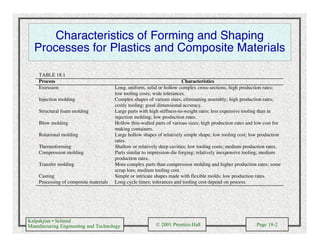
TABLE 18.1
Process Characteristics
Extrusion Long, uniform, solid or hollow complex cross-sections; high production rates;
low tooling costs; wide tolerances.
Injection molding Complex shapes of various sizes, eliminating assembly; high production rates;
costly tooling; good dimensional accuracy.
Structural foam molding Large parts with high stiffness-to-weight ratio; less expensive tooling than in
injection molding; low production rates.
Blow molding Hollow thin-walled parts of various sizes; high production rates and low cost for
making containers.
Rotational molding Large hollow shapes of relatively simple shape; low tooling cost; low production
rates.
Thermoforming Shallow or relatively deep cavities; low tooling costs; medium production rates.
Compression molding Parts similar to impression-die forging; relatively inexpensive tooling; medium
production rates.
Transfer molding More complex parts than compression molding and higher production rates; some
scrap loss; medium tooling cost.
Casting Simple or intricate shapes made with flexible molds; low production rates.
Processing of composite materials Long cycle times; tolerances and tooling cost depend on process.
Kalpakjian • Schmid
Manufacturing Engineering and Technology © 2001 Prentice-Hall Page 18-3
Forming
and
Shaping
Processes
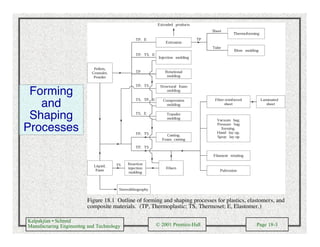
Figure 18.1 Outline of forming and shaping processes for plastics, elastomers, and
composite materials. (TP, Thermoplastic; TS, Thermoset; E, Elastomer.)
Kalpakjian • Schmid
Manufacturing Engineering and Technology © 2001 Prentice-Hall Page 18-4
Extruder
Figure 18.2 Schematic illustration of a typical extruder. Source: Encyclopedia of Polymer Science
and Engineering (2nd ed.). Copyright © 1985. Reprinted by permission of John Wiley & Sons, Inc.
Kalpakjian • Schmid
Manufacturing Engineering and Technology © 2001 Prentice-Hall Page 18-5
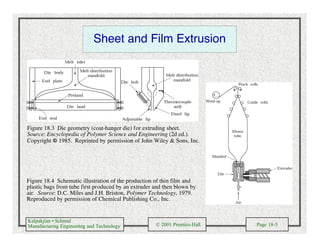
Sheet and Film Extrusion
Figure 18.3 Die geometry (coat-hanger die) for extruding sheet.
Source: Encyclopedia of Polymer Science and Engineering (2d ed.).
Copyright © 1985. Reprinted by permission of John Wiley & Sons, Inc.
Figure 18.4 Schematic illustration of the production of thin film and
plastic bags from tube first produced by an extruder and then blown by
air. Source: D.C. Miles and J.H. Briston, Polymer Technology, 1979.
Reproduced by permission of Chemical Publishing Co., Inc.
Kalpakjian • Schmid
Manufacturing Engineering and Technology © 2001 Prentice-Hall Page 18-6
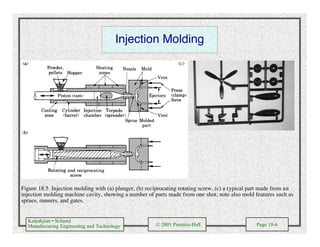
Injection Molding
(c)
Figure 18.5 Injection molding with (a) plunger, (b) reciprocating rotating screw, (c) a typical part made from an
injection molding machine cavity, showing a number of parts made from one shot; note also mold features such as
sprues, runners, and gates.
Kalpakjian • Schmid
Manufacturing Engineering and Technology © 2001 Prentice-Hall Page 18-7
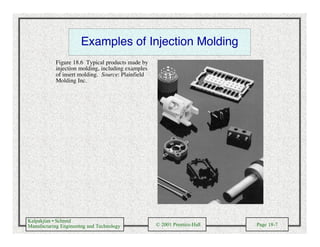
Examples of Injection Molding
Figure 18.6 Typical products made by
injection molding, including examples
of insert molding. Source: Plainfield
Molding Inc.
Kalpakjian • Schmid
Manufacturing Engineering and Technology © 2001 Prentice-Hall Page 18-8
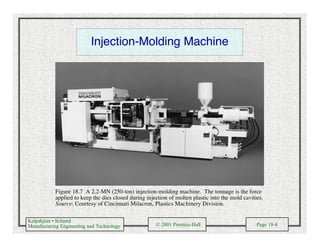
Injection-Molding Machine
Figure 18.7 A 2.2-MN (250-ton) injection-molding machine. The tonnage is the force
applied to keep the dies closed during injection of molten plastic into the mold cavities.
Source: Courtesy of Cincinnati Milacron, Plastics Machinery Division.
Kalpakjian • Schmid
Manufacturing Engineering and Technology © 2001 Prentice-Hall Page 18-9
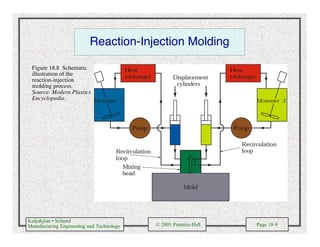
Reaction-Injection Molding
Figure 18.8 Schematic
illustration of the
reaction-injection
molding process.
Source: Modern Plastics
Encyclopedia.
Kalpakjian • Schmid
Manufacturing Engineering and Technology © 2001 Prentice-Hall Page 18-10
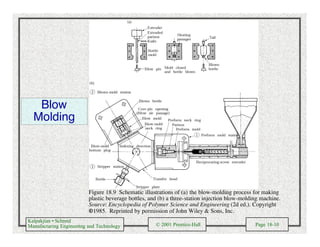
Blow
Molding
Figure 18.9 Schematic illustrations of (a) the blow-molding process for making
plastic beverage bottles, and (b) a three-station injection blow-molding machine.
Source: Encyclopedia of Polymer Science and Engineering (2d ed.). Copyright
©1985. Reprinted by permission of John Wiley & Sons, Inc.
Kalpakjian • Schmid
Manufacturing Engineering and Technology © 2001 Prentice-Hall Page 18-11
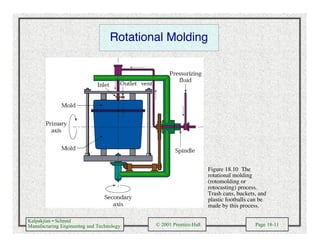
Rotational Molding
Figure 18.10 The
rotational molding
(rotomolding or
rotocasting) process.
Trash cans, buckets, and
plastic footballs can be
made by this process.
Kalpakjian • Schmid
Manufacturing Engineering and Technology © 2001 Prentice-Hall Page 18-12
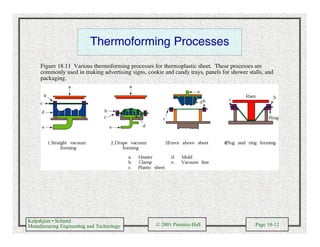
Thermoforming Processes
Figure 18.11 Various thermoforming processes for thermoplastic sheet. These processes are
commonly used in making advertising signs, cookie and candy trays, panels for shower stalls, and
packaging.
Kalpakjian • Schmid
Manufacturing Engineering and Technology © 2001 Prentice-Hall Page 18-13
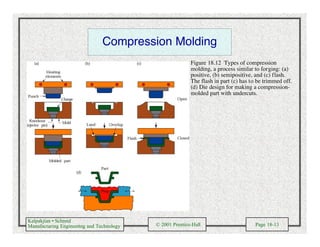
Compression Molding
Figure 18.12 Types of compression
molding, a process similar to forging: (a)
positive, (b) semipositive, and (c) flash.
The flash in part (c) has to be trimmed off.
(d) Die design for making a compression-
molded part with undercuts.
Kalpakjian • Schmid
Manufacturing Engineering and Technology © 2001 Prentice-Hall Page 18-14
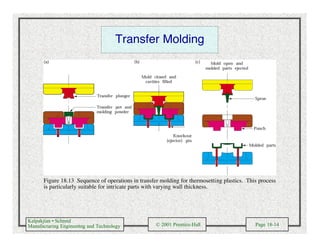
Transfer Molding
Figure 18.13 Sequence of operations in transfer molding for thermosetting plastics. This process
is particularly suitable for intricate parts with varying wall thickness.
Kalpakjian • Schmid
Manufacturing Engineering and Technology © 2001 Prentice-Hall Page 18-15
Casting, Potting and Encapsulation
Figure 18.14 Schematic
illustration of (a) casting, (b)
potting, (c) encapsulation of
plastics.
Kalpakjian • Schmid
Manufacturing Engineering and Technology © 2001 Prentice-Hall Page 18-16
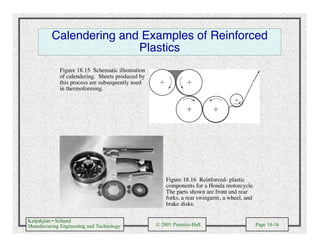
Calendering and Examples of Reinforced
Plastics
Figure 18.15 Schematic illustration
of calendering. Sheets produced by
this process are subsequently used
in thermoforming.
Figure 18.16 Reinforced- plastic
components for a Honda motorcycle.
The parts shown are front and rear
forks, a rear swingarm, a wheel, and
brake disks.
Kalpakjian • Schmid
Manufacturing Engineering and Technology © 2001 Prentice-Hall Page 18-17
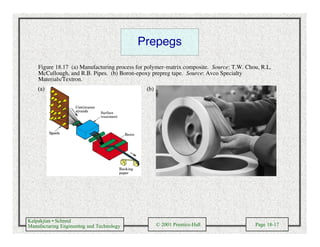
Prepegs
Figure 18.17 (a) Manufacturing process for polymer-matrix composite. Source: T.W. Chou, R.L.
McCullough, and R.B. Pipes. (b) Boron-epoxy prepreg tape. Source: Avco Specialty
Materials/Textron.
(b)(a)
Kalpakjian • Schmid
Manufacturing Engineering and Technology © 2001 Prentice-Hall Page 18-18
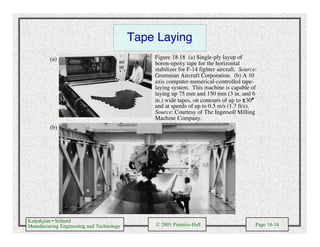
Tape Laying
Figure 18.18 (a) Single-ply layup of
boron-epoxy tape for the horizontal
stabilizer for F-14 fighter aircraft. Source:
Grumman Aircraft Corporation. (b) A 10
axis computer-numerical-controlled tape-
laying system. This machine is capable of
laying up 75 mm and 150 mm (3 in. and 6
in.) wide tapes, on contours of up to ±30°
and at speeds of up to 0.5 m/s (1.7 ft/s).
Source: Courtesy of The Ingersoll Milling
Machine Company.
(a)
(b)
Kalpakjian • Schmid
Manufacturing Engineering and Technology © 2001 Prentice-Hall Page 18-19
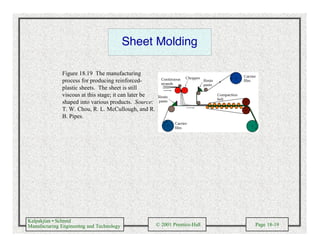
Sheet Molding
Figure 18.19 The manufacturing
process for producing reinforced-
plastic sheets. The sheet is still
viscous at this stage; it can later be
shaped into various products. Source:
T. W. Chou, R. L. McCullough, and R.
B. Pipes.
Kalpakjian • Schmid
Manufacturing Engineering and Technology © 2001 Prentice-Hall Page 18-20
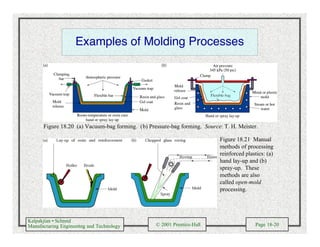
Examples of Molding Processes
Figure 18.20 (a) Vacuum-bag forming. (b) Pressure-bag forming. Source: T. H. Meister.
Figure 18.21 Manual
methods of processing
reinforced plastics: (a)
hand lay-up and (b)
spray-up. These
methods are also
called open-mold
processing.
Kalpakjian • Schmid
Manufacturing Engineering and Technology © 2001 Prentice-Hall Page 18-21
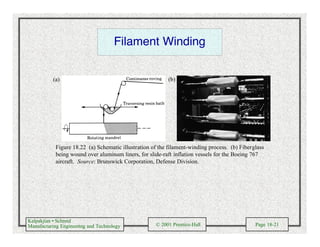
Filament Winding
(b)(a)
Figure 18.22 (a) Schematic illustration of the filament-winding process. (b) Fiberglass
being wound over aluminum liners, for slide-raft inflation vessels for the Boeing 767
aircraft. Source: Brunswick Corporation, Defense Division.
Kalpakjian • Schmid
Manufacturing Engineering and Technology © 2001 Prentice-Hall Page 18-22
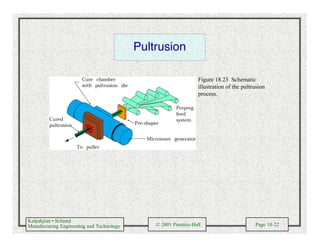
Pultrusion
Figure 18.23 Schematic
illustration of the pultrusion
process.
Kalpakjian • Schmid
Manufacturing Engineering and Technology © 2001 Prentice-Hall Page 18-23
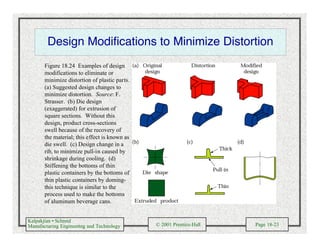
Design Modifications to Minimize Distortion
Figure 18.24 Examples of design
modifications to eliminate or
minimize distortion of plastic parts.
(a) Suggested design changes to
minimize distortion. Source: F.
Strasser. (b) Die design
(exaggerated) for extrusion of
square sections. Without this
design, product cross-sections
swell because of the recovery of
the material; this effect is known as
die swell. (c) Design change in a
rib, to minimize pull-in caused by
shrinkage during cooling. (d)
Stiffening the bottoms of thin
plastic containers by the bottoms of
thin plastic containers by doming-
this technique is similar to the
process used to make the bottoms
of aluminum beverage cans.
Kalpakjian • Schmid
Manufacturing Engineering and Technology © 2001 Prentice-Hall Page 18-24
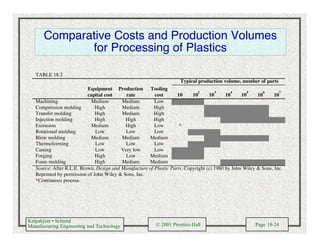
Comparative Costs and Production Volumes
for Processing of Plastics
TABLE 18.2
Typical production volume, number of parts
Equipment
capital cost
Production
rate
Tooling
cost 10 10
2
10
3
10
4
10
5
10
6
10
7
Machining Medium Medium Low
Compression molding High Medium High
Transfer molding High Medium High
Injection molding High High High
Extrusion Medium High Low *
Rotational molding Low Low Low
Blow molding Medium Medium Medium
Thermoforming Low Low Low
Casting Low Very low Low
Forging High Low Medium
Foam molding High Medium Medium
Source: After R.L.E. Brown, Design and Manufacture of Plastic Parts. Copyright (c) 1980 by John Wiley & Sons, Inc.
Reprinted by permission of John Wiley & Sons, Inc.
*Continuous process.
Kalpakjian • Schmid
Manufacturing Engineering and Technology © 2001 Prentice-Hall Page 18-25
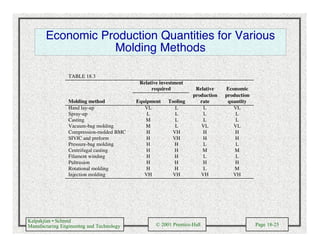
Economic Production Quantities for Various
Molding Methods
TABLE 18.3
Relative investment
required Relative Economic
Molding method Equipment Tooling
production
rate
production
quantity
Hand lay-up
Spray-up
Casting
Vacuum-bag molding
Compression-molded BMC
SIVIC and preform
Pressure-bag molding
Centrifugal casting
Filament winding
Pultrusion
Rotational molding
Injection molding
VL
L
M
M
H
H
H
H
H
H
H
VH
L
L
L
L
VH
VH
H
H
H
H
H
VH
L
L
L
VL
H
H
L
M
L
H
L
VH
VL
L
L
VL
H
H
L
M
L
H
M
VH

Forming and shaping plastics and composite materials

  • 1.
    Kalpakjian • Schmid ManufacturingEngineering and Technology © 2001 Prentice-Hall Page 18-1 CHAPTER 18 Forming and Shaping Plastics and Composite Materials
  • 2.
    Kalpakjian • Schmid ManufacturingEngineering and Technology © 2001 Prentice-Hall Page 18-2 Characteristics of Forming and Shaping Processes for Plastics and Composite Materials TABLE 18.1 Process Characteristics Extrusion Long, uniform, solid or hollow complex cross-sections; high production rates; low tooling costs; wide tolerances. Injection molding Complex shapes of various sizes, eliminating assembly; high production rates; costly tooling; good dimensional accuracy. Structural foam molding Large parts with high stiffness-to-weight ratio; less expensive tooling than in injection molding; low production rates. Blow molding Hollow thin-walled parts of various sizes; high production rates and low cost for making containers. Rotational molding Large hollow shapes of relatively simple shape; low tooling cost; low production rates. Thermoforming Shallow or relatively deep cavities; low tooling costs; medium production rates. Compression molding Parts similar to impression-die forging; relatively inexpensive tooling; medium production rates. Transfer molding More complex parts than compression molding and higher production rates; some scrap loss; medium tooling cost. Casting Simple or intricate shapes made with flexible molds; low production rates. Processing of composite materials Long cycle times; tolerances and tooling cost depend on process.
  • 3.
    Kalpakjian • Schmid ManufacturingEngineering and Technology © 2001 Prentice-Hall Page 18-3 Forming and Shaping Processes Figure 18.1 Outline of forming and shaping processes for plastics, elastomers, and composite materials. (TP, Thermoplastic; TS, Thermoset; E, Elastomer.)
  • 4.
    Kalpakjian • Schmid ManufacturingEngineering and Technology © 2001 Prentice-Hall Page 18-4 Extruder Figure 18.2 Schematic illustration of a typical extruder. Source: Encyclopedia of Polymer Science and Engineering (2nd ed.). Copyright © 1985. Reprinted by permission of John Wiley & Sons, Inc.
  • 5.
    Kalpakjian • Schmid ManufacturingEngineering and Technology © 2001 Prentice-Hall Page 18-5 Sheet and Film Extrusion Figure 18.3 Die geometry (coat-hanger die) for extruding sheet. Source: Encyclopedia of Polymer Science and Engineering (2d ed.). Copyright © 1985. Reprinted by permission of John Wiley & Sons, Inc. Figure 18.4 Schematic illustration of the production of thin film and plastic bags from tube first produced by an extruder and then blown by air. Source: D.C. Miles and J.H. Briston, Polymer Technology, 1979. Reproduced by permission of Chemical Publishing Co., Inc.
  • 6.
    Kalpakjian • Schmid ManufacturingEngineering and Technology © 2001 Prentice-Hall Page 18-6 Injection Molding (c) Figure 18.5 Injection molding with (a) plunger, (b) reciprocating rotating screw, (c) a typical part made from an injection molding machine cavity, showing a number of parts made from one shot; note also mold features such as sprues, runners, and gates.
  • 7.
    Kalpakjian • Schmid ManufacturingEngineering and Technology © 2001 Prentice-Hall Page 18-7 Examples of Injection Molding Figure 18.6 Typical products made by injection molding, including examples of insert molding. Source: Plainfield Molding Inc.
  • 8.
    Kalpakjian • Schmid ManufacturingEngineering and Technology © 2001 Prentice-Hall Page 18-8 Injection-Molding Machine Figure 18.7 A 2.2-MN (250-ton) injection-molding machine. The tonnage is the force applied to keep the dies closed during injection of molten plastic into the mold cavities. Source: Courtesy of Cincinnati Milacron, Plastics Machinery Division.
  • 9.
    Kalpakjian • Schmid ManufacturingEngineering and Technology © 2001 Prentice-Hall Page 18-9 Reaction-Injection Molding Figure 18.8 Schematic illustration of the reaction-injection molding process. Source: Modern Plastics Encyclopedia.
  • 10.
    Kalpakjian • Schmid ManufacturingEngineering and Technology © 2001 Prentice-Hall Page 18-10 Blow Molding Figure 18.9 Schematic illustrations of (a) the blow-molding process for making plastic beverage bottles, and (b) a three-station injection blow-molding machine. Source: Encyclopedia of Polymer Science and Engineering (2d ed.). Copyright ©1985. Reprinted by permission of John Wiley & Sons, Inc.
  • 11.
    Kalpakjian • Schmid ManufacturingEngineering and Technology © 2001 Prentice-Hall Page 18-11 Rotational Molding Figure 18.10 The rotational molding (rotomolding or rotocasting) process. Trash cans, buckets, and plastic footballs can be made by this process.
  • 12.
    Kalpakjian • Schmid ManufacturingEngineering and Technology © 2001 Prentice-Hall Page 18-12 Thermoforming Processes Figure 18.11 Various thermoforming processes for thermoplastic sheet. These processes are commonly used in making advertising signs, cookie and candy trays, panels for shower stalls, and packaging.
  • 13.
    Kalpakjian • Schmid ManufacturingEngineering and Technology © 2001 Prentice-Hall Page 18-13 Compression Molding Figure 18.12 Types of compression molding, a process similar to forging: (a) positive, (b) semipositive, and (c) flash. The flash in part (c) has to be trimmed off. (d) Die design for making a compression- molded part with undercuts.
  • 14.
    Kalpakjian • Schmid ManufacturingEngineering and Technology © 2001 Prentice-Hall Page 18-14 Transfer Molding Figure 18.13 Sequence of operations in transfer molding for thermosetting plastics. This process is particularly suitable for intricate parts with varying wall thickness.
  • 15.
    Kalpakjian • Schmid ManufacturingEngineering and Technology © 2001 Prentice-Hall Page 18-15 Casting, Potting and Encapsulation Figure 18.14 Schematic illustration of (a) casting, (b) potting, (c) encapsulation of plastics.
  • 16.
    Kalpakjian • Schmid ManufacturingEngineering and Technology © 2001 Prentice-Hall Page 18-16 Calendering and Examples of Reinforced Plastics Figure 18.15 Schematic illustration of calendering. Sheets produced by this process are subsequently used in thermoforming. Figure 18.16 Reinforced- plastic components for a Honda motorcycle. The parts shown are front and rear forks, a rear swingarm, a wheel, and brake disks.
  • 17.
    Kalpakjian • Schmid ManufacturingEngineering and Technology © 2001 Prentice-Hall Page 18-17 Prepegs Figure 18.17 (a) Manufacturing process for polymer-matrix composite. Source: T.W. Chou, R.L. McCullough, and R.B. Pipes. (b) Boron-epoxy prepreg tape. Source: Avco Specialty Materials/Textron. (b)(a)
  • 18.
    Kalpakjian • Schmid ManufacturingEngineering and Technology © 2001 Prentice-Hall Page 18-18 Tape Laying Figure 18.18 (a) Single-ply layup of boron-epoxy tape for the horizontal stabilizer for F-14 fighter aircraft. Source: Grumman Aircraft Corporation. (b) A 10 axis computer-numerical-controlled tape- laying system. This machine is capable of laying up 75 mm and 150 mm (3 in. and 6 in.) wide tapes, on contours of up to ±30° and at speeds of up to 0.5 m/s (1.7 ft/s). Source: Courtesy of The Ingersoll Milling Machine Company. (a) (b)
  • 19.
    Kalpakjian • Schmid ManufacturingEngineering and Technology © 2001 Prentice-Hall Page 18-19 Sheet Molding Figure 18.19 The manufacturing process for producing reinforced- plastic sheets. The sheet is still viscous at this stage; it can later be shaped into various products. Source: T. W. Chou, R. L. McCullough, and R. B. Pipes.
  • 20.
    Kalpakjian • Schmid ManufacturingEngineering and Technology © 2001 Prentice-Hall Page 18-20 Examples of Molding Processes Figure 18.20 (a) Vacuum-bag forming. (b) Pressure-bag forming. Source: T. H. Meister. Figure 18.21 Manual methods of processing reinforced plastics: (a) hand lay-up and (b) spray-up. These methods are also called open-mold processing.
  • 21.
    Kalpakjian • Schmid ManufacturingEngineering and Technology © 2001 Prentice-Hall Page 18-21 Filament Winding (b)(a) Figure 18.22 (a) Schematic illustration of the filament-winding process. (b) Fiberglass being wound over aluminum liners, for slide-raft inflation vessels for the Boeing 767 aircraft. Source: Brunswick Corporation, Defense Division.
  • 22.
    Kalpakjian • Schmid ManufacturingEngineering and Technology © 2001 Prentice-Hall Page 18-22 Pultrusion Figure 18.23 Schematic illustration of the pultrusion process.
  • 23.
    Kalpakjian • Schmid ManufacturingEngineering and Technology © 2001 Prentice-Hall Page 18-23 Design Modifications to Minimize Distortion Figure 18.24 Examples of design modifications to eliminate or minimize distortion of plastic parts. (a) Suggested design changes to minimize distortion. Source: F. Strasser. (b) Die design (exaggerated) for extrusion of square sections. Without this design, product cross-sections swell because of the recovery of the material; this effect is known as die swell. (c) Design change in a rib, to minimize pull-in caused by shrinkage during cooling. (d) Stiffening the bottoms of thin plastic containers by the bottoms of thin plastic containers by doming- this technique is similar to the process used to make the bottoms of aluminum beverage cans.
  • 24.
    Kalpakjian • Schmid ManufacturingEngineering and Technology © 2001 Prentice-Hall Page 18-24 Comparative Costs and Production Volumes for Processing of Plastics TABLE 18.2 Typical production volume, number of parts Equipment capital cost Production rate Tooling cost 10 10 2 10 3 10 4 10 5 10 6 10 7 Machining Medium Medium Low Compression molding High Medium High Transfer molding High Medium High Injection molding High High High Extrusion Medium High Low * Rotational molding Low Low Low Blow molding Medium Medium Medium Thermoforming Low Low Low Casting Low Very low Low Forging High Low Medium Foam molding High Medium Medium Source: After R.L.E. Brown, Design and Manufacture of Plastic Parts. Copyright (c) 1980 by John Wiley & Sons, Inc. Reprinted by permission of John Wiley & Sons, Inc. *Continuous process.
  • 25.
    Kalpakjian • Schmid ManufacturingEngineering and Technology © 2001 Prentice-Hall Page 18-25 Economic Production Quantities for Various Molding Methods TABLE 18.3 Relative investment required Relative Economic Molding method Equipment Tooling production rate production quantity Hand lay-up Spray-up Casting Vacuum-bag molding Compression-molded BMC SIVIC and preform Pressure-bag molding Centrifugal casting Filament winding Pultrusion Rotational molding Injection molding VL L M M H H H H H H H VH L L L L VH VH H H H H H VH L L L VL H H L M L H L VH VL L L VL H H L M L H M VH