FORMATION OF
HYDROPHOBIC
MATERIALS
PRESENTED BY GGSESTC BOKARO STEEL CITY
• Some of the common natural
Hydrophobic materials are
waxes, oil ,lotus leaf and fats
HYDROPHOBIC comes also from the Greek word
Hydro(water) and Phobic (fear) it refers to non polar substance
that repels a mass of water.
WHAT IS MEANT HYDROPHOBIC ?
The evaluation of hydrophobicity
is made through water contact
angle measurements.
A water droplet would be
spherical so the water contact
angle will be significantly high.
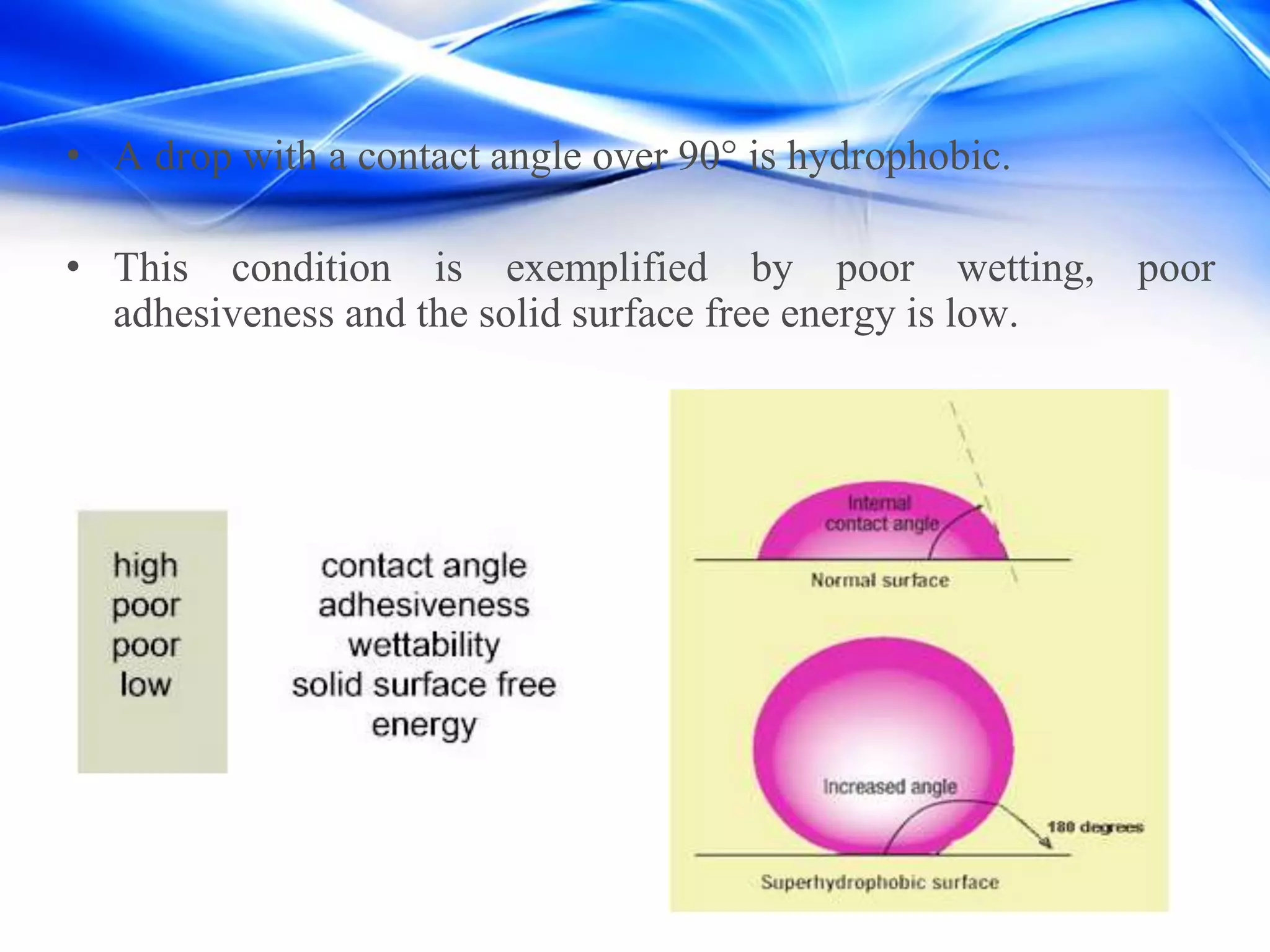
• A drop with a contact angle over 90° is hydrophobic.
• This condition is exemplified by poor wetting, poor
adhesiveness and the solid surface free energy is low.
(Hysteresis) loop
advancing contact angle
receding contact angle
1
2
contact
angle
volume
stick
slip
jump
Young's equation help to understand and describe the
interactions between the forces of cohesion and
adhesion and measure what is referred to as surface
energy.
www.ramehart.com/contactangle.htm
Understanding
nature: Physical
basis of the Lotus-
effect
The Lotus-effect (1):
Superhydrophobicity
 Microstructural
epidermal cells
Nanostructural wax-
crystals
20 μm
When depositing a water drop on a such solid .It can adopt at
least two type of configuration-
Quéré D , Reyssat M Phil.
Trans. R. Soc.
A 2008;366:1539-1556
conforming to the solid surface (Wenzel situation)
Sitting on the top of the posts((Cassie or fakir state)
Homogeneous
substrate, eq=110o
Suspended, ~160o Collapsed, ~140o
Suspended and collapsed drops
Rough surfaces
Wenzel: Liquid
completely fills the
grooves of the solid
Cassie and Baxter:
Liquid “sits” on the
surface roughness
www.me.umn.edu/~lixxx099/EFRI_CAES/Research/t
Hysteresis: 3 dimensions
macroscopic contact angle versus volume
A B
stick
jump
The Lotus-effect (2)
Self-cleaning(2)Water rolls off the surface
taking the contamination
along
VARIOUS METHOD ARE USED FOR THE PREPARATION
OF ROUGH SURFACES
• LAYER- BY- LAYER AND SELF
ASSEMBLY
• SOL-GEL PROCESSING
• ELECTRO-SPINING METHOD
• ELECTROCHEMICAL DEPOSITION
• CHEMICAL VAPOUR DEPOSITION
SUPERHYDROPHOBIC COATING CAN BE MADE FROM
MANY DIFFERENT MATERIALS
• MAGANESE OXIDE POLYSTYRENE (MNO2/PS)
• ZINC OXIDE POLYSTYRENE(ZNO/PS) NANO COMPOSITE
• SILICA NANO COATING
APPLICATIONS
1.A primary purpose of hydrophobic coatings such as
polytetrafluoroethylene(PTFE) or polyxylylene is to act as a
barrier against water commonly seen in automobiles
2.Used in iron and steel industry for anticorrosion .
3.Its is widely used in aerospace industry for providing anti-
icing coating on the surface of the aeroplane .
4.Hydrophobic self cleaning glasses are installed in traffic
sensor control unit.
5.Used in textile industry
.
CONCLUSION
• SURFACE ROUGHNESS
INCREASES HYDROPHOBICITY
• SEVERAL METHOD TO
SYNTHESIZE ARTIFICIAL
SUPERHYDRROPHOBIC
SURFACES
• IT IS RUSTLESS,DUSTLESS
FORMATION OF HYDROPHOBIC MATERIALS

FORMATION OF HYDROPHOBIC MATERIALS

  • 1.
  • 3.
    • Some ofthe common natural Hydrophobic materials are waxes, oil ,lotus leaf and fats HYDROPHOBIC comes also from the Greek word Hydro(water) and Phobic (fear) it refers to non polar substance that repels a mass of water. WHAT IS MEANT HYDROPHOBIC ? The evaluation of hydrophobicity is made through water contact angle measurements. A water droplet would be spherical so the water contact angle will be significantly high.
  • 4.
    • A dropwith a contact angle over 90° is hydrophobic. • This condition is exemplified by poor wetting, poor adhesiveness and the solid surface free energy is low.
  • 5.
    (Hysteresis) loop advancing contactangle receding contact angle 1 2 contact angle volume stick slip jump
  • 6.
    Young's equation helpto understand and describe the interactions between the forces of cohesion and adhesion and measure what is referred to as surface energy. www.ramehart.com/contactangle.htm
  • 7.
    Understanding nature: Physical basis ofthe Lotus- effect The Lotus-effect (1): Superhydrophobicity  Microstructural epidermal cells Nanostructural wax- crystals 20 μm
  • 8.
    When depositing awater drop on a such solid .It can adopt at least two type of configuration- Quéré D , Reyssat M Phil. Trans. R. Soc. A 2008;366:1539-1556 conforming to the solid surface (Wenzel situation) Sitting on the top of the posts((Cassie or fakir state)
  • 9.
    Homogeneous substrate, eq=110o Suspended, ~160oCollapsed, ~140o Suspended and collapsed drops
  • 10.
    Rough surfaces Wenzel: Liquid completelyfills the grooves of the solid Cassie and Baxter: Liquid “sits” on the surface roughness
  • 11.
  • 12.
    Hysteresis: 3 dimensions macroscopiccontact angle versus volume A B stick jump
  • 13.
    The Lotus-effect (2) Self-cleaning(2)Waterrolls off the surface taking the contamination along
  • 14.
    VARIOUS METHOD AREUSED FOR THE PREPARATION OF ROUGH SURFACES • LAYER- BY- LAYER AND SELF ASSEMBLY • SOL-GEL PROCESSING • ELECTRO-SPINING METHOD • ELECTROCHEMICAL DEPOSITION • CHEMICAL VAPOUR DEPOSITION
  • 15.
    SUPERHYDROPHOBIC COATING CANBE MADE FROM MANY DIFFERENT MATERIALS • MAGANESE OXIDE POLYSTYRENE (MNO2/PS) • ZINC OXIDE POLYSTYRENE(ZNO/PS) NANO COMPOSITE • SILICA NANO COATING
  • 16.
    APPLICATIONS 1.A primary purposeof hydrophobic coatings such as polytetrafluoroethylene(PTFE) or polyxylylene is to act as a barrier against water commonly seen in automobiles 2.Used in iron and steel industry for anticorrosion . 3.Its is widely used in aerospace industry for providing anti- icing coating on the surface of the aeroplane . 4.Hydrophobic self cleaning glasses are installed in traffic sensor control unit. 5.Used in textile industry .
  • 17.
    CONCLUSION • SURFACE ROUGHNESS INCREASESHYDROPHOBICITY • SEVERAL METHOD TO SYNTHESIZE ARTIFICIAL SUPERHYDRROPHOBIC SURFACES • IT IS RUSTLESS,DUSTLESS