Formal Jacket
SUBMITTED TO:
Mr. Amit Poghat
SUBMITTED BY:
Gargi Vatsa
Romisha Priyadarshini
Shivam Sagar
Tushar Tumsarkar
Shell fabric
Polyester viscose (PV)
Wool
Polyester wool (poly wool)
NOTE: There is no specified standardisation of what should be used or what not in jacket, one
can use interlining and lining as per the characteristic of the shell fabric and requirement of
the design.
In this presentation we will discuss what is preferred generally and their characteristics.
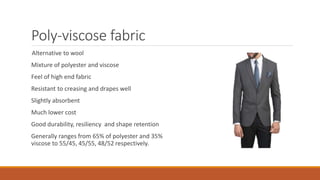
Poly-viscose fabric
Alternative to wool
Mixture of polyester and viscose
Feel of high end fabric
Resistant to creasing and drapes well
Slightly absorbent
Much lower cost
Good durability, resiliency and shape retention
Generally ranges from 65% of polyester and 35%
viscose to 55/45, 45/55, 48/52 respectively.
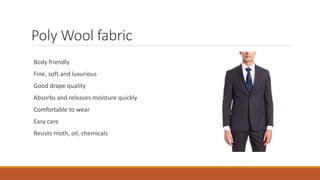
Poly Wool fabric
Body friendly
Fine, soft and luxurious
Good drape quality
Absorbs and releases moisture quickly
Comfortable to wear
Easy care
Resists moth, oil, chemicals
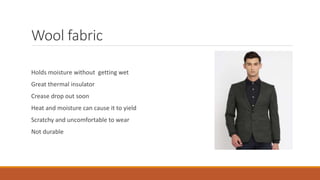
Wool fabric
Holds moisture without getting wet
Great thermal insulator
Crease drop out soon
Heat and moisture can cause it to yield
Scratchy and uncomfortable to wear
Not durable
Lining
Garment’s inner part under the bodice.
Lining allows the garment to drape and fold nicely, prevents it from sticking to the skin,
facilitates dressing by making the inside smoother
Protects the garment from inside, prevents stretching, insulates and reduces translucency of
thin fabrics.
Maintain the shape of the garment
Linings are available as knitted and woven
Linings are joined to main garment by sewing
Linings are widely used in jackets, coats, overcoats, pockets, pocket flaps, children wear, etc.
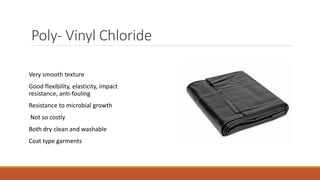
Poly- Vinyl Chloride
Very smooth texture
Good flexibility, elasticity, impact
resistance, anti-fouling
Resistance to microbial growth
Not so costly
Both dry clean and washable
Coat type garments
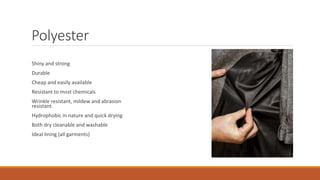
Polyester
Shiny and strong
Durable
Cheap and easily available
Resistant to most chemicals
Wrinkle resistant, mildew and abrasion
resistant.
Hydrophobic in nature and quick drying
Both dry cleanable and washable
Ideal lining (all garments)
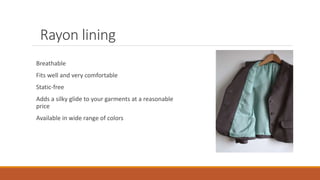
Rayon lining
Breathable
Fits well and very comfortable
Static-free
Adds a silky glide to your garments at a reasonable
price
Available in wide range of colors
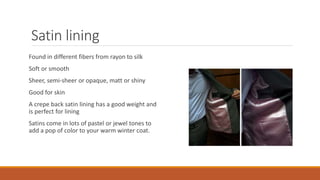
Satin lining
Found in different fibers from rayon to silk
Soft or smooth
Sheer, semi-sheer or opaque, matt or shiny
Good for skin
A crepe back satin lining has a good weight and
is perfect for lining
Satins come in lots of pastel or jewel tones to
add a pop of color to your warm winter coat.
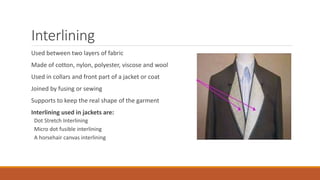
Interlining
Used between two layers of fabric
Made of cotton, nylon, polyester, viscose and wool
Used in collars and front part of a jacket or coat
Joined by fusing or sewing
Supports to keep the real shape of the garment
Interlining used in jackets are:
Dot Stretch Interlining
Micro dot fusible interlining
A horsehair canvas interlining
The traditional method of choosing a suitable interlining fabric is trial and error and/or by past
experience. In general, many problems in fusible interlining selection and use can he avoided if
manufacturers collaborate with their interlining suppliers in choosing the right fusible, and
conduct pre-production testing to ensure consistent performance.
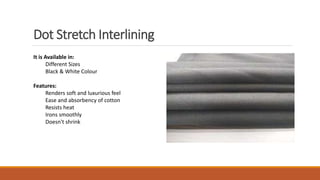
Dot Stretch Interlining
It is Available in:
Different Sizes
Black & White Colour
Features:
Renders soft and luxurious feel
Ease and absorbency of cotton
Resists heat
Irons smoothly
Doesn't shrink
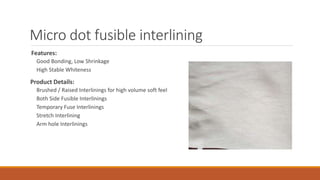
Micro dot fusible interlining
Features:
Good Bonding, Low Shrinkage
High Stable Whiteness
Product Details:
Brushed / Raised Interlinings for high volume soft feel
Both Side Fusible Interlinings
Temporary Fuse Interlinings
Stretch Interlining
Arm hole Interlinings
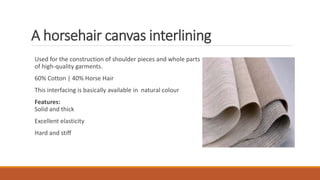
A horsehair canvas interlining
Used for the construction of shoulder pieces and whole parts
of high-quality garments.
60% Cotton | 40% Horse Hair
This interfacing is basically available in natural colour
Features:
Solid and thick
Excellent elasticity
Hard and stiff
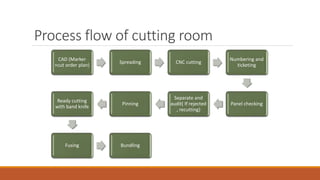
Process flow of cutting room
CAD (Marker
+cut order plan)
Spreading CNC cutting
Numbering and
ticketing
Panel checking
Separate and
audit( If rejected
, recutting)
Pinning
Ready cutting
with band knife
Fusing Bundling
Spreading
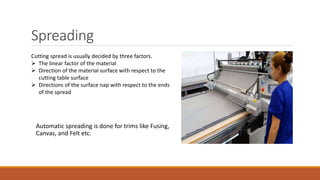
Automatic spreading is done for trims like Fusing,
Canvas, and Felt etc.
Cutting spread is usually decided by three factors.
 The linear factor of the material
 Direction of the material surface with respect to the
cutting table surface
 Directions of the surface nap with respect to the ends
of the spread
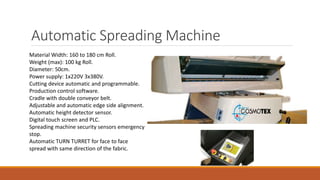
Automatic Spreading Machine
Material Width: 160 to 180 cm Roll.
Weight (max): 100 kg Roll.
Diameter: 50cm.
Power supply: 1x220V 3x380V.
Cutting device automatic and programmable.
Production control software.
Cradle with double conveyor belt.
Adjustable and automatic edge side alignment.
Automatic height detector sensor.
Digital touch screen and PLC.
Spreading machine security sensors emergency
stop.
Automatic TURN TURRET for face to face
spread with same direction of the fabric.
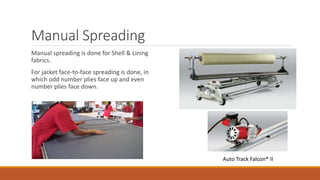
Manual Spreading
Manual spreading is done for Shell & Lining
fabrics.
For jacket face-to-face spreading is done, in
which odd number plies face up and even
number plies face down.
Auto Track Falcon® II
Table Widths
Available 48 – 144 in. (1.22m – 3.66m)
Motors
110v, 1ph, 50/60Hz 220v, 1ph, 50/60Hz Pneumatic Head Option: 60-90psi. Control box only: 110V, 1ph,
50/60Hz or 220V, 1ph, 50/60Hz
Horsepower 0.15hp 0.33hp (pneumatic head option)
Weight with Track &
Lifters 160 lbs. (72.60kg) 157 lbs. (71.20kg) – pneumatic head option
Standard Features Auto Start/Stop, Ply Counter, Speed Setting, Compression Foot, Remote Control
Options Auto Lifter, Foot Pedal, Material Alignment
Blade Size 4 in. (10.2cm)
Cutting Capacity 1.25 in. (3.20cm)
Auto Track Falcon® II
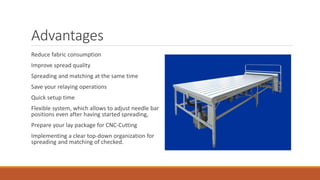
Veith laying Table
Has a lengthwise slotted aluminum top.
Pins are positioned inside the slots.
Needle can be fixed to a position by a brake mechanism
The needle bar positions can be adjusted, even when spreading and matching of the fabric has already
started. This will allow to overcome problems with too much tension or with too much looseness.
The height of the pins can be adjusted by turning a hand-wheel.
Each pin can be individually locked down, i.e. only the minimum needed quantity of pins have to be
used.
VEITH SYSTEM uses special manufactured pins with a rounded tip (ball point), The PIN TABLE can be
used in such a way that it becomes an abstract copy of the marker.
Advantages
Reduce fabric consumption
Improve spread quality
Spreading and matching at the same time
Save your relaying operations
Quick setup time
Flexible system, which allows to adjust needle bar
positions even after having started spreading,
Prepare your lay package for CNC-Cutting
Implementing a clear top-down organization for
spreading and matching of checked.
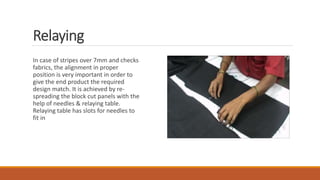
Relaying
In case of stripes over 7mm and checks
fabrics, the alignment in proper
position is very important in order to
give the end product the required
design match. It is achieved by re-
spreading the block cut panels with the
help of needles & relaying table.
Relaying table has slots for needles to
fit in
Cutting
Type of cutter Application
CNC (Automatic) Shell fabric and lining
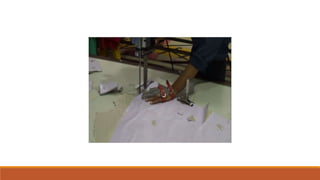
Band knife Recutting of block patterns
Straight knife Canvas, fusing, felt
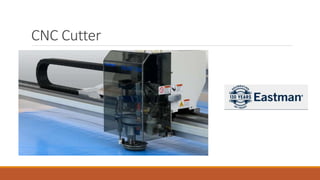
CNC Cutter
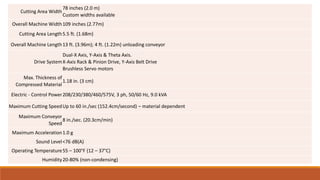
Cutting Area Width
78 inches (2.0 m)
Custom widths available
Overall Machine Width109 inches (2.77m)
Cutting Area Length5.5 ft. (1.68m)
Overall Machine Length13 ft. (3.96m); 4 ft. (1.22m) unloading conveyor
Drive System
Dual-X Axis, Y-Axis & Theta Axis.
X-Axis Rack & Pinion Drive, Y-Axis Belt Drive
Brushless Servo motors
Max. Thickness of
Compressed Material
1.18 in. (3 cm)
Electric - Control Power208/230/380/460/575V, 3 ph, 50/60 Hz, 9.0 kVA
Maximum Cutting SpeedUp to 60 in./sec (152.4cm/second) – material dependent
Maximum Conveyor
Speed
8 in./sec. (20.3cm/min)
Maximum Acceleration1.0 g
Sound Level<76 dB(A)
Operating Temperature55 – 100°F (12 – 37°C)
Humidity20-80% (non-condensing)
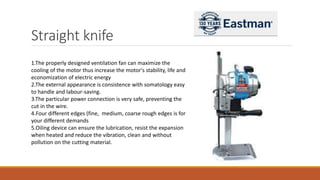
Straight knife
1.The properly designed ventilation fan can maximize the
cooling of the motor thus increase the motor's stability, life and
economization of electric energy
2.The external appearance is consistence with somatology easy
to handle and labour-saving.
3.The particular power connection is very safe, preventing the
cut in the wire.
4.Four different edges (fine, medium, coarse rough edges is for
your different demands
5.Oiling device can ensure the lubrication, resist the expansion
when heated and reduce the vibration, clean and without
pollution on the cutting material.
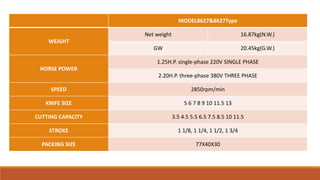
MODEL8627&8627Type
WEIGHT
Net weight 16.87kg(N.W.)
GW 20.45kg(G.W.)
HORSE POWER
1.25H.P. single-phase 220V SINGLE PHASE
2.20H.P. three-phase 380V THREE PHASE
SPEED 2850rpm/min
KNIFE SIZE 5 6 7 8 9 10 11.5 13
CUTTING CAPACITY 3.5 4.5 5.5 6.5 7.5 8.5 10 11.5
STROKE 1 1/8, 1 1/4, 1 1/2, 1 3/4
PACKING SIZE 77X40X30
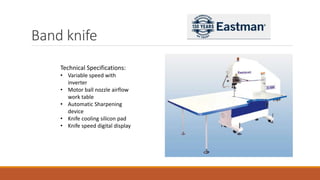
Band knife
Technical Specifications:
• Variable speed with
inverter
• Motor ball nozzle airflow
work table
• Automatic Sharpening
device
• Knife cooling silicon pad
• Knife speed digital display
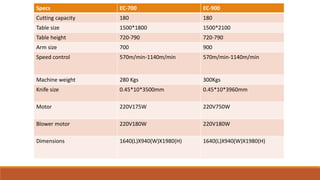
Specs EC-700 EC-900
Cutting capacity 180 180
Table size 1500*1800 1500*2100
Table height 720-790 720-790
Arm size 700 900
Speed control 570m/min-1140m/min 570m/min-1140m/min
Machine weight 280 Kgs 300Kgs
Knife size 0.45*10*3500mm 0.45*10*3960mm
Motor 220V175W 220V750W
Blower motor 220V180W 220V180W
Dimensions 1640(L)X940(W)X1980(H) 1640(L)X940(W)X1980(H)
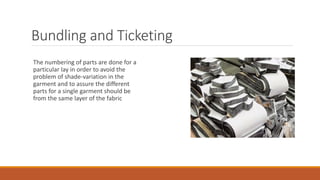
Bundling and Ticketing
The numbering of parts are done for a
particular lay in order to avoid the
problem of shade-variation in the
garment and to assure the different
parts for a single garment should be
from the same layer of the fabric
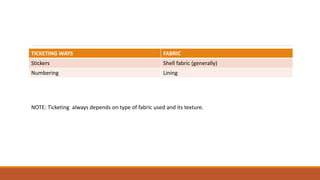
TICKETING WAYS FABRIC
Stickers Shell fabric (generally)
Numbering Lining
NOTE: Ticketing always depends on type of fabric used and its texture.
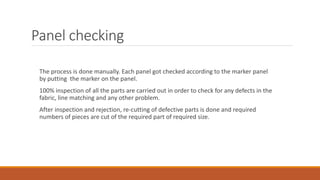
Panel checking
The process is done manually. Each panel got checked according to the marker panel
by putting the marker on the panel.
100% inspection of all the parts are carried out in order to check for any defects in the
fabric, line matching and any other problem.
After inspection and rejection, re-cutting of defective parts is done and required
numbers of pieces are cut of the required part of required size.
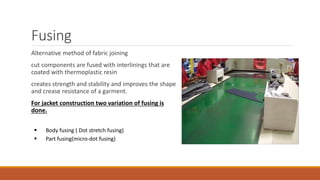
Fusing
Alternative method of fabric joining
cut components are fused with interlinings that are
coated with thermoplastic resin
creates strength and stability and improves the shape
and crease resistance of a garment.
For jacket construction two variation of fusing is
done.
 Body fusing ( Dot stretch fusing)
 Part fusing(micro-dot fusing)
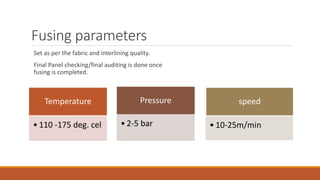
Fusing parameters
Set as per the fabric and interlining quality.
Final Panel checking/final auditing is done once
fusing is completed.
Temperature
• 110 -175 deg. cel
Pressure
• 2-5 bar
speed
• 10-25m/min
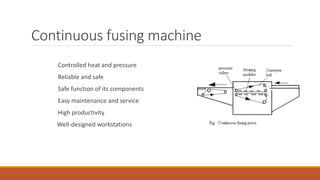
Continuous fusing machine
Controlled heat and pressure
Reliable and safe
Safe function of its components
Easy maintenance and service
High productivity
Well-designed workstations
Advantages of fusible interlinings
Stabilisation and control of crucial regions of the garment.
Strengthening of particular design features.
Maintaining the shape and contouring of the garment.
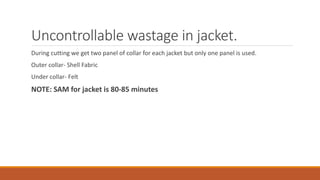
Uncontrollable wastage in jacket.
During cutting we get two panel of collar for each jacket but only one panel is used.
Outer collar- Shell Fabric
Under collar- Felt
NOTE: SAM for jacket is 80-85 minutes
THANK YOU!
Bibliography
carr and latham's technology of clothing manufacture
Apparel manufacturing analysis jacob solinger
https://www.eastmancuts.com/product/talon-25x/
https://www.eastmancuts.com/product/auto-track-falcon-ii/
http://www.cosmotex.net/fabric-spreading-machines-apolo-TT
https://www.linkedin.com/pulse/fusing-technology-garment-industry-rahul-krishnan
http://www.garmentsmerchandising.com/fusing-process-applied-apparel-industry/
http://www.komar.com/Departments/Garment-Manufacturers/Interlinings.aspx
https://www.eastman.com/Pages/Home.aspx
https://www.meyer-machines.com/home/
https://www.eastmancuts.com/product/blue-streak-ii-2/
https://www.iigm.in/Industries/Apparel/Cutting-Fusing/Manual-Cutting/Br/Eastman-USA/Pr/Band-Knives-EC-700N-EC-900N
http://www.garmentinterlining.com/suit-jacket-interlining.html

Formal jackets

  • 1.
    Formal Jacket SUBMITTED TO: Mr.Amit Poghat SUBMITTED BY: Gargi Vatsa Romisha Priyadarshini Shivam Sagar Tushar Tumsarkar
  • 2.
    Shell fabric Polyester viscose(PV) Wool Polyester wool (poly wool) NOTE: There is no specified standardisation of what should be used or what not in jacket, one can use interlining and lining as per the characteristic of the shell fabric and requirement of the design. In this presentation we will discuss what is preferred generally and their characteristics.
  • 3.
    Poly-viscose fabric Alternative towool Mixture of polyester and viscose Feel of high end fabric Resistant to creasing and drapes well Slightly absorbent Much lower cost Good durability, resiliency and shape retention Generally ranges from 65% of polyester and 35% viscose to 55/45, 45/55, 48/52 respectively.
  • 4.
    Poly Wool fabric Bodyfriendly Fine, soft and luxurious Good drape quality Absorbs and releases moisture quickly Comfortable to wear Easy care Resists moth, oil, chemicals
  • 5.
    Wool fabric Holds moisturewithout getting wet Great thermal insulator Crease drop out soon Heat and moisture can cause it to yield Scratchy and uncomfortable to wear Not durable
  • 6.
    Lining Garment’s inner partunder the bodice. Lining allows the garment to drape and fold nicely, prevents it from sticking to the skin, facilitates dressing by making the inside smoother Protects the garment from inside, prevents stretching, insulates and reduces translucency of thin fabrics. Maintain the shape of the garment Linings are available as knitted and woven Linings are joined to main garment by sewing Linings are widely used in jackets, coats, overcoats, pockets, pocket flaps, children wear, etc.
  • 7.
    Poly- Vinyl Chloride Verysmooth texture Good flexibility, elasticity, impact resistance, anti-fouling Resistance to microbial growth Not so costly Both dry clean and washable Coat type garments
  • 8.
    Polyester Shiny and strong Durable Cheapand easily available Resistant to most chemicals Wrinkle resistant, mildew and abrasion resistant. Hydrophobic in nature and quick drying Both dry cleanable and washable Ideal lining (all garments)
  • 9.
    Rayon lining Breathable Fits welland very comfortable Static-free Adds a silky glide to your garments at a reasonable price Available in wide range of colors
  • 10.
    Satin lining Found indifferent fibers from rayon to silk Soft or smooth Sheer, semi-sheer or opaque, matt or shiny Good for skin A crepe back satin lining has a good weight and is perfect for lining Satins come in lots of pastel or jewel tones to add a pop of color to your warm winter coat.
  • 11.
    Interlining Used between twolayers of fabric Made of cotton, nylon, polyester, viscose and wool Used in collars and front part of a jacket or coat Joined by fusing or sewing Supports to keep the real shape of the garment Interlining used in jackets are: Dot Stretch Interlining Micro dot fusible interlining A horsehair canvas interlining
  • 12.
    The traditional methodof choosing a suitable interlining fabric is trial and error and/or by past experience. In general, many problems in fusible interlining selection and use can he avoided if manufacturers collaborate with their interlining suppliers in choosing the right fusible, and conduct pre-production testing to ensure consistent performance.
  • 13.
    Dot Stretch Interlining Itis Available in: Different Sizes Black & White Colour Features: Renders soft and luxurious feel Ease and absorbency of cotton Resists heat Irons smoothly Doesn't shrink
  • 14.
    Micro dot fusibleinterlining Features: Good Bonding, Low Shrinkage High Stable Whiteness Product Details: Brushed / Raised Interlinings for high volume soft feel Both Side Fusible Interlinings Temporary Fuse Interlinings Stretch Interlining Arm hole Interlinings
  • 15.
    A horsehair canvasinterlining Used for the construction of shoulder pieces and whole parts of high-quality garments. 60% Cotton | 40% Horse Hair This interfacing is basically available in natural colour Features: Solid and thick Excellent elasticity Hard and stiff
  • 16.
    Process flow ofcutting room CAD (Marker +cut order plan) Spreading CNC cutting Numbering and ticketing Panel checking Separate and audit( If rejected , recutting) Pinning Ready cutting with band knife Fusing Bundling
  • 17.
    Spreading Automatic spreading isdone for trims like Fusing, Canvas, and Felt etc. Cutting spread is usually decided by three factors.  The linear factor of the material  Direction of the material surface with respect to the cutting table surface  Directions of the surface nap with respect to the ends of the spread
  • 18.
    Automatic Spreading Machine MaterialWidth: 160 to 180 cm Roll. Weight (max): 100 kg Roll. Diameter: 50cm. Power supply: 1x220V 3x380V. Cutting device automatic and programmable. Production control software. Cradle with double conveyor belt. Adjustable and automatic edge side alignment. Automatic height detector sensor. Digital touch screen and PLC. Spreading machine security sensors emergency stop. Automatic TURN TURRET for face to face spread with same direction of the fabric.
  • 19.
    Manual Spreading Manual spreadingis done for Shell & Lining fabrics. For jacket face-to-face spreading is done, in which odd number plies face up and even number plies face down. Auto Track Falcon® II
  • 20.
    Table Widths Available 48– 144 in. (1.22m – 3.66m) Motors 110v, 1ph, 50/60Hz 220v, 1ph, 50/60Hz Pneumatic Head Option: 60-90psi. Control box only: 110V, 1ph, 50/60Hz or 220V, 1ph, 50/60Hz Horsepower 0.15hp 0.33hp (pneumatic head option) Weight with Track & Lifters 160 lbs. (72.60kg) 157 lbs. (71.20kg) – pneumatic head option Standard Features Auto Start/Stop, Ply Counter, Speed Setting, Compression Foot, Remote Control Options Auto Lifter, Foot Pedal, Material Alignment Blade Size 4 in. (10.2cm) Cutting Capacity 1.25 in. (3.20cm) Auto Track Falcon® II
  • 21.
    Veith laying Table Hasa lengthwise slotted aluminum top. Pins are positioned inside the slots. Needle can be fixed to a position by a brake mechanism The needle bar positions can be adjusted, even when spreading and matching of the fabric has already started. This will allow to overcome problems with too much tension or with too much looseness. The height of the pins can be adjusted by turning a hand-wheel. Each pin can be individually locked down, i.e. only the minimum needed quantity of pins have to be used. VEITH SYSTEM uses special manufactured pins with a rounded tip (ball point), The PIN TABLE can be used in such a way that it becomes an abstract copy of the marker.
  • 22.
    Advantages Reduce fabric consumption Improvespread quality Spreading and matching at the same time Save your relaying operations Quick setup time Flexible system, which allows to adjust needle bar positions even after having started spreading, Prepare your lay package for CNC-Cutting Implementing a clear top-down organization for spreading and matching of checked.
  • 23.
    Relaying In case ofstripes over 7mm and checks fabrics, the alignment in proper position is very important in order to give the end product the required design match. It is achieved by re- spreading the block cut panels with the help of needles & relaying table. Relaying table has slots for needles to fit in
  • 24.
    Cutting Type of cutterApplication CNC (Automatic) Shell fabric and lining Band knife Recutting of block patterns Straight knife Canvas, fusing, felt
  • 25.
  • 26.
    Cutting Area Width 78inches (2.0 m) Custom widths available Overall Machine Width109 inches (2.77m) Cutting Area Length5.5 ft. (1.68m) Overall Machine Length13 ft. (3.96m); 4 ft. (1.22m) unloading conveyor Drive System Dual-X Axis, Y-Axis & Theta Axis. X-Axis Rack & Pinion Drive, Y-Axis Belt Drive Brushless Servo motors Max. Thickness of Compressed Material 1.18 in. (3 cm) Electric - Control Power208/230/380/460/575V, 3 ph, 50/60 Hz, 9.0 kVA Maximum Cutting SpeedUp to 60 in./sec (152.4cm/second) – material dependent Maximum Conveyor Speed 8 in./sec. (20.3cm/min) Maximum Acceleration1.0 g Sound Level<76 dB(A) Operating Temperature55 – 100°F (12 – 37°C) Humidity20-80% (non-condensing)
  • 27.
    Straight knife 1.The properlydesigned ventilation fan can maximize the cooling of the motor thus increase the motor's stability, life and economization of electric energy 2.The external appearance is consistence with somatology easy to handle and labour-saving. 3.The particular power connection is very safe, preventing the cut in the wire. 4.Four different edges (fine, medium, coarse rough edges is for your different demands 5.Oiling device can ensure the lubrication, resist the expansion when heated and reduce the vibration, clean and without pollution on the cutting material.
  • 28.
    MODEL8627&8627Type WEIGHT Net weight 16.87kg(N.W.) GW20.45kg(G.W.) HORSE POWER 1.25H.P. single-phase 220V SINGLE PHASE 2.20H.P. three-phase 380V THREE PHASE SPEED 2850rpm/min KNIFE SIZE 5 6 7 8 9 10 11.5 13 CUTTING CAPACITY 3.5 4.5 5.5 6.5 7.5 8.5 10 11.5 STROKE 1 1/8, 1 1/4, 1 1/2, 1 3/4 PACKING SIZE 77X40X30
  • 30.
    Band knife Technical Specifications: •Variable speed with inverter • Motor ball nozzle airflow work table • Automatic Sharpening device • Knife cooling silicon pad • Knife speed digital display
  • 31.
    Specs EC-700 EC-900 Cuttingcapacity 180 180 Table size 1500*1800 1500*2100 Table height 720-790 720-790 Arm size 700 900 Speed control 570m/min-1140m/min 570m/min-1140m/min Machine weight 280 Kgs 300Kgs Knife size 0.45*10*3500mm 0.45*10*3960mm Motor 220V175W 220V750W Blower motor 220V180W 220V180W Dimensions 1640(L)X940(W)X1980(H) 1640(L)X940(W)X1980(H)
  • 32.
    Bundling and Ticketing Thenumbering of parts are done for a particular lay in order to avoid the problem of shade-variation in the garment and to assure the different parts for a single garment should be from the same layer of the fabric
  • 33.
    TICKETING WAYS FABRIC StickersShell fabric (generally) Numbering Lining NOTE: Ticketing always depends on type of fabric used and its texture.
  • 34.
    Panel checking The processis done manually. Each panel got checked according to the marker panel by putting the marker on the panel. 100% inspection of all the parts are carried out in order to check for any defects in the fabric, line matching and any other problem. After inspection and rejection, re-cutting of defective parts is done and required numbers of pieces are cut of the required part of required size.
  • 35.
    Fusing Alternative method offabric joining cut components are fused with interlinings that are coated with thermoplastic resin creates strength and stability and improves the shape and crease resistance of a garment. For jacket construction two variation of fusing is done.  Body fusing ( Dot stretch fusing)  Part fusing(micro-dot fusing)
  • 36.
    Fusing parameters Set asper the fabric and interlining quality. Final Panel checking/final auditing is done once fusing is completed. Temperature • 110 -175 deg. cel Pressure • 2-5 bar speed • 10-25m/min
  • 37.
    Continuous fusing machine Controlledheat and pressure Reliable and safe Safe function of its components Easy maintenance and service High productivity Well-designed workstations
  • 38.
    Advantages of fusibleinterlinings Stabilisation and control of crucial regions of the garment. Strengthening of particular design features. Maintaining the shape and contouring of the garment.
  • 39.
    Uncontrollable wastage injacket. During cutting we get two panel of collar for each jacket but only one panel is used. Outer collar- Shell Fabric Under collar- Felt NOTE: SAM for jacket is 80-85 minutes
  • 40.
  • 41.
    Bibliography carr and latham'stechnology of clothing manufacture Apparel manufacturing analysis jacob solinger https://www.eastmancuts.com/product/talon-25x/ https://www.eastmancuts.com/product/auto-track-falcon-ii/ http://www.cosmotex.net/fabric-spreading-machines-apolo-TT https://www.linkedin.com/pulse/fusing-technology-garment-industry-rahul-krishnan http://www.garmentsmerchandising.com/fusing-process-applied-apparel-industry/ http://www.komar.com/Departments/Garment-Manufacturers/Interlinings.aspx https://www.eastman.com/Pages/Home.aspx https://www.meyer-machines.com/home/ https://www.eastmancuts.com/product/blue-streak-ii-2/ https://www.iigm.in/Industries/Apparel/Cutting-Fusing/Manual-Cutting/Br/Eastman-USA/Pr/Band-Knives-EC-700N-EC-900N http://www.garmentinterlining.com/suit-jacket-interlining.html

Editor's Notes

  • #4 The blend of polyester with viscose contributes durability, resiliency and shape retention. The wet strength of the resultant fabric is also improved, viscose provides absorbency, soft texture, and variety of color. A blend of polyester and viscose generally ranges from 65% of polyester and 35% viscose to 55/45, 45/55, 48/52 respectively. Among these blend levels, 48/52 and 65/35 are commonly used for school uniforms and suiting materials.