Zipper
Raghav garg
Shivam Kumar
Shivam Sagar
Acknowledgement
we would like to express our special thanks of gratitude to
my mentor Mr. AMIT KUMAR PHOGAT who gave me the
golden opportunity to do this wonderful project on the topic
ZIPPER MANUFACTURING, which also helped us in doing
a lot of Research and we came to know about so many
new things we am really thankful to them.
Secondly we would also like to thank our parents and
friends who helped us a lot in finalizing this project within
the limited time frame.
Contents
• History
• Types
• Classification
• Manufacturing
• Durability and Care
• Care
• Patents
• Bibliography
History
• Patented by Elias Howe in 1851, “automatic, continuous clothing
closure”
• Whitcomb Judson in 1893, marketed a "Clasp Locker".
• In 1913 Gideon Sundback came up with what would become the
modern zipper.
• increased the number of fastening elements from four per inch to 10
or 11.
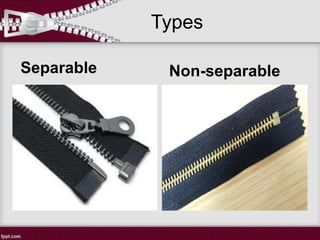
Types
Separable Non-separable
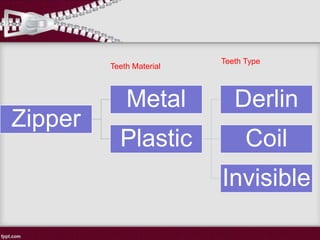
Zipper
Metal
Plastic
Derlin
Coil
Invisible
Teeth Material
Teeth Type
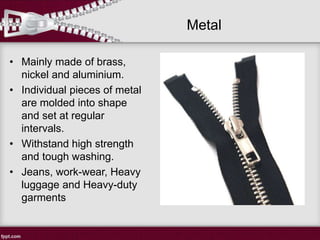
Metal
• Mainly made of brass,
nickel and aluminium.
• Individual pieces of metal
are molded into shape
and set at regular
intervals.
• Withstand high strength
and tough washing.
• Jeans, work-wear, Heavy
luggage and Heavy-duty
garments
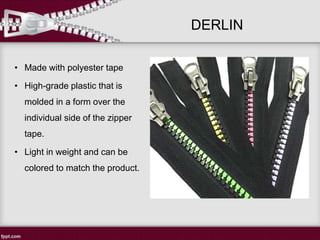
DERLIN
• Made with polyester tape
• High-grade plastic that is
molded in a form over the
individual side of the zipper
tape.
• Light in weight and can be
colored to match the product.
Coil
• Teeth/elements are made
from coiled monofilament
that was traditionally
nylon.
• It is used in anything from
apparel to luggage to
sporting goods and even
automobiles’
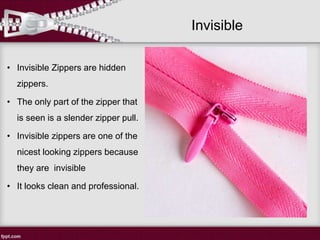
Invisible
• Invisible Zippers are hidden
zippers.
• The only part of the zipper that
is seen is a slender zipper pull.
• Invisible zippers are one of the
nicest looking zippers because
they are invisible
• It looks clean and professional.
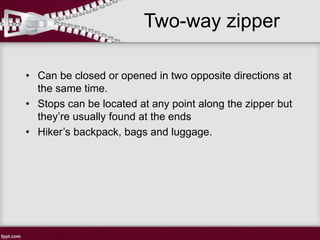
Two-way zipper
• Can be closed or opened in two opposite directions at
the same time.
• Stops can be located at any point along the zipper but
they’re usually found at the ends
• Hiker’s backpack, bags and luggage.
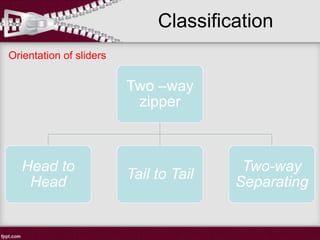
Two –way
zipper
Head to
Head
Tail to Tail
Two-way
Separating
Classification
Orientation of sliders
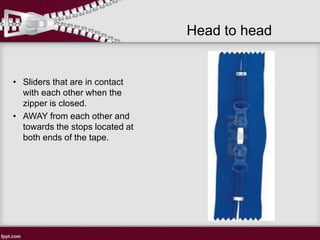
Head to head
• Sliders that are in contact
with each other when the
zipper is closed.
• AWAY from each other and
towards the stops located at
both ends of the tape.
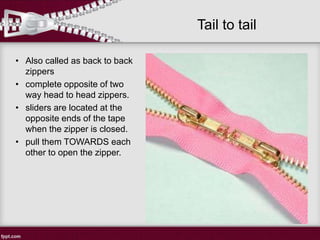
Tail to tail
• Also called as back to back
zippers
• complete opposite of two
way head to head zippers.
• sliders are located at the
opposite ends of the tape
when the zipper is closed.
• pull them TOWARDS each
other to open the zipper.
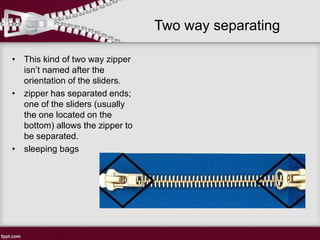
Two way separating
• This kind of two way zipper
isn’t named after the
orientation of the sliders.
• zipper has separated ends;
one of the sliders (usually
the one located on the
bottom) allows the zipper to
be separated.
• sleeping bags
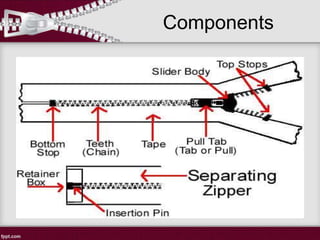
Components
Manufacturing Process
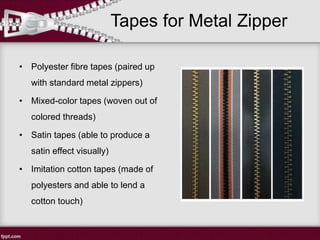
Tapes for Metal Zipper
• Polyester fibre tapes (paired up
with standard metal zippers)
• Mixed-color tapes (woven out of
colored threads)
• Satin tapes (able to produce a
satin effect visually)
• Imitation cotton tapes (made of
polyesters and able to lend a
cotton touch)
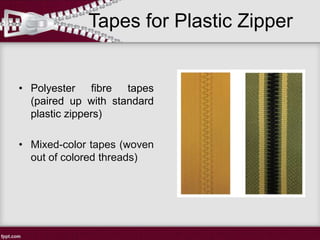
Tapes for Plastic Zipper
• Polyester fibre tapes
(paired up with standard
plastic zippers)
• Mixed-color tapes (woven
out of colored threads)
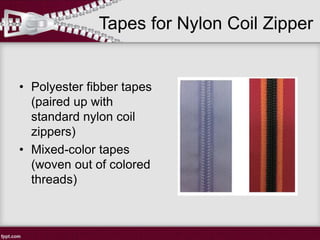
Tapes for Nylon Coil Zipper
• Polyester fibber tapes
(paired up with
standard nylon coil
zippers)
• Mixed-color tapes
(woven out of colored
threads)
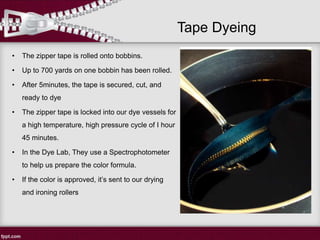
Tape Dyeing
• The zipper tape is rolled onto bobbins.
• Up to 700 yards on one bobbin has been rolled.
• After 5minutes, the tape is secured, cut, and
ready to dye
• The zipper tape is locked into our dye vessels for
a high temperature, high pressure cycle of I hour
45 minutes.
• In the Dye Lab, They use a Spectrophotometer
to help us prepare the color formula.
• If the color is approved, it’s sent to our drying
and ironing rollers
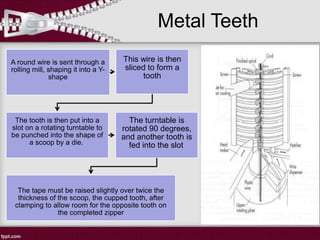
Metal Teeth
A round wire is sent through a
rolling mill, shaping it into a Y-
shape
This wire is then
sliced to form a
tooth
The tooth is then put into a
slot on a rotating turntable to
be punched into the shape of
a scoop by a die.
The turntable is
rotated 90 degrees,
and another tooth is
fed into the slot.
The tape must be raised slightly over twice the
thickness of the scoop, the cupped tooth, after
clamping to allow room for the opposite tooth on
the completed zipper
Plastic Teeth
• It involves notching a round plastic wire before feeding it between
two heated screws
• These screws, one rotating clockwise, the other counter-clockwise,
pull the plastic wire out to form loops.
• A head maker at the front of each loop then forms it into a round
knob
• The plastic spiral is cooled with air. This method requires that a left
spiral and right spiral be made simultaneously on two separate
machines so that the chains will match up on a finished zipper.
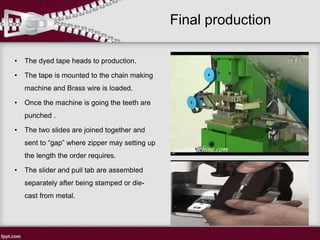
Final production
• The dyed tape heads to production.
• The tape is mounted to the chain making
machine and Brass wire is loaded.
• Once the machine is going the teeth are
punched .
• The two slides are joined together and
sent to “gap” where zipper may setting up
the length the order requires.
• The slider and pull tab are assembled
separately after being stamped or die-
cast from metal.
Durability and Repairs
• Most of the zipper fails to close due to a worn or bent slider not
being able to apply the necessary force to the sides of the teeth to
cause them to interlock.
• When the protective coating of the diecast slider has been worn off
by prolonged usage, the material can corrode.
The corrosion products are usually metal salts which can
accumulate and block the slider from moving.
• When this happens the salt can often be dissolved by submerging
the slider in vinegar or another mild acid. Otherwise the slider needs
to be removed and replaced.
Zipper care
• Open the zipper while pressing over the top.
• Do not press the zipper coil.
• Keep the zipper closed during washing and drying.
• Put on/ remove clothes in open condition of zippers.
• Do not try to force the slider up, in case it catches
thread.
• Secure the pin in the retainer box before pulling the
slider.
• Avoid direct heating on the teeth and slider at the time of
ironing.
Patent
• 25 November 1851 U.S. Patent 8,540 : "Improvement in Fastening
for Garments"
• 29 August 1893 U.S. Patent 504,037 : "Shoe fastening"
• 29 August 1893 U.S. Patent 504,038 : "Clasp Locker or Unlocker
for Shoes"
• 31 March 1896 U.S. Patent 557,207 : "Fastening for Shoes"
• 31 March 1896 U.S. Patent 557,208 : "Clasp-Locker for Shoes"
• 29 April 1913 U.S. Patent 1,060,378 : "Separable fastener"
(Gideon Sundback)
• 20 March 1917 U.S. Patent 1,219,881 : "Separable fastener"
(Gideon Sundback)
• 22 December 1936 U.S. Patent 2,065,250 : "Slider"
Bibliography
• https://www.thomasnet.com/articles/hardware/zipper-history
• https://www.ykkfastening.com/products/zipper/
• https://www.sbs-zipper.com/blog/everything-you-need-to-know-
about-two-way-zippers/
• https://www.ykkfastening.com/products/zipper/precaution_zipper/pre
caution_zip.html
• https://patents.google.com/?q=zipper&oq=zipper
• https://www.sbs-zipper.com/blog/a-simple-easy-guide-to-sbs-zipper-
tapes/

Zipper

  • 1.
  • 2.
    Acknowledgement we would liketo express our special thanks of gratitude to my mentor Mr. AMIT KUMAR PHOGAT who gave me the golden opportunity to do this wonderful project on the topic ZIPPER MANUFACTURING, which also helped us in doing a lot of Research and we came to know about so many new things we am really thankful to them. Secondly we would also like to thank our parents and friends who helped us a lot in finalizing this project within the limited time frame.
  • 3.
    Contents • History • Types •Classification • Manufacturing • Durability and Care • Care • Patents • Bibliography
  • 4.
    History • Patented byElias Howe in 1851, “automatic, continuous clothing closure” • Whitcomb Judson in 1893, marketed a "Clasp Locker". • In 1913 Gideon Sundback came up with what would become the modern zipper. • increased the number of fastening elements from four per inch to 10 or 11.
  • 5.
  • 6.
  • 7.
    Metal • Mainly madeof brass, nickel and aluminium. • Individual pieces of metal are molded into shape and set at regular intervals. • Withstand high strength and tough washing. • Jeans, work-wear, Heavy luggage and Heavy-duty garments
  • 8.
    DERLIN • Made withpolyester tape • High-grade plastic that is molded in a form over the individual side of the zipper tape. • Light in weight and can be colored to match the product.
  • 9.
    Coil • Teeth/elements aremade from coiled monofilament that was traditionally nylon. • It is used in anything from apparel to luggage to sporting goods and even automobiles’
  • 10.
    Invisible • Invisible Zippersare hidden zippers. • The only part of the zipper that is seen is a slender zipper pull. • Invisible zippers are one of the nicest looking zippers because they are invisible • It looks clean and professional.
  • 11.
    Two-way zipper • Canbe closed or opened in two opposite directions at the same time. • Stops can be located at any point along the zipper but they’re usually found at the ends • Hiker’s backpack, bags and luggage.
  • 12.
    Two –way zipper Head to Head Tailto Tail Two-way Separating Classification Orientation of sliders
  • 13.
    Head to head •Sliders that are in contact with each other when the zipper is closed. • AWAY from each other and towards the stops located at both ends of the tape.
  • 14.
    Tail to tail •Also called as back to back zippers • complete opposite of two way head to head zippers. • sliders are located at the opposite ends of the tape when the zipper is closed. • pull them TOWARDS each other to open the zipper.
  • 15.
    Two way separating •This kind of two way zipper isn’t named after the orientation of the sliders. • zipper has separated ends; one of the sliders (usually the one located on the bottom) allows the zipper to be separated. • sleeping bags
  • 16.
  • 17.
  • 18.
    Tapes for MetalZipper • Polyester fibre tapes (paired up with standard metal zippers) • Mixed-color tapes (woven out of colored threads) • Satin tapes (able to produce a satin effect visually) • Imitation cotton tapes (made of polyesters and able to lend a cotton touch)
  • 19.
    Tapes for PlasticZipper • Polyester fibre tapes (paired up with standard plastic zippers) • Mixed-color tapes (woven out of colored threads)
  • 20.
    Tapes for NylonCoil Zipper • Polyester fibber tapes (paired up with standard nylon coil zippers) • Mixed-color tapes (woven out of colored threads)
  • 21.
    Tape Dyeing • Thezipper tape is rolled onto bobbins. • Up to 700 yards on one bobbin has been rolled. • After 5minutes, the tape is secured, cut, and ready to dye • The zipper tape is locked into our dye vessels for a high temperature, high pressure cycle of I hour 45 minutes. • In the Dye Lab, They use a Spectrophotometer to help us prepare the color formula. • If the color is approved, it’s sent to our drying and ironing rollers
  • 22.
    Metal Teeth A roundwire is sent through a rolling mill, shaping it into a Y- shape This wire is then sliced to form a tooth The tooth is then put into a slot on a rotating turntable to be punched into the shape of a scoop by a die. The turntable is rotated 90 degrees, and another tooth is fed into the slot. The tape must be raised slightly over twice the thickness of the scoop, the cupped tooth, after clamping to allow room for the opposite tooth on the completed zipper
  • 23.
    Plastic Teeth • Itinvolves notching a round plastic wire before feeding it between two heated screws • These screws, one rotating clockwise, the other counter-clockwise, pull the plastic wire out to form loops. • A head maker at the front of each loop then forms it into a round knob • The plastic spiral is cooled with air. This method requires that a left spiral and right spiral be made simultaneously on two separate machines so that the chains will match up on a finished zipper.
  • 24.
    Final production • Thedyed tape heads to production. • The tape is mounted to the chain making machine and Brass wire is loaded. • Once the machine is going the teeth are punched . • The two slides are joined together and sent to “gap” where zipper may setting up the length the order requires. • The slider and pull tab are assembled separately after being stamped or die- cast from metal.
  • 25.
    Durability and Repairs •Most of the zipper fails to close due to a worn or bent slider not being able to apply the necessary force to the sides of the teeth to cause them to interlock. • When the protective coating of the diecast slider has been worn off by prolonged usage, the material can corrode. The corrosion products are usually metal salts which can accumulate and block the slider from moving. • When this happens the salt can often be dissolved by submerging the slider in vinegar or another mild acid. Otherwise the slider needs to be removed and replaced.
  • 26.
    Zipper care • Openthe zipper while pressing over the top. • Do not press the zipper coil. • Keep the zipper closed during washing and drying. • Put on/ remove clothes in open condition of zippers. • Do not try to force the slider up, in case it catches thread. • Secure the pin in the retainer box before pulling the slider. • Avoid direct heating on the teeth and slider at the time of ironing.
  • 27.
    Patent • 25 November1851 U.S. Patent 8,540 : "Improvement in Fastening for Garments" • 29 August 1893 U.S. Patent 504,037 : "Shoe fastening" • 29 August 1893 U.S. Patent 504,038 : "Clasp Locker or Unlocker for Shoes" • 31 March 1896 U.S. Patent 557,207 : "Fastening for Shoes" • 31 March 1896 U.S. Patent 557,208 : "Clasp-Locker for Shoes" • 29 April 1913 U.S. Patent 1,060,378 : "Separable fastener" (Gideon Sundback) • 20 March 1917 U.S. Patent 1,219,881 : "Separable fastener" (Gideon Sundback) • 22 December 1936 U.S. Patent 2,065,250 : "Slider"
  • 28.
    Bibliography • https://www.thomasnet.com/articles/hardware/zipper-history • https://www.ykkfastening.com/products/zipper/ •https://www.sbs-zipper.com/blog/everything-you-need-to-know- about-two-way-zippers/ • https://www.ykkfastening.com/products/zipper/precaution_zipper/pre caution_zip.html • https://patents.google.com/?q=zipper&oq=zipper • https://www.sbs-zipper.com/blog/a-simple-easy-guide-to-sbs-zipper- tapes/