How Do Organisms
Reproduce?
Reproduction in human beings
Presented by-
Acknowledgement
I would like to thank my teacher for helping me with this project. She/he allowed
me to work on this project. I would also want to thank my parents and friends who
helped me in finalizing this project within a limited time frame.
Index
● Introduction to
reproduction in human
● Adolescence and Puberty
● Requirements for sexual
reproduction
● Male reproductive system
● Female reproductive
system
Humans use sexual
mode of
reproduction.
Sexual reproduction-
When reproduction takes place as a result of fusion between
two gamets, one from each parent, it is called sexual
reproduction.
– This process of fusion between two gametes is called
fertilization.
– The formation of gametes involves exchange of
chromosomal (genetic) fragments between homologous
chromosomes causing genetic recombination which leads to
variation.
Adolescence & Puberty
Sexual reproduction needs sexual maturation which includes creation of the germ cells ie,
egg (ova) in the female and sperm in the male partner.Therefore, we human beings need to
have a well developed and matured male & female reproductive to reproduce.
Puberty is defined as the phase where a child’s physical and sexual characteristics start to
mature.
Adolescence is defined as the period between the onset of puberty and adulthood.
Changes which occur due to puberty-
● Hair growth in armpits and genital area between thighs.
● Thin hair start to appear on face,legs and arms.
● Skin becomes oily and pimples appear
● Girls start to menstruate and their breast size increases
● Boys start to have thick hair growth on their face(beard & moustache), penis occasionally
becomes erect and enlarged in either daydream or at night.
In humans reproduction happens as two
individuals join their bodies for internal
transfer of cells for fusion,just like
animals mate.But in humans special
organs are required for the sexual act,
such as penis when it becomes erect. In
the human’s the baby is carried in the
mother’s body for long time, and is
breastfed later.So the female
reproductive organs and breasts will
require to mature to accommodate to
these possibilities.
Male
Reproductive
System
The formation of male germ cell (sperms) takes place in the testes
(male reproductive organ)
– Actually a pair of testes are located inside scrotum situated
outside the abdominal cavity. -It is meant to keep relatively a low
temperature needed for the production of sperms by testes.
– Moreover testes release a male sex
Function of testosterone(hormone secreted by testes)):
1. Regulate the production of sperm
2. Brings about changes in appearance seen in boys at the time of
puberty.
The sperms formed are delivered through vas deferens to a tube
which unites with a tube coming from urinary bladder.Along the
path prostate gland and the seminal vesicles add their secretions
and the sperms are in the fluid now.This makes the transportation
of sperms easy and also provides nutrition.
Sperms are tiny bodies constituting genetic material and a long tail
which helps them to move towards the female germ-cell.The
sperms along with the secretion of prostate gland and seminal
vesicle, together constitute semen, which is released and made to
enter into the female genital tract during Copulation.
Female
Reproductive
System
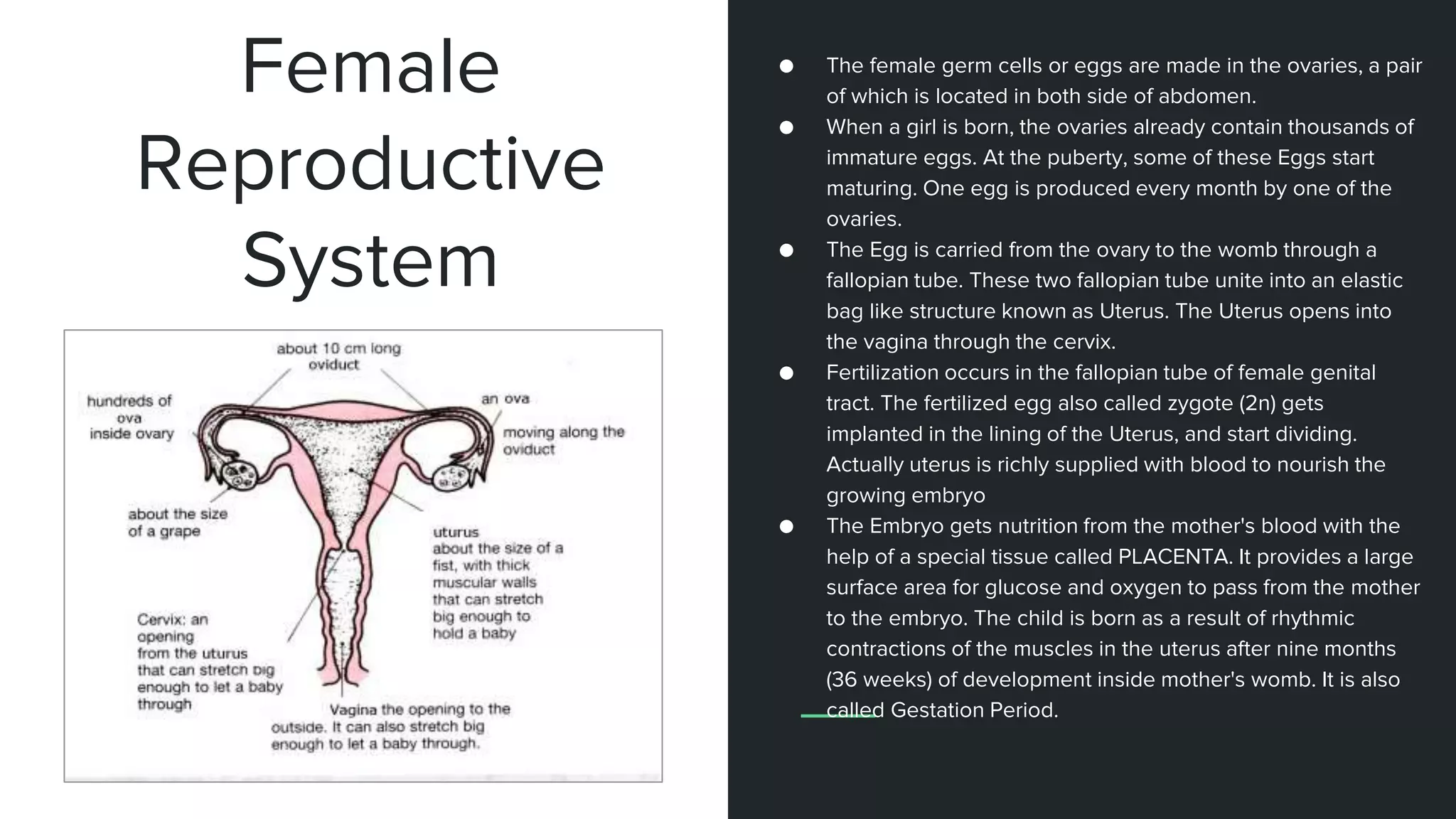
● The female germ cells or eggs are made in the ovaries, a pair
of which is located in both side of abdomen.
● When a girl is born, the ovaries already contain thousands of
immature eggs. At the puberty, some of these Eggs start
maturing. One egg is produced every month by one of the
ovaries.
● The Egg is carried from the ovary to the womb through a
fallopian tube. These two fallopian tube unite into an elastic
bag like structure known as Uterus. The Uterus opens into
the vagina through the cervix.
● Fertilization occurs in the fallopian tube of female genital
tract. The fertilized egg also called zygote (2n) gets
implanted in the lining of the Uterus, and start dividing.
Actually uterus is richly supplied with blood to nourish the
growing embryo
● The Embryo gets nutrition from the mother's blood with the
help of a special tissue called PLACENTA. It provides a large
surface area for glucose and oxygen to pass from the mother
to the embryo. The child is born as a result of rhythmic
contractions of the muscles in the uterus after nine months
(36 weeks) of development inside mother's womb. It is also
called Gestation Period.
Thank
You

NCERT Class 10 Ch.8 How Do Organisms Reproduce

  • 1.
    How Do Organisms Reproduce? Reproductionin human beings Presented by-
  • 2.
    Acknowledgement I would liketo thank my teacher for helping me with this project. She/he allowed me to work on this project. I would also want to thank my parents and friends who helped me in finalizing this project within a limited time frame.
  • 3.
    Index ● Introduction to reproductionin human ● Adolescence and Puberty ● Requirements for sexual reproduction ● Male reproductive system ● Female reproductive system
  • 4.
    Humans use sexual modeof reproduction. Sexual reproduction- When reproduction takes place as a result of fusion between two gamets, one from each parent, it is called sexual reproduction. – This process of fusion between two gametes is called fertilization. – The formation of gametes involves exchange of chromosomal (genetic) fragments between homologous chromosomes causing genetic recombination which leads to variation.
  • 5.
    Adolescence & Puberty Sexualreproduction needs sexual maturation which includes creation of the germ cells ie, egg (ova) in the female and sperm in the male partner.Therefore, we human beings need to have a well developed and matured male & female reproductive to reproduce. Puberty is defined as the phase where a child’s physical and sexual characteristics start to mature. Adolescence is defined as the period between the onset of puberty and adulthood. Changes which occur due to puberty- ● Hair growth in armpits and genital area between thighs. ● Thin hair start to appear on face,legs and arms. ● Skin becomes oily and pimples appear ● Girls start to menstruate and their breast size increases ● Boys start to have thick hair growth on their face(beard & moustache), penis occasionally becomes erect and enlarged in either daydream or at night.
  • 6.
    In humans reproductionhappens as two individuals join their bodies for internal transfer of cells for fusion,just like animals mate.But in humans special organs are required for the sexual act, such as penis when it becomes erect. In the human’s the baby is carried in the mother’s body for long time, and is breastfed later.So the female reproductive organs and breasts will require to mature to accommodate to these possibilities.
  • 7.
    Male Reproductive System The formation ofmale germ cell (sperms) takes place in the testes (male reproductive organ) – Actually a pair of testes are located inside scrotum situated outside the abdominal cavity. -It is meant to keep relatively a low temperature needed for the production of sperms by testes. – Moreover testes release a male sex Function of testosterone(hormone secreted by testes)): 1. Regulate the production of sperm 2. Brings about changes in appearance seen in boys at the time of puberty. The sperms formed are delivered through vas deferens to a tube which unites with a tube coming from urinary bladder.Along the path prostate gland and the seminal vesicles add their secretions and the sperms are in the fluid now.This makes the transportation of sperms easy and also provides nutrition. Sperms are tiny bodies constituting genetic material and a long tail which helps them to move towards the female germ-cell.The sperms along with the secretion of prostate gland and seminal vesicle, together constitute semen, which is released and made to enter into the female genital tract during Copulation.
  • 8.
    Female Reproductive System ● The femalegerm cells or eggs are made in the ovaries, a pair of which is located in both side of abdomen. ● When a girl is born, the ovaries already contain thousands of immature eggs. At the puberty, some of these Eggs start maturing. One egg is produced every month by one of the ovaries. ● The Egg is carried from the ovary to the womb through a fallopian tube. These two fallopian tube unite into an elastic bag like structure known as Uterus. The Uterus opens into the vagina through the cervix. ● Fertilization occurs in the fallopian tube of female genital tract. The fertilized egg also called zygote (2n) gets implanted in the lining of the Uterus, and start dividing. Actually uterus is richly supplied with blood to nourish the growing embryo ● The Embryo gets nutrition from the mother's blood with the help of a special tissue called PLACENTA. It provides a large surface area for glucose and oxygen to pass from the mother to the embryo. The child is born as a result of rhythmic contractions of the muscles in the uterus after nine months (36 weeks) of development inside mother's womb. It is also called Gestation Period.
  • 9.