SIMPLE MECHANISM
4399733744877692510_9812576d46a0bfbea1a3afaf2a7b88b224bafa48.blogspot.com/b/post-preview
Forging
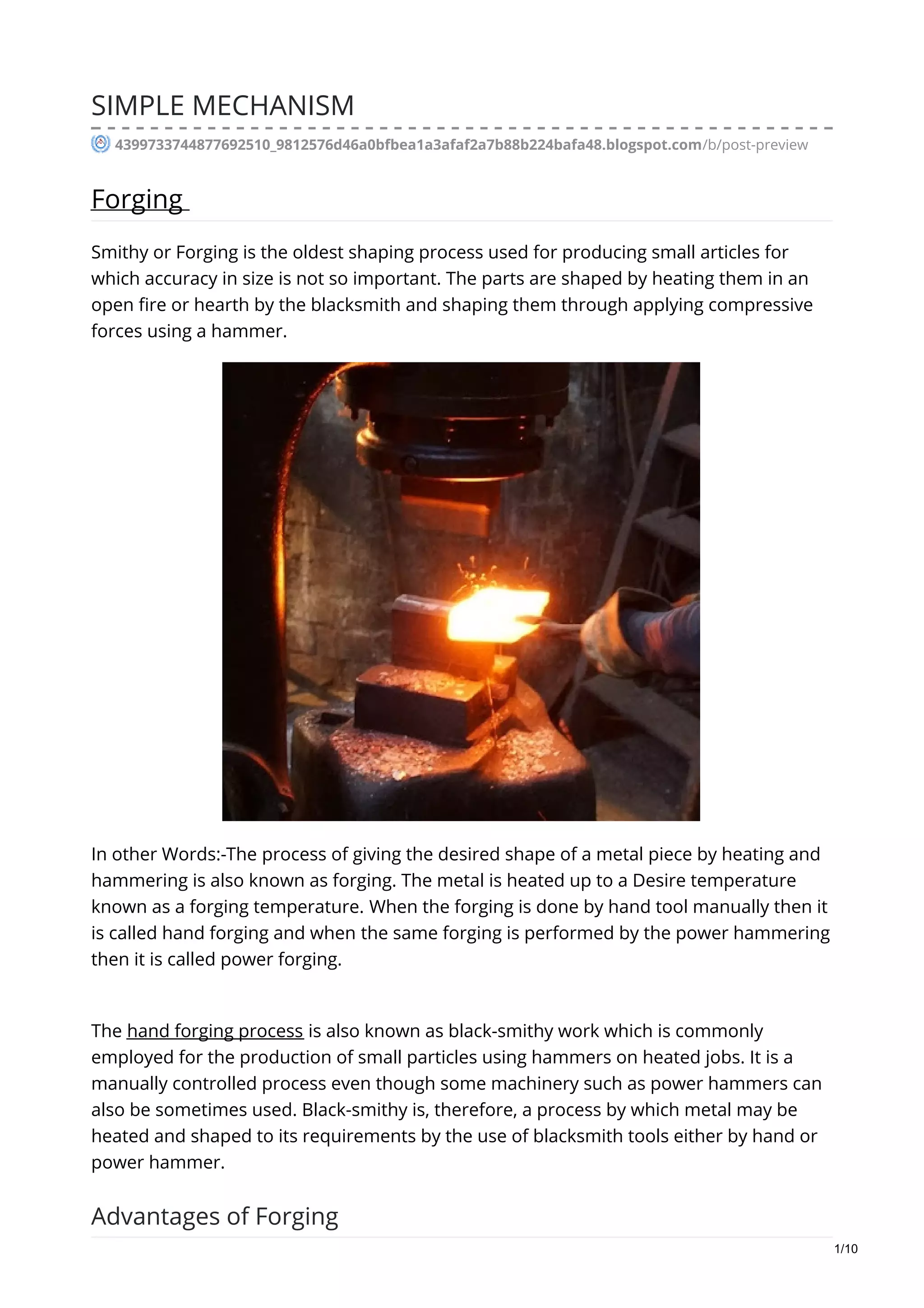
Smithy or Forging is the oldest shaping process used for producing small articles for
which accuracy in size is not so important. The parts are shaped by heating them in an
open fire or hearth by the blacksmith and shaping them through applying compressive
forces using a hammer.
In other Words:-The process of giving the desired shape of a metal piece by heating and
hammering is also known as forging. The metal is heated up to a Desire temperature
known as a forging temperature. When the forging is done by hand tool manually then it
is called hand forging and when the same forging is performed by the power hammering
then it is called power forging.
The hand forging process is also known as black-smithy work which is commonly
employed for the production of small particles using hammers on heated jobs. It is a
manually controlled process even though some machinery such as power hammers can
also be sometimes used. Black-smithy is, therefore, a process by which metal may be
heated and shaped to its requirements by the use of blacksmith tools either by hand or
power hammer.
Advantages of Forging
1/10
1. It refines the structure of the metal.
2. It increases strength.
3. It saves time, material and labor.
Forging Tools and Equipment
1.Furnace or Hearth 2. Anvil
3.Hammers 4.Tongs
5.Chisels 6.Punches and Drifts
7. Flatters 8.Swage Block
9.Set Hammer 10.Bench Vice
Furnace or Hearth
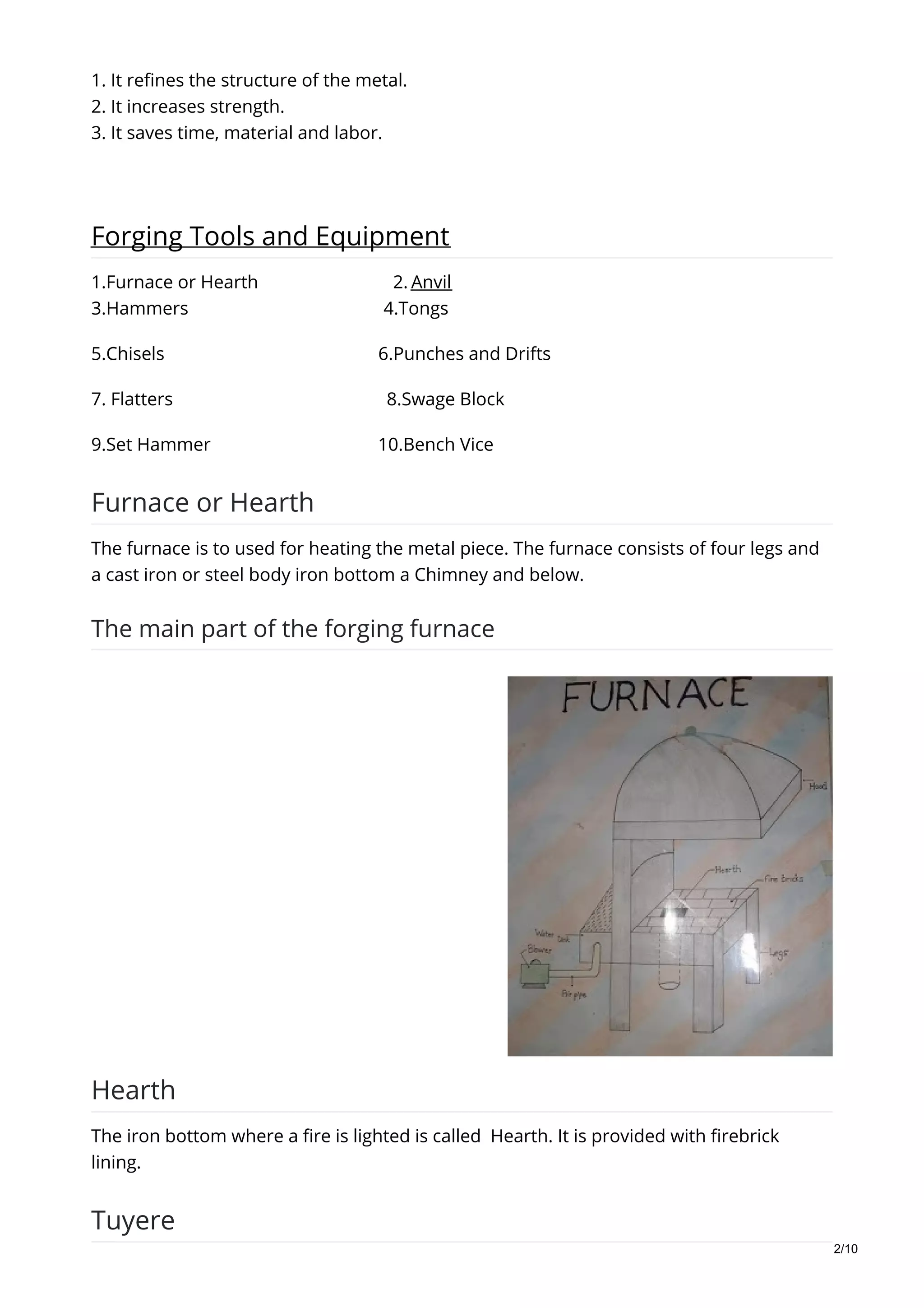
The furnace is to used for heating the metal piece. The furnace consists of four legs and
a cast iron or steel body iron bottom a Chimney and below.
The main part of the forging furnace
Hearth
The iron bottom where a fire is lighted is called Hearth. It is provided with firebrick
lining.
Tuyere
2/10
A pipe coming from the bottom or rear of the earth is known as Tuyere. It is used to
supply the air at high pressure to the furnace.
Hood
The upper part of the Furnace is called a hood. it is made up of mild steel with the
firebrick inside it.
Chimney
The chimney is a fit on the upper end of the Hood. it is used for the purpose of easy
escaping of exhausting gases and smoke.
Fuel used for Forging
1.Solid fuel ⇒ Coal, Coke, and charcoal
2.Liquid ⇒ Oil
3.Gases⇒ Gases
The fuel is commonly used for forging steam coal, coke, and charcoal.
A good fuel should be able to maintain the required forging temperature. It should be
cheap and easily available. It should be easy to fire. It should not proceed with excess
smoke and fly ash lightning the Fire.
The method for lightened the Fire in the Furnace
The space inside the hearth is filled with softwood. While burning this wood fresh Coke is
placed on the one side of the earth. It is slowly brought to the center of the hearth
regulating the air supply from the blower. When the Coke catches fire the whole space is
filled with Coke. The fire should be as deep as possible inside the center of the hearth.
Forging tools name with the images
Anvil
3/10
Anvil
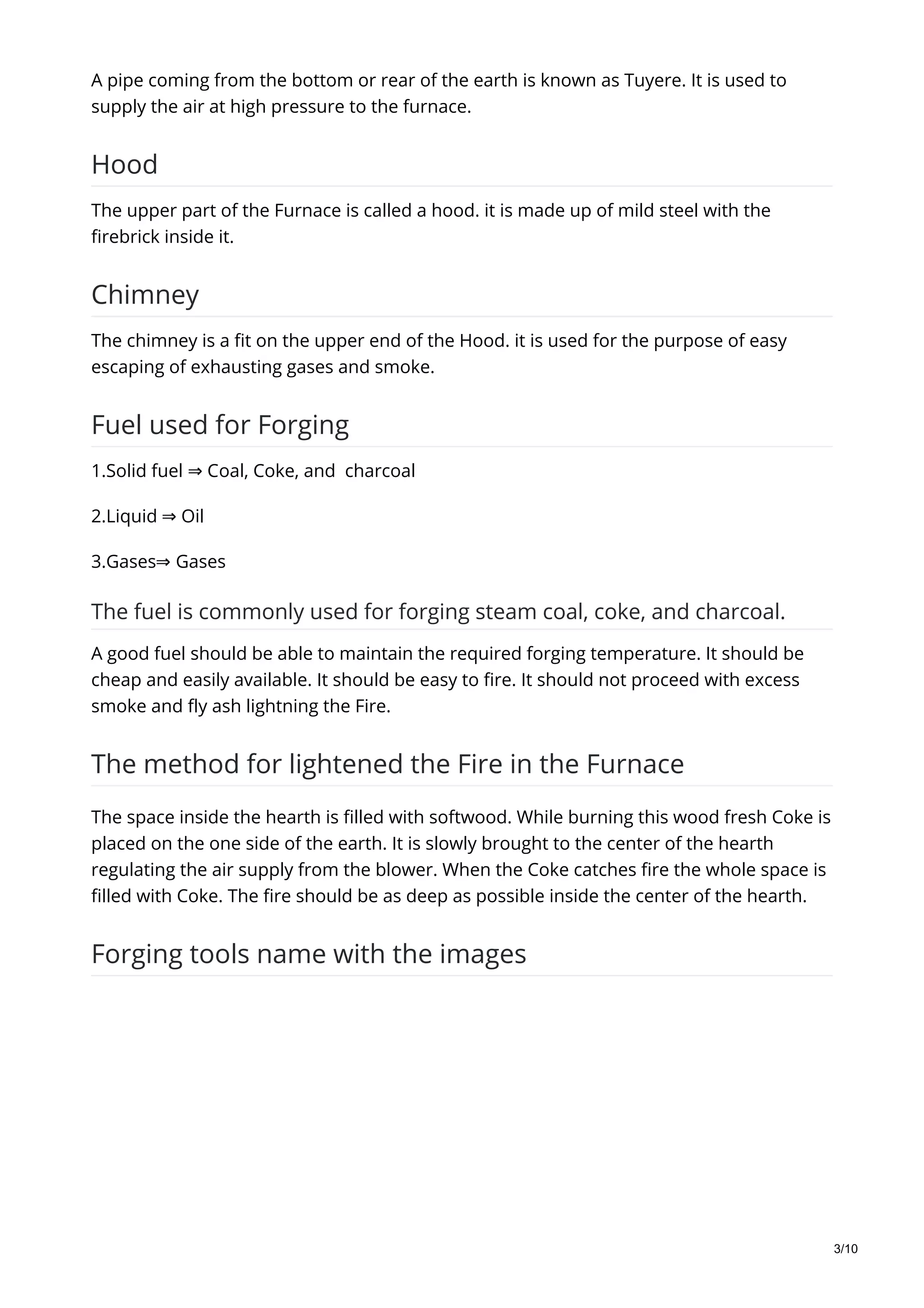
Anvil is the sporting device that is a
sport the material when hammering is
performed on it. A block on which
forging work is done is called Anvil. It
is made up of steel, cast iron or
wrought iron. It acts as a Sporting
device for all forging operation. The
weight of the anvil varies from 100 kg
to 150 kg. It is available in many size
and shape
Hammer
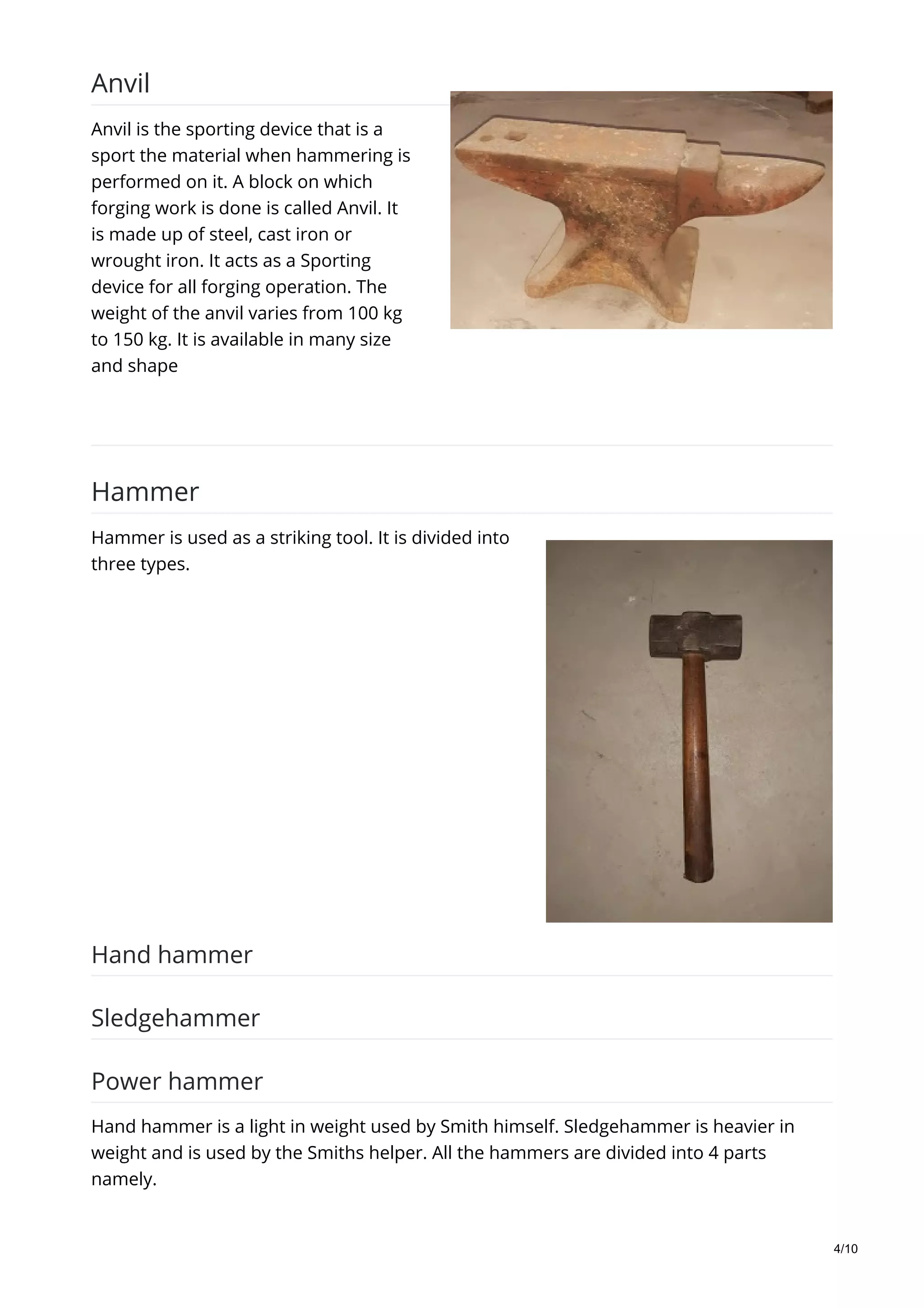
Hammer is used as a striking tool. It is divided into
three types.
Hand hammer
Sledgehammer
Power hammer
Hand hammer is a light in weight used by Smith himself. Sledgehammer is heavier in
weight and is used by the Smiths helper. All the hammers are divided into 4 parts
namely.
4/10
1. Pean 2. Eye 3. Cheeks 4. Face.
Hand hammer of four types based on the shape of pean if the pean is along the axis of
the handle then it is straight peen hammer. When the pean is across the axis of the
handle then it is called cross pean hammer. In case the shape of the pean in the same as
the shape of the face then it is double-ended. If the shape of the pean is spherical then it
is a ball-peen hammer. The weight of the hand hammer varies from 1 kg to 2 kg and that
of the sledgehammer is 3 kg to 8 kg. When the quantity of jobs is to be produced is more
the power hammer is used. Commonly used Hammer:-
Spring hammer
Pneumatic hammer
Steam hammer
Drop hammer
The power hammer is generally driven by electrical power. The job to be produced is
placed on the anvil of the hammer with the help of the liver the weight is allowed to fall
on the job. The factor which influences the working of the hammer.Size and shape of
jobs
The falling weight of the hammer
The height of the falling weight
Tongs
5/10
Tongs are used for holding and turning hot metal
pieces depending upon their uses, tongs are
classified into many types. All types of tongs have a
similar construction to accept the mouth. Tongs
have two legs shifted from a suitable place these
are made up of mild steel. Various types of tong
used in forging shop it is made in two pieces and
both of the pieces are joined by hinges. The length
of the tong varies from 12" to 18".It is classified
based on the shape of the mouth of the tongs.
Chisel
Chisel is used for cutting a metal piece in hot and cold states. Chisel is divided following
categories.
This is also a cutting tool that is used on the workpiece as a cold or hot condition. These
are made up of high carbon steel. It is generally 6 inches to 8 inches long. The top is
flattened and sharp cutting edge made on the bottom side. Chisels are classified on the
basis of the shape and width of the cutting edge. Commonly used forms of chisel are flat,
cross-cut, half-round and diamond point chisel.
Cutting angle of chisels
For hard material 70-75 degree
For medium-hard material 60 degree
For soft material 40 degree
6/10
Flat Chisel
This chisel is flat in shape at the end side. The flat chisel is used for chipping a large
surface. This chisel is used at room temperature so it is called a cold chisel.
Crosscut chisel
The crosscut chisel is narrow chisel and thickness of the
cutting edge is broader than a flat chisel. The flat chisel
is used for cutting grooves.
Half-round chisel
The half-round chisel is used to cut oil grooves in
the bushes and also clearing small round
corners.
7/10
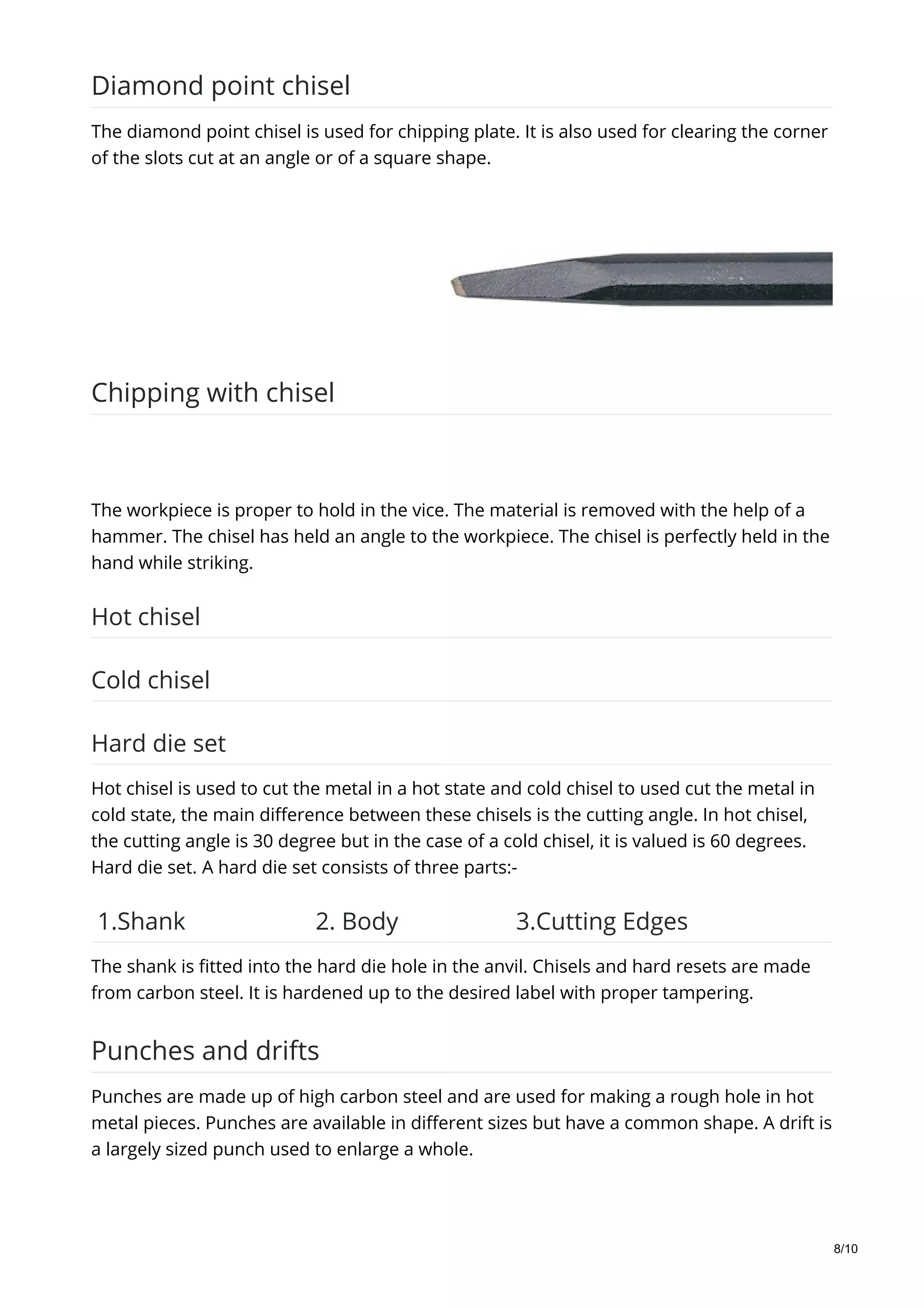
Diamond point chisel
The diamond point chisel is used for chipping plate. It is also used for clearing the corner
of the slots cut at an angle or of a square shape.
Chipping with chisel
The workpiece is proper to hold in the vice. The material is removed with the help of a
hammer. The chisel has held an angle to the workpiece. The chisel is perfectly held in the
hand while striking.
Hot chisel
Cold chisel
Hard die set
Hot chisel is used to cut the metal in a hot state and cold chisel to used cut the metal in
cold state, the main difference between these chisels is the cutting angle. In hot chisel,
the cutting angle is 30 degree but in the case of a cold chisel, it is valued is 60 degrees.
Hard die set. A hard die set consists of three parts:-
1.Shank 2. Body 3.Cutting Edges
The shank is fitted into the hard die hole in the anvil. Chisels and hard resets are made
from carbon steel. It is hardened up to the desired label with proper tampering.
Punches and drifts
Punches are made up of high carbon steel and are used for making a rough hole in hot
metal pieces. Punches are available in different sizes but have a common shape. A drift is
a largely sized punch used to enlarge a whole.
Flatter
8/10
Flatter
Flatter, as indicated by the name flatter, is used to flattening
the workpiece. It is held in a thin wire. The material of the
flatter is high Carbon Steel. The body of the flatter is squared
in cross-section.
Fuller
Fuller is used for grooving and drawing. These are made in two-piece lower and upper
parts. The lower part is mounted on the Anvil and the upper part is held in hand from a
wire handle. These are made up of high carbon steel and medium carbon steel. These
are used for hot work only.
Swages
Swages are used for giving various shapes to the workpieces. These are made up of high
carbon steel and used in two pieces as in the case of the fuller.
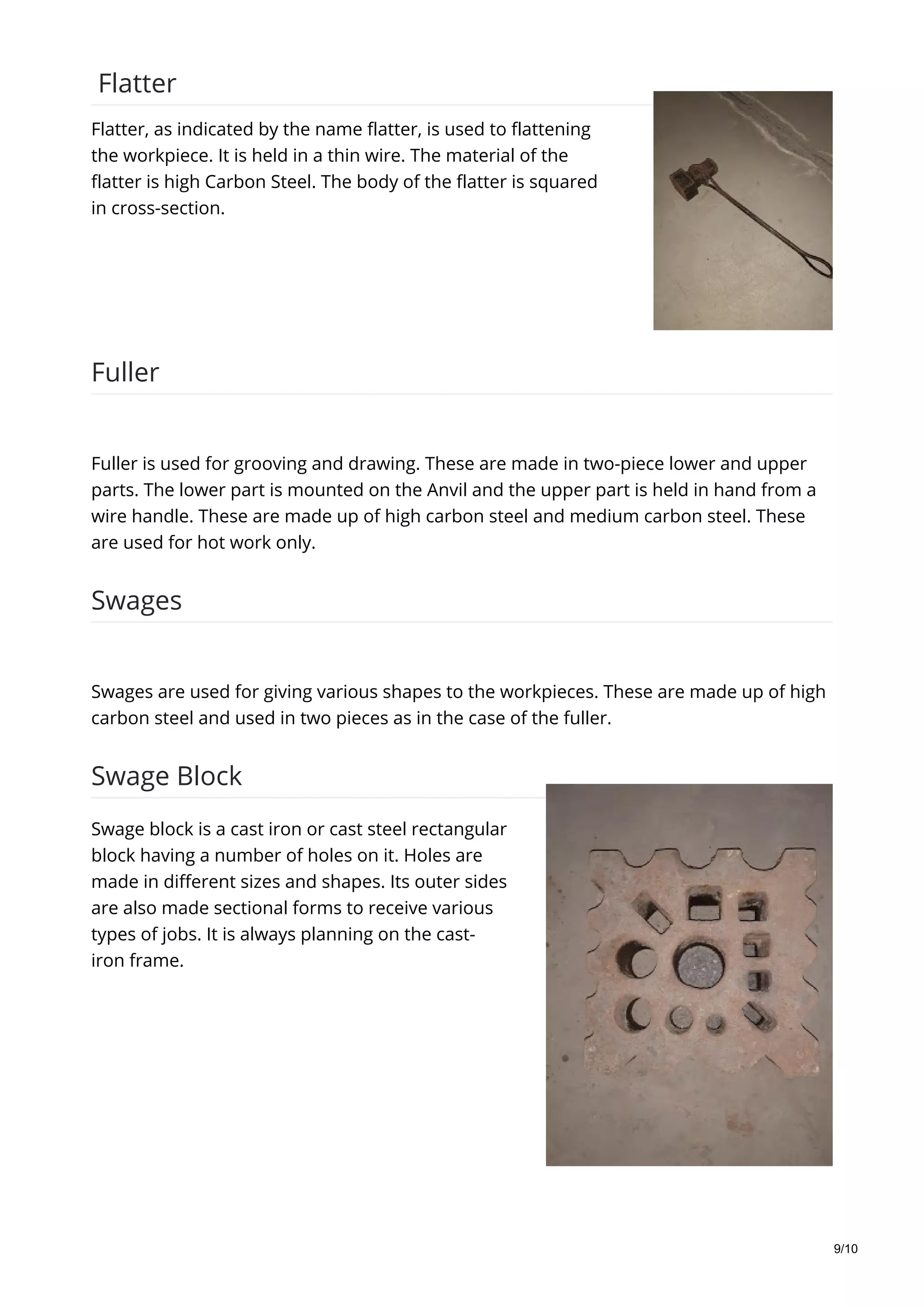
Swage Block
Swage block is a cast iron or cast steel rectangular
block having a number of holes on it. Holes are
made in different sizes and shapes. Its outer sides
are also made sectional forms to receive various
types of jobs. It is always planning on the cast-
iron frame.
Set Hammer
9/10
Set Hammer
The set hammer has a similar shape to the flatters. It is
made to tool steel.
Clamping vice
Clamping vice is only a clamping device used in the Smithy shop. It is mounted with a
table or wooden base. It consists of two jaws a spring and a leg. The hot workpiece is
clamp in it while working.
10/10

Forging

  • 1.
    SIMPLE MECHANISM 4399733744877692510_9812576d46a0bfbea1a3afaf2a7b88b224bafa48.blogspot.com/b/post-preview Forging Smithy orForging is the oldest shaping process used for producing small articles for which accuracy in size is not so important. The parts are shaped by heating them in an open fire or hearth by the blacksmith and shaping them through applying compressive forces using a hammer. In other Words:-The process of giving the desired shape of a metal piece by heating and hammering is also known as forging. The metal is heated up to a Desire temperature known as a forging temperature. When the forging is done by hand tool manually then it is called hand forging and when the same forging is performed by the power hammering then it is called power forging. The hand forging process is also known as black-smithy work which is commonly employed for the production of small particles using hammers on heated jobs. It is a manually controlled process even though some machinery such as power hammers can also be sometimes used. Black-smithy is, therefore, a process by which metal may be heated and shaped to its requirements by the use of blacksmith tools either by hand or power hammer. Advantages of Forging 1/10
  • 2.
    1. It refinesthe structure of the metal. 2. It increases strength. 3. It saves time, material and labor. Forging Tools and Equipment 1.Furnace or Hearth 2. Anvil 3.Hammers 4.Tongs 5.Chisels 6.Punches and Drifts 7. Flatters 8.Swage Block 9.Set Hammer 10.Bench Vice Furnace or Hearth The furnace is to used for heating the metal piece. The furnace consists of four legs and a cast iron or steel body iron bottom a Chimney and below. The main part of the forging furnace Hearth The iron bottom where a fire is lighted is called Hearth. It is provided with firebrick lining. Tuyere 2/10
  • 3.
    A pipe comingfrom the bottom or rear of the earth is known as Tuyere. It is used to supply the air at high pressure to the furnace. Hood The upper part of the Furnace is called a hood. it is made up of mild steel with the firebrick inside it. Chimney The chimney is a fit on the upper end of the Hood. it is used for the purpose of easy escaping of exhausting gases and smoke. Fuel used for Forging 1.Solid fuel ⇒ Coal, Coke, and charcoal 2.Liquid ⇒ Oil 3.Gases⇒ Gases The fuel is commonly used for forging steam coal, coke, and charcoal. A good fuel should be able to maintain the required forging temperature. It should be cheap and easily available. It should be easy to fire. It should not proceed with excess smoke and fly ash lightning the Fire. The method for lightened the Fire in the Furnace The space inside the hearth is filled with softwood. While burning this wood fresh Coke is placed on the one side of the earth. It is slowly brought to the center of the hearth regulating the air supply from the blower. When the Coke catches fire the whole space is filled with Coke. The fire should be as deep as possible inside the center of the hearth. Forging tools name with the images Anvil 3/10
  • 4.
    Anvil Anvil is thesporting device that is a sport the material when hammering is performed on it. A block on which forging work is done is called Anvil. It is made up of steel, cast iron or wrought iron. It acts as a Sporting device for all forging operation. The weight of the anvil varies from 100 kg to 150 kg. It is available in many size and shape Hammer Hammer is used as a striking tool. It is divided into three types. Hand hammer Sledgehammer Power hammer Hand hammer is a light in weight used by Smith himself. Sledgehammer is heavier in weight and is used by the Smiths helper. All the hammers are divided into 4 parts namely. 4/10
  • 5.
    1. Pean 2.Eye 3. Cheeks 4. Face. Hand hammer of four types based on the shape of pean if the pean is along the axis of the handle then it is straight peen hammer. When the pean is across the axis of the handle then it is called cross pean hammer. In case the shape of the pean in the same as the shape of the face then it is double-ended. If the shape of the pean is spherical then it is a ball-peen hammer. The weight of the hand hammer varies from 1 kg to 2 kg and that of the sledgehammer is 3 kg to 8 kg. When the quantity of jobs is to be produced is more the power hammer is used. Commonly used Hammer:- Spring hammer Pneumatic hammer Steam hammer Drop hammer The power hammer is generally driven by electrical power. The job to be produced is placed on the anvil of the hammer with the help of the liver the weight is allowed to fall on the job. The factor which influences the working of the hammer.Size and shape of jobs The falling weight of the hammer The height of the falling weight Tongs 5/10
  • 6.
    Tongs are usedfor holding and turning hot metal pieces depending upon their uses, tongs are classified into many types. All types of tongs have a similar construction to accept the mouth. Tongs have two legs shifted from a suitable place these are made up of mild steel. Various types of tong used in forging shop it is made in two pieces and both of the pieces are joined by hinges. The length of the tong varies from 12" to 18".It is classified based on the shape of the mouth of the tongs. Chisel Chisel is used for cutting a metal piece in hot and cold states. Chisel is divided following categories. This is also a cutting tool that is used on the workpiece as a cold or hot condition. These are made up of high carbon steel. It is generally 6 inches to 8 inches long. The top is flattened and sharp cutting edge made on the bottom side. Chisels are classified on the basis of the shape and width of the cutting edge. Commonly used forms of chisel are flat, cross-cut, half-round and diamond point chisel. Cutting angle of chisels For hard material 70-75 degree For medium-hard material 60 degree For soft material 40 degree 6/10
  • 7.
    Flat Chisel This chiselis flat in shape at the end side. The flat chisel is used for chipping a large surface. This chisel is used at room temperature so it is called a cold chisel. Crosscut chisel The crosscut chisel is narrow chisel and thickness of the cutting edge is broader than a flat chisel. The flat chisel is used for cutting grooves. Half-round chisel The half-round chisel is used to cut oil grooves in the bushes and also clearing small round corners. 7/10
  • 8.
    Diamond point chisel Thediamond point chisel is used for chipping plate. It is also used for clearing the corner of the slots cut at an angle or of a square shape. Chipping with chisel The workpiece is proper to hold in the vice. The material is removed with the help of a hammer. The chisel has held an angle to the workpiece. The chisel is perfectly held in the hand while striking. Hot chisel Cold chisel Hard die set Hot chisel is used to cut the metal in a hot state and cold chisel to used cut the metal in cold state, the main difference between these chisels is the cutting angle. In hot chisel, the cutting angle is 30 degree but in the case of a cold chisel, it is valued is 60 degrees. Hard die set. A hard die set consists of three parts:- 1.Shank 2. Body 3.Cutting Edges The shank is fitted into the hard die hole in the anvil. Chisels and hard resets are made from carbon steel. It is hardened up to the desired label with proper tampering. Punches and drifts Punches are made up of high carbon steel and are used for making a rough hole in hot metal pieces. Punches are available in different sizes but have a common shape. A drift is a largely sized punch used to enlarge a whole. Flatter 8/10
  • 9.
    Flatter Flatter, as indicatedby the name flatter, is used to flattening the workpiece. It is held in a thin wire. The material of the flatter is high Carbon Steel. The body of the flatter is squared in cross-section. Fuller Fuller is used for grooving and drawing. These are made in two-piece lower and upper parts. The lower part is mounted on the Anvil and the upper part is held in hand from a wire handle. These are made up of high carbon steel and medium carbon steel. These are used for hot work only. Swages Swages are used for giving various shapes to the workpieces. These are made up of high carbon steel and used in two pieces as in the case of the fuller. Swage Block Swage block is a cast iron or cast steel rectangular block having a number of holes on it. Holes are made in different sizes and shapes. Its outer sides are also made sectional forms to receive various types of jobs. It is always planning on the cast- iron frame. Set Hammer 9/10
  • 10.
    Set Hammer The sethammer has a similar shape to the flatters. It is made to tool steel. Clamping vice Clamping vice is only a clamping device used in the Smithy shop. It is mounted with a table or wooden base. It consists of two jaws a spring and a leg. The hot workpiece is clamp in it while working. 10/10