JAIPUR NATIONAL UNIVERSITY
SEEDLING SCHOOL OF NURSING
PREPARED BY-
(Prof.) Dr. Rahul Sharma
HOD of Mental Health Nursing
Ph.D. Coordinator
Seedling School of Nursing
FOREST RESOURCES
‘A nation that destroys
its soils destroys itself
Forests are the lungs
of our land, purifying
the air and giving fresh
strength to our people’-
Franklin D. Roosevelt
Introduction
to Natural
Resources
Any material which can be
transformed in a way that it
becomes more valuable and useful
can be termed as resource
The aspect of satisfaction is so
important that we consider a thing or
substance a resource, as so long it
meets our needs
Life on this planet depends upon a
large number of things and services
provided by the nature, which are
known as Natural Resources
Problems
associated
with natural
resources
1. The
unequal
consumption
of natural
resources
A major part of natural resources today
are consumed in the technologically
advanced or ‘developed’ world, usually
termed ‘the west’
The ‘developing nations’ of ‘the east’,
including India and China, also over
use many resources because of their
greater human population
However, the consumption of
resources per capita of the developed
countries is up to 50 times greater than
in most developing countries
2. Planning
land use
Land is a major resource, needed for
not only for food production and animal
husbandry, but also for industry and
growing human settlements
These forms of intensive land use are
frequently extended at the cost of ‘wild
lands’, our remaining forests,
grasslands, wetlands and deserts
Human standard of living and the
health of the ecosystem are indicators
of sustainable use of resources in any
country or region
FOREST
RESOURCE
S
Forest vary in composition and diversity and
can contribute substantially to the economic
development of any country
According to "the state of the World forest
"2022 forests cover 4.06 billion hectare of
the Earths geographical area
Forest resources Indian scenario: the forest
and tree cover the country countinues to
increase with an additional cover of 1,500
square kilometers over the past two years
USES OF
THE
FOREST
Forests are main source of many
commercial products such as wood,
timber, pulpwood etc
Timber obtained from the forest can
used to make plywood, board, doors
and windows, furniture, and agriculture
implements and sports goods
Forest provide food, medicine and
other products needed for tribal people
and play a vital role in the life and
economy of tribes living in the forest
OVER EXPLOITATION OF FOREST
With increasing population
increased demand of fuel
wood, expansion of area
under urban development
and industries has lead to
over exploitation of forest
At present international
level we are losing forest
at the rate of 1.7 crore
hectares annually
Overexploitation also
occurs due to overgrazing
and conversion of forest to
pastures for domestic use
DEFORESTATIO
N
Causes of
deforestation
However in developing countries area under forest is
showing declining trend particularly in tropical region
It is estimated that principle cause of deforestation in
tropics in Africa, Asia and tropical America is
estimated to be 70, 50, and 35% respectively
In India, shifting cultivation is prevalent in northeast
and to limited extent in M.P, Bihar and Andhra
Pradesh and is contributing significantly to
deforestation
Increased population needs more food which has
compelled for increasing area under agriculture crops
compelling for deforestation
Major effects
of
deforestation
Deforestation adversely and
directly affects and
damages the environment
and living beings
Major causes of
deforestation are
CASE
STUDIES
1. Jhum cultivation
Jhum Agriculture or
shifting agriculture has
destroyed large number of
hectare of forest tracts in
North-Eastern states and
Orissa
Jhum agriculture is
subsidence agriculture in
which tract of forest land is
cleared by cutting trees
and it is used for
cultivation
As a result of this practise,
combined with increasing
population there is rapid
deforestation as more and
more cultivators clear
forest to cultivate land
2. Chipko
movement
The Chipko movement or Chipko Andolan is a social-
ecological movement that practised the Gandhian
methods of satyagraha and non-violent resistance,
through the act of hugging trees to protect them from
being felled
The modern Chipko movement started in the early
1970s in the Garhwal Himalayas of Uttarakhand,with
growing awareness towards rapid deforestation
The landmark event in this struggle took place on March
26, 1974, when a group of peasant women in Reni
village, Hemwalghati, in Chamoli district, Uttarakhand,
India, acted to prevent the cutting of trees and reclaim
their traditional forest rights that were threatened by the
contractor system of the state Forest Department
3. Western
Himalayan
region
Over the last decade, there has been
widespread destruction and degradation
of forest resources in Himalayas,
especially western Himalayas
This has resulted in various problems
such as erosion of top soil, irregular
rainfall, changing weather patterns and
floods
Construction of roads on hilly slopes,
have not only undermined their stability,
but also damaged protective vegetation
and forest cover
TIMBER
EXTRACTIO
N
There has been unlimited
exploitation of timber for
commercial use
Due to increased industrial
demand; timber extraction
has significant effect on
forest and tribal people
Logging
Poor logging results in
degraded forest and
may lead to soil erosion
especially on slopes
New logging roads
permit shifting
cultivators and fuel
wood gatherers to gain
access to the logging
area
Loss of long term forest
productivity
MINING
Effects of
dams on
forests and
tribal people
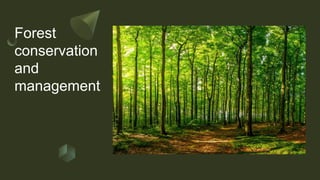
Forest
conservation
and
management

FOREST RESOURCES.pptx

  • 1.
    JAIPUR NATIONAL UNIVERSITY SEEDLINGSCHOOL OF NURSING PREPARED BY- (Prof.) Dr. Rahul Sharma HOD of Mental Health Nursing Ph.D. Coordinator Seedling School of Nursing
  • 2.
  • 3.
    ‘A nation thatdestroys its soils destroys itself Forests are the lungs of our land, purifying the air and giving fresh strength to our people’- Franklin D. Roosevelt
  • 4.
    Introduction to Natural Resources Any materialwhich can be transformed in a way that it becomes more valuable and useful can be termed as resource The aspect of satisfaction is so important that we consider a thing or substance a resource, as so long it meets our needs Life on this planet depends upon a large number of things and services provided by the nature, which are known as Natural Resources
  • 5.
  • 6.
    1. The unequal consumption of natural resources Amajor part of natural resources today are consumed in the technologically advanced or ‘developed’ world, usually termed ‘the west’ The ‘developing nations’ of ‘the east’, including India and China, also over use many resources because of their greater human population However, the consumption of resources per capita of the developed countries is up to 50 times greater than in most developing countries
  • 7.
    2. Planning land use Landis a major resource, needed for not only for food production and animal husbandry, but also for industry and growing human settlements These forms of intensive land use are frequently extended at the cost of ‘wild lands’, our remaining forests, grasslands, wetlands and deserts Human standard of living and the health of the ecosystem are indicators of sustainable use of resources in any country or region
  • 8.
    FOREST RESOURCE S Forest vary incomposition and diversity and can contribute substantially to the economic development of any country According to "the state of the World forest "2022 forests cover 4.06 billion hectare of the Earths geographical area Forest resources Indian scenario: the forest and tree cover the country countinues to increase with an additional cover of 1,500 square kilometers over the past two years
  • 9.
    USES OF THE FOREST Forests aremain source of many commercial products such as wood, timber, pulpwood etc Timber obtained from the forest can used to make plywood, board, doors and windows, furniture, and agriculture implements and sports goods Forest provide food, medicine and other products needed for tribal people and play a vital role in the life and economy of tribes living in the forest
  • 10.
    OVER EXPLOITATION OFFOREST With increasing population increased demand of fuel wood, expansion of area under urban development and industries has lead to over exploitation of forest At present international level we are losing forest at the rate of 1.7 crore hectares annually Overexploitation also occurs due to overgrazing and conversion of forest to pastures for domestic use
  • 11.
  • 12.
    Causes of deforestation However indeveloping countries area under forest is showing declining trend particularly in tropical region It is estimated that principle cause of deforestation in tropics in Africa, Asia and tropical America is estimated to be 70, 50, and 35% respectively In India, shifting cultivation is prevalent in northeast and to limited extent in M.P, Bihar and Andhra Pradesh and is contributing significantly to deforestation Increased population needs more food which has compelled for increasing area under agriculture crops compelling for deforestation
  • 13.
    Major effects of deforestation Deforestation adverselyand directly affects and damages the environment and living beings Major causes of deforestation are
  • 14.
  • 15.
    1. Jhum cultivation JhumAgriculture or shifting agriculture has destroyed large number of hectare of forest tracts in North-Eastern states and Orissa Jhum agriculture is subsidence agriculture in which tract of forest land is cleared by cutting trees and it is used for cultivation As a result of this practise, combined with increasing population there is rapid deforestation as more and more cultivators clear forest to cultivate land
  • 16.
    2. Chipko movement The Chipkomovement or Chipko Andolan is a social- ecological movement that practised the Gandhian methods of satyagraha and non-violent resistance, through the act of hugging trees to protect them from being felled The modern Chipko movement started in the early 1970s in the Garhwal Himalayas of Uttarakhand,with growing awareness towards rapid deforestation The landmark event in this struggle took place on March 26, 1974, when a group of peasant women in Reni village, Hemwalghati, in Chamoli district, Uttarakhand, India, acted to prevent the cutting of trees and reclaim their traditional forest rights that were threatened by the contractor system of the state Forest Department
  • 17.
    3. Western Himalayan region Over thelast decade, there has been widespread destruction and degradation of forest resources in Himalayas, especially western Himalayas This has resulted in various problems such as erosion of top soil, irregular rainfall, changing weather patterns and floods Construction of roads on hilly slopes, have not only undermined their stability, but also damaged protective vegetation and forest cover
  • 18.
    TIMBER EXTRACTIO N There has beenunlimited exploitation of timber for commercial use Due to increased industrial demand; timber extraction has significant effect on forest and tribal people
  • 19.
    Logging Poor logging resultsin degraded forest and may lead to soil erosion especially on slopes New logging roads permit shifting cultivators and fuel wood gatherers to gain access to the logging area Loss of long term forest productivity
  • 20.
  • 21.
    Effects of dams on forestsand tribal people
  • 22.