NATURAL RESOURCES AND ASSOCIATED
PROBLEMS
1. FOREST RESOURCES
2. WATER RESOURCES
3. MINERAL RESOURCES
4. FOOD RESOURCES
5. ENERGY RESOURCES
6. LAND RESOURCES
FOREST RESOURCES
Topics
• INTRODUCTION
• USES
• OVER-EXPLOITATION
• DEFORESTATIONCAUSES&EFFECTS
• TIMBEREXTRACTION
• MINING
• DAMSANDTHEIREFFECTSONFORESTSAND
TRIBALPEOPLE
INTRODUCTION
• The word forest is derived from a Latin
word
• “ Foris” means Outside
• Forest are one of the most important
natural resources of the earth.
• Approximately 1/3rd of the earth’s total area
is covered by forests
INTRODUCTION
•
•
•
•
Forest resources play an important role in the economy of any
country. It is highly complex, changing environment made up of
a living and non living things. Living things include trees, shrubs,
wildlife etc. and non-living things include water, nutrients,
rocks, sunlight and air.
Forest vary a great deal in composition and density and are
distinct from meadows and pastures.
Forest are important to humans and the natural world. For
humans, they have many aesthetics, recreational, economic,
historical, cultural and religious values.
Forest provide fuel, wood, timber, wildlife, habitat, industrial,
forest products, climate regulations, medicinal etc.
IndianScenario
•
•
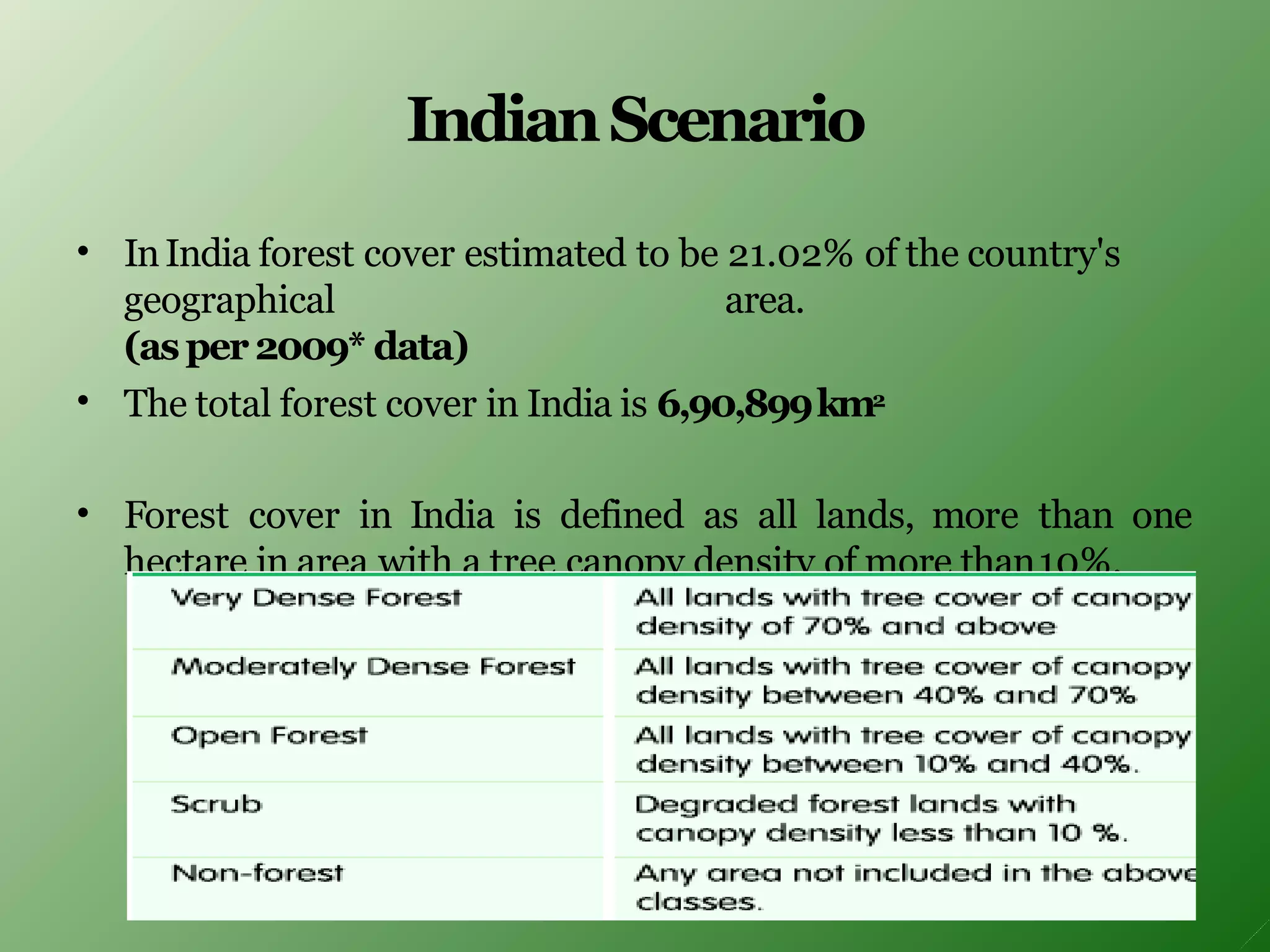
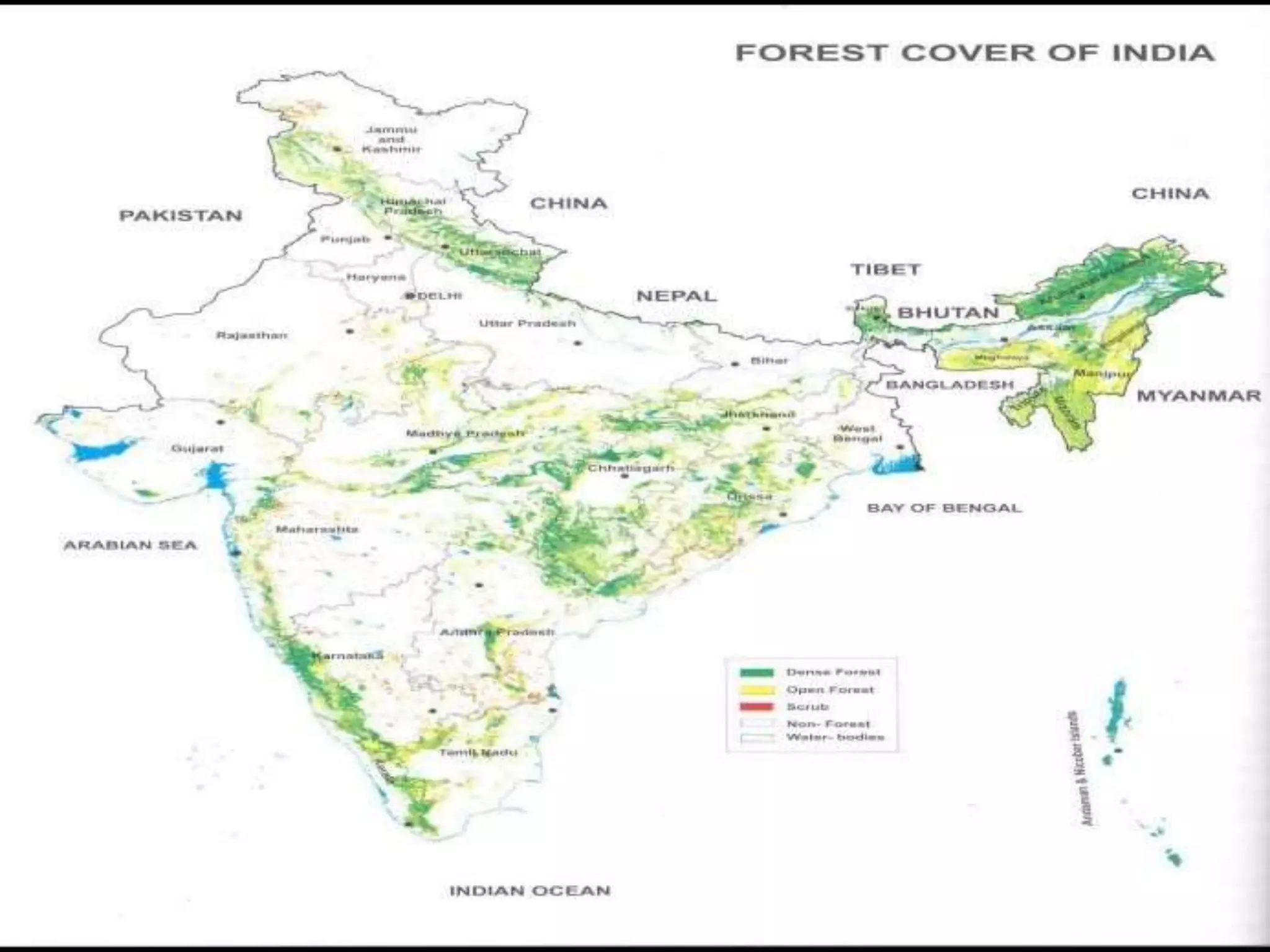
InIndia forest cover estimated to be 21.02% of the country's
geographical area.
(asper2009* data)
The total forest cover in India is 6,90,899km2
• Forest cover in India is defined as all lands, more than one
hectare in area with a tree canopy density of more than10%.
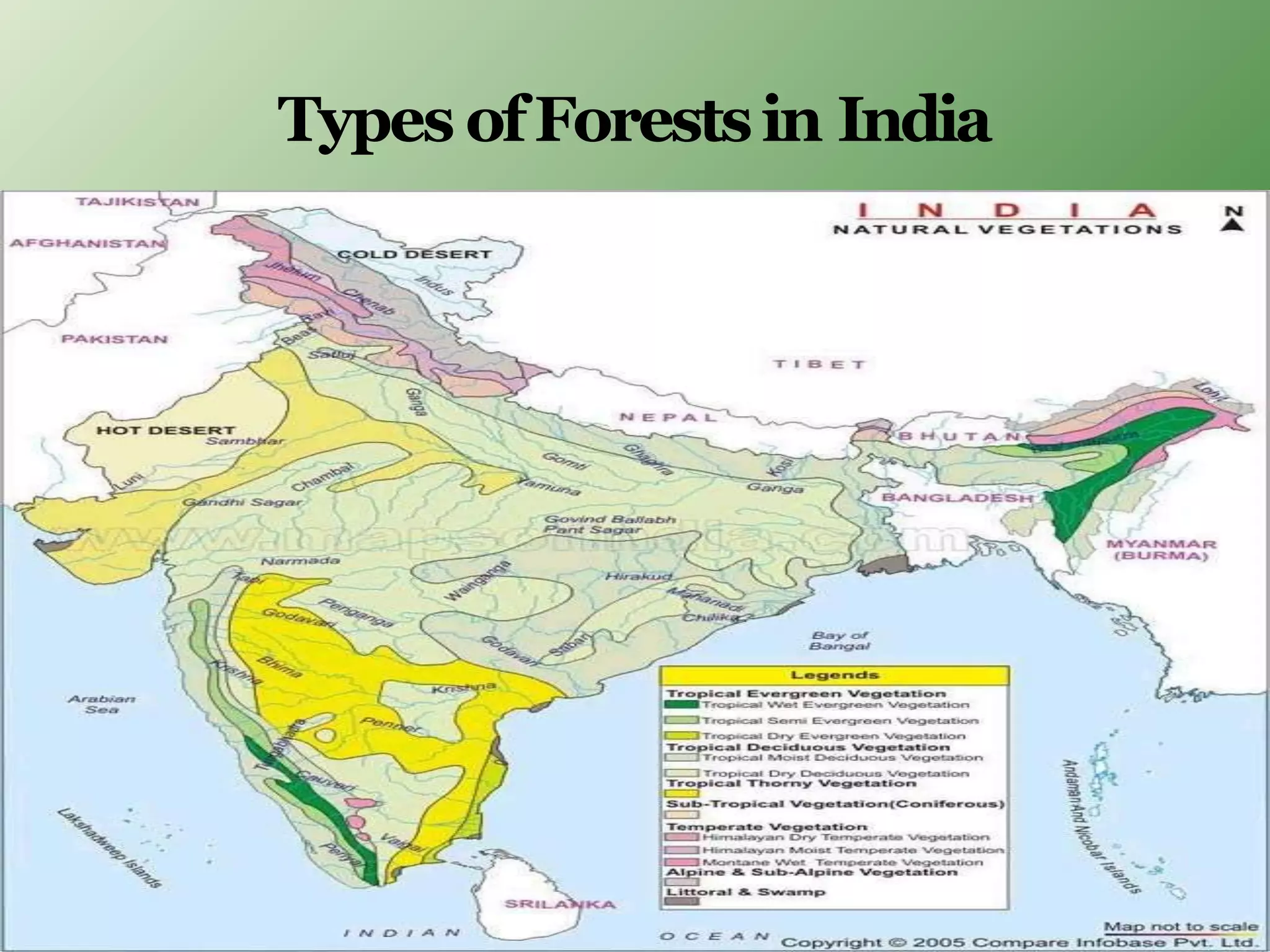
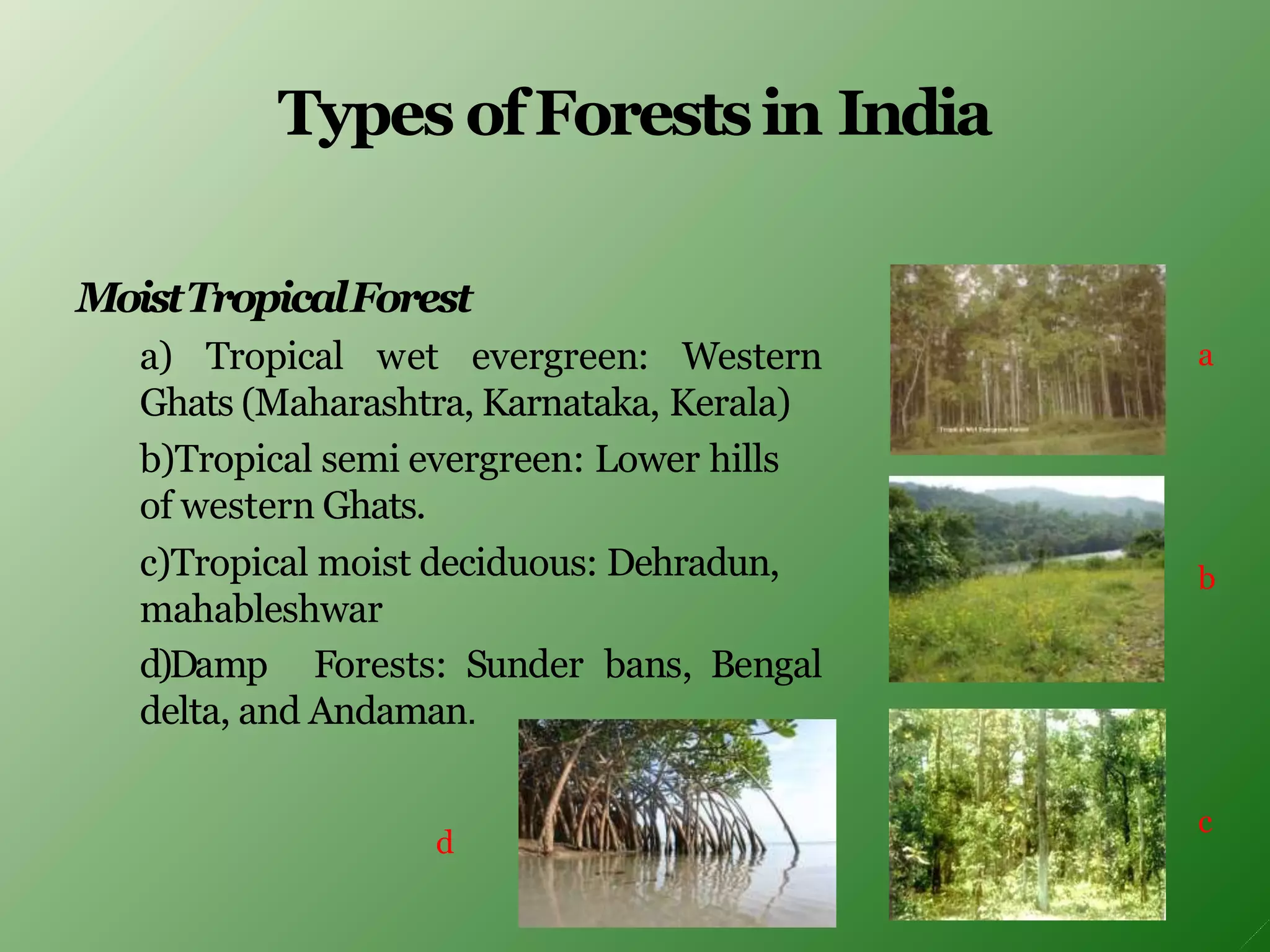
Types ofForestsin India
MoistTropicalForest
a) Tropical wet evergreen: Western
Ghats (Maharashtra, Karnataka, Kerala)
b)Tropical semi evergreen: Lower hills
of western Ghats.
c)Tropical moist deciduous: Dehradun,
mahableshwar
d)Damp Forests: Sunder bans, Bengal
delta, and Andaman.
a
b
d
c
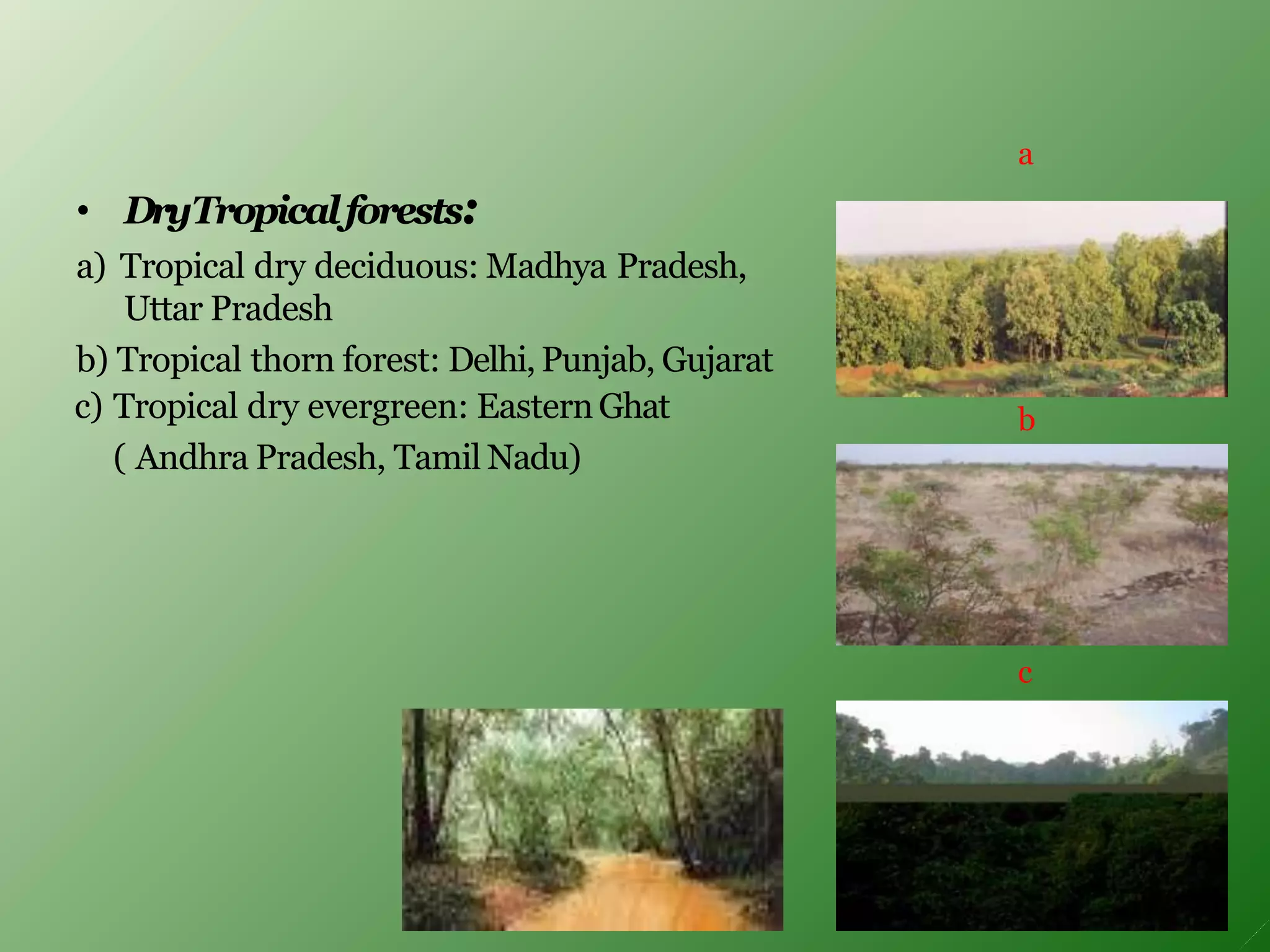
• DryTropicalforests:
a) Tropical dry deciduous: Madhya Pradesh,
Uttar Pradesh
b) Tropical thorn forest: Delhi, Punjab, Gujarat
c) Tropical dry evergreen: EasternGhat
( Andhra Pradesh, Tamil Nadu)
a
b
c
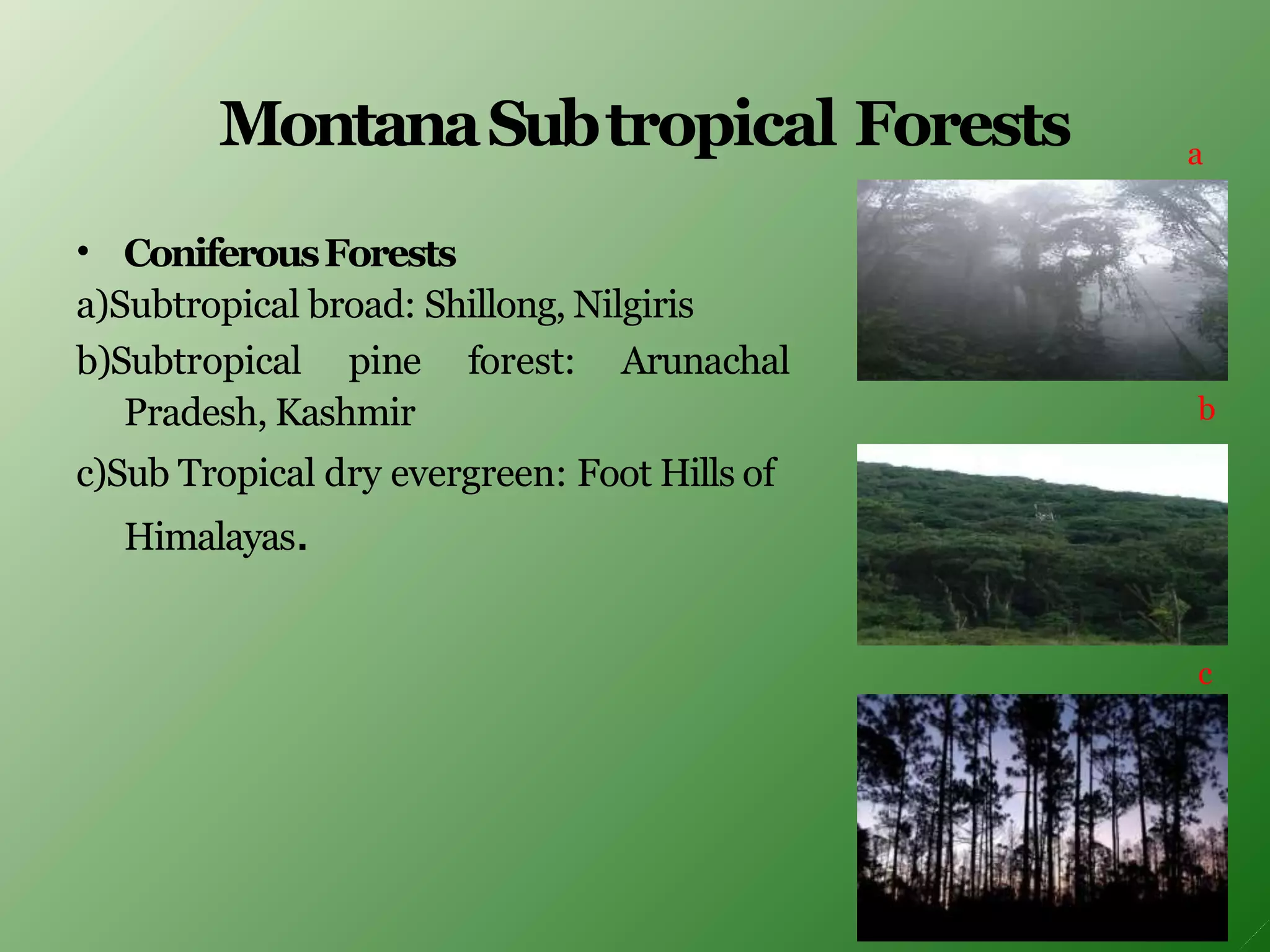
MontanaSubtropical Forests
• ConiferousForests
a)Subtropical broad: Shillong, Nilgiris
b)Subtropical pine forest: Arunachal
Pradesh, Kashmir
c)Sub Tropical dry evergreen: Foot Hills of
Himalayas.
a
b
c
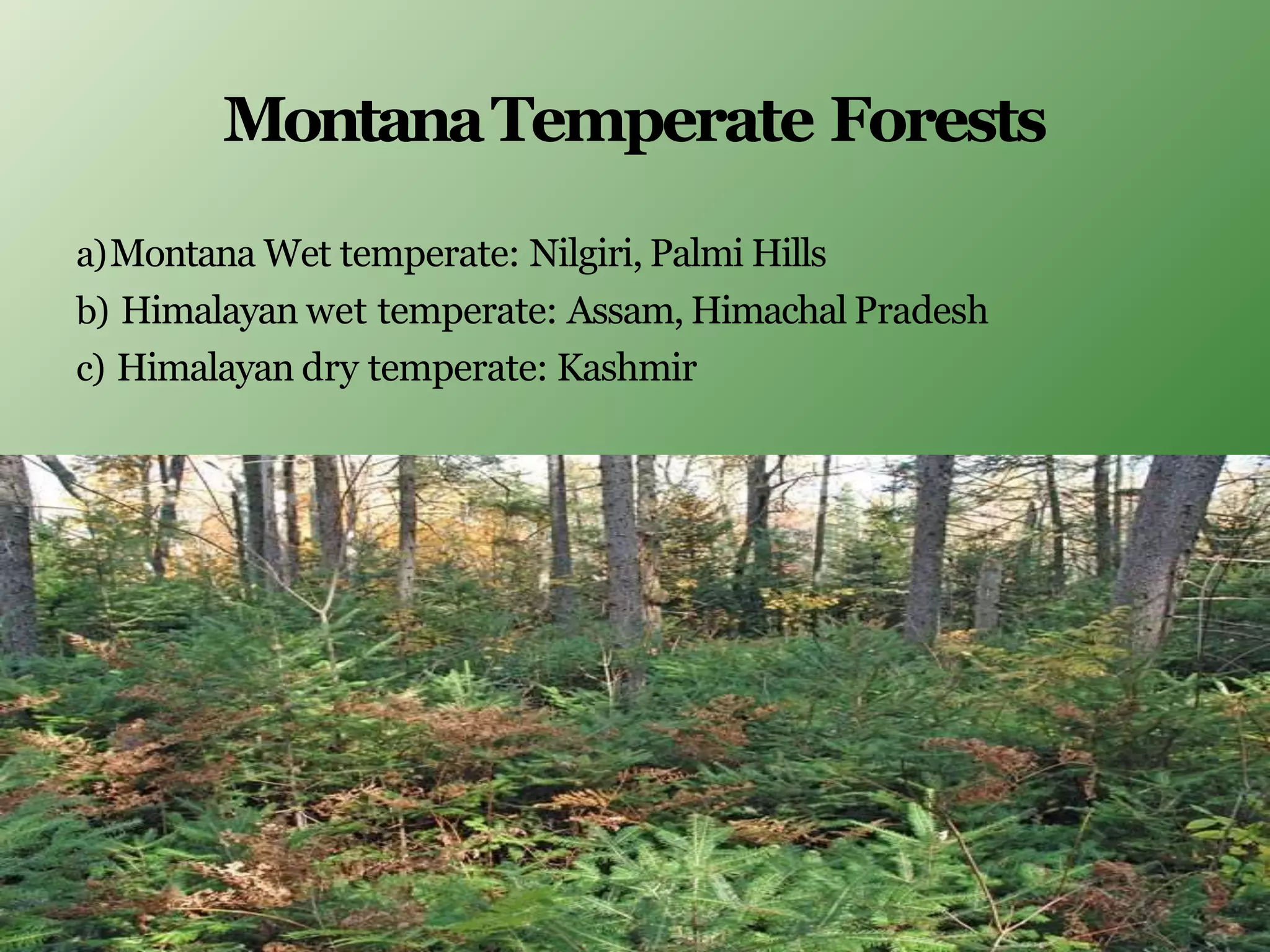
MontanaTemperate Forests
a)Montana Wet temperate: Nilgiri, Palmi Hills
b) Himalayan wet temperate: Assam, Himachal Pradesh
c) Himalayan dry temperate: Kashmir
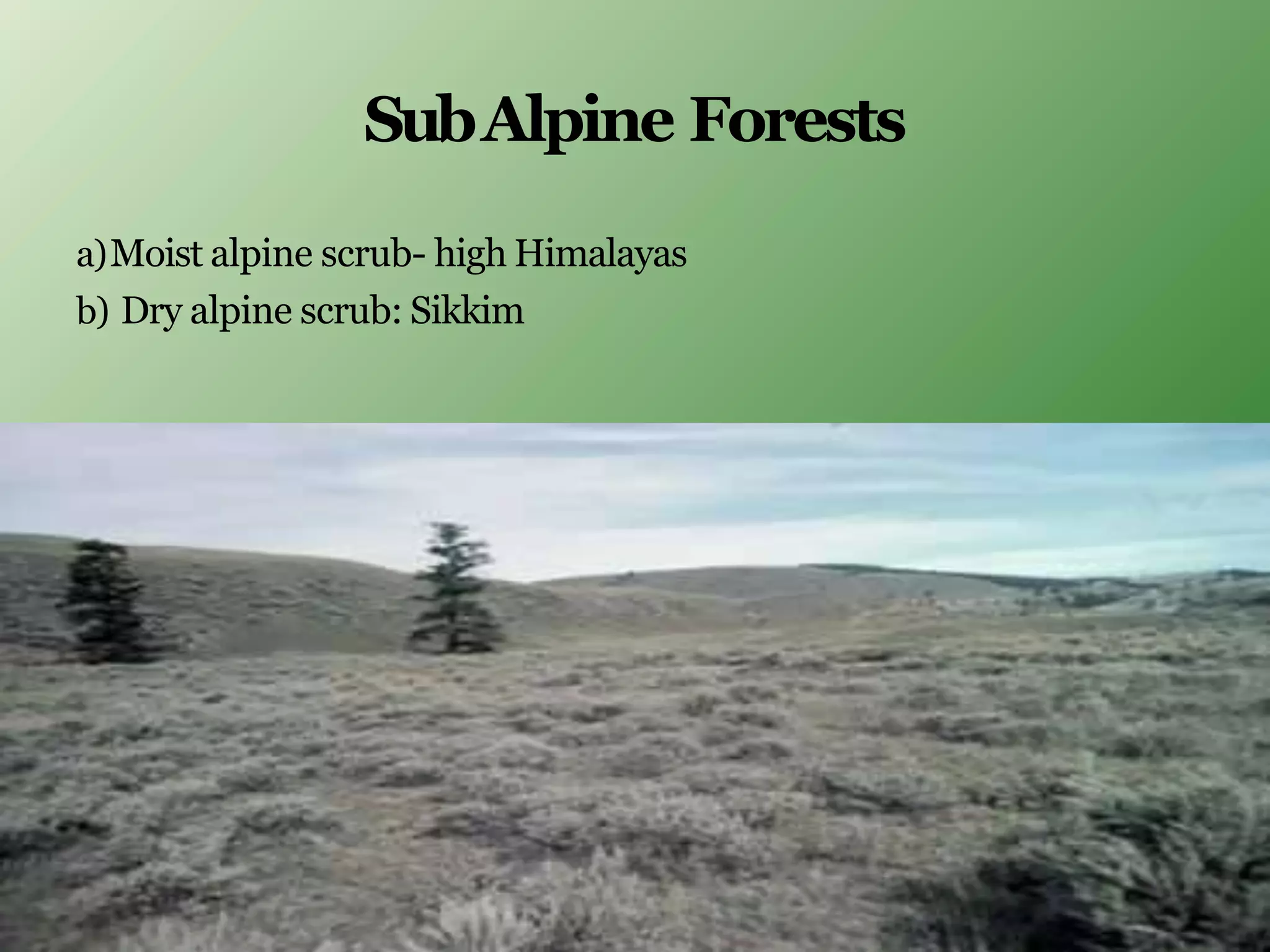
SubAlpine Forests
a)Moist alpine scrub- high Himalayas
b) Dry alpine scrub: Sikkim
ForestDegradationin India
•
•
•
At the beginning of 20thcentury about 30 % of land in India
was covered with forests but by the end of 20thcentury the
forest cover was reduced to20%
As a result of exploitation, the tropical forest cover in
India, is now only reduced to coastal western Ghats and
northern India
We have a huge population size and a very low precipitate
forest area 0.075 Ha per capita as compared to 0.64 ha/
capita of world forest area
•
•
•
The National forest policy has recommended 33 % forest area
for plains and 67 % forhills
The deforestation rate per unit population in India is lowest
among the major tropical countries
For effective forest management of country we have to take the
confidence of tribal who have been living inforest.
USESOF FOREST
•
•
•
•
•
The functions of forest may broadly classified intofollowing
categories
LOCALCONSUMPTIVEUSE
PRODUCTIVEORMARKETUSE
ECOSYSTEMSERVICES
OTHERUSES
LOCALCONSUMPTIVEUSE
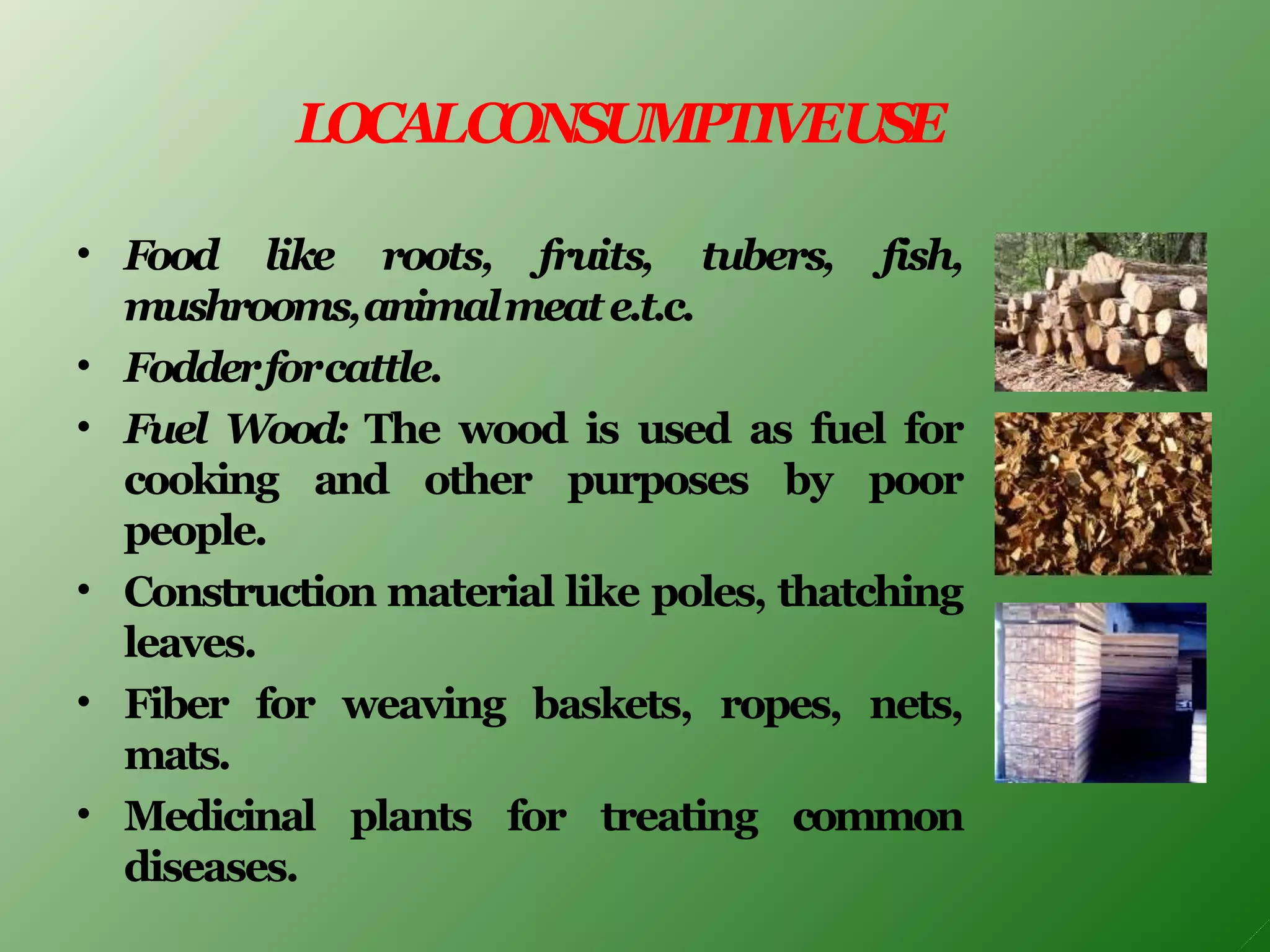
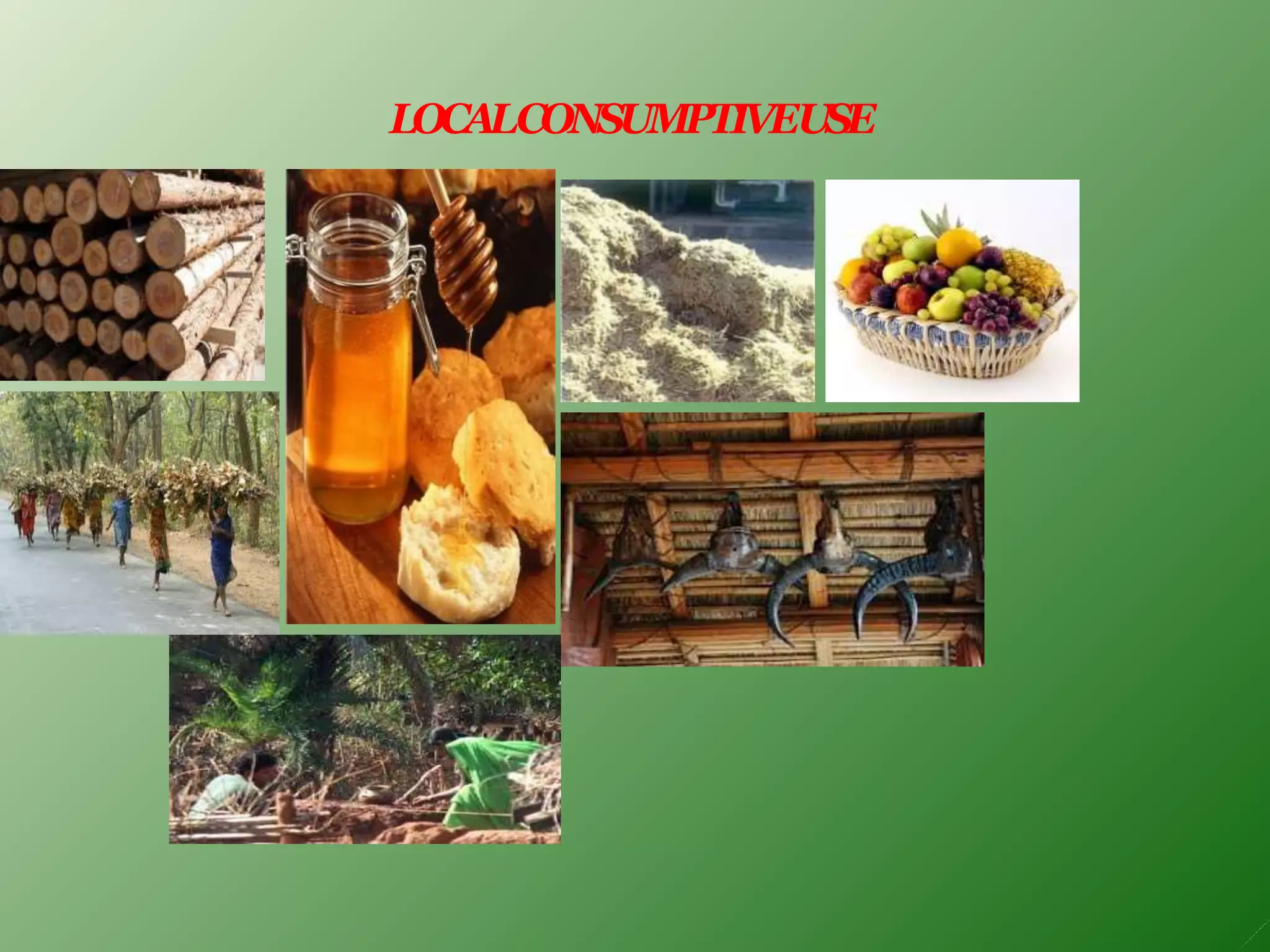
• Food like roots, fruits, tubers, fish,
mushrooms,animalmeate.t.c.
Fodderforcattle.
•
•
•
•
•
Fuel Wood: The wood is used as fuel for
cooking and other purposes by poor
people.
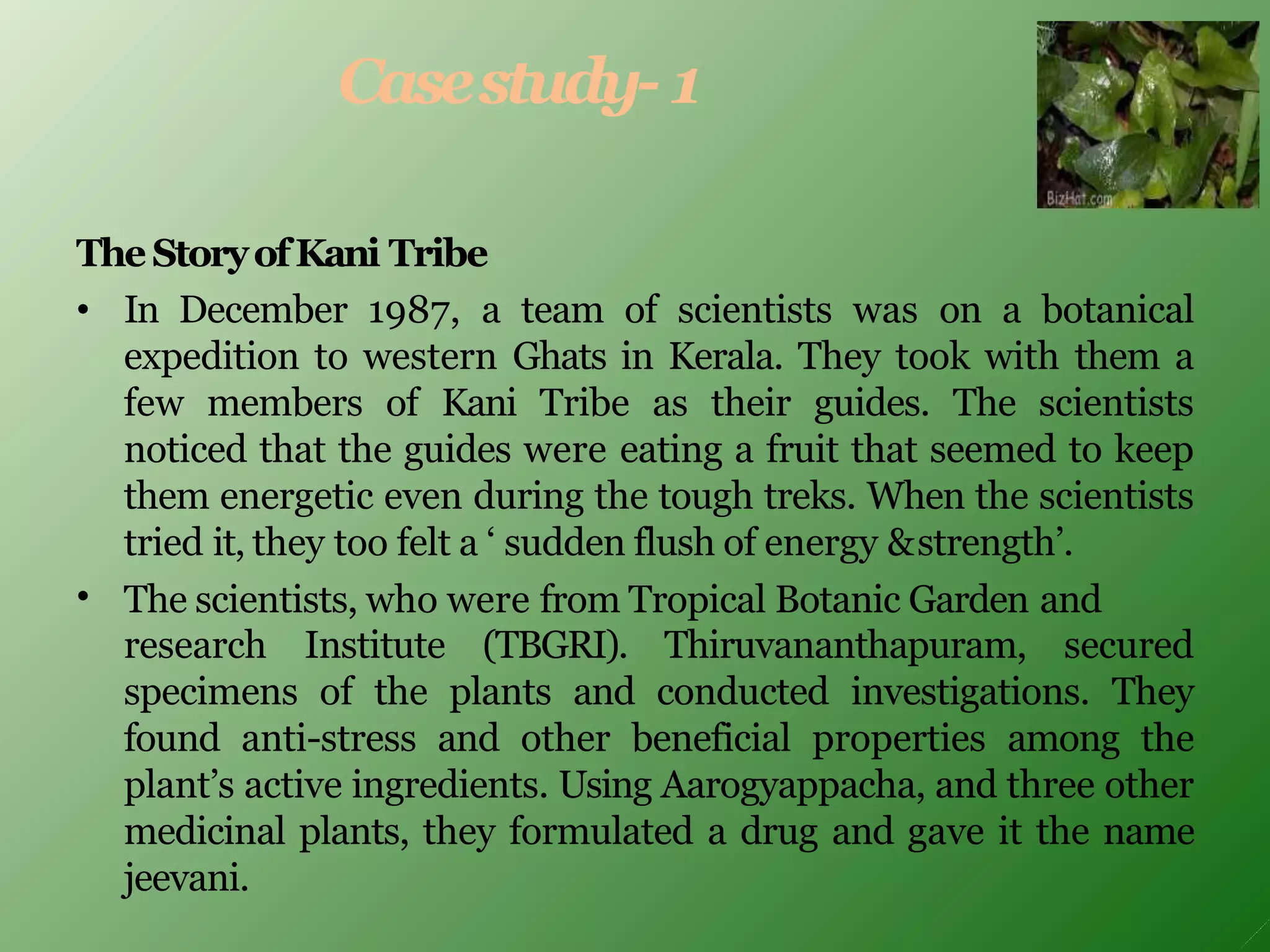
Construction material like poles, thatching
leaves.
Fiber for weaving baskets, ropes, nets,
mats.
Medicinal plants for treating common
diseases.
LOCALCONSUMPTIVEUSE
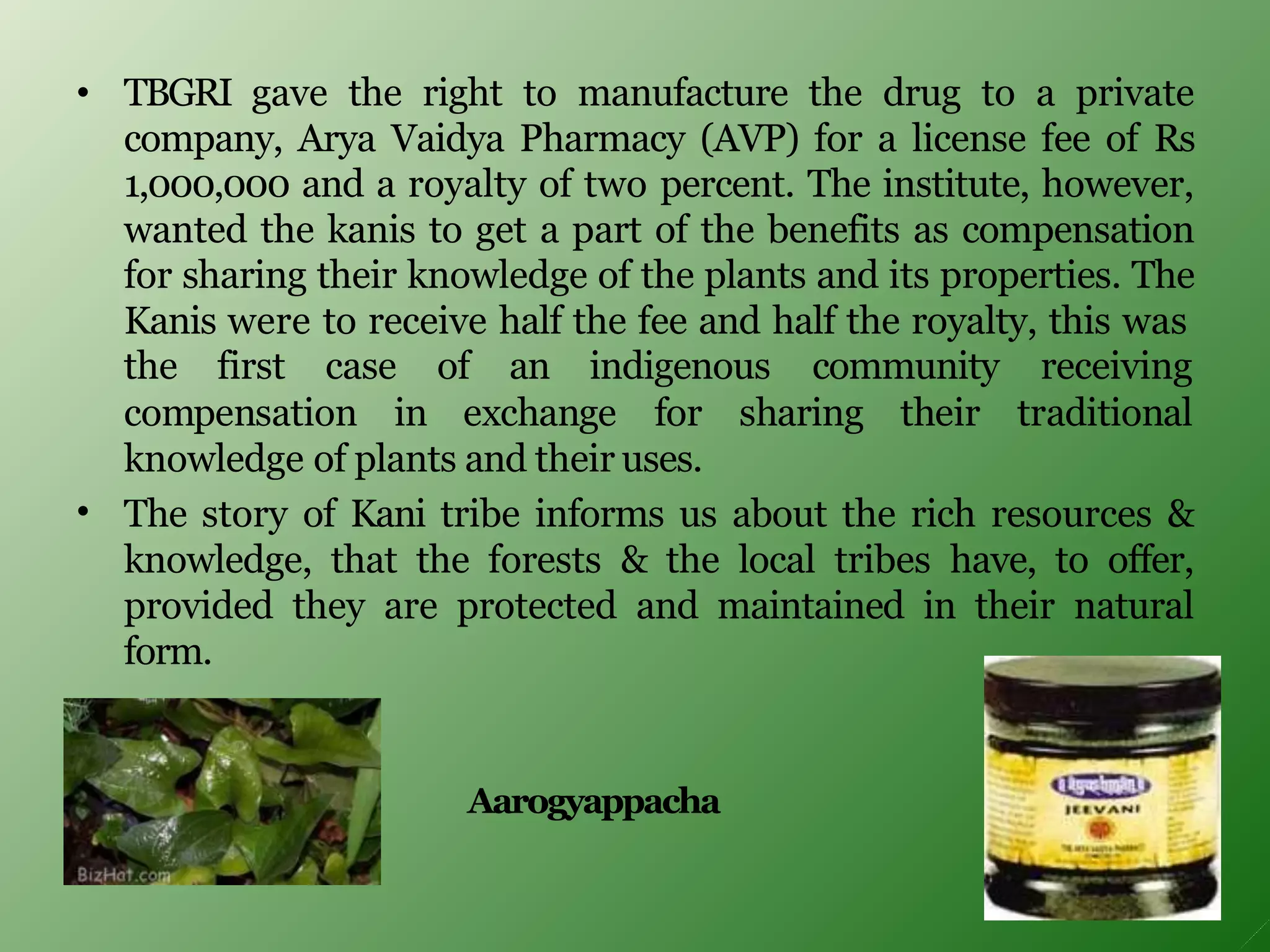
Casestudy- 1
TheStoryofKani Tribe
•
• In December 1987, a team of scientists was on a botanical
expedition to western Ghats in Kerala. They took with them a
few members of Kani Tribe as their guides. The scientists
noticed that the guides were eating a fruit that seemed to keep
them energetic even during the tough treks. When the scientists
tried it, they too felt a ‘ sudden flush of energy &strength’.
The scientists, who were from Tropical Botanic Garden and
research Institute (TBGRI). Thiruvananthapuram, secured
specimens of the plants and conducted investigations. They
found anti-stress and other beneficial properties among the
plant’s active ingredients. Using Aarogyappacha, and three other
medicinal plants, they formulated a drug and gave it the name
jeevani.
• TBGRI gave the right to manufacture the drug to a private
company, Arya Vaidya Pharmacy (AVP) for a license fee of Rs
1,000,000 and a royalty of two percent. The institute, however,
wanted the kanis to get a part of the benefits as compensation
for sharing their knowledge of the plants and its properties. The
Kanis were to receive half the fee and half the royalty, this was
the first case of an indigenous community receiving
compensation in exchange for sharing their traditional
knowledge of plants and their uses.
• The story of Kani tribe informs us about the rich resources &
knowledge, that the forests & the local tribes have, to offer,
provided they are protected and maintained in their natural
form.
Aarogyappacha
PRODUCTIVEORMARKETUSE
• Timber: Wood used for commercial purposes like for
making furniture and other items like boats, bridges and
other day to day uses.
Fruits, fiber, honey, gum e.t.c.
Cane and bamboo products.
•
•
• Raw material for wood based industries: forest provide
raw material for various wood based industries like paper
and pulp, sports goods, furniture, match boxes etc.
ECOSYSTEMSERVICES
• Atmospheric and climate regulation
• Erosion control
• Watershed protection
• Floods and drought control
ECOSYSTEMSERVICES
• Forest Provide protection against Soil erosion, Droughts, floods,
noise, radiations
Soilerosion Floods
Soilerosion Droughts
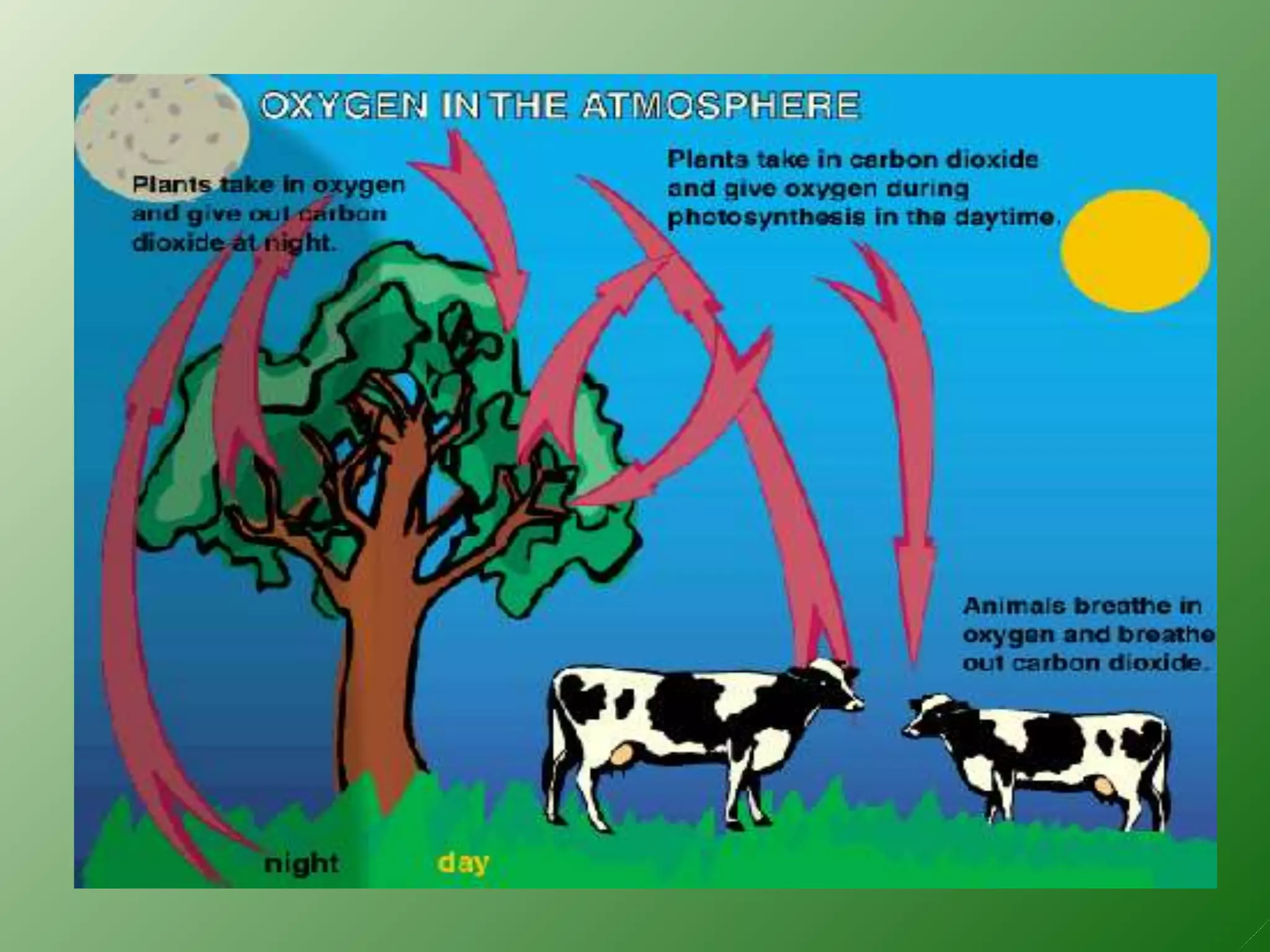
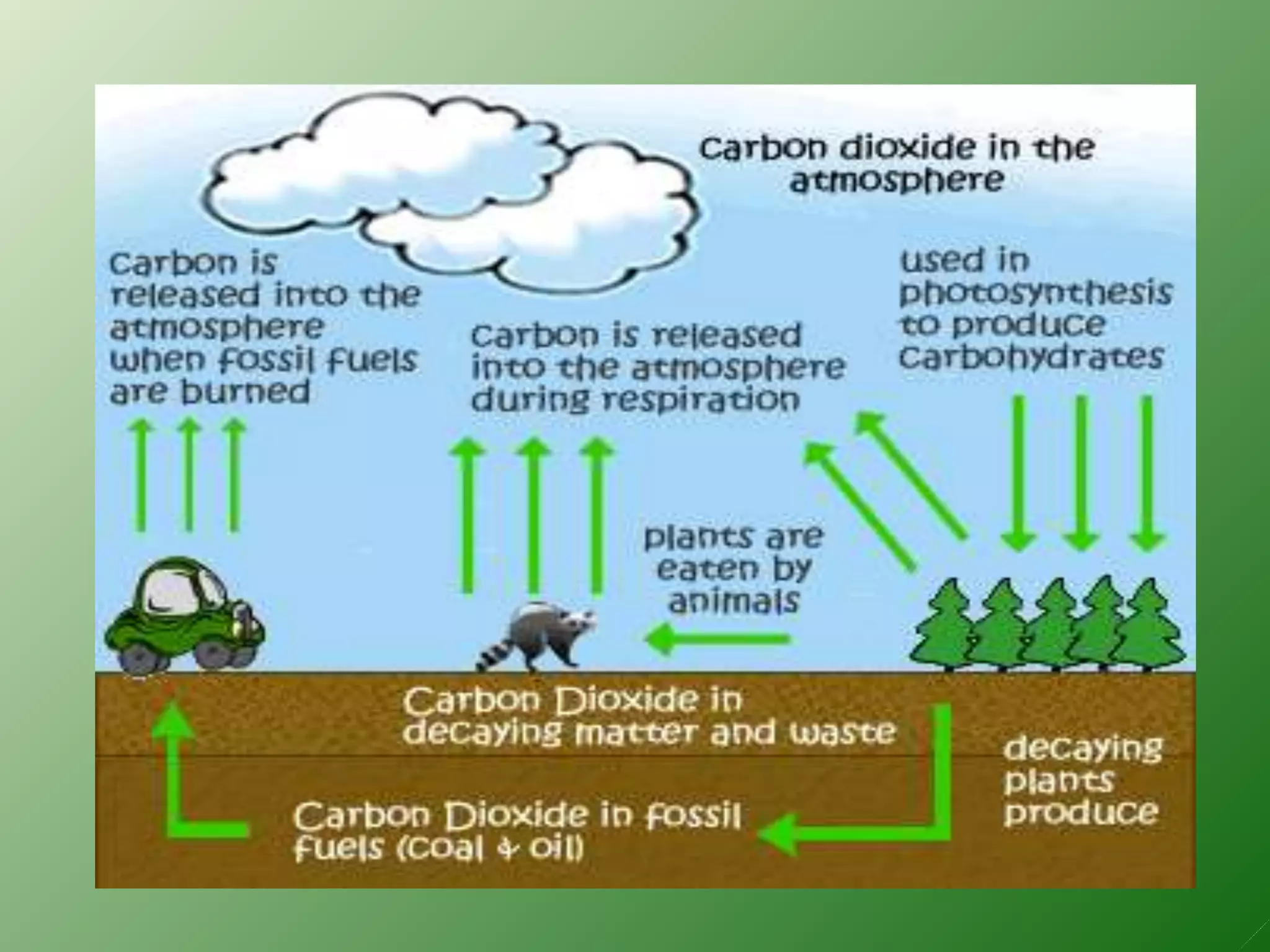
ReductionofGlobal Warming
•The main green house gas co2is used by forests for photosynthesis
process the forest act as a sink for co2there by reducing the green
house effect due to co2
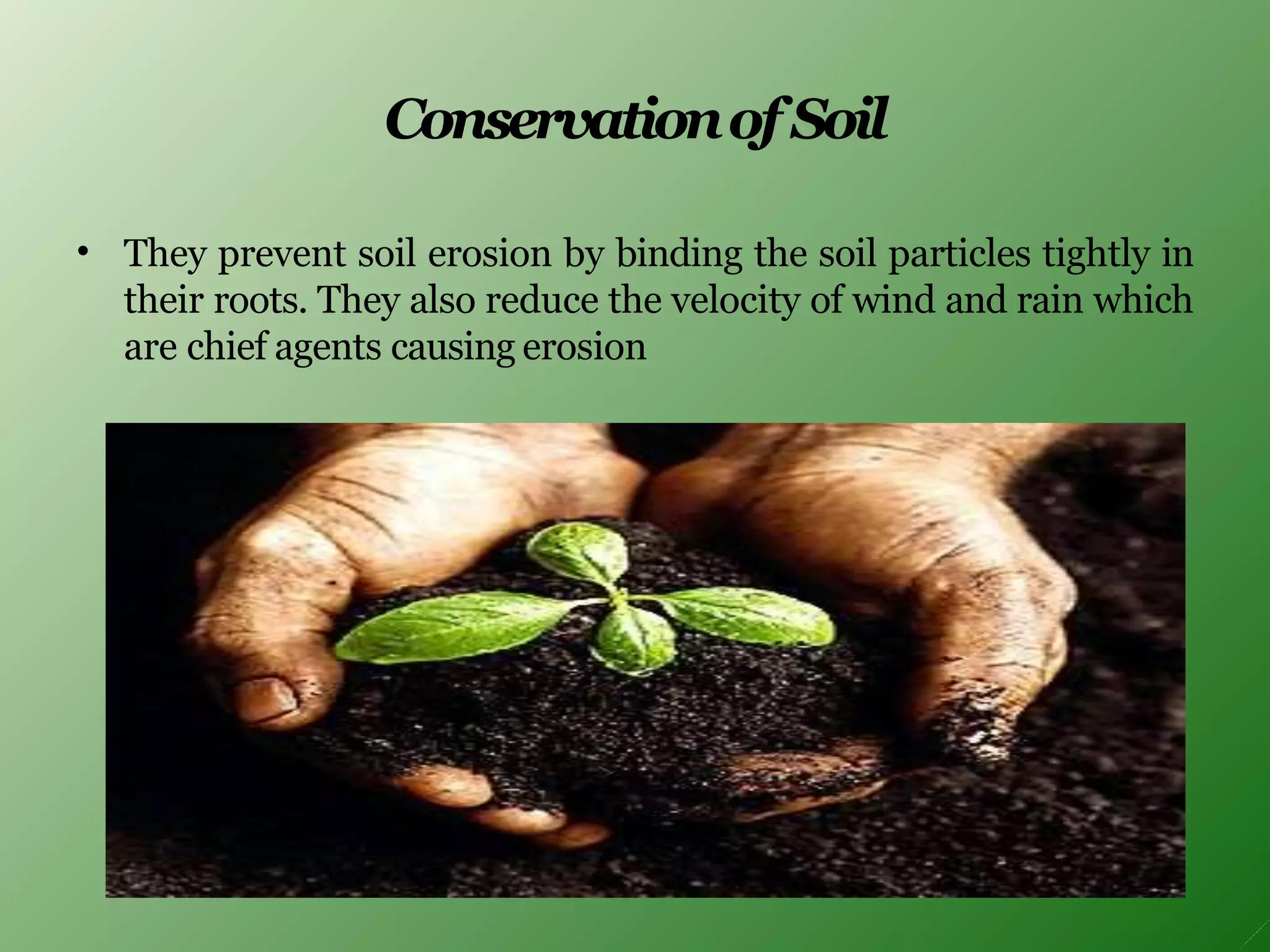
Conservationof Soil
• They prevent soil erosion by binding the soil particles tightly in
their roots. They also reduce the velocity of wind and rain which
are chief agents causing erosion
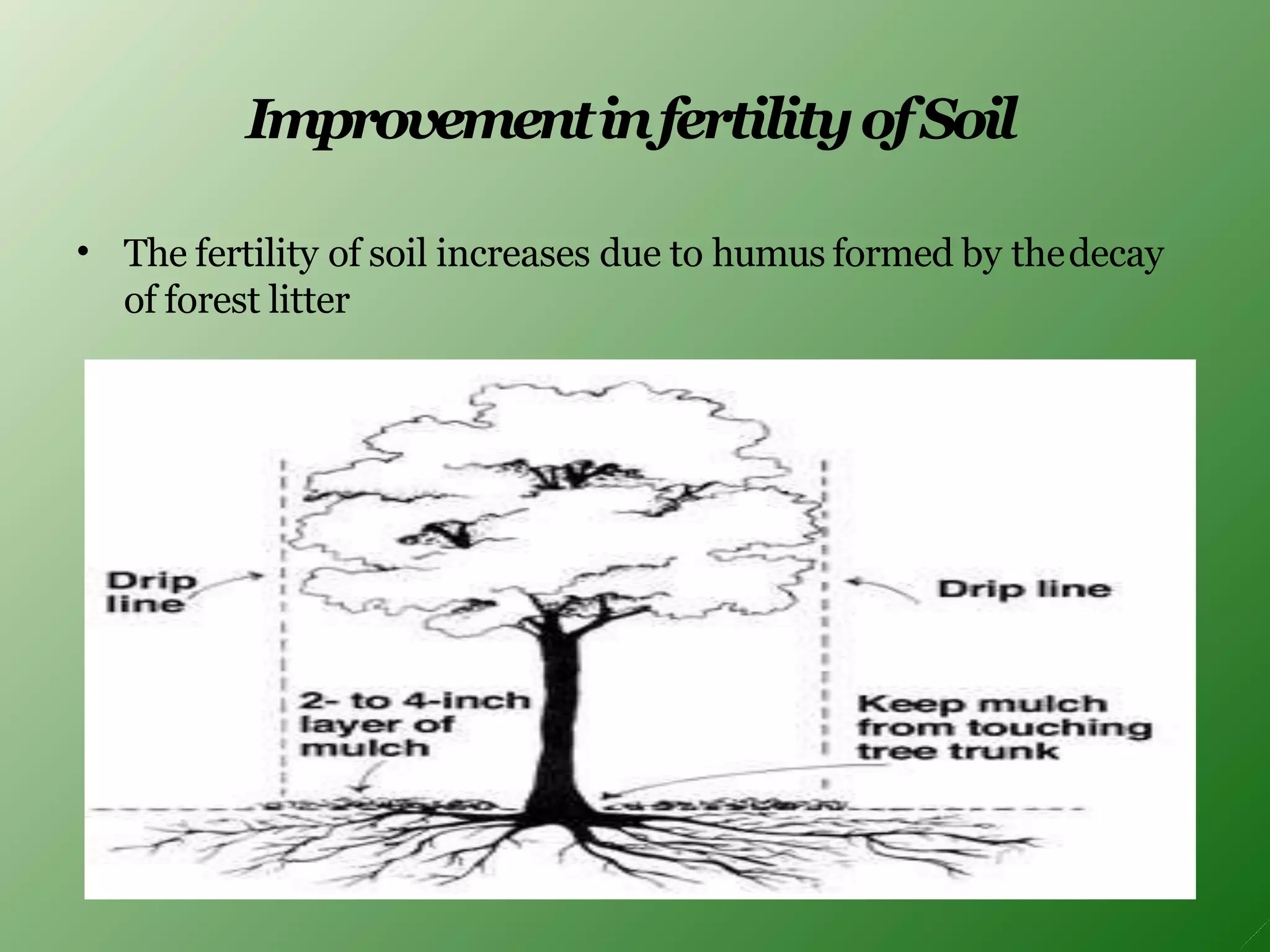
ImprovementinfertilityofSoil
• The fertility of soil increases due to humus formed by thedecay
of forest litter
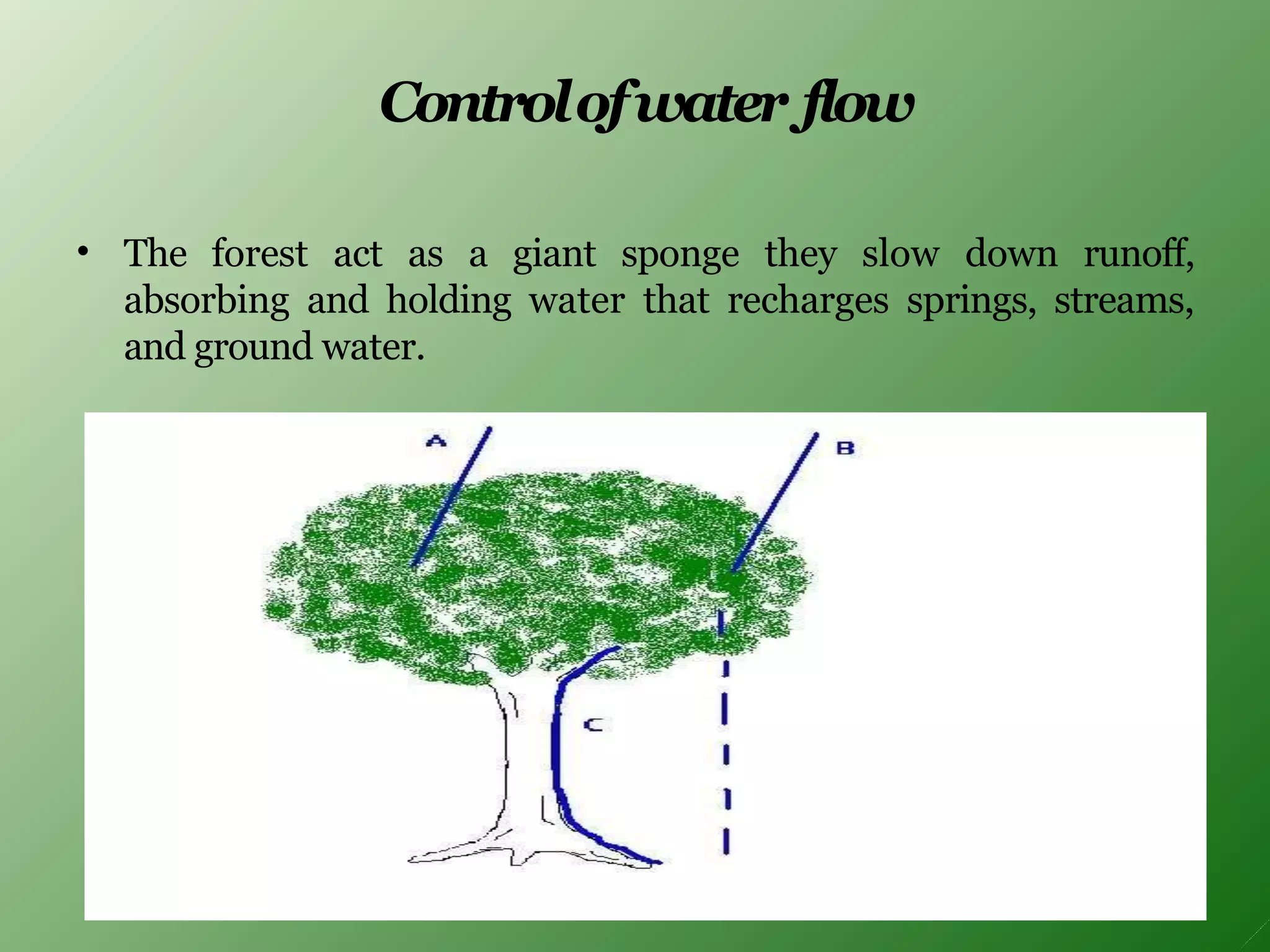
Controlofwater flow
• The forest act as a giant sponge they slow down runoff,
absorbing and holding water that recharges springs, streams,
and ground water.
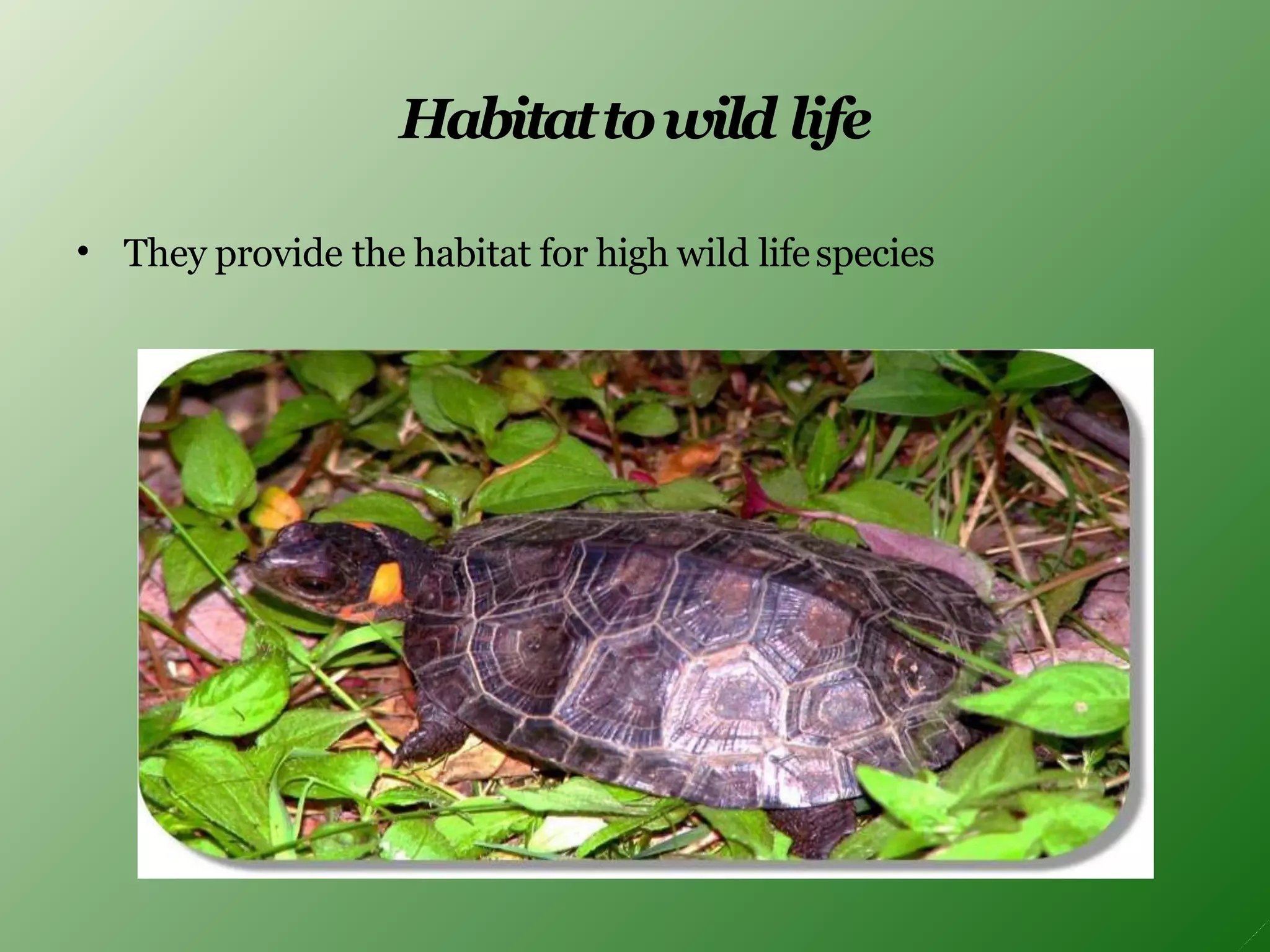
Habitattowild life
• They provide the habitat for high wild lifespecies
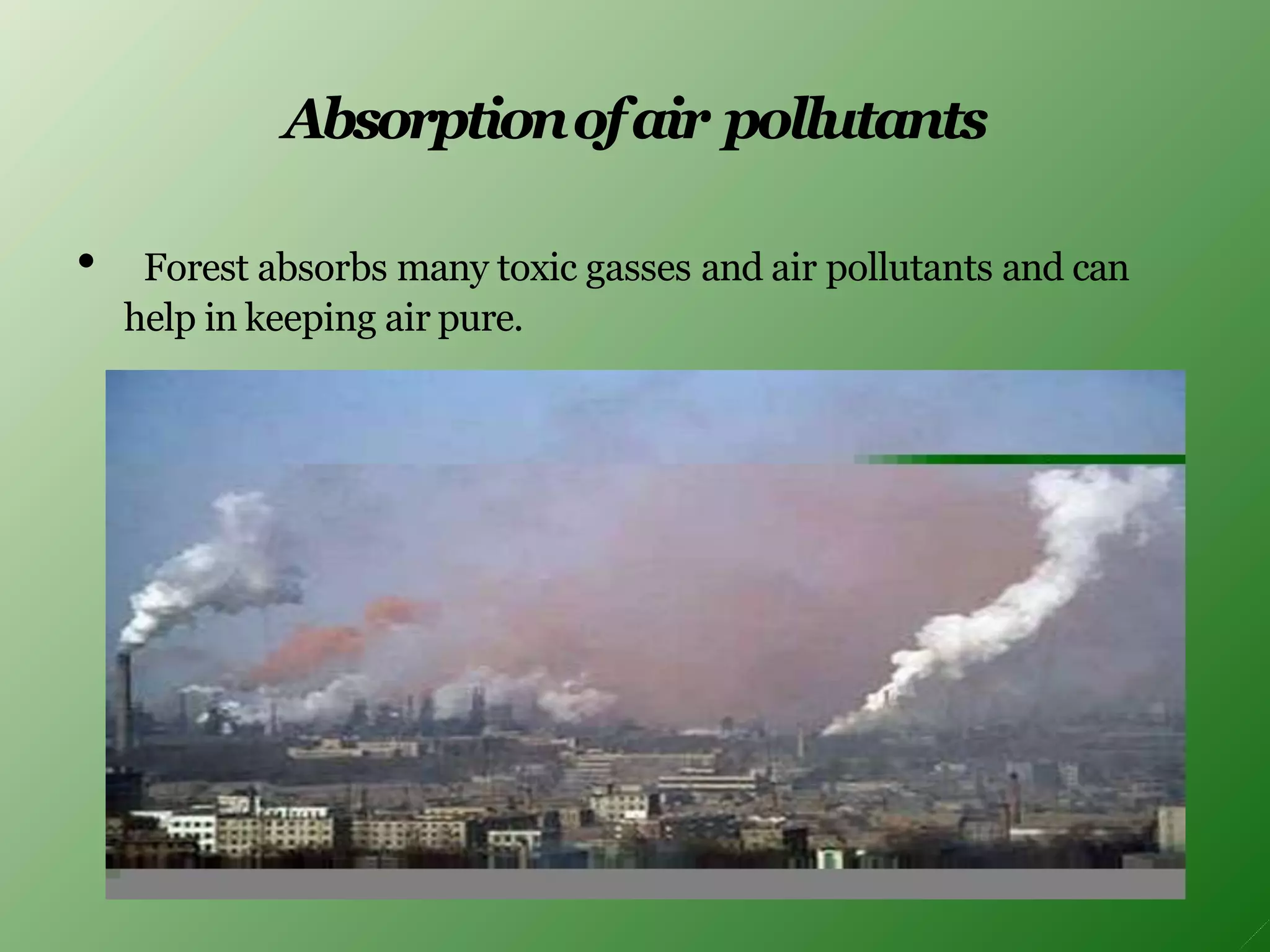
Absorptionofair pollutants
• Forest absorbs many toxic gasses and air pollutants and can
help in keeping air pure.
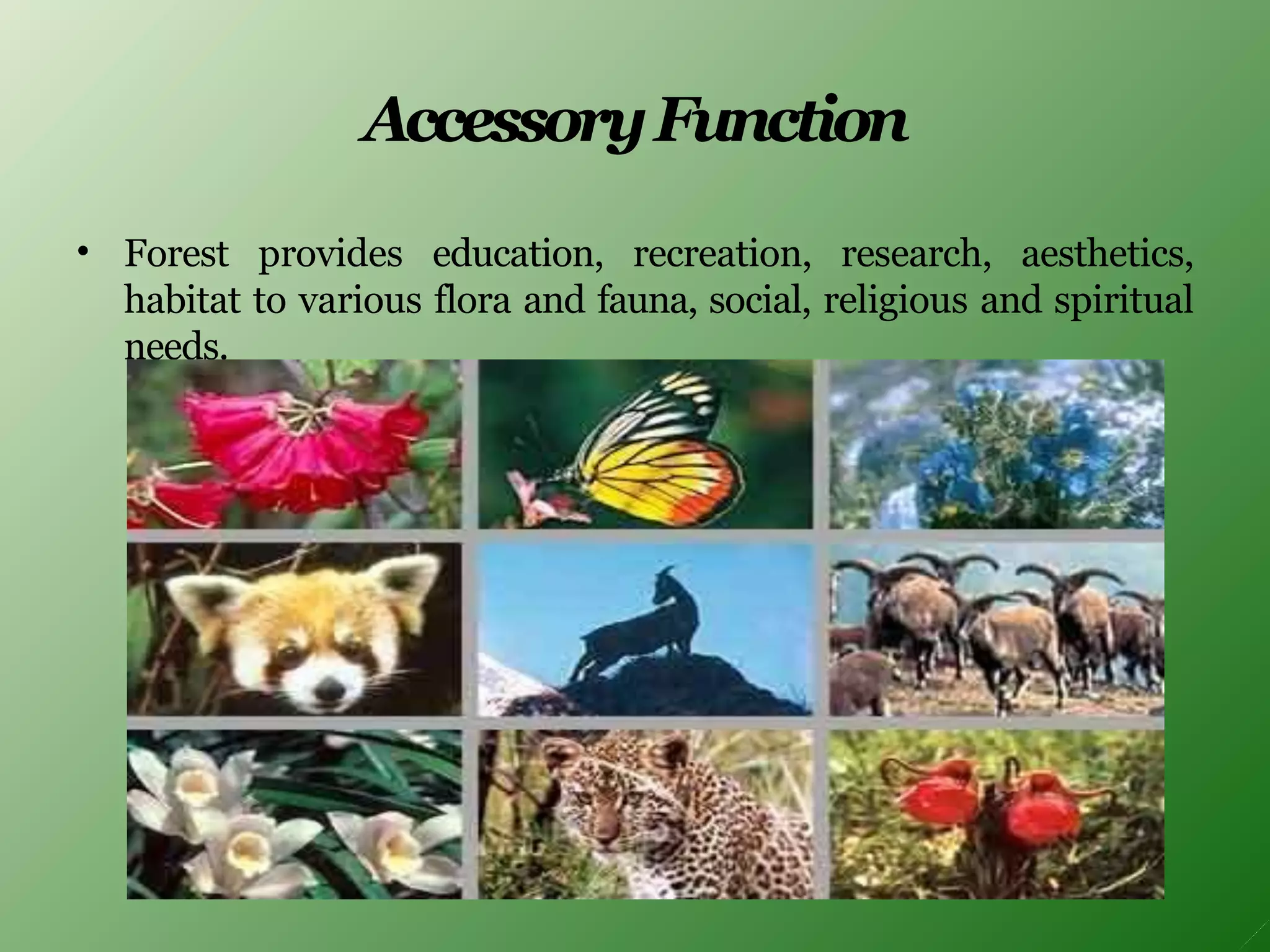
AccessoryFunction
• Forest provides education, recreation, research, aesthetics,
habitat to various flora and fauna, social, religious and spiritual
needs.
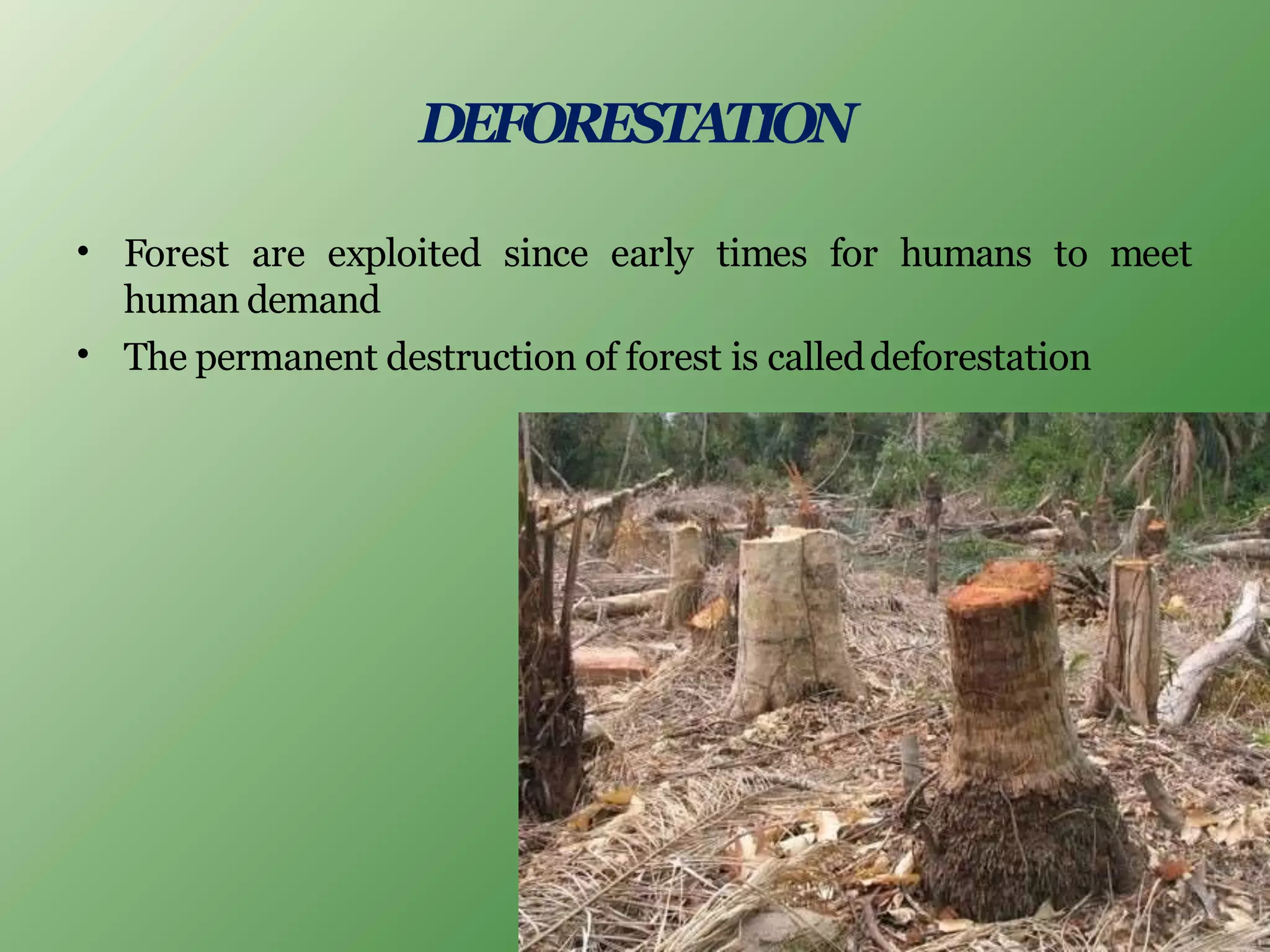
DEFORESTATION
•
•
Forest are exploited since early times for humans to meet
human demand
The permanent destruction of forest is calleddeforestation
Causesof Deforestation
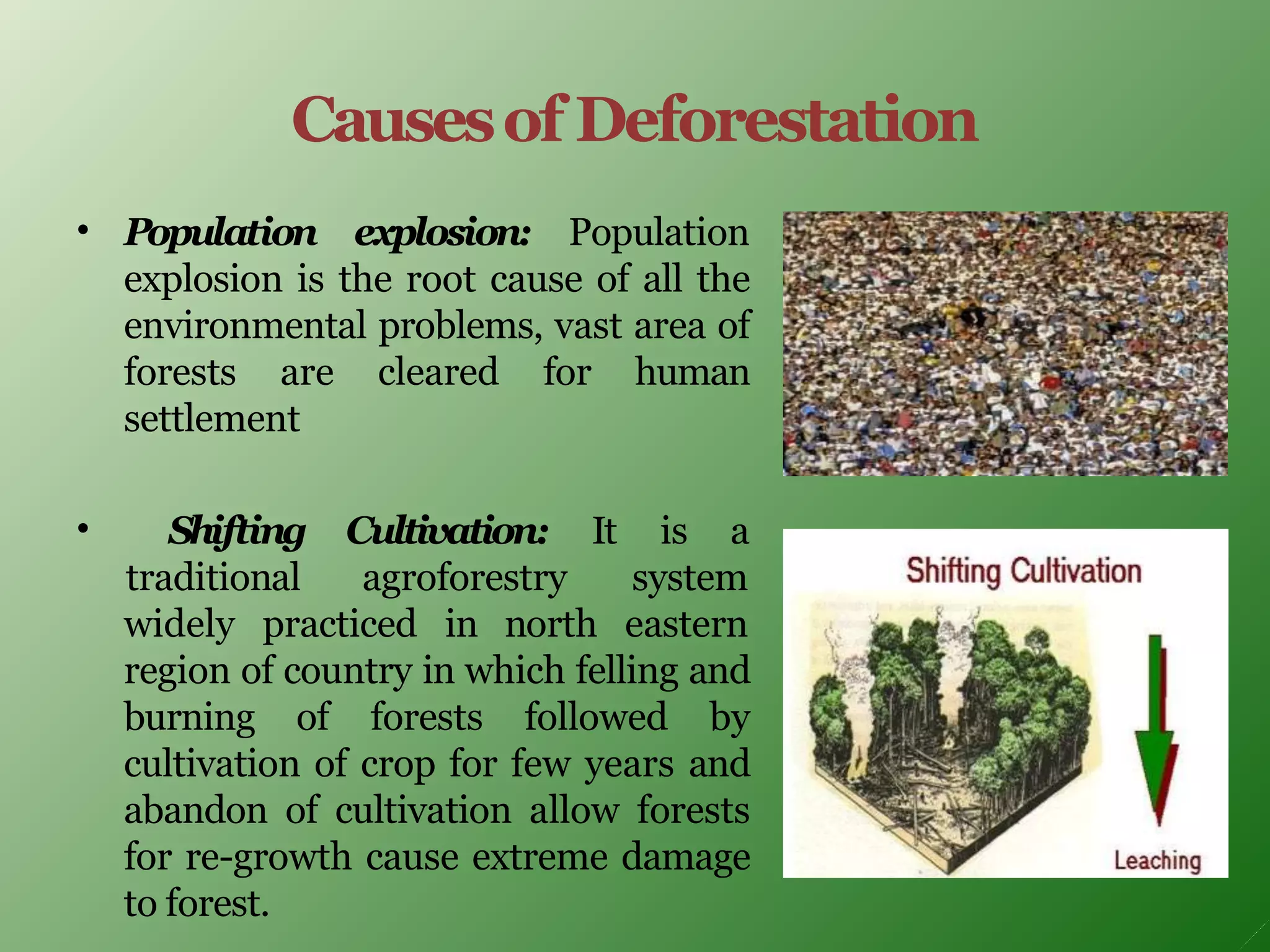
• Population explosion: Population
explosion is the root cause of all the
environmental problems, vast area of
forests are cleared for human
settlement
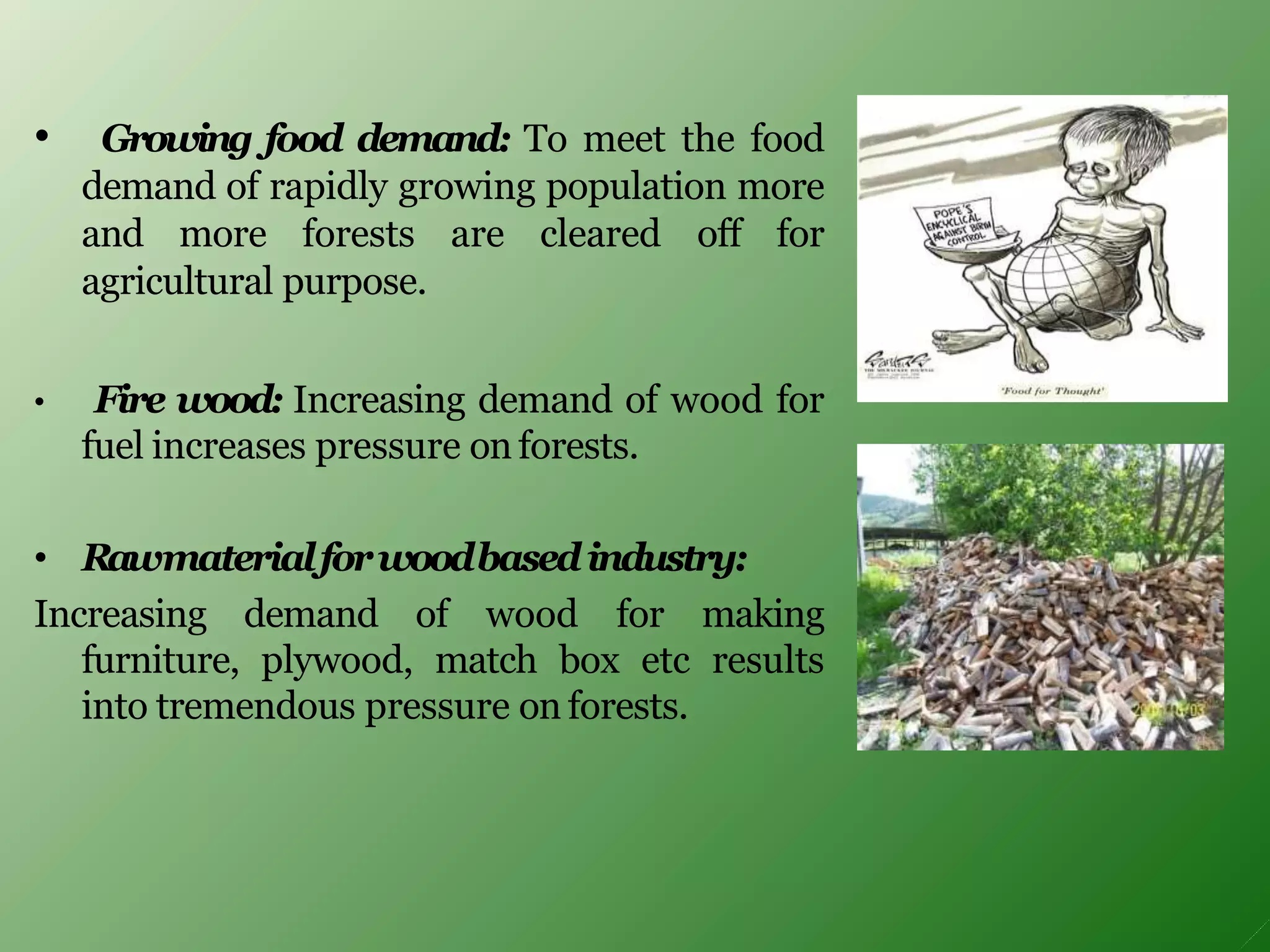
• It is a
Shifting
traditional
Cultivation:
agroforestry system
widely practiced in north eastern
region of country in which felling and
burning of forests followed by
cultivation of crop for few years and
abandon of cultivation allow forests
for re-growth cause extreme damage
to forest.
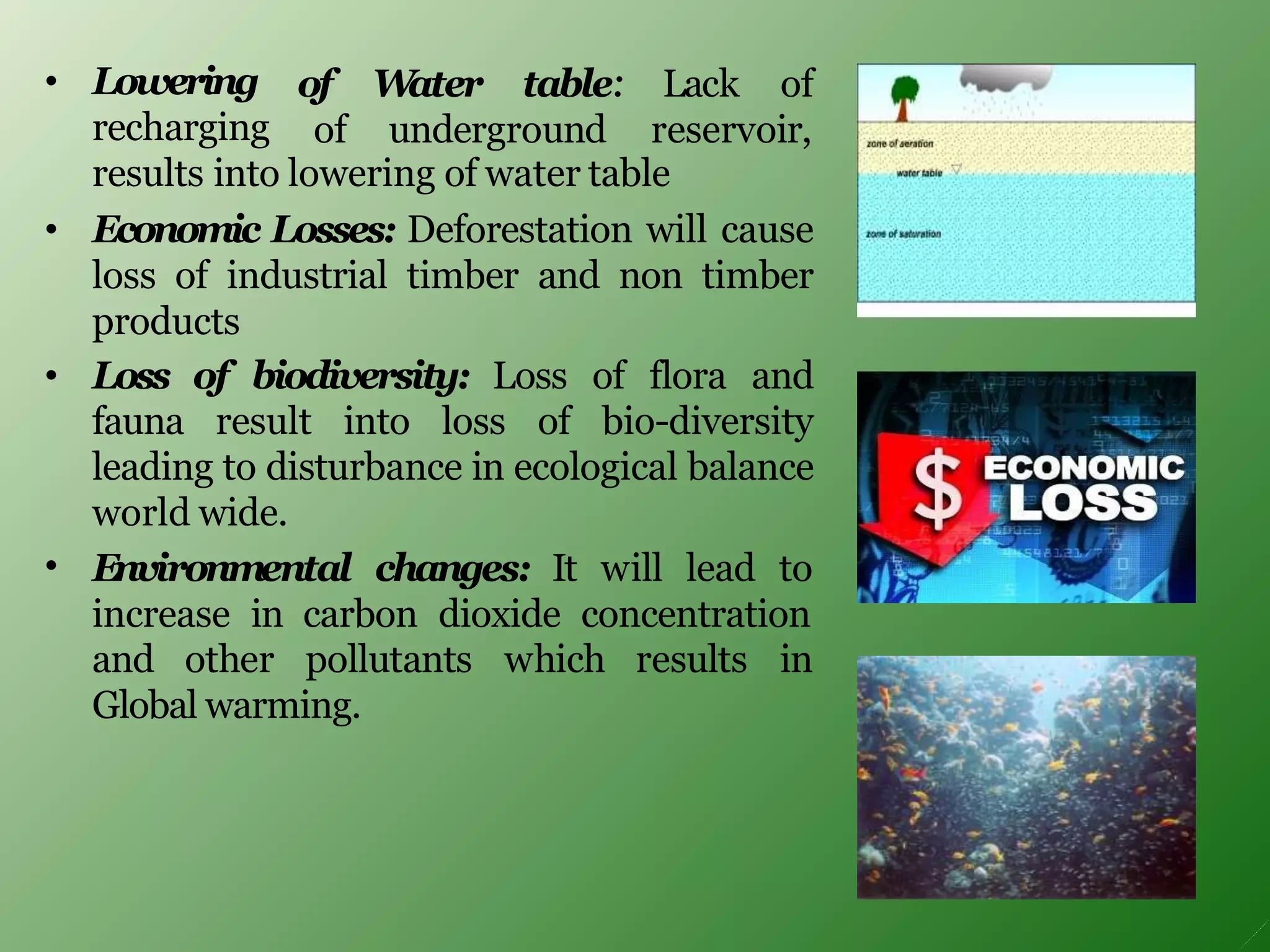
• Growing food demand: To meet the food
demand of rapidly growing population more
and more forests are cleared off for
agricultural purpose.
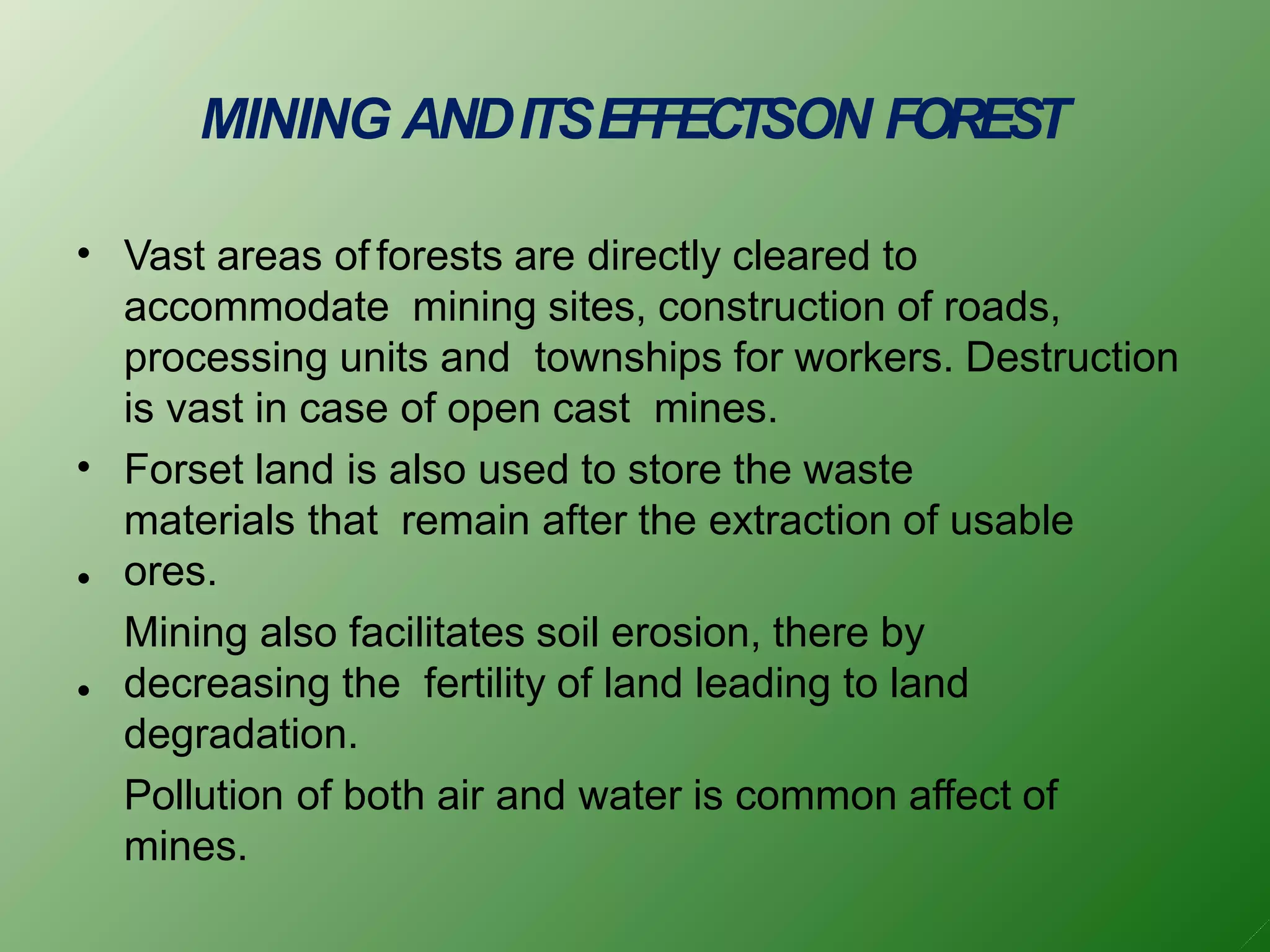
• Fire wood: Increasing demand of wood for
fuel increases pressure on forests.
• Rawmaterialforwoodbasedindustry:
Increasing demand of wood for making
furniture, plywood, match box etc results
into tremendous pressure on forests.
• Infrastructure development: Massive
destruction of forest occurs for various
infrastructure development like, big
dams, highways projects etc.
• Forest fires: Forest fires may be
natural or man made cause a huge loss
of forest
• Overgrazing:Overgrazing of land by
cattle result into soil erosion,
desertification.
• Natural forces: Floods, storms, heavy
winds, snow, lightening are some of
the natural forces
Casestudy-2
• Chipko movement
• Gandhian method of satyagraha
• Commercial looging
• Tactic of tree hugging-ebrace
• April 1973 in upper alakananda
valley
Effectsof Deforestation
• Deforestation adversely affects and
damages the environment
•
•
•
The adverse effect of deforestation are
discussed below:
Soil erosion: The soil gets washed
away with rain water on sloppy areas
in the absence of trees leading to soil
erosion.
Expansion of deserts: Due to strong
winds laden by rock dust, land mass
gradually gets converted in
atmosphere.
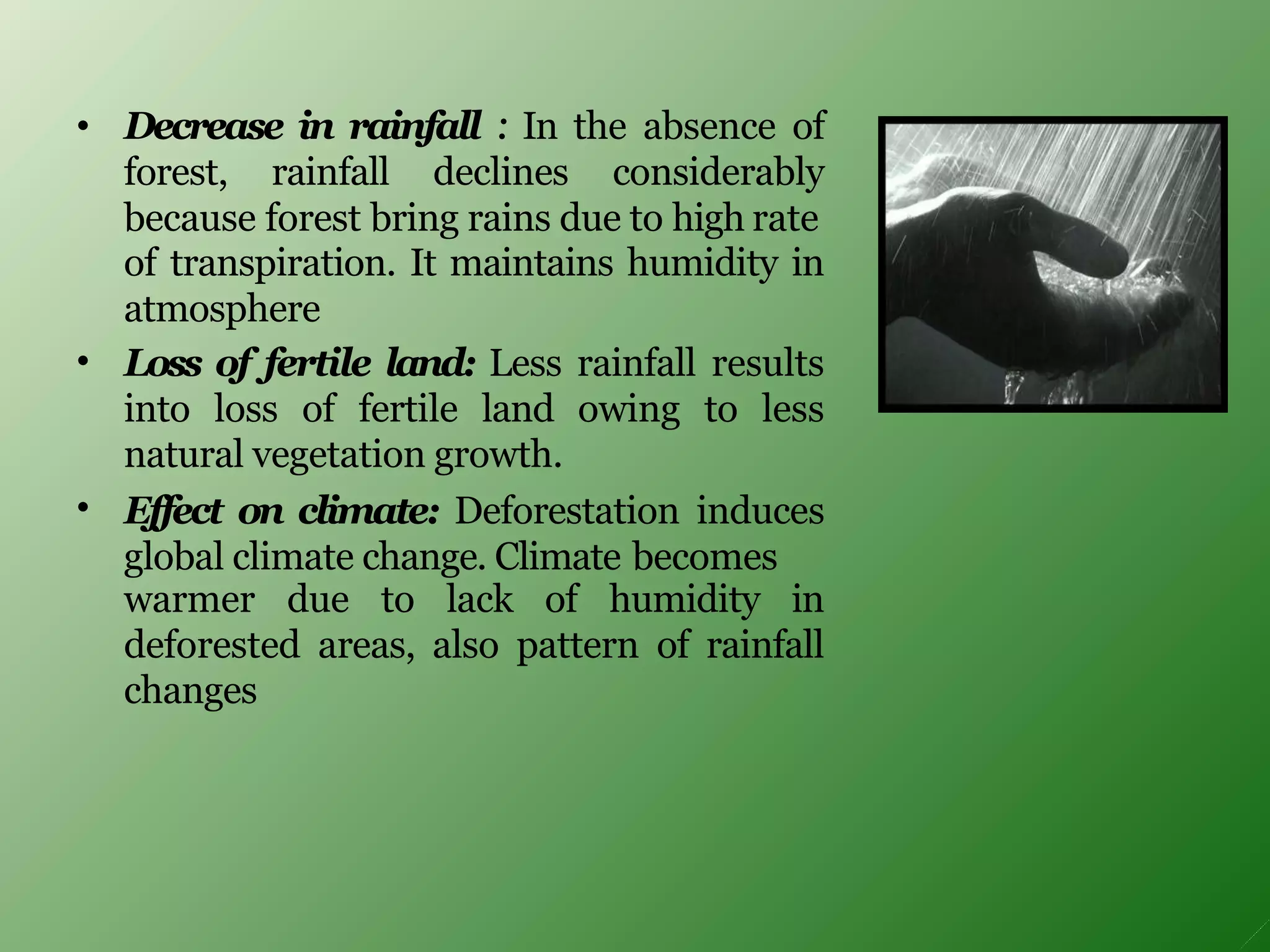
• Decrease in rainfall : In the absence of
forest, rainfall declines considerably
because forest bring rains due to high rate
•
•
of transpiration. It maintains humidity in
atmosphere
Loss of fertile land: Less rainfall results
into loss of fertile land owing to less
natural vegetation growth.
Effect on climate: Deforestation induces
global climate change. Climate becomes
warmer due to lack of humidity in
deforested areas, also pattern of rainfall
changes
• Lowering
recharging
of W
ater table: Lack of
of underground reservoir,
results into lowering of water table
• Economic Losses: Deforestation will cause
loss of industrial timber and non timber
products
• Loss of biodiversity: Loss of flora and
fauna result into loss of bio-diversity
leading to disturbance in ecological balance
world wide.
• Environmental changes: It will lead to
increase in carbon dioxide concentration
and other pollutants which results in
Global warming.
MINING ANDITSEFFECTSON FOREST
•
•
•
•
Vast areas of forests are directly cleared to
accommodate mining sites, construction of roads,
processing units and townships for workers. Destruction
is vast in case of open cast mines.
Forset land is also used to store the waste
materials that remain after the extraction of usable
ores.
Mining also facilitates soil erosion, there by
decreasing the fertility of land leading to land
degradation.
Pollution of both air and water is common affect of
mines.
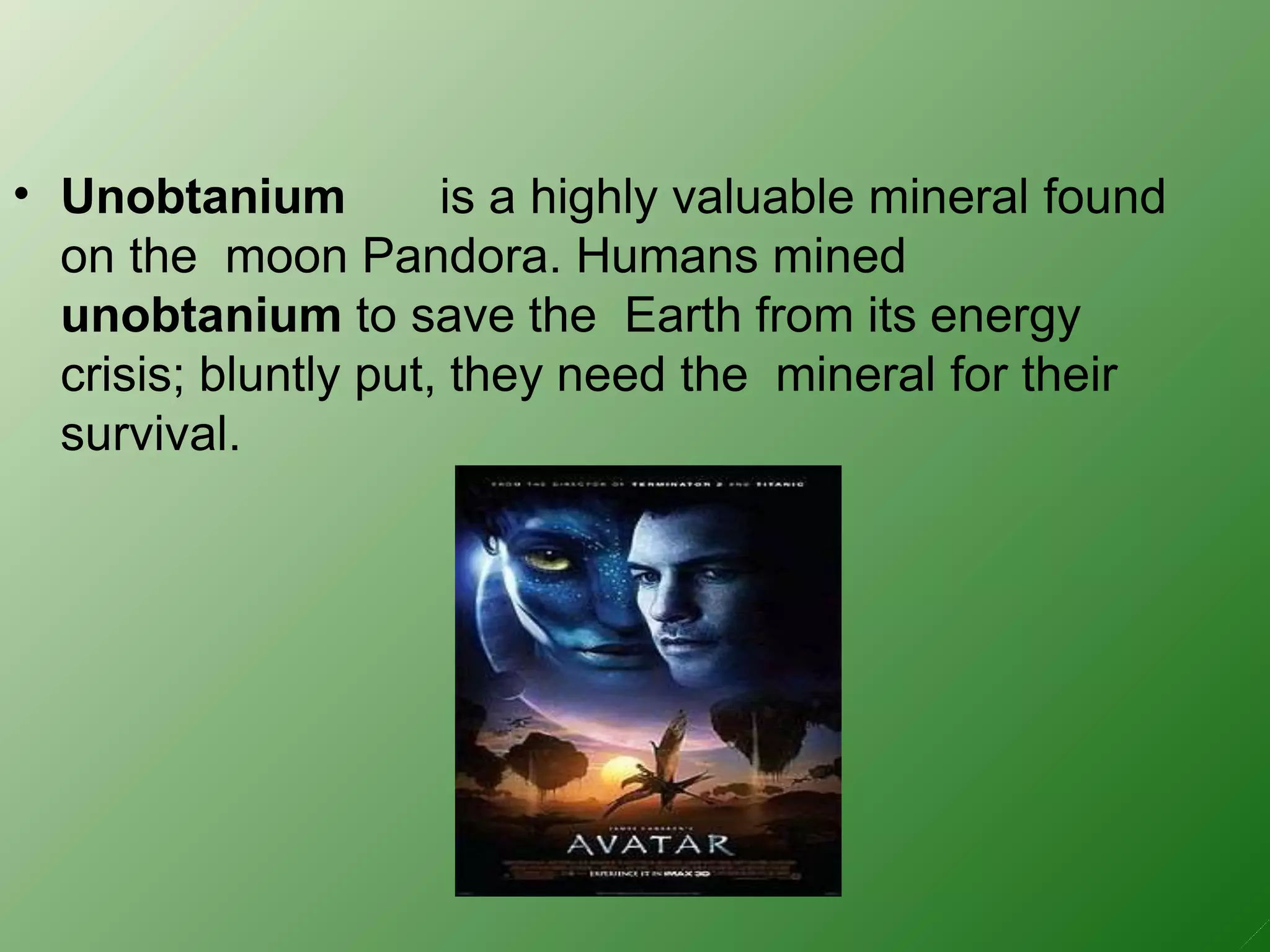
• Unobtanium is a highly valuable mineral found
on the moon Pandora. Humans mined
unobtanium to save the Earth from its energy
crisis; bluntly put, they need the mineral for their
survival.
DAMS AND THEIR EFFECTS ON FOREST
AND TRIBAL PEOPLE
• When a dam is constructed across any river a huge artificial
lake is developed in the catchment area of that dam. It is also
known as back waters. The backwaters covering a large
surface area. Create a lot of ill-effects on the living
•
•
•
•
environment. They are as follows:
It creates the loss of forest which are submerged under the
back waters of the dam.
It creates danger to the habitat of the wild life. The wild life
are forced to migrate.
It also affects the land under cultivation, in the catchment area
as the crops get submerged under water.
The roads, already in existence are put under water after the
construction of dam. So the road network is damaged.
DAMS AND THEIR EFFECTS ON FOREST
AND TRIBAL PEOPLE
•
•
•
The creation of reservoirs in more than 1500 major
river valley projects has flooded 5000 sq. km of
forest land and resulted in their disappearances.
Water logging and Stalinization affects perhaps half the
canal irrigated land in the country, with varying degrees
of severity.
Several sps of wild animal and plants such as river
dolphin Platanista gangetica and Hilsa ilisha have
been pushed to threatened status by dams and
associated impacts.
Contd…
……
•
•
About 50% of the total 18 million people displaced by
dams in india are tribals. The lives and livelihoods of
thses indigenous people suffered heavily. Their forest
based spiritual and cultural existences were also lost
when they were forced to come out of the forest.
Dangerous diseases like malaria developed rapidly
in the command areas of reservoirs which severely
affected the health condition of tribals living in
nearby forest areas.
Case study-
3
• Sardar Sarovar Poject - Narmada
Bacaho Andolan
Case study- 4
• Silent Valley National Park
Forest resources.pptx

Forest resources.pptx

  • 1.
    NATURAL RESOURCES ANDASSOCIATED PROBLEMS 1. FOREST RESOURCES 2. WATER RESOURCES 3. MINERAL RESOURCES 4. FOOD RESOURCES 5. ENERGY RESOURCES 6. LAND RESOURCES
  • 2.
  • 3.
    Topics • INTRODUCTION • USES •OVER-EXPLOITATION • DEFORESTATIONCAUSES&EFFECTS • TIMBEREXTRACTION • MINING • DAMSANDTHEIREFFECTSONFORESTSAND TRIBALPEOPLE
  • 4.
    INTRODUCTION • The wordforest is derived from a Latin word • “ Foris” means Outside • Forest are one of the most important natural resources of the earth. • Approximately 1/3rd of the earth’s total area is covered by forests
  • 5.
    INTRODUCTION • • • • Forest resources playan important role in the economy of any country. It is highly complex, changing environment made up of a living and non living things. Living things include trees, shrubs, wildlife etc. and non-living things include water, nutrients, rocks, sunlight and air. Forest vary a great deal in composition and density and are distinct from meadows and pastures. Forest are important to humans and the natural world. For humans, they have many aesthetics, recreational, economic, historical, cultural and religious values. Forest provide fuel, wood, timber, wildlife, habitat, industrial, forest products, climate regulations, medicinal etc.
  • 6.
    IndianScenario • • InIndia forest coverestimated to be 21.02% of the country's geographical area. (asper2009* data) The total forest cover in India is 6,90,899km2 • Forest cover in India is defined as all lands, more than one hectare in area with a tree canopy density of more than10%.
  • 8.
  • 9.
    Types ofForestsin India MoistTropicalForest a)Tropical wet evergreen: Western Ghats (Maharashtra, Karnataka, Kerala) b)Tropical semi evergreen: Lower hills of western Ghats. c)Tropical moist deciduous: Dehradun, mahableshwar d)Damp Forests: Sunder bans, Bengal delta, and Andaman. a b d c
  • 10.
    • DryTropicalforests: a) Tropicaldry deciduous: Madhya Pradesh, Uttar Pradesh b) Tropical thorn forest: Delhi, Punjab, Gujarat c) Tropical dry evergreen: EasternGhat ( Andhra Pradesh, Tamil Nadu) a b c
  • 11.
    MontanaSubtropical Forests • ConiferousForests a)Subtropicalbroad: Shillong, Nilgiris b)Subtropical pine forest: Arunachal Pradesh, Kashmir c)Sub Tropical dry evergreen: Foot Hills of Himalayas. a b c
  • 12.
    MontanaTemperate Forests a)Montana Wettemperate: Nilgiri, Palmi Hills b) Himalayan wet temperate: Assam, Himachal Pradesh c) Himalayan dry temperate: Kashmir
  • 13.
    SubAlpine Forests a)Moist alpinescrub- high Himalayas b) Dry alpine scrub: Sikkim
  • 14.
    ForestDegradationin India • • • At thebeginning of 20thcentury about 30 % of land in India was covered with forests but by the end of 20thcentury the forest cover was reduced to20% As a result of exploitation, the tropical forest cover in India, is now only reduced to coastal western Ghats and northern India We have a huge population size and a very low precipitate forest area 0.075 Ha per capita as compared to 0.64 ha/ capita of world forest area
  • 15.
    • • • The National forestpolicy has recommended 33 % forest area for plains and 67 % forhills The deforestation rate per unit population in India is lowest among the major tropical countries For effective forest management of country we have to take the confidence of tribal who have been living inforest.
  • 16.
    USESOF FOREST • • • • • The functionsof forest may broadly classified intofollowing categories LOCALCONSUMPTIVEUSE PRODUCTIVEORMARKETUSE ECOSYSTEMSERVICES OTHERUSES
  • 17.
    LOCALCONSUMPTIVEUSE • Food likeroots, fruits, tubers, fish, mushrooms,animalmeate.t.c. Fodderforcattle. • • • • • Fuel Wood: The wood is used as fuel for cooking and other purposes by poor people. Construction material like poles, thatching leaves. Fiber for weaving baskets, ropes, nets, mats. Medicinal plants for treating common diseases.
  • 18.
  • 19.
    Casestudy- 1 TheStoryofKani Tribe • •In December 1987, a team of scientists was on a botanical expedition to western Ghats in Kerala. They took with them a few members of Kani Tribe as their guides. The scientists noticed that the guides were eating a fruit that seemed to keep them energetic even during the tough treks. When the scientists tried it, they too felt a ‘ sudden flush of energy &strength’. The scientists, who were from Tropical Botanic Garden and research Institute (TBGRI). Thiruvananthapuram, secured specimens of the plants and conducted investigations. They found anti-stress and other beneficial properties among the plant’s active ingredients. Using Aarogyappacha, and three other medicinal plants, they formulated a drug and gave it the name jeevani.
  • 20.
    • TBGRI gavethe right to manufacture the drug to a private company, Arya Vaidya Pharmacy (AVP) for a license fee of Rs 1,000,000 and a royalty of two percent. The institute, however, wanted the kanis to get a part of the benefits as compensation for sharing their knowledge of the plants and its properties. The Kanis were to receive half the fee and half the royalty, this was the first case of an indigenous community receiving compensation in exchange for sharing their traditional knowledge of plants and their uses. • The story of Kani tribe informs us about the rich resources & knowledge, that the forests & the local tribes have, to offer, provided they are protected and maintained in their natural form. Aarogyappacha
  • 21.
    PRODUCTIVEORMARKETUSE • Timber: Woodused for commercial purposes like for making furniture and other items like boats, bridges and other day to day uses. Fruits, fiber, honey, gum e.t.c. Cane and bamboo products. • • • Raw material for wood based industries: forest provide raw material for various wood based industries like paper and pulp, sports goods, furniture, match boxes etc.
  • 22.
    ECOSYSTEMSERVICES • Atmospheric andclimate regulation • Erosion control • Watershed protection • Floods and drought control
  • 23.
    ECOSYSTEMSERVICES • Forest Provideprotection against Soil erosion, Droughts, floods, noise, radiations Soilerosion Floods Soilerosion Droughts
  • 26.
    ReductionofGlobal Warming •The maingreen house gas co2is used by forests for photosynthesis process the forest act as a sink for co2there by reducing the green house effect due to co2
  • 27.
    Conservationof Soil • Theyprevent soil erosion by binding the soil particles tightly in their roots. They also reduce the velocity of wind and rain which are chief agents causing erosion
  • 28.
    ImprovementinfertilityofSoil • The fertilityof soil increases due to humus formed by thedecay of forest litter
  • 29.
    Controlofwater flow • Theforest act as a giant sponge they slow down runoff, absorbing and holding water that recharges springs, streams, and ground water.
  • 30.
    Habitattowild life • Theyprovide the habitat for high wild lifespecies
  • 31.
    Absorptionofair pollutants • Forestabsorbs many toxic gasses and air pollutants and can help in keeping air pure.
  • 32.
    AccessoryFunction • Forest provideseducation, recreation, research, aesthetics, habitat to various flora and fauna, social, religious and spiritual needs.
  • 33.
    DEFORESTATION • • Forest are exploitedsince early times for humans to meet human demand The permanent destruction of forest is calleddeforestation
  • 34.
    Causesof Deforestation • Populationexplosion: Population explosion is the root cause of all the environmental problems, vast area of forests are cleared for human settlement • It is a Shifting traditional Cultivation: agroforestry system widely practiced in north eastern region of country in which felling and burning of forests followed by cultivation of crop for few years and abandon of cultivation allow forests for re-growth cause extreme damage to forest.
  • 35.
    • Growing fooddemand: To meet the food demand of rapidly growing population more and more forests are cleared off for agricultural purpose. • Fire wood: Increasing demand of wood for fuel increases pressure on forests. • Rawmaterialforwoodbasedindustry: Increasing demand of wood for making furniture, plywood, match box etc results into tremendous pressure on forests.
  • 36.
    • Infrastructure development:Massive destruction of forest occurs for various infrastructure development like, big dams, highways projects etc. • Forest fires: Forest fires may be natural or man made cause a huge loss of forest • Overgrazing:Overgrazing of land by cattle result into soil erosion, desertification. • Natural forces: Floods, storms, heavy winds, snow, lightening are some of the natural forces
  • 37.
    Casestudy-2 • Chipko movement •Gandhian method of satyagraha • Commercial looging • Tactic of tree hugging-ebrace • April 1973 in upper alakananda valley
  • 38.
    Effectsof Deforestation • Deforestationadversely affects and damages the environment • • • The adverse effect of deforestation are discussed below: Soil erosion: The soil gets washed away with rain water on sloppy areas in the absence of trees leading to soil erosion. Expansion of deserts: Due to strong winds laden by rock dust, land mass gradually gets converted in atmosphere.
  • 39.
    • Decrease inrainfall : In the absence of forest, rainfall declines considerably because forest bring rains due to high rate • • of transpiration. It maintains humidity in atmosphere Loss of fertile land: Less rainfall results into loss of fertile land owing to less natural vegetation growth. Effect on climate: Deforestation induces global climate change. Climate becomes warmer due to lack of humidity in deforested areas, also pattern of rainfall changes
  • 40.
    • Lowering recharging of W atertable: Lack of of underground reservoir, results into lowering of water table • Economic Losses: Deforestation will cause loss of industrial timber and non timber products • Loss of biodiversity: Loss of flora and fauna result into loss of bio-diversity leading to disturbance in ecological balance world wide. • Environmental changes: It will lead to increase in carbon dioxide concentration and other pollutants which results in Global warming.
  • 41.
    MINING ANDITSEFFECTSON FOREST • • • • Vastareas of forests are directly cleared to accommodate mining sites, construction of roads, processing units and townships for workers. Destruction is vast in case of open cast mines. Forset land is also used to store the waste materials that remain after the extraction of usable ores. Mining also facilitates soil erosion, there by decreasing the fertility of land leading to land degradation. Pollution of both air and water is common affect of mines.
  • 42.
    • Unobtanium isa highly valuable mineral found on the moon Pandora. Humans mined unobtanium to save the Earth from its energy crisis; bluntly put, they need the mineral for their survival.
  • 43.
    DAMS AND THEIREFFECTS ON FOREST AND TRIBAL PEOPLE • When a dam is constructed across any river a huge artificial lake is developed in the catchment area of that dam. It is also known as back waters. The backwaters covering a large surface area. Create a lot of ill-effects on the living • • • • environment. They are as follows: It creates the loss of forest which are submerged under the back waters of the dam. It creates danger to the habitat of the wild life. The wild life are forced to migrate. It also affects the land under cultivation, in the catchment area as the crops get submerged under water. The roads, already in existence are put under water after the construction of dam. So the road network is damaged.
  • 44.
    DAMS AND THEIREFFECTS ON FOREST AND TRIBAL PEOPLE • • • The creation of reservoirs in more than 1500 major river valley projects has flooded 5000 sq. km of forest land and resulted in their disappearances. Water logging and Stalinization affects perhaps half the canal irrigated land in the country, with varying degrees of severity. Several sps of wild animal and plants such as river dolphin Platanista gangetica and Hilsa ilisha have been pushed to threatened status by dams and associated impacts.
  • 45.
    Contd… …… • • About 50% ofthe total 18 million people displaced by dams in india are tribals. The lives and livelihoods of thses indigenous people suffered heavily. Their forest based spiritual and cultural existences were also lost when they were forced to come out of the forest. Dangerous diseases like malaria developed rapidly in the command areas of reservoirs which severely affected the health condition of tribals living in nearby forest areas.
  • 46.
    Case study- 3 • SardarSarovar Poject - Narmada Bacaho Andolan Case study- 4 • Silent Valley National Park