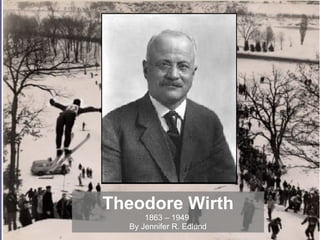
Theodore Wirth 1863 – 1949  By Jennifer R. Edlund
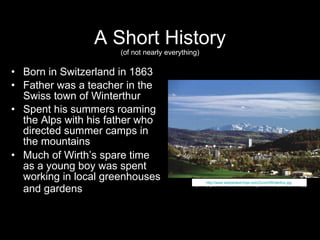
A Short History (of not nearly everything) Born in Switzerland in 1863 Father was a teacher in the Swiss town of Winterthur Spent his summers roaming the Alps with his father who directed summer camps in the mountains Much of Wirth’s spare time as a young boy was spent working in local greenhouses and gardens   http://wwp.greenwichmeantime.com/images/time/europe/switzerland.jpg http://www.switzerland-trips.com/Zurich/Winterthur.jpg
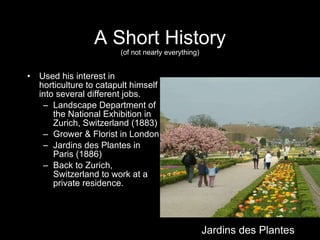
A Short History (of not nearly everything) Used his interest in horticulture to catapult himself into several different jobs.  Landscape Department of the National Exhibition in Zurich, Switzerland (1883) Grower & Florist in London  Jardins des Plantes in Paris (1886) Back to Zurich, Switzerland to work at a private residence. Jardins des Plantes
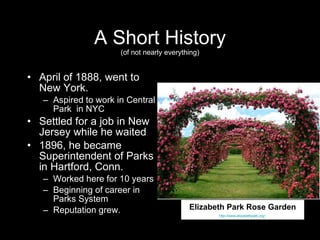
A Short History (of not nearly everything) April of 1888, went to New York. Aspired to work in Central Park  in NYC  Settled for a job in New Jersey while he waited 1896, he became Superintendent of Parks in Hartford, Conn.  Worked here for 10 years  Beginning of career in Parks System Reputation grew. Central Park, New York. http://www.nps.gov/history/history/online_books/park_rec/contents.htm Elizabeth Park Rose Garden http://www.elizabethpark.org/
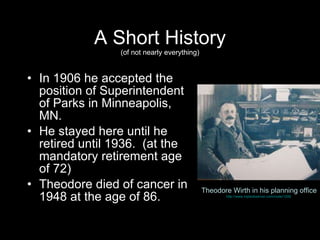
A Short History (of not nearly everything) In 1906 he accepted the position of Superintendent of Parks in Minneapolis, MN. He stayed here until he retired until 1936.  (at the mandatory retirement age of 72) Theodore died of cancer in 1948 at the age of 86.  Theodore Wirth in his planning office http://www.mplsobserver.com/node/1206
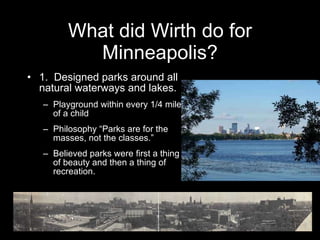
What did Wirth do for Minneapolis? 1.  Designed parks around all natural waterways and lakes. Playground within every 1/4 mile of a child Philosophy “Parks are for the masses, not the classes.” Believed parks were first a thing of beauty and then a thing of recreation.  Theodore Wirth Pool 1941-64
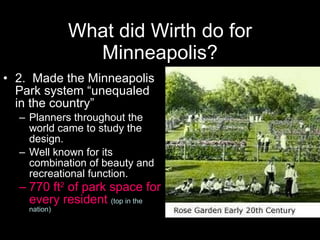
What did Wirth do for Minneapolis? 2.  Made the Minneapolis Park system “unequaled in the country”  Planners throughout the world came to study the design. Well known for its combination of beauty and recreational function. 770 ft 2  of park space for every resident  (top in the nation) Columbia Park http://www.ci.minneapolis.mn.us/neighborhoods/columbiapark_profile_home.asp   Theodore Wirth Park ski jump (1947). Minneapolis Collection, Uncat Photo Parks:  Theodore Wirth Park (formerly Glenwood Park)
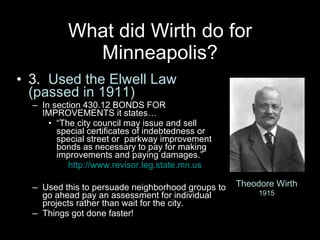
What did Wirth do for Minneapolis? 3.  Used the Elwell Law (passed in 1911) In section 430.12 BONDS FOR IMPROVEMENTS it states…  “ The city council may issue and sell special certificates of indebtedness or special street or  parkway improvement bonds as necessary to pay for making improvements and paying damages.”      http://www.revisor.leg.state.mn.us Used this to persuade neighborhood groups to go ahead pay an assessment for individual projects rather than wait for the city. Things got done faster! Theodore Wirth  1915
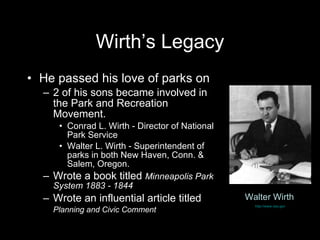
Wirth’s Legacy He passed his love of parks on 2 of his sons became involved in the Park and Recreation Movement. Conrad L. Wirth - Director of National Park Service Walter L. Wirth - Superintendent of parks in both New Haven, Conn. & Salem, Oregon. Wrote a book titled  Minneapolis Park System 1883 - 1844 Wrote an influential article titled  Planning and Civic Comment   Walter Wirth   http://www.nps.gov
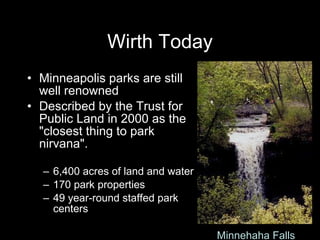
Wirth Today Minneapolis parks are still well renowned  Described by the Trust for Public Land in 2000 as the "closest thing to park nirvana". 6,400 acres of land and water 170 park properties 49 year-round staffed park centers Cherry and the Spoon http://paularmstrongdesigns.com/photos/photos/spoon.jpg Minnehaha Falls
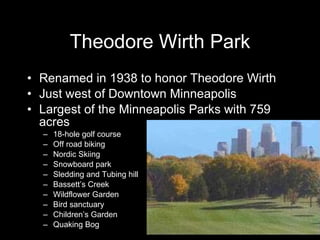
Theodore Wirth Park Renamed in 1938 to honor Theodore Wirth Just west of Downtown Minneapolis Largest of the Minneapolis Parks with 759 acres  18-hole golf course Off road biking Nordic Skiing Snowboard park Sledding and Tubing hill Bassett’s Creek Wildflower Garden Bird sanctuary Children’s Garden Quaking Bog
Annotated Bibliography Wirth, Theodore (1945).  Minneapolis Park System 1883 - 1944: Board of Park Commissioners. This is a book that Theodore Wirth wrote in 1945 about his success as the Superintendent  of the Minneapolis Park System.  It talks about the history of its park system and some of his philosophical ideas behind the planning.
Annotated Bibliography City of Minneapolis Official Website;  http://www.ci.minneapolis.mn.us ;  Visited February 6 ,  2008.  Great search function that directs you to historical cites through out the city’s parks.  A “newer” addition to the list, is the Theodore Wirth House (2002).  Gives a great description of the house, its importance and Theodore’s importance to the city.
Annotated Bibliography National Recreation and Park Association;  ://www.nrpa.org ; visited February 4, 2008 Great resource!  This website gave the best biographical information about Wirth.  It talks about his entire life ventures, not just his role in the development of the Minneapolis Park System.  For a link to the article on Wirth’s Pugsley Award… http://www.nrpa.org/content/default.aspx?documentId=3778
Annotated Bibliography Berthiaume, J.;  Please Walk on the Grass: Wirth-While Legacy of Common Ground; Minneapolis Parks Legacy Society;  http://www.landscapeonline.com/research/article.php?id=8533   This article talks about Wirth’s Mentors, such as Fredrick Law Olmsted, and how they affected his early career.  The article also talks Theodore’s philosophies behind his parks designs, like “parks are for the masses, not the classes”, as well as his legacy he left behind with his children and grandchildren.
Annotated Bibliography Minneapolis Parks and Recreation Board Website;  http://www.minneapolisparks.org ; Visited February 4 th , 2008. This website offers a fantastic look at what Theodore Wirth has left behind, his parks.  Gives both a current and historical overview of the parks.  A great resource for people who live in Minneapolis and are looking for another “secret spot” or visitors who are new to the area.  It has links, maps and overviews of ALL major and minor parks.  This cite even has a link to current plans for Minneapolis’s parks.

Theodore wirth

  • 1.
    Theodore Wirth 1863– 1949 By Jennifer R. Edlund
  • 2.
    A Short History(of not nearly everything) Born in Switzerland in 1863 Father was a teacher in the Swiss town of Winterthur Spent his summers roaming the Alps with his father who directed summer camps in the mountains Much of Wirth’s spare time as a young boy was spent working in local greenhouses and gardens http://wwp.greenwichmeantime.com/images/time/europe/switzerland.jpg http://www.switzerland-trips.com/Zurich/Winterthur.jpg
  • 3.
    A Short History(of not nearly everything) Used his interest in horticulture to catapult himself into several different jobs. Landscape Department of the National Exhibition in Zurich, Switzerland (1883) Grower & Florist in London Jardins des Plantes in Paris (1886) Back to Zurich, Switzerland to work at a private residence. Jardins des Plantes
  • 4.
    A Short History(of not nearly everything) April of 1888, went to New York. Aspired to work in Central Park in NYC Settled for a job in New Jersey while he waited 1896, he became Superintendent of Parks in Hartford, Conn. Worked here for 10 years Beginning of career in Parks System Reputation grew. Central Park, New York. http://www.nps.gov/history/history/online_books/park_rec/contents.htm Elizabeth Park Rose Garden http://www.elizabethpark.org/
  • 5.
    A Short History(of not nearly everything) In 1906 he accepted the position of Superintendent of Parks in Minneapolis, MN. He stayed here until he retired until 1936. (at the mandatory retirement age of 72) Theodore died of cancer in 1948 at the age of 86. Theodore Wirth in his planning office http://www.mplsobserver.com/node/1206
  • 6.
    What did Wirthdo for Minneapolis? 1. Designed parks around all natural waterways and lakes. Playground within every 1/4 mile of a child Philosophy “Parks are for the masses, not the classes.” Believed parks were first a thing of beauty and then a thing of recreation. Theodore Wirth Pool 1941-64
  • 7.
    What did Wirthdo for Minneapolis? 2. Made the Minneapolis Park system “unequaled in the country” Planners throughout the world came to study the design. Well known for its combination of beauty and recreational function. 770 ft 2 of park space for every resident (top in the nation) Columbia Park http://www.ci.minneapolis.mn.us/neighborhoods/columbiapark_profile_home.asp Theodore Wirth Park ski jump (1947). Minneapolis Collection, Uncat Photo Parks: Theodore Wirth Park (formerly Glenwood Park)
  • 8.
    What did Wirthdo for Minneapolis? 3. Used the Elwell Law (passed in 1911) In section 430.12 BONDS FOR IMPROVEMENTS it states… “ The city council may issue and sell special certificates of indebtedness or special street or parkway improvement bonds as necessary to pay for making improvements and paying damages.” http://www.revisor.leg.state.mn.us Used this to persuade neighborhood groups to go ahead pay an assessment for individual projects rather than wait for the city. Things got done faster! Theodore Wirth 1915
  • 9.
    Wirth’s Legacy Hepassed his love of parks on 2 of his sons became involved in the Park and Recreation Movement. Conrad L. Wirth - Director of National Park Service Walter L. Wirth - Superintendent of parks in both New Haven, Conn. & Salem, Oregon. Wrote a book titled Minneapolis Park System 1883 - 1844 Wrote an influential article titled Planning and Civic Comment Walter Wirth http://www.nps.gov
  • 10.
    Wirth Today Minneapolisparks are still well renowned Described by the Trust for Public Land in 2000 as the "closest thing to park nirvana". 6,400 acres of land and water 170 park properties 49 year-round staffed park centers Cherry and the Spoon http://paularmstrongdesigns.com/photos/photos/spoon.jpg Minnehaha Falls
  • 11.
    Theodore Wirth ParkRenamed in 1938 to honor Theodore Wirth Just west of Downtown Minneapolis Largest of the Minneapolis Parks with 759 acres 18-hole golf course Off road biking Nordic Skiing Snowboard park Sledding and Tubing hill Bassett’s Creek Wildflower Garden Bird sanctuary Children’s Garden Quaking Bog
  • 12.
    Annotated Bibliography Wirth,Theodore (1945). Minneapolis Park System 1883 - 1944: Board of Park Commissioners. This is a book that Theodore Wirth wrote in 1945 about his success as the Superintendent of the Minneapolis Park System. It talks about the history of its park system and some of his philosophical ideas behind the planning.
  • 13.
    Annotated Bibliography Cityof Minneapolis Official Website; http://www.ci.minneapolis.mn.us ; Visited February 6 , 2008. Great search function that directs you to historical cites through out the city’s parks. A “newer” addition to the list, is the Theodore Wirth House (2002). Gives a great description of the house, its importance and Theodore’s importance to the city.
  • 14.
    Annotated Bibliography NationalRecreation and Park Association; ://www.nrpa.org ; visited February 4, 2008 Great resource! This website gave the best biographical information about Wirth. It talks about his entire life ventures, not just his role in the development of the Minneapolis Park System. For a link to the article on Wirth’s Pugsley Award… http://www.nrpa.org/content/default.aspx?documentId=3778
  • 15.
    Annotated Bibliography Berthiaume,J.; Please Walk on the Grass: Wirth-While Legacy of Common Ground; Minneapolis Parks Legacy Society; http://www.landscapeonline.com/research/article.php?id=8533 This article talks about Wirth’s Mentors, such as Fredrick Law Olmsted, and how they affected his early career. The article also talks Theodore’s philosophies behind his parks designs, like “parks are for the masses, not the classes”, as well as his legacy he left behind with his children and grandchildren.
  • 16.
    Annotated Bibliography MinneapolisParks and Recreation Board Website; http://www.minneapolisparks.org ; Visited February 4 th , 2008. This website offers a fantastic look at what Theodore Wirth has left behind, his parks. Gives both a current and historical overview of the parks. A great resource for people who live in Minneapolis and are looking for another “secret spot” or visitors who are new to the area. It has links, maps and overviews of ALL major and minor parks. This cite even has a link to current plans for Minneapolis’s parks.