Myths & Facts… Forests,  Carbon, and  Global Warming Doug Heiken
O r e g o n  W i l d (formerly Oregon Natural Resources Council) Mission : To protect and restore Oregon’s wildlands, wildlife, and water as an enduring legacy. Goal : To permanently protect roadless areas and old-growth forest ecosystems. Problem: Climate change threatens forests.   Conserving forests will store carbon and help alleviate a clear threat to earth’s climate and to the forests themselves.
Let’s Face Reality … All net carbon emissions are adverse. None can be considered  insignificant. Nearly everything we do must change.  All ecosystems are important. Forests just happen to store a lot of carbon.  Forest conservation is  part  of the solution to a very large problem.
Forests Really Are the Lungs of the Planet Watch the Planetary Biosphere Breathe Keeling Curve , http://heartspring.net/images/atmospheric_carbon_dioxide.gif
The Essence of Life: Constructing and Deconstructing Carbon Chains Glucose and cellulose are built through  photosynthesis  and broken down to CO 2  by  respiration  and  combustion .
Forests  capture, store, and release  carbon. Forest management affects all three. Relevant carbon pools include  not just live trees , but dead wood, other plants, roots, litter, soil, and wood products.  Method to debunk myths: Find the  grain of truth .  Follow the flow of carbon  from the forest and atmosphere. Consider the  longevity  of carbon in each pool. Understanding forest carbon flows
Systems View: Input-Output Model Ecosystem Carbon Pool:  Live trees, dead wood, soil, forest products Carbon Output to Atmosphere:  Decomposition, respiration, combustion Carbon Input to Forest:   photosynthesis, length of growing season The size of the forest carbon pool is determined by  the  rate  of carbon input relative to output over time
Forest Carbon Storage Following Disturbance
Forest Carbon Storage Following Disturbance clearcut
Disturbance Frequency  Affects Carbon Storage
OVERVIEW Young Forest Myth Wood Products Myth Harvest Myth Fire Myth Tropical Forest Myth Albedo Myth “ Doomsday” Myth Substitution Myth Methane Myth “ No Surprises” Myth Solutions
YOUNG FOREST  MYTH: Fast-growing young forests absorb more carbon and are better for the climate than slow-growing old forests. ——————————————— Reality:   Most old forests are still growing and absorbing carbon.  Old forests  store  far more carbon than young forests.  Mature forests cannot be converted into young forests without losing most of the carbon to the atmosphere.
EXPERTS AGREE “ In contrast to the sink management proposed in the Kyoto protocol, which favors young forest stands,  we argue that preservation of natural old-growth forests may have a larger effect on the carbon cycle than promotion of regrowth . ... [I]ncreasing life-span of the stand, proportionally more carbon can be transferred into a permanent pool of soil carbon ...  replacing unmanaged old-growth forest by young Kyoto stands ... will lead to massive carbon losses to the atmosphere mainly by replacing a large pool with a minute pool of regrowth  and by reducing the flux into a permanent pool of soil organic matter.” Ernst-Detlef Schulze, Christian Wirth, Martin Heimann. CLIMATE CHANGE: Managing Forests After Kyoto. Science 22 September 2000: Vol. 289. no. 5487, pp. 2058 - 2059.
Photosynthesis still happens in old forests.
Old forests store lots of carbon.
“ Dead trees don’t go to heaven.” Olga Krankina
Logging creates  arbon contrast. Logging affects carbon flows: Reduces carbon  capture Reduces carbon  storage Increases carbon  emissions
Where did the carbon go?
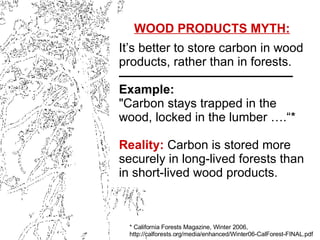
WOOD PRODUCTS MYTH: It’s better to store carbon in wood products, rather than in forests.  —————————————— Example:  "Carbon stays trapped in the wood, locked in the lumber ….“* Reality:   Carbon is stored more securely in long-lived forests than in short-lived wood products.  * California Forests Magazine, Winter 2006,  http://calforests.org/media/enhanced/Winter06-CalForest-FINAL.pdf
Ingerson, Ann L. 2007. U.S. Forest Carbon and Climate Change. Washington, D.C.: The Wilderness Society. Only a small fraction of forest carbon is stored in wood products.  Logging transfers most of the carbon in the forest to the atmosphere as logging slash, mill waste, and processing emissions. Only 15% net storage!
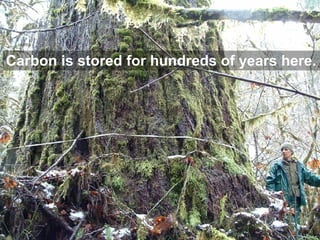
Carbon is stored for hundreds of years here.
Carbon may be stored  for a few years here.
or stored for a some months here…
HARVEST MYTH: Timber harvest “absorbs” carbon. Source: California Forest Products Commission. Modern Forestry & Climate Change.
Ingerson, Ann L. 2007. U.S. Forest Carbon and Climate Change. Washington, D.C.: The Wilderness Society. Reality: logging emits carbon. Just follow the arrows from harvest back to the atmosphere.
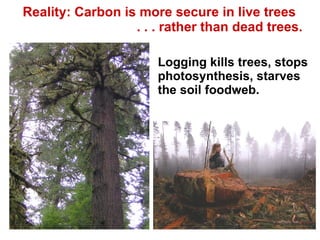
Reality: Carbon is more secure in live trees  . . . rather than dead trees. Logging kills trees, stops photosynthesis, starves the soil foodweb.
Reality: Carbon is safer when protected by tree bark … Living trees have an arsenal of defenses that help keep carbon safe from decay, insects, and fire. rather than paint.
Reality: Carbon is safer in big pieces of wood Logging fragments large wood and increases surface area exposed to microbial decomposition. . . . rather than small.
Reducing canopy cover warms the soil surface and increases the rate of decomposition. Reality: Carbon is more secure in a cool forest  . . . rather than a warm forest.
Reality: Logging debris is burned, emitting carbon.
Summary: Long-lived forests store carbon better … . . . than   short-lived wood products.
FIRE MYTH: Forests are not good places to store carbon because forest fires release stored carbon through combustion. ———————————— Example:  “When a tree burns it releases all the carbon it previously stored.”* * California Forest Products Commission. Modern Forestry & Climate Change.
Reality: Many forests are maintained by fire.
Some trees die … …  so that others may live long and grow large. Fire is an essential ecological process that helps forests stay healthy.
Reality: Fires occur in  limited areas  for a  limited time ,  while photosynthesis dominates everywhere else. Places that don’t burn absorb more carbon  than is released by the places that do burn.
Reality: Fires emit far less carbon than logging. Wayburn, Laurie A., et al. 2000. Forest Carbon in the United States: Opportunities & Options for Private Lands. San Francisco: Pacific Forest Trust.
Reality: Most carbon remains on site after fire. Large dead trees can last for many decades.
Reality: Fire creates charcoal, a stable form of  carbon often incorporated into the soil.
Worst case:  Fire + logging = carbon desert
TROPICAL FOREST MYTH: Forests outside the tropics are unimportant, because they do not contribute significantly to global carbon storage. —————————————— Reality:  Pacific NW temperate rainforests can attain the greatest biomass per acre of any ecosystem on earth. Temperate and boreal forests are very extensive and currently serve as net carbon sinks.
http://www.fao.org/forestry/static/data/fra2005/maps/2.2.jpg
Global Forest Carbon Density Kindermann, et al. 2008. Global cost estimates of reducing carbon emissions through avoided deforestation. Proceedings of the National Academy of Science. July 29, 2008. vol. 105(30) pp 10302–10307.  http://www.pnas.org/content/105/30/10302.full.pdf
http://www.fao.org/forestry/static/data/fra2005/maps/2.7.jpg
ALBEDO MYTH: Forests are dark green, so they exacerbate global warming by absorbing rather than reflecting the sun's energy.
Forests influence climate in 3 ways: Carbon storage –  cooling influence Albedo –   warming influence Evapotranspiration –  cooling influence It’s complicated, but…
Reality: The tension between albedo and carbon storage is most relevant in boreal areas where forests are replaced by snow for long periods.  Albedo is not a big issue in the low elevation temperate forests of the Pacific Northwest that are green virtually all the time.
Reality: Forests also have a cooling effect through cloud formation. Forests transpire a lot of water and emit “cloud condensation nuclei” which helps create reflective clouds that increase albedo.
THE “DOOMSDAY” MYTH: Protecting forests won’t help because climate change will be so extreme, causing forests to release large amounts of carbon due to stress and disturbance. http://www.x-cd.com/mcss04/S01a.pdf
Forests will first … “ Green Up” Then … “ Brown Down” Fire  Insects Drought Longer growing seasons  Drought tolerance CO 2  fertilization Reality: Many forests may  thrive   before they  decline .
The CO 2  enriched atmosphere makes some trees more drought tolerant. With more CO 2  in the air, plants quickly get their fill of carbon, then actively close their stomata which  reduces water loss.
If forests do switch from being carbon sinks to carbon sources, we could exacerbate emissions through misguided logging. i.e. If the carbon emissions from logging forests are added to anticipated emissions from climate-stressed forests, total  carbon emissions will increase.  Reality: Even under extreme climate scenarios,  forest conservation still benefits the climate.
Don’t forget all the other  reasons to protect forests. Forest carbon storage is  complementary  with other important “ecosystem services” that we derive from forests:  Clean Water Fish & Wildlife Habitat Soil Conservation  Quality of Life Economic Diversification Capture, Storage & Release of  Water, Nutrients & Sediment.
Water Wildlife
METHANE   MYTH: Allowing wood to rot in the forest releases methane (CH 4 ) with a warming potential 23 times greater than CO 2 . ——————————— Reality:   Allowing wood to rot in the forest is no worse than wood products that rot in our cities and oxygen-starved landfills.
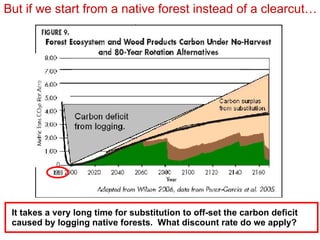
SUBSTITUTION MYTH: Using more wood products reduces carbon emissions because it substitutes for carbon-intensive building materials such as steel and cement. ————————————— Reality:  Substitution is speculative at best because it takes more than a century to off-set the carbon emissions caused by logging mature forests. At best, using wood slightly delays fossil fuel use.
Ingerson, Ann L. 2007. U.S. Forest Carbon and Climate Change. Washington, D.C.: The Wilderness Society. The alleged value of substituting  wood products for steel and concrete.
But if we start from a native forest instead of a clearcut… It takes a very long time for substitution to off-set the carbon deficit caused by logging native forests.  What discount rate do we apply?
SOLUTIONS: Expect surprises.  Correct the market. Conserve forests.
Climate change will be slow. Forests will make a smooth transition to a new equilibrium. ————————————— - Reality:  Accelerating climate change will increase disequilibrium between the climate and biosphere. Reorganization of ecosystems will sometimes be rapid and chaotic.   Ecosystems will disassemble and reassemble in novel ways. Holling et al. In Search of a Theory of Adaptive Change “ NO SURPRISES” MYTH:
Resilience  - Manage ecosystems to be resistant and resilient to change.  Diversity  - Maintain the “library of possibilities” by managing for bio-diversity in all its dimensions.  Spread Risk  - Maintain functional redundancy. Porous landscapes  - Facilitate migration of species. Provide protected areas along climatic gradients. Self-organization  - Where possible, rely on self-organized ecosystem processes, rather than human intervention.  Solution: prepare forests for climate change
Ensure that carbon consequences are reflected in the  price  of wood and other products. This will help: Level the playing field  between wood and alternative materials.  Reduce demand  – e.g., reverse the trend toward larger houses, “supersized” stuff, and excessive packaging. Reuse/Recycle  – e.g., “salvage” wood from old buildings, not forests. Increase longevity  of products – Build things to last. Reward forest owners for conservation. SOLUTION: MARKET CORRECTIONS
Conserve existing large stores of carbon such as old forests and roadless areas. Let young forests grow longer. Extend harvest rotations. During harvest, retain more trees, both live and dead. Avoid uncharacteristic high-severity fire. This might involve removing some small trees. Protect large trees and soil both before, during, and after fire. FOREST  CONSERVATION RECOMMENDATIONS HELP FORESTS “RETAIN” AND “REBUILD” CARBON STORES.
About 1 million acres of mature and old-growth forests remain unprotected on public lands in the northwest. Spotted owl habitat is a great carbon reservoir but the Bush administration is removing safeguards for owl habitat.  BLM is proposing a huge increase in old-growth clearcutting in Western Oregon.  Forest Service and BLM have eliminated protections for biodiversity.  Current policy is going in the wrong direction.
Ingerson, Ann L. 2007. U.S. Forest Carbon and Climate Change. Washington, D.C.: The Wilderness Society. The climate won’t be saved by simply saving forests  …  while continuing to rely on fossil fuels.
It’s not just about forests …
Oceans, prairies, rivers are all at risk, and can play a role in mitigating climate change.
Thanks for listening! Doug Heiken [email_address] www.oregonwild.org Detailed report on forests-carbon-climate available: http://tinyurl.com/2n96m5

Forest, Carbon, Climate Myths

  • 1.
    Myths & Facts…Forests, Carbon, and Global Warming Doug Heiken
  • 2.
    O r eg o n W i l d (formerly Oregon Natural Resources Council) Mission : To protect and restore Oregon’s wildlands, wildlife, and water as an enduring legacy. Goal : To permanently protect roadless areas and old-growth forest ecosystems. Problem: Climate change threatens forests. Conserving forests will store carbon and help alleviate a clear threat to earth’s climate and to the forests themselves.
  • 3.
    Let’s Face Reality… All net carbon emissions are adverse. None can be considered insignificant. Nearly everything we do must change. All ecosystems are important. Forests just happen to store a lot of carbon. Forest conservation is part of the solution to a very large problem.
  • 4.
    Forests Really Arethe Lungs of the Planet Watch the Planetary Biosphere Breathe Keeling Curve , http://heartspring.net/images/atmospheric_carbon_dioxide.gif
  • 5.
    The Essence ofLife: Constructing and Deconstructing Carbon Chains Glucose and cellulose are built through photosynthesis and broken down to CO 2 by respiration and combustion .
  • 6.
    Forests capture,store, and release carbon. Forest management affects all three. Relevant carbon pools include not just live trees , but dead wood, other plants, roots, litter, soil, and wood products. Method to debunk myths: Find the grain of truth . Follow the flow of carbon from the forest and atmosphere. Consider the longevity of carbon in each pool. Understanding forest carbon flows
  • 7.
    Systems View: Input-OutputModel Ecosystem Carbon Pool: Live trees, dead wood, soil, forest products Carbon Output to Atmosphere: Decomposition, respiration, combustion Carbon Input to Forest: photosynthesis, length of growing season The size of the forest carbon pool is determined by the rate of carbon input relative to output over time
  • 8.
    Forest Carbon StorageFollowing Disturbance
  • 9.
    Forest Carbon StorageFollowing Disturbance clearcut
  • 10.
    Disturbance Frequency Affects Carbon Storage
  • 11.
    OVERVIEW Young ForestMyth Wood Products Myth Harvest Myth Fire Myth Tropical Forest Myth Albedo Myth “ Doomsday” Myth Substitution Myth Methane Myth “ No Surprises” Myth Solutions
  • 12.
    YOUNG FOREST MYTH: Fast-growing young forests absorb more carbon and are better for the climate than slow-growing old forests. ——————————————— Reality: Most old forests are still growing and absorbing carbon. Old forests store far more carbon than young forests. Mature forests cannot be converted into young forests without losing most of the carbon to the atmosphere.
  • 13.
    EXPERTS AGREE “In contrast to the sink management proposed in the Kyoto protocol, which favors young forest stands, we argue that preservation of natural old-growth forests may have a larger effect on the carbon cycle than promotion of regrowth . ... [I]ncreasing life-span of the stand, proportionally more carbon can be transferred into a permanent pool of soil carbon ... replacing unmanaged old-growth forest by young Kyoto stands ... will lead to massive carbon losses to the atmosphere mainly by replacing a large pool with a minute pool of regrowth and by reducing the flux into a permanent pool of soil organic matter.” Ernst-Detlef Schulze, Christian Wirth, Martin Heimann. CLIMATE CHANGE: Managing Forests After Kyoto. Science 22 September 2000: Vol. 289. no. 5487, pp. 2058 - 2059.
  • 14.
  • 15.
    Old forests storelots of carbon.
  • 16.
    “ Dead treesdon’t go to heaven.” Olga Krankina
  • 17.
    Logging creates arbon contrast. Logging affects carbon flows: Reduces carbon capture Reduces carbon storage Increases carbon emissions
  • 18.
    Where did thecarbon go?
  • 19.
    WOOD PRODUCTS MYTH:It’s better to store carbon in wood products, rather than in forests. —————————————— Example: "Carbon stays trapped in the wood, locked in the lumber ….“* Reality: Carbon is stored more securely in long-lived forests than in short-lived wood products. * California Forests Magazine, Winter 2006, http://calforests.org/media/enhanced/Winter06-CalForest-FINAL.pdf
  • 20.
    Ingerson, Ann L.2007. U.S. Forest Carbon and Climate Change. Washington, D.C.: The Wilderness Society. Only a small fraction of forest carbon is stored in wood products. Logging transfers most of the carbon in the forest to the atmosphere as logging slash, mill waste, and processing emissions. Only 15% net storage!
  • 21.
    Carbon is storedfor hundreds of years here.
  • 22.
    Carbon may bestored for a few years here.
  • 23.
    or stored fora some months here…
  • 24.
    HARVEST MYTH: Timberharvest “absorbs” carbon. Source: California Forest Products Commission. Modern Forestry & Climate Change.
  • 25.
    Ingerson, Ann L.2007. U.S. Forest Carbon and Climate Change. Washington, D.C.: The Wilderness Society. Reality: logging emits carbon. Just follow the arrows from harvest back to the atmosphere.
  • 26.
    Reality: Carbon ismore secure in live trees . . . rather than dead trees. Logging kills trees, stops photosynthesis, starves the soil foodweb.
  • 27.
    Reality: Carbon issafer when protected by tree bark … Living trees have an arsenal of defenses that help keep carbon safe from decay, insects, and fire. rather than paint.
  • 28.
    Reality: Carbon issafer in big pieces of wood Logging fragments large wood and increases surface area exposed to microbial decomposition. . . . rather than small.
  • 29.
    Reducing canopy coverwarms the soil surface and increases the rate of decomposition. Reality: Carbon is more secure in a cool forest . . . rather than a warm forest.
  • 30.
    Reality: Logging debrisis burned, emitting carbon.
  • 31.
    Summary: Long-lived forestsstore carbon better … . . . than short-lived wood products.
  • 32.
    FIRE MYTH: Forestsare not good places to store carbon because forest fires release stored carbon through combustion. ———————————— Example: “When a tree burns it releases all the carbon it previously stored.”* * California Forest Products Commission. Modern Forestry & Climate Change.
  • 33.
    Reality: Many forestsare maintained by fire.
  • 34.
    Some trees die… … so that others may live long and grow large. Fire is an essential ecological process that helps forests stay healthy.
  • 35.
    Reality: Fires occurin limited areas for a limited time , while photosynthesis dominates everywhere else. Places that don’t burn absorb more carbon than is released by the places that do burn.
  • 36.
    Reality: Fires emitfar less carbon than logging. Wayburn, Laurie A., et al. 2000. Forest Carbon in the United States: Opportunities & Options for Private Lands. San Francisco: Pacific Forest Trust.
  • 37.
    Reality: Most carbonremains on site after fire. Large dead trees can last for many decades.
  • 38.
    Reality: Fire createscharcoal, a stable form of carbon often incorporated into the soil.
  • 39.
    Worst case: Fire + logging = carbon desert
  • 40.
    TROPICAL FOREST MYTH:Forests outside the tropics are unimportant, because they do not contribute significantly to global carbon storage. —————————————— Reality: Pacific NW temperate rainforests can attain the greatest biomass per acre of any ecosystem on earth. Temperate and boreal forests are very extensive and currently serve as net carbon sinks.
  • 41.
  • 42.
    Global Forest CarbonDensity Kindermann, et al. 2008. Global cost estimates of reducing carbon emissions through avoided deforestation. Proceedings of the National Academy of Science. July 29, 2008. vol. 105(30) pp 10302–10307. http://www.pnas.org/content/105/30/10302.full.pdf
  • 43.
  • 44.
    ALBEDO MYTH: Forestsare dark green, so they exacerbate global warming by absorbing rather than reflecting the sun's energy.
  • 45.
    Forests influence climatein 3 ways: Carbon storage – cooling influence Albedo – warming influence Evapotranspiration – cooling influence It’s complicated, but…
  • 46.
    Reality: The tensionbetween albedo and carbon storage is most relevant in boreal areas where forests are replaced by snow for long periods. Albedo is not a big issue in the low elevation temperate forests of the Pacific Northwest that are green virtually all the time.
  • 47.
    Reality: Forests alsohave a cooling effect through cloud formation. Forests transpire a lot of water and emit “cloud condensation nuclei” which helps create reflective clouds that increase albedo.
  • 48.
    THE “DOOMSDAY” MYTH:Protecting forests won’t help because climate change will be so extreme, causing forests to release large amounts of carbon due to stress and disturbance. http://www.x-cd.com/mcss04/S01a.pdf
  • 49.
    Forests will first… “ Green Up” Then … “ Brown Down” Fire Insects Drought Longer growing seasons Drought tolerance CO 2 fertilization Reality: Many forests may thrive before they decline .
  • 50.
    The CO 2 enriched atmosphere makes some trees more drought tolerant. With more CO 2 in the air, plants quickly get their fill of carbon, then actively close their stomata which reduces water loss.
  • 51.
    If forests doswitch from being carbon sinks to carbon sources, we could exacerbate emissions through misguided logging. i.e. If the carbon emissions from logging forests are added to anticipated emissions from climate-stressed forests, total carbon emissions will increase. Reality: Even under extreme climate scenarios, forest conservation still benefits the climate.
  • 52.
    Don’t forget allthe other reasons to protect forests. Forest carbon storage is complementary with other important “ecosystem services” that we derive from forests: Clean Water Fish & Wildlife Habitat Soil Conservation Quality of Life Economic Diversification Capture, Storage & Release of Water, Nutrients & Sediment.
  • 53.
  • 54.
    METHANE MYTH: Allowing wood to rot in the forest releases methane (CH 4 ) with a warming potential 23 times greater than CO 2 . ——————————— Reality: Allowing wood to rot in the forest is no worse than wood products that rot in our cities and oxygen-starved landfills.
  • 55.
    SUBSTITUTION MYTH: Usingmore wood products reduces carbon emissions because it substitutes for carbon-intensive building materials such as steel and cement. ————————————— Reality: Substitution is speculative at best because it takes more than a century to off-set the carbon emissions caused by logging mature forests. At best, using wood slightly delays fossil fuel use.
  • 56.
    Ingerson, Ann L.2007. U.S. Forest Carbon and Climate Change. Washington, D.C.: The Wilderness Society. The alleged value of substituting wood products for steel and concrete.
  • 57.
    But if westart from a native forest instead of a clearcut… It takes a very long time for substitution to off-set the carbon deficit caused by logging native forests. What discount rate do we apply?
  • 58.
    SOLUTIONS: Expect surprises. Correct the market. Conserve forests.
  • 59.
    Climate change willbe slow. Forests will make a smooth transition to a new equilibrium. ————————————— - Reality: Accelerating climate change will increase disequilibrium between the climate and biosphere. Reorganization of ecosystems will sometimes be rapid and chaotic. Ecosystems will disassemble and reassemble in novel ways. Holling et al. In Search of a Theory of Adaptive Change “ NO SURPRISES” MYTH:
  • 60.
    Resilience -Manage ecosystems to be resistant and resilient to change. Diversity - Maintain the “library of possibilities” by managing for bio-diversity in all its dimensions. Spread Risk - Maintain functional redundancy. Porous landscapes - Facilitate migration of species. Provide protected areas along climatic gradients. Self-organization - Where possible, rely on self-organized ecosystem processes, rather than human intervention. Solution: prepare forests for climate change
  • 61.
    Ensure that carbonconsequences are reflected in the price of wood and other products. This will help: Level the playing field between wood and alternative materials. Reduce demand – e.g., reverse the trend toward larger houses, “supersized” stuff, and excessive packaging. Reuse/Recycle – e.g., “salvage” wood from old buildings, not forests. Increase longevity of products – Build things to last. Reward forest owners for conservation. SOLUTION: MARKET CORRECTIONS
  • 62.
    Conserve existing largestores of carbon such as old forests and roadless areas. Let young forests grow longer. Extend harvest rotations. During harvest, retain more trees, both live and dead. Avoid uncharacteristic high-severity fire. This might involve removing some small trees. Protect large trees and soil both before, during, and after fire. FOREST CONSERVATION RECOMMENDATIONS HELP FORESTS “RETAIN” AND “REBUILD” CARBON STORES.
  • 63.
    About 1 millionacres of mature and old-growth forests remain unprotected on public lands in the northwest. Spotted owl habitat is a great carbon reservoir but the Bush administration is removing safeguards for owl habitat. BLM is proposing a huge increase in old-growth clearcutting in Western Oregon. Forest Service and BLM have eliminated protections for biodiversity. Current policy is going in the wrong direction.
  • 64.
    Ingerson, Ann L.2007. U.S. Forest Carbon and Climate Change. Washington, D.C.: The Wilderness Society. The climate won’t be saved by simply saving forests … while continuing to rely on fossil fuels.
  • 65.
    It’s not justabout forests …
  • 66.
    Oceans, prairies, riversare all at risk, and can play a role in mitigating climate change.
  • 67.
    Thanks for listening!Doug Heiken [email_address] www.oregonwild.org Detailed report on forests-carbon-climate available: http://tinyurl.com/2n96m5