By
W.Infant Emiliya
Assistant professor
What is Forensic audit
 A forensic audit examines and evaluates a firm's or
individual's financial records to derive evidence used in
a court of law or legal proceeding.1 Forensic auditing is
a specialization within accounting, and most large
accounting firms have a forensic auditing department.
Forensic audits require accounting and auditing
procedures and expert knowledge about the legal
framework of such an audit.
 A forensic audit is an examination and evaluation of a firm's or individual's
financial records.
 During a forensic audit, an auditor seeks to derive evidence that could
potentially be used in court.
 A forensic audit is used to uncover criminal behaviour such as fraud or
embezzlement.
 When you are a forensic auditor, you specialize in a particular brand of
accounting. Smaller firms may not have a forensic auditor on the payroll,
but most large, commercial accounting firms have forensic auditing
departments.
How Forensic Audits Work
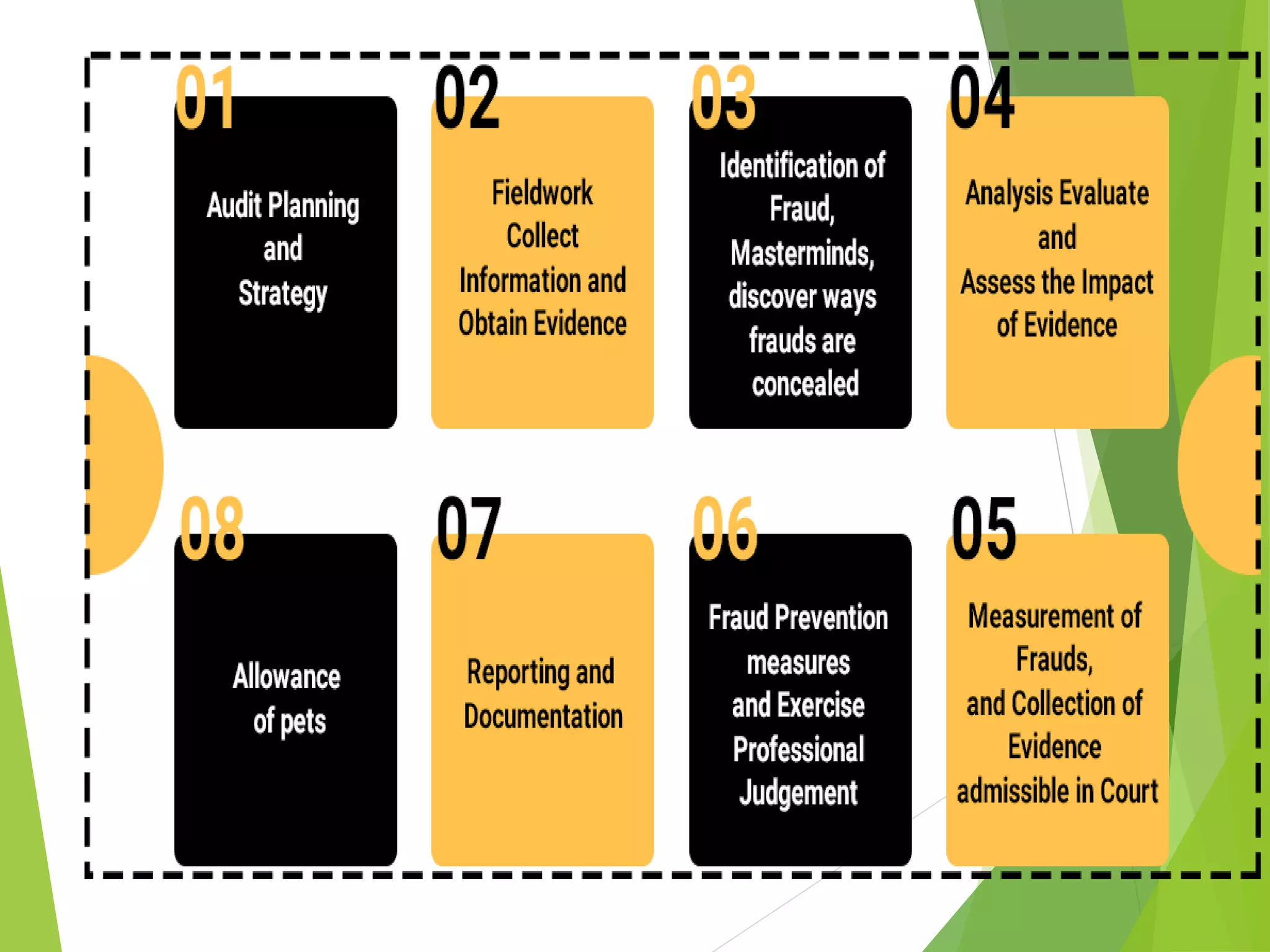
 The process of a forensic audit is similar to a regular
financial audit—planning, collecting evidence, writing a
report—with the additional step of a potential court
appearance. The attorneys for both sides offer evidence
that either uncovers or disproves the fraud and
determines the damages suffered.
Planning the Investigation
During the planning stage, the forensic auditor and team will plan their
investigation to achieve objectives, such as
 Identifying what fraud, if any, is being carried out
 Determining the period during which the fraud occurred
 Discovering how the fraud was concealed
 Naming the perpetrators of the fraud
 Quantifying the loss suffered as a result of the fraud
 Gathering relevant evidence that is admissible in court
 Suggesting measures to prevent such frauds from occurring in the future
Collecting Evidence
 The evidence collected should be adequate to prove the fraudster's
identity (s) in court, reveal the fraud scheme's details, and document the
financial loss suffered and the parties affected by the fraud.
 A logical flow of evidence will help the court in understanding the fraud
and the evidence presented. Forensic auditors are required to take
precautions to ensure that documents and other evidence collected are
not damaged or altered by anyone.
Reporting
 A forensic audit requires a written report about the fraud to be presented
to the client to proceed to file a legal case if they so desire. At a
minimum, the report should include
 The findings of the investigation
 A summary of the evidence collected
 An explanation of how the fraud was perpetrated
 Suggestions for preventing similar frauds in the future—such as improving
internal controls
Court Proceedings
 The forensic auditor must be present during court proceedings to explain
the evidence collected and how the team identified the suspect(s). They
should simplify any complex accounting issues and explain the case in a
layperson’s language so that people who have no understanding of legal or
accounting terms can understand the fraud clearly.
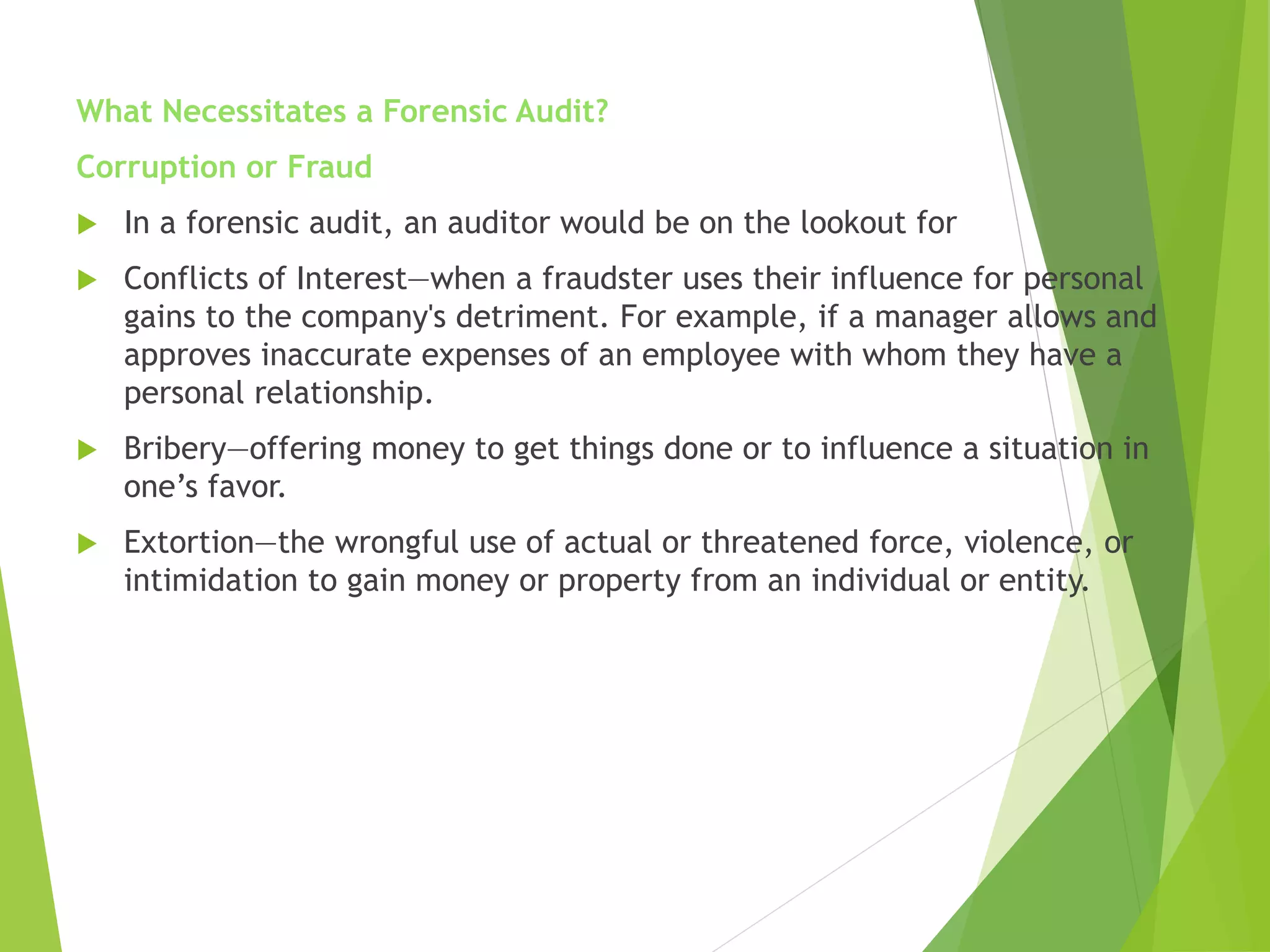
What Necessitates a Forensic Audit?
Corruption or Fraud
 In a forensic audit, an auditor would be on the lookout for
 Conflicts of Interest—when a fraudster uses their influence for personal
gains to the company's detriment. For example, if a manager allows and
approves inaccurate expenses of an employee with whom they have a
personal relationship.
 Bribery—offering money to get things done or to influence a situation in
one’s favor.
 Extortion—the wrongful use of actual or threatened force, violence, or
intimidation to gain money or property from an individual or entity.
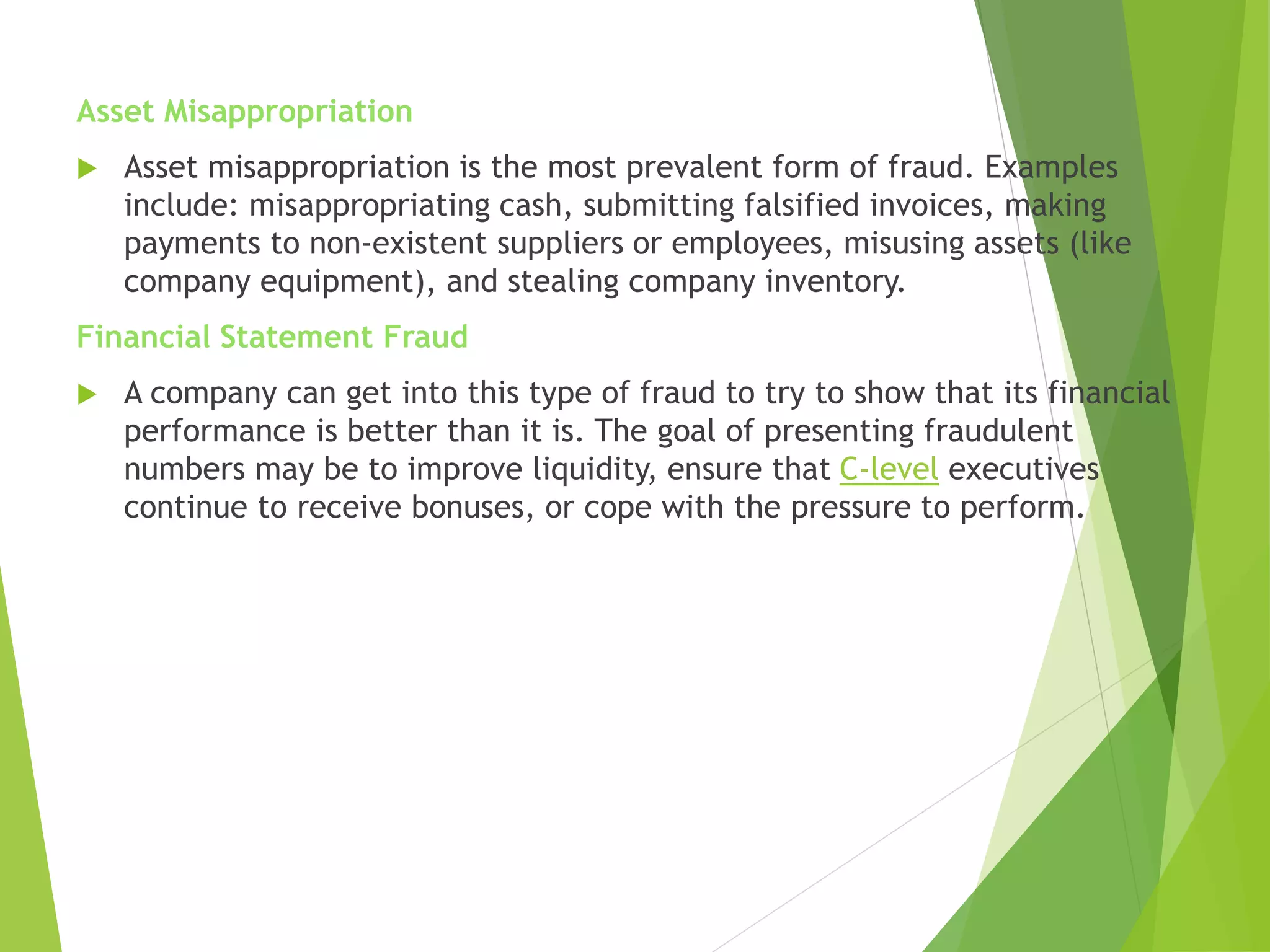
Asset Misappropriation
 Asset misappropriation is the most prevalent form of fraud. Examples
include: misappropriating cash, submitting falsified invoices, making
payments to non-existent suppliers or employees, misusing assets (like
company equipment), and stealing company inventory.
Financial Statement Fraud
 A company can get into this type of fraud to try to show that its financial
performance is better than it is. The goal of presenting fraudulent
numbers may be to improve liquidity, ensure that C-level executives
continue to receive bonuses, or cope with the pressure to perform.
Forensic Audit Procedures

Forensic Audit Procedures

  • 1.
  • 2.
    What is Forensicaudit  A forensic audit examines and evaluates a firm's or individual's financial records to derive evidence used in a court of law or legal proceeding.1 Forensic auditing is a specialization within accounting, and most large accounting firms have a forensic auditing department. Forensic audits require accounting and auditing procedures and expert knowledge about the legal framework of such an audit.
  • 3.
     A forensicaudit is an examination and evaluation of a firm's or individual's financial records.  During a forensic audit, an auditor seeks to derive evidence that could potentially be used in court.  A forensic audit is used to uncover criminal behaviour such as fraud or embezzlement.  When you are a forensic auditor, you specialize in a particular brand of accounting. Smaller firms may not have a forensic auditor on the payroll, but most large, commercial accounting firms have forensic auditing departments.
  • 5.
    How Forensic AuditsWork  The process of a forensic audit is similar to a regular financial audit—planning, collecting evidence, writing a report—with the additional step of a potential court appearance. The attorneys for both sides offer evidence that either uncovers or disproves the fraud and determines the damages suffered.
  • 6.
    Planning the Investigation Duringthe planning stage, the forensic auditor and team will plan their investigation to achieve objectives, such as  Identifying what fraud, if any, is being carried out  Determining the period during which the fraud occurred  Discovering how the fraud was concealed  Naming the perpetrators of the fraud  Quantifying the loss suffered as a result of the fraud  Gathering relevant evidence that is admissible in court  Suggesting measures to prevent such frauds from occurring in the future
  • 7.
    Collecting Evidence  Theevidence collected should be adequate to prove the fraudster's identity (s) in court, reveal the fraud scheme's details, and document the financial loss suffered and the parties affected by the fraud.  A logical flow of evidence will help the court in understanding the fraud and the evidence presented. Forensic auditors are required to take precautions to ensure that documents and other evidence collected are not damaged or altered by anyone.
  • 8.
    Reporting  A forensicaudit requires a written report about the fraud to be presented to the client to proceed to file a legal case if they so desire. At a minimum, the report should include  The findings of the investigation  A summary of the evidence collected  An explanation of how the fraud was perpetrated  Suggestions for preventing similar frauds in the future—such as improving internal controls Court Proceedings  The forensic auditor must be present during court proceedings to explain the evidence collected and how the team identified the suspect(s). They should simplify any complex accounting issues and explain the case in a layperson’s language so that people who have no understanding of legal or accounting terms can understand the fraud clearly.
  • 9.
    What Necessitates aForensic Audit? Corruption or Fraud  In a forensic audit, an auditor would be on the lookout for  Conflicts of Interest—when a fraudster uses their influence for personal gains to the company's detriment. For example, if a manager allows and approves inaccurate expenses of an employee with whom they have a personal relationship.  Bribery—offering money to get things done or to influence a situation in one’s favor.  Extortion—the wrongful use of actual or threatened force, violence, or intimidation to gain money or property from an individual or entity.
  • 10.
    Asset Misappropriation  Assetmisappropriation is the most prevalent form of fraud. Examples include: misappropriating cash, submitting falsified invoices, making payments to non-existent suppliers or employees, misusing assets (like company equipment), and stealing company inventory. Financial Statement Fraud  A company can get into this type of fraud to try to show that its financial performance is better than it is. The goal of presenting fraudulent numbers may be to improve liquidity, ensure that C-level executives continue to receive bonuses, or cope with the pressure to perform.