ANTI MONEY
  LAUNDERING
P O L I T I C A L LY E X P O S E D P E R S O N S


                 Presented by:
                  Besart Qerimi
            besart.qerimi@gmail.com
                       2011
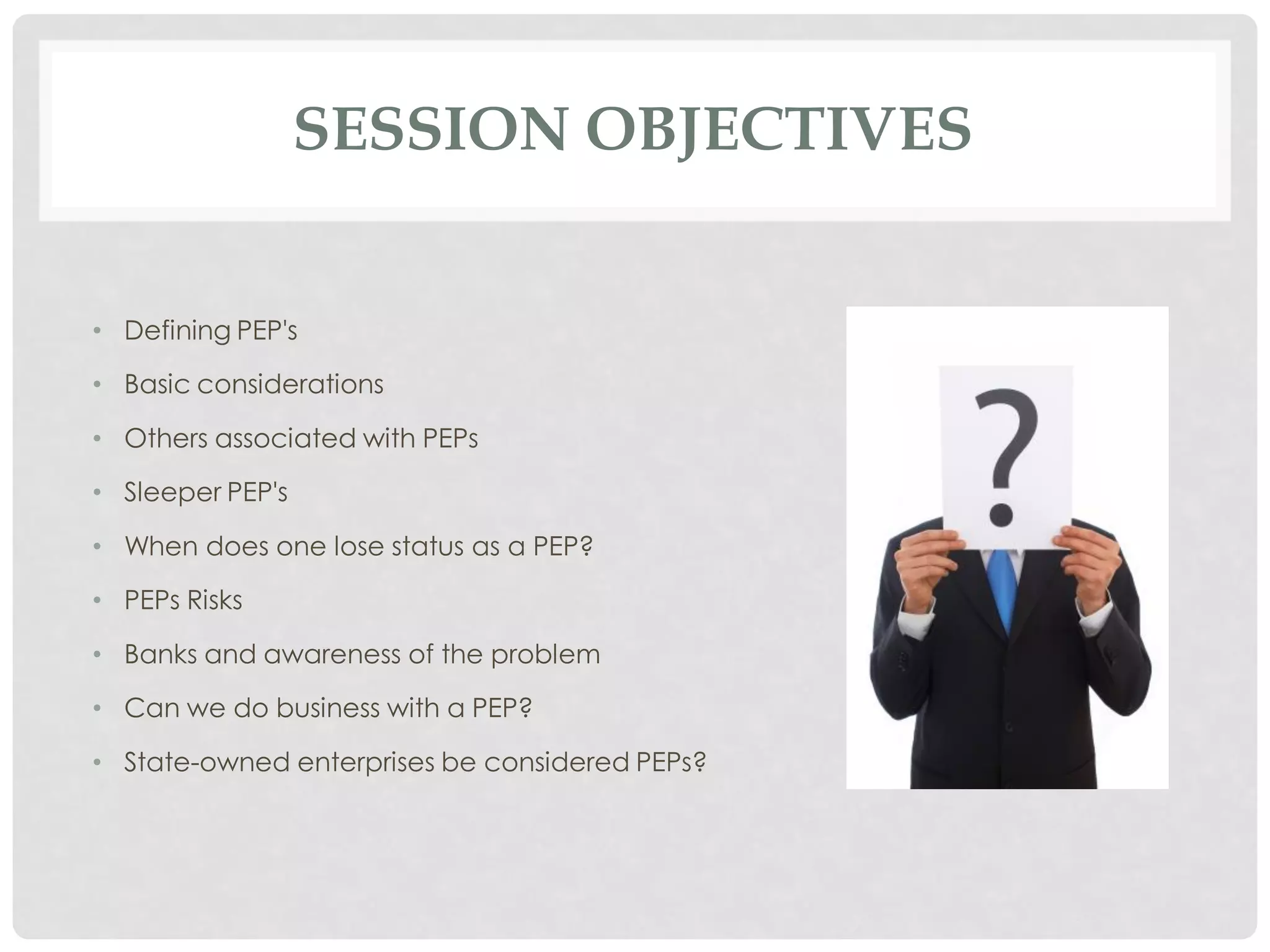
SESSION OBJECTIVES


• Defining PEP's

• Basic considerations

• Others associated with PEPs

• Sleeper PEP's

• When does one lose status as a PEP?

• PEPs Risks

• Banks and awareness of the problem

• Can we do business with a PEP?

• State-owned enterprises be considered PEPs?
DEFINING POLITICALLY EXPOSED
             PERSONS


“Politically Exposed Persons”(PEPs) are individuals who are or have been entrusted

with prominent public functions in a foreign country, for example Heads of State or of
government, senior politicians, senior government, judicial or military officials, senior
executives of state owned corporations, important political party officials. Business
relationships with family members or close associates of PEPs involve reputational risks
similar to those with PEPs themselves. The definition is not intended to cover middle
ranking or more junior individuals in the foregoing categories.”


                                                                Financial Action Task Force
SHOULD STATE-OWNED ENTERPRISES
     BE CONSIDERED PEPS?

• State-owned        enterprises,     including
  central banks, should not be considered
  PEPs.


• The individuals who manage and run
  the state-owned enterprise at senior
  levels, however, could qualify as PEP


• All   state-owned     enterprises   are   not
  necessarily low risk, such entities should
  be      assessed   using   appropriate    risk
  factors.
HOW CAN A PEP OR THEIR “CLOSE FAMILY OR
        ASSOCIATES” BE IDENTIFIED?


• Making enquiries regarding PEP status
  of potential customers during the
  account opening process


• Screening potential customers against
  a database of such persons. (e.g.
  developed internally, provided by an
  external service provider-world check,
  down jones)
FINANCIAL INSTITUTIONS


• Financial institutions should, in relation to politically exposed persons, should:

   • Have appropriate risk management systems to determine whether the
      customer is a politically exposed person

   • Apply appropriate enhanced procedures and controls

   • Obtain senior management approval

   • Take reasonable measures to establish the source of wealth and source of funds

   • Conduct enhanced ongoing monitoring of the business relationship

   • PEPs are a special category of customers, all designated as high risk for money
      laundering.

                                                           New FATF Recommendation 12
APPLYING A RISK-BASED APPROACH


• It is flexible

• It is effective

• It is proportionate
HOW LONG DOES ONE REMAIN A PEP?


• The Wolfsberg Group provides the
  following insight into its interpretation
  of the „expiration date‟ on a PEP:

“Rule of thumb“: 1 year after giving up
           any political function.


• The latest EU working paper on the
  Third Money Laundering Directive
  and FATF do not mention any time
  limit.
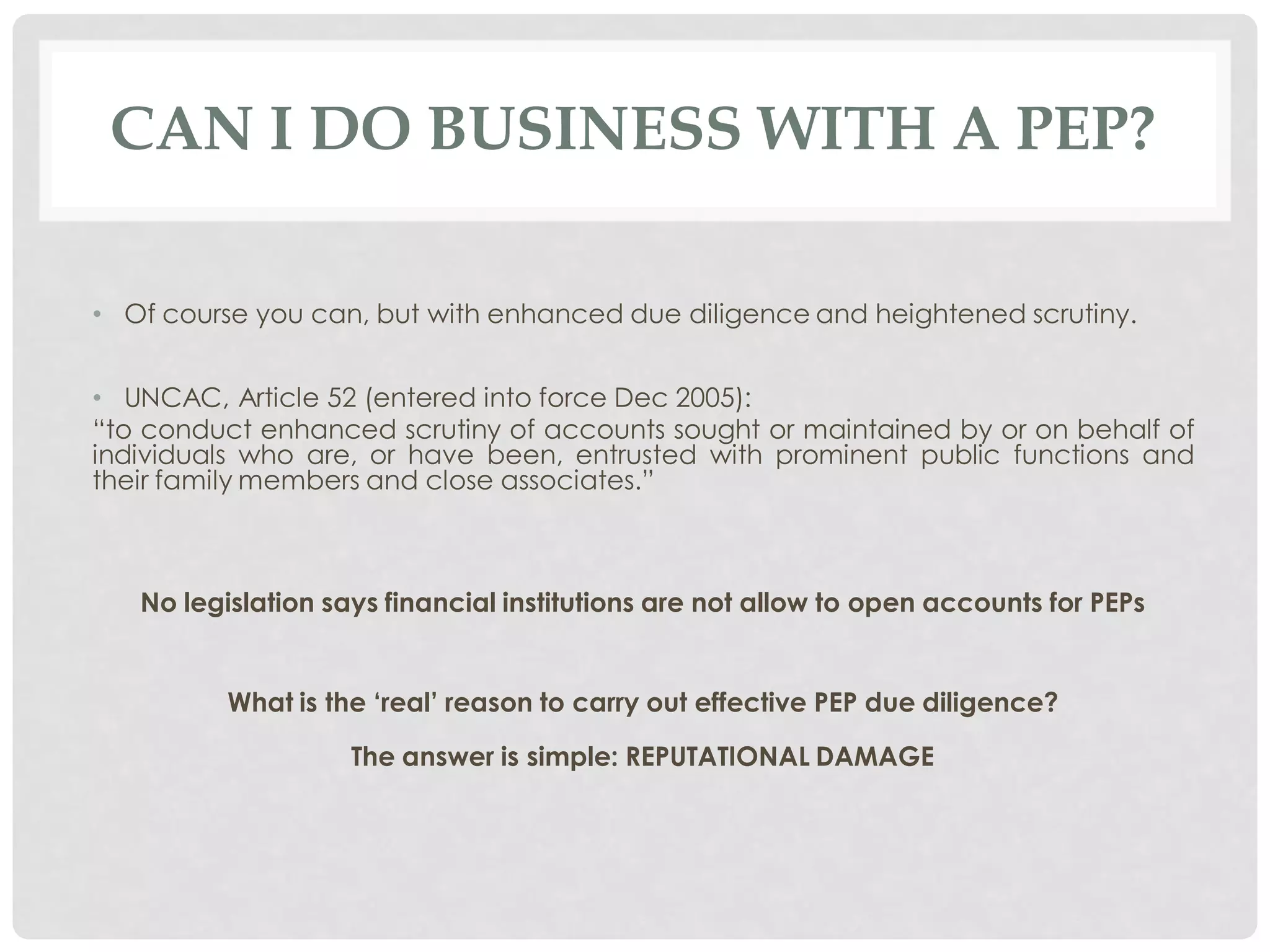
CAN I DO BUSINESS WITH A PEP?

• Of course you can, but with enhanced due diligence and heightened scrutiny.


• UNCAC, Article 52 (entered into force Dec 2005):
“to conduct enhanced scrutiny of accounts sought or maintained by or on behalf of
individuals who are, or have been, entrusted with prominent public functions and
their family members and close associates.”


   No legislation says financial institutions are not allow to open accounts for PEPs


          What is the „real‟ reason to carry out effective PEP due diligence?

                    The answer is simple: REPUTATIONAL DAMAGE
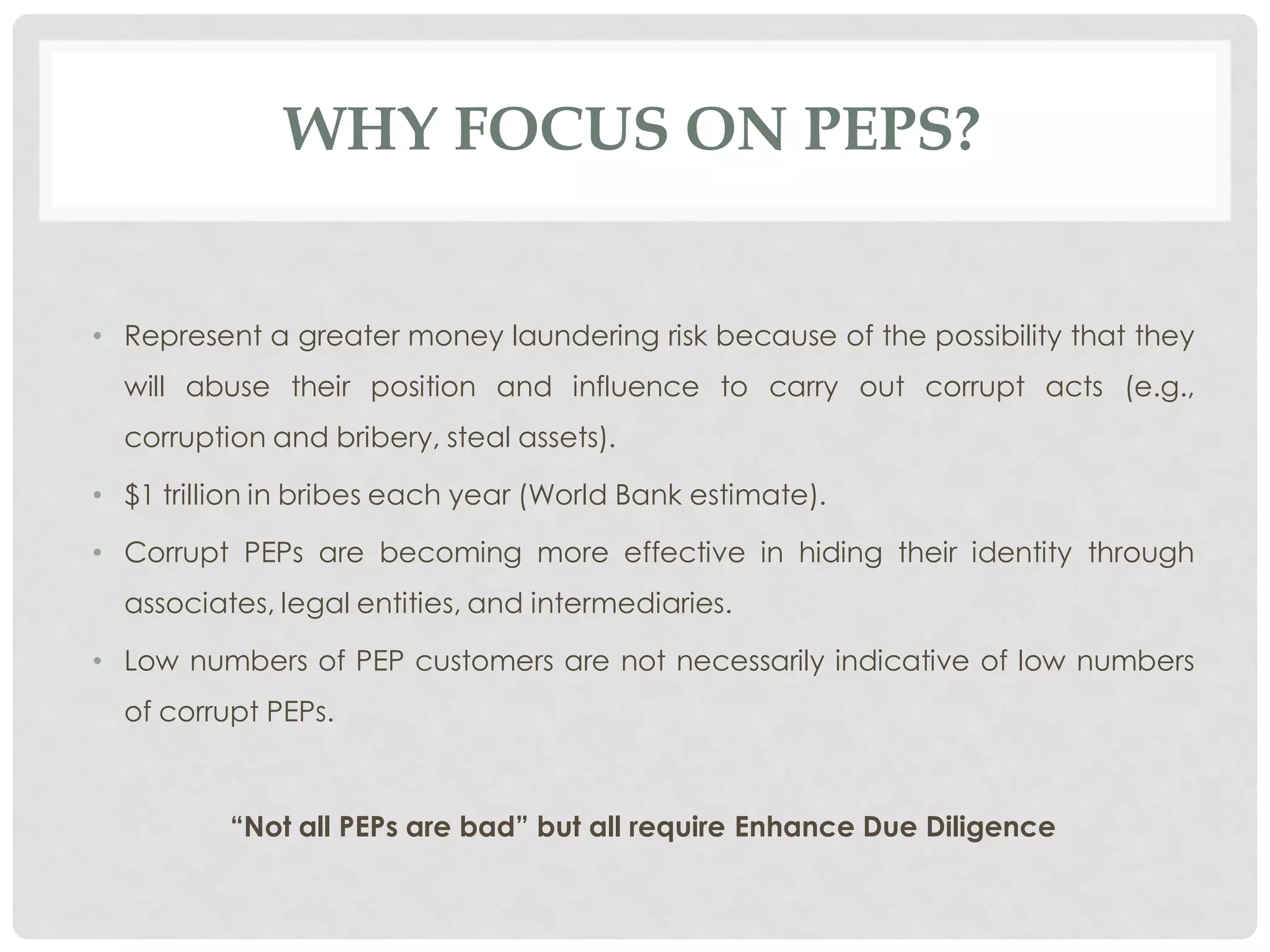
WHY FOCUS ON PEPS?


• Represent a greater money laundering risk because of the possibility that they
  will abuse their position and influence to carry out corrupt acts (e.g.,
  corruption and bribery, steal assets).

• $1 trillion in bribes each year (World Bank estimate).

• Corrupt PEPs are becoming more effective in hiding their identity through
  associates, legal entities, and intermediaries.

• Low numbers of PEP customers are not necessarily indicative of low numbers
  of corrupt PEPs.


          “Not all PEPs are bad” but all require Enhance Due Diligence
WHY FOCUS ON PEPS?


The FATF consultation paper quoted in point 3 clearly indicates
that a PEP with „something to hide‟ may well choose to
conceal his or her identity by using some form of corporate
structure. This is with the greatest certainty where financial
institutions are most likely to find the skeletons in their closets.
WHAT ARE SOME OF THE
                CHALLENGES?

• Corruption exploitation
• Inadequate regular reviews of high-risk and PEP customers in order to update
  CDD
• Keeping AML policies and procedures up-to-date
• Inadequate EDD on family members or close associates of PEPs
• No corrupt PEP activity in banks or in other sectors
   • Few PEP STRs
   • Few investigations or prosecutions for grand corruption
• Identifying national and international PEPs


                       Where is the corrupt money?
HAVE YOU TRULY UNDERSTOOD YOUR PEP REQUIREMENTS, IDENTIFIED YOUR

PEP RISK AND HAVE YOU SET OUT TO IMPLEMENT A PEP POLICY THAT WILL

PROTECT YOUR INSTITUTION, ITS REPUTATION AND INDEED, YOUR JOB?
THANK YOU FOR YOUR ATTENTION

Anti money laundering - PEPs

  • 1.
    ANTI MONEY LAUNDERING P O L I T I C A L LY E X P O S E D P E R S O N S Presented by: Besart Qerimi besart.qerimi@gmail.com 2011
  • 2.
    SESSION OBJECTIVES • DefiningPEP's • Basic considerations • Others associated with PEPs • Sleeper PEP's • When does one lose status as a PEP? • PEPs Risks • Banks and awareness of the problem • Can we do business with a PEP? • State-owned enterprises be considered PEPs?
  • 3.
    DEFINING POLITICALLY EXPOSED PERSONS “Politically Exposed Persons”(PEPs) are individuals who are or have been entrusted with prominent public functions in a foreign country, for example Heads of State or of government, senior politicians, senior government, judicial or military officials, senior executives of state owned corporations, important political party officials. Business relationships with family members or close associates of PEPs involve reputational risks similar to those with PEPs themselves. The definition is not intended to cover middle ranking or more junior individuals in the foregoing categories.” Financial Action Task Force
  • 4.
    SHOULD STATE-OWNED ENTERPRISES BE CONSIDERED PEPS? • State-owned enterprises, including central banks, should not be considered PEPs. • The individuals who manage and run the state-owned enterprise at senior levels, however, could qualify as PEP • All state-owned enterprises are not necessarily low risk, such entities should be assessed using appropriate risk factors.
  • 5.
    HOW CAN APEP OR THEIR “CLOSE FAMILY OR ASSOCIATES” BE IDENTIFIED? • Making enquiries regarding PEP status of potential customers during the account opening process • Screening potential customers against a database of such persons. (e.g. developed internally, provided by an external service provider-world check, down jones)
  • 6.
    FINANCIAL INSTITUTIONS • Financialinstitutions should, in relation to politically exposed persons, should: • Have appropriate risk management systems to determine whether the customer is a politically exposed person • Apply appropriate enhanced procedures and controls • Obtain senior management approval • Take reasonable measures to establish the source of wealth and source of funds • Conduct enhanced ongoing monitoring of the business relationship • PEPs are a special category of customers, all designated as high risk for money laundering. New FATF Recommendation 12
  • 7.
    APPLYING A RISK-BASEDAPPROACH • It is flexible • It is effective • It is proportionate
  • 8.
    HOW LONG DOESONE REMAIN A PEP? • The Wolfsberg Group provides the following insight into its interpretation of the „expiration date‟ on a PEP: “Rule of thumb“: 1 year after giving up any political function. • The latest EU working paper on the Third Money Laundering Directive and FATF do not mention any time limit.
  • 9.
    CAN I DOBUSINESS WITH A PEP? • Of course you can, but with enhanced due diligence and heightened scrutiny. • UNCAC, Article 52 (entered into force Dec 2005): “to conduct enhanced scrutiny of accounts sought or maintained by or on behalf of individuals who are, or have been, entrusted with prominent public functions and their family members and close associates.” No legislation says financial institutions are not allow to open accounts for PEPs What is the „real‟ reason to carry out effective PEP due diligence? The answer is simple: REPUTATIONAL DAMAGE
  • 10.
    WHY FOCUS ONPEPS? • Represent a greater money laundering risk because of the possibility that they will abuse their position and influence to carry out corrupt acts (e.g., corruption and bribery, steal assets). • $1 trillion in bribes each year (World Bank estimate). • Corrupt PEPs are becoming more effective in hiding their identity through associates, legal entities, and intermediaries. • Low numbers of PEP customers are not necessarily indicative of low numbers of corrupt PEPs. “Not all PEPs are bad” but all require Enhance Due Diligence
  • 11.
    WHY FOCUS ONPEPS? The FATF consultation paper quoted in point 3 clearly indicates that a PEP with „something to hide‟ may well choose to conceal his or her identity by using some form of corporate structure. This is with the greatest certainty where financial institutions are most likely to find the skeletons in their closets.
  • 12.
    WHAT ARE SOMEOF THE CHALLENGES? • Corruption exploitation • Inadequate regular reviews of high-risk and PEP customers in order to update CDD • Keeping AML policies and procedures up-to-date • Inadequate EDD on family members or close associates of PEPs • No corrupt PEP activity in banks or in other sectors • Few PEP STRs • Few investigations or prosecutions for grand corruption • Identifying national and international PEPs Where is the corrupt money?
  • 13.
    HAVE YOU TRULYUNDERSTOOD YOUR PEP REQUIREMENTS, IDENTIFIED YOUR PEP RISK AND HAVE YOU SET OUT TO IMPLEMENT A PEP POLICY THAT WILL PROTECT YOUR INSTITUTION, ITS REPUTATION AND INDEED, YOUR JOB?
  • 14.
    THANK YOU FORYOUR ATTENTION