2015
Sophia Sedighi (N0568448)
Course Lecturer: Dr.Chris McCollin
3/19/2015
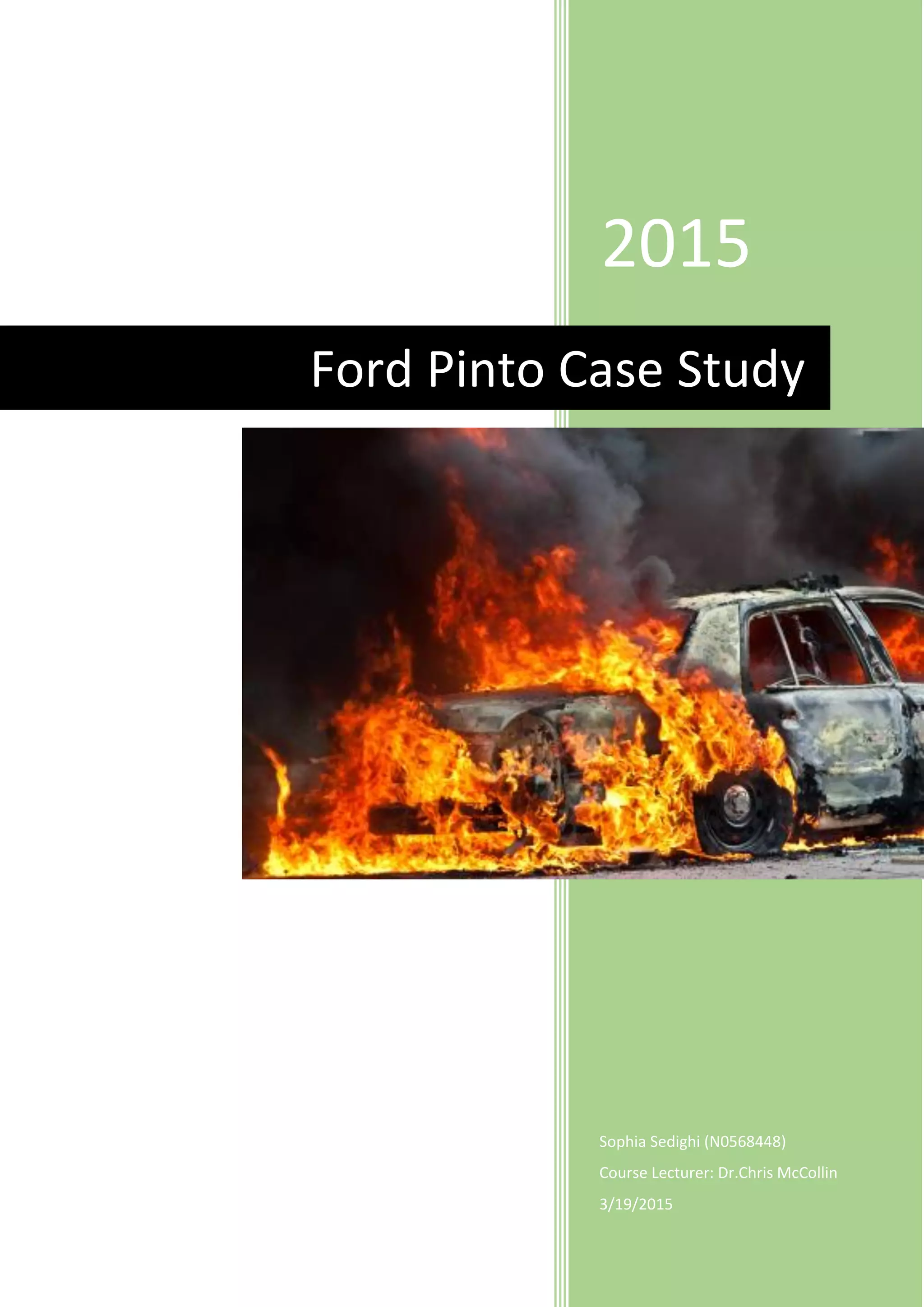
Ford Pinto Case Study
1 | P a g e
Contents
Introduction............................................................................................................................................2
Description of the system and it’s working environment ....................................................................2
Description of the top event (catastrophic failure) ..............................................................................3
Describe the failures and their causes which contributed to the catastrophe....................................3
Describe if similar less catastrophic events had or have since taken place.........................................6
The recommendations which were made to stop the top event from recurring................................7
Cause and effect diagram ......................................................................................................................7
Cause-Consequence Trees .....................................................................................................................8
HAZOPS report .......................................................................................................................................8
WHAT-IF Analysis ...................................................................................................................................9
FMEA FORMAT (RPN METHOD)...........................................................................................................10
ALE Risk Assessment Sheet..................................................................................................................11
5whys analysis......................................................................................................................................11
Fault Tree..............................................................................................................................................12
References............................................................................................................................................14
2 | P a g e
Introduction
The catastrophic failure started all when vice-president of the Ford Motor
Company, Iacocca, decided to introduce a subcompact car and manufacture it
cost and time efficiency, in an effort to gain the market share for small-car
segment in May 1968, against the new Japanese competitors and VW. The car
was designed and manufactured on an accelerated schedule. No more than 2000
pounds, not a penny over $2000 and a delivery deadline of just 25month. This
was a record at the time and still these figures are impressive today. (guide,
2014)
The time and cost limit was the start of something that ended up to a disaster. A
disaster that should never happened in the first place, simple management
decisions caused a lot of death and unforgivable injuries.
Description of the system and it’s working environment
When a rear end collision happens in a most of the cars, the bumper is a
protection that stops the impact of pressure on the fuel tank, in the ford pinto
case the bumper was so weak that had no role in a case of accident, also the
space between the bumper and the fuel tank was only 9 inches which in this
case made the tank more vulnerable to get punctured.
Also in the most designs fuel tank is positioned above the rear axle or behind it
and there is a spare tire mounted between the bumper and fuel tank to absorb
forces in collisions, but Pinto neglected these alternative solutions in the hope of
gaining more trunk space.
The normal required time from an idea to production of a new tooling has a
fixed time of usually 18 months. And normally, an auto manufacturer doesn’t
begin tooling until the other processes are almost over. Manufacturing car
model is about 43 months. The Pinto schedule time was just under 25 months.
Frank G. Olsen is an experienced engineer who had experience in several major
projects such as Mustang, Ford Fairlane and Torino, who was in charge of the
testing. And he decided not to reveal the tests results to Iacocca.
The fuel pump in old cars were attached to the engine, which as in new cars
they are installed in the fuel tank. (Anon., 2013)
Also to consider rear-end collisions likely happens twice more at daylight than
darkness. (John M. Sullivan Micheal J. Flannagan, n.d.)
3 | P a g e
Description of the top event (catastrophic failure)
The first explosion happened when Sandra Gillespie’s brand new Ford Pinto
stalled in the Minneapolis highway and another car rear-ends her car at speed of
28 miles per hour, the Pinto’s gas tank ruptured and burst in to fire, she died but
her 3 years old baby survived with third degree burn.
The other Catastrophic event happened on August 1978, when three teenage
girls decided to stop on the unsafe shoulder of the highway because the gas cap
fell off, and a van struck the pinto at about fifty miles per hour, the two
passenger died as the Pinto burst in to flames and the driver was ejected from
the car and died later in the hospital. (Boyce, n.d.)
Describe the failures and their causes which contributed to the
catastrophe
In an effort of designing a car with more trunk space, fuel tank was placed
behind the rear axle, which usually located above the rear axle, and later on, the
evidence showed that this design and the fact that the gas tank and the rear axle
were separated only nine inches, made the car more vulnerable to rear-end
collision. There were also bolts that were positioned in a way that threatened the
gas tank. And also in the event of an accident, the fuel filler pipe design would
resulted in a higher probability of disconnection from tank and causing gas
spillage. Gas spillage can lead to explosion and deadly fires. (Schwartz, 1991)
The vehicle’s lack of reinforcing structure between the rear panel and the fuel
tank, made the tank more vulnerable to be pushed forward and punctured by the
protruding bolts of the differential.
According to an article by Mark Dowie; Mother Jones, 1977, Ford was aware of
the design problem, but refused to pay for a redesign and decided it would be
cheaper to pay off possible lawsuits.
Ford neglected to add reinforcement between fuel tank and the rear panel, to
protect the easily ruptured fuel tank. (Dowie, 1977)
The problem discovered when manufacturing process get in the testing phase; in
low-speed rear-end crash testing, the fuel tank, positioned behind the rear axle
and in front of the rear bumper, exhibited several flaws, and in result the filler
neck would tear away from the sheet-metal tank and spill fuel beneath the car.
The tank was also easily punctured by bolts from the differential and nearby
brackets.
4 | P a g e
Plastic was used a lot in a number of interior components and the front grille, to
keep the costs down and weight less.
If you take a look at the rear end of the Ford Pinto, you’ll see a long silvery
object hanging down under the bumper which is the gas tank, and begins about
six inches forward of the bumper. In late models the bumper is designed to
withstand a collision of only about five miles per hour but earlier bumpers may
as well not have been on the car as they don’t offer much protection for the gas
tank. If you ran in to a Pinto you were following at over 30 miles per hour, the
rear end of the car would buckle right up to the back seat, the tube leading to the
gas-tank cap would be ripped away from the tank itself and gas would
immediately begin sloshing onto the road, the buckled gas tank would be
jammed up against the differential, which contains four sharp bolts and shock
absorber bracket and sub frame member and rear leaf spring shackle plate and
bracket and exhaust muffler brackets, which likely make holes in the fuel tank
and spill more gas. A spark from a cigarette, ignition, or scraping metal can put
both cars in flames. Separation of vehicle floor pan at wheel wells allows fire
entry into the passenger compartment. (Birsch, 1994)
Ford engineers discovered this problem in pre-production crash tests, based on
internal company documents Ford has crash-tested the Pinto at a top-secret site
more than 40 times and that every test made at over 25 mph without special
structural alteration has resulted in a ruptured fuel tank. But because assembly-
line machinery was already tooled when engineers found this defect, Ford
officials denied under oath having crash-tested the Pinto and management’s
attitude was to get the product out the door as fast as possible, even though Ford
owned the patent on a much safer gas tank. (Engineer, 2006)
Only 3 cars passed the test with unbroken fuel tanks, in one of them engineers
placed an inexpensive light-weight plastic baffle between the front of the gas
tank and the differential housing. In another one they placed a piece of steel
between the tank and the bumper and in third test, the gas tank was lined with a
rubber bladder. But none of these protective methods used in final productions,
as it says in the Mother Jones report safety wasn’t a popular subject around Ford
in those days and Iacocca was fond of saying, Safety doesn’t sell. (Wojdyla,
2011)
Although Ford had access to a new design which would decrease the possibility
of the Ford Pinto from exploding, the company chose not to implement the
design, which would have cost $11 per car, even though it had done an analysis
showing that the new design would result in 180 less deaths. The company
defended itself on the grounds that it used the accepted risk/benefit analysis to
5 | P a g e
determine if the monetary costs of making the change were greater than the
societal benefit. Based on the numbers Ford used, the cost would have been
$137 million versus the $49.5 million price tag put on the deaths, injuries, and
car damages, and thus Ford felt justified not implementing the design
change. This risk/benefit analysis was created out of the development of
product liability, culminating at Judge Learned Hand's BPL formula,
Based on this analysis, Ford legally chose not to make the design changes which
would have made the Pinto safer. However, just because it was legal doesn't
necessarily mean that it was ethical. It is difficult to understand how a price can
be put on saving a human life. (Leggett, 1999)
They estimated 180 burn deaths ($200000 per death), 180 serious burn injuries
($67000 per injury) and 2100 burned vehicles ($700 per vehicle)
Total: 180 x ($200,000) + 180 x ($67,000) + 2100 x ($700) = $49.5 Million
And then calculated the cost of recalling the cars:
Sales: 11 million cars, 1.5 million light trucks
Unit Cost: $11 per car, $11 per truck
Total Cost: 11,000,000 x ($11) + 1,500,000 x ($ I 1) = $137 Million
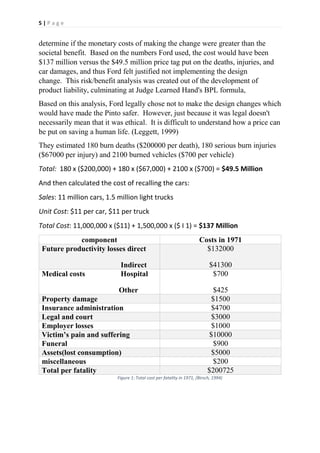
component Costs in 1971
Future productivity losses direct
Indirect
$132000
$41300
Medical costs Hospital
Other
$700
$425
Property damage $1500
Insurance administration $4700
Legal and court $3000
Employer losses $1000
Victim’s pain and suffering $10000
Funeral $900
Assets(lost consumption) $5000
miscellaneous $200
Total per fatality $200725
Figure 1: Total cost per fatality in 1971, (Birsch, 1994)
6 | P a g e
If Ford could reduce the cost of recalling each car to $3.96, the benefits would
become breakeven with costs. (Nerdster, 2013)
One of the other reasons of neglecting the safety by Ford was the failure of
earlier advertising campaign around safety which failed and the company
realized safety was not a primary selling point and they thought if they recall the
cars it will have a bad effect in publicity. (sherefkin, 2003)
The first management issue was that Iacocca the vice president of Ford
Company gave a very limited time to produce the Pinto, known as ‘Lee Car’,
the compressed schedule meant that any design changes typically made before
production-line tooling would have to be made during it. The second
management issue was that the car shouldn’t weight more than 2000 pounds and
costs no more than $2000, so they made the car mostly of cheap materials, a lot
of part used was plastic. The third issue was when engineers did the car test and
discovered the problem some say they didn’t reveal the problem and based of
the cost-benefit analysis they decided legally to make no changes to the car.
There were various ways of making the Pinto’s gas tank safer. Although the
estimated price of these safety improvements ranged from only $5 to $8 per
vehicle, Ford evidently reasoned that the increased cost outweighed the benefits
of a new tank design. Was that the right decision? To put safety of human
beings in danger to gain more profit and the market share for small cars?
Describe if similar less catastrophic events had or have since taken
place
A Telsa Model S caught fire in the fall 2013, the car was travelling at high
speeds, hit a piece of debris that punctured the car’s battery and ignited.
On 2011 and 2012, the Chevy Volt made headlines when some of test vehicles
caught fire during impact testing, in this case leaking coolant interacted with the
damaged batteries to spark the blaze.
In 2012 a recall of about 90000 Ford cars equipped with a specific Eco Boost
powertrain happened, an engine that was overheating, the flowchart was flexible
with a software update; modifying the car’s computer to help keep engine
temperature at a safer level. (LaPine, 2013)
In 2001, BMW recalls the new Minis because of the risk of explosion when
filling the cars with fuel, this is due to a design fault; static electricity could
cause a spark, when a fuel pump nozzle is inserted. In the result of recall the
calls no fire or injuries happened.
7 | P a g e
235,000 Mini Coopers recalled over fire risk worldwide, nearly 30,000 of them
were for Britain. Engineers detected an electrical fault, a problem which can
cause the water pump to fail and causing the car to overheat, it could create a
heat build-up in the wiring and some smouldering. The malfunction involves a
computer circuit board which controls a turbocharger cooling system. If the
system fails, the car’s water pump can start to smoulder, possibly leading to a
fire (Telegraph, 2012)
Karina Collins, 25 years old, she was driving with her Mini Cooper on the M4
in August 2012, when the car suddenly lost power, she managed to pull up on
the hard shoulder and she noticed the engine bay was on fire. (Dolan, 2012)
The recommendations which were made to stop the top event from
recurring
The car was recalled in 1978 when a lawsuit has won, Ford provide a plastic
protective shield to be installed between the fuel tank and the differential bolts,
another plastic shield applied to deflect contact with the right-rear shock
absorber and a new fuel-tank filler neck extended deeper into the tank and it
was also more resistant to breaking off in a rear-end collision. (Anon., n.d.)
On the modified pinto they used flexible filler tube with shut-off valve to
prevent fuel loss if filler tube is separated from tank, a spare tire mounted
horizontally to absorb forces in collisions, they also applied a U-joint deflector
and also a driveshaft deflection and control unit, and they replaced the old fuel
tank with saddle-type fuel tank located forward of the rear axle and under re-
shaped floor pan. (Birsch, 1994)
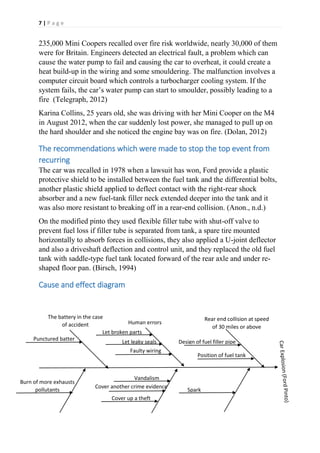
Cause and effect diagram
Punctured batter
Vandalism
Cover another crime evidence
Cover up a theft
Faulty wiring
Let leaky seals
Let broken parts
Design of fuel filler pipe
Position of fuel tank
Rear end collision at speed
of 30 miles or above
Spark
Human errors
The battery in the case
of accident
Burn of more exhausts
pollutants
8 | P a g e
Cause-Consequence Trees
Cause- consequence Tree is not applicable to Ford Pinto Case.
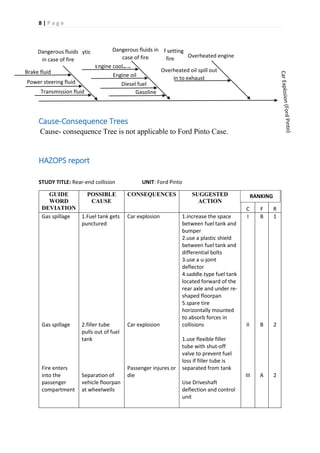
HAZOPS report
STUDY TITLE: Rear-end collision UNIT: Ford Pinto
GUIDE
WORD
DEVIATION
POSSIBLE
CAUSE
CONSEQUENCES SUGGESTED
ACTION
C F R
Gas spillage
Gas spillage
Fire enters
into the
passenger
compartment
1.Fuel tank gets
punctured
2.filler tube
pulls out of fuel
tank
Separation of
vehicle floorpan
at wheelwells
Car explosion
Car explosion
Passenger injures or
die
1.increase the space
between fuel tank and
bumper
2.use a plastic shield
between fuel tank and
differential bolts
3.use a u-joint
deflector
4.saddle.type fuel tank
located forward of the
rear axle and under re-
shaped floorpan
5.spare tire
horizontally mounted
to absorb forces in
collisions
1.use flexible filler
tube with shut-off
valve to prevent fuel
loss if filler tube is
separated from tank
Use Driveshaft
deflection and control
unit
I
II
III
B
B
A
1
2
2
Engine coolant
Brake fluid
Power steering fluid
Transmission fluid
Engine oil
Diesel fuel
Gasoline
Overheated oil spill out
in to exhaust
Gas SpillageCriminal act of setting
the car on fire
Overheating catalytic
convertors
Overheated engine
Dangerous fluids in
case of fire
Dangerous fluids
in case of fire
RANKING
9 | P a g e
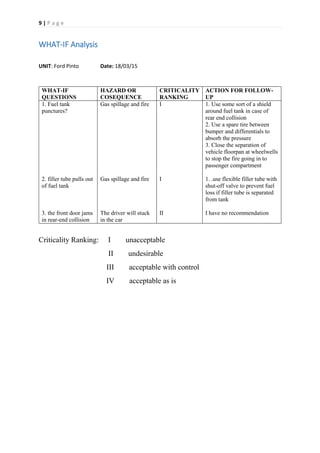
WHAT-IF Analysis
UNIT: Ford Pinto Date: 18/03/15
WHAT-IF
QUESTIONS
HAZARD OR
COSEQUENCE
CRITICALITY
RANKING
ACTION FOR FOLLOW-
UP
1. Fuel tank
punctures?
2. filler tube pulls out
of fuel tank
3. the front door jams
in rear-end collision
Gas spillage and fire
The driver will stuck
in the car
I
I
II
1. Use some sort of a shield
around fuel tank in case of
rear end collision
2. Use a spare tire between
bumper and differentials to
absorb the pressure
3. Close the separation of
vehicle floorpan at wheelwells
to stop the fire going in to
passenger compartment
1. .use flexible filler tube with
shut-off valve to prevent fuel
loss if filler tube is separated
from tank
I have no recommendation
Criticality Ranking: I unacceptable
II undesirable
III acceptable with control
IV acceptable as is
10 | P a g e
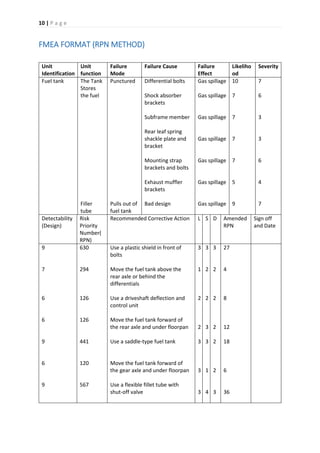
FMEA FORMAT (RPN METHOD)
Unit
Identification
Unit
function
Failure
Mode
Failure Cause Failure
Effect
Likeliho
od
Severity
Fuel tank The Tank
Stores
the fuel
Filler
tube
Punctured
Pulls out of
fuel tank
Differential bolts
Shock absorber
brackets
Subframe member
Rear leaf spring
shackle plate and
bracket
Mounting strap
brackets and bolts
Exhaust muffler
brackets
Bad design
Gas spillage
Gas spillage
Gas spillage
Gas spillage
Gas spillage
Gas spillage
Gas spillage
10
7
7
7
7
5
9
7
6
3
3
6
4
7
Detectability
(Design)
Risk
Priority
Number(
RPN)
Recommended Corrective Action L S D Amended
RPN
Sign off
and Date
9
7
6
6
9
6
9
630
294
126
126
441
120
567
Use a plastic shield in front of
bolts
Move the fuel tank above the
rear axle or behind the
differentials
Use a driveshaft deflection and
control unit
Move the fuel tank forward of
the rear axle and under floorpan
Use a saddle-type fuel tank
Move the fuel tank forward of
the gear axle and under floorpan
Use a flexible fillet tube with
shut-off valve
3
1
2
2
3
3
3
3
2
2
3
3
1
4
3
2
2
2
2
2
3
27
4
8
12
18
6
36
11 | P a g e
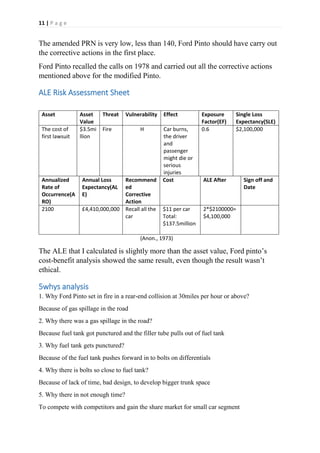
The amended PRN is very low, less than 140, Ford Pinto should have carry out
the corrective actions in the first place.
Ford Pinto recalled the calls on 1978 and carried out all the corrective actions
mentioned above for the modified Pinto.
ALE Risk Assessment Sheet
Asset Asset
Value
Threat Vulnerability Effect Exposure
Factor(EF)
Single Loss
Expectancy(SLE)
The cost of
first lawsuit
$3.5mi
llion
Fire H Car burns,
the driver
and
passenger
might die or
serious
injuries
0.6 $2,100,000
Annualized
Rate of
Occurrence(A
RO)
Annual Loss
Expectancy(AL
E)
Recommend
ed
Corrective
Action
Cost ALE After Sign off and
Date
2100 £4,410,000,000 Recall all the
car
$11 per car
Total:
$137.5million
2*$2100000=
$4,100,000
(Anon., 1973)
The ALE that I calculated is slightly more than the asset value, Ford pinto’s
cost-benefit analysis showed the same result, even though the result wasn’t
ethical.
5whys analysis
1. Why Ford Pinto set in fire in a rear-end collision at 30miles per hour or above?
Because of gas spillage in the road
2. Why there was a gas spillage in the road?
Because fuel tank got punctured and the filler tube pulls out of fuel tank
3. Why fuel tank gets punctured?
Because of the fuel tank pushes forward in to bolts on differentials
4. Why there is bolts so close to fuel tank?
Because of lack of time, bad design, to develop bigger trunk space
5. Why there in not enough time?
To compete with competitors and gain the share market for small car segment
12 | P a g e
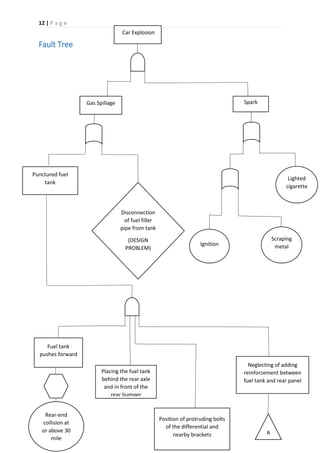
Fault Tree
Car Explosion
Gas Spillage Spark
Lighted
cigarette
Scraping
metalIgnition
Punctured fuel
tank
Disconnection
of fuel filler
pipe from tank
(DESIGN
PROBLEM)
Fuel tank
pushes forward
Placing the fuel tank
behind the rear axle
and in front of the
rear bumper
Position of protruding bolts
of the differential and
nearby brackets
Neglecting of adding
reinforcement between
fuel tank and rear panel
A
Rear-end
collision at
or above 30
mile
13 | P a g e
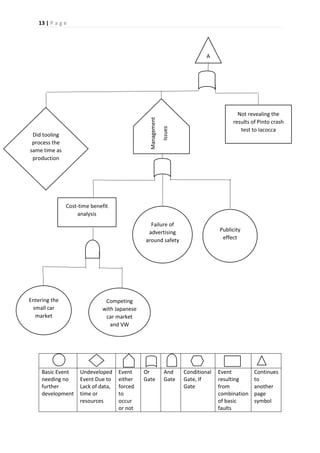
Basic Event
needing no
further
development
Undeveloped
Event Due to
Lack of data,
time or
resources
Event
either
forced
to
occur
or not
Or
Gate
And
Gate
Conditional
Gate, If
Gate
Event
resulting
from
combination
of basic
faults
Continues
to
another
page
symbol
A
Management
Issues
Cost-time benefit
analysis
Failure of
advertising
around safety
Publicity
effect
Entering the
small car
market
Competing
with Japanese
car market
and VW
Not revealing the
results of Pinto crash
test to Iacocca
Did tooling
process the
same time as
production
14 | P a g e
References
Anon., 1973. Ford 'pinto' Memo. [Online]
Available at: http://web1.calbaptist.edu/dskubik/pinto.htm
[Accessed 18 march 2015].
Anon., 2013. AutoEducation. [Online]
Available at: http://www.autoeducation.com/autoshop101/fuel.htm
[Accessed 21 February 2015].
Anon., n.d. RCRSD. [Online]
Available at: http://www.rcrsd.com/news/mark-robinson-ford-pinto/
[Accessed 16 March 2015].
Birsch, D., 1994. THE FORD PINTO CASE: A Study in Applied Ethics, Business, and Technology.
NewYork: State University of NewYork .
Boyce, D., n.d. The Ford Pinto Case. [Online]
Available at: http://fordpintoethics.webs.com/
[Accessed 3 March 2015].
Dowie, M., 1977. Mother Jones. [Online]
Available at: http://www.motherjones.com/politics/1977/09/pinto-madness
[Accessed 8 February 2015].
Engineer, T., 2006. ENGINEERING.COM. [Online]
Available at: http://www.engineering.com/Library/ArticlesPage/tabid/85/ArticleID/166/Ford-
Pinto.aspx
[Accessed 3 march 2015].
guide, A. E. o. c., 2014. howstuffworks. [Online]
Available at: http://auto.howstuffworks.com/1971-1980-ford-pinto.htm/printable
[Accessed 23 february 2015].
John M. Sullivan Micheal J. Flannagan, n.d. RISK OF FATAL REAR-END COLLISIONS, Michigan:
University of Michigan.
LaPine, C., 2013. howstuffworks. [Online]
Available at: http://auto.howstuffworks.com/car-driving-safety/accidents-hazardous-conditions/10-
causes-of-car-fires.htm#page=5
[Accessed 16 March 2015].
Leggett, C., 1999. THE VALUATION OF LIFE AS IT APPLIES TO THE NEGLIGENCY ARGUMENT. [Online]
Available at: http://users.wfu.edu/palmitar/Law&Valuation/Papers/1999/Leggett-pinto.html
[Accessed 23 february 2015].
Nerdster, P., 2013. Pn. [Online]
Available at: http://professornerdster.com/lee-iacocca-dont-elaborate-much-on-your-deadly-
mistakes/
[Accessed 20 February 2015].
Schwartz, G. T., 1991. THE MYTH OF THE FORD PINTO CASE. Volume 43:1013, pp. 1013-1068.
15 | P a g e
sherefkin, R., 2003. Automotive News. [Online]
Available at: http://www.autonews.com/article/20030616/SUB/306160770/lee-iacoccas-pinto:-a-
fiery-failure
[Accessed 16 March 2015].
Telegraph, T., 2012. MINI Cooper S Recall, s.l.: Telegraph.
Wojdyla, B., 2011. popular machines. [Online]
Available at: http://www.popularmechanics.com/cars/a6700/top-automotive-engineering-failures-
ford-pinto-fuel-tanks/
[Accessed 6 February 2015].

ford pinto case study

  • 1.
    2015 Sophia Sedighi (N0568448) CourseLecturer: Dr.Chris McCollin 3/19/2015 Ford Pinto Case Study
  • 2.
    1 | Pa g e Contents Introduction............................................................................................................................................2 Description of the system and it’s working environment ....................................................................2 Description of the top event (catastrophic failure) ..............................................................................3 Describe the failures and their causes which contributed to the catastrophe....................................3 Describe if similar less catastrophic events had or have since taken place.........................................6 The recommendations which were made to stop the top event from recurring................................7 Cause and effect diagram ......................................................................................................................7 Cause-Consequence Trees .....................................................................................................................8 HAZOPS report .......................................................................................................................................8 WHAT-IF Analysis ...................................................................................................................................9 FMEA FORMAT (RPN METHOD)...........................................................................................................10 ALE Risk Assessment Sheet..................................................................................................................11 5whys analysis......................................................................................................................................11 Fault Tree..............................................................................................................................................12 References............................................................................................................................................14
  • 3.
    2 | Pa g e Introduction The catastrophic failure started all when vice-president of the Ford Motor Company, Iacocca, decided to introduce a subcompact car and manufacture it cost and time efficiency, in an effort to gain the market share for small-car segment in May 1968, against the new Japanese competitors and VW. The car was designed and manufactured on an accelerated schedule. No more than 2000 pounds, not a penny over $2000 and a delivery deadline of just 25month. This was a record at the time and still these figures are impressive today. (guide, 2014) The time and cost limit was the start of something that ended up to a disaster. A disaster that should never happened in the first place, simple management decisions caused a lot of death and unforgivable injuries. Description of the system and it’s working environment When a rear end collision happens in a most of the cars, the bumper is a protection that stops the impact of pressure on the fuel tank, in the ford pinto case the bumper was so weak that had no role in a case of accident, also the space between the bumper and the fuel tank was only 9 inches which in this case made the tank more vulnerable to get punctured. Also in the most designs fuel tank is positioned above the rear axle or behind it and there is a spare tire mounted between the bumper and fuel tank to absorb forces in collisions, but Pinto neglected these alternative solutions in the hope of gaining more trunk space. The normal required time from an idea to production of a new tooling has a fixed time of usually 18 months. And normally, an auto manufacturer doesn’t begin tooling until the other processes are almost over. Manufacturing car model is about 43 months. The Pinto schedule time was just under 25 months. Frank G. Olsen is an experienced engineer who had experience in several major projects such as Mustang, Ford Fairlane and Torino, who was in charge of the testing. And he decided not to reveal the tests results to Iacocca. The fuel pump in old cars were attached to the engine, which as in new cars they are installed in the fuel tank. (Anon., 2013) Also to consider rear-end collisions likely happens twice more at daylight than darkness. (John M. Sullivan Micheal J. Flannagan, n.d.)
  • 4.
    3 | Pa g e Description of the top event (catastrophic failure) The first explosion happened when Sandra Gillespie’s brand new Ford Pinto stalled in the Minneapolis highway and another car rear-ends her car at speed of 28 miles per hour, the Pinto’s gas tank ruptured and burst in to fire, she died but her 3 years old baby survived with third degree burn. The other Catastrophic event happened on August 1978, when three teenage girls decided to stop on the unsafe shoulder of the highway because the gas cap fell off, and a van struck the pinto at about fifty miles per hour, the two passenger died as the Pinto burst in to flames and the driver was ejected from the car and died later in the hospital. (Boyce, n.d.) Describe the failures and their causes which contributed to the catastrophe In an effort of designing a car with more trunk space, fuel tank was placed behind the rear axle, which usually located above the rear axle, and later on, the evidence showed that this design and the fact that the gas tank and the rear axle were separated only nine inches, made the car more vulnerable to rear-end collision. There were also bolts that were positioned in a way that threatened the gas tank. And also in the event of an accident, the fuel filler pipe design would resulted in a higher probability of disconnection from tank and causing gas spillage. Gas spillage can lead to explosion and deadly fires. (Schwartz, 1991) The vehicle’s lack of reinforcing structure between the rear panel and the fuel tank, made the tank more vulnerable to be pushed forward and punctured by the protruding bolts of the differential. According to an article by Mark Dowie; Mother Jones, 1977, Ford was aware of the design problem, but refused to pay for a redesign and decided it would be cheaper to pay off possible lawsuits. Ford neglected to add reinforcement between fuel tank and the rear panel, to protect the easily ruptured fuel tank. (Dowie, 1977) The problem discovered when manufacturing process get in the testing phase; in low-speed rear-end crash testing, the fuel tank, positioned behind the rear axle and in front of the rear bumper, exhibited several flaws, and in result the filler neck would tear away from the sheet-metal tank and spill fuel beneath the car. The tank was also easily punctured by bolts from the differential and nearby brackets.
  • 5.
    4 | Pa g e Plastic was used a lot in a number of interior components and the front grille, to keep the costs down and weight less. If you take a look at the rear end of the Ford Pinto, you’ll see a long silvery object hanging down under the bumper which is the gas tank, and begins about six inches forward of the bumper. In late models the bumper is designed to withstand a collision of only about five miles per hour but earlier bumpers may as well not have been on the car as they don’t offer much protection for the gas tank. If you ran in to a Pinto you were following at over 30 miles per hour, the rear end of the car would buckle right up to the back seat, the tube leading to the gas-tank cap would be ripped away from the tank itself and gas would immediately begin sloshing onto the road, the buckled gas tank would be jammed up against the differential, which contains four sharp bolts and shock absorber bracket and sub frame member and rear leaf spring shackle plate and bracket and exhaust muffler brackets, which likely make holes in the fuel tank and spill more gas. A spark from a cigarette, ignition, or scraping metal can put both cars in flames. Separation of vehicle floor pan at wheel wells allows fire entry into the passenger compartment. (Birsch, 1994) Ford engineers discovered this problem in pre-production crash tests, based on internal company documents Ford has crash-tested the Pinto at a top-secret site more than 40 times and that every test made at over 25 mph without special structural alteration has resulted in a ruptured fuel tank. But because assembly- line machinery was already tooled when engineers found this defect, Ford officials denied under oath having crash-tested the Pinto and management’s attitude was to get the product out the door as fast as possible, even though Ford owned the patent on a much safer gas tank. (Engineer, 2006) Only 3 cars passed the test with unbroken fuel tanks, in one of them engineers placed an inexpensive light-weight plastic baffle between the front of the gas tank and the differential housing. In another one they placed a piece of steel between the tank and the bumper and in third test, the gas tank was lined with a rubber bladder. But none of these protective methods used in final productions, as it says in the Mother Jones report safety wasn’t a popular subject around Ford in those days and Iacocca was fond of saying, Safety doesn’t sell. (Wojdyla, 2011) Although Ford had access to a new design which would decrease the possibility of the Ford Pinto from exploding, the company chose not to implement the design, which would have cost $11 per car, even though it had done an analysis showing that the new design would result in 180 less deaths. The company defended itself on the grounds that it used the accepted risk/benefit analysis to
  • 6.
    5 | Pa g e determine if the monetary costs of making the change were greater than the societal benefit. Based on the numbers Ford used, the cost would have been $137 million versus the $49.5 million price tag put on the deaths, injuries, and car damages, and thus Ford felt justified not implementing the design change. This risk/benefit analysis was created out of the development of product liability, culminating at Judge Learned Hand's BPL formula, Based on this analysis, Ford legally chose not to make the design changes which would have made the Pinto safer. However, just because it was legal doesn't necessarily mean that it was ethical. It is difficult to understand how a price can be put on saving a human life. (Leggett, 1999) They estimated 180 burn deaths ($200000 per death), 180 serious burn injuries ($67000 per injury) and 2100 burned vehicles ($700 per vehicle) Total: 180 x ($200,000) + 180 x ($67,000) + 2100 x ($700) = $49.5 Million And then calculated the cost of recalling the cars: Sales: 11 million cars, 1.5 million light trucks Unit Cost: $11 per car, $11 per truck Total Cost: 11,000,000 x ($11) + 1,500,000 x ($ I 1) = $137 Million component Costs in 1971 Future productivity losses direct Indirect $132000 $41300 Medical costs Hospital Other $700 $425 Property damage $1500 Insurance administration $4700 Legal and court $3000 Employer losses $1000 Victim’s pain and suffering $10000 Funeral $900 Assets(lost consumption) $5000 miscellaneous $200 Total per fatality $200725 Figure 1: Total cost per fatality in 1971, (Birsch, 1994)
  • 7.
    6 | Pa g e If Ford could reduce the cost of recalling each car to $3.96, the benefits would become breakeven with costs. (Nerdster, 2013) One of the other reasons of neglecting the safety by Ford was the failure of earlier advertising campaign around safety which failed and the company realized safety was not a primary selling point and they thought if they recall the cars it will have a bad effect in publicity. (sherefkin, 2003) The first management issue was that Iacocca the vice president of Ford Company gave a very limited time to produce the Pinto, known as ‘Lee Car’, the compressed schedule meant that any design changes typically made before production-line tooling would have to be made during it. The second management issue was that the car shouldn’t weight more than 2000 pounds and costs no more than $2000, so they made the car mostly of cheap materials, a lot of part used was plastic. The third issue was when engineers did the car test and discovered the problem some say they didn’t reveal the problem and based of the cost-benefit analysis they decided legally to make no changes to the car. There were various ways of making the Pinto’s gas tank safer. Although the estimated price of these safety improvements ranged from only $5 to $8 per vehicle, Ford evidently reasoned that the increased cost outweighed the benefits of a new tank design. Was that the right decision? To put safety of human beings in danger to gain more profit and the market share for small cars? Describe if similar less catastrophic events had or have since taken place A Telsa Model S caught fire in the fall 2013, the car was travelling at high speeds, hit a piece of debris that punctured the car’s battery and ignited. On 2011 and 2012, the Chevy Volt made headlines when some of test vehicles caught fire during impact testing, in this case leaking coolant interacted with the damaged batteries to spark the blaze. In 2012 a recall of about 90000 Ford cars equipped with a specific Eco Boost powertrain happened, an engine that was overheating, the flowchart was flexible with a software update; modifying the car’s computer to help keep engine temperature at a safer level. (LaPine, 2013) In 2001, BMW recalls the new Minis because of the risk of explosion when filling the cars with fuel, this is due to a design fault; static electricity could cause a spark, when a fuel pump nozzle is inserted. In the result of recall the calls no fire or injuries happened.
  • 8.
    7 | Pa g e 235,000 Mini Coopers recalled over fire risk worldwide, nearly 30,000 of them were for Britain. Engineers detected an electrical fault, a problem which can cause the water pump to fail and causing the car to overheat, it could create a heat build-up in the wiring and some smouldering. The malfunction involves a computer circuit board which controls a turbocharger cooling system. If the system fails, the car’s water pump can start to smoulder, possibly leading to a fire (Telegraph, 2012) Karina Collins, 25 years old, she was driving with her Mini Cooper on the M4 in August 2012, when the car suddenly lost power, she managed to pull up on the hard shoulder and she noticed the engine bay was on fire. (Dolan, 2012) The recommendations which were made to stop the top event from recurring The car was recalled in 1978 when a lawsuit has won, Ford provide a plastic protective shield to be installed between the fuel tank and the differential bolts, another plastic shield applied to deflect contact with the right-rear shock absorber and a new fuel-tank filler neck extended deeper into the tank and it was also more resistant to breaking off in a rear-end collision. (Anon., n.d.) On the modified pinto they used flexible filler tube with shut-off valve to prevent fuel loss if filler tube is separated from tank, a spare tire mounted horizontally to absorb forces in collisions, they also applied a U-joint deflector and also a driveshaft deflection and control unit, and they replaced the old fuel tank with saddle-type fuel tank located forward of the rear axle and under re- shaped floor pan. (Birsch, 1994) Cause and effect diagram Punctured batter Vandalism Cover another crime evidence Cover up a theft Faulty wiring Let leaky seals Let broken parts Design of fuel filler pipe Position of fuel tank Rear end collision at speed of 30 miles or above Spark Human errors The battery in the case of accident Burn of more exhausts pollutants
  • 9.
    8 | Pa g e Cause-Consequence Trees Cause- consequence Tree is not applicable to Ford Pinto Case. HAZOPS report STUDY TITLE: Rear-end collision UNIT: Ford Pinto GUIDE WORD DEVIATION POSSIBLE CAUSE CONSEQUENCES SUGGESTED ACTION C F R Gas spillage Gas spillage Fire enters into the passenger compartment 1.Fuel tank gets punctured 2.filler tube pulls out of fuel tank Separation of vehicle floorpan at wheelwells Car explosion Car explosion Passenger injures or die 1.increase the space between fuel tank and bumper 2.use a plastic shield between fuel tank and differential bolts 3.use a u-joint deflector 4.saddle.type fuel tank located forward of the rear axle and under re- shaped floorpan 5.spare tire horizontally mounted to absorb forces in collisions 1.use flexible filler tube with shut-off valve to prevent fuel loss if filler tube is separated from tank Use Driveshaft deflection and control unit I II III B B A 1 2 2 Engine coolant Brake fluid Power steering fluid Transmission fluid Engine oil Diesel fuel Gasoline Overheated oil spill out in to exhaust Gas SpillageCriminal act of setting the car on fire Overheating catalytic convertors Overheated engine Dangerous fluids in case of fire Dangerous fluids in case of fire RANKING
  • 10.
    9 | Pa g e WHAT-IF Analysis UNIT: Ford Pinto Date: 18/03/15 WHAT-IF QUESTIONS HAZARD OR COSEQUENCE CRITICALITY RANKING ACTION FOR FOLLOW- UP 1. Fuel tank punctures? 2. filler tube pulls out of fuel tank 3. the front door jams in rear-end collision Gas spillage and fire Gas spillage and fire The driver will stuck in the car I I II 1. Use some sort of a shield around fuel tank in case of rear end collision 2. Use a spare tire between bumper and differentials to absorb the pressure 3. Close the separation of vehicle floorpan at wheelwells to stop the fire going in to passenger compartment 1. .use flexible filler tube with shut-off valve to prevent fuel loss if filler tube is separated from tank I have no recommendation Criticality Ranking: I unacceptable II undesirable III acceptable with control IV acceptable as is
  • 11.
    10 | Pa g e FMEA FORMAT (RPN METHOD) Unit Identification Unit function Failure Mode Failure Cause Failure Effect Likeliho od Severity Fuel tank The Tank Stores the fuel Filler tube Punctured Pulls out of fuel tank Differential bolts Shock absorber brackets Subframe member Rear leaf spring shackle plate and bracket Mounting strap brackets and bolts Exhaust muffler brackets Bad design Gas spillage Gas spillage Gas spillage Gas spillage Gas spillage Gas spillage Gas spillage 10 7 7 7 7 5 9 7 6 3 3 6 4 7 Detectability (Design) Risk Priority Number( RPN) Recommended Corrective Action L S D Amended RPN Sign off and Date 9 7 6 6 9 6 9 630 294 126 126 441 120 567 Use a plastic shield in front of bolts Move the fuel tank above the rear axle or behind the differentials Use a driveshaft deflection and control unit Move the fuel tank forward of the rear axle and under floorpan Use a saddle-type fuel tank Move the fuel tank forward of the gear axle and under floorpan Use a flexible fillet tube with shut-off valve 3 1 2 2 3 3 3 3 2 2 3 3 1 4 3 2 2 2 2 2 3 27 4 8 12 18 6 36
  • 12.
    11 | Pa g e The amended PRN is very low, less than 140, Ford Pinto should have carry out the corrective actions in the first place. Ford Pinto recalled the calls on 1978 and carried out all the corrective actions mentioned above for the modified Pinto. ALE Risk Assessment Sheet Asset Asset Value Threat Vulnerability Effect Exposure Factor(EF) Single Loss Expectancy(SLE) The cost of first lawsuit $3.5mi llion Fire H Car burns, the driver and passenger might die or serious injuries 0.6 $2,100,000 Annualized Rate of Occurrence(A RO) Annual Loss Expectancy(AL E) Recommend ed Corrective Action Cost ALE After Sign off and Date 2100 £4,410,000,000 Recall all the car $11 per car Total: $137.5million 2*$2100000= $4,100,000 (Anon., 1973) The ALE that I calculated is slightly more than the asset value, Ford pinto’s cost-benefit analysis showed the same result, even though the result wasn’t ethical. 5whys analysis 1. Why Ford Pinto set in fire in a rear-end collision at 30miles per hour or above? Because of gas spillage in the road 2. Why there was a gas spillage in the road? Because fuel tank got punctured and the filler tube pulls out of fuel tank 3. Why fuel tank gets punctured? Because of the fuel tank pushes forward in to bolts on differentials 4. Why there is bolts so close to fuel tank? Because of lack of time, bad design, to develop bigger trunk space 5. Why there in not enough time? To compete with competitors and gain the share market for small car segment
  • 13.
    12 | Pa g e Fault Tree Car Explosion Gas Spillage Spark Lighted cigarette Scraping metalIgnition Punctured fuel tank Disconnection of fuel filler pipe from tank (DESIGN PROBLEM) Fuel tank pushes forward Placing the fuel tank behind the rear axle and in front of the rear bumper Position of protruding bolts of the differential and nearby brackets Neglecting of adding reinforcement between fuel tank and rear panel A Rear-end collision at or above 30 mile
  • 14.
    13 | Pa g e Basic Event needing no further development Undeveloped Event Due to Lack of data, time or resources Event either forced to occur or not Or Gate And Gate Conditional Gate, If Gate Event resulting from combination of basic faults Continues to another page symbol A Management Issues Cost-time benefit analysis Failure of advertising around safety Publicity effect Entering the small car market Competing with Japanese car market and VW Not revealing the results of Pinto crash test to Iacocca Did tooling process the same time as production
  • 15.
    14 | Pa g e References Anon., 1973. Ford 'pinto' Memo. [Online] Available at: http://web1.calbaptist.edu/dskubik/pinto.htm [Accessed 18 march 2015]. Anon., 2013. AutoEducation. [Online] Available at: http://www.autoeducation.com/autoshop101/fuel.htm [Accessed 21 February 2015]. Anon., n.d. RCRSD. [Online] Available at: http://www.rcrsd.com/news/mark-robinson-ford-pinto/ [Accessed 16 March 2015]. Birsch, D., 1994. THE FORD PINTO CASE: A Study in Applied Ethics, Business, and Technology. NewYork: State University of NewYork . Boyce, D., n.d. The Ford Pinto Case. [Online] Available at: http://fordpintoethics.webs.com/ [Accessed 3 March 2015]. Dowie, M., 1977. Mother Jones. [Online] Available at: http://www.motherjones.com/politics/1977/09/pinto-madness [Accessed 8 February 2015]. Engineer, T., 2006. ENGINEERING.COM. [Online] Available at: http://www.engineering.com/Library/ArticlesPage/tabid/85/ArticleID/166/Ford- Pinto.aspx [Accessed 3 march 2015]. guide, A. E. o. c., 2014. howstuffworks. [Online] Available at: http://auto.howstuffworks.com/1971-1980-ford-pinto.htm/printable [Accessed 23 february 2015]. John M. Sullivan Micheal J. Flannagan, n.d. RISK OF FATAL REAR-END COLLISIONS, Michigan: University of Michigan. LaPine, C., 2013. howstuffworks. [Online] Available at: http://auto.howstuffworks.com/car-driving-safety/accidents-hazardous-conditions/10- causes-of-car-fires.htm#page=5 [Accessed 16 March 2015]. Leggett, C., 1999. THE VALUATION OF LIFE AS IT APPLIES TO THE NEGLIGENCY ARGUMENT. [Online] Available at: http://users.wfu.edu/palmitar/Law&Valuation/Papers/1999/Leggett-pinto.html [Accessed 23 february 2015]. Nerdster, P., 2013. Pn. [Online] Available at: http://professornerdster.com/lee-iacocca-dont-elaborate-much-on-your-deadly- mistakes/ [Accessed 20 February 2015]. Schwartz, G. T., 1991. THE MYTH OF THE FORD PINTO CASE. Volume 43:1013, pp. 1013-1068.
  • 16.
    15 | Pa g e sherefkin, R., 2003. Automotive News. [Online] Available at: http://www.autonews.com/article/20030616/SUB/306160770/lee-iacoccas-pinto:-a- fiery-failure [Accessed 16 March 2015]. Telegraph, T., 2012. MINI Cooper S Recall, s.l.: Telegraph. Wojdyla, B., 2011. popular machines. [Online] Available at: http://www.popularmechanics.com/cars/a6700/top-automotive-engineering-failures- ford-pinto-fuel-tanks/ [Accessed 6 February 2015].