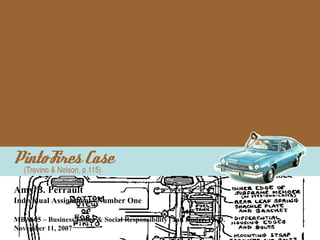
Amy B. Perrault Individual Assignment | Number One MBA605 – Business Ethics & Social Responsibility | Jan Ruder, Ph.D. November 11, 2007
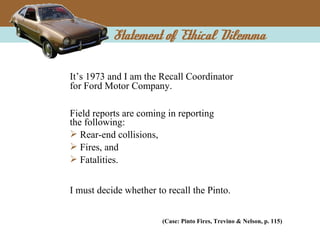
It’s 1973 and I am the Recall Coordinator  for Ford Motor Company. Field reports are coming in reporting the following: Rear-end collisions, Fires, and Fatalities. I must decide whether to recall the Pinto. (Case: Pinto Fires, Trevino & Nelson, p. 115)
Before the Pinto, Ford was immersed in an intense, internal struggle between    “Bunky”   Knudson and Lee Iacocca over the company’s product line. ●   Major pressure to compete with German & Japanese compact cars. Iacocca and the compact car won the struggle. ●   The Pinto debuted in 1971 after the shortest (the most rushed)    production in history. Ford is fully aware of the faulty fuel tank design; crash testing after debut revealed the    fuel tank often ruptured during rear-end impact. ●   In Ford’s opinion, it is too late (or rather too costly) for redesign. The company’s president, Iacocca, insists: ●   Keep the original gas tank design; costs need to be kept down for the    “cost conscious” Pinto buyer. ●   Besides, “Safety doesn’t sell.” Colleagues, other Ford engineers, agree with Iacocca’s opinion about the faulty gas tank,    “Safety isn’t the issue, trunk space is.” Reports show, “The Cost of Dying in a Pinto” outweighs the benefits by almost three times.  ●   $137.5 million cost vs. $49.5 million benefits.
The Pinto’s production was rushed and mistakes were clearly made: Do I ignore the field reports coming in? Do I recommend changes to current production? Do I recommend a total recall? According to the National Highway Traffic Safety Administration standards,    the Pinto meets safety requirements. However, reports are not bumps and bruises, the reports are fatal explosions. I am the  Recall Coordinator  – I was hired to determine when a product is too    dangerous to the public due to defect and needs to be returned to the factory. Which obligation comes first – my obligation to Ford or    my obligation to protecting the general public? With the intense pressure to make the Pinto a success,    will I lose my job when I recall the car? What to my legal guidelines say? There is a tremendous amount of pressure placed on me by my employer, Ford,    to agree with the consensus of the company – “Safety is not an issue.” Will I be able to look at myself in the mirror if more consumers are killed in their    Pintos if I do not place the recall?
Recall Coordinator (me) Ford Motor Company Ford Pinto consumers  My fellow Ford employees Ford Pinto consumers’ passengers Members of the general public involved    in Ford Pinto accidents General public
If I recall the Pinto, I may lose my job. If I recall the Pinto, I may save lives. ●   Consumers, passengers, and general public. According to “The Cost of Dying in a Pinto” report, costs outweigh the benefits.   ●   Will the benefits of recalling the Pinto now outweigh the costs in      the long term both in financial and saved human life revenue? What type of reputation will Ford Motor Company have once the general public finds out the company knew of the Pinto’s glaring defect, did not recall, and    continued production? If I recall the Pinto, my fellow employees may lose their jobs. Will the general public accept the message Ford is sending,    “Ford does not care if we kill you and your family.”
I have an obligation to Ford to ensure our products sustain a certain level of    quality after purchase – even if the product was poorly designed and produced.  I have an obligation to Ford’s consumers to ensure their safety when using our    products – especially when the product was poorly designed and produced. I have an obligation to the general public to ensure Ford’s products are safe. I have an obligation to myself to do the job I was hired to do;    I have an obligation to myself to be honest, especially when saving    people’s lives are  involved. I have an obligation to my fellow coworkers; correcting manufacturer defects now   will uphold Ford’s reputation as an honest automobile dealer, ensuring repeat    customers.
THREE LEVELS OF ETHICAL GUIDES: Professional:  Ford believes safety doesn’t sell; buyers buy because  of price point and special features. Community:  The general public wants safe automobiles on the road. Personal:  Do I believe my company’s stance on the Pinto’s safety? Would I allow my own family to drive Pintos - without the recall?
Could I look myself in the mirror if I did not recall the Pinto and it was one of    my loved ones to die in the next Pinto rear-end, low-impact explosion? Recalling the Pinto would mean I could save lives. Could I find another job, if I lose this one? Am I really doing my job if Ford is pressuring me not to factor safety into    my decisions? I am supposed to be selling a product to enhance lives, not destroy them.
After considering the facts, conflicts, involved parties, consequences, obligations, standards, and checking my gut, I have come to the conclusion I am recommending the Pinto be recalled.  I cannot work for a company who knowingly produces faulty products, knowingly ignores reports of product failure (resulting in fatalities), and then asks me to ignore their incompetence and the duties of my position. I could not look at myself in the mirror knowing I could prevent people from dying – even if it means losing my job. There are other jobs. If I was qualified for this position, I will be qualified for others. The point that hit home, and which was my deciding factor, was asking myself, “Is the Pinto – with the faulty gas tank – safe enough to let my own loved ones drive?” When two roads are diverged in a corporate wood, taking the one less traveled by Pintos makes all the difference.
Trevino, Linda, and Katherine Nelson. Managing Business Ethics.  Fourth Edition. New Jersey: John Wiley & Sons, Inc., 2007.

Ford Pinto_Ethics Case Study

  • 1.
    Amy B. PerraultIndividual Assignment | Number One MBA605 – Business Ethics & Social Responsibility | Jan Ruder, Ph.D. November 11, 2007
  • 2.
    It’s 1973 andI am the Recall Coordinator for Ford Motor Company. Field reports are coming in reporting the following: Rear-end collisions, Fires, and Fatalities. I must decide whether to recall the Pinto. (Case: Pinto Fires, Trevino & Nelson, p. 115)
  • 3.
    Before the Pinto,Ford was immersed in an intense, internal struggle between “Bunky” Knudson and Lee Iacocca over the company’s product line. ● Major pressure to compete with German & Japanese compact cars. Iacocca and the compact car won the struggle. ● The Pinto debuted in 1971 after the shortest (the most rushed) production in history. Ford is fully aware of the faulty fuel tank design; crash testing after debut revealed the fuel tank often ruptured during rear-end impact. ● In Ford’s opinion, it is too late (or rather too costly) for redesign. The company’s president, Iacocca, insists: ● Keep the original gas tank design; costs need to be kept down for the “cost conscious” Pinto buyer. ● Besides, “Safety doesn’t sell.” Colleagues, other Ford engineers, agree with Iacocca’s opinion about the faulty gas tank, “Safety isn’t the issue, trunk space is.” Reports show, “The Cost of Dying in a Pinto” outweighs the benefits by almost three times. ● $137.5 million cost vs. $49.5 million benefits.
  • 4.
    The Pinto’s productionwas rushed and mistakes were clearly made: Do I ignore the field reports coming in? Do I recommend changes to current production? Do I recommend a total recall? According to the National Highway Traffic Safety Administration standards, the Pinto meets safety requirements. However, reports are not bumps and bruises, the reports are fatal explosions. I am the Recall Coordinator – I was hired to determine when a product is too dangerous to the public due to defect and needs to be returned to the factory. Which obligation comes first – my obligation to Ford or my obligation to protecting the general public? With the intense pressure to make the Pinto a success, will I lose my job when I recall the car? What to my legal guidelines say? There is a tremendous amount of pressure placed on me by my employer, Ford, to agree with the consensus of the company – “Safety is not an issue.” Will I be able to look at myself in the mirror if more consumers are killed in their Pintos if I do not place the recall?
  • 5.
    Recall Coordinator (me)Ford Motor Company Ford Pinto consumers My fellow Ford employees Ford Pinto consumers’ passengers Members of the general public involved in Ford Pinto accidents General public
  • 6.
    If I recallthe Pinto, I may lose my job. If I recall the Pinto, I may save lives. ● Consumers, passengers, and general public. According to “The Cost of Dying in a Pinto” report, costs outweigh the benefits. ● Will the benefits of recalling the Pinto now outweigh the costs in the long term both in financial and saved human life revenue? What type of reputation will Ford Motor Company have once the general public finds out the company knew of the Pinto’s glaring defect, did not recall, and continued production? If I recall the Pinto, my fellow employees may lose their jobs. Will the general public accept the message Ford is sending, “Ford does not care if we kill you and your family.”
  • 7.
    I have anobligation to Ford to ensure our products sustain a certain level of quality after purchase – even if the product was poorly designed and produced. I have an obligation to Ford’s consumers to ensure their safety when using our products – especially when the product was poorly designed and produced. I have an obligation to the general public to ensure Ford’s products are safe. I have an obligation to myself to do the job I was hired to do; I have an obligation to myself to be honest, especially when saving people’s lives are involved. I have an obligation to my fellow coworkers; correcting manufacturer defects now will uphold Ford’s reputation as an honest automobile dealer, ensuring repeat customers.
  • 8.
    THREE LEVELS OFETHICAL GUIDES: Professional: Ford believes safety doesn’t sell; buyers buy because of price point and special features. Community: The general public wants safe automobiles on the road. Personal: Do I believe my company’s stance on the Pinto’s safety? Would I allow my own family to drive Pintos - without the recall?
  • 9.
    Could I lookmyself in the mirror if I did not recall the Pinto and it was one of my loved ones to die in the next Pinto rear-end, low-impact explosion? Recalling the Pinto would mean I could save lives. Could I find another job, if I lose this one? Am I really doing my job if Ford is pressuring me not to factor safety into my decisions? I am supposed to be selling a product to enhance lives, not destroy them.
  • 10.
    After considering thefacts, conflicts, involved parties, consequences, obligations, standards, and checking my gut, I have come to the conclusion I am recommending the Pinto be recalled. I cannot work for a company who knowingly produces faulty products, knowingly ignores reports of product failure (resulting in fatalities), and then asks me to ignore their incompetence and the duties of my position. I could not look at myself in the mirror knowing I could prevent people from dying – even if it means losing my job. There are other jobs. If I was qualified for this position, I will be qualified for others. The point that hit home, and which was my deciding factor, was asking myself, “Is the Pinto – with the faulty gas tank – safe enough to let my own loved ones drive?” When two roads are diverged in a corporate wood, taking the one less traveled by Pintos makes all the difference.
  • 11.
    Trevino, Linda, andKatherine Nelson. Managing Business Ethics. Fourth Edition. New Jersey: John Wiley & Sons, Inc., 2007.