WHAT IS
FORCE?
Define force.
Describe what force can do to
objects.
OBJECTIVES
Describe the two main
categories of forces.
1
2
3
A force is a push or
pull in a particular
direction. It results
from an object's
interaction with
another object.
FORCE
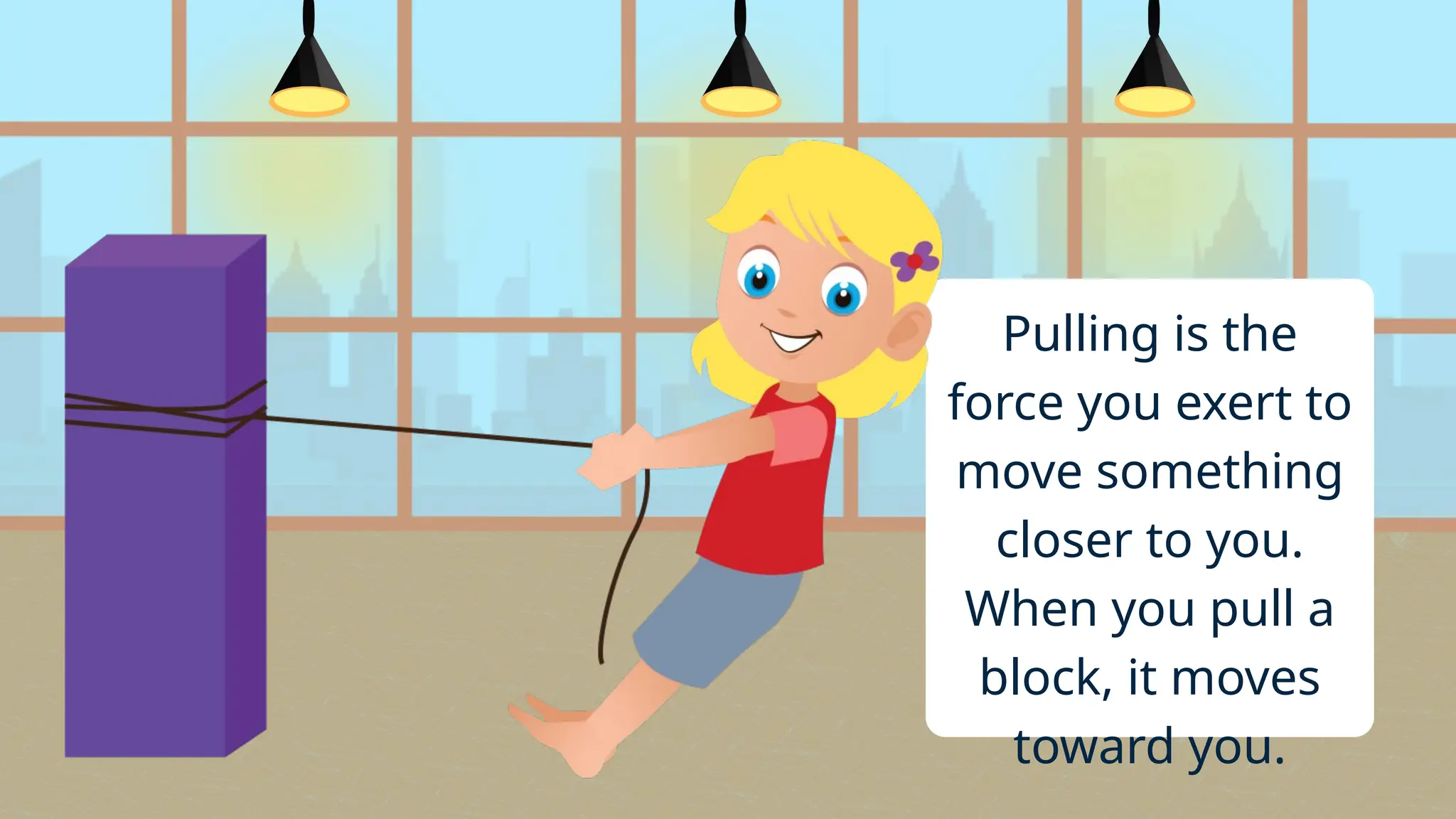
Pulling is the
force you exert to
move something
closer to you.
When you pull a
block, it moves
toward you.
The opposite of pulling is
pushing. Pushing is the
force you exert to move
something away from you.
When you push a block, it
moves away from you.
What can force do?
Questio
n
An ice hockey player
uses a force to move the
hockey puck.
A FORCE CAN
MAKE THE OBJECT
MOVE.
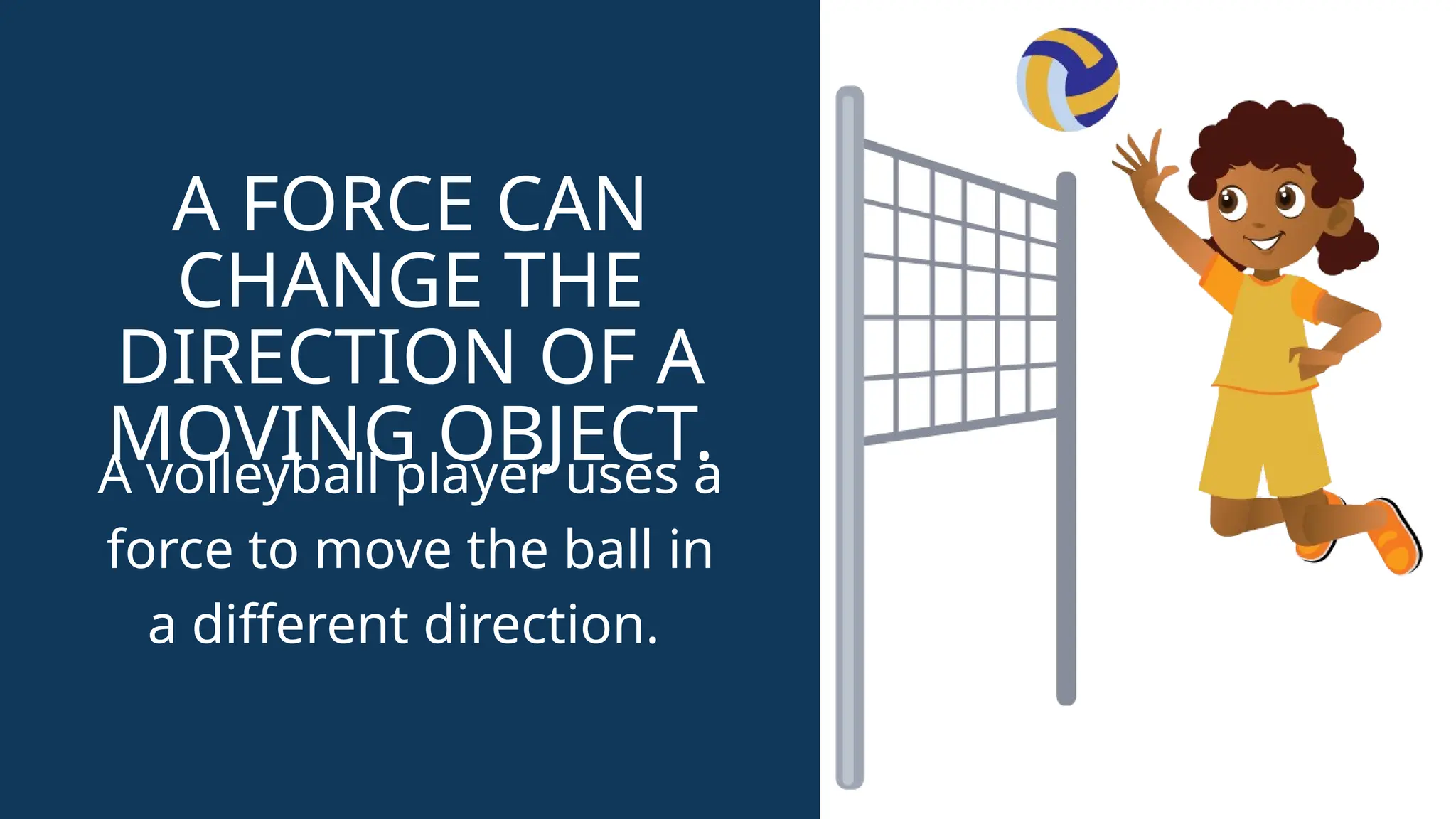
A volleyball player uses a
force to move the ball in
a different direction.
A FORCE CAN
CHANGE THE
DIRECTION OF A
MOVING OBJECT.
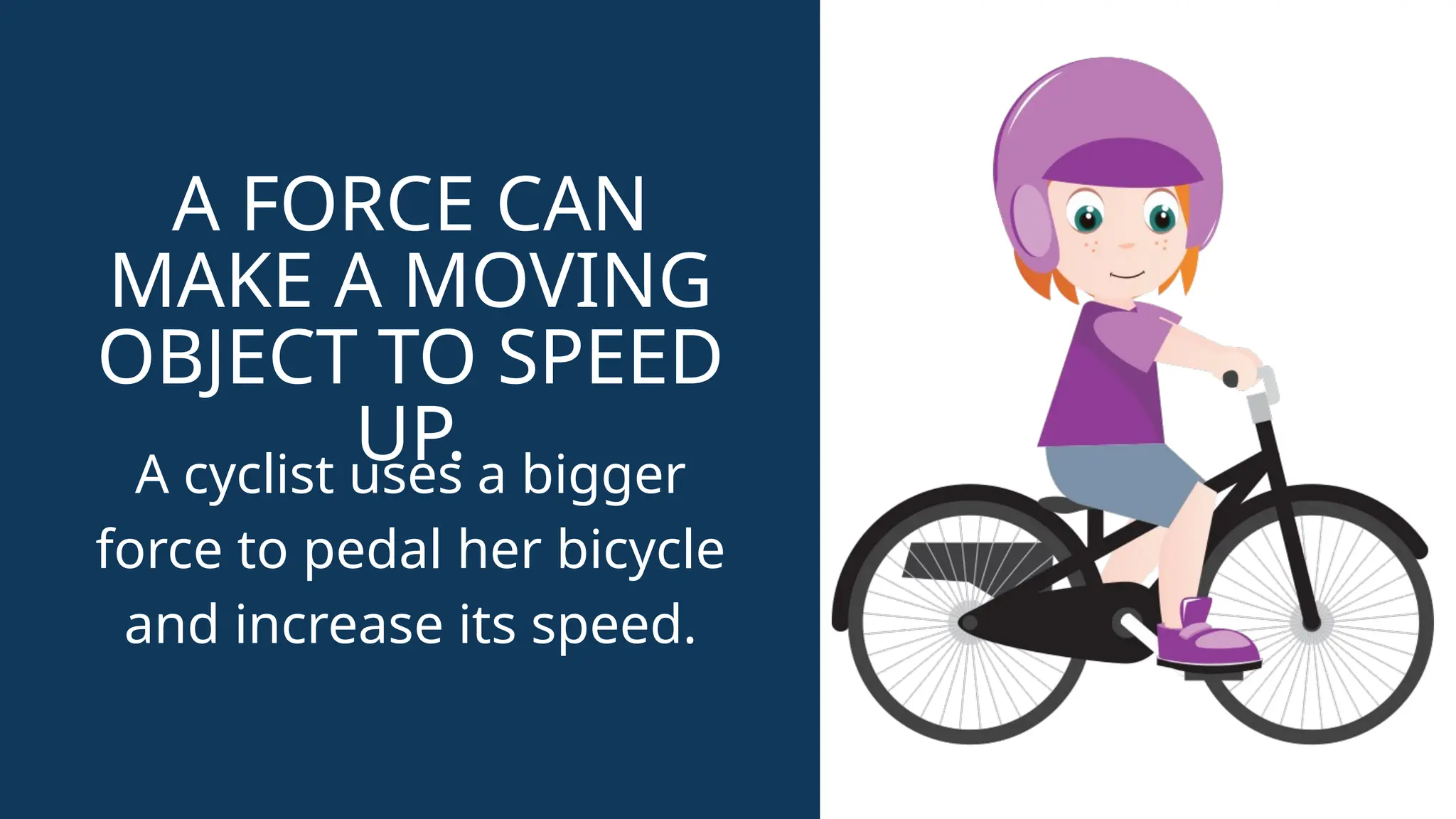
A cyclist uses a bigger
force to pedal her bicycle
and increase its speed.
A FORCE CAN
MAKE A MOVING
OBJECT TO SPEED
UP.
A baseball player uses a
force to catch the ball
and stop it from moving.
A FORCE CAN
STOP A MOVING
OBJECT.
A baker uses a force to
change the shape and
consistency of his
mixture.
A FORCE CAN
CHANGE THE
PROPERTY OF A
MATERIAL.
Balanced Forces
Forces are balanced when two forces
acting on an object are of the same
size and act in opposite directions. In
this scenario, the resultant force is
zero.
The resultant force is the overall force
acting on an object when two or more
forces are combined.
Weight of
the books
(15 N)
Reaction force of the
surface
(15 N)
Balanced Forces
When balanced forces act on
an object at rest, it remains
stationary.
When balanced forces act on a moving
object, it moves at a constant speed in
the same direction.
Weight of the
books
(15 N)
Reaction force
of the surface
(15 N)
Thrust
(2,000 N)
Drag
(2,000 N)
Unbalanced Forces
We can say that forces are unbalanced
when two (or more) forces acting on
an object are not equal in size. This
means that the resultant force is no
longer zero.
Unbalanced forces cause changes in
the motion of an object. Pushing force
(200 N)
Box starts moving to
the right
Friction
(100 N)
Unbalanced Forces
Unbalanced forces cause a
stationary object to move.
Unbalanced forces can speed up or slow
down an object. They can also change the
direction of a moving object.
Pushing force
(500 N)
Crate starts moving
to the right
Car speeds up to the
right
Friction
(300 N)
Thrust
(3,000 N)
Drag
(1,000 N)
Unbalanced Forces
The change in motion of a moving object depends on the direction
of the resultant force.
Resultant force = 3,000 N + (-1,000 N)
= 2,000 N
Resultant force = 1,000 N + (-2,000 N)
= -1,000 N
1,000 N 2,000 N
3,000 N 1,000 N
The truck speeds up to the left The truck slows down
TUG OF WAR RIDING THE SKATEBOARD
Forces Around Us
Winning the tug of war requires an
unbalanced force. The team that exerts
the larger force wins.
To initiate movement or increase speed on
a skateboard, an unbalanced force is
generated by pushing against the ground
with your foot.
What are the two
main categories of
forces?
Questio
n
There are two main
categories of forces
— contact forces and
non-contact forces.
TWO
CATEGORIES
OF FORCES
Contact forces result from two objects
touching each other.
dribbling a
basketball
kicking a
soccer ball
hitting a
shuttlecock
Non-contact forces act on an object without
coming into contact with another object.
gravitational
force
magnetic
force
electrostatic
force
Magnetic force is a
force that attracts or
repels magnetic
objects. It is the push
or pull exerted by a
magnet.
MAGNETIC
FORCE
Gravitational force is the
force by which an object
attracts another object
towards itself. The Earth
pulls objects towards itself
due to its gravitational
force.
GRAVITATIONA
L FORCE
Electrostatic force is the
force that exists
between electrically
charged particles.
ELECTROSTATIC
FORCE
CHECK FOR
UNDERSTANDING
What is force?
What can force do?
What are examples of the two
main categories of forces?
Thank you so

Forces and Motion Science Educational Presentation in Yellow, Blue and Green Illustrative Animated Style (2).pptx

  • 1.
  • 2.
    Define force. Describe whatforce can do to objects. OBJECTIVES Describe the two main categories of forces. 1 2 3
  • 3.
    A force isa push or pull in a particular direction. It results from an object's interaction with another object. FORCE
  • 4.
    Pulling is the forceyou exert to move something closer to you. When you pull a block, it moves toward you.
  • 5.
    The opposite ofpulling is pushing. Pushing is the force you exert to move something away from you. When you push a block, it moves away from you.
  • 6.
    What can forcedo? Questio n
  • 7.
    An ice hockeyplayer uses a force to move the hockey puck. A FORCE CAN MAKE THE OBJECT MOVE.
  • 8.
    A volleyball playeruses a force to move the ball in a different direction. A FORCE CAN CHANGE THE DIRECTION OF A MOVING OBJECT.
  • 9.
    A cyclist usesa bigger force to pedal her bicycle and increase its speed. A FORCE CAN MAKE A MOVING OBJECT TO SPEED UP.
  • 10.
    A baseball playeruses a force to catch the ball and stop it from moving. A FORCE CAN STOP A MOVING OBJECT.
  • 11.
    A baker usesa force to change the shape and consistency of his mixture. A FORCE CAN CHANGE THE PROPERTY OF A MATERIAL.
  • 12.
    Balanced Forces Forces arebalanced when two forces acting on an object are of the same size and act in opposite directions. In this scenario, the resultant force is zero. The resultant force is the overall force acting on an object when two or more forces are combined. Weight of the books (15 N) Reaction force of the surface (15 N)
  • 13.
    Balanced Forces When balancedforces act on an object at rest, it remains stationary. When balanced forces act on a moving object, it moves at a constant speed in the same direction. Weight of the books (15 N) Reaction force of the surface (15 N) Thrust (2,000 N) Drag (2,000 N)
  • 14.
    Unbalanced Forces We cansay that forces are unbalanced when two (or more) forces acting on an object are not equal in size. This means that the resultant force is no longer zero. Unbalanced forces cause changes in the motion of an object. Pushing force (200 N) Box starts moving to the right Friction (100 N)
  • 15.
    Unbalanced Forces Unbalanced forcescause a stationary object to move. Unbalanced forces can speed up or slow down an object. They can also change the direction of a moving object. Pushing force (500 N) Crate starts moving to the right Car speeds up to the right Friction (300 N) Thrust (3,000 N) Drag (1,000 N)
  • 16.
    Unbalanced Forces The changein motion of a moving object depends on the direction of the resultant force. Resultant force = 3,000 N + (-1,000 N) = 2,000 N Resultant force = 1,000 N + (-2,000 N) = -1,000 N 1,000 N 2,000 N 3,000 N 1,000 N The truck speeds up to the left The truck slows down
  • 17.
    TUG OF WARRIDING THE SKATEBOARD Forces Around Us Winning the tug of war requires an unbalanced force. The team that exerts the larger force wins. To initiate movement or increase speed on a skateboard, an unbalanced force is generated by pushing against the ground with your foot.
  • 18.
    What are thetwo main categories of forces? Questio n
  • 19.
    There are twomain categories of forces — contact forces and non-contact forces. TWO CATEGORIES OF FORCES
  • 20.
    Contact forces resultfrom two objects touching each other. dribbling a basketball kicking a soccer ball hitting a shuttlecock
  • 21.
    Non-contact forces acton an object without coming into contact with another object. gravitational force magnetic force electrostatic force
  • 22.
    Magnetic force isa force that attracts or repels magnetic objects. It is the push or pull exerted by a magnet. MAGNETIC FORCE
  • 23.
    Gravitational force isthe force by which an object attracts another object towards itself. The Earth pulls objects towards itself due to its gravitational force. GRAVITATIONA L FORCE
  • 24.
    Electrostatic force isthe force that exists between electrically charged particles. ELECTROSTATIC FORCE
  • 25.
    CHECK FOR UNDERSTANDING What isforce? What can force do? What are examples of the two main categories of forces?
  • 26.