o e oo e d p ere
V lum f C n an S h
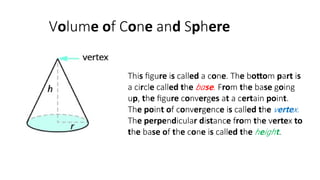
s re s ed o e e otto p rt s
Thi figu i call a c n . Th b m a i
r e ed t e
a ci cl call h se
ba . ro t e se o
F m h ba g ing
p t e re o er es t ert po t
u , h figu c nv g a a c ain in .
e po t o o er e e s ed t e
Th in f c nv g nc i call h erte
v x.
e perpe d r d st e ro t e erte to
Th n icula i anc f m h v x
t e se o t e o e s ed t e
h ba f h c n i call h e t
h igh .
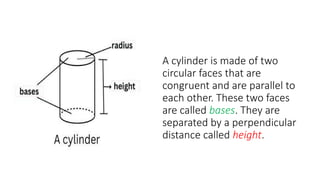
A cylinder ismade of two
circular faces that are
congruent and are parallel to
each other. These two faces
are called bases. They are
separated by a perpendicular
distance called height.
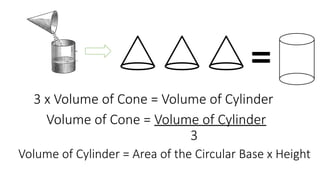
3 x Volumeof Cone = Volume of Cylinder
Volume of Cone = Volume of Cylinder
3
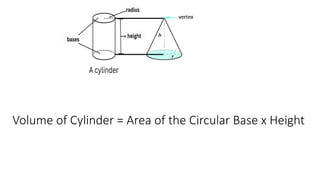
Volume of Cylinder = Area of the Circular Base x Height
7.
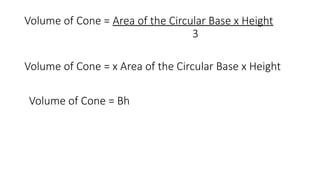
Volume of Cone= Area of the Circular Base x Height
3
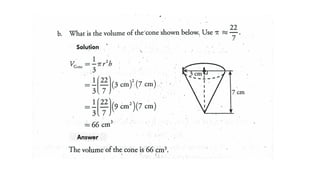
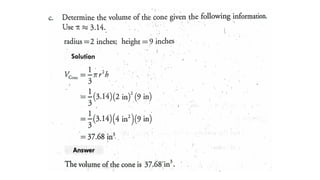
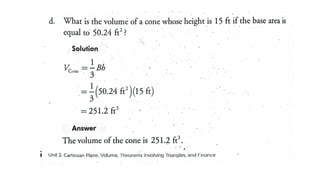
Volume of Cone = x Area of the Circular Base x Height
Volume of Cone = Bh
8.
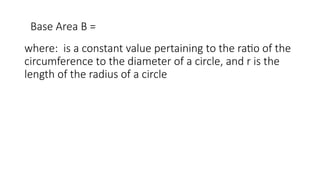
where: is aconstant value pertaining to the ratio of the
circumference to the diameter of a circle, and r is the
length of the radius of a circle
Base Area B =
Editor's Notes
#1 ou will look at pictures of round objects like a basketball, an orange, a bubble, or the Earth.
You will be asked:
“What do all these objects have in common?”
“Do you think they are flat or do they have space inside?”
You will imagine holding one of those objects in your hand.
“If you were to fill it with water, how much do you think it could hold?”
You will compare it (in your mind or on paper) to a cube or box.
“Which one do you think can hold more — the ball or the box of the same size?”
You will share your guesses with the class or write your thoughts on paper.
You will be guided by the teacher to think:
“The amount of space inside something is called its volume. Today, we’ll learn how to find the volume of a sphere!”