Polynomial
Dissection
CHAPTER 1
Factoring
Polynomials with a
Common Factor
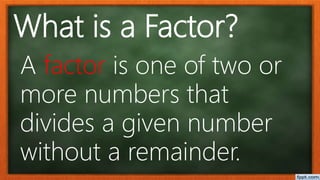
What is a Factor?
A factor is one of two or
more numbers that
divides a given number
without a remainder.
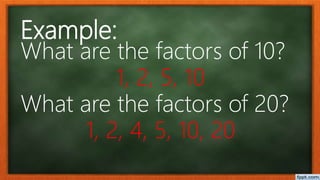
Example:
What are the factors of 10?
1, 2, 5, 10
What are the factors of 20?
1, 2, 4, 5, 10, 20
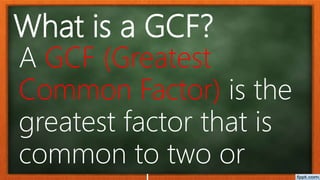
What is a GCF?
A GCF (Greatest
Common Factor) is the
greatest factor that is
common to two or
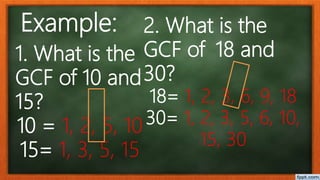
1. What is the
GCF of 10 and
15?
10 = 1, 2, 5, 10
15= 1, 3, 5, 15
2. What is the
GCF of 18 and
30?
18= 1, 2, 3, 6, 9, 18
30= 1, 2, 3, 5, 6, 10,
15, 30
Example:
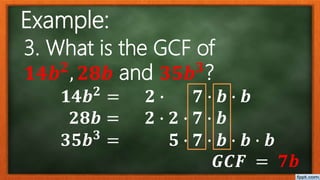
3. What is the GCF of
𝟏𝟒𝒃 𝟐
, 𝟐𝟖𝒃 and 𝟑𝟓𝒃 𝟑
?
𝟏𝟒𝒃 𝟐
= 𝟐 ∙ 𝟕 ∙ 𝒃 ∙ 𝒃
𝟐𝟖𝒃 = 𝟐 ∙ 𝟐 ∙ 𝟕 ∙ 𝒃
𝟑𝟓𝒃 𝟑
= 𝟓 ∙ 𝟕 ∙ 𝒃 ∙ 𝒃 ∙ 𝒃
𝑮𝑪𝑭 = 𝟕𝒃
Example:
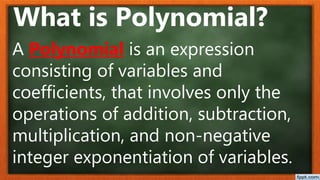
A Polynomial is an expression
consisting of variables and
coefficients, that involves only the
operations of addition, subtraction,
multiplication, and non-negative
integer exponentiation of variables.
What is Polynomial?
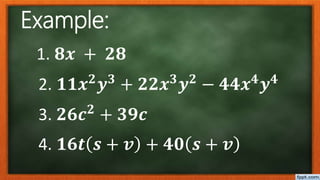
1. 𝟖𝒙 + 𝟐𝟖
Example:
2. 𝟏𝟏𝒙 𝟐
𝒚 𝟑
+ 𝟐𝟐𝒙 𝟑
𝒚 𝟐
− 𝟒𝟒𝒙 𝟒
𝒚 𝟒
3. 𝟐𝟔𝒄 𝟐
+ 𝟑𝟗𝒄
4. 𝟏𝟔𝒕 𝒔 + 𝒗 + 𝟒𝟎 𝒔 + 𝒗
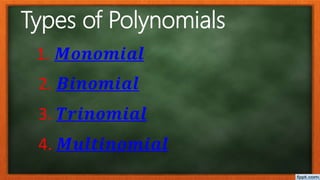
1. 𝑴𝒐𝒏𝒐𝒎𝒊𝒂𝒍
Types of Polynomials
2. 𝑩𝒊𝒏𝒐𝒎𝒊𝒂𝒍
3. 𝑻𝒓𝒊𝒏𝒐𝒎𝒊𝒂𝒍
4. 𝑴𝒖𝒍𝒕𝒊𝒏𝒐𝒎𝒊𝒂𝒍
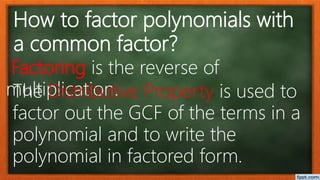
How to factor polynomials with
a common factor?
Factoring is the reverse of
multiplication.The Distributive Property is used to
factor out the GCF of the terms in a
polynomial and to write the
polynomial in factored form.
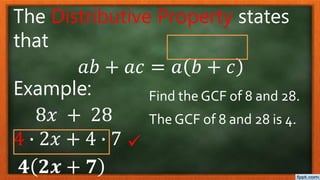
The Distributive Property states
that
𝑎𝑏 + 𝑎𝑐 = 𝑎 𝑏 + 𝑐
Example:
8𝑥 + 28
4 ∙ 2𝑥 + 4 ∙ 7
𝟒 𝟐𝒙 + 𝟕
Find the GCF of 8 and 28.
The GCF of 8 and 28 is 4.

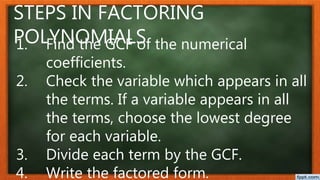
STEPS IN FACTORING
POLYNOMIALS1. Find the GCF of the numerical
coefficients.
2. Check the variable which appears in all
the terms. If a variable appears in all
the terms, choose the lowest degree
for each variable.
3. Divide each term by the GCF.
4. Write the factored form.
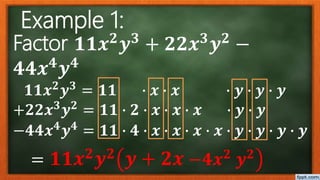
Factor 𝟏𝟏𝒙 𝟐
𝒚 𝟑
+ 𝟐𝟐𝒙 𝟑
𝒚 𝟐
−
𝟒𝟒𝒙 𝟒
𝒚 𝟒
𝟏𝟏𝒙 𝟐 𝒚 𝟑 = 𝟏𝟏 ∙ 𝒙 ∙ 𝒙 ∙ 𝒚 ∙ 𝒚 ∙ 𝒚
+𝟐𝟐𝒙 𝟑 𝒚 𝟐 = 𝟏𝟏 ∙ 𝟐 ∙ 𝒙 ∙ 𝒙 ∙ 𝒙 ∙ 𝒚 ∙ 𝒚
−𝟒𝟒𝒙 𝟒 𝒚 𝟒 = 𝟏𝟏 ∙ 𝟒 ∙ 𝒙 ∙ 𝒙 ∙ 𝒙 ∙ 𝒙 ∙ 𝒚 ∙ 𝒚 ∙ 𝒚 ∙ 𝒚
Example 1:
= 𝟏𝟏𝒙 𝟐 𝒚 𝟐 𝒚 + 𝟐𝒙 −𝟒𝒙 𝟐
𝒚 𝟐
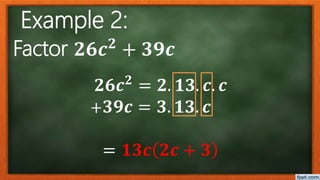
Factor 𝟐𝟔𝒄 𝟐
+ 𝟑𝟗𝒄
𝟐𝟔𝒄 𝟐
= 𝟐. 𝟏𝟑. 𝒄. 𝒄
+ 𝟑𝟗𝒄 = 𝟑. 𝟏𝟑. 𝒄
= 𝟏𝟑𝒄 𝟐𝒄 + 𝟑
Example 2:
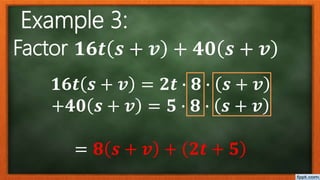
Factor 𝟏𝟔𝒕 𝒔 + 𝒗 + 𝟒𝟎 𝒔 + 𝒗
𝟏𝟔𝒕 𝒔 + 𝒗 = 𝟐𝒕 ∙ 𝟖 ∙ 𝒔 + 𝒗
+𝟒𝟎 𝒔 + 𝒗 = 𝟓 ∙ 𝟖 ∙ 𝒔 + 𝒗
= 𝟖 𝒔 + 𝒗 + 𝟐𝒕 + 𝟓
Example 3:

Factoring with common factors

  • 1.
  • 2.
  • 3.
    What is aFactor? A factor is one of two or more numbers that divides a given number without a remainder.
  • 4.
    Example: What are thefactors of 10? 1, 2, 5, 10 What are the factors of 20? 1, 2, 4, 5, 10, 20
  • 5.
    What is aGCF? A GCF (Greatest Common Factor) is the greatest factor that is common to two or
  • 6.
    1. What isthe GCF of 10 and 15? 10 = 1, 2, 5, 10 15= 1, 3, 5, 15 2. What is the GCF of 18 and 30? 18= 1, 2, 3, 6, 9, 18 30= 1, 2, 3, 5, 6, 10, 15, 30 Example:
  • 7.
    3. What isthe GCF of 𝟏𝟒𝒃 𝟐 , 𝟐𝟖𝒃 and 𝟑𝟓𝒃 𝟑 ? 𝟏𝟒𝒃 𝟐 = 𝟐 ∙ 𝟕 ∙ 𝒃 ∙ 𝒃 𝟐𝟖𝒃 = 𝟐 ∙ 𝟐 ∙ 𝟕 ∙ 𝒃 𝟑𝟓𝒃 𝟑 = 𝟓 ∙ 𝟕 ∙ 𝒃 ∙ 𝒃 ∙ 𝒃 𝑮𝑪𝑭 = 𝟕𝒃 Example:
  • 8.
    A Polynomial isan expression consisting of variables and coefficients, that involves only the operations of addition, subtraction, multiplication, and non-negative integer exponentiation of variables. What is Polynomial?
  • 9.
    1. 𝟖𝒙 +𝟐𝟖 Example: 2. 𝟏𝟏𝒙 𝟐 𝒚 𝟑 + 𝟐𝟐𝒙 𝟑 𝒚 𝟐 − 𝟒𝟒𝒙 𝟒 𝒚 𝟒 3. 𝟐𝟔𝒄 𝟐 + 𝟑𝟗𝒄 4. 𝟏𝟔𝒕 𝒔 + 𝒗 + 𝟒𝟎 𝒔 + 𝒗
  • 10.
    1. 𝑴𝒐𝒏𝒐𝒎𝒊𝒂𝒍 Types ofPolynomials 2. 𝑩𝒊𝒏𝒐𝒎𝒊𝒂𝒍 3. 𝑻𝒓𝒊𝒏𝒐𝒎𝒊𝒂𝒍 4. 𝑴𝒖𝒍𝒕𝒊𝒏𝒐𝒎𝒊𝒂𝒍
  • 11.
    How to factorpolynomials with a common factor? Factoring is the reverse of multiplication.The Distributive Property is used to factor out the GCF of the terms in a polynomial and to write the polynomial in factored form.
  • 12.
    The Distributive Propertystates that 𝑎𝑏 + 𝑎𝑐 = 𝑎 𝑏 + 𝑐 Example: 8𝑥 + 28 4 ∙ 2𝑥 + 4 ∙ 7 𝟒 𝟐𝒙 + 𝟕 Find the GCF of 8 and 28. The GCF of 8 and 28 is 4. 
  • 13.
    STEPS IN FACTORING POLYNOMIALS1.Find the GCF of the numerical coefficients. 2. Check the variable which appears in all the terms. If a variable appears in all the terms, choose the lowest degree for each variable. 3. Divide each term by the GCF. 4. Write the factored form.
  • 14.
    Factor 𝟏𝟏𝒙 𝟐 𝒚𝟑 + 𝟐𝟐𝒙 𝟑 𝒚 𝟐 − 𝟒𝟒𝒙 𝟒 𝒚 𝟒 𝟏𝟏𝒙 𝟐 𝒚 𝟑 = 𝟏𝟏 ∙ 𝒙 ∙ 𝒙 ∙ 𝒚 ∙ 𝒚 ∙ 𝒚 +𝟐𝟐𝒙 𝟑 𝒚 𝟐 = 𝟏𝟏 ∙ 𝟐 ∙ 𝒙 ∙ 𝒙 ∙ 𝒙 ∙ 𝒚 ∙ 𝒚 −𝟒𝟒𝒙 𝟒 𝒚 𝟒 = 𝟏𝟏 ∙ 𝟒 ∙ 𝒙 ∙ 𝒙 ∙ 𝒙 ∙ 𝒙 ∙ 𝒚 ∙ 𝒚 ∙ 𝒚 ∙ 𝒚 Example 1: = 𝟏𝟏𝒙 𝟐 𝒚 𝟐 𝒚 + 𝟐𝒙 −𝟒𝒙 𝟐 𝒚 𝟐
  • 15.
    Factor 𝟐𝟔𝒄 𝟐 +𝟑𝟗𝒄 𝟐𝟔𝒄 𝟐 = 𝟐. 𝟏𝟑. 𝒄. 𝒄 + 𝟑𝟗𝒄 = 𝟑. 𝟏𝟑. 𝒄 = 𝟏𝟑𝒄 𝟐𝒄 + 𝟑 Example 2:
  • 16.
    Factor 𝟏𝟔𝒕 𝒔+ 𝒗 + 𝟒𝟎 𝒔 + 𝒗 𝟏𝟔𝒕 𝒔 + 𝒗 = 𝟐𝒕 ∙ 𝟖 ∙ 𝒔 + 𝒗 +𝟒𝟎 𝒔 + 𝒗 = 𝟓 ∙ 𝟖 ∙ 𝒔 + 𝒗 = 𝟖 𝒔 + 𝒗 + 𝟐𝒕 + 𝟓 Example 3: