Economic growth is essential for creating jobs and
improving wellbeing. Without a solid economic base,
poverty and inequality cannot be eliminated. Finland helps
developing countries to reinforce their economies and
bolster private-sector activity to create jobs and opportu-
nities for entrepreneurship.
Finnish development policy is guided by human rights,
which meansthatthese rights are systematicallyintegrated
as means and objectives in development cooperation.
The World Bank and other Internation-
al Financial Institutions are important
partners when supporting business
environment reforms, the develop-
ment of economic institutions and
infrastructure, and access to finance.
Finland gave funding to the Unit-
ed Nations Industrial Development
Organization (UNIDO, EUR 4.2 mil-
lion in 2014−2015) and will give the
International Trade Centre (ITC, EUR 3.2
million in 2016–2017).
Finland’s main partner in the support ofthe trading capac-
ity ofthe Least Developed Countries is the Enhanced Inte-
grated Framework (EIF, pledged funding of EUR 10 mil-
lion in 2016−2020).
When it comes to promoting Corporate Social Responsi-
bility, the UN Global Compact is Finland’s principal stra-
tegic partner.
Finland also supports partnerships and business oppor-
tunities of Finnish enterprises in developing countries.
The objective is to facilitate job creation and innova-
tion, the transfer of knowledge and good busi-
ness practices, as well as to increase trade.
Instruments include Finnfund, Finn-
partnership, Business with Impact
(BEAM) and the Public Sector Invest-
ment Facility (PIF). The Team Fin-
land network also helps in these
efforts through other means than
development cooperation.
From 2016 to 2019, Finland will
contribute over EUR 500 million to mobi-
lise investments for sustainable develop-
ment in developing countries. This contribution
will be in the form of capital investments and loans.
REINFORCING DEVELOPING
COUNTRIES’ ECONOMIES
More jobs, livelihoods and wellbeing
Through its actions, Finland promotes:
•	 Better access for everyone, especially women, young people and the poorest
	 in society, to decent work, livelihoods and income.
•	 A more dynamic and diversified private sector and related economic activity
	 in developing countries.
•	 International business rules that support the development and sustainability
	 of enterprises and that help them meet the internationally agreed standards
	 in developing countries.
•	 Innovations and new know-how, value chains and technologies that are used
	 in ways for the benefit of sustainable development.
Finland will channel
EUR 500 million to
mobilise investments
for sustainable
development.
SOMALIA
VIETNAM
AFGHANISTAN
KYRGYZSTAN
TANZANIA
NEPAL
UZBEKISTAN
ZAMBIA
http://formin.finland.fi/developmentpolicy
Private Sector Development is one
of Finland’s development cooperation
sectors in Zambia. Finland supports
the UN joint programme that promotes
sustainable business among micro,
small and medium-sized enterprises
(MSMEs) along the building construction
value chain. This programme also supports
these enterprises in extending basic
social protection to workers. Finland has
committed EUR 8.7 million to the pro-
gramme for the period 2013−2018. The
programme has created more than 2,600
green and decent jobs and improved the
quality of 2,000 jobs in MSMEs in two
years.
In Tanzania, Finland funds the develop-
ment of the innovation ecosystem and
supports private sector innovation.
Finland has allocated EUR 8.95 million to
the project for the period 2017−2021.
Examples of Finland’s actions:
The Enhanced Integrated Framework is a global multi-donor programme which is aimed at supporting the Least Developed Countries
be more active players in the global trading system. The programme delivers trade-related assistance, facilitates production of
trade-related needs assessments and improves the countries’ capacities to integrate trade into their national development strate-
gies. Finland has pledged EUR 10 million in 2016−2020.
Afghanistan Reconstruction Trust Fund
is Finland’s primary channel of support
for the recovery and reconstruction
of Afghanistan. Finland has granted
EUR 50 million to the Trust Fund for
the period 2014−2018. The Fund
has improved access to services, for
example, education, health, energy,
infrastructure, water and sanitation and
has created employment for Afghan
people.
UN Women implements a project
in Nepal that helps improve the
entrepreneurship of the poorest
and most vulnerable women
and develop their skills. Finland
has allocated EUR 4 million in
2015−2017.
Finland’s two major projects in Central Asia concentrate
on trade and employment. The Aid for Trade project
supports trade-policy reforms, productivity of farmers
and agribusiness enterprises, cross-border subregional
trade and women’s entrepreneurship in the in Kyr-
gyzstan, Tajikistan and Uzbekistan. Finland supports the
United Nations Development Programme (UNDP) with a
contribution of EUR 9 million in 2014−2018. The Decent
Work project helps improve occupational safety and
health, employment and social protection in Kyrgyzstan
and Tajikistan. Finland’s grant to the International Labour
Organization (ILO) is EUR 4 million in 2014−2018 for the
implementation of this project.
TAJIKISTAN
Finland supports Vietnam,
with a contribution of EUR
9.9 million in 2014−2018, to
create a start-up ecosystem
and to help enterprises and
other organisations develop
innovative products and
services.
Trademark East Africa (TMEA) is a joint initiative of eight
donors, including Finland, to improve trade flows in East
Africa. Its budget is USD 560 million, of which Finland
contributed EUR 6 million from 2013 to 2016. TMEA activities
include support to the Dar es Salaam and Mombasa ports, and
for border management infrastructure, collection systems
for trade-related revenue and policy dialogue. Additionally,
a central component of TMEA’s work is to support female
entrepreneurs and traders.
Finland also finances regional innovation
cooperation in several Southern African
countries. Finland has granted EUR 9.3 million
for supporting private sector innovation and
socially inclusive business development in
2017−2020.
The World Bank’s Multi-Partner Fund
supports peacebuilding and statebuild-
ing in Somalia by strengthening gov-
ernance and the management of state
revenues, including taxation, as well
as by reviving the country’s economy,
infrastructure, electricity distribution
and the private sector. Finland’s
contribution amounts to EUR 4 million in
2016−2019.
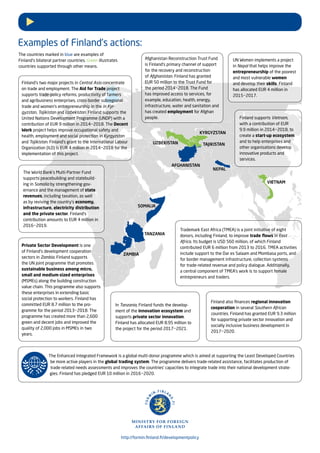
The countries marked in blue are examples of
Finland’s bilateral partner countries. Green illustrates
countries supported through other means.

Reinforcing developing countries' economies

  • 1.
    Economic growth isessential for creating jobs and improving wellbeing. Without a solid economic base, poverty and inequality cannot be eliminated. Finland helps developing countries to reinforce their economies and bolster private-sector activity to create jobs and opportu- nities for entrepreneurship. Finnish development policy is guided by human rights, which meansthatthese rights are systematicallyintegrated as means and objectives in development cooperation. The World Bank and other Internation- al Financial Institutions are important partners when supporting business environment reforms, the develop- ment of economic institutions and infrastructure, and access to finance. Finland gave funding to the Unit- ed Nations Industrial Development Organization (UNIDO, EUR 4.2 mil- lion in 2014−2015) and will give the International Trade Centre (ITC, EUR 3.2 million in 2016–2017). Finland’s main partner in the support ofthe trading capac- ity ofthe Least Developed Countries is the Enhanced Inte- grated Framework (EIF, pledged funding of EUR 10 mil- lion in 2016−2020). When it comes to promoting Corporate Social Responsi- bility, the UN Global Compact is Finland’s principal stra- tegic partner. Finland also supports partnerships and business oppor- tunities of Finnish enterprises in developing countries. The objective is to facilitate job creation and innova- tion, the transfer of knowledge and good busi- ness practices, as well as to increase trade. Instruments include Finnfund, Finn- partnership, Business with Impact (BEAM) and the Public Sector Invest- ment Facility (PIF). The Team Fin- land network also helps in these efforts through other means than development cooperation. From 2016 to 2019, Finland will contribute over EUR 500 million to mobi- lise investments for sustainable develop- ment in developing countries. This contribution will be in the form of capital investments and loans. REINFORCING DEVELOPING COUNTRIES’ ECONOMIES More jobs, livelihoods and wellbeing Through its actions, Finland promotes: • Better access for everyone, especially women, young people and the poorest in society, to decent work, livelihoods and income. • A more dynamic and diversified private sector and related economic activity in developing countries. • International business rules that support the development and sustainability of enterprises and that help them meet the internationally agreed standards in developing countries. • Innovations and new know-how, value chains and technologies that are used in ways for the benefit of sustainable development. Finland will channel EUR 500 million to mobilise investments for sustainable development.
  • 2.
    SOMALIA VIETNAM AFGHANISTAN KYRGYZSTAN TANZANIA NEPAL UZBEKISTAN ZAMBIA http://formin.finland.fi/developmentpolicy Private Sector Developmentis one of Finland’s development cooperation sectors in Zambia. Finland supports the UN joint programme that promotes sustainable business among micro, small and medium-sized enterprises (MSMEs) along the building construction value chain. This programme also supports these enterprises in extending basic social protection to workers. Finland has committed EUR 8.7 million to the pro- gramme for the period 2013−2018. The programme has created more than 2,600 green and decent jobs and improved the quality of 2,000 jobs in MSMEs in two years. In Tanzania, Finland funds the develop- ment of the innovation ecosystem and supports private sector innovation. Finland has allocated EUR 8.95 million to the project for the period 2017−2021. Examples of Finland’s actions: The Enhanced Integrated Framework is a global multi-donor programme which is aimed at supporting the Least Developed Countries be more active players in the global trading system. The programme delivers trade-related assistance, facilitates production of trade-related needs assessments and improves the countries’ capacities to integrate trade into their national development strate- gies. Finland has pledged EUR 10 million in 2016−2020. Afghanistan Reconstruction Trust Fund is Finland’s primary channel of support for the recovery and reconstruction of Afghanistan. Finland has granted EUR 50 million to the Trust Fund for the period 2014−2018. The Fund has improved access to services, for example, education, health, energy, infrastructure, water and sanitation and has created employment for Afghan people. UN Women implements a project in Nepal that helps improve the entrepreneurship of the poorest and most vulnerable women and develop their skills. Finland has allocated EUR 4 million in 2015−2017. Finland’s two major projects in Central Asia concentrate on trade and employment. The Aid for Trade project supports trade-policy reforms, productivity of farmers and agribusiness enterprises, cross-border subregional trade and women’s entrepreneurship in the in Kyr- gyzstan, Tajikistan and Uzbekistan. Finland supports the United Nations Development Programme (UNDP) with a contribution of EUR 9 million in 2014−2018. The Decent Work project helps improve occupational safety and health, employment and social protection in Kyrgyzstan and Tajikistan. Finland’s grant to the International Labour Organization (ILO) is EUR 4 million in 2014−2018 for the implementation of this project. TAJIKISTAN Finland supports Vietnam, with a contribution of EUR 9.9 million in 2014−2018, to create a start-up ecosystem and to help enterprises and other organisations develop innovative products and services. Trademark East Africa (TMEA) is a joint initiative of eight donors, including Finland, to improve trade flows in East Africa. Its budget is USD 560 million, of which Finland contributed EUR 6 million from 2013 to 2016. TMEA activities include support to the Dar es Salaam and Mombasa ports, and for border management infrastructure, collection systems for trade-related revenue and policy dialogue. Additionally, a central component of TMEA’s work is to support female entrepreneurs and traders. Finland also finances regional innovation cooperation in several Southern African countries. Finland has granted EUR 9.3 million for supporting private sector innovation and socially inclusive business development in 2017−2020. The World Bank’s Multi-Partner Fund supports peacebuilding and statebuild- ing in Somalia by strengthening gov- ernance and the management of state revenues, including taxation, as well as by reviving the country’s economy, infrastructure, electricity distribution and the private sector. Finland’s contribution amounts to EUR 4 million in 2016−2019. The countries marked in blue are examples of Finland’s bilateral partner countries. Green illustrates countries supported through other means.