FINLAND’S DEVELOPMENT POLICY
One World, One Future: Toward sustainable development
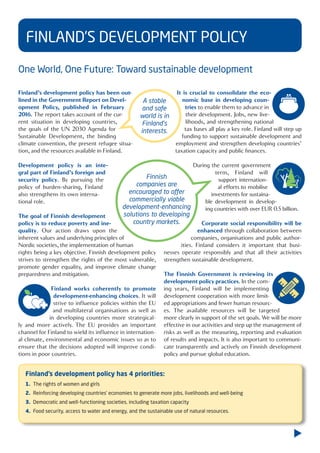
Finland’s development policy has been out-
lined in the Government Report on Devel-
opment Policy, published in February
2016. The report takes account of the cur-
rent situation in developing countries,
the goals of the UN 2030 Agenda for
Sustainable Development, the binding
climate convention, the present refugee situa-
tion, and the resources available in Finland.
Development policy is an inte-
gral part of Finland’s foreign and
security policy. By pursuing the
policy of burden-sharing, Finland
also strengthens its own interna-
tional role.
The goal of Finnish development
policy is to reduce poverty and ine-
quality. Our action draws upon the
inherent values and underlying principles of
Nordic societies, the implementation of human
rights being a key objective. Finnish development policy
strives to strengthen the rights of the most vulnerable,
promote gender equality, and improve climate change
preparedness and mitigation.
Finland works coherently to promote
development-enhancing choices. It will
strive to influence policies within the EU
and multilateral organisations as well as
in developing countries more strategical-
ly and more actively. The EU provides an important
channel for Finland to wield its influence in internation-
al climate, environmental and economic issues so as to
ensure that the decisions adopted will improve condi-
tions in poor countries.
It is crucial to consolidate the eco-
nomic base in developing coun-
tries to enable them to advance in
their development. Jobs, new live-
lihoods, and strengthening national
tax bases all play a key role. Finland will step up
funding to support sustainable development and
employment and strengthen developing countries’
taxation capacity and public finances.
During the current government
term, Finland will
support internation-
al efforts to mobilise
investments for sustaina-
ble development in develop-
ing countries with over EUR 0.5 billion.
Corporate social responsibility will be
enhanced through collaboration between
companies, organisations and public author-
ities. Finland considers it important that busi-
nesses operate responsibly and that all their activities
strengthen sustainable development.
The Finnish Government is reviewing its
development policy practices. In the com-
ing years, Finland will be implementing
development cooperation with more limit-
ed appropriations and fewer human resourc-
es. The available resources will be targeted
more clearly in support of the set goals. We will be more
effective in our activities and step up the management of
risks as well as the measuring, reporting and evaluation
of results and impacts. It is also important to communi-
cate transparently and actively on Finnish development
policy and pursue global education.
A stable
and safe
world is in
Finland’s
interests.
Finnish
companies are
encouraged to offer
commercially viable
development-enhancing
solutions to developing
country markets.
Finland’s development policy has 4 priorities:
1.	 The rights of women and girls
2.	 Reinforcing developing countries’ economies to generate more jobs, livelihoods and well-being
3.	 Democratic and well-functioning societies, including taxation capacity
4.	 Food security, access to water and energy, and the sustainable use of natural resources.
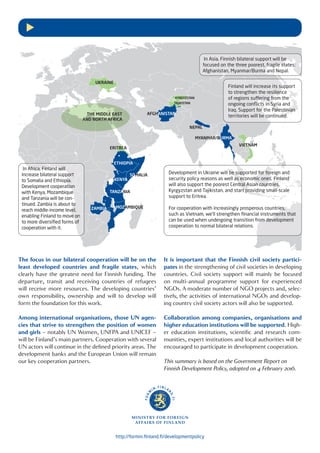
Finland will increase its support
to strengthen the resilience
of regions suffering from the
ongoing conflicts in Syria and
Iraq. Support for the Palestinian
territories will be continued.
In Asia, Finnish bilateral support will be
focused on the three poorest, fragile states:
Afghanistan, Myanmar/Burma and Nepal.
Development in Ukraine will be supported for foreign and
security policy reasons as well as economic ones. Finland
will also support the poorest Central Asian countries,
Kyrgyzstan and Tajikistan, and start providing small-scale
support to Eritrea.
For cooperation with increasingly prosperous countries,
such as Vietnam, we’ll strengthen financial instruments that
can be used when undergoing transition from development
cooperation to normal bilateral relations.
In Africa, Finland will
increase bilateral support
to Somalia and Ethiopia.
Development cooperation
with Kenya, Mozambique
and Tanzania will be con-
tinued. Zambia is about to
reach middle-income level,
enabling Finland to move on
to more diversified forms of
cooperation with it.
The focus in our bilateral cooperation will be on the
least developed countries and fragile states, which
clearly have the greatest need for Finnish funding. The
departure, transit and receiving countries of refugees
will receive more resources. The developing countries’
own responsibility, ownership and will to develop will
form the foundation for this work.
Among international organisations, those UN agen-
cies that strive to strengthen the position of women
and girls – notably UN Women, UNFPA and UNICEF –
will be Finland’s main partners. Cooperation with several
UN actors will continue in the defined priority areas. The
development banks and the European Union will remain
our key cooperation partners.
It is important that the Finnish civil society partici-
pates in the strengthening of civil societies in developing
countries. Civil society support will mainly be focused
on multi-annual programme support for experienced
NGOs. A moderate number of NGO projects and, selec-
tively, the activities of international NGOs and develop-
ing country civil society actors will also be supported.
Collaboration among companies, organisations and
higher education institutions will be supported. High-
er education institutions, scientific and research com-
munities, expert institutions and local authorities will be
encouraged to participate in development cooperation.
This summary is based on the Government Report on
Finnish Development Policy, adopted on 4 February 2016.
ETHIOPIA
UKRAINE
VIETNAM
THE MIDDLE EAST
AND NORTH AFRICA
ERITREA
KENYA
NEPAL
MYANMAR/BURMA
ZAMBIA MOZAMBIQUE
TANZANIA
SOMALIA
AFGHANISTAN
TAJIKISTAN
KYRGYZSTAN
http://formin.finland.fi/developmentpolicy

Finland's development policy

  • 1.
    FINLAND’S DEVELOPMENT POLICY OneWorld, One Future: Toward sustainable development Finland’s development policy has been out- lined in the Government Report on Devel- opment Policy, published in February 2016. The report takes account of the cur- rent situation in developing countries, the goals of the UN 2030 Agenda for Sustainable Development, the binding climate convention, the present refugee situa- tion, and the resources available in Finland. Development policy is an inte- gral part of Finland’s foreign and security policy. By pursuing the policy of burden-sharing, Finland also strengthens its own interna- tional role. The goal of Finnish development policy is to reduce poverty and ine- quality. Our action draws upon the inherent values and underlying principles of Nordic societies, the implementation of human rights being a key objective. Finnish development policy strives to strengthen the rights of the most vulnerable, promote gender equality, and improve climate change preparedness and mitigation. Finland works coherently to promote development-enhancing choices. It will strive to influence policies within the EU and multilateral organisations as well as in developing countries more strategical- ly and more actively. The EU provides an important channel for Finland to wield its influence in internation- al climate, environmental and economic issues so as to ensure that the decisions adopted will improve condi- tions in poor countries. It is crucial to consolidate the eco- nomic base in developing coun- tries to enable them to advance in their development. Jobs, new live- lihoods, and strengthening national tax bases all play a key role. Finland will step up funding to support sustainable development and employment and strengthen developing countries’ taxation capacity and public finances. During the current government term, Finland will support internation- al efforts to mobilise investments for sustaina- ble development in develop- ing countries with over EUR 0.5 billion. Corporate social responsibility will be enhanced through collaboration between companies, organisations and public author- ities. Finland considers it important that busi- nesses operate responsibly and that all their activities strengthen sustainable development. The Finnish Government is reviewing its development policy practices. In the com- ing years, Finland will be implementing development cooperation with more limit- ed appropriations and fewer human resourc- es. The available resources will be targeted more clearly in support of the set goals. We will be more effective in our activities and step up the management of risks as well as the measuring, reporting and evaluation of results and impacts. It is also important to communi- cate transparently and actively on Finnish development policy and pursue global education. A stable and safe world is in Finland’s interests. Finnish companies are encouraged to offer commercially viable development-enhancing solutions to developing country markets. Finland’s development policy has 4 priorities: 1. The rights of women and girls 2. Reinforcing developing countries’ economies to generate more jobs, livelihoods and well-being 3. Democratic and well-functioning societies, including taxation capacity 4. Food security, access to water and energy, and the sustainable use of natural resources.
  • 2.
    Finland will increaseits support to strengthen the resilience of regions suffering from the ongoing conflicts in Syria and Iraq. Support for the Palestinian territories will be continued. In Asia, Finnish bilateral support will be focused on the three poorest, fragile states: Afghanistan, Myanmar/Burma and Nepal. Development in Ukraine will be supported for foreign and security policy reasons as well as economic ones. Finland will also support the poorest Central Asian countries, Kyrgyzstan and Tajikistan, and start providing small-scale support to Eritrea. For cooperation with increasingly prosperous countries, such as Vietnam, we’ll strengthen financial instruments that can be used when undergoing transition from development cooperation to normal bilateral relations. In Africa, Finland will increase bilateral support to Somalia and Ethiopia. Development cooperation with Kenya, Mozambique and Tanzania will be con- tinued. Zambia is about to reach middle-income level, enabling Finland to move on to more diversified forms of cooperation with it. The focus in our bilateral cooperation will be on the least developed countries and fragile states, which clearly have the greatest need for Finnish funding. The departure, transit and receiving countries of refugees will receive more resources. The developing countries’ own responsibility, ownership and will to develop will form the foundation for this work. Among international organisations, those UN agen- cies that strive to strengthen the position of women and girls – notably UN Women, UNFPA and UNICEF – will be Finland’s main partners. Cooperation with several UN actors will continue in the defined priority areas. The development banks and the European Union will remain our key cooperation partners. It is important that the Finnish civil society partici- pates in the strengthening of civil societies in developing countries. Civil society support will mainly be focused on multi-annual programme support for experienced NGOs. A moderate number of NGO projects and, selec- tively, the activities of international NGOs and develop- ing country civil society actors will also be supported. Collaboration among companies, organisations and higher education institutions will be supported. High- er education institutions, scientific and research com- munities, expert institutions and local authorities will be encouraged to participate in development cooperation. This summary is based on the Government Report on Finnish Development Policy, adopted on 4 February 2016. ETHIOPIA UKRAINE VIETNAM THE MIDDLE EAST AND NORTH AFRICA ERITREA KENYA NEPAL MYANMAR/BURMA ZAMBIA MOZAMBIQUE TANZANIA SOMALIA AFGHANISTAN TAJIKISTAN KYRGYZSTAN http://formin.finland.fi/developmentpolicy