Food safety metrics relevant
to low- and middle-income
countries
Working group members: Delia Grace1, Silvia Alonso1, Paula Domiguez-Salas1,2, Anna Fahrion3, Barbara
Häsler4, Martin Heilmann5, Vivian Hoffmann6, Erastus Kang’ethe7, Kristina Roesel1
1 International Livestock Research Institute, Nairobi 2 London School of Hygiene and Tropical Medicine, London 3 World Health Organization, Geneva
4 Royal Veterinary College, London 5 Food and Agriculture Organization of the United Nations, Rome 6 International Food Policy Research Institute, Washington
7 University of Nairobi, Nairobi
Background
Mounting evidence on the high burdens of foodborne disease (FBD), rapid transformation of agri-food systems, and increasing
concerns about food safety are powerful motivations for better understanding food safety in low- and middle-income countries
(LMICs). A working group was established to provide a synthesis about measuring food safety in the context of generating actionable
evidence and to identify needs and opportunities for food safety research in LMICs.
Research needs for LMICs
• What are the multiple burdens of FBD in a given country
(health, economic, social) and what can best be done to
mitigate them? (Development methods (participatory risk
assessment) and novel technologies (ICT) are promising)
• What happens to food rejected by trade partners? Are
there spillover benefits from export and how can these
be maximized?
• How can risk analysis work for mass domestic markets?
• How can standards work better for LMICs? (Dual
standards? Regional standards? Holistic standards?)
• How can food safety be driven by evidence rather than
(mis)perception as now predominates in LMICs?
Delia Grace
d.grace@cgiar.org ● Box 30709 Nairobi Kenya ● +254 20 422 3465
We acknowledge support from the ANH Academy in developing the report and the CGIAR
Research Program on Agriculture for Nutrition and Health, LSHTM, RVC, WHO and FAO for
supporting time of scientists in preparing and reviewing the document
This document is licensed for use under the Creative Commons Attribution 4.0 International
Licence. July 2017
©Martin Heilmann/ ILRI, FUB
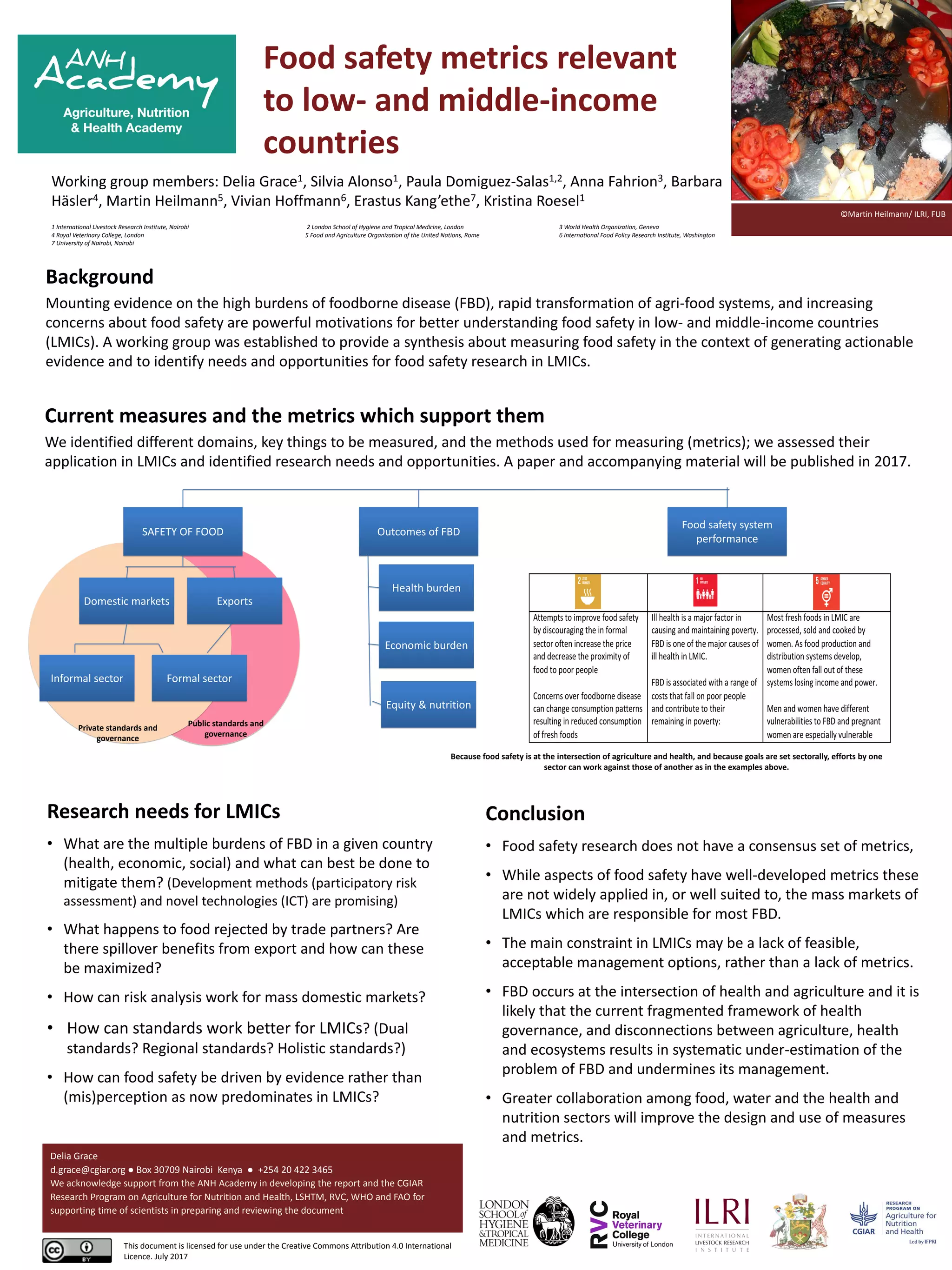
Current measures and the metrics which support them
We identified different domains, key things to be measured, and the methods used for measuring (metrics); we assessed their
application in LMICs and identified research needs and opportunities. A paper and accompanying material will be published in 2017.
SAFETY OF FOOD Outcomes of FBD
Food safety system
performance
Domestic markets Exports
Formal sectorInformal sector
Health burden
Economic burden
Equity & nutrition
Conclusion
• Food safety research does not have a consensus set of metrics,
• While aspects of food safety have well-developed metrics these
are not widely applied in, or well suited to, the mass markets of
LMICs which are responsible for most FBD.
• The main constraint in LMICs may be a lack of feasible,
acceptable management options, rather than a lack of metrics.
• FBD occurs at the intersection of health and agriculture and it is
likely that the current fragmented framework of health
governance, and disconnections between agriculture, health
and ecosystems results in systematic under-estimation of the
problem of FBD and undermines its management.
• Greater collaboration among food, water and the health and
nutrition sectors will improve the design and use of measures
and metrics.
Private standards and
governance
Public standards and
governance
Because food safety is at the intersection of agriculture and health, and because goals are set sectorally, efforts by one
sector can work against those of another as in the examples above.

Food safety metrics relevant to low- and middle-income countries

  • 1.
    Food safety metricsrelevant to low- and middle-income countries Working group members: Delia Grace1, Silvia Alonso1, Paula Domiguez-Salas1,2, Anna Fahrion3, Barbara Häsler4, Martin Heilmann5, Vivian Hoffmann6, Erastus Kang’ethe7, Kristina Roesel1 1 International Livestock Research Institute, Nairobi 2 London School of Hygiene and Tropical Medicine, London 3 World Health Organization, Geneva 4 Royal Veterinary College, London 5 Food and Agriculture Organization of the United Nations, Rome 6 International Food Policy Research Institute, Washington 7 University of Nairobi, Nairobi Background Mounting evidence on the high burdens of foodborne disease (FBD), rapid transformation of agri-food systems, and increasing concerns about food safety are powerful motivations for better understanding food safety in low- and middle-income countries (LMICs). A working group was established to provide a synthesis about measuring food safety in the context of generating actionable evidence and to identify needs and opportunities for food safety research in LMICs. Research needs for LMICs • What are the multiple burdens of FBD in a given country (health, economic, social) and what can best be done to mitigate them? (Development methods (participatory risk assessment) and novel technologies (ICT) are promising) • What happens to food rejected by trade partners? Are there spillover benefits from export and how can these be maximized? • How can risk analysis work for mass domestic markets? • How can standards work better for LMICs? (Dual standards? Regional standards? Holistic standards?) • How can food safety be driven by evidence rather than (mis)perception as now predominates in LMICs? Delia Grace d.grace@cgiar.org ● Box 30709 Nairobi Kenya ● +254 20 422 3465 We acknowledge support from the ANH Academy in developing the report and the CGIAR Research Program on Agriculture for Nutrition and Health, LSHTM, RVC, WHO and FAO for supporting time of scientists in preparing and reviewing the document This document is licensed for use under the Creative Commons Attribution 4.0 International Licence. July 2017 ©Martin Heilmann/ ILRI, FUB Current measures and the metrics which support them We identified different domains, key things to be measured, and the methods used for measuring (metrics); we assessed their application in LMICs and identified research needs and opportunities. A paper and accompanying material will be published in 2017. SAFETY OF FOOD Outcomes of FBD Food safety system performance Domestic markets Exports Formal sectorInformal sector Health burden Economic burden Equity & nutrition Conclusion • Food safety research does not have a consensus set of metrics, • While aspects of food safety have well-developed metrics these are not widely applied in, or well suited to, the mass markets of LMICs which are responsible for most FBD. • The main constraint in LMICs may be a lack of feasible, acceptable management options, rather than a lack of metrics. • FBD occurs at the intersection of health and agriculture and it is likely that the current fragmented framework of health governance, and disconnections between agriculture, health and ecosystems results in systematic under-estimation of the problem of FBD and undermines its management. • Greater collaboration among food, water and the health and nutrition sectors will improve the design and use of measures and metrics. Private standards and governance Public standards and governance Because food safety is at the intersection of agriculture and health, and because goals are set sectorally, efforts by one sector can work against those of another as in the examples above.