Retail Management
Module 2: Retail Environment Analysis
Retailer Classification
Learning Outcomes: Retailer Classification
• 2.1 List the classification characteristics of various types of retailers by
ownership
• 2.1.1 Match a retailer with its structural organization based on its classification
• 2.1.2 Match a retailer with its advantages and disadvantages based on its
classification
Practice Question 1
In this module, we’ll study the retail environment analysis. A retailer is the last
step of the supply chain. It is where consumers go to obtain goods and
services. To best meet consumers’ needs, there are many types of retail
formats, reflecting different scopes and strategies.
Write for five minutes all of the answers you can think of to the following
question:
Why evaluate different types of retail institutions?
Five Primary Ownership Types:
1. Corporate chain: multiple stores, central ownership, and consistent
standards operating on a large scale
2. Independent store: buy products through wholesalers which apply
an upcharge for warehousing and handling product
3. Wholesaler: product distributors focused on supply chain and
logistics
4. Franchise: owned by individual business owners who have
contracted with larger company
5. Co-op: when several independent retailers join together to
consolidate purchases, increasing buying power
Retailer Types:
Advantages & Disadvantages
Club and Warehouse Stores: offer value, require memberships
Mass Merchandisers: low prices, busy
Convenience and Drug Stores: limited selection
Discount and Dollar Stores: low prices, lesser: known brands
Natural and Organic Stores: array of unique items at high price
Specialty Retailers: offers alternative to mass merchandisers
Online Retailers: home delivery
Traditional Grocers: wide assortment, local
Practice Question 2
Serving communities in the Pacific Northwest with over 60 stores in Washington
and Oregon, QFC Supermarkets is an example of what kind of retailer?
Food Retailers
Learning Outcomes: Food Retailers
• 2.2.3 Discuss the current trends affecting food retailers
• 2.3 Compare and contrast service and merchandise retailers
Changes in Food Retailing
Retailers aren’t just competing with one another through the items they offer
and the pricing they set. Instead, they’re competing on a whole host of other
criteria, such as convenience and customer service.
Convenience: is the store nearby? Is there ample parking? Will they have what I
need?
Customer Service: is this a place I like to shop? Is the store clean? Are the staff
available/helpful, can I get in and out quickly
Variety and Assortment of Goods in Food Retail
Categories are divided into several segments & sub-segments, which can be
further divided into brands and into Stock Keeping Units (SKU)
• Segments and sub-segments: dry soup (ramen), ingredients
• Leading brands: Campbell’s, Progresso
Retailers make assortment decisions at category, segment, brand, & SKU level
• Family Dollar vs. Sam’s Club
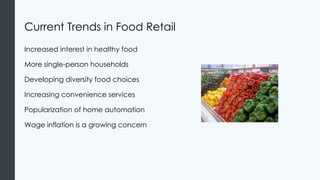
Current Trends in Food Retail
Increased interest in healthy food
More single-person households
Developing diversity food choices
Increasing convenience services
Popularization of home automation
Wage inflation is a growing concern
Service and Merchandise Retailers
Learning Outcomes: Service and Merchandise
Retailers
• 2.3.1 Assess the variety and assortment levels of goods for each type of
merchandise retailer
• 2.3.2 Describe the choices each type of merchandise retailer is currently
making to adapt in the current landscape
• 2.3.3 Name an assortment of service retailer types
Assortment Levels and Types of Retailers
Department stores:
Category specialist:
Specialty stores:
Full line discount stores
Drug stores
Off-price stores
Activity
Full line discount stores are retailers that provide name-brand products at a
lower cost than other stores.
What is an example of a full-line discount store near you? What do they sell?
How are they different from a specialty store and a department store?
Discuss your thoughts with a partner, and take notes about your contrast and
comparisons.
Adapting to the Current Landscape
Lack of product differentiation is reason some retailers have developed private
label or store brand items
Merchandise retailers: focus more on product quality to differentiate themselves
from competition
Customer service: focus of service retailers
Types of Service Retailers
No service versus Self-service
Full-service
• Accepting multiple forms of payments, such as cash, check, or
credit card
• Offering delivery services
• Making recommendations or providing demonstrations, such as
offering recipes, cooking classes, or product samples
• Allowing exchanges or returns
• Allowing special orders
• Providing customer loyalty programs
Store-Based Strategy Mixes
Learning Outcomes: Store-Based Strategy Mixes
• 2.4 Discuss store-based strategy mixes
• 2.4.1 Identify the four levels on the wheel of retailing
• 2.4.2 Explain the retail life cycle
• 2.4.3 Define scrambled merchandising
• 2.4.4 Discuss how a retail institution can evolve through mergers,
diversification, and downsizing
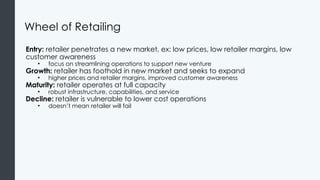
Wheel of Retailing
Entry: retailer penetrates a new market, ex: low prices, low retailer margins, low
customer awareness
• focus on streamlining operations to support new venture
Growth: retailer has foothold in new market and seeks to expand
• higher prices and retailer margins, improved customer awareness
Maturity: retailer operates at full capacity
• robust infrastructure, capabilities, and service
Decline: retailer is vulnerable to lower cost operations
• doesn’t mean retailer will fail
Retail Tactic:
Scrambled Merchandising
broadens assortment to include items that are generally outside their focus
Adds to shopping experience rather than distracting
Risk comes when unexpected items are included in assortment that confuse
shoppers.
Can detract from experience and tarnish retailer’s brand image
Evolving Through Mergers, Diversification, and
Downsizing
Throughout 1990s, retail food industry underwent period of consolidation
Consolidation lead to long-term trend where sales are concentrated among
fewer number of retailers (1992, 20 largest food retailers accounted for 39.2% of
grocery sales; 2000, 54.7%, 2016, 66.6%)
Mergers and Acquisitions: transactions in which ownership of companies &
business organizations are combined
Competitive Analysis
Learning Outcomes: Competitive Analysis
• 2.5 Evaluate the elements of a competitive analysis
• 2.5.1 State the places retail managers should go to obtain information on
their competition
• 2.5.2 Use NAICS codes to determine direct competitors
Obtaining Information on Competition
Collecting from Industry
• Government reports
• white papers
• industry publications
Specific competitors:
• Press releases,
• financial reporting,
• weekly circulars,
• store visits
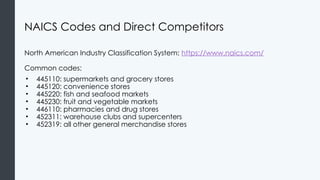
NAICS Codes and Direct Competitors
North American Industry Classification System: https://www.naics.com/
Common codes:
• 445110: supermarkets and grocery stores
• 445120: convenience stores
• 445220: fish and seafood markets
• 445230: fruit and vegetable markets
• 446110: pharmacies and drug stores
• 452311: warehouse clubs and supercenters
• 452319: all other general merchandise stores
Quick Review
• Over 20 years, groceries have moved from grocery stores and supermarkets
to whole host of other channels
• Existing grocery formats are competing with host of new competitors
• Pressure of e-commerce will continue, and mobile technology has changed
shopper behavior
• Demographic changes in population: baby-boomers are reflecting interest in
health and wellness
• Wage pressure: cost of labor is concern but companies are trying to ease
these pressures
• Many reasons to be optimistic for future of retail: moving into period of
experiential shopping, rise in specialty stores

RetailManagement_02_Retail Environment Analysis

  • 1.
    Retail Management Module 2:Retail Environment Analysis
  • 2.
  • 3.
    Learning Outcomes: RetailerClassification • 2.1 List the classification characteristics of various types of retailers by ownership • 2.1.1 Match a retailer with its structural organization based on its classification • 2.1.2 Match a retailer with its advantages and disadvantages based on its classification
  • 4.
    Practice Question 1 Inthis module, we’ll study the retail environment analysis. A retailer is the last step of the supply chain. It is where consumers go to obtain goods and services. To best meet consumers’ needs, there are many types of retail formats, reflecting different scopes and strategies. Write for five minutes all of the answers you can think of to the following question: Why evaluate different types of retail institutions?
  • 5.
    Five Primary OwnershipTypes: 1. Corporate chain: multiple stores, central ownership, and consistent standards operating on a large scale 2. Independent store: buy products through wholesalers which apply an upcharge for warehousing and handling product 3. Wholesaler: product distributors focused on supply chain and logistics 4. Franchise: owned by individual business owners who have contracted with larger company 5. Co-op: when several independent retailers join together to consolidate purchases, increasing buying power
  • 6.
    Retailer Types: Advantages &Disadvantages Club and Warehouse Stores: offer value, require memberships Mass Merchandisers: low prices, busy Convenience and Drug Stores: limited selection Discount and Dollar Stores: low prices, lesser: known brands Natural and Organic Stores: array of unique items at high price Specialty Retailers: offers alternative to mass merchandisers Online Retailers: home delivery Traditional Grocers: wide assortment, local
  • 7.
    Practice Question 2 Servingcommunities in the Pacific Northwest with over 60 stores in Washington and Oregon, QFC Supermarkets is an example of what kind of retailer?
  • 8.
  • 9.
    Learning Outcomes: FoodRetailers • 2.2.3 Discuss the current trends affecting food retailers • 2.3 Compare and contrast service and merchandise retailers
  • 10.
    Changes in FoodRetailing Retailers aren’t just competing with one another through the items they offer and the pricing they set. Instead, they’re competing on a whole host of other criteria, such as convenience and customer service. Convenience: is the store nearby? Is there ample parking? Will they have what I need? Customer Service: is this a place I like to shop? Is the store clean? Are the staff available/helpful, can I get in and out quickly
  • 11.
    Variety and Assortmentof Goods in Food Retail Categories are divided into several segments & sub-segments, which can be further divided into brands and into Stock Keeping Units (SKU) • Segments and sub-segments: dry soup (ramen), ingredients • Leading brands: Campbell’s, Progresso Retailers make assortment decisions at category, segment, brand, & SKU level • Family Dollar vs. Sam’s Club
  • 12.
    Current Trends inFood Retail Increased interest in healthy food More single-person households Developing diversity food choices Increasing convenience services Popularization of home automation Wage inflation is a growing concern
  • 13.
  • 14.
    Learning Outcomes: Serviceand Merchandise Retailers • 2.3.1 Assess the variety and assortment levels of goods for each type of merchandise retailer • 2.3.2 Describe the choices each type of merchandise retailer is currently making to adapt in the current landscape • 2.3.3 Name an assortment of service retailer types
  • 15.
    Assortment Levels andTypes of Retailers Department stores: Category specialist: Specialty stores: Full line discount stores Drug stores Off-price stores
  • 16.
    Activity Full line discountstores are retailers that provide name-brand products at a lower cost than other stores. What is an example of a full-line discount store near you? What do they sell? How are they different from a specialty store and a department store? Discuss your thoughts with a partner, and take notes about your contrast and comparisons.
  • 17.
    Adapting to theCurrent Landscape Lack of product differentiation is reason some retailers have developed private label or store brand items Merchandise retailers: focus more on product quality to differentiate themselves from competition Customer service: focus of service retailers
  • 18.
    Types of ServiceRetailers No service versus Self-service Full-service • Accepting multiple forms of payments, such as cash, check, or credit card • Offering delivery services • Making recommendations or providing demonstrations, such as offering recipes, cooking classes, or product samples • Allowing exchanges or returns • Allowing special orders • Providing customer loyalty programs
  • 19.
  • 20.
    Learning Outcomes: Store-BasedStrategy Mixes • 2.4 Discuss store-based strategy mixes • 2.4.1 Identify the four levels on the wheel of retailing • 2.4.2 Explain the retail life cycle • 2.4.3 Define scrambled merchandising • 2.4.4 Discuss how a retail institution can evolve through mergers, diversification, and downsizing
  • 21.
    Wheel of Retailing Entry:retailer penetrates a new market, ex: low prices, low retailer margins, low customer awareness • focus on streamlining operations to support new venture Growth: retailer has foothold in new market and seeks to expand • higher prices and retailer margins, improved customer awareness Maturity: retailer operates at full capacity • robust infrastructure, capabilities, and service Decline: retailer is vulnerable to lower cost operations • doesn’t mean retailer will fail
  • 22.
    Retail Tactic: Scrambled Merchandising broadensassortment to include items that are generally outside their focus Adds to shopping experience rather than distracting Risk comes when unexpected items are included in assortment that confuse shoppers. Can detract from experience and tarnish retailer’s brand image
  • 23.
    Evolving Through Mergers,Diversification, and Downsizing Throughout 1990s, retail food industry underwent period of consolidation Consolidation lead to long-term trend where sales are concentrated among fewer number of retailers (1992, 20 largest food retailers accounted for 39.2% of grocery sales; 2000, 54.7%, 2016, 66.6%) Mergers and Acquisitions: transactions in which ownership of companies & business organizations are combined
  • 24.
  • 25.
    Learning Outcomes: CompetitiveAnalysis • 2.5 Evaluate the elements of a competitive analysis • 2.5.1 State the places retail managers should go to obtain information on their competition • 2.5.2 Use NAICS codes to determine direct competitors
  • 26.
    Obtaining Information onCompetition Collecting from Industry • Government reports • white papers • industry publications Specific competitors: • Press releases, • financial reporting, • weekly circulars, • store visits
  • 27.
    NAICS Codes andDirect Competitors North American Industry Classification System: https://www.naics.com/ Common codes: • 445110: supermarkets and grocery stores • 445120: convenience stores • 445220: fish and seafood markets • 445230: fruit and vegetable markets • 446110: pharmacies and drug stores • 452311: warehouse clubs and supercenters • 452319: all other general merchandise stores
  • 28.
    Quick Review • Over20 years, groceries have moved from grocery stores and supermarkets to whole host of other channels • Existing grocery formats are competing with host of new competitors • Pressure of e-commerce will continue, and mobile technology has changed shopper behavior • Demographic changes in population: baby-boomers are reflecting interest in health and wellness • Wage pressure: cost of labor is concern but companies are trying to ease these pressures • Many reasons to be optimistic for future of retail: moving into period of experiential shopping, rise in specialty stores

Editor's Notes

  • #1 Cover Image: "Hangers in a clothes store." Authored by: Artificial Photography. Provided by: Upsplash. Located at: https://unsplash.com/photos/vB5qtt8X4NA. Content Type: CC Licensed Content, Shared Previously. License: CC0: No Rights Reserved. All text in these slides is taken from https://courses.lumenlearning.com/wm-retailmanagement/ where it is published under one or more open licenses. All images in these slides are attributed in the notes of the slide on which they appear and licensed as indicated.
  • #4 Encourage students to write anything that comes to mind. It’s important to point out that while the typical supermarket hasn’t changed much in over sixty years, what has changed is the number of places and number of ways you can get your groceries. And because more changes to food retailing are on the horizon, it’s important to understand the differences in retail formats, including how they compete with each other.
  • #5 Structural Organization of Retailers
  • #6 Here is a more extensive list of retailer types: Club and Warehouse Stores: BJ’s, Costco, Sam’s Club offer lowest price per unit and carry only about 10% of the total number of products available in a typical grocery store Mass Merchandisers: Wal-Mart, Target, and Kmart provide shoppers with one-stop shop by offering multiple categories, a broad selection, and deep inventory creating contact efficiency Convenience and Drug Stores: opportunistic food retailers, offering single-serve portions, smaller package sizes, and high velocity items Discount and Dollar Stores: Aldi’s, Dollar Tree are no-frills value formats that primarily stock shelf-stable, packaged food. Staffing is minimal Natural and Organic Stores: Whole Foods, Sprouts, Trader Joe’s cater to health-conscious shoppers, offering generally priced foods at a significant premium to traditional grocery products Specialty Retailers: on the rise as alternative to mass merchandisers and online retailers, such as bakers and butchers Online Retailers: Wal-Mart offers at home delivery, also companies like Blue Apron and Hello Fresh send meal preparation kits Traditional Grocers: primary retail outlet for food sales (grocery stores and supermarkets)
  • #7 It’s a corporate chain. QFC, Quality Food Centers, are a subsidiary of Kroger. Encourage students to discuss why it’s not a franchise or an independent store. You can read more about the structural organization of retailers on this page: https://courses.lumenlearning.com/wm-retailmanagement/chapter/structural-organization-of-retailers/
  • #10 Groceries have moved to whole host of other channels, where non-traditional formats use groceries to increase store traffic and revenue
  • #11 It’s important to understand merchandise this way because retailers make assortment decisions at the category, segment, brand, and SKU level to target a distinct consumer or shopping occasion.
  • #12 Rise of healthy food: baby boomers have become more focused on diet and the role that food plays in managing wellness (sugar-free, fat-free, low-sodium products) Single living: those who have put off life events want smaller pack size and flexible packaging Diversity in food: cultural changes mean food and flavor variety Future is convenient: online grocery delivery and subscription services Home automation: appliances can communicate, impacting the way people shop for food Cost pressure: wage inflation is a concern, efforts for large companies to reduce labor costs Image: Bell Peppers. Authored by: Ray Bouknight. Provided by: Flickr. Located at: https://flic.kr/p/ejCkLk. License: CC BY: Attribution
  • #15 Department stores: offer broad assortments of products with multiple departments separating product categories Category specialist: retailers that specialize in one category of products (Office Depot, Toys R Us) Specialty stores: specific type of products they sell (florists, locksmiths, hardware stores) Full line discount stores: retailers that provide name-brands at lower cost Drug stores: smaller variety, but have depth in assortment of health products Off-price stores: high quality products at cheap prices
  • #16 Full line discount stores are retailers that provide name-brand products at a lower cost than other stores. They make money by keeping sales high in order to be able to sell name-brand products at a lower cost than elsewhere. This system also necessitates lots of variety and a wide assortment so that sales can be driven up more easily.
  • #18 “No Service,” such as Amazon Go concept stores don’t have associates or check lanes. Self-service, such as most grocery shopping experiences, have product available on-shelf for shopper’s individual selection. Full-service: accepting multiple forms of payment, delivery services, recommendations, allowing returns, allowing special orders, providing customer loyalty programs. The cost is increased labor, requires premium pricing
  • #21 Please note that entry into the decline phase does not guarantee the retailer will fail. Instead, retailers in decline can reinvent themselves through acquisition, divestiture, or strategic change. However, it is important to know that when customer acquisition falls below the rate of customer loss, a retailer is in decline and must reevaluate its strategy.
  • #22 Furthermore, if the new products aren’t appreciated or shopped, they can risk high inventory, leading to markdowns and write-offs
  • #23 Merger is legal consolidation of two entities into one Acquisition occurs when one entity takes ownership of another’s M&A’s can help organizations grow, shrink, or change nature of business
  • #26 The US federal government publishes information on industry trends. You may also set up Google Alerts to track competition. Begin with weekly circulars published by competitors and evaluate their items or spend time visiting competition
  • #27 Please note, however, that the above list is not exhaustive. For example, there are unique codes for candy stores, stores that sell nuts, bakeries that bake goods on premises, and bakeries that don’t. What’s important is that you can identify your NAICS code to see statistics about your specific industry, allowing you to get a better understanding of your competitive set.
  • #28 Encourage students to return to the Practice Question on slide 4. Ask them to reflect on what they’ve learned to see if they have a different idea on why it’s important to evaluate different types of retail institutions.