FOOD CHAIN and FOOD WEB
FOOD CHAIN
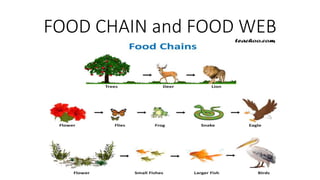
• Food chain, in ecology, the sequence of transfers of matter and
energy in the form of food from organism to organism.
• Plants, which convert solar energy to food by photosynthesis,
are the primary food source.
• In a predator chain, a plant-eating animal is eaten by a flesh-
eating animal.
• In a parasite chain, a smaller organism consumes part of a
larger host and may itself be parasitized by even smaller
organisms.
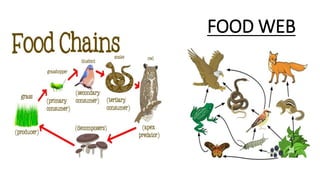
Consumers are the next link in a food chain.
There are three levels of consumers.
Primary consumers (1 st Order) – Worms, insects, squirrels,
mice: all eat plants (HERBIVORES) ex: squirrel eats acorns
Secondary consumers (2 nd Order) – Eat the primary consumers
(CARNIVORES) example: cat eats squirrel
Tertiary consumers (3 rd order) – Eat the primary and secondary
consumers (CARNIVORES) ex: wolf eats cat and squirrel
• Omnivores eat both plants and meat – They can be
EITHER primary or secondary consumers.
• Scavengers =They eat the remains of dead organisms
left by the consumers - vultures, coyotes, hyenas
• The decomposers =The last links in the chain are the
decomposers. (They break things down) Like bacteria, mold,
fungi, mushrooms
The decomposers
If you die, they eat you.
If you poop, they eat that.
If you lose a leaf, they eat it.
Whenever something that was alive dies, the decomposers get it.
• Decomposers break down nutrients in the dead "stuff" and
return it to the soil .
• The producers can then use the nutrients and elements once
it's in the soil.
• The decomposers complete the system, returning essential
molecules to the producers.
FOOD WEB
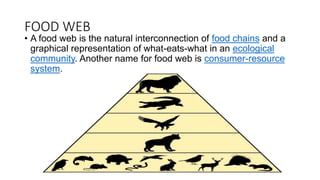
• A food web is the natural interconnection of food chains and a
graphical representation of what-eats-what in an ecological
community. Another name for food web is consumer-resource
system.
A food web consists of all the food chains in a single ecosystem. Each living thing in an ecosystem is part of multiple
food chains. Each food chain is one possible path that energy and nutrients may take as they move through the
ecosystem
• The food web is a simplified illustration of the various methods
of feeding that links an ecosystem into a unified system of
exchange.
• There are different kinds of feeding relations that can be roughly
divided into herbivory, carnivory, scavenging and parasitism
Difference Between Food Chain And Food Web
Food Chain
• A linear pathway showing the flow of
energy.
• An organism of higher level trophic
feeds on a specific organism of lower
trophic level.
• Does not affect the adaptability and
competitiveness of organisms.
Food Web
• A multitude of networks showing the
flow of energy.
• An organism of a higher trophic level
has access to more members of a
lower trophic level.
• It has a role in improving the
adaptability and competitiveness of an
organism.
FOOD WEB
THANK YOU

food chain.pptx

  • 1.
  • 2.
    FOOD CHAIN • Foodchain, in ecology, the sequence of transfers of matter and energy in the form of food from organism to organism. • Plants, which convert solar energy to food by photosynthesis, are the primary food source. • In a predator chain, a plant-eating animal is eaten by a flesh- eating animal. • In a parasite chain, a smaller organism consumes part of a larger host and may itself be parasitized by even smaller organisms.
  • 3.
    Consumers are thenext link in a food chain. There are three levels of consumers. Primary consumers (1 st Order) – Worms, insects, squirrels, mice: all eat plants (HERBIVORES) ex: squirrel eats acorns Secondary consumers (2 nd Order) – Eat the primary consumers (CARNIVORES) example: cat eats squirrel Tertiary consumers (3 rd order) – Eat the primary and secondary consumers (CARNIVORES) ex: wolf eats cat and squirrel
  • 4.
    • Omnivores eatboth plants and meat – They can be EITHER primary or secondary consumers. • Scavengers =They eat the remains of dead organisms left by the consumers - vultures, coyotes, hyenas • The decomposers =The last links in the chain are the decomposers. (They break things down) Like bacteria, mold, fungi, mushrooms
  • 5.
    The decomposers If youdie, they eat you. If you poop, they eat that. If you lose a leaf, they eat it. Whenever something that was alive dies, the decomposers get it. • Decomposers break down nutrients in the dead "stuff" and return it to the soil . • The producers can then use the nutrients and elements once it's in the soil. • The decomposers complete the system, returning essential molecules to the producers.
  • 6.
    FOOD WEB • Afood web is the natural interconnection of food chains and a graphical representation of what-eats-what in an ecological community. Another name for food web is consumer-resource system.
  • 7.
    A food webconsists of all the food chains in a single ecosystem. Each living thing in an ecosystem is part of multiple food chains. Each food chain is one possible path that energy and nutrients may take as they move through the ecosystem • The food web is a simplified illustration of the various methods of feeding that links an ecosystem into a unified system of exchange. • There are different kinds of feeding relations that can be roughly divided into herbivory, carnivory, scavenging and parasitism
  • 8.
    Difference Between FoodChain And Food Web Food Chain • A linear pathway showing the flow of energy. • An organism of higher level trophic feeds on a specific organism of lower trophic level. • Does not affect the adaptability and competitiveness of organisms. Food Web • A multitude of networks showing the flow of energy. • An organism of a higher trophic level has access to more members of a lower trophic level. • It has a role in improving the adaptability and competitiveness of an organism.
  • 9.
  • 10.