2
PROMOTE FOOD
AND BEVERAGE
PRODUCTS
Lesson 3
LESSON 3.1
TYPES AND
CHARACTERISTICS
OF MENU
03
WHAT IS A MENU?
• It is the most important controlling
element in the servicing process of
any restaurant type or establishment.
• It is figuratively referred to as the
“authorized representative” of a
restaurant.
• It is also a list of all the food and
drink offered in an establishment
during its operation and is arranged
in a particular order.
04
Dish structures
1. SPECIALTIES/SIGNATURE DISHES
2. SNACKS (COLD AND HOT)
3. SOUPS
4. MAIN COURSES (FISH, MEAT AND
VEGETARIAN SEPARATELY)
5. DESSERTS
6. DRINKS (ALCOHOLIC, NON-ALCOHOLIC,
HOT AND COLD BEVERAGES)
05
6
ALCOHOLIC DRINKS
7
1. WINES
8
DOMESTIC WHITE AND RED
9
IMPORTED WHITE AND RED
10
SPARKLING AND SOUTHERN WINES
11
WHITE AND RED VERMOUTH
12
2. APERITIFS
13
BITTER AND ANISEED APERITIFS
14
3. SPIRITS AND LIQUORS
15
VODKA
16
WHISKEY (SCOTCH, IRISH BOURBON, CANADIAN)
17
GIN
18
RUM
19
BRANDY
20
COGNAC
21
CALVADOS
22
BEER
23
DOMESTIC AND IMPORTED BEER
24
MIXED DRINKS AND COCKTAILS
25
NON-ALCOHOLIC DRINKS
26
• SOFT DRINKS,
MINERAL WATER,
AND JUICES
• HOT DRINKS,
COFFEE, TEA,
AND MILK
27
MINERAL WATER
• LOCAL MINERAL WATER
• NATIONAL MINERAL WATER
• IMPORTED MINERAL WATER
(PERIER, EVIAN).
• STILL MINERAL WATER
(WITHOUT GAS)
• SPRING WATER
• TABLE WATER (BONAQUA)
28
MENU FAMILIARIZATION
29
• Dishes that take a long time to prepare or those which might suit someone
in a hurry
• Dishes available for vegetarians or those customers with special dietary
considerations (e.g. no dairy products or allergies to certain foods like
nuts)
• Vegetables, salads, or other accompaniments that will be served with the
meal
• Whether it is possible to vary the dish, e.g. replacing vegetables with salad
• Prices of dishes not on the menu
• Ingredients used to prepare the dish
• Methods of cooking used for the dish
30
2 REASONS WHY THE CUSTOMER IS UNABLE
TO INTERPRET THE MENU:
• They might have difficulty understanding the language. This may
be particularly true if the customer is a foreigner and does not
have a sound understanding of the written language used on the
menu. In this case, the server should try to explain each dish
clearly and slowly, pointing to pictures where appropriate.
• The menu might contain terms that are unfamiliar to the customer
because there are terms that are derived from the French language
and are used worldwide to describe a dish or the type of cooking
method used.
31
CLASSIC MENU SEQUENCE
This format is used to lay out menus as well as to indicate the order of the
various courses. The actual number of courses on menu and dishes within
each course will depend on the size and class of the establishment, often
follow the classic sequence.
32
STARTERS
33
HORS D’ OEVRES
(ORDEVS)
TRADITIONALLY, THIS COURSE
CONSISTED OF A VARIETY OF
COMPOUND SALADS BUT NOW
INLCUDES ITEMS SUCH AS
PATAS, MOUSSES, FRUIT,
CHARCUTERIE, AND SMOKED
FISH.
34
SOUPS
(POTAGES)
INCLUDES ALL SOUPS, BOTH
HOD AND COLD.
35
EGG DISH
(OEUFS)
THERE ARE A GREAT NUMBER
OF EGG DISHES BEYOND THE
USUAL OMELETS, BUT THESE
HAVE NOT RETAINED THEIR
POPULARITY ON MODERN
MINUS.
36
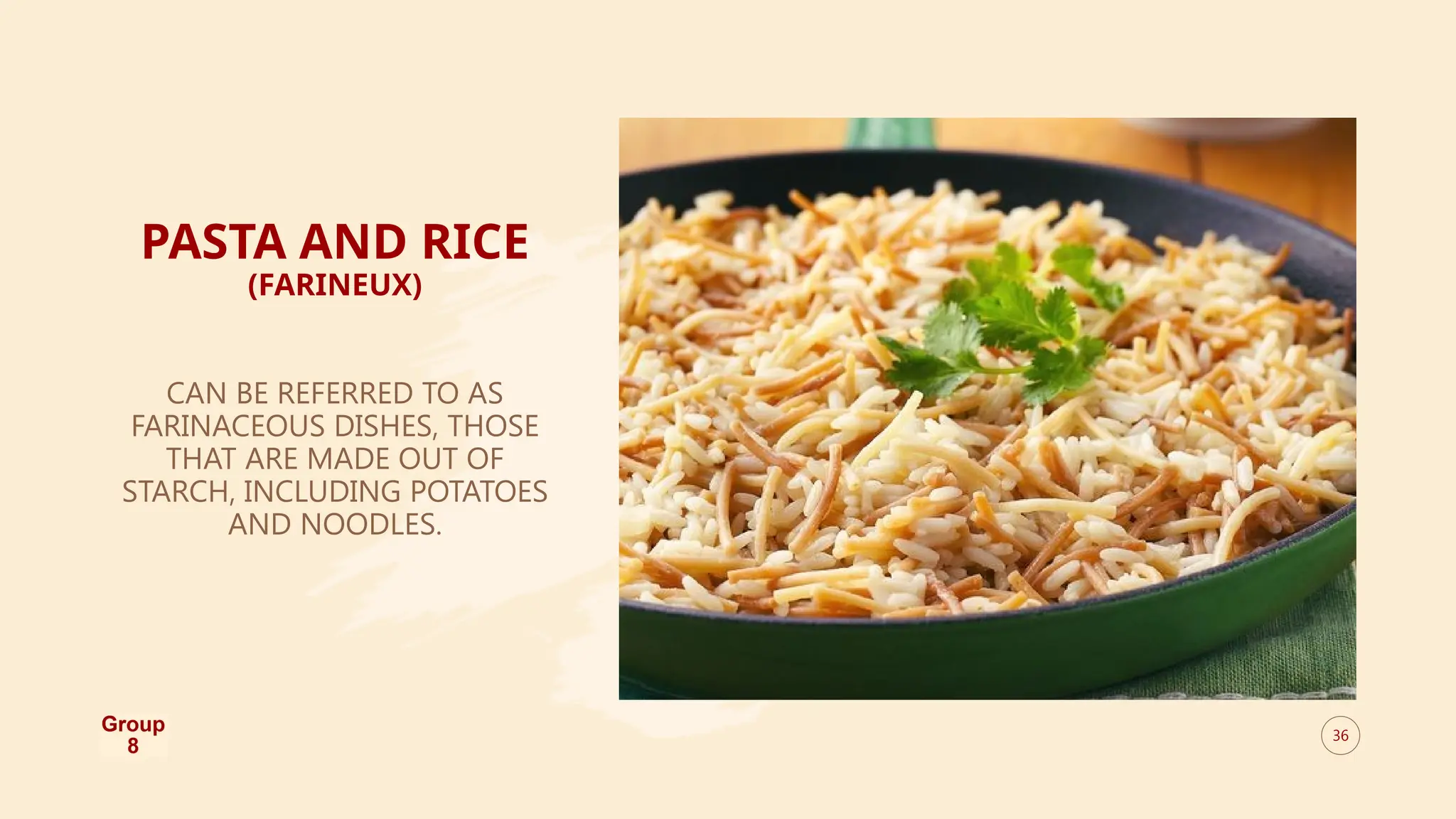
PASTA AND RICE
(FARINEUX)
CAN BE REFERRED TO AS
FARINACEOUS DISHES, THOSE
THAT ARE MADE OUT OF
STARCH, INCLUDING POTATOES
AND NOODLES.
37
MAIN COURSES
38
FISH
(POISSON)
A FISH DISH, BOTH HOT AND
COLD. FISH DISHES, SUCH AS
SMOKED SALMON OR SEAFOOD
COCKTAILS, ARE MAINLY
CONSIDERED TO BE HORS D’
OEUVRES DISHES AND
THEREFORE WOULD BE SERVED
EARLIER IN A MEAL.
39
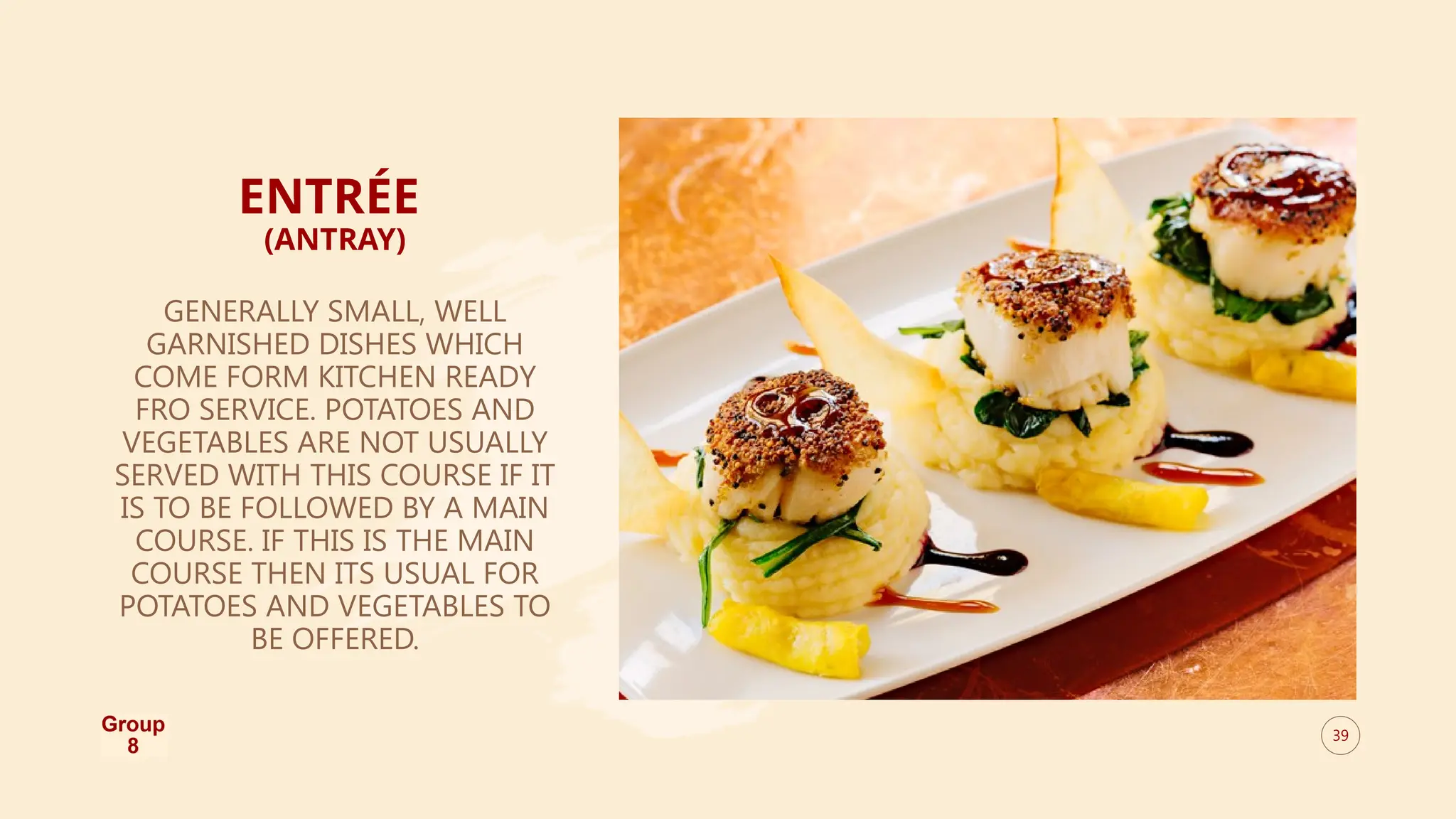
ENTRÉE
(ANTRAY)
GENERALLY SMALL, WELL
GARNISHED DISHES WHICH
COME FORM KITCHEN READY
FRO SERVICE. POTATOES AND
VEGETABLES ARE NOT USUALLY
SERVED WITH THIS COURSE IF IT
IS TO BE FOLLOWED BY A MAIN
COURSE. IF THIS IS THE MAIN
COURSE THEN ITS USUAL FOR
POTATOES AND VEGETABLES TO
BE OFFERED.
40
RELEVÉ
MAIN ROASTS OR OTHER
LARGER JOINTS OF MEAT,
WHICH WOULD BE SERVED
TOGETHER WITH POTATOES AND
VEGETABLES.
41
ROAST
(RÔTI)
TRADITIONALLY REFERS TO
RASTED GAME OR POULTRY
DISHES.
42
VEGETABLES
(LEGUMES)
VEGETABLES, APART FROM
VEGETABLES SERVED WITH THE
RELEVE OR ROAST COURSES
( E.G. ASPARAGUS AND
ARTICHOKES) SERVED AS A
SEPARATE COURSE, ALTHOUGH
THESE TYPES OF DISHES ARE
NOW MORE COMMONLY
SERVED AS STARTERS.
43
SALAD
(SALADE)
A SMALL PLATE OF SALAD THAT
IS TAKEN AFTER A MAIN
COURSE (OR COURSES) AND IS
QUITE OFTEN SIMPLY A GREEN
SALAD AND DRESSING.
44
COLD BUFFET
(BUFFET FROID)
A VARIETY OF COLD MEATS AND
FISH, CHEESE AND EGG ITEMS
TOGETHER WITH A RANGE OF
SALADS AND DRESSINGS.
45
SORBET
(GRANITES)
TRADITIONALLY , SORBETS WERE
SERVED TO GIVE A PAUSE
WITHIN A MEAL, ALLOWING THE
PALATE TO BE REFRESHED. THEY
ARE LIGHTLY FROZEN WATER
ICES, WHICH IS USUALLY BASED
ON UNSWEETENED FRUIT JUICE,
AND MIGHT BE SERVED WITH
SPIRIT, LIQUOR OR EVEN
CHAMPAGNE.
46
AFTERS
47
CHEESE
(FROMAGE)
A RANGE OF CHEESES AND
VARIOUS ACCOMPANIMENTS,
INCLUDING BISCUITS, BREADS,
CELERY, GRAPES, AND APPLES;
CAN ALSO REFER TO CHEESE-
BASED DISHES SUCH AS
SOUFFLES.
48
SWEETS
(ENTREMENTS)
HOT AND COLD PUDDINGS
49
SAVOURY
(SAVOUREUX)
SIMPLE SAVOURIES, SUCH AS
WELSH RAREBIT OR OTHER
ITEMS ON TOAST, OR IN PASTRY
OR SAVOURY SOUFFLES, MIGHT
BE SERVED AT THIS STAGE.
50
FRUIT
(DESSERT)
FRESH FRUIT, NUT, AND
SOMETIMES CANDIED FRUITS.
51
BEVERAGES
TRADITIONALLY, IT REFERS
TO COFFEE BUT NOW, IT
ALSO INCLUDES A WIDER
RANGE OF BEVERAGES THAT
ARE GENERALLY AVAILABLE,
SUCH AS TEA, TISANES, AND
CHOCOLATE AND
PROPRIETY BEVERAGES.
52
FOOD ITEMS USED AS
ACCOMPANIMENTS
Accompaniments are offered mainly to
enhance the flavor of the main dish or
to counteract its richness. Some of
these items have specific uses in
particular dishes and others are used
generally across a number of dishes.
53
CHILI SAUCE
DESCRIPTION: HOT SAUCE, MOSTLY
CHINESE MADE
USE: WITH CHINESE-STYLE FOODS
54
CRANBERRY
SAUCE
DESCRIPTION: SAUCE MADE FROM
CRANBERRIES, USUALLY AVAILABLE AS A
PROPRIETARY SAUCE. IT CAN BE SERVED
HOT OR COLD.
USE: ROAST TURKEY
55
HORSERADISH
SAUCE
DESCRIPTION: HOT-TASTING SAUCE
MADE FROM HORSERADISH ROOT,
AVAILABLE AS PROPRIETARY SAUCE,
WHICH NEEDS CREAMING DOWN.
USE: ROAST BEEF AND CHICKEN
MARYLAND AND ALSO COLD DISHES
WHEN CREAMED DOWN.
56
MINT JELLY
DESCRIPTION: SWEETISH JELLY MADE
WITH MINT; PROPRIETARY VERSIONS
USE: ROAST LAMB, AS AN ALTERNATIVE
TO MINT SAUCE. ALSO OFFERED WITH
ROAST MUTTON.
57
FRENCH
DRESSING
DESCRIPTION: DRESSING MADE FROM
OIL AND WINE VINEGAR OR LEMON
JUICE, WITH SEASONING. MUSTARD AND
HERBS MAY BE ADDED.
USE: SALADS
58
LESSON 3.2
SUGGESTIVE
SELLING
59
SUGGESTIVE SELLING
It is the act of giving suggestions and
ideas to add to the dining guests’
original orders, which in turn leads to
increased sales and higher level of
customer satisfaction. The server
should be careful not to become too
aggressive but rather, he should be
more helpful by giving ample time to
the guest in deciding.
60
SUGGESTIVE SELLING TIPS
• DO NOT INTERRUPT THE DINING
GUEST WHILE THEY ARE
ORDERING SOMETHING. Suggest
food or beverage when the guest is
done with their order. Such an
interruption might create an element
of doubt in the guest’s mind that you
are merely suggesting items only to
increase the sales and that you really
have no concern for his needs.
• FEEL FREE TO SUGGEST THINGS
IN PROPER TIME. Do not hesitate!
You might lose the extra sale due
to your reluctance. You can make
suggestions from each section on
the menu.
61
• UNDERSTAND THE GUEST’S
NEEDS. Try to suggest to his/her
requirements. For example, find
out whether the guest is health
conscious or vegetarian, and
suggest to him/her accordingly.
• AVOID USING WORDS
DESCRIBING NEGATIVITY such as
“do not”, “not” and “cannot”. Find
some relevant positive words that
would not change the meaning but
would serve the purpose of
expressing thoughts.
62
• USE DESCRIPTIVE WORDS TO
DESCCRIBE THE DISH. Let the
guest visualize the dish that they
will be persuaded to order. Use
appropriate words to describe the
food such as: freshly prepared,
delicately seasoned, soft and juicy,
mouthwatering, flavorful, and/or
spicy.
• “REPEAT” YOUR SUGGESTION
TO THE OTHER GUESTS. It might
happen that the guest you initially
suggested something turns down
the offer. Do not get discouraged,
as the next guest or some other
guests within the same group or
party might like it. Just a word of
suggestion costs nothing to either
of the parties.
63
• ALWAYS BE PRICE-SENSITIVE. Treat each
sale differently according to its own
situation. Like, if someone is looking for
orders in the range of Php300- Php500, do
not try to order something over Php1,000
or more.
• Suggestions according to the season also
play an important role.
64
BASICS TO WINE AND FOOD PAIRING
It is also imperative to know the standard food and beverage pairings, like
burger and fries, steaks and salads, steak and mashed potato, dessert and
coffee, or seafood with white wine.
65
66
LESSON 3.3
CARRY OUT
UP-SELLING
STARTEGIES
67
UP-SELLING
STRATEGIES
It is a marketing strategy in a
restaurant to convince the guest to
spend more money. Restaurant
servers, cashiers, and kitchen staff
who have contact with the customer
should know appropriate and actual
ways to upsell menu items. To
become effective, they must be
trained and practiced for this sales
technique. These useful methods for
up-selling will help increase sales
and tip money.
68
HOW
TO
UPSELL?
HOW TO UPSELL?
HOW TO UPSELL?
HOW TO UPSELL?
HOW TO UPSELL?
HOW
TO
UPSELL?
HOW TO UPSELL?
HOW TO UPSELL?
HOW TO UPSELL?
H
O
W
TO
U
PSELL?
H
O
W
T
O
U
P
S
E
L
L
?
69
OFFER MULTIPLE
SUGGESTIONS
Workers can upsell
whether they work in a
quick-service
restaurant or a swanky
lounge.
70
USE EMBELLISHED
DESCRIPTIONS
Servers and restaurant
workers can upsell by
describing the ingredients,
cooking process or
presentation of a dish as a
means of enticing customers
and convincing them to buy.
71
WINE PAIRING
Wine can provide an excellent
complement to a meal. Therefore,
wine pairing is also a great way to
upsell to your customers. However,
satisfying the customer‘s palate
with a well-paired wine requires
training, experience, and extensive
knowledge of both the food and
wine menus.
72
FIVE KEYS FOR UP-
SELLING DESSERT ITEMS
Desserts are lucrative
yet challenging items to
up-sell. The guest is
often satisfied from the
main entrée and may not
ask for dessert.
73
1. Present dessert menus
after lunch or dinner.
2. Use vivid descriptions.
3. Bring out the dessert tray.
4. Offer low-calorie options.
5. Show off your desserts.
74
WAYS ON HOW TO TRAIN
STAFF ABOUT UPSELLING
1. Allow servers to taste menu
items.
2. Train in menu knowledge.
3. Suggest vivid descriptions.
4. Role play with Food and
Beverage Service Attendant or
Waiter.
5. Provide rewards.
75
UP-SELLING BASICS
It is a skill that should be done
with sensitivity to the customers. It
should be done in a way that the
customer does not realize he or
she is being sold something.
76
UP-SELLING BASICS
The waiter should not wait to hear
if the customer wants an appetizer.
Instead, he should go right ahead
and tell them about a popular
special that the kitchen was
running.
77
UP-SELLING THE
ENTRÉE
Let us say the customer is not
interested in an appetizer or a
drink special. He knows exactly
what he wants. That does not
mean the server cannot employ a
few more up-selling techniques.
78
UP-SELLING
DESSERT
The ultimate upsell is the dessert.
The best way to up-sell desserts is
to give a mouthwatering
description. Offer dessert before
the customer has a chance to
think about it. Describe it. Make
the customer want it. Make it
tempting.
THANK YOU!

food and beverage services-promote f&b products.pptx

  • 2.
  • 3.
  • 4.
    WHAT IS AMENU? • It is the most important controlling element in the servicing process of any restaurant type or establishment. • It is figuratively referred to as the “authorized representative” of a restaurant. • It is also a list of all the food and drink offered in an establishment during its operation and is arranged in a particular order. 04
  • 5.
    Dish structures 1. SPECIALTIES/SIGNATUREDISHES 2. SNACKS (COLD AND HOT) 3. SOUPS 4. MAIN COURSES (FISH, MEAT AND VEGETARIAN SEPARATELY) 5. DESSERTS 6. DRINKS (ALCOHOLIC, NON-ALCOHOLIC, HOT AND COLD BEVERAGES) 05
  • 6.
  • 7.
  • 8.
  • 9.
  • 10.
  • 11.
  • 12.
  • 13.
  • 14.
  • 15.
  • 16.
    16 WHISKEY (SCOTCH, IRISHBOURBON, CANADIAN)
  • 17.
  • 18.
  • 19.
  • 20.
  • 21.
  • 22.
  • 23.
  • 24.
  • 25.
  • 26.
    26 • SOFT DRINKS, MINERALWATER, AND JUICES • HOT DRINKS, COFFEE, TEA, AND MILK
  • 27.
    27 MINERAL WATER • LOCALMINERAL WATER • NATIONAL MINERAL WATER • IMPORTED MINERAL WATER (PERIER, EVIAN). • STILL MINERAL WATER (WITHOUT GAS) • SPRING WATER • TABLE WATER (BONAQUA)
  • 28.
  • 29.
    29 • Dishes thattake a long time to prepare or those which might suit someone in a hurry • Dishes available for vegetarians or those customers with special dietary considerations (e.g. no dairy products or allergies to certain foods like nuts) • Vegetables, salads, or other accompaniments that will be served with the meal • Whether it is possible to vary the dish, e.g. replacing vegetables with salad • Prices of dishes not on the menu • Ingredients used to prepare the dish • Methods of cooking used for the dish
  • 30.
    30 2 REASONS WHYTHE CUSTOMER IS UNABLE TO INTERPRET THE MENU: • They might have difficulty understanding the language. This may be particularly true if the customer is a foreigner and does not have a sound understanding of the written language used on the menu. In this case, the server should try to explain each dish clearly and slowly, pointing to pictures where appropriate. • The menu might contain terms that are unfamiliar to the customer because there are terms that are derived from the French language and are used worldwide to describe a dish or the type of cooking method used.
  • 31.
    31 CLASSIC MENU SEQUENCE Thisformat is used to lay out menus as well as to indicate the order of the various courses. The actual number of courses on menu and dishes within each course will depend on the size and class of the establishment, often follow the classic sequence.
  • 32.
  • 33.
    33 HORS D’ OEVRES (ORDEVS) TRADITIONALLY,THIS COURSE CONSISTED OF A VARIETY OF COMPOUND SALADS BUT NOW INLCUDES ITEMS SUCH AS PATAS, MOUSSES, FRUIT, CHARCUTERIE, AND SMOKED FISH.
  • 34.
  • 35.
    35 EGG DISH (OEUFS) THERE AREA GREAT NUMBER OF EGG DISHES BEYOND THE USUAL OMELETS, BUT THESE HAVE NOT RETAINED THEIR POPULARITY ON MODERN MINUS.
  • 36.
    36 PASTA AND RICE (FARINEUX) CANBE REFERRED TO AS FARINACEOUS DISHES, THOSE THAT ARE MADE OUT OF STARCH, INCLUDING POTATOES AND NOODLES.
  • 37.
  • 38.
    38 FISH (POISSON) A FISH DISH,BOTH HOT AND COLD. FISH DISHES, SUCH AS SMOKED SALMON OR SEAFOOD COCKTAILS, ARE MAINLY CONSIDERED TO BE HORS D’ OEUVRES DISHES AND THEREFORE WOULD BE SERVED EARLIER IN A MEAL.
  • 39.
    39 ENTRÉE (ANTRAY) GENERALLY SMALL, WELL GARNISHEDDISHES WHICH COME FORM KITCHEN READY FRO SERVICE. POTATOES AND VEGETABLES ARE NOT USUALLY SERVED WITH THIS COURSE IF IT IS TO BE FOLLOWED BY A MAIN COURSE. IF THIS IS THE MAIN COURSE THEN ITS USUAL FOR POTATOES AND VEGETABLES TO BE OFFERED.
  • 40.
    40 RELEVÉ MAIN ROASTS OROTHER LARGER JOINTS OF MEAT, WHICH WOULD BE SERVED TOGETHER WITH POTATOES AND VEGETABLES.
  • 41.
  • 42.
    42 VEGETABLES (LEGUMES) VEGETABLES, APART FROM VEGETABLESSERVED WITH THE RELEVE OR ROAST COURSES ( E.G. ASPARAGUS AND ARTICHOKES) SERVED AS A SEPARATE COURSE, ALTHOUGH THESE TYPES OF DISHES ARE NOW MORE COMMONLY SERVED AS STARTERS.
  • 43.
    43 SALAD (SALADE) A SMALL PLATEOF SALAD THAT IS TAKEN AFTER A MAIN COURSE (OR COURSES) AND IS QUITE OFTEN SIMPLY A GREEN SALAD AND DRESSING.
  • 44.
    44 COLD BUFFET (BUFFET FROID) AVARIETY OF COLD MEATS AND FISH, CHEESE AND EGG ITEMS TOGETHER WITH A RANGE OF SALADS AND DRESSINGS.
  • 45.
    45 SORBET (GRANITES) TRADITIONALLY , SORBETSWERE SERVED TO GIVE A PAUSE WITHIN A MEAL, ALLOWING THE PALATE TO BE REFRESHED. THEY ARE LIGHTLY FROZEN WATER ICES, WHICH IS USUALLY BASED ON UNSWEETENED FRUIT JUICE, AND MIGHT BE SERVED WITH SPIRIT, LIQUOR OR EVEN CHAMPAGNE.
  • 46.
  • 47.
    47 CHEESE (FROMAGE) A RANGE OFCHEESES AND VARIOUS ACCOMPANIMENTS, INCLUDING BISCUITS, BREADS, CELERY, GRAPES, AND APPLES; CAN ALSO REFER TO CHEESE- BASED DISHES SUCH AS SOUFFLES.
  • 48.
  • 49.
    49 SAVOURY (SAVOUREUX) SIMPLE SAVOURIES, SUCHAS WELSH RAREBIT OR OTHER ITEMS ON TOAST, OR IN PASTRY OR SAVOURY SOUFFLES, MIGHT BE SERVED AT THIS STAGE.
  • 50.
    50 FRUIT (DESSERT) FRESH FRUIT, NUT,AND SOMETIMES CANDIED FRUITS.
  • 51.
    51 BEVERAGES TRADITIONALLY, IT REFERS TOCOFFEE BUT NOW, IT ALSO INCLUDES A WIDER RANGE OF BEVERAGES THAT ARE GENERALLY AVAILABLE, SUCH AS TEA, TISANES, AND CHOCOLATE AND PROPRIETY BEVERAGES.
  • 52.
    52 FOOD ITEMS USEDAS ACCOMPANIMENTS Accompaniments are offered mainly to enhance the flavor of the main dish or to counteract its richness. Some of these items have specific uses in particular dishes and others are used generally across a number of dishes.
  • 53.
    53 CHILI SAUCE DESCRIPTION: HOTSAUCE, MOSTLY CHINESE MADE USE: WITH CHINESE-STYLE FOODS
  • 54.
    54 CRANBERRY SAUCE DESCRIPTION: SAUCE MADEFROM CRANBERRIES, USUALLY AVAILABLE AS A PROPRIETARY SAUCE. IT CAN BE SERVED HOT OR COLD. USE: ROAST TURKEY
  • 55.
    55 HORSERADISH SAUCE DESCRIPTION: HOT-TASTING SAUCE MADEFROM HORSERADISH ROOT, AVAILABLE AS PROPRIETARY SAUCE, WHICH NEEDS CREAMING DOWN. USE: ROAST BEEF AND CHICKEN MARYLAND AND ALSO COLD DISHES WHEN CREAMED DOWN.
  • 56.
    56 MINT JELLY DESCRIPTION: SWEETISHJELLY MADE WITH MINT; PROPRIETARY VERSIONS USE: ROAST LAMB, AS AN ALTERNATIVE TO MINT SAUCE. ALSO OFFERED WITH ROAST MUTTON.
  • 57.
    57 FRENCH DRESSING DESCRIPTION: DRESSING MADEFROM OIL AND WINE VINEGAR OR LEMON JUICE, WITH SEASONING. MUSTARD AND HERBS MAY BE ADDED. USE: SALADS
  • 58.
  • 59.
    59 SUGGESTIVE SELLING It isthe act of giving suggestions and ideas to add to the dining guests’ original orders, which in turn leads to increased sales and higher level of customer satisfaction. The server should be careful not to become too aggressive but rather, he should be more helpful by giving ample time to the guest in deciding.
  • 60.
    60 SUGGESTIVE SELLING TIPS •DO NOT INTERRUPT THE DINING GUEST WHILE THEY ARE ORDERING SOMETHING. Suggest food or beverage when the guest is done with their order. Such an interruption might create an element of doubt in the guest’s mind that you are merely suggesting items only to increase the sales and that you really have no concern for his needs. • FEEL FREE TO SUGGEST THINGS IN PROPER TIME. Do not hesitate! You might lose the extra sale due to your reluctance. You can make suggestions from each section on the menu.
  • 61.
    61 • UNDERSTAND THEGUEST’S NEEDS. Try to suggest to his/her requirements. For example, find out whether the guest is health conscious or vegetarian, and suggest to him/her accordingly. • AVOID USING WORDS DESCRIBING NEGATIVITY such as “do not”, “not” and “cannot”. Find some relevant positive words that would not change the meaning but would serve the purpose of expressing thoughts.
  • 62.
    62 • USE DESCRIPTIVEWORDS TO DESCCRIBE THE DISH. Let the guest visualize the dish that they will be persuaded to order. Use appropriate words to describe the food such as: freshly prepared, delicately seasoned, soft and juicy, mouthwatering, flavorful, and/or spicy. • “REPEAT” YOUR SUGGESTION TO THE OTHER GUESTS. It might happen that the guest you initially suggested something turns down the offer. Do not get discouraged, as the next guest or some other guests within the same group or party might like it. Just a word of suggestion costs nothing to either of the parties.
  • 63.
    63 • ALWAYS BEPRICE-SENSITIVE. Treat each sale differently according to its own situation. Like, if someone is looking for orders in the range of Php300- Php500, do not try to order something over Php1,000 or more. • Suggestions according to the season also play an important role.
  • 64.
    64 BASICS TO WINEAND FOOD PAIRING It is also imperative to know the standard food and beverage pairings, like burger and fries, steaks and salads, steak and mashed potato, dessert and coffee, or seafood with white wine.
  • 65.
  • 66.
  • 67.
    67 UP-SELLING STRATEGIES It is amarketing strategy in a restaurant to convince the guest to spend more money. Restaurant servers, cashiers, and kitchen staff who have contact with the customer should know appropriate and actual ways to upsell menu items. To become effective, they must be trained and practiced for this sales technique. These useful methods for up-selling will help increase sales and tip money.
  • 68.
    68 HOW TO UPSELL? HOW TO UPSELL? HOWTO UPSELL? HOW TO UPSELL? HOW TO UPSELL? HOW TO UPSELL? HOW TO UPSELL? HOW TO UPSELL? HOW TO UPSELL? H O W TO U PSELL? H O W T O U P S E L L ?
  • 69.
    69 OFFER MULTIPLE SUGGESTIONS Workers canupsell whether they work in a quick-service restaurant or a swanky lounge.
  • 70.
    70 USE EMBELLISHED DESCRIPTIONS Servers andrestaurant workers can upsell by describing the ingredients, cooking process or presentation of a dish as a means of enticing customers and convincing them to buy.
  • 71.
    71 WINE PAIRING Wine canprovide an excellent complement to a meal. Therefore, wine pairing is also a great way to upsell to your customers. However, satisfying the customer‘s palate with a well-paired wine requires training, experience, and extensive knowledge of both the food and wine menus.
  • 72.
    72 FIVE KEYS FORUP- SELLING DESSERT ITEMS Desserts are lucrative yet challenging items to up-sell. The guest is often satisfied from the main entrée and may not ask for dessert.
  • 73.
    73 1. Present dessertmenus after lunch or dinner. 2. Use vivid descriptions. 3. Bring out the dessert tray. 4. Offer low-calorie options. 5. Show off your desserts.
  • 74.
    74 WAYS ON HOWTO TRAIN STAFF ABOUT UPSELLING 1. Allow servers to taste menu items. 2. Train in menu knowledge. 3. Suggest vivid descriptions. 4. Role play with Food and Beverage Service Attendant or Waiter. 5. Provide rewards.
  • 75.
    75 UP-SELLING BASICS It isa skill that should be done with sensitivity to the customers. It should be done in a way that the customer does not realize he or she is being sold something.
  • 76.
    76 UP-SELLING BASICS The waitershould not wait to hear if the customer wants an appetizer. Instead, he should go right ahead and tell them about a popular special that the kitchen was running.
  • 77.
    77 UP-SELLING THE ENTRÉE Let ussay the customer is not interested in an appetizer or a drink special. He knows exactly what he wants. That does not mean the server cannot employ a few more up-selling techniques.
  • 78.
    78 UP-SELLING DESSERT The ultimate upsellis the dessert. The best way to up-sell desserts is to give a mouthwatering description. Offer dessert before the customer has a chance to think about it. Describe it. Make the customer want it. Make it tempting.
  • 79.