Chapter 4- slide 1
Chapter Four
Managing Marketing Information to
Gain Customer Insights
Chapter 4- slide 2
Copyright © 2010 Pearson Education, Inc.
Publishing as Prentice Hall
Learning Objectives
• Marketing Information and Customer Insights
• Assessing Marketing Information Needs
• Developing Marketing Information
• Marketing Research
• Analyzing Marketing Information
• Distributing and Using Marketing Information
• Other Marketing Information Considerations
Topic Outline
Chapter 4- slide 3
Copyright © 2010 Pearson Education, Inc.
Publishing as Prentice Hall
Marketing Information and
Customer Insights
• Fresh and deep insights into customers’
needs and wants
• Difficult to obtain
– Not obvious
– Customers unsure of their behavior
• Not derived from more information but
better information and more effective use of
existing information
Customer Insights
Chapter 4- slide 4
Copyright © 2010 Pearson Education, Inc.
Publishing as Prentice Hall
Marketing Information and
Customer Insights
• Companies are forming customer
insights teams
– Include all company functional areas
– Use insights to create more value for their
customers
– Customer control could be a problem
Customer Insights
Chapter 4- slide 5
Copyright © 2010 Pearson Education, Inc.
Publishing as Prentice Hall
Marketing Information and
Customer Insights
Marketing information system (MIS)
consists of people and procedures
for:
– Assessing informational needs
– Developing needed information
– Helping decision makers use the information
to generate customer insights
Marketing Information Systems (MIS)
Chapter 4- slide 6
Copyright © 2010 Pearson Education, Inc.
Publishing as Prentice Hall
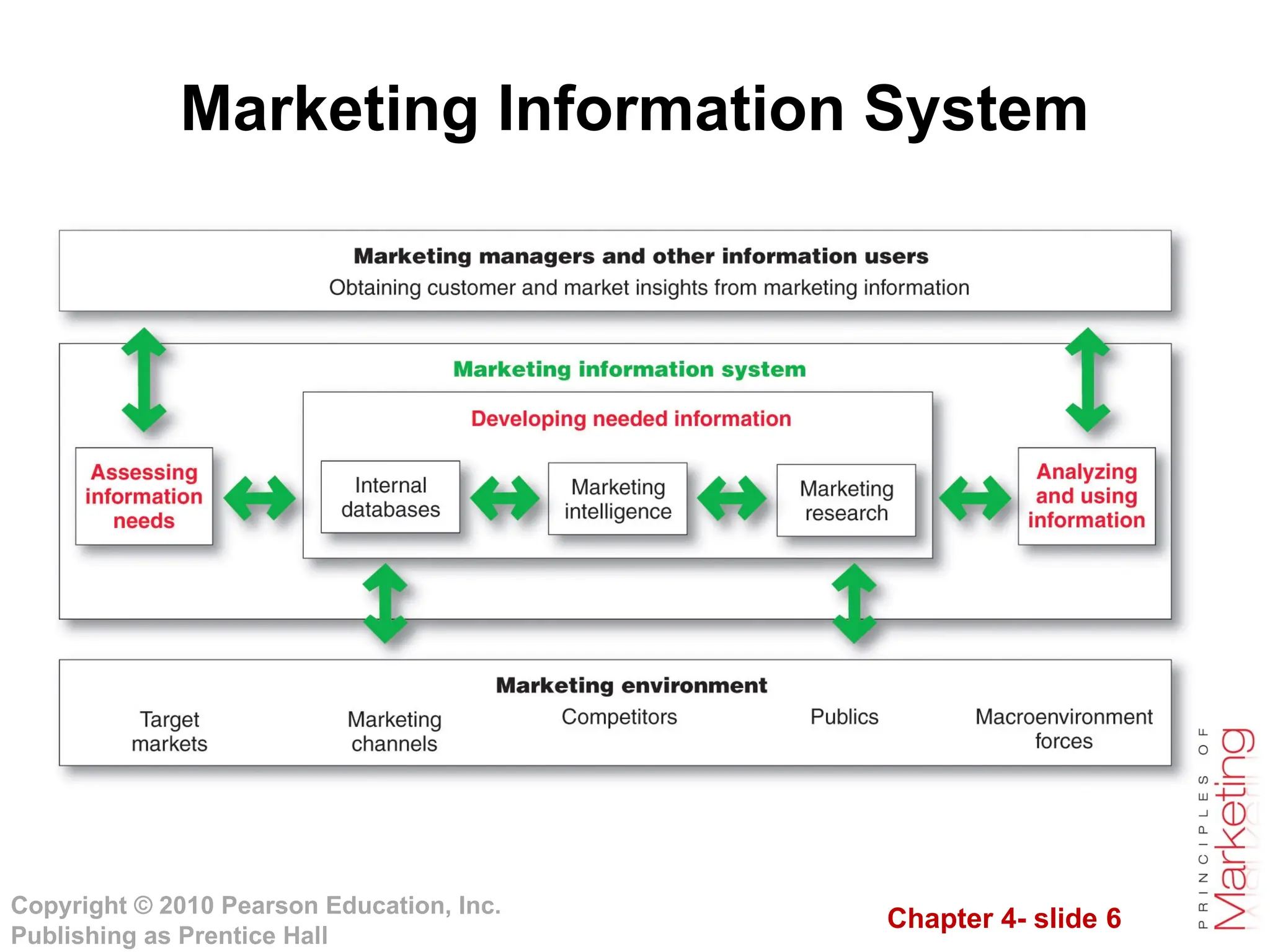
Marketing Information System
Chapter 4- slide 7
Copyright © 2010 Pearson Education, Inc.
Publishing as Prentice Hall
Assessing Marketing Information
Needs
MIS provides information to the company’s
marketing and other managers and
external partners such as suppliers,
resellers, and marketing service agencies
Chapter 4- slide 8
Copyright © 2010 Pearson Education, Inc.
Publishing as Prentice Hall
Assessing Marketing Information
Needs
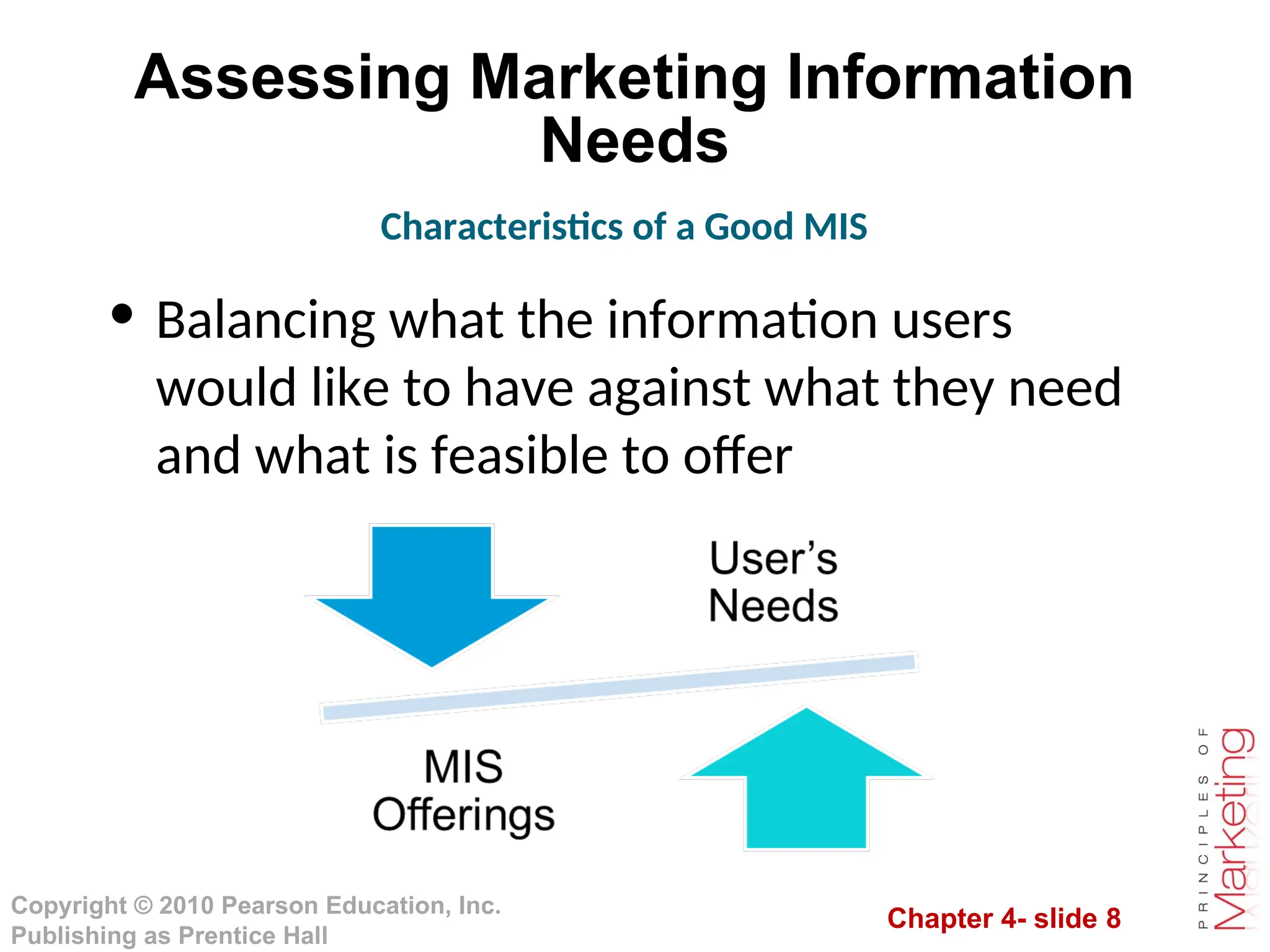
• Balancing what the information users
would like to have against what they need
and what is feasible to offer
Characteristics of a Good MIS
Chapter 4- slide 9
Copyright © 2010 Pearson Education, Inc.
Publishing as Prentice Hall
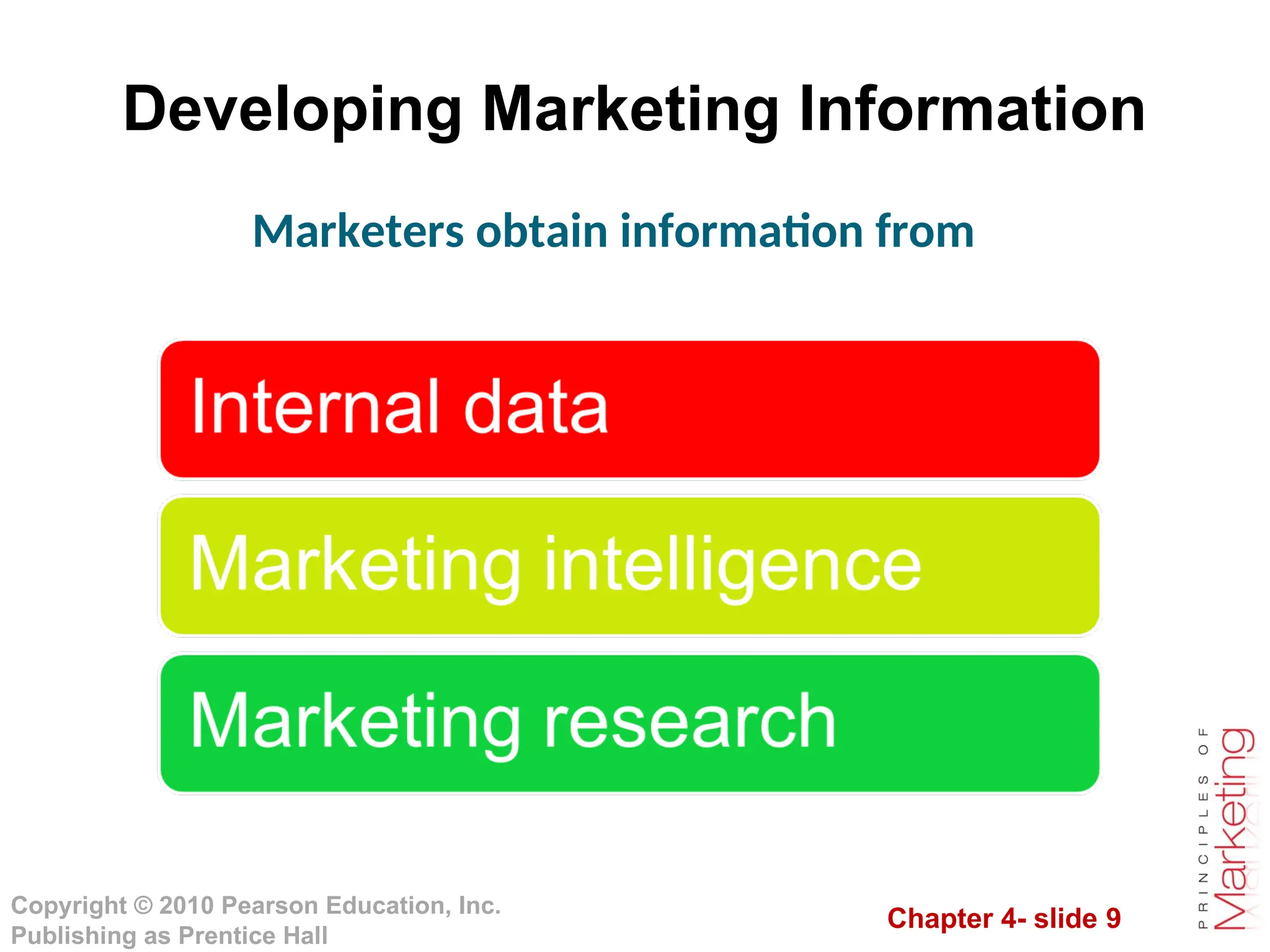
Developing Marketing Information
Marketers obtain information from
Chapter 4- slide 10
Copyright © 2010 Pearson Education, Inc.
Publishing as Prentice Hall
Developing Marketing Information
Internal databases are electronic
collections of consumer and market
information obtained from data
sources within the company network
Internal Data
Chapter 4- slide 11
Copyright © 2010 Pearson Education, Inc.
Publishing as Prentice Hall
Developing Marketing Information
Marketing intelligence is the systematic
collection and analysis of publicly available
information about consumers, competitors,
and developments in the marketplace
Marketing Intelligence
Chapter 4- slide 12
Copyright © 2010 Pearson Education, Inc.
Publishing as Prentice Hall
Developing Marketing Information
Marketing Research
Marketing research is the
systematic design, collection,
analysis, and reporting of data
relevant to a specific marketing
situation facing an organization
Chapter 4- slide 13
Copyright © 2010 Pearson Education, Inc.
Publishing as Prentice Hall
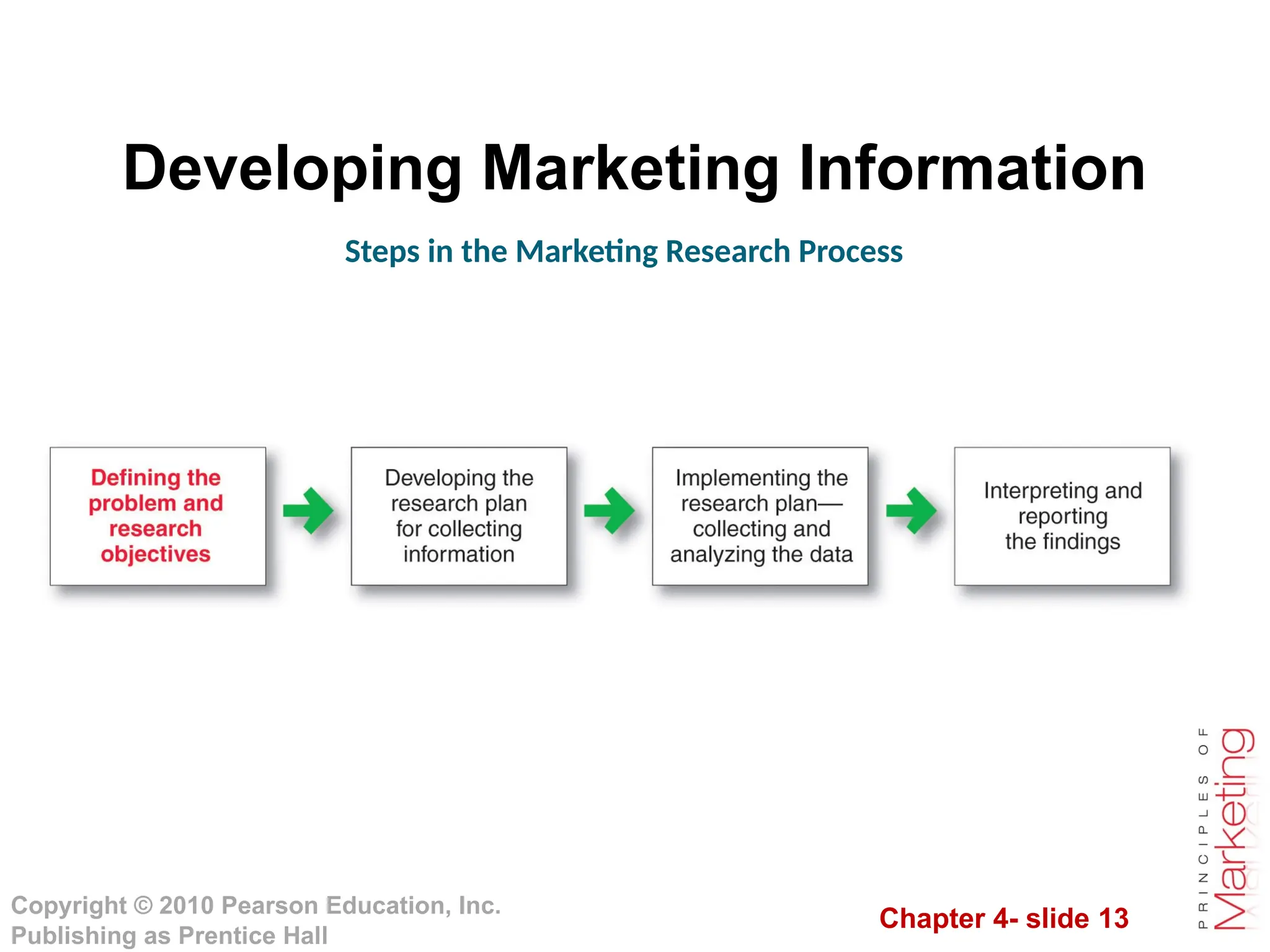
Developing Marketing Information
Steps in the Marketing Research Process
Chapter 4- slide 14
Copyright © 2010 Pearson Education, Inc.
Publishing as Prentice Hall
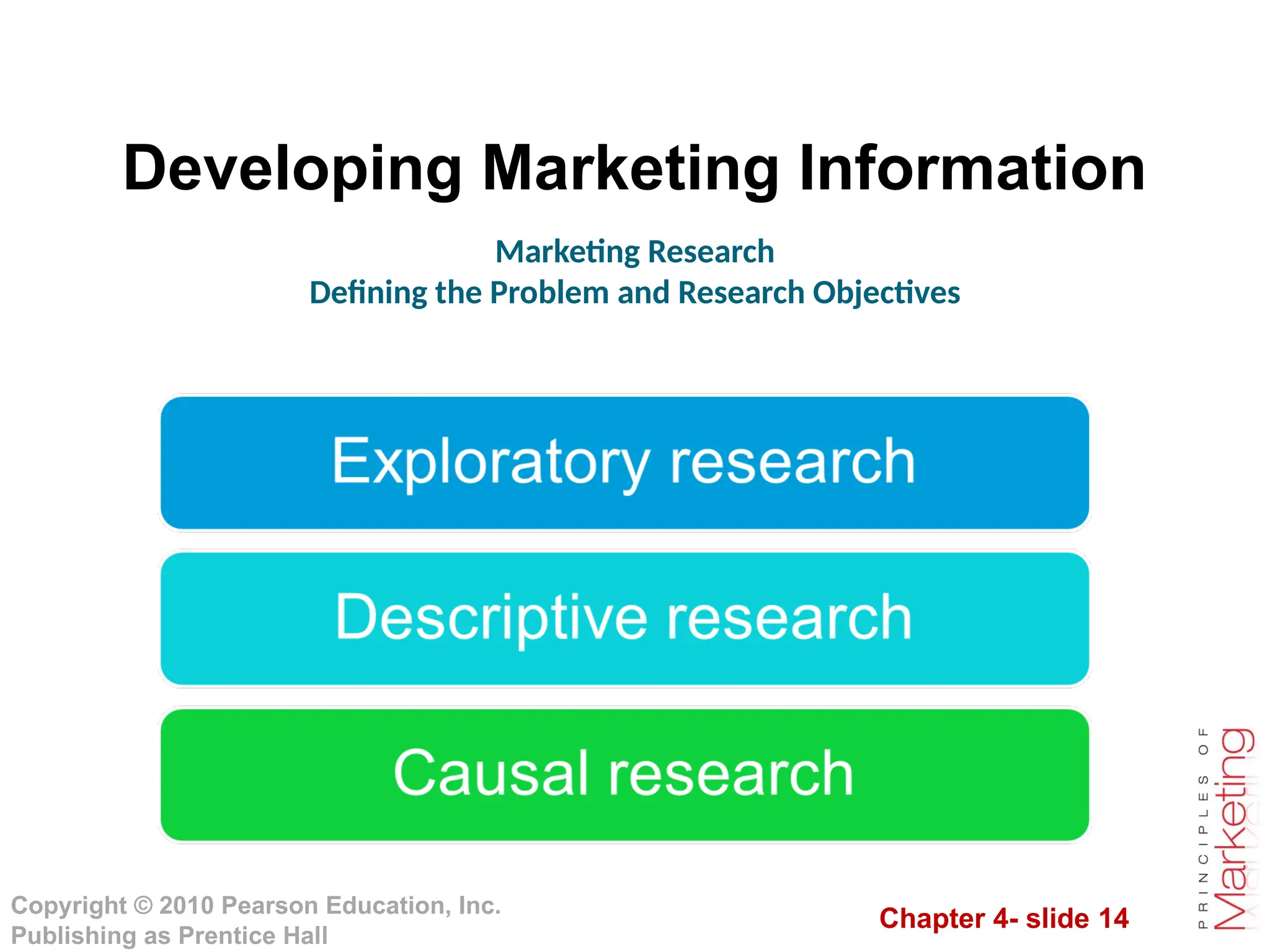
Developing Marketing Information
Marketing Research
Defining the Problem and Research Objectives
Chapter 4- slide 15
Copyright © 2010 Pearson Education, Inc.
Publishing as Prentice Hall
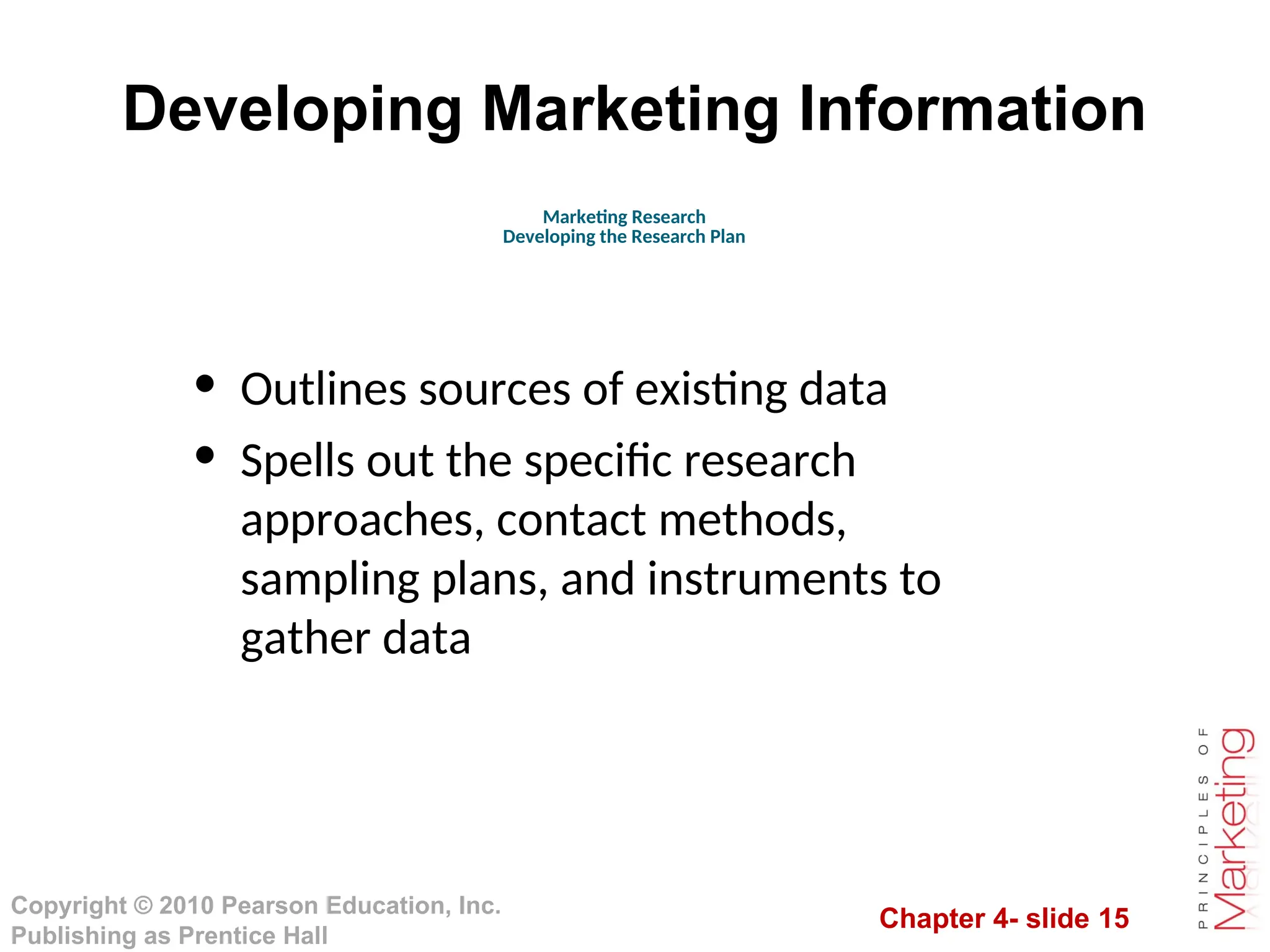
Developing Marketing Information
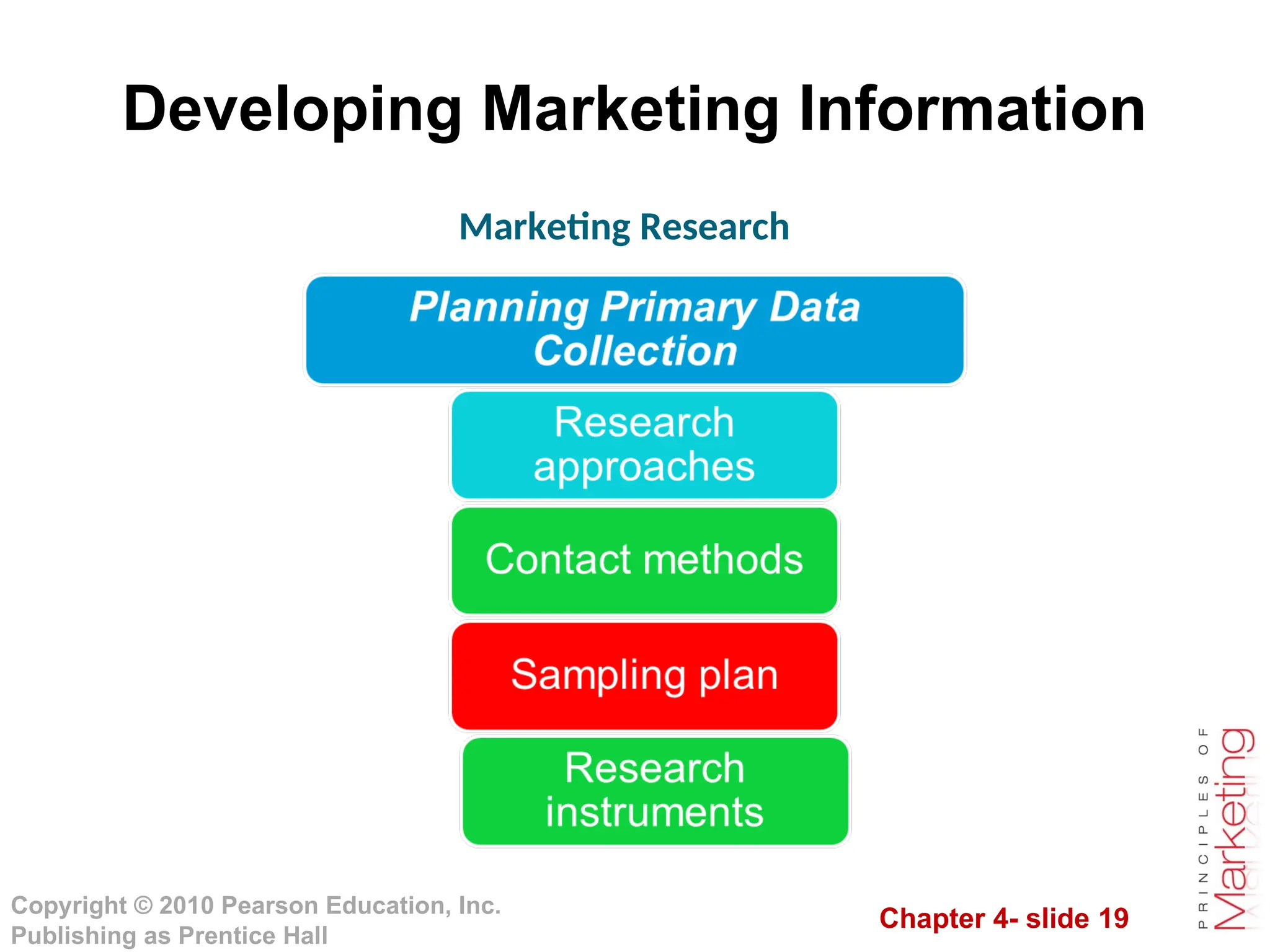
• Outlines sources of existing data
• Spells out the specific research
approaches, contact methods,
sampling plans, and instruments to
gather data
Marketing Research
Developing the Research Plan
Chapter 4- slide 16
Copyright © 2010 Pearson Education, Inc.
Publishing as Prentice Hall
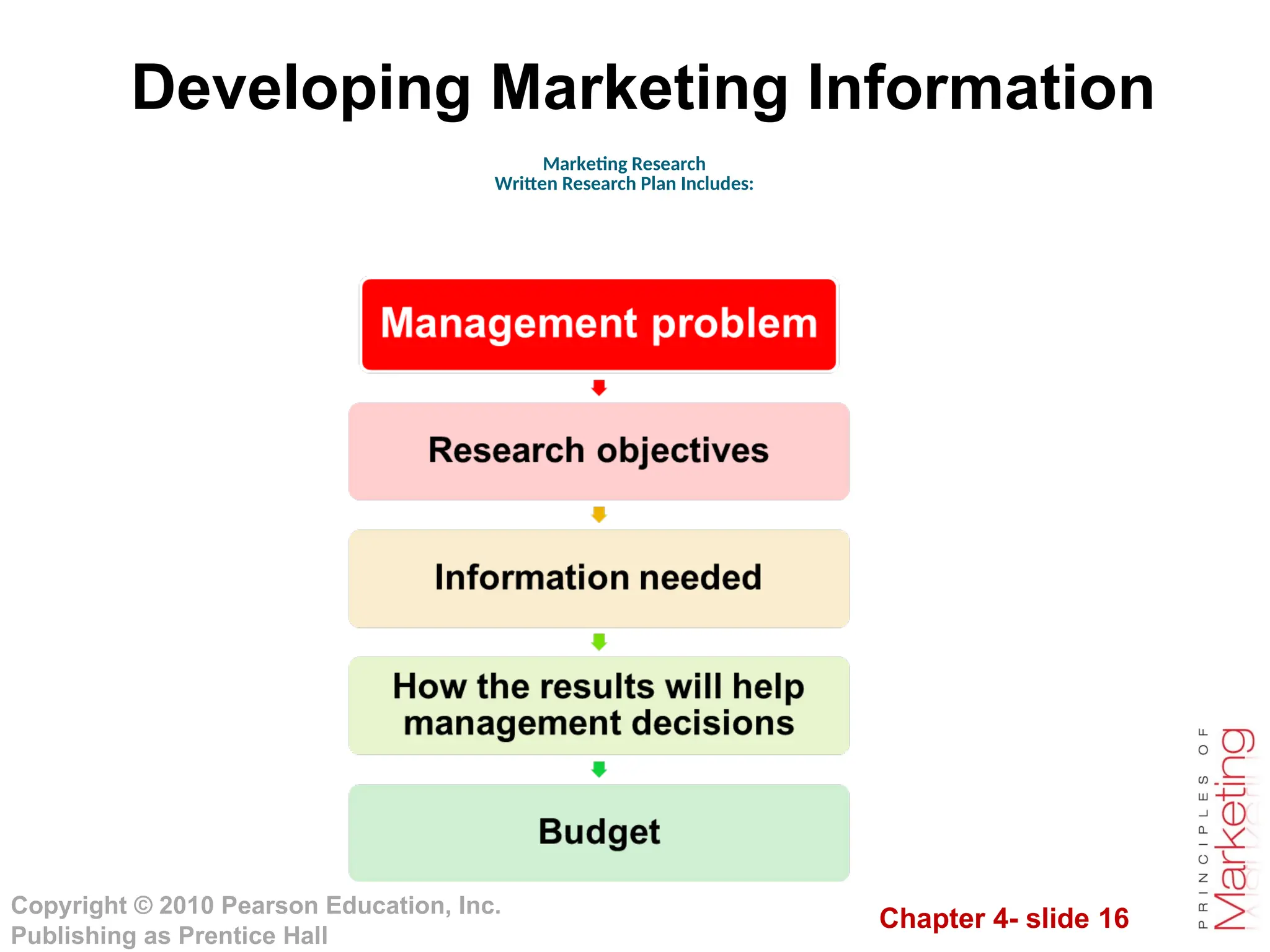
Developing Marketing Information
Marketing Research
Written Research Plan Includes:
Chapter 4- slide 17
Copyright © 2010 Pearson Education, Inc.
Publishing as Prentice Hall
Developing Marketing Information
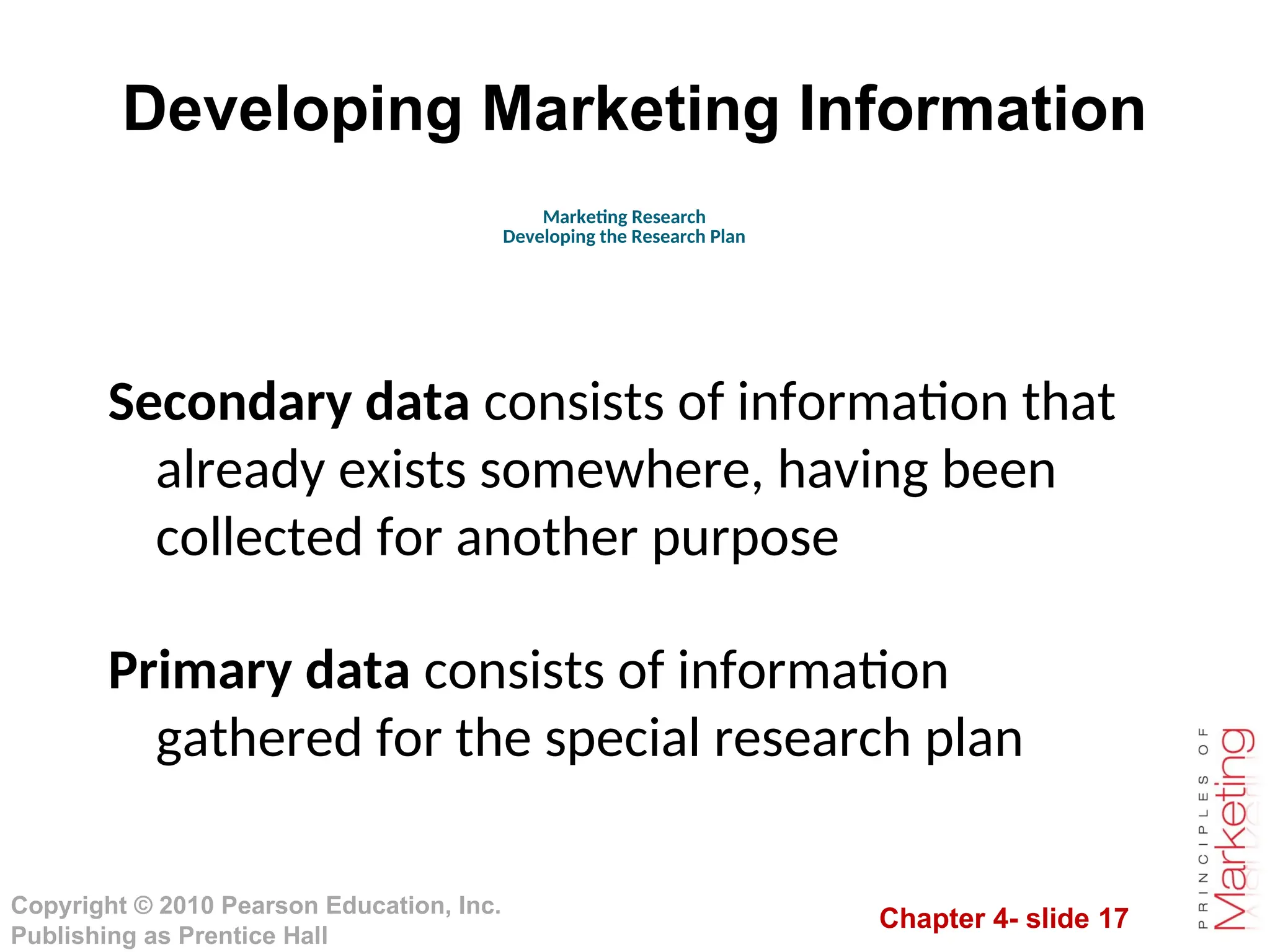
Secondary data consists of information that
already exists somewhere, having been
collected for another purpose
Primary data consists of information
gathered for the special research plan
Marketing Research
Developing the Research Plan
Chapter 4- slide 18
Copyright © 2010 Pearson Education, Inc.
Publishing as Prentice Hall
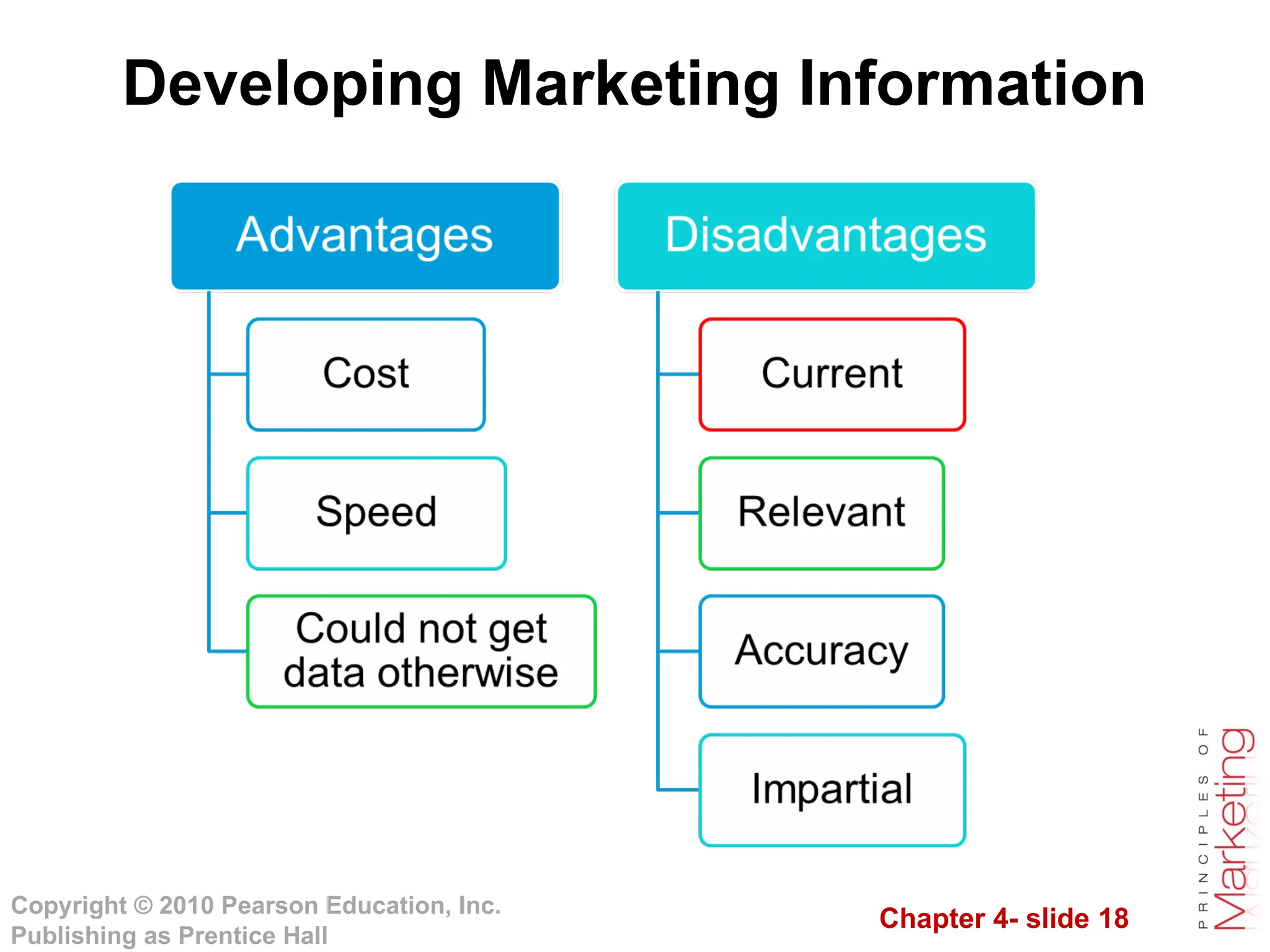
Developing Marketing Information
Chapter 4- slide 19
Copyright © 2010 Pearson Education, Inc.
Publishing as Prentice Hall
Developing Marketing Information
Marketing Research
Chapter 4- slide 20
Copyright © 2010 Pearson Education, Inc.
Publishing as Prentice Hall
Developing Marketing Information
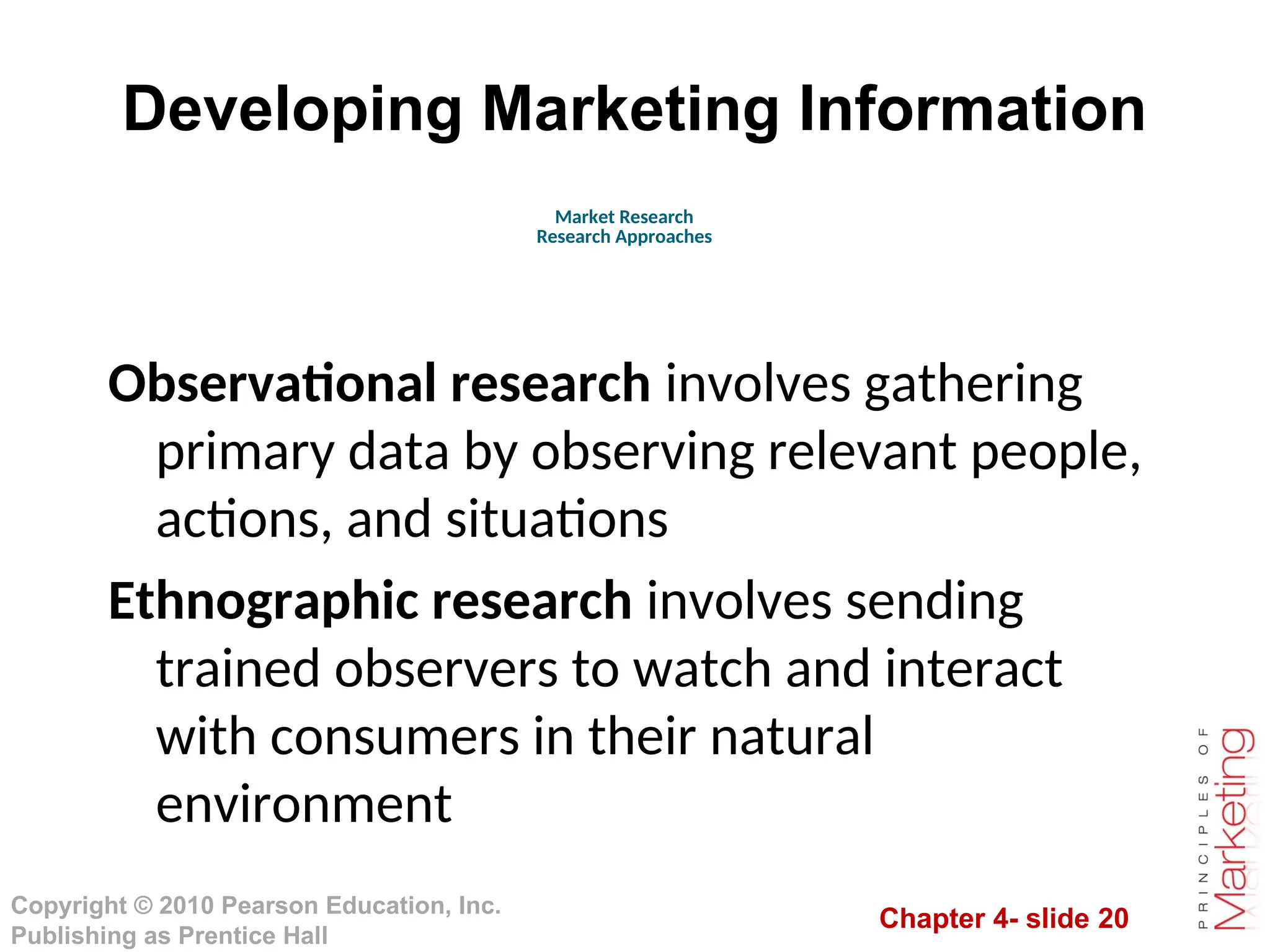
Observational research involves gathering
primary data by observing relevant people,
actions, and situations
Ethnographic research involves sending
trained observers to watch and interact
with consumers in their natural
environment
Market Research
Research Approaches
Chapter 4- slide 21
Copyright © 2010 Pearson Education, Inc.
Publishing as Prentice Hall
Developing Marketing Information
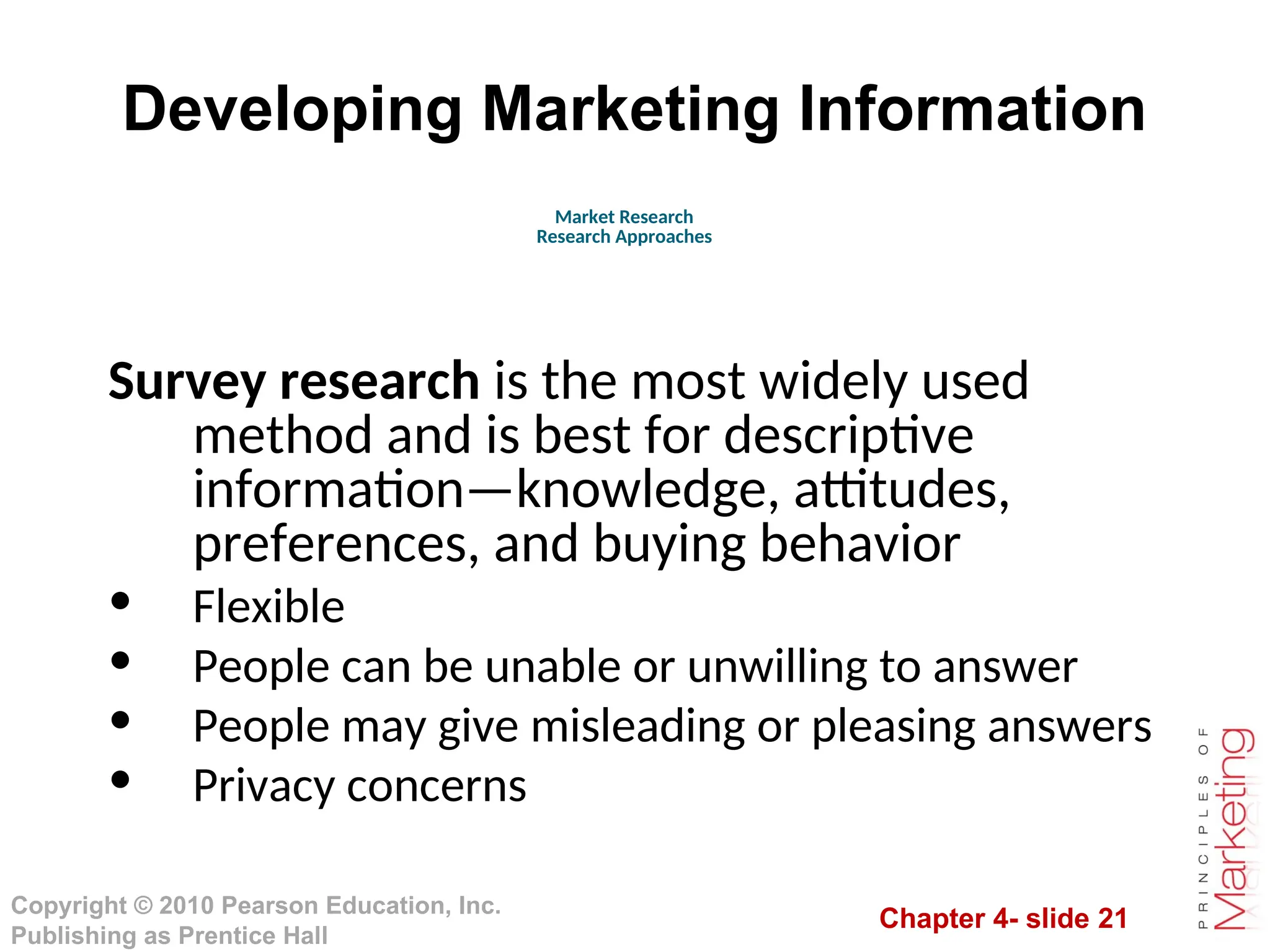
Survey research is the most widely used
method and is best for descriptive
information—knowledge, attitudes,
preferences, and buying behavior
• Flexible
• People can be unable or unwilling to answer
• People may give misleading or pleasing answers
• Privacy concerns
Market Research
Research Approaches
Chapter 4- slide 22
Copyright © 2010 Pearson Education, Inc.
Publishing as Prentice Hall
Developing Marketing Information
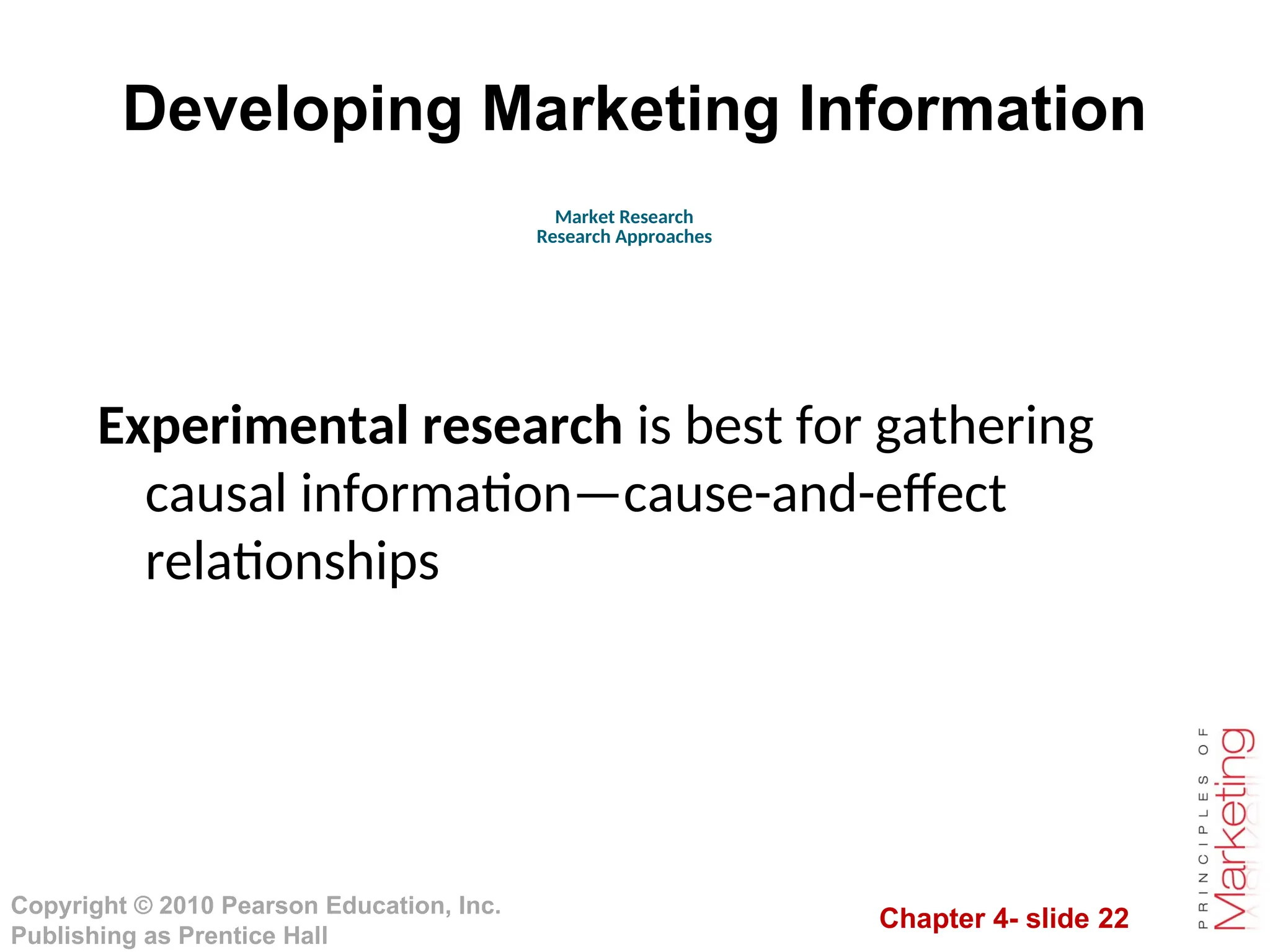
Experimental research is best for gathering
causal information—cause-and-effect
relationships
Market Research
Research Approaches
Chapter 4- slide 23
Copyright © 2010 Pearson Education, Inc.
Publishing as Prentice Hall
Developing Marketing Information
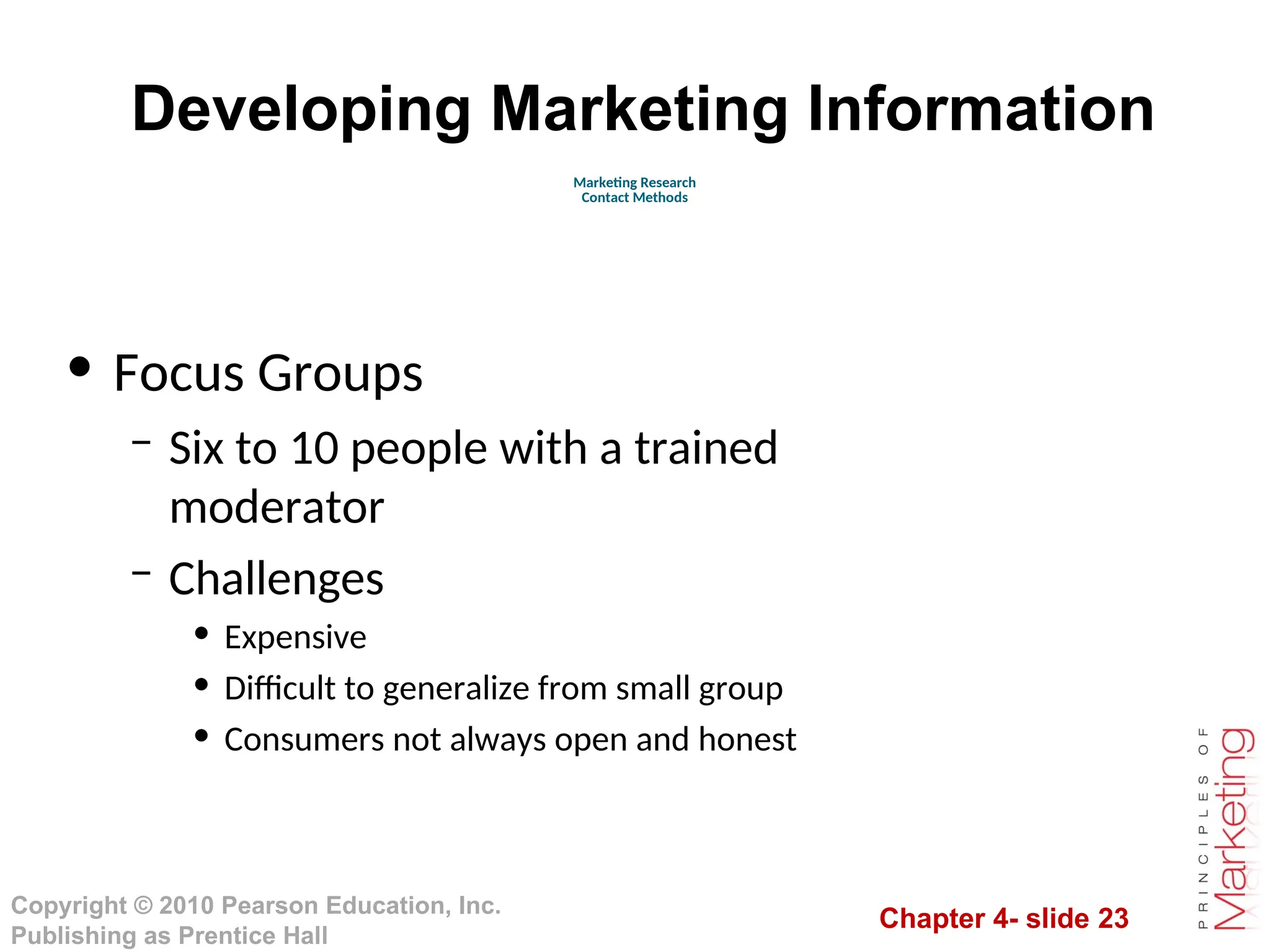
• Focus Groups
– Six to 10 people with a trained
moderator
– Challenges
• Expensive
• Difficult to generalize from small group
• Consumers not always open and honest
Marketing Research
Contact Methods
Chapter 4- slide 24
Copyright © 2010 Pearson Education, Inc.
Publishing as Prentice Hall
Developing Marketing Information
Marketing Research
Contact Methods
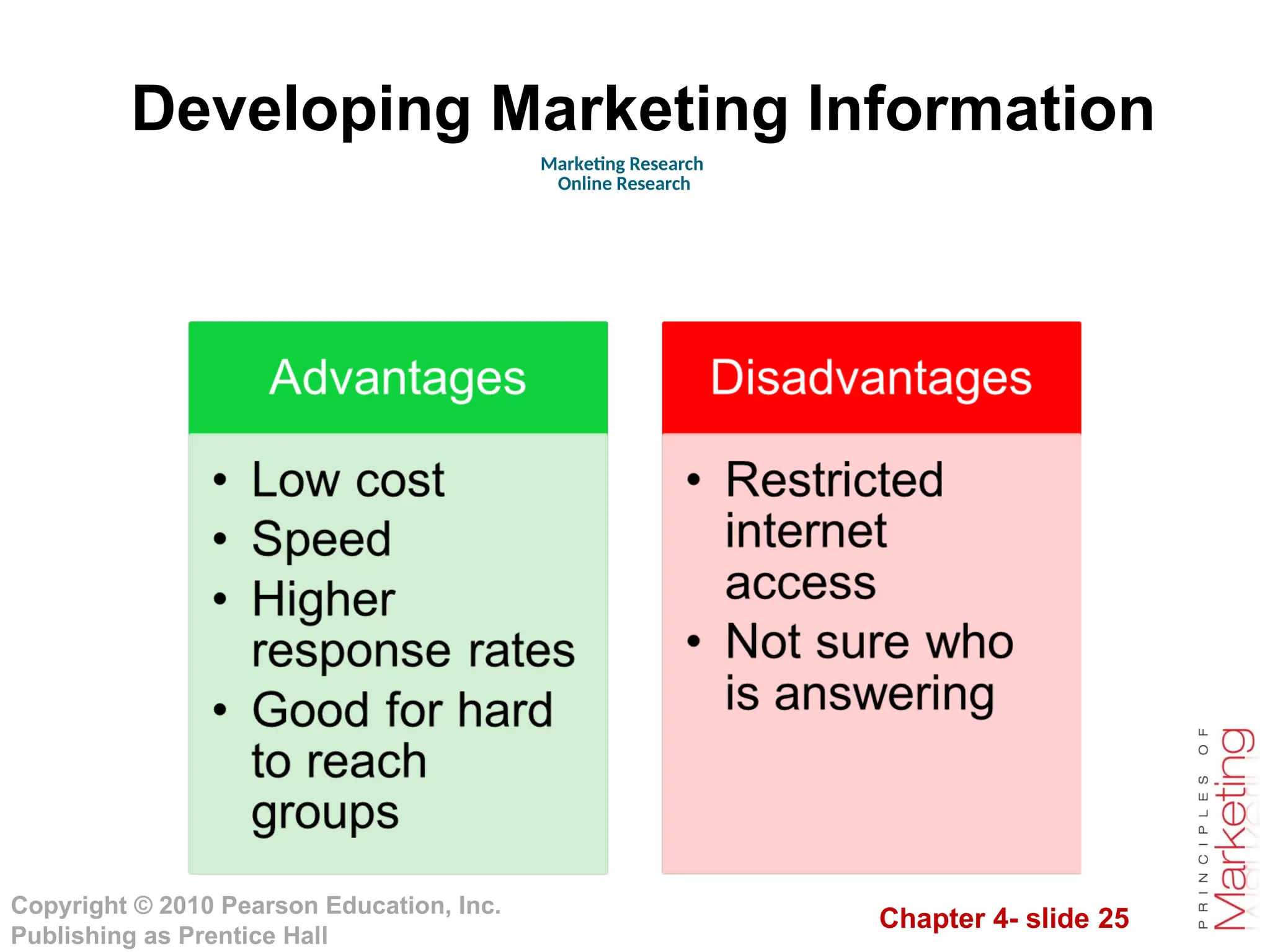
Chapter 4- slide 25
Copyright © 2010 Pearson Education, Inc.
Publishing as Prentice Hall
Developing Marketing Information
Marketing Research
Online Research
Chapter 4- slide 26
Copyright © 2010 Pearson Education, Inc.
Publishing as Prentice Hall
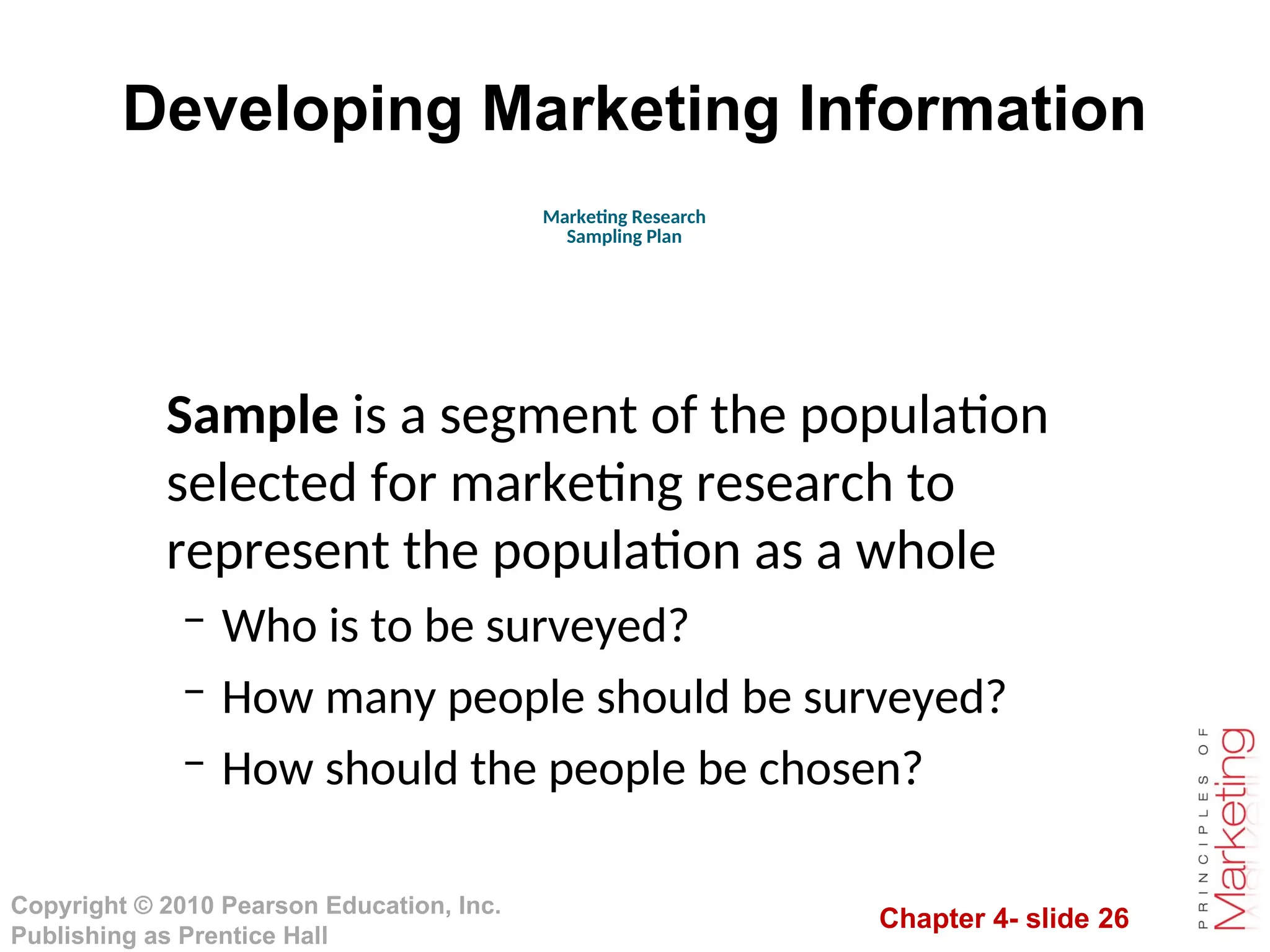
Developing Marketing Information
Sample is a segment of the population
selected for marketing research to
represent the population as a whole
– Who is to be surveyed?
– How many people should be surveyed?
– How should the people be chosen?
Marketing Research
Sampling Plan
Chapter 4- slide 27
Copyright © 2010 Pearson Education, Inc.
Publishing as Prentice Hall
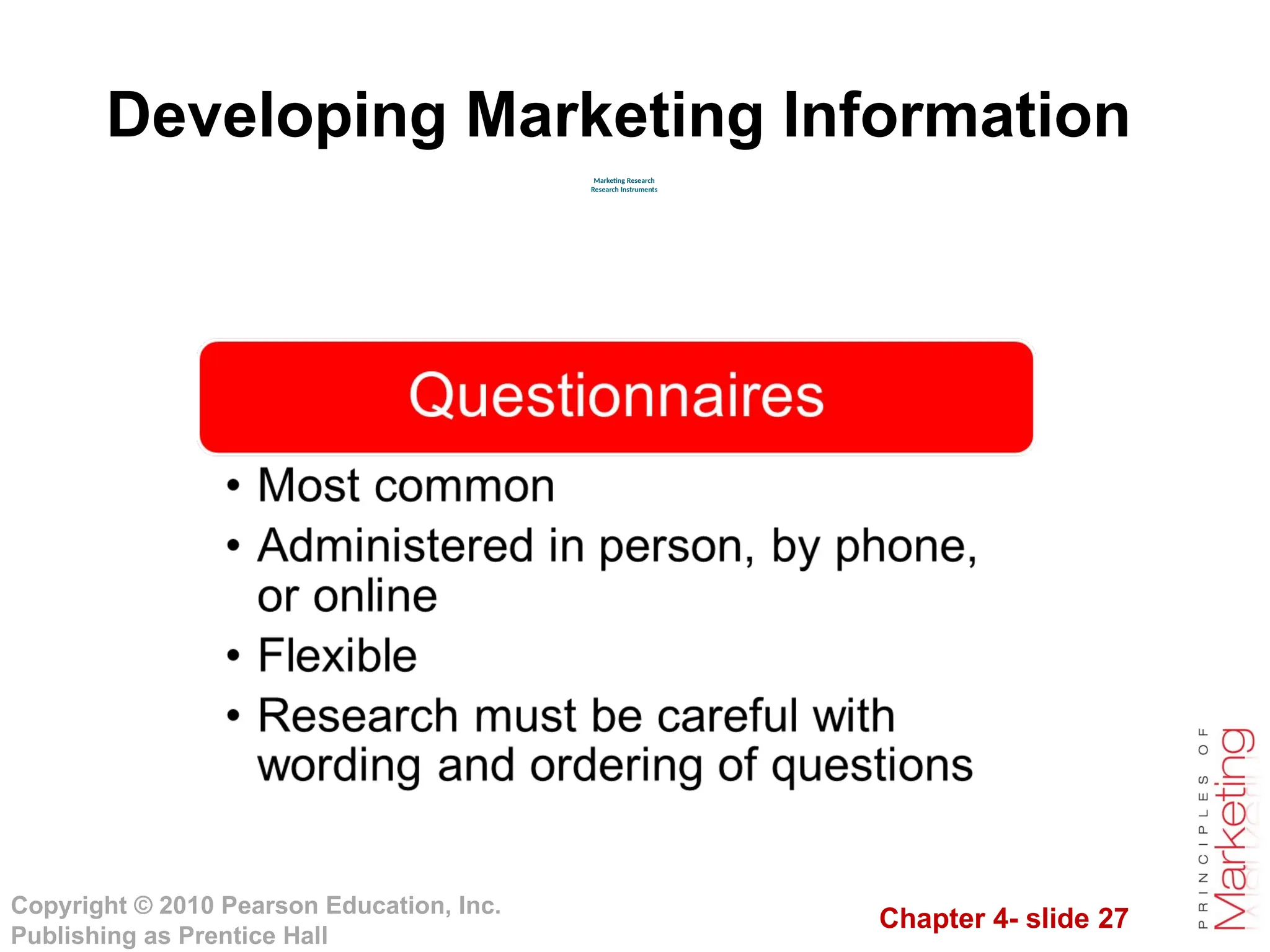
Developing Marketing Information
Marketing Research
Research Instruments
Chapter 4- slide 28
Copyright © 2010 Pearson Education, Inc.
Publishing as Prentice Hall
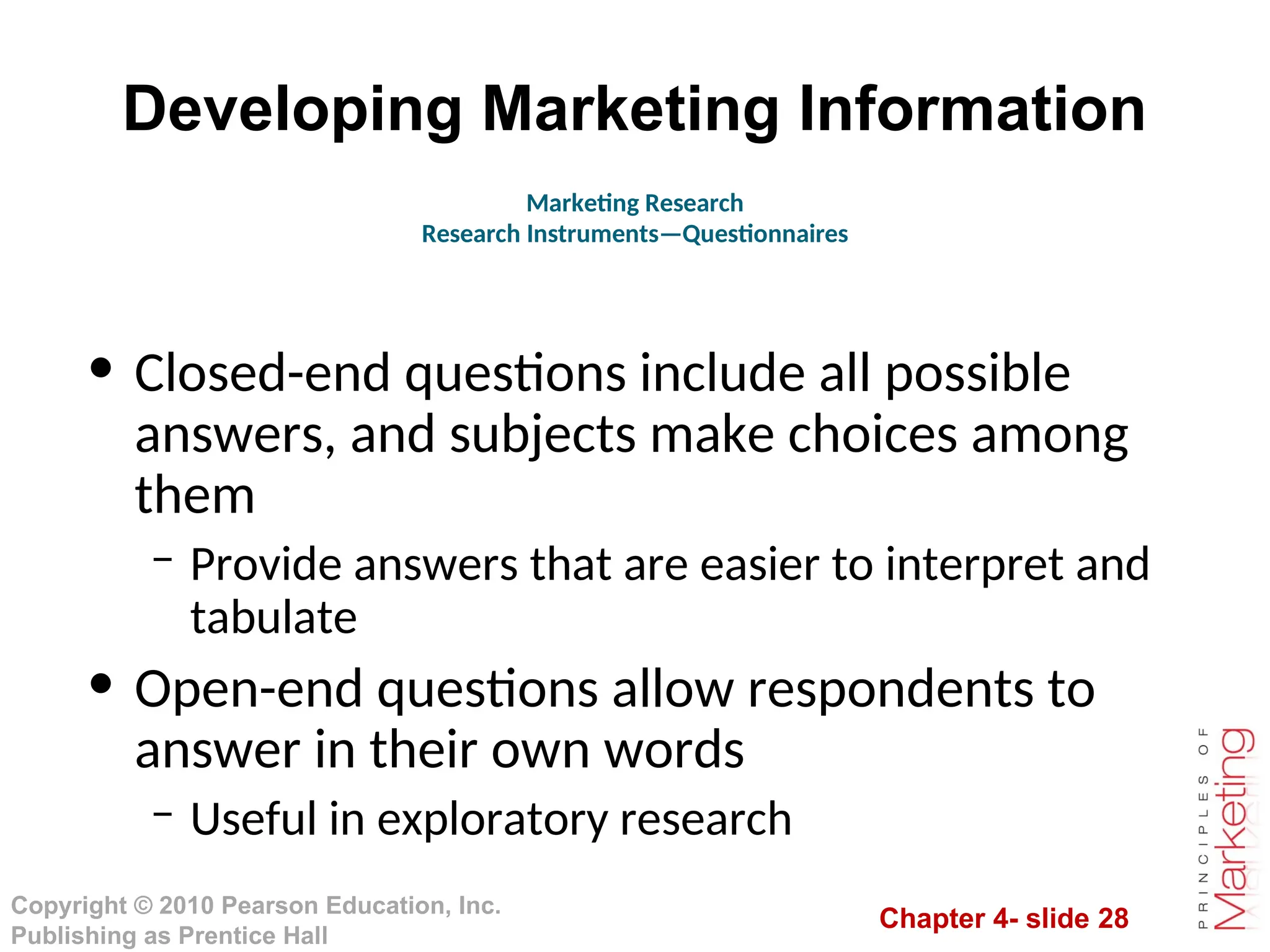
Developing Marketing Information
• Closed-end questions include all possible
answers, and subjects make choices among
them
– Provide answers that are easier to interpret and
tabulate
• Open-end questions allow respondents to
answer in their own words
– Useful in exploratory research
Marketing Research
Research Instruments—Questionnaires
Chapter 4- slide 29
Copyright © 2010 Pearson Education, Inc.
Publishing as Prentice Hall
Developing Marketing Information
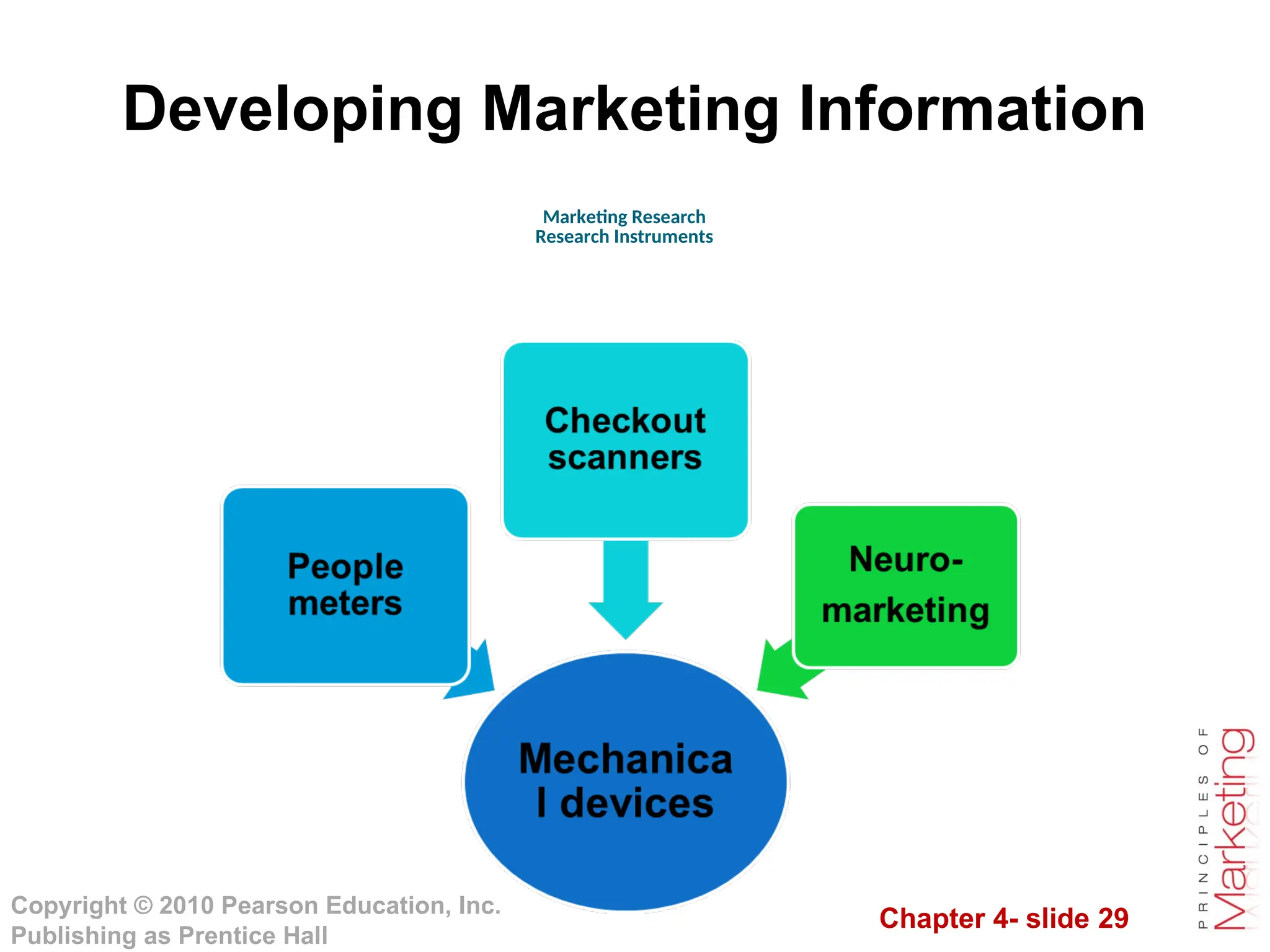
Marketing Research
Research Instruments
Chapter 4- slide 30
Copyright © 2010 Pearson Education, Inc.
Publishing as Prentice Hall
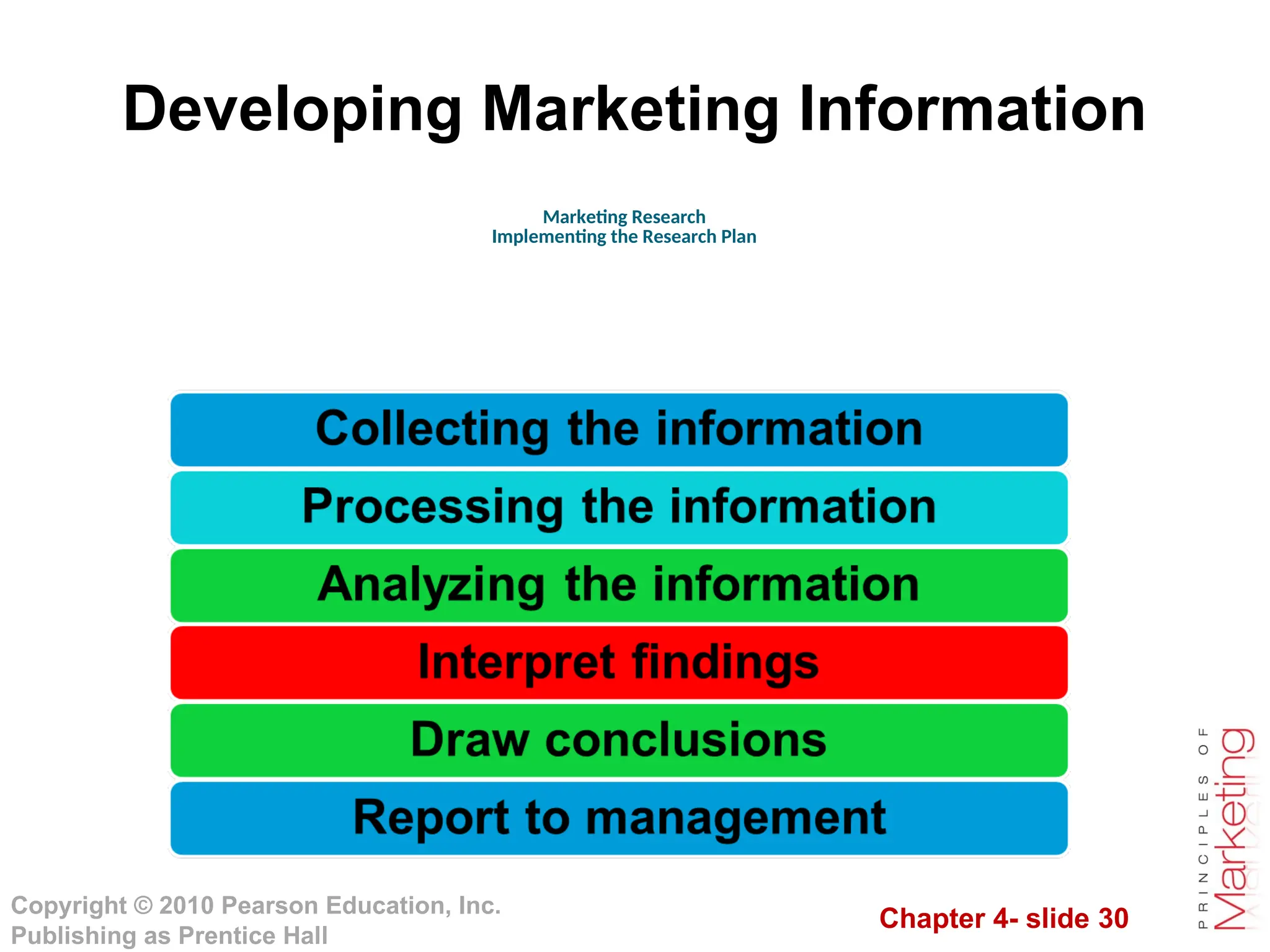
Developing Marketing Information
Marketing Research
Implementing the Research Plan
Chapter 4- slide 31
Copyright © 2010 Pearson Education, Inc.
Publishing as Prentice Hall
Analyzing and Using Marketing
Information
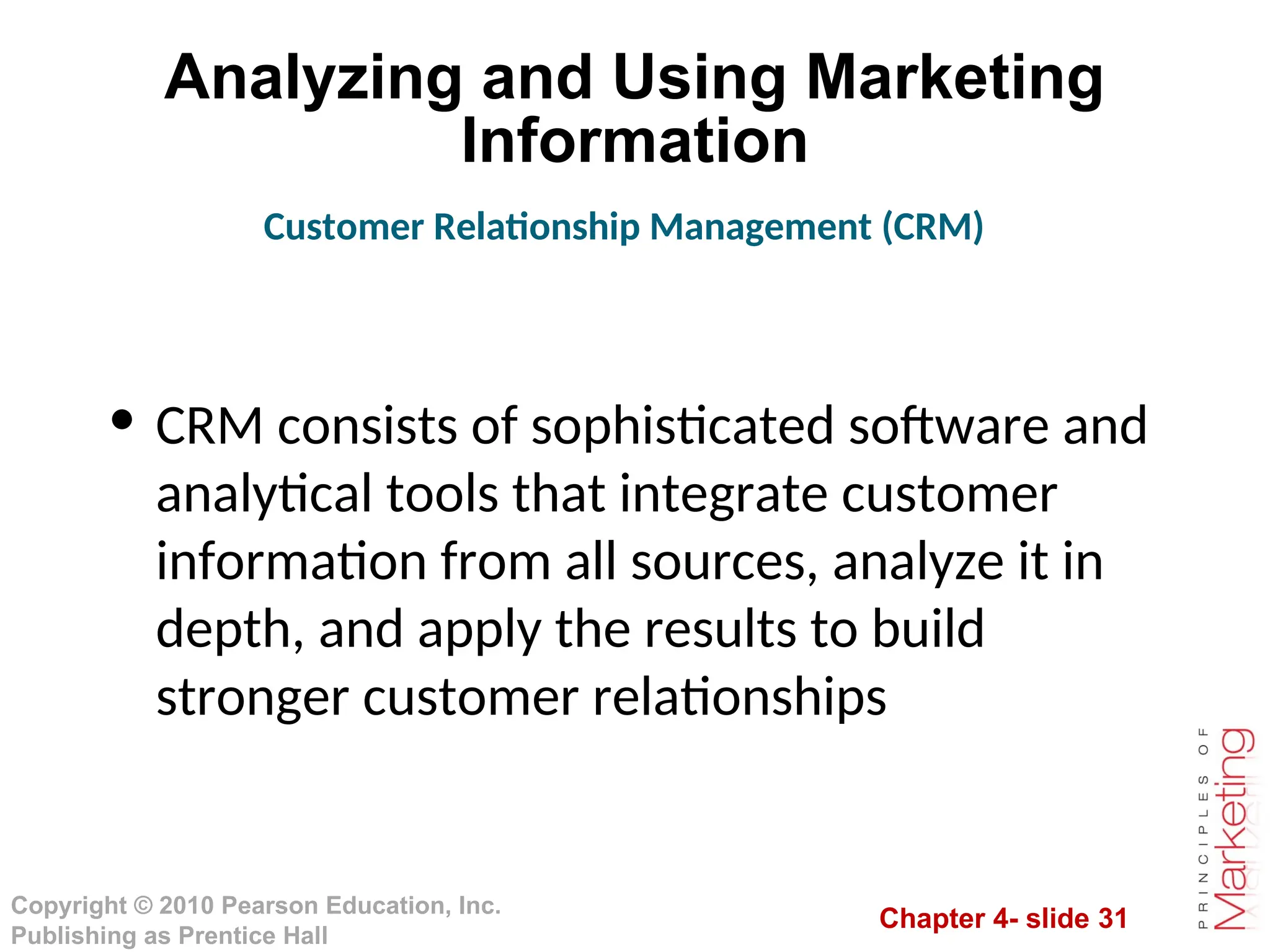
• CRM consists of sophisticated software and
analytical tools that integrate customer
information from all sources, analyze it in
depth, and apply the results to build
stronger customer relationships
Customer Relationship Management (CRM)
Chapter 4- slide 32
Copyright © 2010 Pearson Education, Inc.
Publishing as Prentice Hall
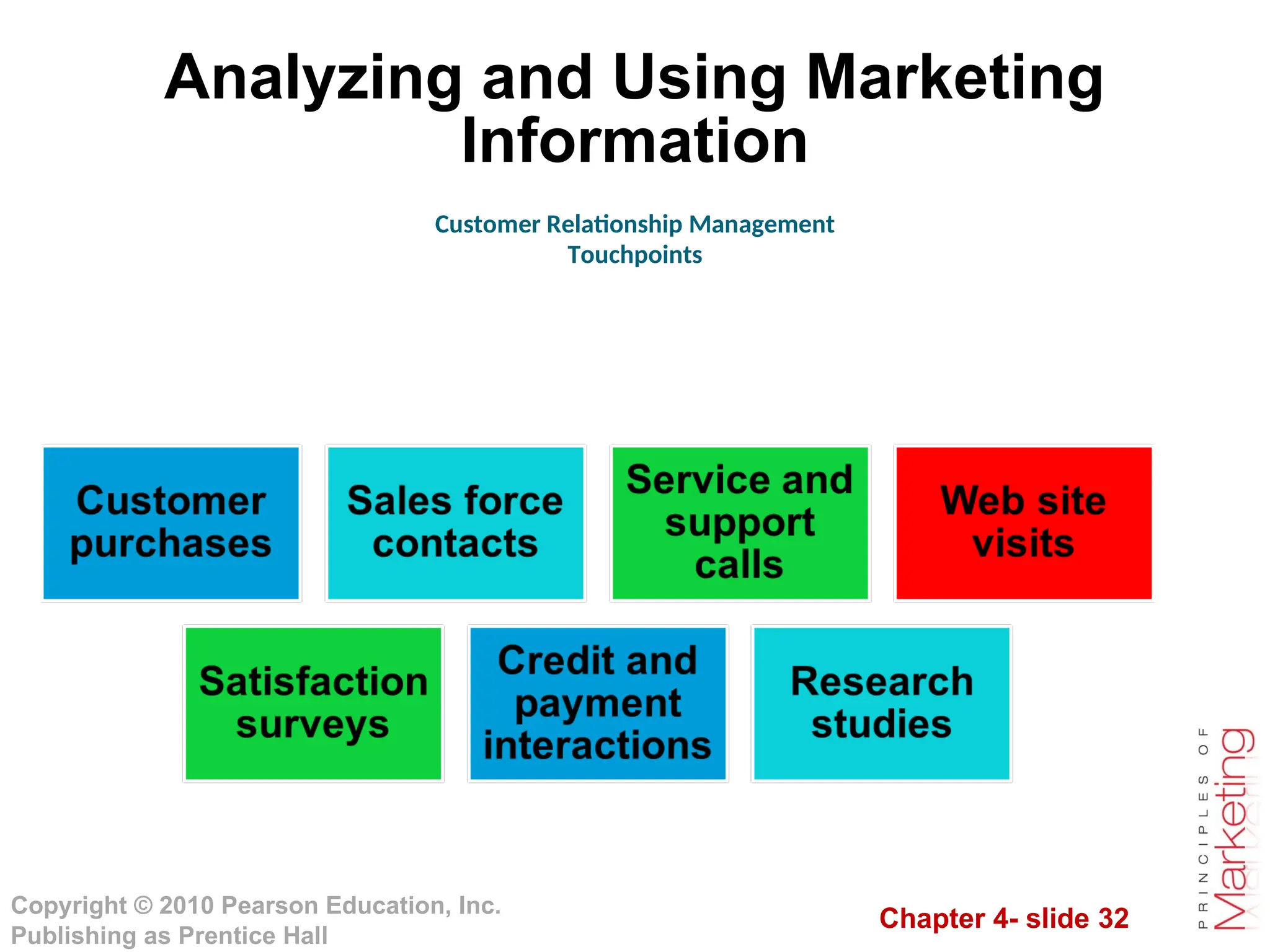
Analyzing and Using Marketing
Information
Customer Relationship Management
Touchpoints
Chapter 4- slide 33
Copyright © 2010 Pearson Education, Inc.
Publishing as Prentice Hall
Distributing and Using Marketing
Information
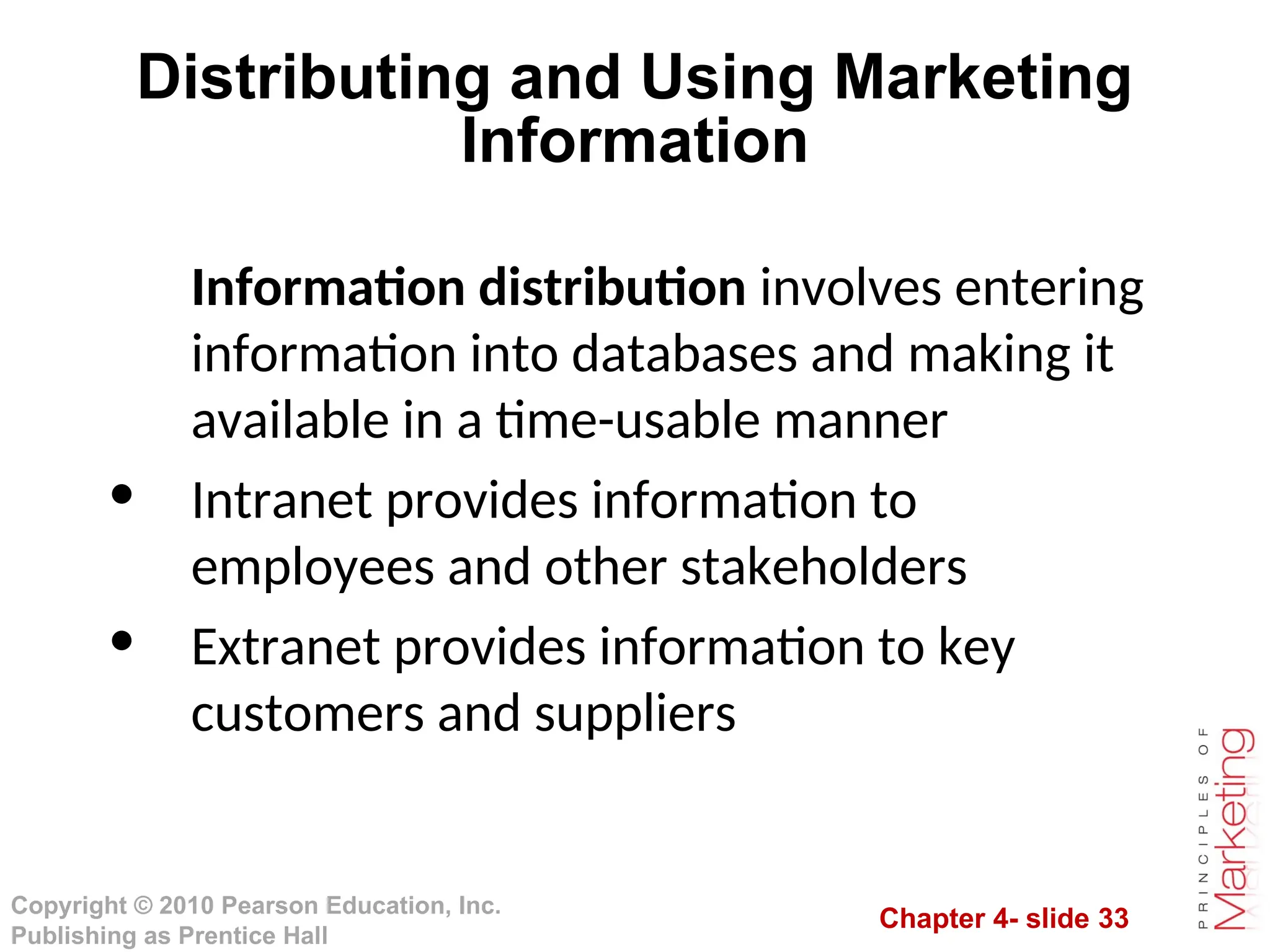
Information distribution involves entering
information into databases and making it
available in a time-usable manner
• Intranet provides information to
employees and other stakeholders
• Extranet provides information to key
customers and suppliers
Chapter 4- slide 34
Copyright © 2010 Pearson Education, Inc.
Publishing as Prentice Hall
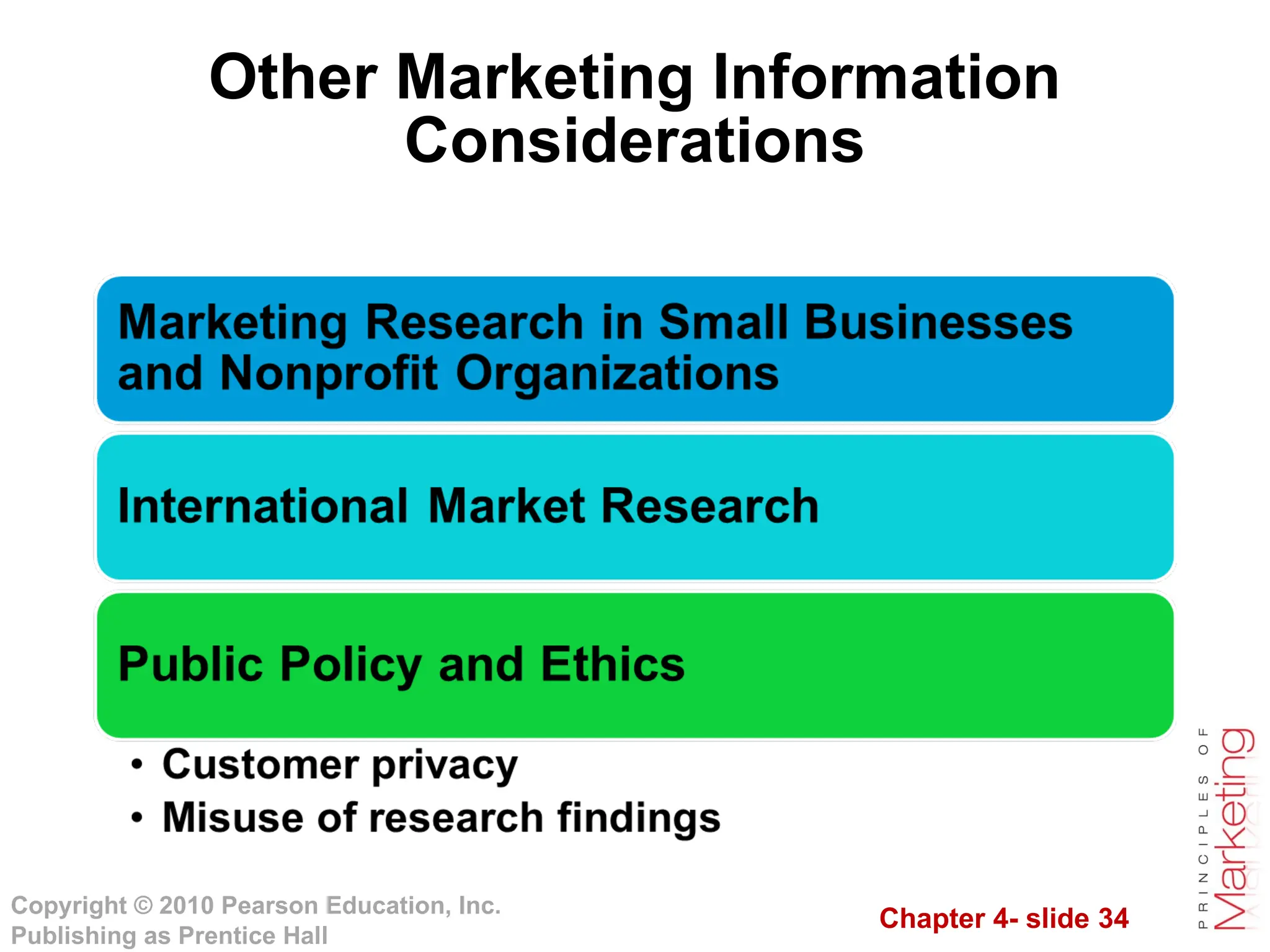
Other Marketing Information
Considerations
Chapter 4- slide 35
Copyright © 2010 Pearson Education, Inc.
Publishing as Prentice Hall
All rights reserved. No part of this publication may be reproduced, stored in a
retrieval system, or transmitted, in any form or by any means, electronic,
mechanical, photocopying, recording, or otherwise, without the prior written
permission of the publisher. Printed in the United States of America.
Copyright © 2010 Pearson Education, Inc.
Publishing as Prentice Hall

Chapt04ppt. fhftttttttttttyyyyyyyyyyyyyy

  • 1.
    Chapter 4- slide1 Chapter Four Managing Marketing Information to Gain Customer Insights
  • 2.
    Chapter 4- slide2 Copyright © 2010 Pearson Education, Inc. Publishing as Prentice Hall Learning Objectives • Marketing Information and Customer Insights • Assessing Marketing Information Needs • Developing Marketing Information • Marketing Research • Analyzing Marketing Information • Distributing and Using Marketing Information • Other Marketing Information Considerations Topic Outline
  • 3.
    Chapter 4- slide3 Copyright © 2010 Pearson Education, Inc. Publishing as Prentice Hall Marketing Information and Customer Insights • Fresh and deep insights into customers’ needs and wants • Difficult to obtain – Not obvious – Customers unsure of their behavior • Not derived from more information but better information and more effective use of existing information Customer Insights
  • 4.
    Chapter 4- slide4 Copyright © 2010 Pearson Education, Inc. Publishing as Prentice Hall Marketing Information and Customer Insights • Companies are forming customer insights teams – Include all company functional areas – Use insights to create more value for their customers – Customer control could be a problem Customer Insights
  • 5.
    Chapter 4- slide5 Copyright © 2010 Pearson Education, Inc. Publishing as Prentice Hall Marketing Information and Customer Insights Marketing information system (MIS) consists of people and procedures for: – Assessing informational needs – Developing needed information – Helping decision makers use the information to generate customer insights Marketing Information Systems (MIS)
  • 6.
    Chapter 4- slide6 Copyright © 2010 Pearson Education, Inc. Publishing as Prentice Hall Marketing Information System
  • 7.
    Chapter 4- slide7 Copyright © 2010 Pearson Education, Inc. Publishing as Prentice Hall Assessing Marketing Information Needs MIS provides information to the company’s marketing and other managers and external partners such as suppliers, resellers, and marketing service agencies
  • 8.
    Chapter 4- slide8 Copyright © 2010 Pearson Education, Inc. Publishing as Prentice Hall Assessing Marketing Information Needs • Balancing what the information users would like to have against what they need and what is feasible to offer Characteristics of a Good MIS
  • 9.
    Chapter 4- slide9 Copyright © 2010 Pearson Education, Inc. Publishing as Prentice Hall Developing Marketing Information Marketers obtain information from
  • 10.
    Chapter 4- slide10 Copyright © 2010 Pearson Education, Inc. Publishing as Prentice Hall Developing Marketing Information Internal databases are electronic collections of consumer and market information obtained from data sources within the company network Internal Data
  • 11.
    Chapter 4- slide11 Copyright © 2010 Pearson Education, Inc. Publishing as Prentice Hall Developing Marketing Information Marketing intelligence is the systematic collection and analysis of publicly available information about consumers, competitors, and developments in the marketplace Marketing Intelligence
  • 12.
    Chapter 4- slide12 Copyright © 2010 Pearson Education, Inc. Publishing as Prentice Hall Developing Marketing Information Marketing Research Marketing research is the systematic design, collection, analysis, and reporting of data relevant to a specific marketing situation facing an organization
  • 13.
    Chapter 4- slide13 Copyright © 2010 Pearson Education, Inc. Publishing as Prentice Hall Developing Marketing Information Steps in the Marketing Research Process
  • 14.
    Chapter 4- slide14 Copyright © 2010 Pearson Education, Inc. Publishing as Prentice Hall Developing Marketing Information Marketing Research Defining the Problem and Research Objectives
  • 15.
    Chapter 4- slide15 Copyright © 2010 Pearson Education, Inc. Publishing as Prentice Hall Developing Marketing Information • Outlines sources of existing data • Spells out the specific research approaches, contact methods, sampling plans, and instruments to gather data Marketing Research Developing the Research Plan
  • 16.
    Chapter 4- slide16 Copyright © 2010 Pearson Education, Inc. Publishing as Prentice Hall Developing Marketing Information Marketing Research Written Research Plan Includes:
  • 17.
    Chapter 4- slide17 Copyright © 2010 Pearson Education, Inc. Publishing as Prentice Hall Developing Marketing Information Secondary data consists of information that already exists somewhere, having been collected for another purpose Primary data consists of information gathered for the special research plan Marketing Research Developing the Research Plan
  • 18.
    Chapter 4- slide18 Copyright © 2010 Pearson Education, Inc. Publishing as Prentice Hall Developing Marketing Information
  • 19.
    Chapter 4- slide19 Copyright © 2010 Pearson Education, Inc. Publishing as Prentice Hall Developing Marketing Information Marketing Research
  • 20.
    Chapter 4- slide20 Copyright © 2010 Pearson Education, Inc. Publishing as Prentice Hall Developing Marketing Information Observational research involves gathering primary data by observing relevant people, actions, and situations Ethnographic research involves sending trained observers to watch and interact with consumers in their natural environment Market Research Research Approaches
  • 21.
    Chapter 4- slide21 Copyright © 2010 Pearson Education, Inc. Publishing as Prentice Hall Developing Marketing Information Survey research is the most widely used method and is best for descriptive information—knowledge, attitudes, preferences, and buying behavior • Flexible • People can be unable or unwilling to answer • People may give misleading or pleasing answers • Privacy concerns Market Research Research Approaches
  • 22.
    Chapter 4- slide22 Copyright © 2010 Pearson Education, Inc. Publishing as Prentice Hall Developing Marketing Information Experimental research is best for gathering causal information—cause-and-effect relationships Market Research Research Approaches
  • 23.
    Chapter 4- slide23 Copyright © 2010 Pearson Education, Inc. Publishing as Prentice Hall Developing Marketing Information • Focus Groups – Six to 10 people with a trained moderator – Challenges • Expensive • Difficult to generalize from small group • Consumers not always open and honest Marketing Research Contact Methods
  • 24.
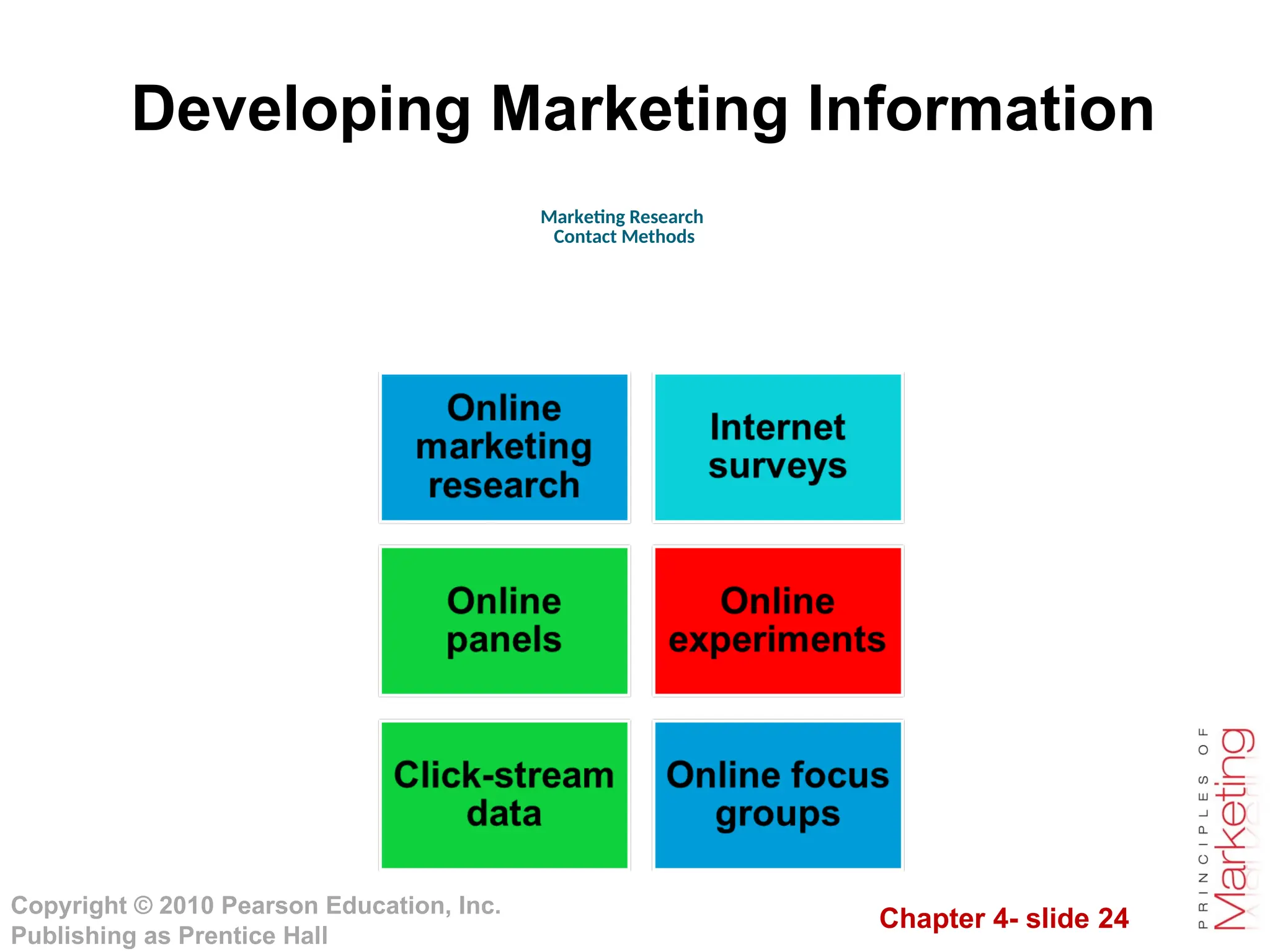
    Chapter 4- slide24 Copyright © 2010 Pearson Education, Inc. Publishing as Prentice Hall Developing Marketing Information Marketing Research Contact Methods
  • 25.
    Chapter 4- slide25 Copyright © 2010 Pearson Education, Inc. Publishing as Prentice Hall Developing Marketing Information Marketing Research Online Research
  • 26.
    Chapter 4- slide26 Copyright © 2010 Pearson Education, Inc. Publishing as Prentice Hall Developing Marketing Information Sample is a segment of the population selected for marketing research to represent the population as a whole – Who is to be surveyed? – How many people should be surveyed? – How should the people be chosen? Marketing Research Sampling Plan
  • 27.
    Chapter 4- slide27 Copyright © 2010 Pearson Education, Inc. Publishing as Prentice Hall Developing Marketing Information Marketing Research Research Instruments
  • 28.
    Chapter 4- slide28 Copyright © 2010 Pearson Education, Inc. Publishing as Prentice Hall Developing Marketing Information • Closed-end questions include all possible answers, and subjects make choices among them – Provide answers that are easier to interpret and tabulate • Open-end questions allow respondents to answer in their own words – Useful in exploratory research Marketing Research Research Instruments—Questionnaires
  • 29.
    Chapter 4- slide29 Copyright © 2010 Pearson Education, Inc. Publishing as Prentice Hall Developing Marketing Information Marketing Research Research Instruments
  • 30.
    Chapter 4- slide30 Copyright © 2010 Pearson Education, Inc. Publishing as Prentice Hall Developing Marketing Information Marketing Research Implementing the Research Plan
  • 31.
    Chapter 4- slide31 Copyright © 2010 Pearson Education, Inc. Publishing as Prentice Hall Analyzing and Using Marketing Information • CRM consists of sophisticated software and analytical tools that integrate customer information from all sources, analyze it in depth, and apply the results to build stronger customer relationships Customer Relationship Management (CRM)
  • 32.
    Chapter 4- slide32 Copyright © 2010 Pearson Education, Inc. Publishing as Prentice Hall Analyzing and Using Marketing Information Customer Relationship Management Touchpoints
  • 33.
    Chapter 4- slide33 Copyright © 2010 Pearson Education, Inc. Publishing as Prentice Hall Distributing and Using Marketing Information Information distribution involves entering information into databases and making it available in a time-usable manner • Intranet provides information to employees and other stakeholders • Extranet provides information to key customers and suppliers
  • 34.
    Chapter 4- slide34 Copyright © 2010 Pearson Education, Inc. Publishing as Prentice Hall Other Marketing Information Considerations
  • 35.
    Chapter 4- slide35 Copyright © 2010 Pearson Education, Inc. Publishing as Prentice Hall All rights reserved. No part of this publication may be reproduced, stored in a retrieval system, or transmitted, in any form or by any means, electronic, mechanical, photocopying, recording, or otherwise, without the prior written permission of the publisher. Printed in the United States of America. Copyright © 2010 Pearson Education, Inc. Copyright © 2010 Pearson Education, Inc. Publishing as Prentice Hall Publishing as Prentice Hall