Example 1. Multiply (x + 2) ( x – 4).
Solution:
The FOIL Method makes use of the Distributive Property.
Multiply the First terms: (x + 2) (x - 4) =x2
Multiply the Outer terms: (x + 2) (x - 4) = -4x
Multiply the Inner terms: (x + 2) (x - 4) = 2x
Multiply the Last terms: (x + 2) (x - 4) = -8
Combine like terms: x2 – 4x + 2x - 8 = x2 – 2x - 8
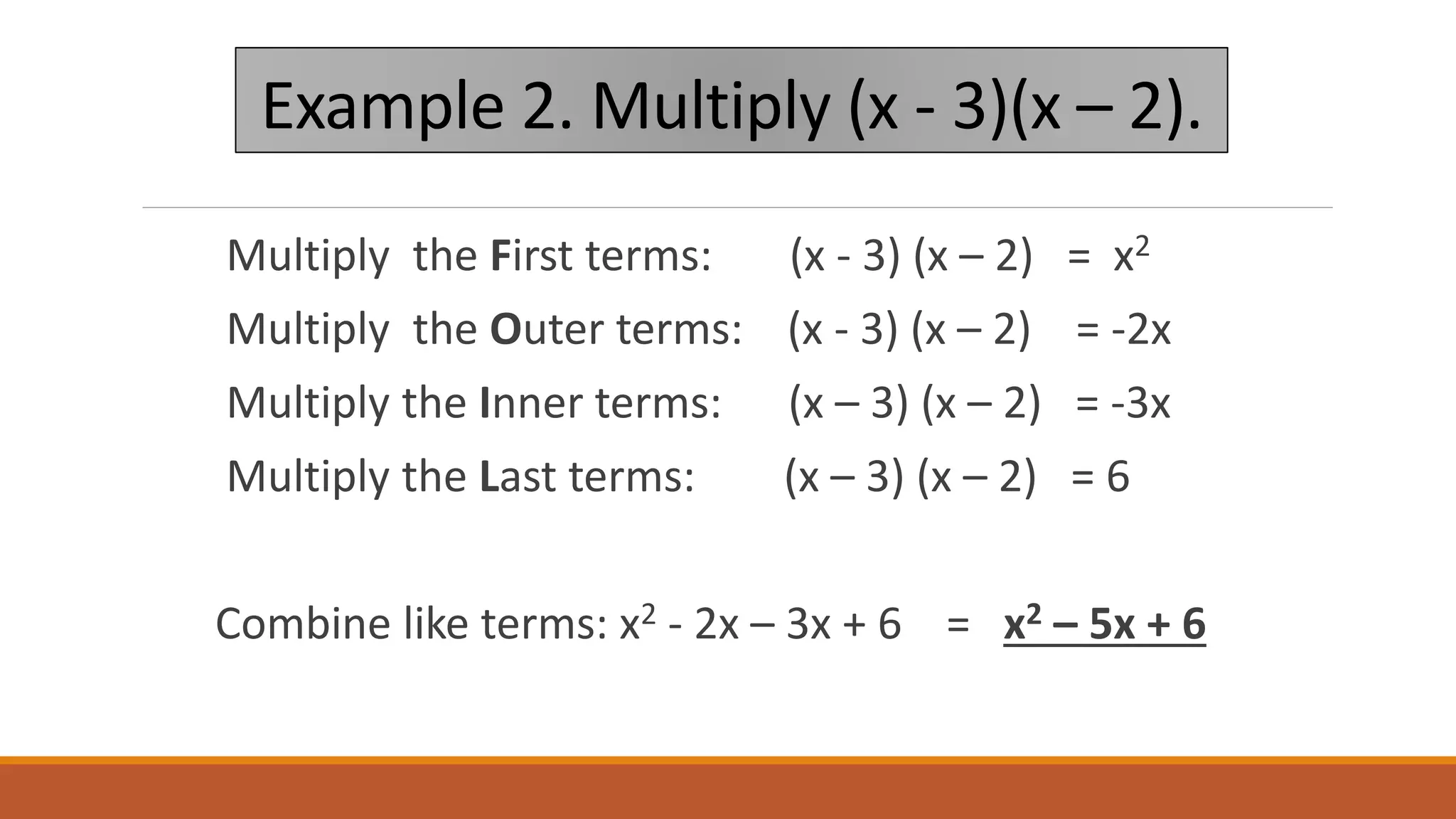
Example 2. Multiply (x - 3)(x – 2).
Multiply the First terms: (x - 3) (x – 2) = x2
Multiply the Outer terms: (x - 3) (x – 2) = -2x
Multiply the Inner terms: (x – 3) (x – 2) = -3x
Multiply the Last terms: (x – 3) (x – 2) = 6
Combine like terms: x2 - 2x – 3x + 6 = x2 – 5x + 6
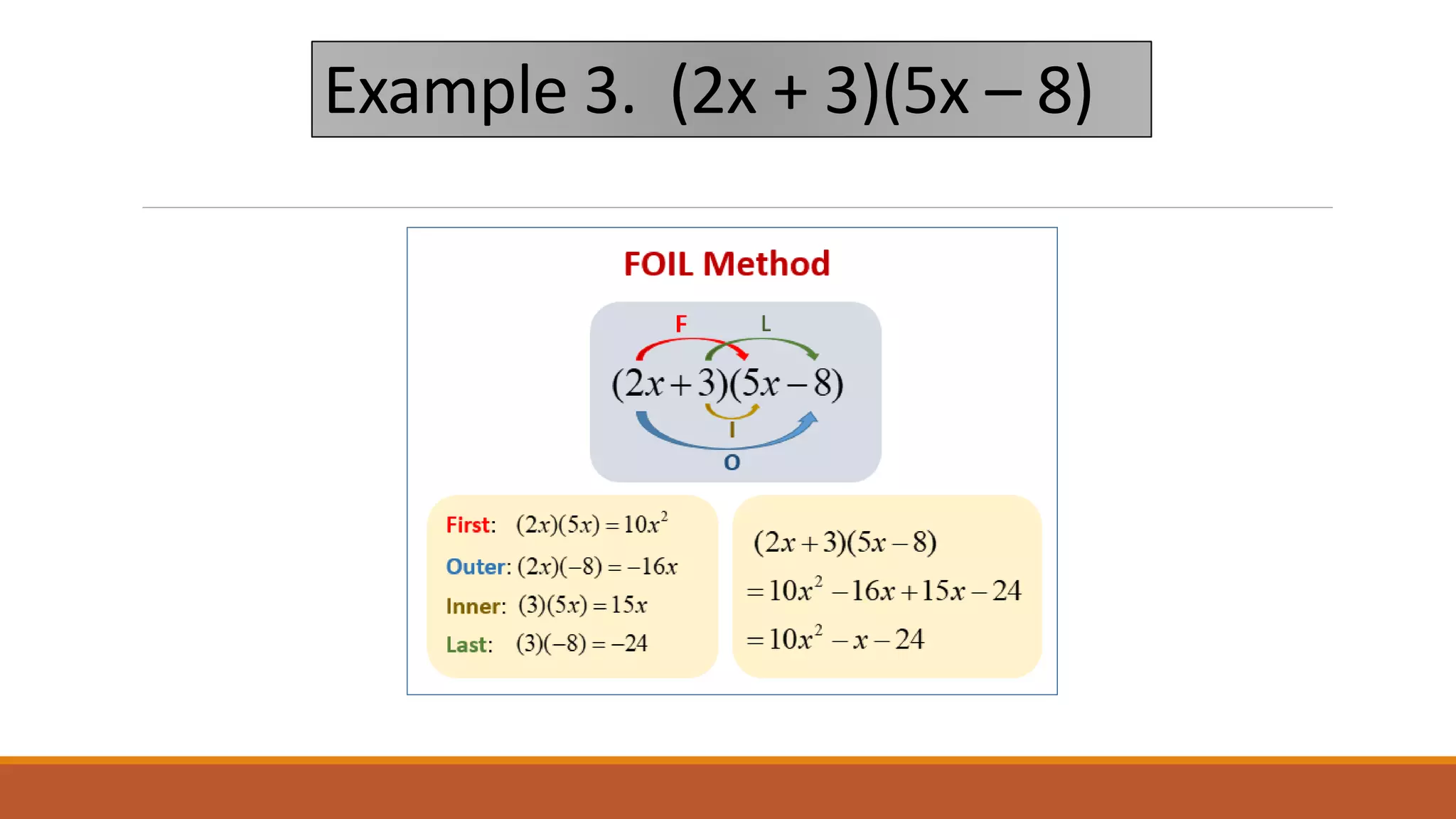
Example 3. (2x + 3)(5x – 8)
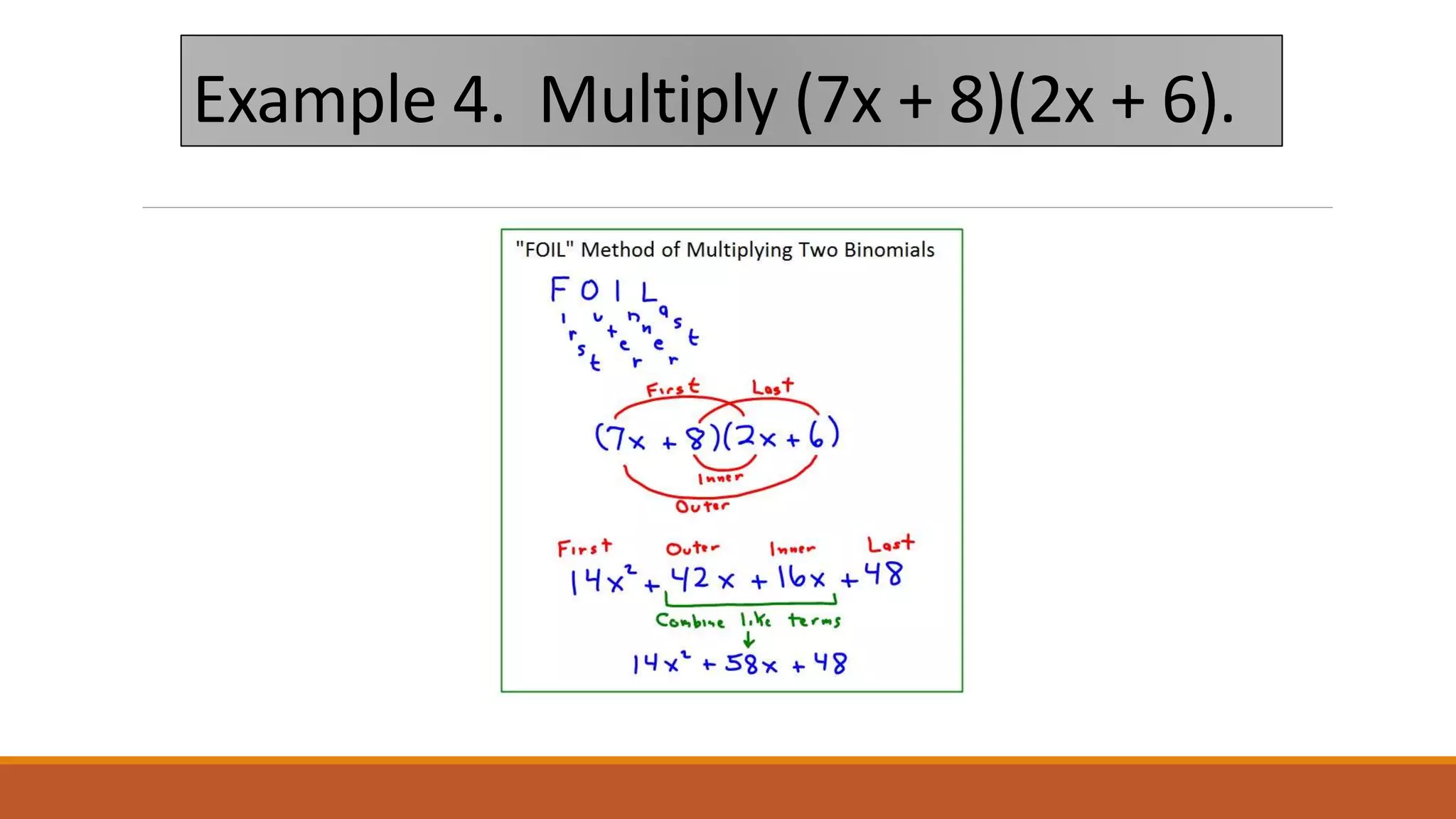
Example 4. Multiply (7x + 8)(2x + 6).
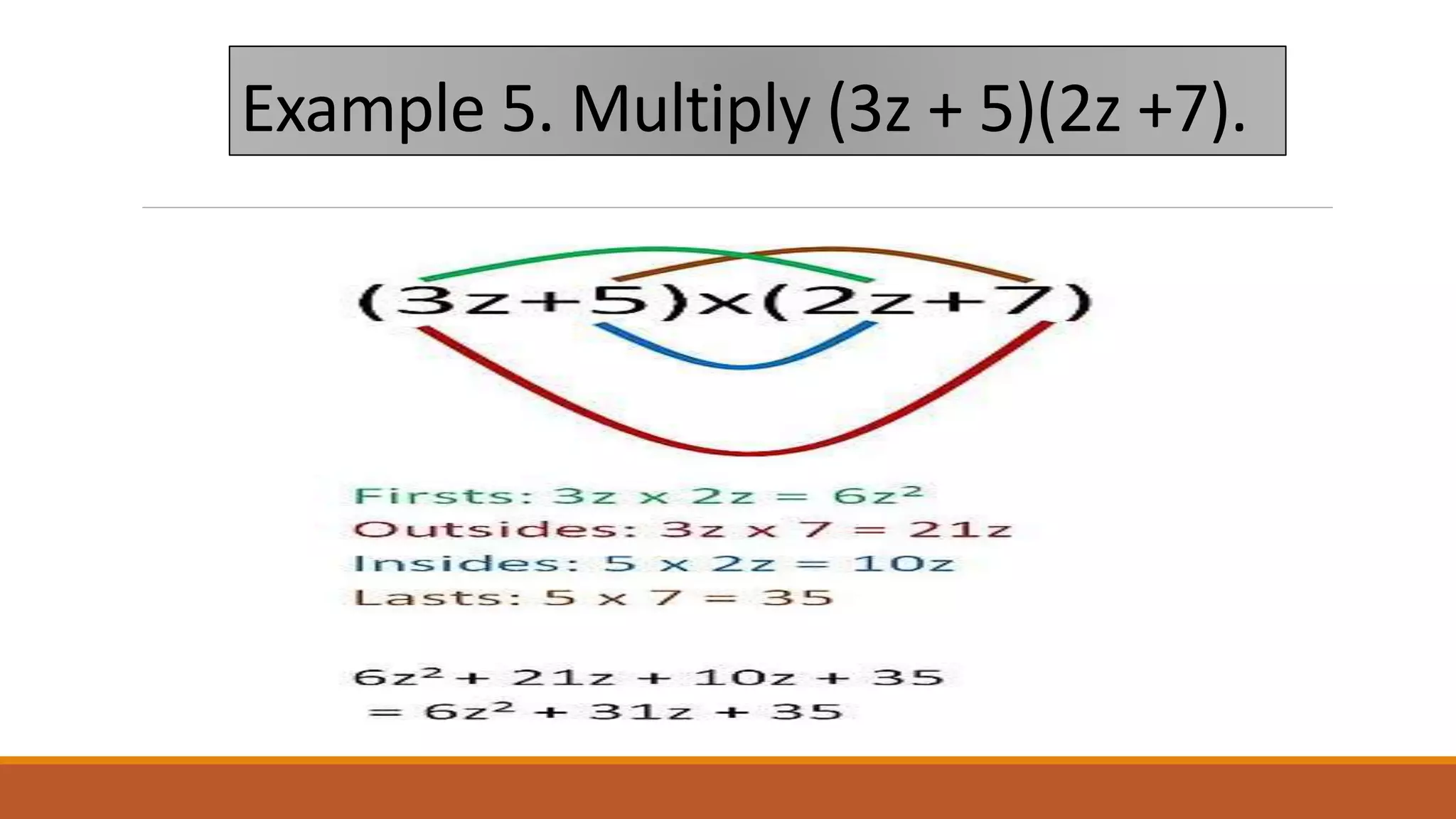
Example 5. Multiply (3z + 5)(2z +7).

Foil method

  • 2.
    Example 1. Multiply(x + 2) ( x – 4). Solution: The FOIL Method makes use of the Distributive Property. Multiply the First terms: (x + 2) (x - 4) =x2 Multiply the Outer terms: (x + 2) (x - 4) = -4x Multiply the Inner terms: (x + 2) (x - 4) = 2x Multiply the Last terms: (x + 2) (x - 4) = -8 Combine like terms: x2 – 4x + 2x - 8 = x2 – 2x - 8
  • 3.
    Example 2. Multiply(x - 3)(x – 2). Multiply the First terms: (x - 3) (x – 2) = x2 Multiply the Outer terms: (x - 3) (x – 2) = -2x Multiply the Inner terms: (x – 3) (x – 2) = -3x Multiply the Last terms: (x – 3) (x – 2) = 6 Combine like terms: x2 - 2x – 3x + 6 = x2 – 5x + 6
  • 4.
    Example 3. (2x+ 3)(5x – 8)
  • 5.
    Example 4. Multiply(7x + 8)(2x + 6).
  • 6.
    Example 5. Multiply(3z + 5)(2z +7).