FNAC THYROID
INTRODUCTION
• Fine Needle Aspiration Cytology(FNAC) is a technique whereby cells are obtained
from a lesion using a thin bore needle and smears are made for cytopathological
diagnosis.
• This technique is based on the fact that tumor cells are less cohesive and are easily
aspirated.
• It is a simple,quick and inexpensive method and is usually performed as an
outpatient procedure.
• Used in the diagnosis of thyroid nodules,breast lumps,liver disease,subcutaneous
soft tissue mass,oral and salivary gland lesions.
FNAC THYROID
• FNAC is the investigation of choice for thyroid Nodules.
• As FNAC distinguishes between benign and malignant lesions quite
effectively,its use has markedly decreased the number of unnecessary thyroid
surgeries.
• USG guidance increases the accuracy of FNAC
• Sensitivity: 93.4% ; specificity: 74.9%
EQUIPMENTS
• NEEDLE: 22-23 gauge needle; 1.5 inch length
• SYRINGE: 20 ml
• GLASS SLIDES
• FIXATIVES: 95% ethanol
• STAINS: Papanicolaou stain, hematoxylin&eosin stain,Romanowsky stain
• MICROSCOPE
TECHNIQUE
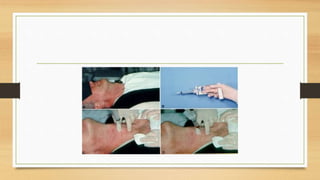
• After sterilizing the skin over the palpable mass, 23 gauge needle is introduced
through the skin into the mass.
• Having confirmed the position of the needle within the mass,negative pressure
should be created within the syringe by pulling the plunger.
• The needle should be moved back and froth through the mass in different rotational
directions
• Suction should be maintained throughout the process. By this method,the needle
can cut loose many small pieces of tissue that can be aspirated
• To and fro strokes should be repeated 6-8 times.
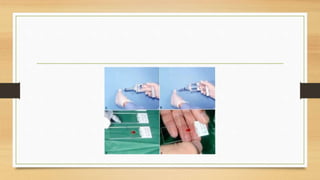
• After the aspirations ,all suction should be released before removing the
needle from the mass by allowing the syringe plunger to return gently to its
resting position.
• The needle is then withdrawn gently from the mass and a firm pressure
should be applied over the site to limit hematoma formation
INDICATIONS OF FNA IN THYROID
LESIONS
1. Evaluation of solitary thyroid nodules (to distinguish benign from
malignant)
2. Evaluation of diffuse thyroid lesions (to distinguish
inflammatory/autoimmune lesions from nodular goiter)
3. Confirmation and categorisation of clinically obvious thyroid malignancy
4. For prognosis
CONTRAINDICATIONS
• No contraindications
COMPLICATIONS
• Minor hematoma
• Rarely, puncture of the trachea, carotid artery or jugular vein
LIMITATIONS
• Cannot differentiate between follicular adenoma and carcinoma
• Needling may convert hot nodule to a cold nodule and vice versa therefore all non-
invasive investigations should be done before FNA
• False positive results:
Hashimoto’s
Graves’s
Toxic nodules
BETHESDA SYSTEM
1.NON-DIAGNOSTIC OR UNSATISFACTORY:
• Cyst fluid only
• Virtually acellular specimen
2.BENIGN
• Consistent with benign follicular nodule- adematoid nodule,colloid nodule
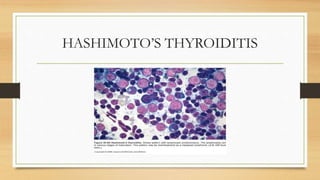
• Consistent with lymphocytic (hashimoto’s) thyroiditis
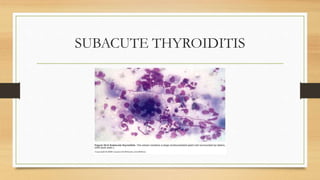
• Consistent with granulomatous (subacute) thyroiditis
3. ATYPIA OF UNDETERMINED SIGNIFICANCE
4.FOLLICULAR NEOPLASM OR SUSPICIOUS FOR FOLLICULAR
NEOPLASM
5.SUSPICIOUS FOR MALIGNANCY
6.MALIGNANT
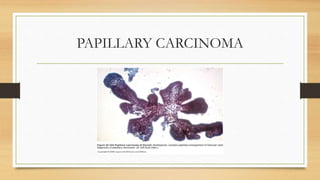
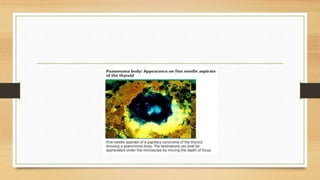
• Papillary thyroid carcinoma.
• Medullary thyroid carcinoma.
• Undifferentiated (anaplastic) carcinoma
• Squamous cell carcinoma
• Metastatic carcinoma
• Non-Hodgkins lymphoma
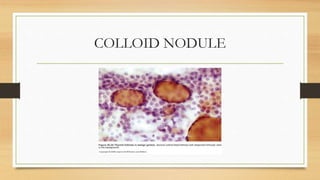
COLLOID NODULE
SUBACUTE THYROIDITIS
HASHIMOTO’S THYROIDITIS
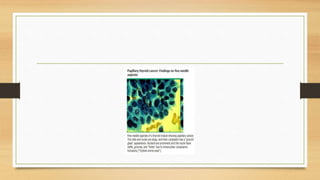
PAPILLARY CARCINOMA
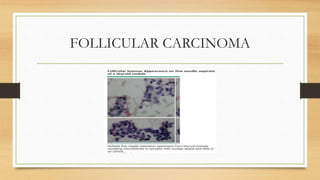
FOLLICULAR CARCINOMA
• FNAC cannot differentiate between follicular adenoma and carcinoma as it
depends upon capsular and angioinversion
• Options in follicular ca: Frozen section biopsy
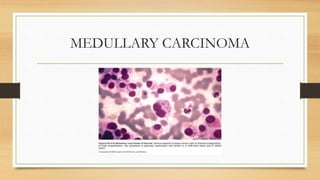
MEDULLARY CARCINOMA
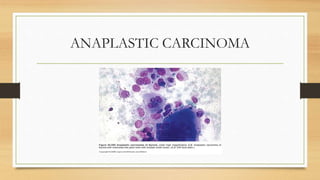
ANAPLASTIC CARCINOMA
BETHESDA SYSTEM FOR REPORTING
THYROID CYTOPATHOLOGY
DIAGNOSTIC CATEGORIES RECOMMENDED
MANAGEMENTS
RISK OF MALIGNANCY
Nondiagnostic or unsatisfactory Repeat FNA with USG guidance -
Benign Clinical followup & repeat FNA if the
lesion increases in size
0-3%
Atypia of undetermined significance or Follicular
lesion of undetermined significance
Repeat FNA 5-15%
Follicular neoplasm or suspicious for a follicular
neoplasm
surgical lobectomy 15-30%
Suspicious for malignancy Near total thyroidectomy 60-75%
Malignant Total thyroidectomy 97-99%
THANK YOU

Fnac thyroid

  • 1.
  • 2.
    INTRODUCTION • Fine NeedleAspiration Cytology(FNAC) is a technique whereby cells are obtained from a lesion using a thin bore needle and smears are made for cytopathological diagnosis. • This technique is based on the fact that tumor cells are less cohesive and are easily aspirated. • It is a simple,quick and inexpensive method and is usually performed as an outpatient procedure. • Used in the diagnosis of thyroid nodules,breast lumps,liver disease,subcutaneous soft tissue mass,oral and salivary gland lesions.
  • 3.
    FNAC THYROID • FNACis the investigation of choice for thyroid Nodules. • As FNAC distinguishes between benign and malignant lesions quite effectively,its use has markedly decreased the number of unnecessary thyroid surgeries. • USG guidance increases the accuracy of FNAC • Sensitivity: 93.4% ; specificity: 74.9%
  • 4.
    EQUIPMENTS • NEEDLE: 22-23gauge needle; 1.5 inch length • SYRINGE: 20 ml • GLASS SLIDES • FIXATIVES: 95% ethanol • STAINS: Papanicolaou stain, hematoxylin&eosin stain,Romanowsky stain • MICROSCOPE
  • 5.
    TECHNIQUE • After sterilizingthe skin over the palpable mass, 23 gauge needle is introduced through the skin into the mass. • Having confirmed the position of the needle within the mass,negative pressure should be created within the syringe by pulling the plunger. • The needle should be moved back and froth through the mass in different rotational directions • Suction should be maintained throughout the process. By this method,the needle can cut loose many small pieces of tissue that can be aspirated • To and fro strokes should be repeated 6-8 times.
  • 6.
    • After theaspirations ,all suction should be released before removing the needle from the mass by allowing the syringe plunger to return gently to its resting position. • The needle is then withdrawn gently from the mass and a firm pressure should be applied over the site to limit hematoma formation
  • 9.
    INDICATIONS OF FNAIN THYROID LESIONS 1. Evaluation of solitary thyroid nodules (to distinguish benign from malignant) 2. Evaluation of diffuse thyroid lesions (to distinguish inflammatory/autoimmune lesions from nodular goiter) 3. Confirmation and categorisation of clinically obvious thyroid malignancy 4. For prognosis
  • 10.
  • 11.
    COMPLICATIONS • Minor hematoma •Rarely, puncture of the trachea, carotid artery or jugular vein
  • 12.
    LIMITATIONS • Cannot differentiatebetween follicular adenoma and carcinoma • Needling may convert hot nodule to a cold nodule and vice versa therefore all non- invasive investigations should be done before FNA • False positive results: Hashimoto’s Graves’s Toxic nodules
  • 13.
    BETHESDA SYSTEM 1.NON-DIAGNOSTIC ORUNSATISFACTORY: • Cyst fluid only • Virtually acellular specimen 2.BENIGN • Consistent with benign follicular nodule- adematoid nodule,colloid nodule • Consistent with lymphocytic (hashimoto’s) thyroiditis • Consistent with granulomatous (subacute) thyroiditis
  • 14.
    3. ATYPIA OFUNDETERMINED SIGNIFICANCE 4.FOLLICULAR NEOPLASM OR SUSPICIOUS FOR FOLLICULAR NEOPLASM 5.SUSPICIOUS FOR MALIGNANCY
  • 15.
    6.MALIGNANT • Papillary thyroidcarcinoma. • Medullary thyroid carcinoma. • Undifferentiated (anaplastic) carcinoma • Squamous cell carcinoma • Metastatic carcinoma • Non-Hodgkins lymphoma
  • 16.
  • 17.
  • 18.
  • 19.
  • 22.
  • 23.
    • FNAC cannotdifferentiate between follicular adenoma and carcinoma as it depends upon capsular and angioinversion • Options in follicular ca: Frozen section biopsy
  • 24.
  • 25.
  • 26.
    BETHESDA SYSTEM FORREPORTING THYROID CYTOPATHOLOGY DIAGNOSTIC CATEGORIES RECOMMENDED MANAGEMENTS RISK OF MALIGNANCY Nondiagnostic or unsatisfactory Repeat FNA with USG guidance - Benign Clinical followup & repeat FNA if the lesion increases in size 0-3% Atypia of undetermined significance or Follicular lesion of undetermined significance Repeat FNA 5-15% Follicular neoplasm or suspicious for a follicular neoplasm surgical lobectomy 15-30% Suspicious for malignancy Near total thyroidectomy 60-75% Malignant Total thyroidectomy 97-99%
  • 27.