FINANCIAL MANAGEMENT
Unit-1
Introduction of Financial Management
(25%)
Dr. Radha Vyas
CHAPTER OUTLINE
 Meaning & Nature of Financial Management (FM)
 Finance and Related Disciplines
 Scope of Financial Management
 Goals of FM: Profit Maximisation, Wealth Maximisation –
Traditional & Modern Approach
 Functions of Finance – Finance Decision, Investment
Decision, Dividend Decision & Liquidity Decision
 Roles of a Finance Manager
 Concept of Time Value of Money: Why People Value
Money Today?
 Concept of Present Value, Future Value (Lump sum,
Simple Annuity & Growing Annuity) 2
MEANING OF FM – FM MEANS RAISING OF
ADEQUATE FUNDS AT THE MINIMUM COST AND USING
THEM EFFECTIVELY IN BUSINESS.
FM IS CONCERNED WITH THE FINANCIAL PROBLEMS
OF BUSINESS ORGANISATION.
3
DEFINITIONS
 According to Hoagland, “Financial Management is
concerned mainly with such matters as, how a business
corporation raises its finance and how it makes use of it”.
 According to Soloman, “Financial Management is
concerned with the efficient use of an important
economic resource, namely, Capital Funds”.
4
NATURE OF FM
1. Primary nature of financial management focus towards valuation
of company. That is the reason where all the financial decisions is
directly linked with optimizing / maximization the value of a company.
Finance functionality like investment, distribution of profit earnings,
raising of capital, etc. are the part of management activities.
2. Nature of financial management basically involves decision
where risk and return are linked with investment. Generally high
risk investment yield high returns on investments. So, role of finance
manager is to effectively calculate the level of risk company is
involve and take the appropriate decision which can satisfy
shareholders, investors or founder of the company.
3. Finance is a foundation of economic activities. The person
who Manages finance is called as finance manager. Important role of
finance manager is to control finance and implement the plans. For
any company finance manager plays a crucial role in it. Many times it
happens that lack of skills or wrong decisions can lead to heavy
losses to an organization.
5
5. The nature of financial management is never a
separate entity. Even as an operational manager or
functional manager one has to take responsibility of
financial management.
6. Nature of financial management is multi-
disciplinary. Financial management depends upon
various other factors like: accounting, banking, inflation,
economy, etc. for the better utilization of finances.
7. Approach of financial management is not limited to
business functions but it is a backbone of commerce,
economic and industry.
4. Financial Management is an important function in company’s
management. Financial factors are considered in all the company’s
decisions and all the departments of an organization. It affects
success, growth and volatility of a company. Finance is said to be
the lifeline of a business.
6
FINANCE & RELATED DISCIPLINES
7
Finance
&
Economics
Finance
&
HR
Finance
&
Production
Finance
&
Marketing
Finance
&
Accounting
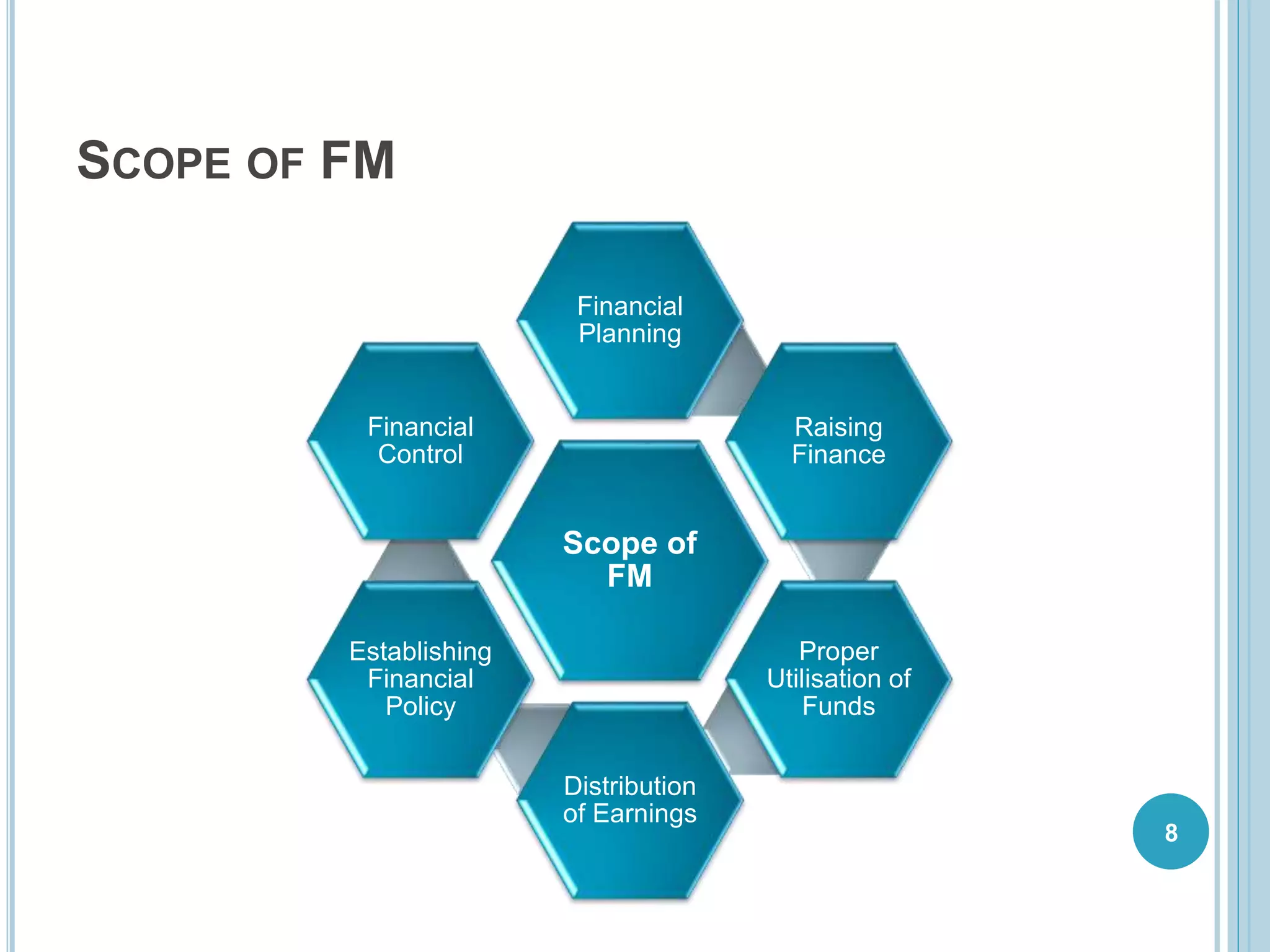
SCOPE OF FM
Scope of
FM
Financial
Planning
Raising
Finance
Proper
Utilisation of
Funds
Distribution
of Earnings
Establishing
Financial
Policy
Financial
Control
8
GOALS OF FM
Goals
Profit
Maximisation
Wealth
Maximisation
9
LIMITATIONS OF PROFIT MAXIMISATION
 The concept of profit is vague
 It ignores time value of money
 It ignores risk
10
WEALTH MAXIMISATION=SHAREHOLDERS’
WEALTH MAXIMISATION
D=A/(1+r)n
Net Present Value>0 = Positive
NPV = Present Value of Cash Inflow – Present Value
of Cash Outflow
NPV= 481400 -500000 = -18600
Investment (Cash Outflow)= Rs. 500000, Required
Rate of Return=10%
A Return (Future Value) - Discount
(Cash Inflow) PV Factor PV of Cash Inflow
1 100000 0.909 90900
2 200000 0.826 165200
3 300000 0.751 225300
481400
11
EVOLUTION OR APPROACHES OF FM
12
Approach
Traditional
Modern
DIFFERENCE BETWEEN TRADITIONAL
APPROACH & MODERN APPROACH
Traditional Phase Modern Phase
The function of efficient
utilization of funds is ignored
under this approach.
Finance function includes both
raising finance and utilizing it
most effectively for business.
It concentrates on the problem
or finance of joint stock
companies only.
It deals with problem of finance
of all types of business units
like sole proprietors,
partnership firms, etc.
It considers sources of long
term only.
The problems of long term
finance and working capital are
included in scope of finance
function.
13
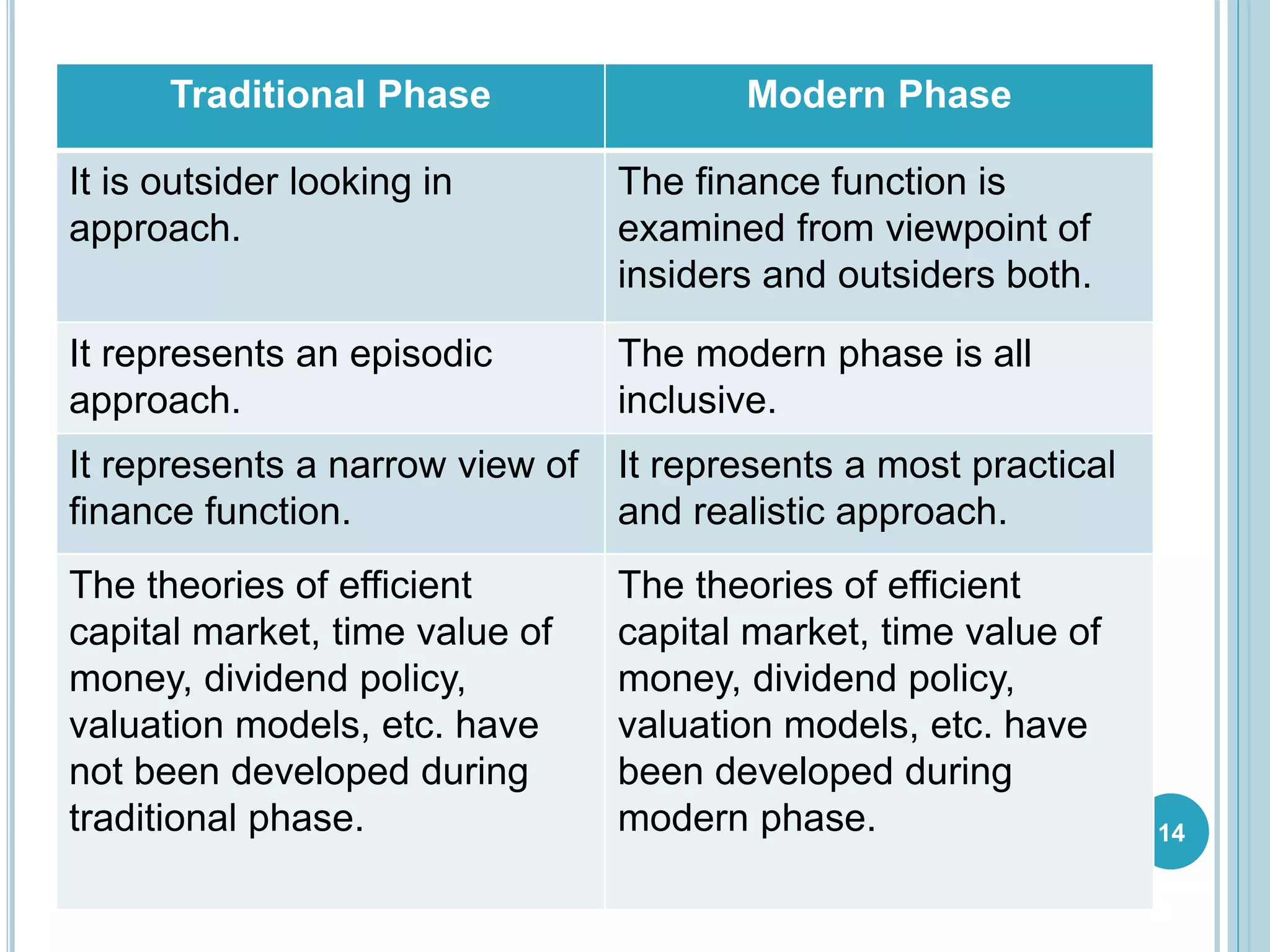
Traditional Phase Modern Phase
It is outsider looking in
approach.
The finance function is
examined from viewpoint of
insiders and outsiders both.
It represents an episodic
approach.
The modern phase is all
inclusive.
It represents a narrow view of
finance function.
It represents a most practical
and realistic approach.
The theories of efficient
capital market, time value of
money, dividend policy,
valuation models, etc. have
not been developed during
traditional phase.
The theories of efficient
capital market, time value of
money, dividend policy,
valuation models, etc. have
been developed during
modern phase. 14
FUNCTIONS OF FM
15
FM
Finance
Decision
Liquidity
Decision
Dividend
Decision
Investment
Decision
ROLES OF A FINANCE MANAGER
16
 Raising of Funds
 Allocation of Funds
 Profit Planning
 Understanding Capital
Markets
VARIOUS CONCEPTS
17
THANK YOU

FM-Unit 1_Introduction.pptx

  • 1.
    FINANCIAL MANAGEMENT Unit-1 Introduction ofFinancial Management (25%) Dr. Radha Vyas
  • 2.
    CHAPTER OUTLINE  Meaning& Nature of Financial Management (FM)  Finance and Related Disciplines  Scope of Financial Management  Goals of FM: Profit Maximisation, Wealth Maximisation – Traditional & Modern Approach  Functions of Finance – Finance Decision, Investment Decision, Dividend Decision & Liquidity Decision  Roles of a Finance Manager  Concept of Time Value of Money: Why People Value Money Today?  Concept of Present Value, Future Value (Lump sum, Simple Annuity & Growing Annuity) 2
  • 3.
    MEANING OF FM– FM MEANS RAISING OF ADEQUATE FUNDS AT THE MINIMUM COST AND USING THEM EFFECTIVELY IN BUSINESS. FM IS CONCERNED WITH THE FINANCIAL PROBLEMS OF BUSINESS ORGANISATION. 3
  • 4.
    DEFINITIONS  According toHoagland, “Financial Management is concerned mainly with such matters as, how a business corporation raises its finance and how it makes use of it”.  According to Soloman, “Financial Management is concerned with the efficient use of an important economic resource, namely, Capital Funds”. 4
  • 5.
    NATURE OF FM 1.Primary nature of financial management focus towards valuation of company. That is the reason where all the financial decisions is directly linked with optimizing / maximization the value of a company. Finance functionality like investment, distribution of profit earnings, raising of capital, etc. are the part of management activities. 2. Nature of financial management basically involves decision where risk and return are linked with investment. Generally high risk investment yield high returns on investments. So, role of finance manager is to effectively calculate the level of risk company is involve and take the appropriate decision which can satisfy shareholders, investors or founder of the company. 3. Finance is a foundation of economic activities. The person who Manages finance is called as finance manager. Important role of finance manager is to control finance and implement the plans. For any company finance manager plays a crucial role in it. Many times it happens that lack of skills or wrong decisions can lead to heavy losses to an organization. 5
  • 6.
    5. The natureof financial management is never a separate entity. Even as an operational manager or functional manager one has to take responsibility of financial management. 6. Nature of financial management is multi- disciplinary. Financial management depends upon various other factors like: accounting, banking, inflation, economy, etc. for the better utilization of finances. 7. Approach of financial management is not limited to business functions but it is a backbone of commerce, economic and industry. 4. Financial Management is an important function in company’s management. Financial factors are considered in all the company’s decisions and all the departments of an organization. It affects success, growth and volatility of a company. Finance is said to be the lifeline of a business. 6
  • 7.
    FINANCE & RELATEDDISCIPLINES 7 Finance & Economics Finance & HR Finance & Production Finance & Marketing Finance & Accounting
  • 8.
    SCOPE OF FM Scopeof FM Financial Planning Raising Finance Proper Utilisation of Funds Distribution of Earnings Establishing Financial Policy Financial Control 8
  • 9.
  • 10.
    LIMITATIONS OF PROFITMAXIMISATION  The concept of profit is vague  It ignores time value of money  It ignores risk 10
  • 11.
    WEALTH MAXIMISATION=SHAREHOLDERS’ WEALTH MAXIMISATION D=A/(1+r)n NetPresent Value>0 = Positive NPV = Present Value of Cash Inflow – Present Value of Cash Outflow NPV= 481400 -500000 = -18600 Investment (Cash Outflow)= Rs. 500000, Required Rate of Return=10% A Return (Future Value) - Discount (Cash Inflow) PV Factor PV of Cash Inflow 1 100000 0.909 90900 2 200000 0.826 165200 3 300000 0.751 225300 481400 11
  • 12.
    EVOLUTION OR APPROACHESOF FM 12 Approach Traditional Modern
  • 13.
    DIFFERENCE BETWEEN TRADITIONAL APPROACH& MODERN APPROACH Traditional Phase Modern Phase The function of efficient utilization of funds is ignored under this approach. Finance function includes both raising finance and utilizing it most effectively for business. It concentrates on the problem or finance of joint stock companies only. It deals with problem of finance of all types of business units like sole proprietors, partnership firms, etc. It considers sources of long term only. The problems of long term finance and working capital are included in scope of finance function. 13
  • 14.
    Traditional Phase ModernPhase It is outsider looking in approach. The finance function is examined from viewpoint of insiders and outsiders both. It represents an episodic approach. The modern phase is all inclusive. It represents a narrow view of finance function. It represents a most practical and realistic approach. The theories of efficient capital market, time value of money, dividend policy, valuation models, etc. have not been developed during traditional phase. The theories of efficient capital market, time value of money, dividend policy, valuation models, etc. have been developed during modern phase. 14
  • 15.
  • 16.
    ROLES OF AFINANCE MANAGER 16  Raising of Funds  Allocation of Funds  Profit Planning  Understanding Capital Markets
  • 17.
  • 18.