Derivatives: Futures, Options, and Swaps
Chapter 4-4
Learning Objectives
1. Explain what derivatives are and how they
transfer risk.
2. Distinguish between forward and futures
contracts.
3. Define put and call options and describe how
to use them.
4. Show how swaps can be used to manage risk
or to conceal it.
Introduction
• Although open to abuse, derivatives can be extremely
helpful financial instruments.
• They can reduce risk, allowing firms and individual to
enter into agreements that they could not have
otherwise.
• Derivatives can also be used an insurance against
future events.
• Warren Buffett, the famed investor, called derivatives
“weapons of financial mass destruction.”
The Basics: Defining Derivatives
• A derivative is a financial instrument whose
value depends on, is derived from, the value of
some other financial instrument, call the
underlying asset.
– Examples of assets include stocks, bonds, wheat,
snowfall, and stock market indexes like S&P 500.
• For example:
– A contractual agreement between two investors that
obligates one to make a payment to the other,
depending on the movement of interest rates over the
next year.
• An interest-rate futures contract
The Basics: Defining Derivatives
Derivatives are different from outright
purchases because:
1. Derivatives provide an easy way for
investors to profit from price declines.
2. In a derivatives transaction, one person’s
loss is always another person’s gain.
The Basics: Defining Derivatives
• While derivatives can be used to speculate, or
gamble on future price movements, they allow
investors to manage and reduce risk.
– Farmers use derivatives regularly to insure
themselves against fluctuations in the price of their
crops.
• The purpose of derivatives is to transfer risk
from one person or firm to another.
The Basics: Defining Derivatives
• By shifting risk to those willing and able to
bear it, derivatives increase the risk-carrying
capacity of the economy as a whole.
– This improves the allocation of resources and
increase the level of output.
• The downside is that derivatives also allow
individuals and firms to conceal the true
nature of certain financial transactions.
Forward and Futures
• A forward, or forward contract, is an
agreement between a buyer and a seller to
exchange a commodity or financial instrument
for a specified amount of cash on a
prearranged future date.
• Because they are customized, forward
contracts are very difficult to resell.
Forward and Futures
• A future, or futures contract, is a forward
contract that has been standardized and sold
through an organized exchange.
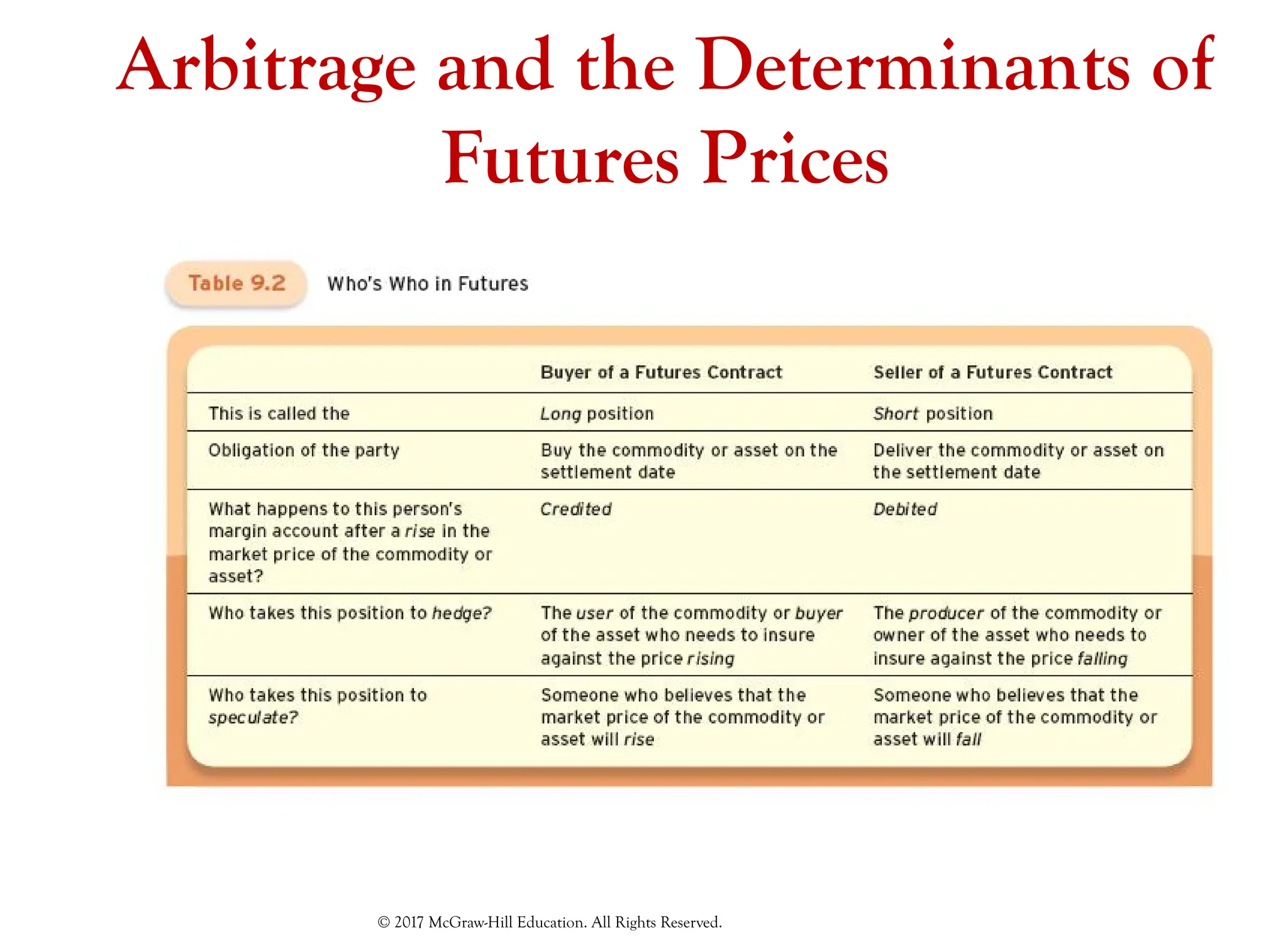
– The contract specifies that the seller (short position)
will deliver some quantity of a commodity or financial
instrument to the buyer (long position) on a specific
date, called the settlement or delivery date, for a
predetermined price.
Forward and Futures
• No payments are made when the contract is
agreed to.
• The seller/short position benefits from declines
in the price of the underlying asset.
• The buyer/long position benefits from increases
in the price of the underlying asset.
Forward and Futures
• The two parties to a futures contract each make
an agreement with a clearing corporation.
• The clearing corporation operates like a large
insurance company and is the counter party to
both sides of the transaction.
– They guarantee that the parties will meet their
obligations.
• This lowers the risk buyers and sellers face.
• The clearing corporation has the ability to
monitor traders and the incentive to limit their
risk taking.
Margin Accounts and Marking to
Market
• The clearing corporation requires both parties
to a futures contract to place a deposit with the
corporation.
– This is called posting margin in a margin account.
– This guarantees when the contract comes due, the
parties will be able to meet their obligations.
Margin Accounts and Marking to
Market
• The clearing corporation posts daily gains and
losses on the contract to the margin account of
the parties involved.
– This is called marking to market.
• Doing this each day ensures that sellers always
have the resources to make delivery and buyers
can always pay.
• If someone’s margin account falls below the
minimum, the clearing corporation will sell the
contracts, ending the person’s participation in
the market.
Hedging and Speculating with Futures
• Futures contracts allow the transfer of risk
between buyer and seller through hedging or
speculation.
– For example of the sale of a U.S. Treasury bond
future contract, the seller/short position benefits
from the price declines.
• The seller of the futures contract can guarantee the
price at which the bonds are sold.
– The purchaser wishes to insure against possible
price increases.
Hedging and Speculating with Futures
• Buying a futures contract fixes the price that
the fund will need to pay.
– In this example, both sides use the futures
contract as a hedge - they are both hedgers.
• Producers and users of commodities employ
futures markets to hedge their risks as well:
farmers, mining companies, oil drillers, etc.
– They own the commodity outright, so they want
to stabilize revenue streams.
– Those buying want to reduce risk of fluctuations in
input costs.
Hedging and Speculating with Futures
• Speculators are trying to make a profit.
– They bet on price movements.
• Sellers of futures are betting that prices will fall.
• Buyers of futures are betting that prices will risk.
• Futures contracts are popular tools for
speculation because they are cheap.
• An investor needs only a small amount to invest -
the margin - to purchase the future contract.
– Margin requirements of 10% or less are common.
Hedging and Speculating with Futures
• For our example of U.S. Treasury bonds futures
contracts, The Chicago Board of Trade requires
an initial margin of only $1,350 per contract.
– This investment gives the investor the same returns as
the purchase of $100,000 worth of bonds.
– It is as if the investor borrowed the remaining $98,650
without having to pay any interest.
• Speculators can use futures to obtain very large
amounts of leverage at a very low cost.
• We can make markets more robust by
shifting trading from over-the-counter (OTC)
markets to transactions with a centralized
counterparty (CCP).
• When trading OTC with many partners, a firm
can build up excessively large positions
without other parties being aware of the risk.
• A CCP has the ability, as well as the incentive,
to monitor the riskiness of its counterparties.
• Standardization of contracts also facilitates
CPP monitoring.
• A CCP can refuse to trade with a risky client
or insist on a risk premium.
• A CCP also limits its own risk through
economies of scale.
– Most trades are offset against one another.
• CCPs have helped markets function well even
when traders cannot pay.
Arbitrage and the Determinants of
Futures Prices
• On the settlement or delivery date, the price of the
futures contract must equal the price of the
underlying asset the seller is obligated to deliver.
– If not, then it would be possible to make a risk-free profit
by engaging in offsetting cash and futures transactions.
• The practice of simultaneously buying and selling
financial instruments in order to benefit from
temporary price differences is called arbitrage the
people who engage in it are called arbitrageurs.
Arbitrage and the Determinants of
Futures Prices
• If the price of a specific bond is higher in one
market than in another:
– The arbitrageur can buy at the low price and sell at the
high price.
– This increases demand in one market and supply in
another.
– The increase in demand raises price in that market.
– The increase in supply lowers price in the other market.
– This continues until the prices are equal in both
markets.
Arbitrage and the Determinants of Futures
Prices
• As long as there are arbitrageurs, on the day when a
futures contract is settled, the price of a bond
futures contract will be the same as the market
price - or spot price - of the bond.
• How is this done?
– The arbitrageur borrows at the current market interest
rate.
– These funds are used to buy a bond and sell a bond
futures contract.
– The interest owed on the loan and received from the bond
cancel out.
– The futures price must move in lockstep with the market
price of the bond.
Arbitrage and the Determinants of
Futures Prices
© 2017 McGraw-Hill Education. All Rights Reserved.
Calls, Puts, and All That: Definitions
• Options are agreements between two parties.
– The seller is an option writer.
– A buyer is an option holder.
• A call option is the right to buy, “call away”, a
given quantity of an underlying asset at a
predetermined price, called the strike price (or
exercise price), on or before a specific date.
– A July 2016 call option on 100 shares of Apple stock at
a strike price of 100 gives the option holder the right to
buy 100 shares of Apple for $100 each prior to the 3rd
Friday of July 2016.
Calls, Puts, and All That: Definitions
• The writer of the call option must sell the
share if and when the holder choose to use
the call option.
• The holder of the call is not required to buy
the shares - they have the option if it is
beneficial.
– When the Apple stock price exceeds the option
strike price of 100, the option holder can either
call away the 100 shares by exercising the option
or sell the option at a profit.
Calls, Puts, and All That: Definitions
• When the price of the stock is above the strike
price of the call option, exercising the option is
profitable and the option is said to be in the
money.
• If the price of the stock exactly equals the strike
price, the option is said to be at the money.
• If the strike price exceeds the market price of
the stock, it is termed out of the money.
Calls, Puts, and All That: Definitions
• A put option gives the holder the right but not
the obligation to sell the underlying asset at a
predetermined price on or before a fixed date
• The writer of the option is obliged to buy the
shares should the holder choose to exercise the
option.
• The same terminology that is used to describe
calls, is also used to describe puts:
– In the money - profitable
– At the money - same price
– Out of the money - not profitable
Calls, Puts, and All That: Definitions
• Although options can be customized, most
are standardized and traded on exchanges.
• A clearing corporation guarantees the
obligations embodied in the option -- those
of the option writer.
– The options writer is required to post margin.
– The option holder incurs no obligation, so no
margin is needed.
Calls, Puts, and All That: Definitions
• There are two types of calls and puts:
• American options can be exercised on any date
from the time they are written to the expiration
date.
• European options can be exercised only on the
day they expire.
Using Options
• Options transfer risk from the buyer to the seller,
so can be used for both hedging and speculation.
• For someone who wants to purchase an asset in
the future, a call option ensure that the cost of
buying the asset will not rise.
• For someone who plans to sell the asset in the
future, a put option ensures that the price at
which the asset can be sold will not go down.
Using Options
Say you think interest rates are going to fall.
• You can:
– Buy a bond but that’s expensive as you need
money.
– Buy a futures contract taking the long position -
low investment but high risk.
– Buy a call option that pays off only if the interest
rate falls - if you are wrong, only cost is the price
of the option.
Using Options
The option writer can take a large loss, so who
does this?
1. Speculators willing to take the risk and bet that
prices will not move against them.
2. Dealers called market makers who engage in
the regular purchase and sale of the underlying
asset.
Using Options
• Market makers both
– Own the underlying asset so they can deliver it, and
– Are willing to buy the underlying asset so they have it
read to sell to someone else.
• If you own the underlying asset, writing a call
option that obligates you to sell it at a fixed price
is not that risky.
• Market makers write options to get the fees from
the buyer.
Using Options
• Options are very versatile and can be bought
and sold in many combinations.
• Allow investors to get rid of risks they do not
want and keep the ones they do.
• Options allow investors to bet that prices will be
volatile.
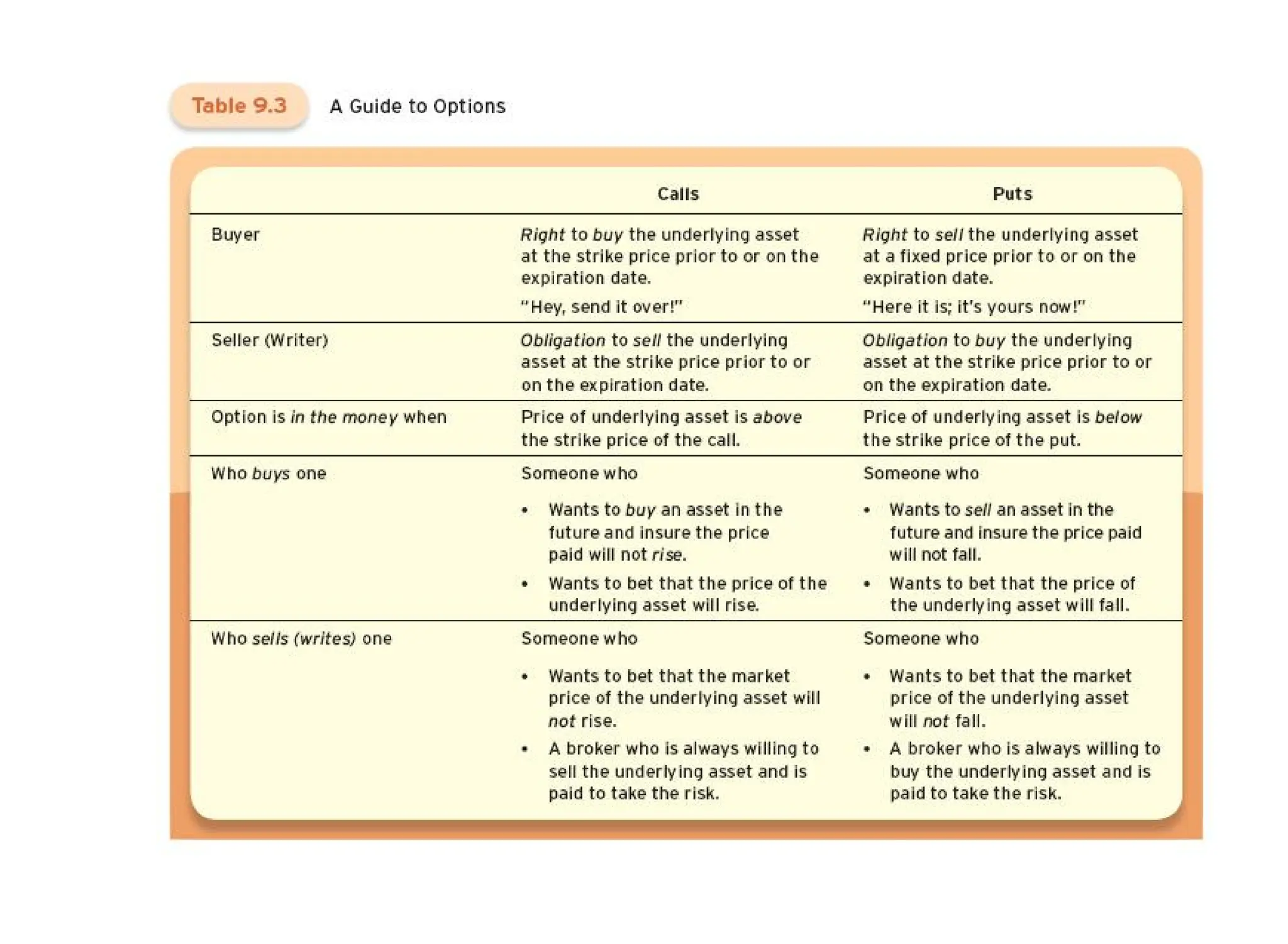
• Table 9.3 summarizes options.
• Corporations work hard to appear profitable.
• Financial statements can be misleading.
• Never trust a statement unless it meets
regulatory standards.
• The more open a company is in its financial
accounting, the more likely that it is honest.
• Diversification reduces risk.
Pricing Options: Intrinsic Value and
the Time Value of the Option
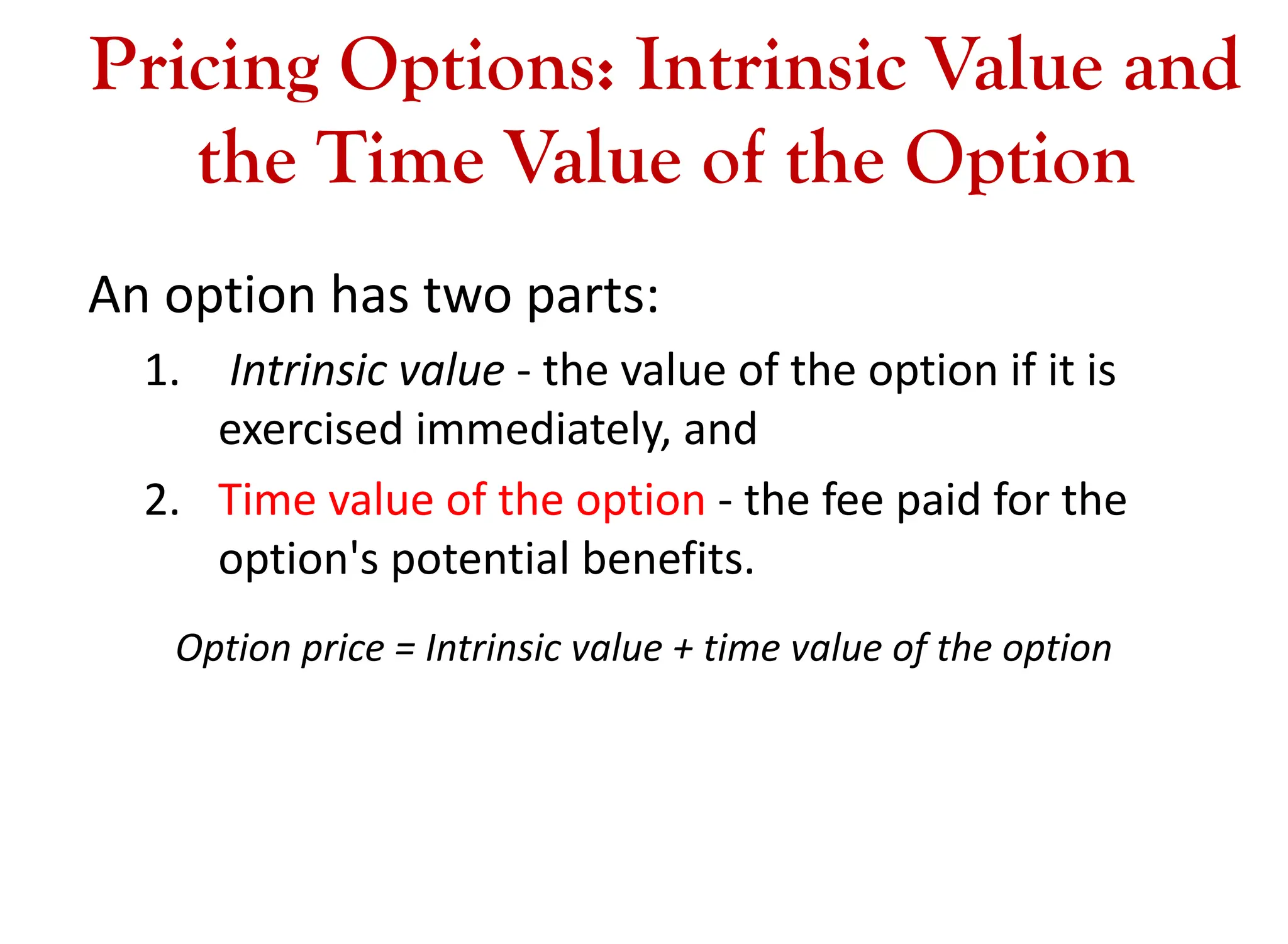
An option has two parts:
1. Intrinsic value - the value of the option if it is
exercised immediately, and
2. Time value of the option - the fee paid for the
option's potential benefits.
Option price = Intrinsic value + time value of the option
Pricing Options: Intrinsic Value and
the Time Value of the Option
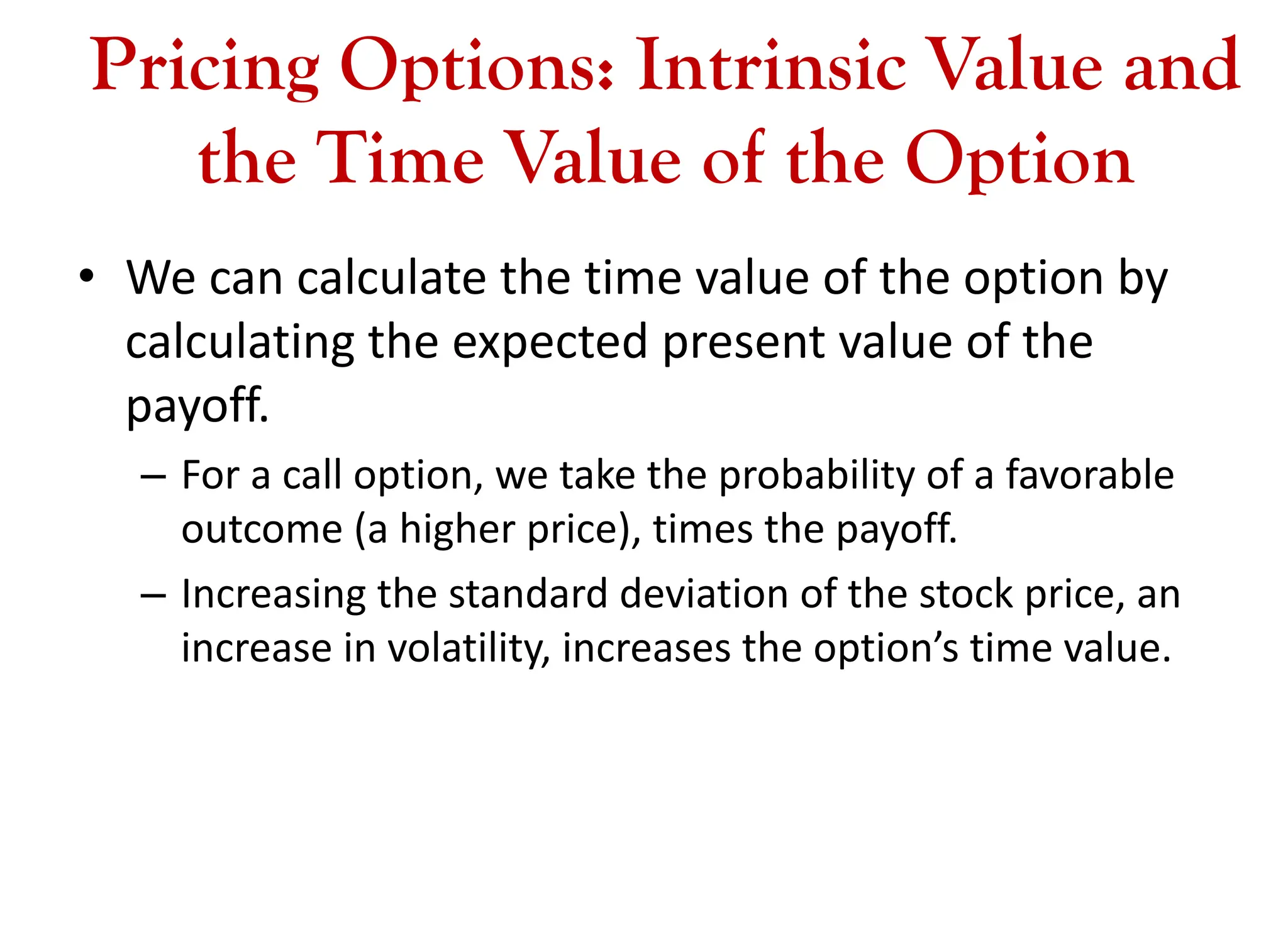
• We can calculate the time value of the option by
calculating the expected present value of the
payoff.
– For a call option, we take the probability of a favorable
outcome (a higher price), times the payoff.
– Increasing the standard deviation of the stock price, an
increase in volatility, increases the option’s time value.
General Considerations
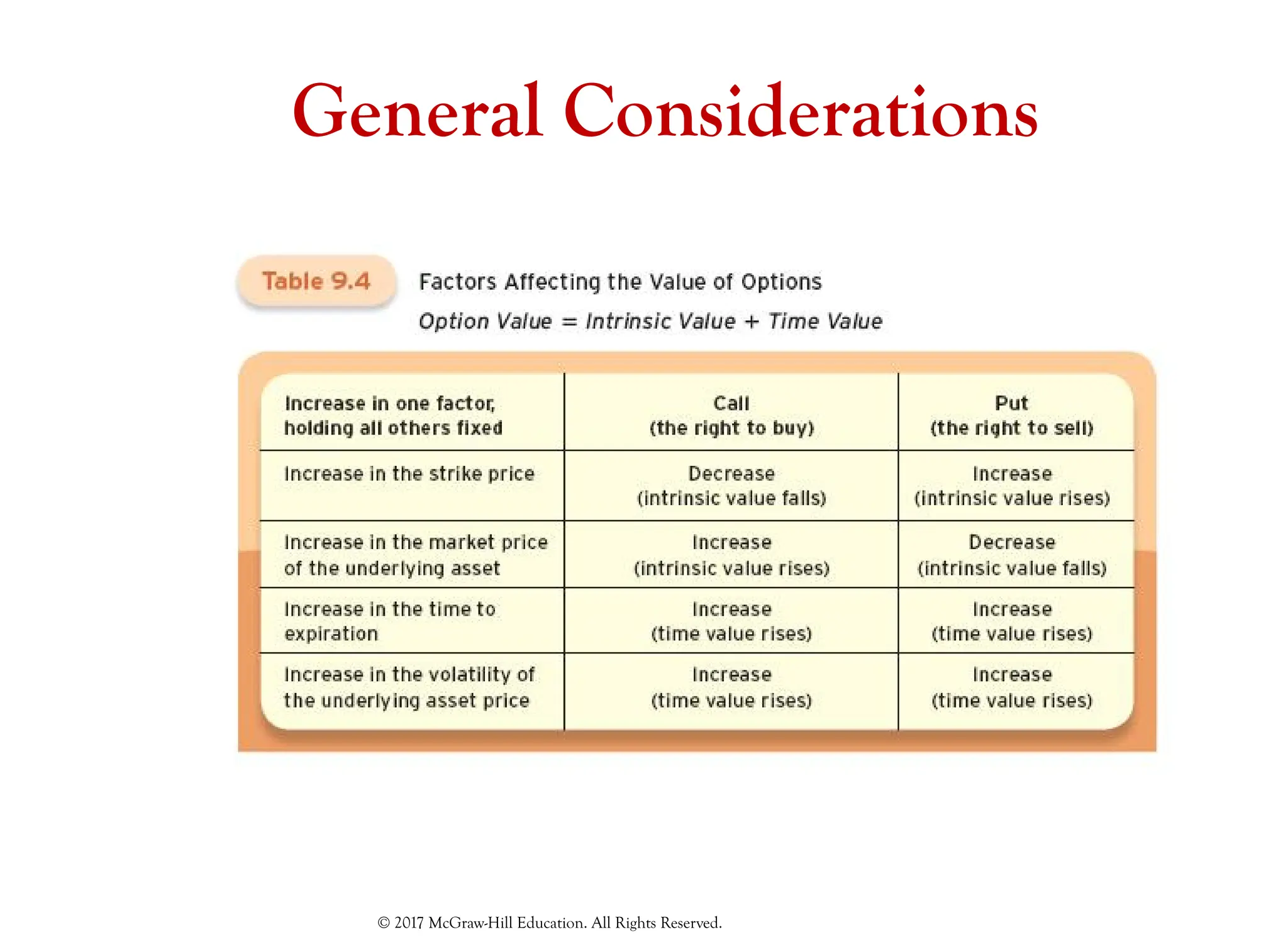
• Calculating the price of an option and how it
might change means developing some rules for
figuring out its intrinsic value and time value.
• The most important thing to remember is that a
buyer is not bound to exercise the option.
• Because the options can either be exercised or
expire worthless, we can conclude that the
intrinsic value depends only on what the holder
receives if the option is exercised.
General Considerations
• For an in-the-money call, or the option to buy, the
intrinsic value to the holder is the market price of
the underlying asset minus the strike price.
• If the call is at the money or out of the money, it has
no intrinsic value.
• Similarly, the intrinsic value of a put, or the option
to sell, equals the strike price minus the market
price of the underlying asset, or zero - which ever is
greater.
General Considerations
• Prior to expiration, there is always the chance
that the price of the underlying asset will move
making the option valuable.
• The longer the time to expiration, the bigger the
likely payoff when the option does expire and,
thus, the more valuable it is.
General Considerations
• The likelihood that an option will pay off
depends on the volatility, or standard deviation,
of the price of the underlying asset.
– The more variability there is in the asset’s price, the
more chance it has to move into the money.
– Therefore the option’s time value increases with
volatility in the price of the underlying asset.
– Increased volatility has no cost to the option holder -
only benefits.
General Considerations
• The bigger the risk being insured, the more
valuable the insurance, and the higher the price
investors will pay.
• The circumstances under which the payment is
made have an important impact on the option’s
time value.
• Table 9.4 summarizes the factors affecting the
value of options.
General Considerations
© 2017 McGraw-Hill Education. All Rights Reserved.
• The price of a company’s stock could
skyrocket or the company could go bankrupt.
• Generally employees are not allowed to sell
their stock options for a set period of time
and may need to stay with the firm to
exercise them.
• If taking stock options means a lower salary,
then you are paying for them and should
think hard about that offer.
• Investing in the same company that pays your
salary is risky.
The Value of Options: Some Examples
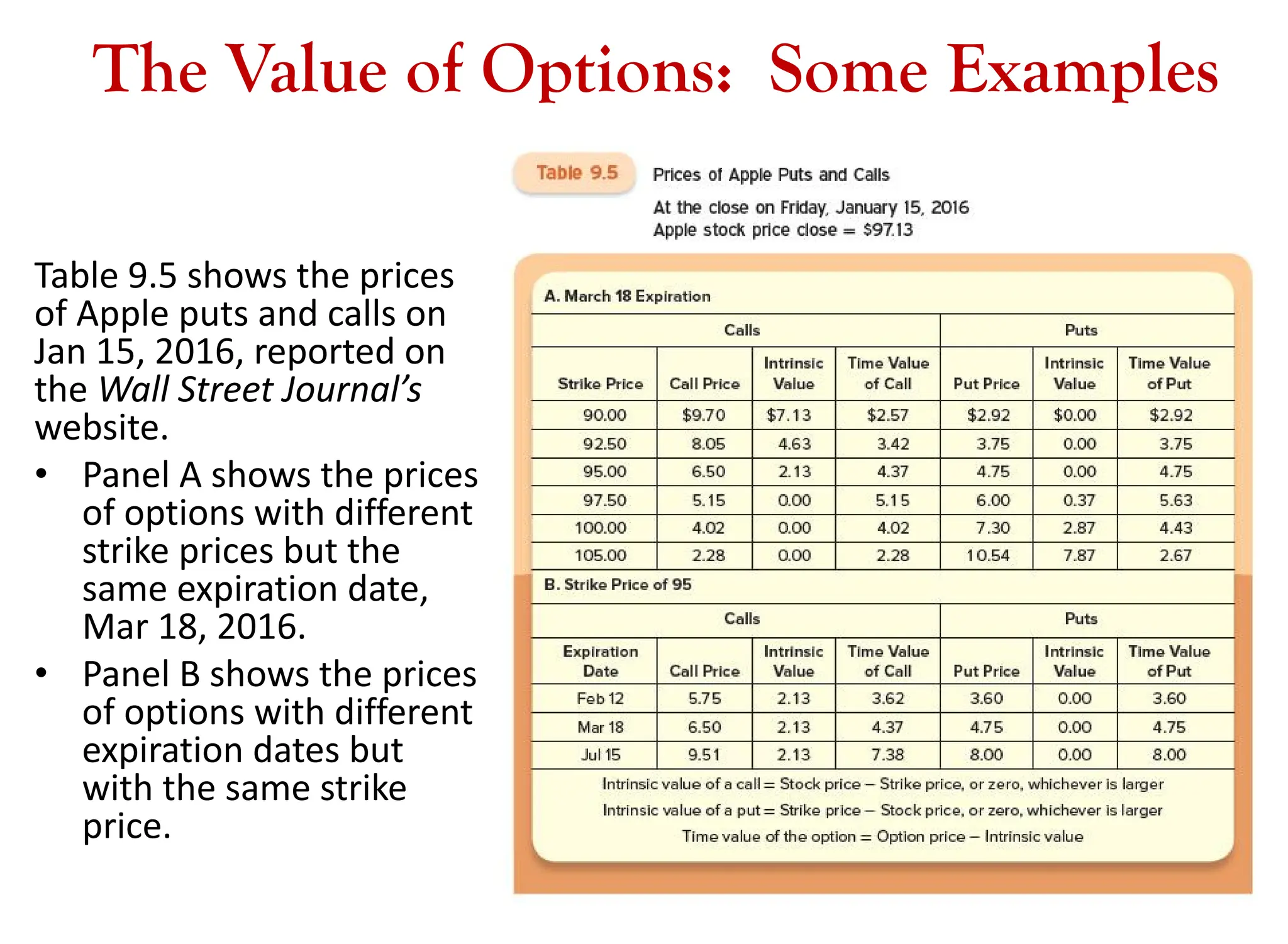
Table 9.5 shows the prices
of Apple puts and calls on
Jan 15, 2016, reported on
the Wall Street Journal’s
website.
• Panel A shows the prices
of options with different
strike prices but the
same expiration date,
Mar 18, 2016.
• Panel B shows the prices
of options with different
expiration dates but
with the same strike
price.
The Value of Options: Some Examples
What can we discover?
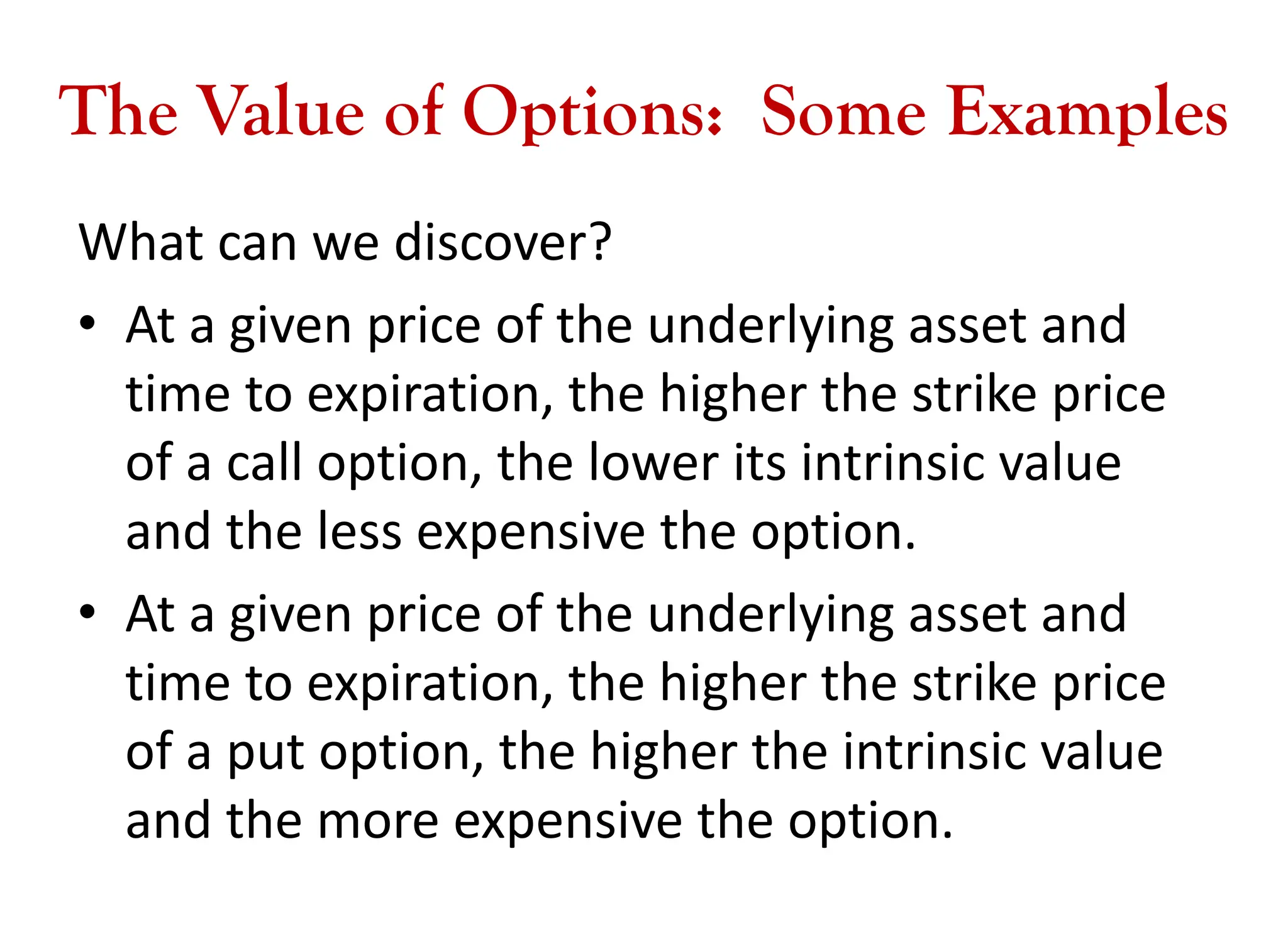
• At a given price of the underlying asset and
time to expiration, the higher the strike price
of a call option, the lower its intrinsic value
and the less expensive the option.
• At a given price of the underlying asset and
time to expiration, the higher the strike price
of a put option, the higher the intrinsic value
and the more expensive the option.
The Value of Options: Some Examples
What can we discover (cont.)?
• The closer the strike price is to the current
price of the underlying asset, the larger the
option's time value.
• Deep in-the-money options have lower time
value.
• The longer the time to expiration at a given
strike price, the higher the option price.
Swaps
• Swaps are contracts that allow traders to
transfer risk just like other derivatives.
– Interest-rate swaps which allow one swap party,
for a fee, to alter the stream of payments it makes
or receives.
– Credit-default swaps (CDS) which are a form of
insurance that allow a buyer to own a bond or
mortgage without bearing its full default risk.
Understanding Interest-Rate Swaps
• Interest-rate swaps are agreements between
two counterparties to exchange periodic
interest-rate payments over some future period,
based on an agreed-upon amount of principal,
called the notional principal.
• The term notional is used because the principal
of a swap is not borrowed, lent, or exchanged.
Understanding Interest-Rate Swaps
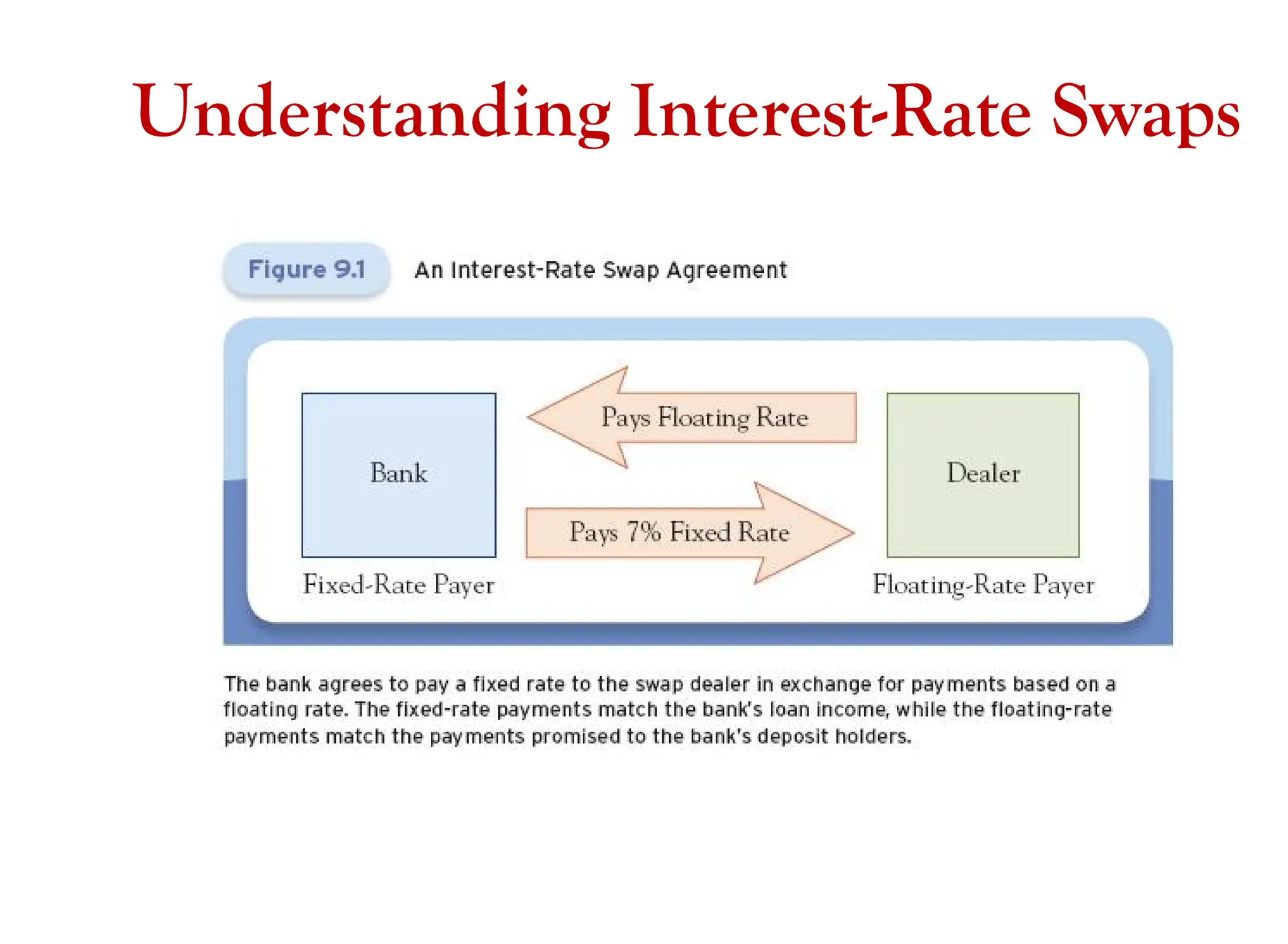
• In the simplest type of interest-rate swap, one
party agrees to make payments based on a fixed
interest rate, and in exchange the counterparty
agrees to make payments based on a floating
interest rate.
– This turns fixed rates in to floating rates and vice
versa.
Understanding Interest-Rate Swaps
• LTCM had engaged in a large number of complex
speculative transactions, including interest rate
swaps and options writing, which all failed
simultaneously.
• Large banks, insurance companies, pension funds,
and mutual-fund companies with whom LTCM did
business were at risk of being bankrupted
themselves.
• The Federal Reserve had no choice but to step in
and ensure that the financial system remained
sound.
Pricing and Using Interest Rate Swaps
• Pricing interest-rate swaps means figuring
out the fixed interest rate to be paid.
• Financial firms begin by noting the market
interest rate on a U.S. Treasury bond of the
same maturity as the swap, called a
benchmark.
• The rate to be paid by the fixed-rate payer,
the swap rate, is the benchmark rate plus a
premium.
Pricing and Using Interest Rate Swaps
• The difference between the benchmark rate and
the swap rate is called the swap spread and is a
measure of risk.
– The swap spread has become a measure of overall
risk in the economy.
– When the swap spread widens, it signals that general
economic conditions are deteriorating.
Pricing and Using Interest Rate Swaps
• Who uses interest-rate swaps?
– Banks
• Deposits are short-term liabilities
• Loans are long-term assets
• Swaps help control risk
– Government debt managers
• Issue long-term debt relatively cheaply
• Tax revenue matches up better with short-term interest
rate
Pricing and Using Interest Rate Swaps
• The primary risk in a swap is the risk that one
of the parties will default.
– The risk is not very high because the other side
can enter into another agreement to replace the
one that failed.
• Unlike futures and options, swaps are not
traded on organized exchanges.
– Swaps are very difficult to resell.
• The VIX (fear index) is a measure of the
uncertainty and risk that investors see over
the future, specifically the next 30 days
– Gauge of implied volatility
• When low, stock market liquidity and valuations are
usually high (confidence)
• When high, stock trading is more difficult and
valuations suffer (cautious about uncertainty)
• Low volatility breeds risk and complacency
Credit-Default Swaps
• A credit-default swap (CDS) is a credit derivative
that allows lenders to insure themselves against
the risk that a borrower will default.
• The buyer of a CDS makes payments, like
insurance premiums, to the seller, and the seller
agrees to pay the buyer if an underlying loan or
security defaults.
• The CDS buyer pays a fee to transfer the risk of
default, the credit risk, to the CDS seller.
• A CDS agreement often lasts several years and
requires that collateral be posted to protect
against the inability to pay of either the seller or
the buyer of the insurance.
Credit-Default Swaps
CDS contributed to the financial crisis in three
important ways:
1. Fostering uncertainty about who bears the
credit risk on a given loan or security,
2. Making the leading CDS sellers mutually
vulnerable, and
3. Making it easier for sellers of insurance to
assume and conceal risk.
Credit-Default Swaps
• Because CDS contracts are traded over the
counter (OTC), even traders cannot identify
others who take on concentrated positions on
one side of a trade.
• So long as CDS trading lacks transparency, the
lingering worry is that a failure of one institution
could bring down the financial system as a
whole.

FMI - Chapter 4 Pt. II, Derivativees.pdf

  • 1.
    Derivatives: Futures, Options,and Swaps Chapter 4-4
  • 2.
    Learning Objectives 1. Explainwhat derivatives are and how they transfer risk. 2. Distinguish between forward and futures contracts. 3. Define put and call options and describe how to use them. 4. Show how swaps can be used to manage risk or to conceal it.
  • 3.
    Introduction • Although opento abuse, derivatives can be extremely helpful financial instruments. • They can reduce risk, allowing firms and individual to enter into agreements that they could not have otherwise. • Derivatives can also be used an insurance against future events. • Warren Buffett, the famed investor, called derivatives “weapons of financial mass destruction.”
  • 4.
    The Basics: DefiningDerivatives • A derivative is a financial instrument whose value depends on, is derived from, the value of some other financial instrument, call the underlying asset. – Examples of assets include stocks, bonds, wheat, snowfall, and stock market indexes like S&P 500. • For example: – A contractual agreement between two investors that obligates one to make a payment to the other, depending on the movement of interest rates over the next year. • An interest-rate futures contract
  • 5.
    The Basics: DefiningDerivatives Derivatives are different from outright purchases because: 1. Derivatives provide an easy way for investors to profit from price declines. 2. In a derivatives transaction, one person’s loss is always another person’s gain.
  • 6.
    The Basics: DefiningDerivatives • While derivatives can be used to speculate, or gamble on future price movements, they allow investors to manage and reduce risk. – Farmers use derivatives regularly to insure themselves against fluctuations in the price of their crops. • The purpose of derivatives is to transfer risk from one person or firm to another.
  • 7.
    The Basics: DefiningDerivatives • By shifting risk to those willing and able to bear it, derivatives increase the risk-carrying capacity of the economy as a whole. – This improves the allocation of resources and increase the level of output. • The downside is that derivatives also allow individuals and firms to conceal the true nature of certain financial transactions.
  • 8.
    Forward and Futures •A forward, or forward contract, is an agreement between a buyer and a seller to exchange a commodity or financial instrument for a specified amount of cash on a prearranged future date. • Because they are customized, forward contracts are very difficult to resell.
  • 9.
    Forward and Futures •A future, or futures contract, is a forward contract that has been standardized and sold through an organized exchange. – The contract specifies that the seller (short position) will deliver some quantity of a commodity or financial instrument to the buyer (long position) on a specific date, called the settlement or delivery date, for a predetermined price.
  • 10.
    Forward and Futures •No payments are made when the contract is agreed to. • The seller/short position benefits from declines in the price of the underlying asset. • The buyer/long position benefits from increases in the price of the underlying asset.
  • 11.
    Forward and Futures •The two parties to a futures contract each make an agreement with a clearing corporation. • The clearing corporation operates like a large insurance company and is the counter party to both sides of the transaction. – They guarantee that the parties will meet their obligations. • This lowers the risk buyers and sellers face. • The clearing corporation has the ability to monitor traders and the incentive to limit their risk taking.
  • 12.
    Margin Accounts andMarking to Market • The clearing corporation requires both parties to a futures contract to place a deposit with the corporation. – This is called posting margin in a margin account. – This guarantees when the contract comes due, the parties will be able to meet their obligations.
  • 13.
    Margin Accounts andMarking to Market • The clearing corporation posts daily gains and losses on the contract to the margin account of the parties involved. – This is called marking to market. • Doing this each day ensures that sellers always have the resources to make delivery and buyers can always pay. • If someone’s margin account falls below the minimum, the clearing corporation will sell the contracts, ending the person’s participation in the market.
  • 14.
    Hedging and Speculatingwith Futures • Futures contracts allow the transfer of risk between buyer and seller through hedging or speculation. – For example of the sale of a U.S. Treasury bond future contract, the seller/short position benefits from the price declines. • The seller of the futures contract can guarantee the price at which the bonds are sold. – The purchaser wishes to insure against possible price increases.
  • 15.
    Hedging and Speculatingwith Futures • Buying a futures contract fixes the price that the fund will need to pay. – In this example, both sides use the futures contract as a hedge - they are both hedgers. • Producers and users of commodities employ futures markets to hedge their risks as well: farmers, mining companies, oil drillers, etc. – They own the commodity outright, so they want to stabilize revenue streams. – Those buying want to reduce risk of fluctuations in input costs.
  • 16.
    Hedging and Speculatingwith Futures • Speculators are trying to make a profit. – They bet on price movements. • Sellers of futures are betting that prices will fall. • Buyers of futures are betting that prices will risk. • Futures contracts are popular tools for speculation because they are cheap. • An investor needs only a small amount to invest - the margin - to purchase the future contract. – Margin requirements of 10% or less are common.
  • 17.
    Hedging and Speculatingwith Futures • For our example of U.S. Treasury bonds futures contracts, The Chicago Board of Trade requires an initial margin of only $1,350 per contract. – This investment gives the investor the same returns as the purchase of $100,000 worth of bonds. – It is as if the investor borrowed the remaining $98,650 without having to pay any interest. • Speculators can use futures to obtain very large amounts of leverage at a very low cost.
  • 18.
    • We canmake markets more robust by shifting trading from over-the-counter (OTC) markets to transactions with a centralized counterparty (CCP). • When trading OTC with many partners, a firm can build up excessively large positions without other parties being aware of the risk. • A CCP has the ability, as well as the incentive, to monitor the riskiness of its counterparties.
  • 19.
    • Standardization ofcontracts also facilitates CPP monitoring. • A CCP can refuse to trade with a risky client or insist on a risk premium. • A CCP also limits its own risk through economies of scale. – Most trades are offset against one another. • CCPs have helped markets function well even when traders cannot pay.
  • 20.
    Arbitrage and theDeterminants of Futures Prices • On the settlement or delivery date, the price of the futures contract must equal the price of the underlying asset the seller is obligated to deliver. – If not, then it would be possible to make a risk-free profit by engaging in offsetting cash and futures transactions. • The practice of simultaneously buying and selling financial instruments in order to benefit from temporary price differences is called arbitrage the people who engage in it are called arbitrageurs.
  • 21.
    Arbitrage and theDeterminants of Futures Prices • If the price of a specific bond is higher in one market than in another: – The arbitrageur can buy at the low price and sell at the high price. – This increases demand in one market and supply in another. – The increase in demand raises price in that market. – The increase in supply lowers price in the other market. – This continues until the prices are equal in both markets.
  • 22.
    Arbitrage and theDeterminants of Futures Prices • As long as there are arbitrageurs, on the day when a futures contract is settled, the price of a bond futures contract will be the same as the market price - or spot price - of the bond. • How is this done? – The arbitrageur borrows at the current market interest rate. – These funds are used to buy a bond and sell a bond futures contract. – The interest owed on the loan and received from the bond cancel out. – The futures price must move in lockstep with the market price of the bond.
  • 23.
    Arbitrage and theDeterminants of Futures Prices © 2017 McGraw-Hill Education. All Rights Reserved.
  • 24.
    Calls, Puts, andAll That: Definitions • Options are agreements between two parties. – The seller is an option writer. – A buyer is an option holder. • A call option is the right to buy, “call away”, a given quantity of an underlying asset at a predetermined price, called the strike price (or exercise price), on or before a specific date. – A July 2016 call option on 100 shares of Apple stock at a strike price of 100 gives the option holder the right to buy 100 shares of Apple for $100 each prior to the 3rd Friday of July 2016.
  • 25.
    Calls, Puts, andAll That: Definitions • The writer of the call option must sell the share if and when the holder choose to use the call option. • The holder of the call is not required to buy the shares - they have the option if it is beneficial. – When the Apple stock price exceeds the option strike price of 100, the option holder can either call away the 100 shares by exercising the option or sell the option at a profit.
  • 26.
    Calls, Puts, andAll That: Definitions • When the price of the stock is above the strike price of the call option, exercising the option is profitable and the option is said to be in the money. • If the price of the stock exactly equals the strike price, the option is said to be at the money. • If the strike price exceeds the market price of the stock, it is termed out of the money.
  • 27.
    Calls, Puts, andAll That: Definitions • A put option gives the holder the right but not the obligation to sell the underlying asset at a predetermined price on or before a fixed date • The writer of the option is obliged to buy the shares should the holder choose to exercise the option. • The same terminology that is used to describe calls, is also used to describe puts: – In the money - profitable – At the money - same price – Out of the money - not profitable
  • 28.
    Calls, Puts, andAll That: Definitions • Although options can be customized, most are standardized and traded on exchanges. • A clearing corporation guarantees the obligations embodied in the option -- those of the option writer. – The options writer is required to post margin. – The option holder incurs no obligation, so no margin is needed.
  • 29.
    Calls, Puts, andAll That: Definitions • There are two types of calls and puts: • American options can be exercised on any date from the time they are written to the expiration date. • European options can be exercised only on the day they expire.
  • 30.
    Using Options • Optionstransfer risk from the buyer to the seller, so can be used for both hedging and speculation. • For someone who wants to purchase an asset in the future, a call option ensure that the cost of buying the asset will not rise. • For someone who plans to sell the asset in the future, a put option ensures that the price at which the asset can be sold will not go down.
  • 31.
    Using Options Say youthink interest rates are going to fall. • You can: – Buy a bond but that’s expensive as you need money. – Buy a futures contract taking the long position - low investment but high risk. – Buy a call option that pays off only if the interest rate falls - if you are wrong, only cost is the price of the option.
  • 32.
    Using Options The optionwriter can take a large loss, so who does this? 1. Speculators willing to take the risk and bet that prices will not move against them. 2. Dealers called market makers who engage in the regular purchase and sale of the underlying asset.
  • 33.
    Using Options • Marketmakers both – Own the underlying asset so they can deliver it, and – Are willing to buy the underlying asset so they have it read to sell to someone else. • If you own the underlying asset, writing a call option that obligates you to sell it at a fixed price is not that risky. • Market makers write options to get the fees from the buyer.
  • 34.
    Using Options • Optionsare very versatile and can be bought and sold in many combinations. • Allow investors to get rid of risks they do not want and keep the ones they do. • Options allow investors to bet that prices will be volatile. • Table 9.3 summarizes options.
  • 36.
    • Corporations workhard to appear profitable. • Financial statements can be misleading. • Never trust a statement unless it meets regulatory standards. • The more open a company is in its financial accounting, the more likely that it is honest. • Diversification reduces risk.
  • 37.
    Pricing Options: IntrinsicValue and the Time Value of the Option An option has two parts: 1. Intrinsic value - the value of the option if it is exercised immediately, and 2. Time value of the option - the fee paid for the option's potential benefits. Option price = Intrinsic value + time value of the option
  • 38.
    Pricing Options: IntrinsicValue and the Time Value of the Option • We can calculate the time value of the option by calculating the expected present value of the payoff. – For a call option, we take the probability of a favorable outcome (a higher price), times the payoff. – Increasing the standard deviation of the stock price, an increase in volatility, increases the option’s time value.
  • 39.
    General Considerations • Calculatingthe price of an option and how it might change means developing some rules for figuring out its intrinsic value and time value. • The most important thing to remember is that a buyer is not bound to exercise the option. • Because the options can either be exercised or expire worthless, we can conclude that the intrinsic value depends only on what the holder receives if the option is exercised.
  • 40.
    General Considerations • Foran in-the-money call, or the option to buy, the intrinsic value to the holder is the market price of the underlying asset minus the strike price. • If the call is at the money or out of the money, it has no intrinsic value. • Similarly, the intrinsic value of a put, or the option to sell, equals the strike price minus the market price of the underlying asset, or zero - which ever is greater.
  • 41.
    General Considerations • Priorto expiration, there is always the chance that the price of the underlying asset will move making the option valuable. • The longer the time to expiration, the bigger the likely payoff when the option does expire and, thus, the more valuable it is.
  • 42.
    General Considerations • Thelikelihood that an option will pay off depends on the volatility, or standard deviation, of the price of the underlying asset. – The more variability there is in the asset’s price, the more chance it has to move into the money. – Therefore the option’s time value increases with volatility in the price of the underlying asset. – Increased volatility has no cost to the option holder - only benefits.
  • 43.
    General Considerations • Thebigger the risk being insured, the more valuable the insurance, and the higher the price investors will pay. • The circumstances under which the payment is made have an important impact on the option’s time value. • Table 9.4 summarizes the factors affecting the value of options.
  • 44.
    General Considerations © 2017McGraw-Hill Education. All Rights Reserved.
  • 45.
    • The priceof a company’s stock could skyrocket or the company could go bankrupt. • Generally employees are not allowed to sell their stock options for a set period of time and may need to stay with the firm to exercise them. • If taking stock options means a lower salary, then you are paying for them and should think hard about that offer. • Investing in the same company that pays your salary is risky.
  • 46.
    The Value ofOptions: Some Examples Table 9.5 shows the prices of Apple puts and calls on Jan 15, 2016, reported on the Wall Street Journal’s website. • Panel A shows the prices of options with different strike prices but the same expiration date, Mar 18, 2016. • Panel B shows the prices of options with different expiration dates but with the same strike price.
  • 47.
    The Value ofOptions: Some Examples What can we discover? • At a given price of the underlying asset and time to expiration, the higher the strike price of a call option, the lower its intrinsic value and the less expensive the option. • At a given price of the underlying asset and time to expiration, the higher the strike price of a put option, the higher the intrinsic value and the more expensive the option.
  • 48.
    The Value ofOptions: Some Examples What can we discover (cont.)? • The closer the strike price is to the current price of the underlying asset, the larger the option's time value. • Deep in-the-money options have lower time value. • The longer the time to expiration at a given strike price, the higher the option price.
  • 49.
    Swaps • Swaps arecontracts that allow traders to transfer risk just like other derivatives. – Interest-rate swaps which allow one swap party, for a fee, to alter the stream of payments it makes or receives. – Credit-default swaps (CDS) which are a form of insurance that allow a buyer to own a bond or mortgage without bearing its full default risk.
  • 50.
    Understanding Interest-Rate Swaps •Interest-rate swaps are agreements between two counterparties to exchange periodic interest-rate payments over some future period, based on an agreed-upon amount of principal, called the notional principal. • The term notional is used because the principal of a swap is not borrowed, lent, or exchanged.
  • 51.
    Understanding Interest-Rate Swaps •In the simplest type of interest-rate swap, one party agrees to make payments based on a fixed interest rate, and in exchange the counterparty agrees to make payments based on a floating interest rate. – This turns fixed rates in to floating rates and vice versa.
  • 52.
  • 53.
    • LTCM hadengaged in a large number of complex speculative transactions, including interest rate swaps and options writing, which all failed simultaneously. • Large banks, insurance companies, pension funds, and mutual-fund companies with whom LTCM did business were at risk of being bankrupted themselves. • The Federal Reserve had no choice but to step in and ensure that the financial system remained sound.
  • 54.
    Pricing and UsingInterest Rate Swaps • Pricing interest-rate swaps means figuring out the fixed interest rate to be paid. • Financial firms begin by noting the market interest rate on a U.S. Treasury bond of the same maturity as the swap, called a benchmark. • The rate to be paid by the fixed-rate payer, the swap rate, is the benchmark rate plus a premium.
  • 55.
    Pricing and UsingInterest Rate Swaps • The difference between the benchmark rate and the swap rate is called the swap spread and is a measure of risk. – The swap spread has become a measure of overall risk in the economy. – When the swap spread widens, it signals that general economic conditions are deteriorating.
  • 56.
    Pricing and UsingInterest Rate Swaps • Who uses interest-rate swaps? – Banks • Deposits are short-term liabilities • Loans are long-term assets • Swaps help control risk – Government debt managers • Issue long-term debt relatively cheaply • Tax revenue matches up better with short-term interest rate
  • 57.
    Pricing and UsingInterest Rate Swaps • The primary risk in a swap is the risk that one of the parties will default. – The risk is not very high because the other side can enter into another agreement to replace the one that failed. • Unlike futures and options, swaps are not traded on organized exchanges. – Swaps are very difficult to resell.
  • 58.
    • The VIX(fear index) is a measure of the uncertainty and risk that investors see over the future, specifically the next 30 days – Gauge of implied volatility • When low, stock market liquidity and valuations are usually high (confidence) • When high, stock trading is more difficult and valuations suffer (cautious about uncertainty) • Low volatility breeds risk and complacency
  • 59.
    Credit-Default Swaps • Acredit-default swap (CDS) is a credit derivative that allows lenders to insure themselves against the risk that a borrower will default. • The buyer of a CDS makes payments, like insurance premiums, to the seller, and the seller agrees to pay the buyer if an underlying loan or security defaults. • The CDS buyer pays a fee to transfer the risk of default, the credit risk, to the CDS seller. • A CDS agreement often lasts several years and requires that collateral be posted to protect against the inability to pay of either the seller or the buyer of the insurance.
  • 60.
    Credit-Default Swaps CDS contributedto the financial crisis in three important ways: 1. Fostering uncertainty about who bears the credit risk on a given loan or security, 2. Making the leading CDS sellers mutually vulnerable, and 3. Making it easier for sellers of insurance to assume and conceal risk.
  • 61.
    Credit-Default Swaps • BecauseCDS contracts are traded over the counter (OTC), even traders cannot identify others who take on concentrated positions on one side of a trade. • So long as CDS trading lacks transparency, the lingering worry is that a failure of one institution could bring down the financial system as a whole.