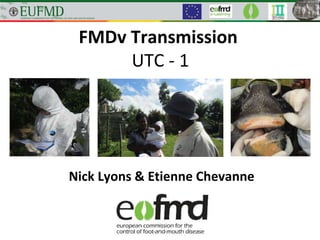
FMDv Transmission
UTC - 1
Nick Lyons & Etienne Chevanne
“FMD is the most contagious disease on the planet”
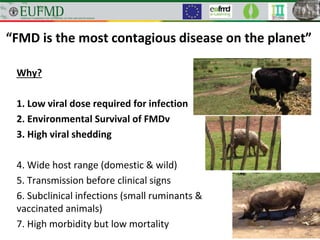
Why?
1. Low viral dose required for infection
2. Environmental Survival of FMDv
3. High viral shedding
4. Wide host range (domestic & wild)
5. Transmission before clinical signs
6. Subclinical infections (small ruminants &
vaccinated animals)
7. High morbidity but low mortality
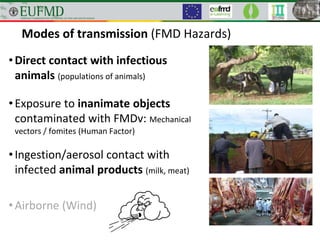
Modes of transmission (FMD Hazards)
•Direct contact with infectious
animals (populations of animals)
•Exposure to inanimate objects
contaminated with FMDv: Mechanical
vectors / fomites (Human Factor)
•Ingestion/aerosol contact with
infected animal products (milk, meat)
•Airborne (Wind)
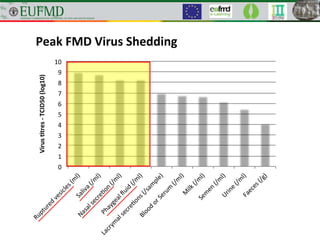
Peak FMD Virus Shedding
0
1
2
3
4
5
6
7
8
9
10
Ruptured
vesicles(m
l)Saliva
(/m
l)
Nasalsecre
on
(/m
l)
Phaygealfluid
(/m
l)
Lacrym
alsecre
ons(/sam
ple)
Blood
orSerum
(/m
l)M
ilk(/m
l)Sem
en
(/m
l)Urine
(/m
l)Faeces(/g)
Virustres-TCID50(log10)
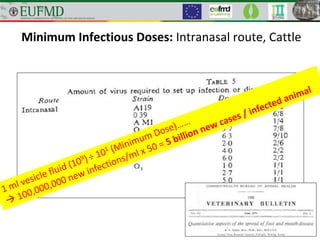
Minimum Infectious Doses: Intranasal route, Cattle
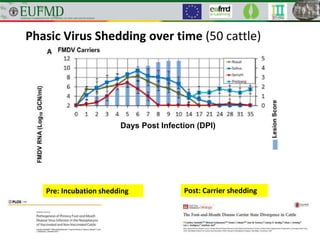
Phasic Virus Shedding over time (50 cattle)
Hours Post Infection (HPI)
Days Post Infection (DPI)
Pre: Incubation shedding Post: Carrier shedding
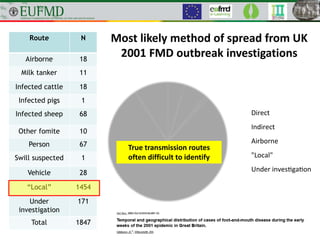
Most likely method of spread from UK
2001 FMD outbreak investigations
Route N
Airborne 18
Milk tanker 11
Infected cattle 18
Infected pigs 1
Infected sheep 68
Other fomite 10
Person 67
Swill suspected 1
Vehicle 28
“Local” 1454
Under
investigation
171
Total 1847
Direct
Indirect
Airborne
"Local"
Under inves ga on
~79%
True transmission routes
often difficult to identify
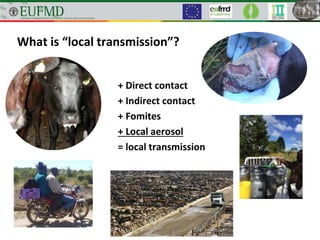
What is “local transmission”?
+ Direct contact
+ Indirect contact
+ Fomites
+ Local aerosol
= local transmission
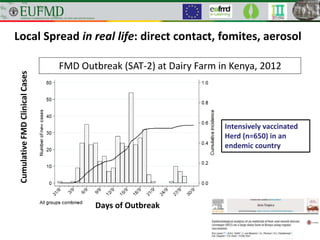
Local Spread in real life: direct contact, fomites, aerosol
FMD Outbreak (SAT-2) at Dairy Farm in Kenya, 2012
CumulativeFMDClinicalCases
Intensively vaccinated
Herd (n=650) in an
endemic country
Days of Outbreak
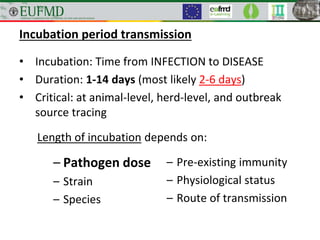
Incubation period transmission
• Incubation: Time from INFECTION to DISEASE
• Duration: 1-14 days (most likely 2-6 days)
• Critical: at animal-level, herd-level, and outbreak
source tracing
– Pre-existing immunity
– Physiological status
– Route of transmission
Length of incubation depends on:
– Pathogen dose
– Strain
– Species
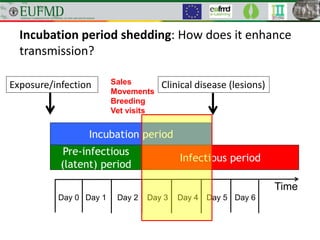
Pre-infectious
(latent) period
Incubation period
Infectious period
Exposure/infection
Day 0 Day 1 Day 6Day 3Day 2 Day 4 Day 5
Time
Incubation period shedding: How does it enhance
transmission?
Sales
Movements
Breeding
Vet visits
Clinical disease (lesions)
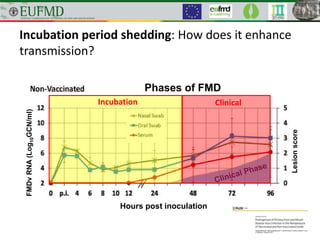
Phases of FMD
Lesionscore
FMDvRNA(Log10GCN/ml)
Hours post inoculation
Incubation period shedding: How does it enhance
transmission?
Incubation Clinical
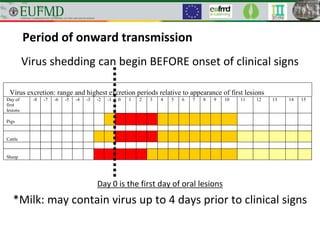
Period of onward transmission
Virus shedding can begin BEFORE onset of clinical signs
Day 0 is the first day of oral lesions
*Milk: may contain virus up to 4 days prior to clinical signs
Virus excretion: range and highest excretion periods relative to appearance of first lesions
Day of
first
lesions
-8 -7 -6 -5 -4 -3 -2 -1 0 1 2 3 4 5 6 7 8 9 10 11 12 13 14 15
Pigs
Cattle
Sheep
Risk of airborne spread
• Lab and some field data supports role of airborne transmission
although favourable climatic conditions required
• Conventional wisdom re: generating and receiving aerosols
• Difficult to prove definitively in the field
• Must be aware and consider during an outbreak
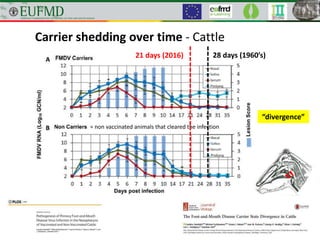
Carrier shedding over time - Cattle
= non vaccinated animals that cleared the infection
28 days (1960’s)21 days (2016)
“divergence”
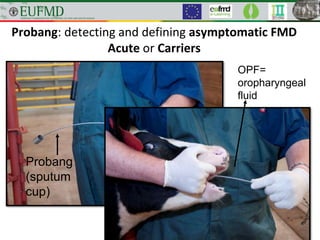
Probang: detecting and defining asymptomatic FMD
Acute or Carriers
Probang
(sputum
cup)
OPF=
oropharyngeal
fluid
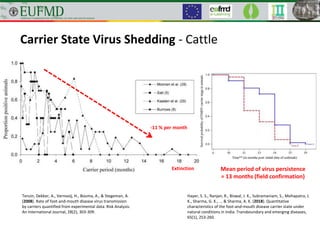
Carrier State Virus Shedding - Cattle
Tenzin, Dekker, A., Vernooij, H., Bouma, A., & Stegeman, A.
(2008). Rate of foot‐and‐mouth disease virus transmission
by carriers quantified from experimental data. Risk Analysis:
An International Journal, 28(2), 303-309.
Hayer, S. S., Ranjan, R., Biswal, J. K., Subramaniam, S., Mohapatra, J.
K., Sharma, G. K., ... & Sharma, A. K. (2018). Quantitative
characteristics of the foot‐and‐mouth disease carrier state under
natural conditions in India. Transboundary and emerging diseases,
65(1), 253-260.
Mean period of virus persistence
= 13 months (field confirmation)
-11 % per month
Extinction
Field trials
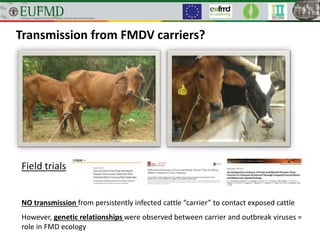
NO transmission from persistently infected cattle “carrier” to contact exposed cattle
However, genetic relationships were observed between carrier and outbreak viruses =
role in FMD ecology
Transmission from FMDV carriers?
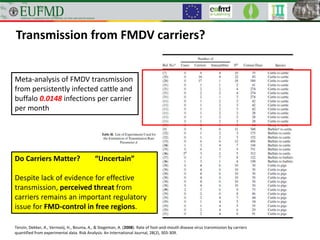
Meta-analysis of FMDV transmission
from persistently infected cattle and
buffalo 0.0148 infections per carrier
per month
Do Carriers Matter? “Uncertain”
Despite lack of evidence for effective
transmission, perceived threat from
carriers remains an important regulatory
issue for FMD-control in free regions.
Tenzin, Dekker, A., Vernooij, H., Bouma, A., & Stegeman, A. (2008). Rate of foot‐and‐mouth disease virus transmission by carriers
quantified from experimental data. Risk Analysis: An International Journal, 28(2), 303-309.
Transmission from FMDV carriers?
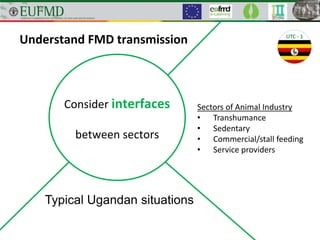
Understand FMD transmission
Typical Ugandan situations
Sectors of Animal Industry
• Transhumance
• Sedentary
• Commercial/stall feeding
• Service providers
Consider interfaces
between sectors
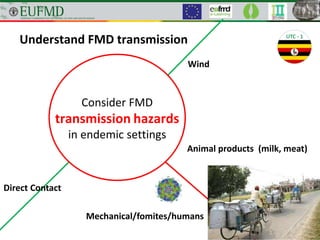
Understand FMD transmission
Consider FMD
transmission hazards
in endemic settings
Animal products (milk, meat)
Direct Contact
Wind
Mechanical/fomites/humans
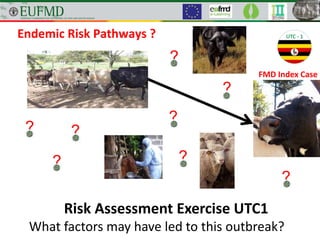
Endemic Risk Pathways ?
Risk Assessment Exercise UTC1
What factors may have led to this outbreak?
?
FMD Index Case
?
?
?
?
?
?
?
Thanks for your attention
Questions on transmission?

Fmd transmission Uganda Training Course

  • 1.
    FMDv Transmission UTC -1 Nick Lyons & Etienne Chevanne
  • 2.
    “FMD is themost contagious disease on the planet” Why? 1. Low viral dose required for infection 2. Environmental Survival of FMDv 3. High viral shedding 4. Wide host range (domestic & wild) 5. Transmission before clinical signs 6. Subclinical infections (small ruminants & vaccinated animals) 7. High morbidity but low mortality
  • 3.
    Modes of transmission(FMD Hazards) •Direct contact with infectious animals (populations of animals) •Exposure to inanimate objects contaminated with FMDv: Mechanical vectors / fomites (Human Factor) •Ingestion/aerosol contact with infected animal products (milk, meat) •Airborne (Wind)
  • 4.
    Peak FMD VirusShedding 0 1 2 3 4 5 6 7 8 9 10 Ruptured vesicles(m l)Saliva (/m l) Nasalsecre on (/m l) Phaygealfluid (/m l) Lacrym alsecre ons(/sam ple) Blood orSerum (/m l)M ilk(/m l)Sem en (/m l)Urine (/m l)Faeces(/g) Virustres-TCID50(log10)
  • 5.
    Minimum Infectious Doses:Intranasal route, Cattle
  • 6.
    Phasic Virus Sheddingover time (50 cattle) Hours Post Infection (HPI) Days Post Infection (DPI) Pre: Incubation shedding Post: Carrier shedding
  • 7.
    Most likely methodof spread from UK 2001 FMD outbreak investigations Route N Airborne 18 Milk tanker 11 Infected cattle 18 Infected pigs 1 Infected sheep 68 Other fomite 10 Person 67 Swill suspected 1 Vehicle 28 “Local” 1454 Under investigation 171 Total 1847 Direct Indirect Airborne "Local" Under inves ga on ~79% True transmission routes often difficult to identify
  • 8.
    What is “localtransmission”? + Direct contact + Indirect contact + Fomites + Local aerosol = local transmission
  • 9.
    Local Spread inreal life: direct contact, fomites, aerosol FMD Outbreak (SAT-2) at Dairy Farm in Kenya, 2012 CumulativeFMDClinicalCases Intensively vaccinated Herd (n=650) in an endemic country Days of Outbreak
  • 10.
    Incubation period transmission •Incubation: Time from INFECTION to DISEASE • Duration: 1-14 days (most likely 2-6 days) • Critical: at animal-level, herd-level, and outbreak source tracing – Pre-existing immunity – Physiological status – Route of transmission Length of incubation depends on: – Pathogen dose – Strain – Species
  • 11.
    Pre-infectious (latent) period Incubation period Infectiousperiod Exposure/infection Day 0 Day 1 Day 6Day 3Day 2 Day 4 Day 5 Time Incubation period shedding: How does it enhance transmission? Sales Movements Breeding Vet visits Clinical disease (lesions)
  • 12.
    Phases of FMD Lesionscore FMDvRNA(Log10GCN/ml) Hourspost inoculation Incubation period shedding: How does it enhance transmission? Incubation Clinical
  • 13.
    Period of onwardtransmission Virus shedding can begin BEFORE onset of clinical signs Day 0 is the first day of oral lesions *Milk: may contain virus up to 4 days prior to clinical signs Virus excretion: range and highest excretion periods relative to appearance of first lesions Day of first lesions -8 -7 -6 -5 -4 -3 -2 -1 0 1 2 3 4 5 6 7 8 9 10 11 12 13 14 15 Pigs Cattle Sheep
  • 14.
    Risk of airbornespread • Lab and some field data supports role of airborne transmission although favourable climatic conditions required • Conventional wisdom re: generating and receiving aerosols • Difficult to prove definitively in the field • Must be aware and consider during an outbreak
  • 15.
    Carrier shedding overtime - Cattle = non vaccinated animals that cleared the infection 28 days (1960’s)21 days (2016) “divergence”
  • 16.
    Probang: detecting anddefining asymptomatic FMD Acute or Carriers Probang (sputum cup) OPF= oropharyngeal fluid
  • 17.
    Carrier State VirusShedding - Cattle Tenzin, Dekker, A., Vernooij, H., Bouma, A., & Stegeman, A. (2008). Rate of foot‐and‐mouth disease virus transmission by carriers quantified from experimental data. Risk Analysis: An International Journal, 28(2), 303-309. Hayer, S. S., Ranjan, R., Biswal, J. K., Subramaniam, S., Mohapatra, J. K., Sharma, G. K., ... & Sharma, A. K. (2018). Quantitative characteristics of the foot‐and‐mouth disease carrier state under natural conditions in India. Transboundary and emerging diseases, 65(1), 253-260. Mean period of virus persistence = 13 months (field confirmation) -11 % per month Extinction
  • 18.
    Field trials NO transmissionfrom persistently infected cattle “carrier” to contact exposed cattle However, genetic relationships were observed between carrier and outbreak viruses = role in FMD ecology Transmission from FMDV carriers?
  • 19.
    Meta-analysis of FMDVtransmission from persistently infected cattle and buffalo 0.0148 infections per carrier per month Do Carriers Matter? “Uncertain” Despite lack of evidence for effective transmission, perceived threat from carriers remains an important regulatory issue for FMD-control in free regions. Tenzin, Dekker, A., Vernooij, H., Bouma, A., & Stegeman, A. (2008). Rate of foot‐and‐mouth disease virus transmission by carriers quantified from experimental data. Risk Analysis: An International Journal, 28(2), 303-309. Transmission from FMDV carriers?
  • 20.
    Understand FMD transmission TypicalUgandan situations Sectors of Animal Industry • Transhumance • Sedentary • Commercial/stall feeding • Service providers Consider interfaces between sectors
  • 21.
    Understand FMD transmission ConsiderFMD transmission hazards in endemic settings Animal products (milk, meat) Direct Contact Wind Mechanical/fomites/humans
  • 22.
    Endemic Risk Pathways? Risk Assessment Exercise UTC1 What factors may have led to this outbreak? ? FMD Index Case ? ? ? ? ? ? ?
  • 23.
    Thanks for yourattention Questions on transmission?