Use of Fly ash in
Roads
PRESENTED BY:
HIMANSHU PIPALIYA
Introduction
 Fly ash is a fine residue of coal combustion in
the Thermal Power Plants.
 The thermal grade Indian coal contains 35 to
45% of ash resulting in generation of huge
quantity of fly ash.
 Coal being the main raw material for thermal
power generation, ash is the essential by
product.
Conti..
 Huge quantity of bottom ash & fly ash are generated from boilers of
coal fired Thermal Power Plants (TPP).
 Internationally fly ash is considered as a by product which can be used
for many appliances.
 As a result of experiences gained in these projects, specifications for
 construction of road embankments and guidelines for usage of fly ash
for rural roads were compiled and these have been published by the
Indian Roads Congress.
Fly ash as a Road construction material
For overall evaluation of industrial wastes for use as construction materials a ‘NICE’ criterion
has been suggested which is explained below:
 ‘N’on-hazardous: Fly Ash non-hazardous with regard to ignitability, corrosivity, reactivity
and toxicity.
 ‘I’m provable: It should possess high potential for improvability of its properties, such as
workability, performance in conjunction with additives.
 ‘C’ompatible with other construction materials and consistent in its properties.
 ‘E’conomically feasible, it should have the characteristics of low unit cost and high quality
resulting in savings on construction cost, usable as produced without costly processing,
enough and easily available
fly ash is a really ‘NICE’ material for use in road pavements and embankments.
Characteristics of Fly Ash
The following characteristics of fly ash make it a preferred material for
road construction.
 Lightweight as compared to commonly used fill material (local soils),
therefore, causes lesser settlements.
 Higher value of California Bearing Ratio as compared to soil provides
for a more efficient design of road pavement.
 Pozzolanic hardening property imparts additional strength to the road
pavements/embankments and decreases the post construction
horizontal pressure on retaining walls.
Conti…
 Easy to handle and compact because the material is light and there are
no large lumps to be broken down. Can be compacted using either
vibratory or static rollers.
 High permeability ensures free and efficient drainage. After rainfall,
water gets drained out freely ensuring better workability than soil,
especially during monsoons. Work on fly ash fills/ embankments can
be restarted within a few hours after rainfall, while in case of soil it
requires much longer period.
 Fly Ash decreases swelling potential of expansive soils.
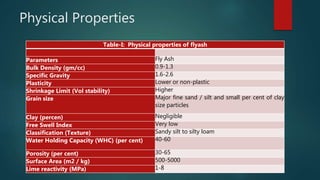
Physical Properties
Table-I: Physical properties of flyash
Parameters Fly Ash
Bulk Density (gm/cc) 0.9-1.3
Specific Gravity 1.6-2.6
Plasticity Lower or non-plastic
Shrinkage Limit (Vol stability) Higher
Grain size Major fine sand / silt and small per cent of clay
size particles
Clay (percen) Negligible
Free Swell Index Very low
Classification (Texture) Sandy silt to silty loam
Water Holding Capacity (WHC) (per cent) 40-60
Porosity (per cent) 30-65
Surface Area (m2 / kg) 500-5000
Lime reactivity (MPa) 1-8
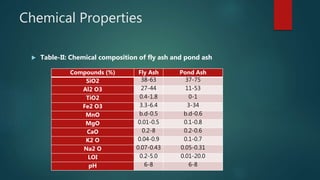
Chemical Properties
 Table-II: Chemical composition of fly ash and pond ash
Compounds (%) Fly Ash Pond Ash
SiO2 38-63 37-75
Al2 O3 27-44 11-53
TiO2 0.4-1.8 0-1
Fe2 O3 3.3-6.4 3-34
MnO b.d-0.5 b.d-0.6
MgO 0.01-0.5 0.1-0.8
CaO 0.2-8 0.2-0.6
K2 O 0.04-0.9 0.1-0.7
Na2 O 0.07-0.43 0.05-0.31
LOI 0.2-5.0 0.01-20.0
pH 6-8 6-8
Use of Fly ash in Road Making
Bulk utilization of fly ash in construction has a lot of potential. National Highway
Authority of India (NHAI) is currently using 100 lakh Tonne fly ash in construction in
different NH projects in India and proposed to increase it two folds in the future.
The scope of utilization of fly ash in Road construction are:
 Embankments and backfills – Reinforced or unreinforced.
 Stabilisation of subgrade, sub-base and base course.
 For replacing a part of OPC in Concrete pavements, paving blocks, kerb stones.
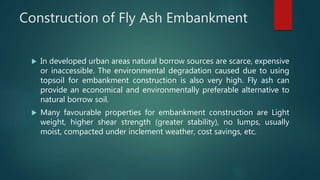
Construction of Fly Ash Embankment
 In developed urban areas natural borrow sources are scarce, expensive
or inaccessible. The environmental degradation caused due to using
topsoil for embankment construction is also very high. Fly ash can
provide an economical and environmentally preferable alternative to
natural borrow soil.
 Many favourable properties for embankment construction are Light
weight, higher shear strength (greater stability), no lumps, usually
moist, compacted under inclement weather, cost savings, etc.
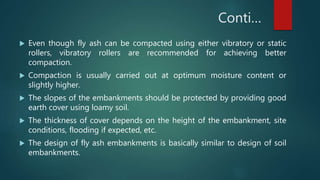
Conti…
 Even though fly ash can be compacted using either vibratory or static
rollers, vibratory rollers are recommended for achieving better
compaction.
 Compaction is usually carried out at optimum moisture content or
slightly higher.
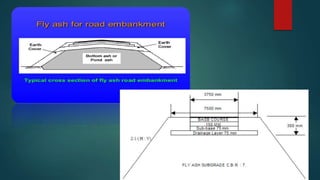
 The slopes of the embankments should be protected by providing good
earth cover using loamy soil.
 The thickness of cover depends on the height of the embankment, site
conditions, flooding if expected, etc.
 The design of fly ash embankments is basically similar to design of soil
embankments.
 The design techniques use limit equilibrium method for stability
analysis of embankment.
 Many computer software's are available for quickly analysing stability
of different types of embankment sections.
 The compacted thickness of intermediate soil layers may vary from 0.2
to 0.4 m.
 Geo synthetic materials like geo grids or geo textiles can be used as
reinforcement for construction of reinforced fly ash embankments.
Conti…
Methodology
The methodology of construction of embankment with fly ash differs from the
construction with ordinary soil in the following ways :
 The Fly ash embankment should be covered on the sides and top up by
suitable earth to prevent erosion of ash.
 Site investigation is required for determining characteristics of materials and
detailed design before its application.
 Embankment constructed in flood–prone areas should be protected by stone
pitching.
 The sulphate content in fly ash should be within the specified limits otherwise
it may create corrosion, if metallic pipes, metallic reinforcement, etc. come in
contact with fly ash.
Engineering Properties
The following engineering properties are to be determined
before undertaking fly ash embankment construction.
 Particle size distribution.
 Maximum dry-density.
 Shear strength and permeability.
 Drainage properties.
Highlights of IRC SP:58
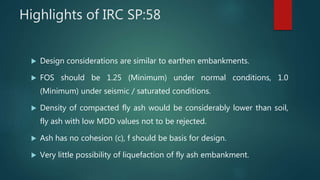
 Design considerations are similar to earthen embankments.
 FOS should be 1.25 (Minimum) under normal conditions, 1.0
(Minimum) under seismic / saturated conditions.
 Density of compacted fly ash would be considerably lower than soil,
fly ash with low MDD values not to be rejected.
 Ash has no cohesion (c), f should be basis for design.
 Very little possibility of liquefaction of fly ash embankment.
Conti…
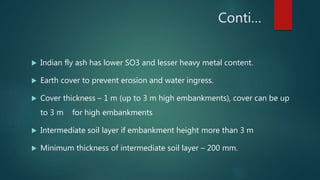
 Indian fly ash has lower SO3 and lesser heavy metal content.
 Earth cover to prevent erosion and water ingress.
 Cover thickness – 1 m (up to 3 m high embankments), cover can be up
to 3 m for high embankments
 Intermediate soil layer if embankment height more than 3 m
 Minimum thickness of intermediate soil layer – 200 mm.
Flyash in roads

Flyash in roads

  • 1.
    Use of Flyash in Roads PRESENTED BY: HIMANSHU PIPALIYA
  • 2.
    Introduction  Fly ashis a fine residue of coal combustion in the Thermal Power Plants.  The thermal grade Indian coal contains 35 to 45% of ash resulting in generation of huge quantity of fly ash.  Coal being the main raw material for thermal power generation, ash is the essential by product.
  • 3.
    Conti..  Huge quantityof bottom ash & fly ash are generated from boilers of coal fired Thermal Power Plants (TPP).  Internationally fly ash is considered as a by product which can be used for many appliances.  As a result of experiences gained in these projects, specifications for  construction of road embankments and guidelines for usage of fly ash for rural roads were compiled and these have been published by the Indian Roads Congress.
  • 4.
    Fly ash asa Road construction material For overall evaluation of industrial wastes for use as construction materials a ‘NICE’ criterion has been suggested which is explained below:  ‘N’on-hazardous: Fly Ash non-hazardous with regard to ignitability, corrosivity, reactivity and toxicity.  ‘I’m provable: It should possess high potential for improvability of its properties, such as workability, performance in conjunction with additives.  ‘C’ompatible with other construction materials and consistent in its properties.  ‘E’conomically feasible, it should have the characteristics of low unit cost and high quality resulting in savings on construction cost, usable as produced without costly processing, enough and easily available fly ash is a really ‘NICE’ material for use in road pavements and embankments.
  • 5.
    Characteristics of FlyAsh The following characteristics of fly ash make it a preferred material for road construction.  Lightweight as compared to commonly used fill material (local soils), therefore, causes lesser settlements.  Higher value of California Bearing Ratio as compared to soil provides for a more efficient design of road pavement.  Pozzolanic hardening property imparts additional strength to the road pavements/embankments and decreases the post construction horizontal pressure on retaining walls.
  • 6.
    Conti…  Easy tohandle and compact because the material is light and there are no large lumps to be broken down. Can be compacted using either vibratory or static rollers.  High permeability ensures free and efficient drainage. After rainfall, water gets drained out freely ensuring better workability than soil, especially during monsoons. Work on fly ash fills/ embankments can be restarted within a few hours after rainfall, while in case of soil it requires much longer period.  Fly Ash decreases swelling potential of expansive soils.
  • 7.
    Physical Properties Table-I: Physicalproperties of flyash Parameters Fly Ash Bulk Density (gm/cc) 0.9-1.3 Specific Gravity 1.6-2.6 Plasticity Lower or non-plastic Shrinkage Limit (Vol stability) Higher Grain size Major fine sand / silt and small per cent of clay size particles Clay (percen) Negligible Free Swell Index Very low Classification (Texture) Sandy silt to silty loam Water Holding Capacity (WHC) (per cent) 40-60 Porosity (per cent) 30-65 Surface Area (m2 / kg) 500-5000 Lime reactivity (MPa) 1-8
  • 8.
    Chemical Properties  Table-II:Chemical composition of fly ash and pond ash Compounds (%) Fly Ash Pond Ash SiO2 38-63 37-75 Al2 O3 27-44 11-53 TiO2 0.4-1.8 0-1 Fe2 O3 3.3-6.4 3-34 MnO b.d-0.5 b.d-0.6 MgO 0.01-0.5 0.1-0.8 CaO 0.2-8 0.2-0.6 K2 O 0.04-0.9 0.1-0.7 Na2 O 0.07-0.43 0.05-0.31 LOI 0.2-5.0 0.01-20.0 pH 6-8 6-8
  • 9.
    Use of Flyash in Road Making Bulk utilization of fly ash in construction has a lot of potential. National Highway Authority of India (NHAI) is currently using 100 lakh Tonne fly ash in construction in different NH projects in India and proposed to increase it two folds in the future. The scope of utilization of fly ash in Road construction are:  Embankments and backfills – Reinforced or unreinforced.  Stabilisation of subgrade, sub-base and base course.  For replacing a part of OPC in Concrete pavements, paving blocks, kerb stones.
  • 10.
    Construction of FlyAsh Embankment  In developed urban areas natural borrow sources are scarce, expensive or inaccessible. The environmental degradation caused due to using topsoil for embankment construction is also very high. Fly ash can provide an economical and environmentally preferable alternative to natural borrow soil.  Many favourable properties for embankment construction are Light weight, higher shear strength (greater stability), no lumps, usually moist, compacted under inclement weather, cost savings, etc.
  • 11.
    Conti…  Even thoughfly ash can be compacted using either vibratory or static rollers, vibratory rollers are recommended for achieving better compaction.  Compaction is usually carried out at optimum moisture content or slightly higher.  The slopes of the embankments should be protected by providing good earth cover using loamy soil.  The thickness of cover depends on the height of the embankment, site conditions, flooding if expected, etc.  The design of fly ash embankments is basically similar to design of soil embankments.
  • 12.
     The designtechniques use limit equilibrium method for stability analysis of embankment.  Many computer software's are available for quickly analysing stability of different types of embankment sections.  The compacted thickness of intermediate soil layers may vary from 0.2 to 0.4 m.  Geo synthetic materials like geo grids or geo textiles can be used as reinforcement for construction of reinforced fly ash embankments. Conti…
  • 14.
    Methodology The methodology ofconstruction of embankment with fly ash differs from the construction with ordinary soil in the following ways :  The Fly ash embankment should be covered on the sides and top up by suitable earth to prevent erosion of ash.  Site investigation is required for determining characteristics of materials and detailed design before its application.  Embankment constructed in flood–prone areas should be protected by stone pitching.  The sulphate content in fly ash should be within the specified limits otherwise it may create corrosion, if metallic pipes, metallic reinforcement, etc. come in contact with fly ash.
  • 15.
    Engineering Properties The followingengineering properties are to be determined before undertaking fly ash embankment construction.  Particle size distribution.  Maximum dry-density.  Shear strength and permeability.  Drainage properties.
  • 16.
    Highlights of IRCSP:58  Design considerations are similar to earthen embankments.  FOS should be 1.25 (Minimum) under normal conditions, 1.0 (Minimum) under seismic / saturated conditions.  Density of compacted fly ash would be considerably lower than soil, fly ash with low MDD values not to be rejected.  Ash has no cohesion (c), f should be basis for design.  Very little possibility of liquefaction of fly ash embankment.
  • 17.
    Conti…  Indian flyash has lower SO3 and lesser heavy metal content.  Earth cover to prevent erosion and water ingress.  Cover thickness – 1 m (up to 3 m high embankments), cover can be up to 3 m for high embankments  Intermediate soil layer if embankment height more than 3 m  Minimum thickness of intermediate soil layer – 200 mm.