SRCCpostertemplateprovidedbyInstructionalResourcesandOfficeofUndergraduateResearch
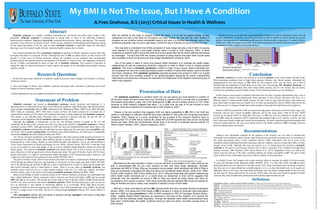
My BMI Is Not The Issue, But I Have A Condition
A.Yves Gnohoue, B.S (2013) Critical Issues in Health & Wellness
1. Do the risk factors that contribute to metabolic syndrome present a major change in the lifestyles of African
American women?
2. Does knowledge of obesity and metabolic syndrome encourage better outcomes of physical and overall
health for African American women?
3.What modifications can one establish for healthier living that is not susceptible to the metabolic syndrome?
Metabolic syndrome; also known as dysmetabolic syndrome, obesity syndrome and Syndrome X, is
characterized as an individual having three of the following conditions: high blood sugar, high blood pressure,
large waistline (visceral fat) and low HDL cholesterol levels (Bhatheja & Bhatt, 2006; Ervin, 2009; Hawkins,
2007; Lakka & Laaksonen, 2007). With three or more of these risk factors present one is at high risk of
cardiovascular diseases (CVD) which will eventually lead them to being diagnosed with metabolic syndrome.
This disease is one affecting many Americans and is expected to increase with age. By age 60, 40% of
Americans will be diagnosed with the metabolic syndrome (Grundy, 2008).
Although this epidemic is continuously on the rise and affecting millions of people in the U.S and
worldwide, for the sake of this research one will be focusing on the specifics of metabolic syndrome in African
American women (AAW). Although focusing on AAW one must also understand that many factors play a role
in metabolic syndrome and that before an individual becomes diagnosed, they may have been susceptible to the
risk factors due to genetic predisposition, environment, and cultural differences, all which play a considerable
role beside sedentary life style (Lakka & Laaksonen, 2007).
The African American population is the focus population, like many disease health medical personnel’s try
to understand how different disease affect different groups of people. The problems of Metabolic syndrome
being present in AAW creates a burden on what health promoters and educators want to see and according to
United States Department of Health and Human Services (HHS), Healthy People 2020 (2012) what they want
to see is an increase in years and quality of life as well as eliminate health disparities among all racial and
ethnic groups. The relation of metabolic syndrome and Health People 2020 is that it focuses on one of the
many objectives of their program such as heart disease and stroke. The goal of Healthy People 2020 for heart
disease and stroke is to improve cardiovascular health and quality of life through prevention, detection, and
treatment of risk factors for heart attack and stroke (HHS, HP 2020, 2012).
The goal of Healthy People 2020 for heart disease and stroke is to improve cardiovascular health and quality
of life through prevention, detection, and treatment of risk factors for heart attack and stroke (HHS, HP 2020,
2012). By introducing the problem of MS one is able to understand how it helps in improving the health risks
that would eventually lead to a heart attack or stroke. There is no one cause of metabolic syndrome, but
multiple causes which all serve as a chain reaction leading to the next. For AAW age, cultural, and family
histories all play a part in the chances of developing metabolic syndrome (Bhatheja & Bhatt, 2006).
Based on knowledge of health conditions present in the African American community one understands that
from cultural differences African Americans tend to consume soul food; foods high in LDL and not enough
HDL and high in salt content. This already has set the body at risk for increase chance of high blood pressure,
which is one of the risk factors that lead to metabolic syndrome. While blood pressure plays a part one can see
how an individual is also capable of developing diabetes or is overweight. While high blood pressure,
possibility of diabetes, and overweight are the conditions of an AAW hypothetically in her mid20’s. By the age
of 50-55 a change occurs in her body, she has or is going through menopause (Barad, 2012; Henry-Okafor et
al., 2011_
After menopause women lack the ability to produce enough estrogen in the body to help fight
and protect the heart (Barad, 2012).
Metabolic syndrome is a complex condition represented by risk factors that affect many people in this
generation. Metabolic syndrome is characterized as having three or more of the following conditions;
cardiovascular conditions, abdominal visceral fat, increased blood pressure, obesity, and diabetes. The research
correlates to the objectives of Healthy People’s 2020s mission statement of eliminating health disparities among
all and improving quality of life for years to come, metabolic syndrome in particular targets the individuals
showing a case of increased weight who later experience health concerns due to obesity.
This research identifies the risks of metabolic syndrome in specifics to African American women; their risks
are higher than those of Caucasian women. Although the risks of MS can affect anyone, as this research will
present it is more sever in African American women, the condition can be contained with recommended
moderate high to low physical activity with duration of 30 minutes 3-5 times a week. The importance of physical
activity is highly recommended for those at high risk of metabolic syndrome. This research is important in
setting the stage for future intervention to better improve the quality of all individuals facing health concerns
related to weight.
Statement of Problem
Research Questions
Abstract
Based on the information acquired for the purpose of the research, one was able to conclude that
individuals with conditions such as obesity, high blood pressure and insulin resistance have no awareness of
the extent and prolong effect of their conditions (Brown, 2008). Individuals with one or more of the
conditions should understand from their physicians, that the condition can have a long terms effect on there
already severe health. Although they may not perceive it as so, being obese all correlate to metabolic
syndrome at one point in time because someone who is obese is already at risk of diabetes and high blood
pressure (Grundy, 2008; Hawkins, 2007; Henry-Okafor et al., 2011). Regardless of how you look at the
matter everyone with any of the above example condition are already susceptible to MS. The goal or what
must be done to have individuals more aware of their condition is informing them.
As Healthy People 2020 sought to do in their everyday efforts to increase the quality of life and number
of years and eliminate health disparities (HHS, HP2020, 2012). It is clear that AAW with MS are those
individuals that fit into the objectives of Healthy People 2020. These individuals know the health conditions
they face are not of great debate but as health educators it is a set duty that health risks to all people are
addressed, rather or not if they are being followed through. One can simply compare health to laws, the laws
are there and are being enforced but not everyone follows them, the same rule should be applied to health
concerns, they must be addressed continuously until and after improvements are met.
Definitions
Presentation of Data
Based on the next set of data from comparing health conditions of AAW to Caucasian women, one will
see how important it is that this research be presented in order to inform as well as educate the general
public of the importance of understanding MS and how obesity can play a major part. As stated by Brown
(2008) one is able to compare the severity of the following disease presented in the chart in terms of their
prevalence in AAW compare to Caucasian Women.
Recommendations
Metabolic syndrome in essence has become an increased epidemic in the United States and still rising.
With preexisting conditions such as high blood pressure, diabetes, and obesity present, individuals are
predetermined to have the disease of MS. While for this research AAW were the focus, one is able to
conclude that this population of individuals are at large risk of developing MS. Metabolic Syndrome is a
condition that reminds individuals that while minor health concerns may be over looked, they are slowly
evolving into something of greater health concern if intervention precautions are not introduced.
Further analysis and research is needed to determine how the risks of genetic abnormalities play a role in
MS. Researchers, doctors and professionals, those presented in this research and those who focus on a
different aspect of cardiovascular health concerns all have come to agree that preventive intervention are
good initial steps in improving one’s health. Few of which are presented by Brown (2008), believed the one
way that one can see change in health and overall condition is through life modification and weight loss.
Hawkins (2007) presented that AAW are reported having greater satisfaction with their body image more
frequently and are now viewed acceptable ethnically and by the social peers. Clark & El-Atat, (2007)
focused on prevention which he stated that with focus on BMI one will see reduction in weight and can
prevent MS. Lakka & Laaksonen (2007) mentioned that moderate high to low intensity exercise can help
show a decrease in body weight and visceral fat accumulation. All these researches presented throughout this
research conclude that the only way to see improvement in the health condition of MS is through conscious
decisions making about ones health.
BMI stands as the main identifier of rather or not an individual is overweight or not, many AAW do not
tend to acknowledge BMI but are more focused on their own body image satisfaction. Normally
individuals with BMI of 18.5kg- 25kg are considered normal weight, while individuals with BMI of 25kg to
30kg are considered overweight and 30kg and above are considered obese (Brown, 2008; Ervin, 2009;
Grundy, 2008; Hawkins, 2007; Henry-Okafor et al., 2011). Although these data help assist in determining
which health levels individuals are in, a recent study by Braverman & Shah (2012) suggests that
individuals who are classified as having a BMI of 30kg and above as being obese may show an
inconsistency from person to person. Their study concluded that the standard BMI should be lowered to
24kg for females and 28 for males, more research is needed in focus of this matter.
AAW are ¼ times more likely to die from MS imposed death than their Caucaian Women counterparts
(Brown, 2008). CVD being one of the results of MS is showed in a study by American heart association
data from 2005 as being prevalence in 49% of AAW compared to 35% of Caucasian Women (Brown,
2008). Healthy People 2020s objectives as mentioned in the body of this research is to improve the
quality of life and eliminate health disparities. Through the decades many health advancements have
been seen. Unfortunately, the health conditions faced by racial and ethnic minorities surpass those of
other groups.
With the inability of the body to properly protect the heart, it is at risk for plaque buildup of fatty
substances not only in the heart but throughout the body. Clearly one can see the chain reaction in
progress as one condition almost immediately leads to the next. It is obvious that although many of the
conditions presented may not occur right away, in AAW the risk or chances of it occurring are very high.
One was able to understand how AAWs perception of body image can play a role in them not paying
close attention to their diet s and health choices when it comes to food (Hawkins, 2007). A study
presented by Hawkins (2007) found that AAW tend to be a great deal heavier before defining themselves
as overweight. The fact that AAW are socially accepted as being heavier then their white counter parts
also correlates to them not showing any body image dissatisfaction (Hawkins, 2007).
One of the goals or tasks of future and present health educators is to evaluate the health needs,
implementing as well as presenting preventive measures in order to offset a new or already present
epidemic. The focus of metabolic syndrome in AAW is a topic of such nature, where individuals who
are at greatest risk have the underlying already present condition of abdominal obesity, inactive life style
and insulin resistance. With metabolic syndrome projected as being more present in AAW, it is of great
concern that with such condition present in our global population assessing the needs, implementing
interventions and preventive measures be essential to the betterment of the targeted concerned group of
AAW in this research.
Conclusion
The metabolic syndrome is a condition which one can say serves as a final element or creation of
all the minor health concerns faced every day. According to Hawkins (2007) one was able to understand
that obesity alone plays a major role in the development of MS, and an increase chance of CVD. While
focusing on AAW research suggests that about 1 in 4 AAW over the age of 55 are inclined to have
diabetes, while also projecting an increased rate in AAW (Hawkins, 2007).
Obesity is the one condition that suggests AAW are highly susceptible to MS, 66% of all AAW are
obese or overweight no effective methods have been adopted to help guide this recognized population
(Hawkins, 2007). Based on a survey conducted for the purpose of the research Hawkins came to
conclude that 71% of AAW live an inactive life, where 68% of AAW reported less than 20 min of physical
activity per week. While the recommended activity level is 30 minute of moderate physical activity 3-5
times a week (Hawkins, 2007; Lakka & Laaksonen, 2007).
0
10
20
30
40
50
60
70
80
CVD49-35 CHD7.8-6 BP46.6-31.9 Heart
Failure3.3-2.1
Stroke 4.1-2.7 Overweight7
9.6-56.6
African Am Women
Caucasian Women Graph made by: Yves Gnohoue.
Dysmetabolic syndrome – (another name for metabolic syndrome) - Group of risk factors that raises risk for heart disease stroke
Epidemic - an outbreak of a disease that spreads more quickly and more extensively among a group of people than would normally be expected
Estrogen - a steroid hormone, produced mainly in the ovaries, that stimulates estrus and the development of female secondary sexual characteristics
Epidemic – described as a case affecting many people at the same time; when present in as disease spreads from person to person
HDL – high density lipoprotein
LDL – low density lipoprotein
Metabolic syndrome - Group of risk factors that raises risk for heart disease stroke
Menopause - Diminished menstruation and cessation; usually occurs between ages 45 - 50
MS – metabolic syndrome
Predisposition - the fact or condition of being predisposed
Prevalence- Widespread
Susceptible – Ability to be influenced by something else due to previous condition; to be easily affected
Sedentary – Inactive lifestyle to sit most of the time and getting little exercise
Visceral fat – Fats that are stored in, over, and under the abdominal extremities.

My BMI is Not The Issue, But I Have A Condition

  • 1.
    SRCCpostertemplateprovidedbyInstructionalResourcesandOfficeofUndergraduateResearch My BMI IsNot The Issue, But I Have A Condition A.Yves Gnohoue, B.S (2013) Critical Issues in Health & Wellness 1. Do the risk factors that contribute to metabolic syndrome present a major change in the lifestyles of African American women? 2. Does knowledge of obesity and metabolic syndrome encourage better outcomes of physical and overall health for African American women? 3.What modifications can one establish for healthier living that is not susceptible to the metabolic syndrome? Metabolic syndrome; also known as dysmetabolic syndrome, obesity syndrome and Syndrome X, is characterized as an individual having three of the following conditions: high blood sugar, high blood pressure, large waistline (visceral fat) and low HDL cholesterol levels (Bhatheja & Bhatt, 2006; Ervin, 2009; Hawkins, 2007; Lakka & Laaksonen, 2007). With three or more of these risk factors present one is at high risk of cardiovascular diseases (CVD) which will eventually lead them to being diagnosed with metabolic syndrome. This disease is one affecting many Americans and is expected to increase with age. By age 60, 40% of Americans will be diagnosed with the metabolic syndrome (Grundy, 2008). Although this epidemic is continuously on the rise and affecting millions of people in the U.S and worldwide, for the sake of this research one will be focusing on the specifics of metabolic syndrome in African American women (AAW). Although focusing on AAW one must also understand that many factors play a role in metabolic syndrome and that before an individual becomes diagnosed, they may have been susceptible to the risk factors due to genetic predisposition, environment, and cultural differences, all which play a considerable role beside sedentary life style (Lakka & Laaksonen, 2007). The African American population is the focus population, like many disease health medical personnel’s try to understand how different disease affect different groups of people. The problems of Metabolic syndrome being present in AAW creates a burden on what health promoters and educators want to see and according to United States Department of Health and Human Services (HHS), Healthy People 2020 (2012) what they want to see is an increase in years and quality of life as well as eliminate health disparities among all racial and ethnic groups. The relation of metabolic syndrome and Health People 2020 is that it focuses on one of the many objectives of their program such as heart disease and stroke. The goal of Healthy People 2020 for heart disease and stroke is to improve cardiovascular health and quality of life through prevention, detection, and treatment of risk factors for heart attack and stroke (HHS, HP 2020, 2012). The goal of Healthy People 2020 for heart disease and stroke is to improve cardiovascular health and quality of life through prevention, detection, and treatment of risk factors for heart attack and stroke (HHS, HP 2020, 2012). By introducing the problem of MS one is able to understand how it helps in improving the health risks that would eventually lead to a heart attack or stroke. There is no one cause of metabolic syndrome, but multiple causes which all serve as a chain reaction leading to the next. For AAW age, cultural, and family histories all play a part in the chances of developing metabolic syndrome (Bhatheja & Bhatt, 2006). Based on knowledge of health conditions present in the African American community one understands that from cultural differences African Americans tend to consume soul food; foods high in LDL and not enough HDL and high in salt content. This already has set the body at risk for increase chance of high blood pressure, which is one of the risk factors that lead to metabolic syndrome. While blood pressure plays a part one can see how an individual is also capable of developing diabetes or is overweight. While high blood pressure, possibility of diabetes, and overweight are the conditions of an AAW hypothetically in her mid20’s. By the age of 50-55 a change occurs in her body, she has or is going through menopause (Barad, 2012; Henry-Okafor et al., 2011_ After menopause women lack the ability to produce enough estrogen in the body to help fight and protect the heart (Barad, 2012). Metabolic syndrome is a complex condition represented by risk factors that affect many people in this generation. Metabolic syndrome is characterized as having three or more of the following conditions; cardiovascular conditions, abdominal visceral fat, increased blood pressure, obesity, and diabetes. The research correlates to the objectives of Healthy People’s 2020s mission statement of eliminating health disparities among all and improving quality of life for years to come, metabolic syndrome in particular targets the individuals showing a case of increased weight who later experience health concerns due to obesity. This research identifies the risks of metabolic syndrome in specifics to African American women; their risks are higher than those of Caucasian women. Although the risks of MS can affect anyone, as this research will present it is more sever in African American women, the condition can be contained with recommended moderate high to low physical activity with duration of 30 minutes 3-5 times a week. The importance of physical activity is highly recommended for those at high risk of metabolic syndrome. This research is important in setting the stage for future intervention to better improve the quality of all individuals facing health concerns related to weight. Statement of Problem Research Questions Abstract Based on the information acquired for the purpose of the research, one was able to conclude that individuals with conditions such as obesity, high blood pressure and insulin resistance have no awareness of the extent and prolong effect of their conditions (Brown, 2008). Individuals with one or more of the conditions should understand from their physicians, that the condition can have a long terms effect on there already severe health. Although they may not perceive it as so, being obese all correlate to metabolic syndrome at one point in time because someone who is obese is already at risk of diabetes and high blood pressure (Grundy, 2008; Hawkins, 2007; Henry-Okafor et al., 2011). Regardless of how you look at the matter everyone with any of the above example condition are already susceptible to MS. The goal or what must be done to have individuals more aware of their condition is informing them. As Healthy People 2020 sought to do in their everyday efforts to increase the quality of life and number of years and eliminate health disparities (HHS, HP2020, 2012). It is clear that AAW with MS are those individuals that fit into the objectives of Healthy People 2020. These individuals know the health conditions they face are not of great debate but as health educators it is a set duty that health risks to all people are addressed, rather or not if they are being followed through. One can simply compare health to laws, the laws are there and are being enforced but not everyone follows them, the same rule should be applied to health concerns, they must be addressed continuously until and after improvements are met. Definitions Presentation of Data Based on the next set of data from comparing health conditions of AAW to Caucasian women, one will see how important it is that this research be presented in order to inform as well as educate the general public of the importance of understanding MS and how obesity can play a major part. As stated by Brown (2008) one is able to compare the severity of the following disease presented in the chart in terms of their prevalence in AAW compare to Caucasian Women. Recommendations Metabolic syndrome in essence has become an increased epidemic in the United States and still rising. With preexisting conditions such as high blood pressure, diabetes, and obesity present, individuals are predetermined to have the disease of MS. While for this research AAW were the focus, one is able to conclude that this population of individuals are at large risk of developing MS. Metabolic Syndrome is a condition that reminds individuals that while minor health concerns may be over looked, they are slowly evolving into something of greater health concern if intervention precautions are not introduced. Further analysis and research is needed to determine how the risks of genetic abnormalities play a role in MS. Researchers, doctors and professionals, those presented in this research and those who focus on a different aspect of cardiovascular health concerns all have come to agree that preventive intervention are good initial steps in improving one’s health. Few of which are presented by Brown (2008), believed the one way that one can see change in health and overall condition is through life modification and weight loss. Hawkins (2007) presented that AAW are reported having greater satisfaction with their body image more frequently and are now viewed acceptable ethnically and by the social peers. Clark & El-Atat, (2007) focused on prevention which he stated that with focus on BMI one will see reduction in weight and can prevent MS. Lakka & Laaksonen (2007) mentioned that moderate high to low intensity exercise can help show a decrease in body weight and visceral fat accumulation. All these researches presented throughout this research conclude that the only way to see improvement in the health condition of MS is through conscious decisions making about ones health. BMI stands as the main identifier of rather or not an individual is overweight or not, many AAW do not tend to acknowledge BMI but are more focused on their own body image satisfaction. Normally individuals with BMI of 18.5kg- 25kg are considered normal weight, while individuals with BMI of 25kg to 30kg are considered overweight and 30kg and above are considered obese (Brown, 2008; Ervin, 2009; Grundy, 2008; Hawkins, 2007; Henry-Okafor et al., 2011). Although these data help assist in determining which health levels individuals are in, a recent study by Braverman & Shah (2012) suggests that individuals who are classified as having a BMI of 30kg and above as being obese may show an inconsistency from person to person. Their study concluded that the standard BMI should be lowered to 24kg for females and 28 for males, more research is needed in focus of this matter. AAW are ¼ times more likely to die from MS imposed death than their Caucaian Women counterparts (Brown, 2008). CVD being one of the results of MS is showed in a study by American heart association data from 2005 as being prevalence in 49% of AAW compared to 35% of Caucasian Women (Brown, 2008). Healthy People 2020s objectives as mentioned in the body of this research is to improve the quality of life and eliminate health disparities. Through the decades many health advancements have been seen. Unfortunately, the health conditions faced by racial and ethnic minorities surpass those of other groups. With the inability of the body to properly protect the heart, it is at risk for plaque buildup of fatty substances not only in the heart but throughout the body. Clearly one can see the chain reaction in progress as one condition almost immediately leads to the next. It is obvious that although many of the conditions presented may not occur right away, in AAW the risk or chances of it occurring are very high. One was able to understand how AAWs perception of body image can play a role in them not paying close attention to their diet s and health choices when it comes to food (Hawkins, 2007). A study presented by Hawkins (2007) found that AAW tend to be a great deal heavier before defining themselves as overweight. The fact that AAW are socially accepted as being heavier then their white counter parts also correlates to them not showing any body image dissatisfaction (Hawkins, 2007). One of the goals or tasks of future and present health educators is to evaluate the health needs, implementing as well as presenting preventive measures in order to offset a new or already present epidemic. The focus of metabolic syndrome in AAW is a topic of such nature, where individuals who are at greatest risk have the underlying already present condition of abdominal obesity, inactive life style and insulin resistance. With metabolic syndrome projected as being more present in AAW, it is of great concern that with such condition present in our global population assessing the needs, implementing interventions and preventive measures be essential to the betterment of the targeted concerned group of AAW in this research. Conclusion The metabolic syndrome is a condition which one can say serves as a final element or creation of all the minor health concerns faced every day. According to Hawkins (2007) one was able to understand that obesity alone plays a major role in the development of MS, and an increase chance of CVD. While focusing on AAW research suggests that about 1 in 4 AAW over the age of 55 are inclined to have diabetes, while also projecting an increased rate in AAW (Hawkins, 2007). Obesity is the one condition that suggests AAW are highly susceptible to MS, 66% of all AAW are obese or overweight no effective methods have been adopted to help guide this recognized population (Hawkins, 2007). Based on a survey conducted for the purpose of the research Hawkins came to conclude that 71% of AAW live an inactive life, where 68% of AAW reported less than 20 min of physical activity per week. While the recommended activity level is 30 minute of moderate physical activity 3-5 times a week (Hawkins, 2007; Lakka & Laaksonen, 2007). 0 10 20 30 40 50 60 70 80 CVD49-35 CHD7.8-6 BP46.6-31.9 Heart Failure3.3-2.1 Stroke 4.1-2.7 Overweight7 9.6-56.6 African Am Women Caucasian Women Graph made by: Yves Gnohoue. Dysmetabolic syndrome – (another name for metabolic syndrome) - Group of risk factors that raises risk for heart disease stroke Epidemic - an outbreak of a disease that spreads more quickly and more extensively among a group of people than would normally be expected Estrogen - a steroid hormone, produced mainly in the ovaries, that stimulates estrus and the development of female secondary sexual characteristics Epidemic – described as a case affecting many people at the same time; when present in as disease spreads from person to person HDL – high density lipoprotein LDL – low density lipoprotein Metabolic syndrome - Group of risk factors that raises risk for heart disease stroke Menopause - Diminished menstruation and cessation; usually occurs between ages 45 - 50 MS – metabolic syndrome Predisposition - the fact or condition of being predisposed Prevalence- Widespread Susceptible – Ability to be influenced by something else due to previous condition; to be easily affected Sedentary – Inactive lifestyle to sit most of the time and getting little exercise Visceral fat – Fats that are stored in, over, and under the abdominal extremities.