EE - 304 . 56 1
Name of the Faculty : B.V.Ramadevi
Designation : Lecturer
Branch : Electrical
Institute : Govt. Polytechnic , Gudur
Year/Semester : III semester
Subject : Electrical Measurements and
Batteries
Code :EE-304
Topic : Transducers and Sensors
Sub topic : Transducers
Duration : 50 minutes
Teaching Aids : PPT
DEPARTMENT OF TECHNICAL EDUCATION
ANDHRA PRADESH
RECAP
Q) Name the devices used for measurement of
Temperature
Answer :
Thermistors and Thermocouples
Q) Which type of thermistors are most
commonly used ?
 a) NTC type
 b) PTC type
 c) Both
 d) None 2
EE - 304 . 56
Objectives
After completion of this period you should be able to
know about
Strain transducers
Factors influencing the choice of transducers
3
EE - 304 . 56
Strain gauge
Strain serves as an index of pressure
Strain gauge are classified as
Mechanical,
Optical and
Electrical
Strain transfers the from the specimen to the basic gauge
element
Electrical strain gauge measure the changes that occurs in
Resistance,
Inductance and
Capacitance
The most versatile type electrical strain gauge is the
Resistance type.
4
EE - 304 . 56
High accuracy
Reliable data and known performance
Flat frequency response from steady state to several
thousand Hertz
Standardized signal conditioning device
Advantages of using Electrical Strain Gauge:
5
EE - 304 . 56
Experimental stress analysis of machine structures
Construction of force , torque , pressure , flow and
acceleration transducers
Applications of Strain Gauges:
6
EE - 304 . 56
Types of Strain Gauges:
 1. Unbonded resistance wire strain gauge
 2 . Bonded resistance wire strain gauge
 3. Bonded metal foil strain gauge
 4. Bonded semiconductor strain gauge
 5. Vacuum deposited thin metal film strain gauge
 6. Sputter deposited thin metal strain gauge
 7. Diffused metal strain gauge
7
EE - 304 . 56
Strain Gauge Measurement Technique
A metal wire or the foil whose strain is to be measured
is attached to the element
The element deforms as soon as stress is applied.
As strain is a fractional change in resistance reflects
strain of gauge and element
Wheatstone bridge has very high sensitivity for
deflecting very small change in resistance
8
EE - 304 . 56
Unbonded Resistance Strain Gauge
Construction :
It consists of a wire stretched between two points
in an insulating medium such as air
The diameter of the wire is about 25µm
This wire is kept under tension so that there is no
sag and no free vibration
Unbonded strain gauges are usually connected in
a bridge circuit
9
EE - 304 . 56
Working :
apply load
Stress produced
strain changes resistance of one arm of the bridge
bridge gets unbalanced and produces O/p
O/p is proportional to strain
10
EE - 304 . 56
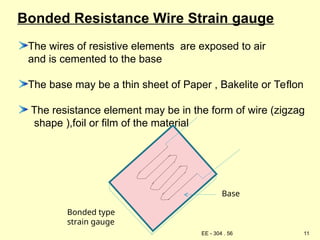
Bonded Resistance Wire Strain gauge
The wires of resistive elements are exposed to air
and is cemented to the base
The base may be a thin sheet of Paper , Bakelite or Teflon
The resistance element may be in the form of wire (zigzag
shape ),foil or film of the material
11
EE - 304 . 56
Bonded type
strain gauge
Base
Metallic Bonded Strain Gauge
Construction:
A fine wire element about 25 µ m or less in diameter is
looped back and forth on a base or mounting plate
The base (carrier ) is connected to the member
subjected to stress.
The grid of line wire is connected on a carrier
Carrier may be sheet of paper , Bakelite , Teflon
12
EE - 304 . 56
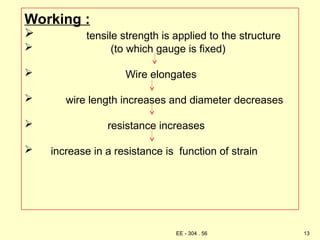
Working :
 tensile strength is applied to the structure
 (to which gauge is fixed)
 Wire elongates
 wire length increases and diameter decreases
 resistance increases
 increase in a resistance is function of strain
13
EE - 304 . 56
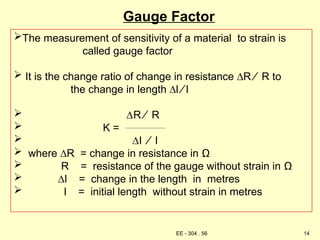
Gauge Factor
The measurement of sensitivity of a material to strain is
called gauge factor
 It is the change ratio of change in resistance ∆R ⁄ R to
the change in length ∆l ⁄ l
 ∆R ⁄ R
 K =
 ∆l ⁄ l
 where ∆R = change in resistance in Ω
 R = resistance of the gauge without strain in Ω
 ∆l = change in the length in metres
 l = initial length without strain in metres
14
EE - 304 . 56
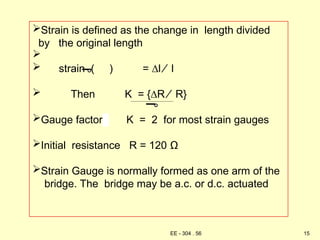
Strain is defined as the change in length divided
by the original length

 strain ( ) = ∆l ⁄ l
 Then K = {∆R ⁄ R}
Gauge factor K = 2 for most strain gauges
Initial resistance R = 120 Ω
Strain Gauge is normally formed as one arm of the
bridge. The bridge may be a.c. or d.c. actuated
15
EE - 304 . 56
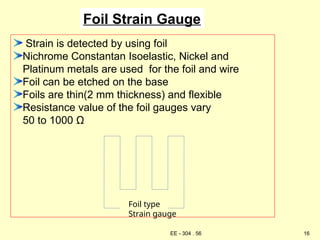
Foil Strain Gauge
Strain is detected by using foil
Nichrome Constantan Isoelastic, Nickel and
Platinum metals are used for the foil and wire
Foil can be etched on the base
Foils are thin(2 mm thickness) and flexible
Resistance value of the foil gauges vary
50 to 1000 Ω
Foil type
Strain gauge
16
EE - 304 . 56
Due to large surface area foil gauges have a much
greater dissipation capacity
Foil strain gauges can be used at a higher
operating temperature range
The characteristic of wire type and foil type strain
gauge are similar
Strain gauge factor is also same for wire type and
foil type strain gauges
These strain gauges can be mounted in remote
and restricted places and especially on curved
surfaces
They can be fabricated on a large scale and in any
shape
17
EE - 304 . 56
Semiconductor Strain Gauge
The basic principle of operation is Piezoresistive
effect
When strain applied, resistivity of the semiconductor
changes corresponding to it resistance changes
( In metallic gauges the change in resistance
is mainly due to dimension strained)
18
EE - 304 . 56
Construction
Germanium and silicon are used as semiconductor
material
Thickness of semiconductor wafer of filaments is
0.05 mm
They are bonded on insulating material Teflon
Gold leads are used for making contacts
These strain gauges are fabricated along with an
IC OP-AMP which act as a pressure transducer
19
EE - 304 . 56
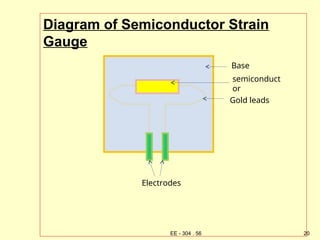
semiconduct
or
Gold leads
Electrodes
Base
Diagram of Semiconductor Strain
Gauge
20
EE - 304 . 56
Semiconductor strain gauges are used when
a very high value of gauge factor is desired
The gauge factor of these are about130+10%
for a unit of 350 Ω
The gauge is stable and can be operated with
conventional indicating and recording systems
21
EE - 304 . 56
Applications of Semiconductor Strain Gauges
Measurement of strain and the associated stress in
experimental stress analysis
Measurement of pressure, acceleration and
Temperature
Investigate strain in many structural materials over a
wide range of environmental conditions
In medical field investigation
22
EE - 304 . 56
Advantages :
High gauge factor
Long life (more than 10 X 106
operations )
Excellent frequency response
Very small in size ranging from 0.7 to 7 mm
Disadvantages:
1. Very sensitive to change in temperature
2. The gauge is more expensive
3. The linearity of the gauge is poor
4. The gauge factor varies with strain
23
EE - 304 . 56
Selection of a transducer
or
Factors influencing the Choice of
Transducer
Selection of an appropriate transducer is an important
decision to be taken for obtaining accurate results
This is because ,it is transducer through which the I/p
signal is transformed to a proportional electrical signal
24
EE - 304 . 56
The following points are to be considered
while selecting a particular transducer
1. The nature of the physical quantity to be measured
 Operating principle
 Operating range
 Sensitivity
 Accuracy
 Electrical parameters
 Transient and frequency response
 Environmental considerations
 Usage and ruggedness
 Errors
25
EE - 304 . 56
11. Loading effects
12. Stability and Reliability
13. Cost and availability
26
EE - 304 . 56
SUMMARY
In this period , we have discussed about
• Types of strain tranducers
• Factors influencing the choice of tranducers
Quiz
Q) What is the most versatile type of Electrical
Transducer
a) Resistance type
b) Inductance type
c) Capacitance type
d) None
Q) Identify the insulating materials used for base
in Strain gauges
a)Paper
b)Bakelite
c)Teflon
d)All the above
28
EE - 304 . 56
Questions
1. What is a Strain Gauge ?
2. List various types of Strain Gauges.
3 . What are the factors to be considered while
selecting the Transducers ?
4. Explain briefly about unbonded and bonded
resistance wire strain gauge.
29
EE - 304 . 56

Engineering topics strain gauge report ppt

  • 1.
    EE - 304. 56 1 Name of the Faculty : B.V.Ramadevi Designation : Lecturer Branch : Electrical Institute : Govt. Polytechnic , Gudur Year/Semester : III semester Subject : Electrical Measurements and Batteries Code :EE-304 Topic : Transducers and Sensors Sub topic : Transducers Duration : 50 minutes Teaching Aids : PPT DEPARTMENT OF TECHNICAL EDUCATION ANDHRA PRADESH
  • 2.
    RECAP Q) Name thedevices used for measurement of Temperature Answer : Thermistors and Thermocouples Q) Which type of thermistors are most commonly used ?  a) NTC type  b) PTC type  c) Both  d) None 2 EE - 304 . 56
  • 3.
    Objectives After completion ofthis period you should be able to know about Strain transducers Factors influencing the choice of transducers 3 EE - 304 . 56
  • 4.
    Strain gauge Strain servesas an index of pressure Strain gauge are classified as Mechanical, Optical and Electrical Strain transfers the from the specimen to the basic gauge element Electrical strain gauge measure the changes that occurs in Resistance, Inductance and Capacitance The most versatile type electrical strain gauge is the Resistance type. 4 EE - 304 . 56
  • 5.
    High accuracy Reliable dataand known performance Flat frequency response from steady state to several thousand Hertz Standardized signal conditioning device Advantages of using Electrical Strain Gauge: 5 EE - 304 . 56
  • 6.
    Experimental stress analysisof machine structures Construction of force , torque , pressure , flow and acceleration transducers Applications of Strain Gauges: 6 EE - 304 . 56
  • 7.
    Types of StrainGauges:  1. Unbonded resistance wire strain gauge  2 . Bonded resistance wire strain gauge  3. Bonded metal foil strain gauge  4. Bonded semiconductor strain gauge  5. Vacuum deposited thin metal film strain gauge  6. Sputter deposited thin metal strain gauge  7. Diffused metal strain gauge 7 EE - 304 . 56
  • 8.
    Strain Gauge MeasurementTechnique A metal wire or the foil whose strain is to be measured is attached to the element The element deforms as soon as stress is applied. As strain is a fractional change in resistance reflects strain of gauge and element Wheatstone bridge has very high sensitivity for deflecting very small change in resistance 8 EE - 304 . 56
  • 9.
    Unbonded Resistance StrainGauge Construction : It consists of a wire stretched between two points in an insulating medium such as air The diameter of the wire is about 25µm This wire is kept under tension so that there is no sag and no free vibration Unbonded strain gauges are usually connected in a bridge circuit 9 EE - 304 . 56
  • 10.
    Working : apply load Stressproduced strain changes resistance of one arm of the bridge bridge gets unbalanced and produces O/p O/p is proportional to strain 10 EE - 304 . 56
  • 11.
    Bonded Resistance WireStrain gauge The wires of resistive elements are exposed to air and is cemented to the base The base may be a thin sheet of Paper , Bakelite or Teflon The resistance element may be in the form of wire (zigzag shape ),foil or film of the material 11 EE - 304 . 56 Bonded type strain gauge Base
  • 12.
    Metallic Bonded StrainGauge Construction: A fine wire element about 25 µ m or less in diameter is looped back and forth on a base or mounting plate The base (carrier ) is connected to the member subjected to stress. The grid of line wire is connected on a carrier Carrier may be sheet of paper , Bakelite , Teflon 12 EE - 304 . 56
  • 13.
    Working :  tensilestrength is applied to the structure  (to which gauge is fixed)  Wire elongates  wire length increases and diameter decreases  resistance increases  increase in a resistance is function of strain 13 EE - 304 . 56
  • 14.
    Gauge Factor The measurementof sensitivity of a material to strain is called gauge factor  It is the change ratio of change in resistance ∆R ⁄ R to the change in length ∆l ⁄ l  ∆R ⁄ R  K =  ∆l ⁄ l  where ∆R = change in resistance in Ω  R = resistance of the gauge without strain in Ω  ∆l = change in the length in metres  l = initial length without strain in metres 14 EE - 304 . 56
  • 15.
    Strain is definedas the change in length divided by the original length   strain ( ) = ∆l ⁄ l  Then K = {∆R ⁄ R} Gauge factor K = 2 for most strain gauges Initial resistance R = 120 Ω Strain Gauge is normally formed as one arm of the bridge. The bridge may be a.c. or d.c. actuated 15 EE - 304 . 56
  • 16.
    Foil Strain Gauge Strainis detected by using foil Nichrome Constantan Isoelastic, Nickel and Platinum metals are used for the foil and wire Foil can be etched on the base Foils are thin(2 mm thickness) and flexible Resistance value of the foil gauges vary 50 to 1000 Ω Foil type Strain gauge 16 EE - 304 . 56
  • 17.
    Due to largesurface area foil gauges have a much greater dissipation capacity Foil strain gauges can be used at a higher operating temperature range The characteristic of wire type and foil type strain gauge are similar Strain gauge factor is also same for wire type and foil type strain gauges These strain gauges can be mounted in remote and restricted places and especially on curved surfaces They can be fabricated on a large scale and in any shape 17 EE - 304 . 56
  • 18.
    Semiconductor Strain Gauge Thebasic principle of operation is Piezoresistive effect When strain applied, resistivity of the semiconductor changes corresponding to it resistance changes ( In metallic gauges the change in resistance is mainly due to dimension strained) 18 EE - 304 . 56
  • 19.
    Construction Germanium and siliconare used as semiconductor material Thickness of semiconductor wafer of filaments is 0.05 mm They are bonded on insulating material Teflon Gold leads are used for making contacts These strain gauges are fabricated along with an IC OP-AMP which act as a pressure transducer 19 EE - 304 . 56
  • 20.
    semiconduct or Gold leads Electrodes Base Diagram ofSemiconductor Strain Gauge 20 EE - 304 . 56
  • 21.
    Semiconductor strain gaugesare used when a very high value of gauge factor is desired The gauge factor of these are about130+10% for a unit of 350 Ω The gauge is stable and can be operated with conventional indicating and recording systems 21 EE - 304 . 56
  • 22.
    Applications of SemiconductorStrain Gauges Measurement of strain and the associated stress in experimental stress analysis Measurement of pressure, acceleration and Temperature Investigate strain in many structural materials over a wide range of environmental conditions In medical field investigation 22 EE - 304 . 56
  • 23.
    Advantages : High gaugefactor Long life (more than 10 X 106 operations ) Excellent frequency response Very small in size ranging from 0.7 to 7 mm Disadvantages: 1. Very sensitive to change in temperature 2. The gauge is more expensive 3. The linearity of the gauge is poor 4. The gauge factor varies with strain 23 EE - 304 . 56
  • 24.
    Selection of atransducer or Factors influencing the Choice of Transducer Selection of an appropriate transducer is an important decision to be taken for obtaining accurate results This is because ,it is transducer through which the I/p signal is transformed to a proportional electrical signal 24 EE - 304 . 56
  • 25.
    The following pointsare to be considered while selecting a particular transducer 1. The nature of the physical quantity to be measured  Operating principle  Operating range  Sensitivity  Accuracy  Electrical parameters  Transient and frequency response  Environmental considerations  Usage and ruggedness  Errors 25 EE - 304 . 56
  • 26.
    11. Loading effects 12.Stability and Reliability 13. Cost and availability 26 EE - 304 . 56
  • 27.
    SUMMARY In this period, we have discussed about • Types of strain tranducers • Factors influencing the choice of tranducers
  • 28.
    Quiz Q) What isthe most versatile type of Electrical Transducer a) Resistance type b) Inductance type c) Capacitance type d) None Q) Identify the insulating materials used for base in Strain gauges a)Paper b)Bakelite c)Teflon d)All the above 28 EE - 304 . 56
  • 29.
    Questions 1. What isa Strain Gauge ? 2. List various types of Strain Gauges. 3 . What are the factors to be considered while selecting the Transducers ? 4. Explain briefly about unbonded and bonded resistance wire strain gauge. 29 EE - 304 . 56