Design Considerations for the Construction and Operation of Flour Milling Facilities. Part I  Planning, Structural, and Life Safety Gregory D Williams, Ph.D., P.E., S.E. Kurt Rosentrater, Ph.D
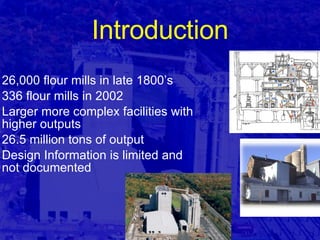
Introduction 26,000 flour mills in late 1800’s 336 flour mills in 2002 Larger more complex facilities with higher outputs 26.5 million tons of output Design Information is limited and not documented
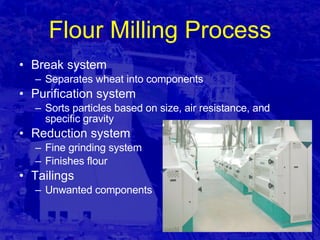
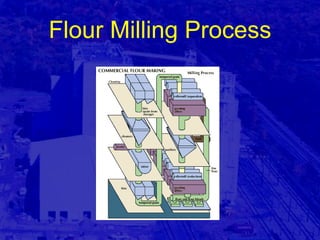
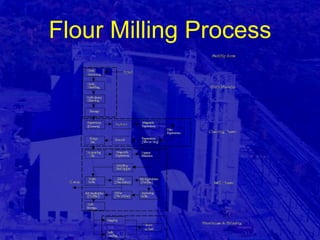
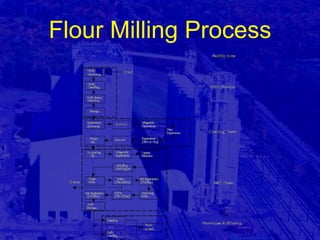
Flour Milling Process Break system Separates wheat into components Purification system Sorts particles based on size, air resistance, and specific gravity  Reduction system Fine grinding system Finishes flour Tailings Unwanted components
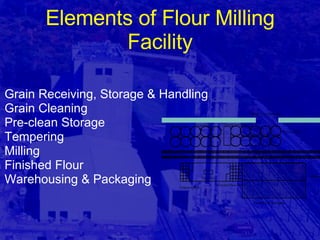
Elements of Flour Milling Facility Grain Receiving, Storage & Handling Grain Cleaning Pre-clean Storage  Tempering Milling Finished Flour Warehousing & Packaging
Flour Milling Process
Facility Planning Long Range Planning Strategic vision Organizational objectives Grain Supply Local farm sources Geographic area Wheat types Economic factors Local Grain types and volumes Global Population trends Demographics ROI
Facility Planning Regulatory Issues Good Manufacturing Practices (GMP’s) Identity Preservation Location/Site Transportation and Infrastructure Utilities Roads Rails/Trucking Site Properties Soil Bearing Drainage Expansion/New Construction Upgrading or expanding existing facility
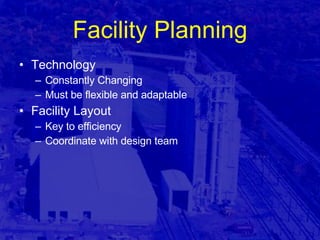
Facility Planning Technology Constantly Changing Must be flexible and adaptable Facility Layout Key to efficiency Coordinate with design team
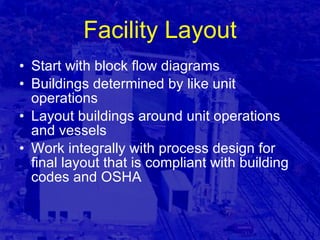
Facility Layout Start with block flow diagrams Buildings determined by like unit operations Layout buildings around unit operations and vessels Work integrally with process design for final layout that is compliant with building codes and OSHA
Flour Milling Process
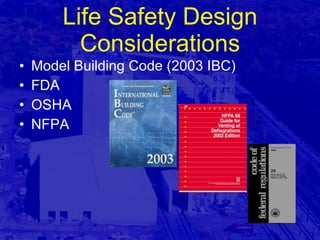
Life Safety Design Considerations Model Building Code (2003 IBC) FDA OSHA NFPA
Model Building Codes International Building Code Occupancy Construction type Height and floor area Location on site Special requirements Design Details
Occupancy Group B – Business Offices Group H-2 – Hazardous –  Grain storage Grain Cleaning  Milling areas Group F1 - Factory and Industrial  Further processing areas Group S – Storage Warehouse areas
Fire Rated Construction Types Types I to V Types I & II are least combustible Concrete and steel construction Types III,IV, & V are more combustible Includes wood structures Most Flour Mills are Type I construction Details – Chapter 7 of the International Building Code  Floors, partitions, exterior walls, barriers, etc
Height and Floor Areas Function of occupancy type and construction type Frontage area and sprinkler systems can increase allowable area Unlimited Area buildings can be built if certain height, sprinkler, and frontage requirements are met
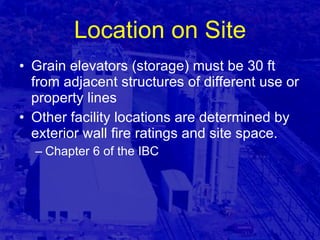
Location on Site Grain elevators (storage) must be 30 ft from adjacent structures of different use or property lines Other facility locations are determined by exterior wall fire ratings and site space. Chapter 6 of the IBC
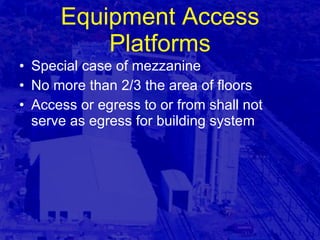
Equipment Access Platforms Special case of mezzanine No more than 2/3 the area of floors Access or egress to or from shall not serve as egress for building system
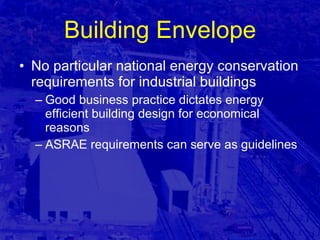
Building Envelope No particular national energy conservation requirements for industrial buildings Good business practice dictates energy efficient building design for economical reasons ASRAE requirements can serve as guidelines
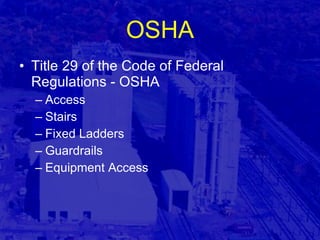
OSHA Title 29 of the Code of Federal Regulations - OSHA Access Stairs Fixed Ladders Guardrails Equipment Access
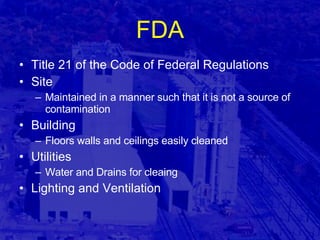
FDA Title 21 of the Code of Federal Regulations Site Maintained in a manner such that it is not a source of contamination Building Floors walls and ceilings easily cleaned Utilities Water and Drains for cleaing Lighting and Ventilation
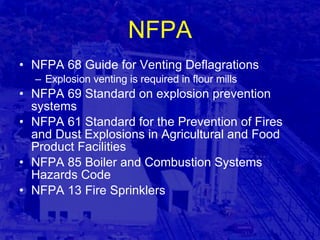
NFPA NFPA 68 Guide for Venting Deflagrations Explosion venting is required in flour mills NFPA 69 Standard on explosion prevention systems NFPA 61 Standard for the Prevention of Fires and Dust Explosions in Agricultural and Food Product Facilities NFPA 85 Boiler and Combustion Systems Hazards Code NFPA 13 Fire Sprinklers
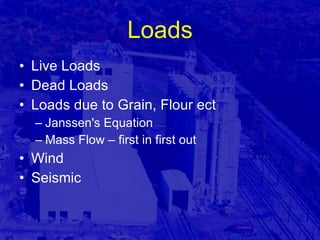
Loads Live Loads Dead Loads Loads due to Grain, Flour ect Janssen's Equation Mass Flow – first in first out Wind Seismic
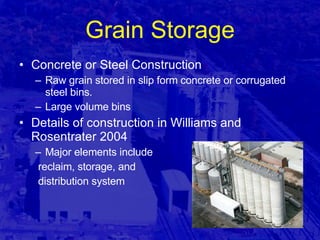
Grain Storage Concrete or Steel Construction Raw grain stored in slip form concrete or corrugated steel bins. Large volume bins Details of construction in Williams and Rosentrater 2004 Major elements include reclaim, storage, and distribution system
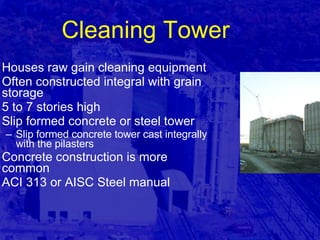
Cleaning Tower Houses raw gain cleaning equipment Often constructed integral with grain storage 5 to 7 stories high Slip formed concrete or steel tower Slip formed concrete tower cast integrally with the pilasters Concrete construction is more common ACI 313 or AISC Steel manual
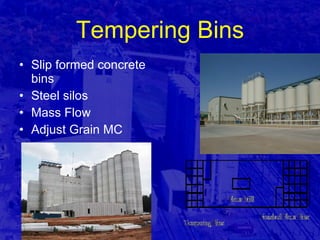
Tempering Bins Slip formed concrete bins Steel silos Mass Flow Adjust Grain MC
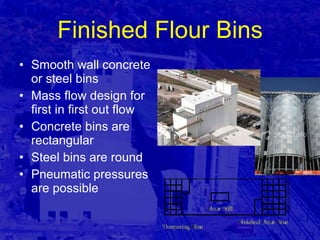
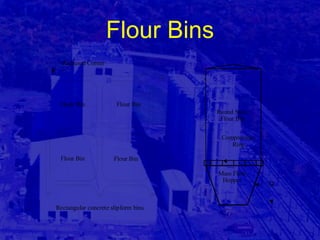
Finished Flour Bins Smooth wall concrete or steel bins Mass flow design for first in first out flow Concrete bins are rectangular Steel bins are round Pneumatic pressures are possible
Flour Bins
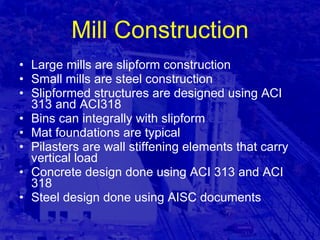
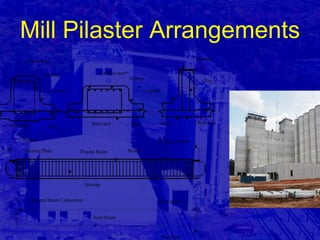
Mill Construction Large mills are slipform construction Small mills are steel construction Slipformed structures are designed using ACI 313 and ACI318 Bins can integrally with slipform Mat foundations are typical Pilasters are wall stiffening elements that carry vertical load Concrete design done using ACI 313 and ACI 318 Steel design done using AISC documents
Mill Pilaster Arrangements
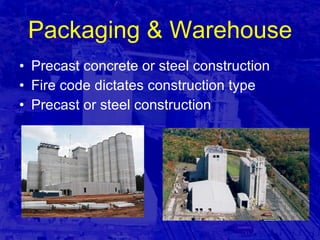
Packaging & Warehouse Precast concrete or steel construction Fire code dictates construction type Precast or steel construction
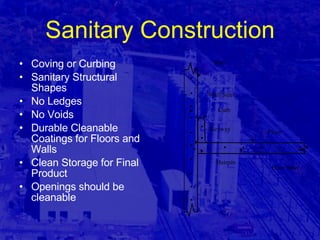
Sanitary Construction Coving or Curbing Sanitary Structural Shapes No Ledges No Voids Durable Cleanable Coatings for Floors and Walls Clean Storage for Final Product Openings should be cleanable
Summary Brief overview of planning and life safety considerations for Flour Milling Facilities Refer to paper for specific details and code sections Excellent opportunities for Agricultural Engineers

Flour Milling Plant Design

  • 1.
    Design Considerations forthe Construction and Operation of Flour Milling Facilities. Part I Planning, Structural, and Life Safety Gregory D Williams, Ph.D., P.E., S.E. Kurt Rosentrater, Ph.D
  • 2.
    Introduction 26,000 flourmills in late 1800’s 336 flour mills in 2002 Larger more complex facilities with higher outputs 26.5 million tons of output Design Information is limited and not documented
  • 3.
    Flour Milling ProcessBreak system Separates wheat into components Purification system Sorts particles based on size, air resistance, and specific gravity Reduction system Fine grinding system Finishes flour Tailings Unwanted components
  • 4.
    Elements of FlourMilling Facility Grain Receiving, Storage & Handling Grain Cleaning Pre-clean Storage Tempering Milling Finished Flour Warehousing & Packaging
  • 5.
  • 6.
  • 7.
    Facility Planning LongRange Planning Strategic vision Organizational objectives Grain Supply Local farm sources Geographic area Wheat types Economic factors Local Grain types and volumes Global Population trends Demographics ROI
  • 8.
    Facility Planning RegulatoryIssues Good Manufacturing Practices (GMP’s) Identity Preservation Location/Site Transportation and Infrastructure Utilities Roads Rails/Trucking Site Properties Soil Bearing Drainage Expansion/New Construction Upgrading or expanding existing facility
  • 9.
    Facility Planning TechnologyConstantly Changing Must be flexible and adaptable Facility Layout Key to efficiency Coordinate with design team
  • 10.
    Facility Layout Startwith block flow diagrams Buildings determined by like unit operations Layout buildings around unit operations and vessels Work integrally with process design for final layout that is compliant with building codes and OSHA
  • 11.
  • 12.
    Life Safety DesignConsiderations Model Building Code (2003 IBC) FDA OSHA NFPA
  • 13.
    Model Building CodesInternational Building Code Occupancy Construction type Height and floor area Location on site Special requirements Design Details
  • 14.
    Occupancy Group B– Business Offices Group H-2 – Hazardous – Grain storage Grain Cleaning Milling areas Group F1 - Factory and Industrial Further processing areas Group S – Storage Warehouse areas
  • 15.
    Fire Rated ConstructionTypes Types I to V Types I & II are least combustible Concrete and steel construction Types III,IV, & V are more combustible Includes wood structures Most Flour Mills are Type I construction Details – Chapter 7 of the International Building Code Floors, partitions, exterior walls, barriers, etc
  • 16.
    Height and FloorAreas Function of occupancy type and construction type Frontage area and sprinkler systems can increase allowable area Unlimited Area buildings can be built if certain height, sprinkler, and frontage requirements are met
  • 17.
    Location on SiteGrain elevators (storage) must be 30 ft from adjacent structures of different use or property lines Other facility locations are determined by exterior wall fire ratings and site space. Chapter 6 of the IBC
  • 18.
    Equipment Access PlatformsSpecial case of mezzanine No more than 2/3 the area of floors Access or egress to or from shall not serve as egress for building system
  • 19.
    Building Envelope Noparticular national energy conservation requirements for industrial buildings Good business practice dictates energy efficient building design for economical reasons ASRAE requirements can serve as guidelines
  • 20.
    OSHA Title 29of the Code of Federal Regulations - OSHA Access Stairs Fixed Ladders Guardrails Equipment Access
  • 21.
    FDA Title 21of the Code of Federal Regulations Site Maintained in a manner such that it is not a source of contamination Building Floors walls and ceilings easily cleaned Utilities Water and Drains for cleaing Lighting and Ventilation
  • 22.
    NFPA NFPA 68Guide for Venting Deflagrations Explosion venting is required in flour mills NFPA 69 Standard on explosion prevention systems NFPA 61 Standard for the Prevention of Fires and Dust Explosions in Agricultural and Food Product Facilities NFPA 85 Boiler and Combustion Systems Hazards Code NFPA 13 Fire Sprinklers
  • 23.
    Loads Live LoadsDead Loads Loads due to Grain, Flour ect Janssen's Equation Mass Flow – first in first out Wind Seismic
  • 24.
    Grain Storage Concreteor Steel Construction Raw grain stored in slip form concrete or corrugated steel bins. Large volume bins Details of construction in Williams and Rosentrater 2004 Major elements include reclaim, storage, and distribution system
  • 25.
    Cleaning Tower Housesraw gain cleaning equipment Often constructed integral with grain storage 5 to 7 stories high Slip formed concrete or steel tower Slip formed concrete tower cast integrally with the pilasters Concrete construction is more common ACI 313 or AISC Steel manual
  • 26.
    Tempering Bins Slipformed concrete bins Steel silos Mass Flow Adjust Grain MC
  • 27.
    Finished Flour BinsSmooth wall concrete or steel bins Mass flow design for first in first out flow Concrete bins are rectangular Steel bins are round Pneumatic pressures are possible
  • 28.
  • 29.
    Mill Construction Largemills are slipform construction Small mills are steel construction Slipformed structures are designed using ACI 313 and ACI318 Bins can integrally with slipform Mat foundations are typical Pilasters are wall stiffening elements that carry vertical load Concrete design done using ACI 313 and ACI 318 Steel design done using AISC documents
  • 30.
  • 31.
    Packaging & WarehousePrecast concrete or steel construction Fire code dictates construction type Precast or steel construction
  • 32.
    Sanitary Construction Covingor Curbing Sanitary Structural Shapes No Ledges No Voids Durable Cleanable Coatings for Floors and Walls Clean Storage for Final Product Openings should be cleanable
  • 33.
    Summary Brief overviewof planning and life safety considerations for Flour Milling Facilities Refer to paper for specific details and code sections Excellent opportunities for Agricultural Engineers