TECHNICAL GENERAL CPL
MRS.SOUMYA KUMARI K P/SGI/OFAA
CONVENTIONAL SYSTEMS
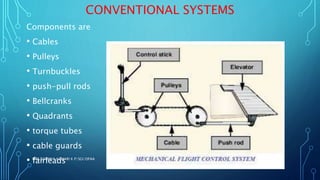
Components are
• Cables
• Pulleys
• Turnbuckles
• push-pull rods
• Bellcranks
• Quadrants
• torque tubes
• cable guards
• fairleads
MRS.SOUMYA KUMARI K P/SGI/OFAA
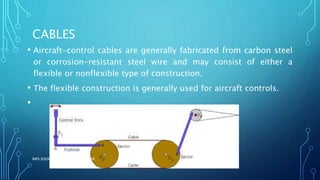
CABLES
• Aircraft-control cables are generally fabricated from carbon steel
or corrosion-resistant steel wire and may consist of either a
flexible or nonflexible type of construction.
• The flexible construction is generally used for aircraft controls.
•
MRS.SOUMYA KUMARI K P/SGI/OFAA
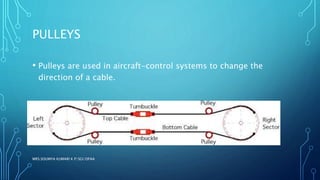
PULLEYS
• Pulleys are used in aircraft-control systems to change the
direction of a cable.
MRS.SOUMYA KUMARI K P/SGI/OFAA
TURNBUCKLES
• Turnbuckles are commonly used for adjusting the tension of the
control cables
MRS.SOUMYA KUMARI K P/SGI/OFAA
BELLCRANK
• A bellcrank is used to
transmit force and permit
a change in the direction
of the force.
MRS.SOUMYA KUMARI K P/SGI/OFAA
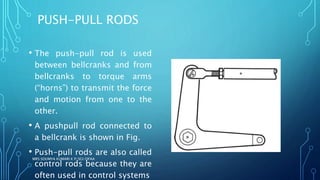
PUSH-PULL RODS
• The push-pull rod is used
between bellcranks and from
bellcranks to torque arms
(“horns”) to transmit the force
and motion from one to the
other.
• A pushpull rod connected to
a bellcrank is shown in Fig.
• Push-pull rods are also called
control rods because they are
often used in control systems
MRS.SOUMYA KUMARI K P/SGI/OFAA
QUADRANT
• A quadrant serves the same
purpose as a wheel; however,
the quadrant moves through
a relatively small arc, perhaps
as much as 100°.
• often employed at the base of
a control column or control
stick to impart force and
motion to a cable system.
MRS.SOUMYA KUMARI K P/SGI/OFAA
TORQUE TUBE
• A torque tube is a hollow
shaft by which the linear
motion of a cable or push-
pull tube is changed to rotary
motion.
• A torque arm, or horn, is
attached to the tube by
welding or bolting and
imparts a twisting motion to
the tube as the arm is moved
back and forth
MRS.SOUMYA KUMARI K P/SGI/OFAA
CABLE GUARDS, OR GUARD PINS
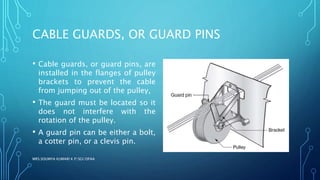
• Cable guards, or guard pins, are
installed in the flanges of pulley
brackets to prevent the cable
from jumping out of the pulley,
• The guard must be located so it
does not interfere with the
rotation of the pulley.
• A guard pin can be either a bolt,
a cotter pin, or a clevis pin.
MRS.SOUMYA KUMARI K P/SGI/OFAA
FAIRLEAD
• A fairlead serves as a guide to
prevent wear and vibration of
a cable.
• These units must be installed
in such a manner that there is
no contact between the cable
and the aircraft structure.
• The principal functions of
fairleads are to dampen
vibration, maintain cable
alignment, and to seal
MRS.SOUMYA KUMARI K P/SGI/OFAA
MODERN FLYING CONTROLS
Powered flying
controls
Power assisted
controls
Power
actuated
systems
MRS.SOUMYA KUMARI K P/SGI/OFAA
POWER ASSISTED
CONTROLS
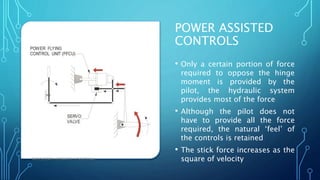
• Only a certain portion of force
required to oppose the hinge
moment is provided by the
pilot, the hydraulic system
provides most of the force
• Although the pilot does not
have to provide all the force
required, the natural ‘feel’ of
the controls is retained
• The stick force increases as the
square of velocity
MRS.SOUMYA KUMARI K P/SGI/OFAA
FULLY POWERED
CONTROLS
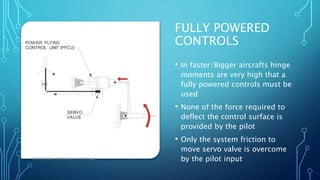
• In faster/Bigger aircrafts hinge
moments are very high that a
fully powered controls must be
used
• None of the force required to
deflect the control surface is
provided by the pilot
• Only the system friction to
move servo valve is overcome
by the pilot input
MRS.SOUMYA KUMARI K P/SGI/OFAA
All the necessary power to move the
control surface is supplied by the
aircraft hydraulic system
Aerodynamic loads on the control
surface is unable to move the cockpit
controls, so powered flying controls
are known as “irreversible” controls
MRS.SOUMYA KUMARI K P/SGI/OFAA
ARTIFICIAL
‘Q’ FEEL
• With a fully
powered flying
control, the pilot
is unaware of the
aerodynamic
force on the
controls, so it is
necessary to
incorporate
“Artificial feel” to
prevent aircraft
from being
MRS.SOUMYA KUMARI K P/SGI/OFAA
ARTIFICIAL
‘Q’ FEEL
A device, sensitive to dynamic pressure or
Q is used
Pitot pressure is fed to one side of a
chamber and static pressure to the other
It moves the diaphragm under the influence
of changing dynamic pressure
It provides a “resistance” or “feel” on the
pilot input controls, proportional to speed
MRS.SOUMYA KUMARI K P/SGI/OFAA
THANK YOU
MRS.SOUMYA KUMARI K P/SGI/OFAA

Flight controls.pptx

  • 1.
  • 2.
    CONVENTIONAL SYSTEMS Components are •Cables • Pulleys • Turnbuckles • push-pull rods • Bellcranks • Quadrants • torque tubes • cable guards • fairleads MRS.SOUMYA KUMARI K P/SGI/OFAA
  • 3.
    CABLES • Aircraft-control cablesare generally fabricated from carbon steel or corrosion-resistant steel wire and may consist of either a flexible or nonflexible type of construction. • The flexible construction is generally used for aircraft controls. • MRS.SOUMYA KUMARI K P/SGI/OFAA
  • 4.
    PULLEYS • Pulleys areused in aircraft-control systems to change the direction of a cable. MRS.SOUMYA KUMARI K P/SGI/OFAA
  • 5.
    TURNBUCKLES • Turnbuckles arecommonly used for adjusting the tension of the control cables MRS.SOUMYA KUMARI K P/SGI/OFAA
  • 6.
    BELLCRANK • A bellcrankis used to transmit force and permit a change in the direction of the force. MRS.SOUMYA KUMARI K P/SGI/OFAA
  • 7.
    PUSH-PULL RODS • Thepush-pull rod is used between bellcranks and from bellcranks to torque arms (“horns”) to transmit the force and motion from one to the other. • A pushpull rod connected to a bellcrank is shown in Fig. • Push-pull rods are also called control rods because they are often used in control systems MRS.SOUMYA KUMARI K P/SGI/OFAA
  • 8.
    QUADRANT • A quadrantserves the same purpose as a wheel; however, the quadrant moves through a relatively small arc, perhaps as much as 100°. • often employed at the base of a control column or control stick to impart force and motion to a cable system. MRS.SOUMYA KUMARI K P/SGI/OFAA
  • 9.
    TORQUE TUBE • Atorque tube is a hollow shaft by which the linear motion of a cable or push- pull tube is changed to rotary motion. • A torque arm, or horn, is attached to the tube by welding or bolting and imparts a twisting motion to the tube as the arm is moved back and forth MRS.SOUMYA KUMARI K P/SGI/OFAA
  • 10.
    CABLE GUARDS, ORGUARD PINS • Cable guards, or guard pins, are installed in the flanges of pulley brackets to prevent the cable from jumping out of the pulley, • The guard must be located so it does not interfere with the rotation of the pulley. • A guard pin can be either a bolt, a cotter pin, or a clevis pin. MRS.SOUMYA KUMARI K P/SGI/OFAA
  • 11.
    FAIRLEAD • A fairleadserves as a guide to prevent wear and vibration of a cable. • These units must be installed in such a manner that there is no contact between the cable and the aircraft structure. • The principal functions of fairleads are to dampen vibration, maintain cable alignment, and to seal MRS.SOUMYA KUMARI K P/SGI/OFAA
  • 12.
    MODERN FLYING CONTROLS Poweredflying controls Power assisted controls Power actuated systems MRS.SOUMYA KUMARI K P/SGI/OFAA
  • 13.
    POWER ASSISTED CONTROLS • Onlya certain portion of force required to oppose the hinge moment is provided by the pilot, the hydraulic system provides most of the force • Although the pilot does not have to provide all the force required, the natural ‘feel’ of the controls is retained • The stick force increases as the square of velocity MRS.SOUMYA KUMARI K P/SGI/OFAA
  • 14.
    FULLY POWERED CONTROLS • Infaster/Bigger aircrafts hinge moments are very high that a fully powered controls must be used • None of the force required to deflect the control surface is provided by the pilot • Only the system friction to move servo valve is overcome by the pilot input MRS.SOUMYA KUMARI K P/SGI/OFAA
  • 15.
    All the necessarypower to move the control surface is supplied by the aircraft hydraulic system Aerodynamic loads on the control surface is unable to move the cockpit controls, so powered flying controls are known as “irreversible” controls MRS.SOUMYA KUMARI K P/SGI/OFAA
  • 16.
    ARTIFICIAL ‘Q’ FEEL • Witha fully powered flying control, the pilot is unaware of the aerodynamic force on the controls, so it is necessary to incorporate “Artificial feel” to prevent aircraft from being MRS.SOUMYA KUMARI K P/SGI/OFAA
  • 17.
    ARTIFICIAL ‘Q’ FEEL A device,sensitive to dynamic pressure or Q is used Pitot pressure is fed to one side of a chamber and static pressure to the other It moves the diaphragm under the influence of changing dynamic pressure It provides a “resistance” or “feel” on the pilot input controls, proportional to speed MRS.SOUMYA KUMARI K P/SGI/OFAA
  • 18.