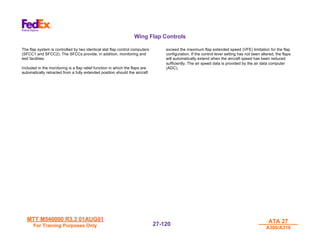
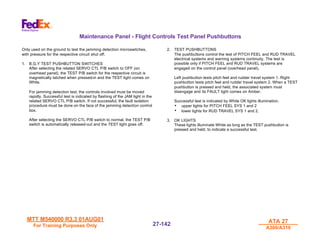
MTT M540000 R3.3 01AUG01
For Training Purposes Only
ATA 27
ATA 27
A300/A310
A300/A310
27-
27-1
1
ATA 27
ATA 27
Flight Controls
Flight Controls
MTT M540000 R3.3 01AUG01
For Training Purposes Only
ATA 27
ATA 27
A300/A310
A300/A310
27-
27-2
2
THIS PAGE INTENTIONALLY
LEFT BLANK
MTT M540000 R3.3 01AUG01
For Training Purposes Only
ATA 27
ATA 27
A300/A310
A300/A310
27-
27-3
3
FLIGHT CONTROL
SURFACES -
GENERAL
MTT M540000 R3.3 01AUG01
For Training Purposes Only
ATA 27
ATA 27
A300/A310
A300/A310
27-
27-4
4
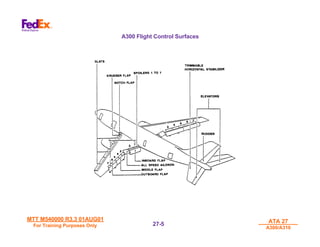
A300/A310 FLIGHT CONTROL SURFACES
The control of the aircraft is achieved by:
• the primary flight controls
• the secondary flight controls
The primary flight controls ensure:
• ROLL CONTROL achieved on each wing by:
- one aileron
- five roll spoilers, upper wing surfaces No. 3 through No. 7.
• PITCH CONTROL achieved by two elevators hinged on the
trimmable horizontal stabilizer.
• PITCH TRIM CONTROL achieved by the trimmable horizontal
stabilizer hinged on the aircraft structure.
• YAW CONTROL achieved by one rudder.
The secondary flight controls are the:
• FLAPS
- three single slotted flaps on each wing
• LIFT AUGMENTATION devices on each wing
- three slats
- one Krueger flap
- one notch flap—not applicable to A310
• SPEEDBRAKES No. 1 through No. 5 on the upper surface of each
wing
• GROUND SPOILERS No. 1 through No. 7 on the upper surface of
each wing
MTT M540000 R3.3 01AUG01
For Training Purposes Only
ATA 27
ATA 27
A300/A310
A300/A310
27-
27-5
5
A300 Flight Control Surfaces
MTT M540000 R3.3 01AUG01
For Training Purposes Only
ATA 27
ATA 27
A300/A310
A300/A310
27-
27-6
6
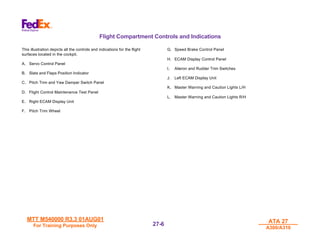
Flight Compartment Controls and Indications
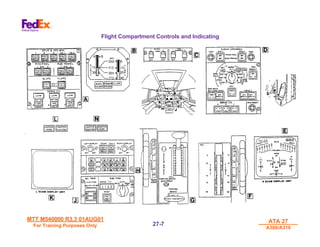
This illustration depicts all the controls and indications for the flight
surfaces located in the cockpit.
A. Servo Control Panel
B. Slats and Flaps Position Indicator
C. Pitch Trim and Yaw Damper Switch Panel
D. Flight Control Maintenance Test Panel
E. Right ECAM Display Unit
F. Pitch Trim Wheel
G. Speed Brake Control Panel
H. ECAM Display Control Panel
I. Aileron and Rudder Trim Switches
J. Left ECAM Display Unit
K. Master Warning and Caution Lights L/H
L. Master Warning and Caution Lights R/H
MTT M540000 R3.3 01AUG01
For Training Purposes Only
ATA 27
ATA 27
A300/A310
A300/A310
27-
27-7
7
Flight Compartment Controls and Indicating
MTT M540000 R3.3 01AUG01
For Training Purposes Only
ATA 27
ATA 27
A300/A310
A300/A310
27-
27-8
8
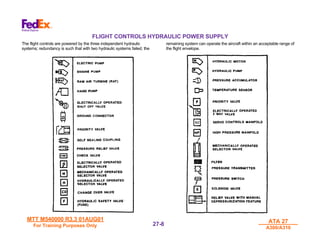
FLIGHT CONTROLS HYDRAULIC POWER SUPPLY
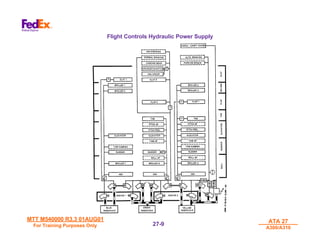
The flight controls are powered by the three independent hydraulic
systems; redundancy is such that with two hydraulic systems failed, the
remaining system can operate the aircraft within an acceptable range of
the flight envelope.
MTT M540000 R3.3 01AUG01
For Training Purposes Only
ATA 27
ATA 27
A300/A310
A300/A310
27-
27-9
9
Flight Controls Hydraulic Power Supply
MTT M540000 R3.3 01AUG01
For Training Purposes Only
ATA 27
ATA 27
A300/A310
A300/A310
27-
27-10
10
THIS PAGE INTENTIONALLY
LEFT BLANK
MTT M540000 R3.3 01AUG01
For Training Purposes Only
ATA 27
ATA 27
A300/A310
A300/A310
27-
27-11
11
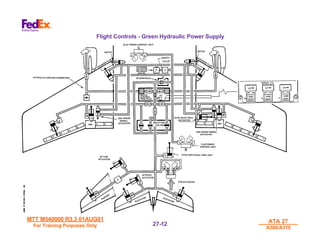
FLIGHT CONTROLS - GREEN
HYDRAULIC POWER SUPPLY
MTT M540000 R3.3 01AUG01
For Training Purposes Only
ATA 27
ATA 27
A300/A310
A300/A310
27-
27-12
12
Flight Controls - Green Hydraulic Power Supply
MTT M540000 R3.3 01AUG01
For Training Purposes Only
ATA 27
ATA 27
A300/A310
A300/A310
27-
27-13
13
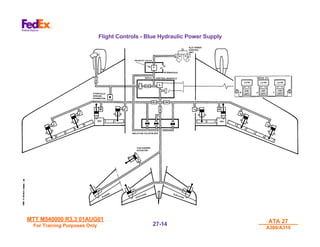
FLIGHT CONTROLS - BLUE
HYDRAULIC POWER SUPPLY
MTT M540000 R3.3 01AUG01
For Training Purposes Only
ATA 27
ATA 27
A300/A310
A300/A310
27-
27-14
14
Flight Controls - Blue Hydraulic Power Supply
MTT M540000 R3.3 01AUG01
For Training Purposes Only
ATA 27
ATA 27
A300/A310
A300/A310
27-
27-15
15
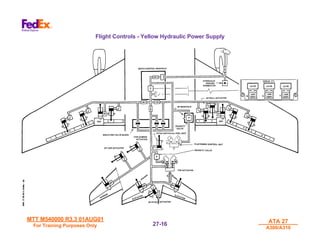
FLIGHT CONTROLS - YELLOW
HYDRAULIC POWER SUPPLY
MTT M540000 R3.3 01AUG01
For Training Purposes Only
ATA 27
ATA 27
A300/A310
A300/A310
27-
27-16
16
Flight Controls - Yellow Hydraulic Power Supply
MTT M540000 R3.3 01AUG01
For Training Purposes Only
ATA 27
ATA 27
A300/A310
A300/A310
27-
27-17
17
THIS PAGE INTENTIONALLY
LEFT BLANK
MTT M540000 R3.3 01AUG01
For Training Purposes Only
ATA 27
ATA 27
A300/A310
A300/A310
27-
27-18
18
SERVO CONTROL P/B SWITCHES
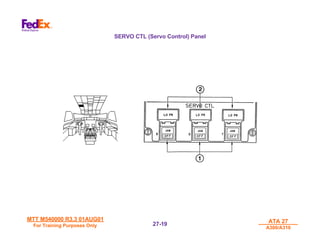
1. SERVO CTL PUSHBUTTON SWITCHES
All these P/B switches are guarded. These P/B switches control
the servo shut-off valves for the individual hydraulic circuits Blue,
Green and Yellow.
• NORMAL (P/B SWITCH PRESSED-IN)
Hydraulic power is supplied to the corresponding users as
soon as pressure is available in the corresponding hydraulic
system.
• OFF (P/B SWITCH RELEASED-OUT)
The OFF light comes on White and the hydraulic power
supply to the corresponding users is shut off. The associated
JAM warning is inhibited and LO PR Amber illumination
confirms the OFF selection.
• JAM
When a P/B switch is pressed-in, the associated JAM light
comes on Amber when a jamming is detected in the related
hydraulic control valves of rudder, elevator, ailerons or
trimmable horizontal stabilizer. Illumination of a JAM light is
accompanied by ECAM activation. The jammed control is
identified on the Warning Display (left CRT).
2. B, G, Y LO PR LIGHTS
A light comes on Amber when the flight control supply pressure in
the corres ponding hydraulic system has dropped (below 1450 PSI)
downstream of the servo control valve, or when the hydraulic supply
has been shut off. Illumination of an Amber LO PR light is
accompanied by ECAM activation.
NOTE: The SERVO CTL P/B switch positions and associated warnings
are repeated on the ECAM hydraulic system page.
- To prevent inadvertent complete deactivation of servo controls, only
two systems can be deactivated at a time by selection of SERVO
CTL P/B switches to OFF. When the third P/B switch is selected to
OFF all three systems are reactivated regardless of P/B switch
setting.
MTT M540000 R3.3 01AUG01
For Training Purposes Only
ATA 27
ATA 27
A300/A310
A300/A310
27-
27-19
19
SERVO CTL (Servo Control) Panel
MTT M540000 R3.3 01AUG01
For Training Purposes Only
ATA 27
ATA 27
A300/A310
A300/A310
27-
27-20
20
THIS PAGE INTENTIONALLY
LEFT BLANK
MTT M540000 R3.3 01AUG01
For Training Purposes Only
ATA 27
ATA 27
A300/A310
A300/A310
27-
27-21
21
ROLL CONTROL
SECTION
MTT M540000 R3.3 01AUG01
For Training Purposes Only
ATA 27
ATA 27
A300/A310
A300/A310
27-
27-22
22
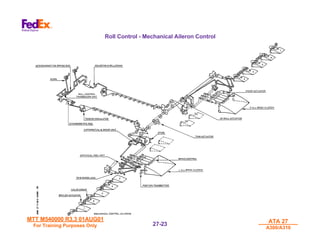
ROLL CONTROL
The roll control surfaces on each wing are:
• One (1) aileron powered by 3 servo controls
• 5 roll spoilers, each one powered by one (1) servo control.
The spoiler system is supplied from two normal bus bars (28 V DC and
26 V AC). If the normal buses have been cut off before landing, power is
supplied again to three spoiler groups by pressing the LAND RECOVERY
P/B switch on the overhead panel.
From the two interconnected control wheels, the roll inputs are
transmitted to the ailerons by dual cables providing fail safe operation. In
each wing the inputs are transmitted to a differential unit receiving
additional inputs from:
• artificial feel unit
• aileron droop unit
• trim screw jack
In case of jamming in one control run, the interconnected spring strut can
be compressed to permit operation of the other control run to the other
wing. The pilot effort required on the wheel is between 34 lbs. and 90 lbs.
Spoiler control is still available but downgraded. Each servo control
linkage on the aileron includes a spring rod to protect it against a
runaway if an input lever on one jack remains in the open position.
The artificial feel is provided by a spring loaded rod. The, trim actuator is
electrically signaled by a control on the center pedestal. In order to
improve the aerodynamic characteristics, a droop signal coming from the
slats control system moves the ailerons down 9.2° maximum when the
slats are extended. During cruise, the operational limits for aileron trim
are ±2°. The roll spoilers and speedbrakes are electrically signaled by
two identical computers (EFCU-Electrical Flight Control Units) that
elaborate the roll orders by processing the signals coming from the
control wheel position transducers units.
Each computer is composed of two control units and two monitoring
units. Each unit controls or monitors one group of surfaces. Each group is
made of one or two pairs of servo controls: spoilers 2-3, spoilers 4-1,
spoilers 5-7, spoilers 6. Thus, for a group of servo controls, the
corresponding control unit is in one computer and the monitoring unit is in
the other one. For the roll spoilers the control laws are such that they are
not usually used unless the control wheel is moved enough. An autopilot
servo actuator is mounted adjacent to the RH wing rear cable quadrant. It
drives the complete control via a detent lever which can be overridden by
the pilots.
INTERFACE WITH AUTOPILOT SYSTEM
An autopilot actuator is mounted adjacent to the right wing rear cable
quadrant; it drives the complete control via a detent lever which can be
overridden by the pilots. Dynamometric rods are installed upstream of the
cable tension regulators, they provide control signals to the control wheel
steering system.
MTT M540000 R3.3 01AUG01
For Training Purposes Only
ATA 27
ATA 27
A300/A310
A300/A310
27-
27-23
23
Roll Control - Mechanical Aileron Control
MTT M540000 R3.3 01AUG01
For Training Purposes Only
ATA 27
ATA 27
A300/A310
A300/A310
27-
27-24
24
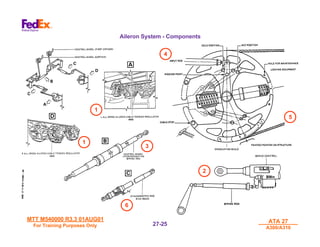
AILERON SYSTEM - COMPONENTS DESCRIPTION
1. CABLE TENSION REGULATORS
Two tension regulators maintain a constant tension on the cables of
28.13 ± 5.30 lbf. They are identical apart from the input lever
position. They incorporate provision for installation of a special tool
used for installing the regulator on the aircraft.
2. SERVO CONTROL ACTUATING SPRING ROD
The three ASA servo control actuating spring rods prevent runaway
of the control system if an input lever jams on its servo control body.
3. CONTROL WHEEL INTERCONNECTING SPRING ROD
The two control wheels are interconnected by a spring rod in order to
allow one of the crew members to control half the surfaces in the
event of any single item jamming in the mechanical control system.
4. RODS
Push-pull rods are adjustable or nonadjustable length, fitted with
replaceable ends.
5. CABLES
The flexible cables (Dia. 3.2 mm/0.126 in.) are made of zinc-coated
carbon steel. The cable end fittings are equipped with barrels for
quick installation and fool proofing; turnbuckles are cliplocked.
Fairleads are of the roller type, for low friction purposes. The fairlead
supports allow passage of the cable end fittings. At bulkheads,
cables are fed through pressure seals.
6. DYNAMOMETRIC RODS
The Flight Control Computer uses signals from the dynamometric
rods to detect the Captain's and First Officer's loads on the control
wheels. There are two rods for the pitch axis and two for the roll axis.
There is no rod in the yaw axis. The rods are placed in series in the
Flight Control linkages.
MTT M540000 R3.3 01AUG01
For Training Purposes Only
ATA 27
ATA 27
A300/A310
A300/A310
27-
27-25
25
Aileron System - Components
1
4
6
3
5
2
1
MTT M540000 R3.3 01AUG01
For Training Purposes Only
ATA 27
ATA 27
A300/A310
A300/A310
27-
27-26
26
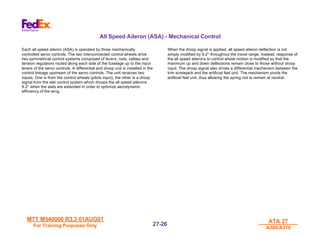
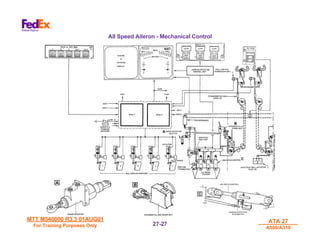
All Speed Aileron (ASA) - Mechanical Control
Each all speed aileron (ASA) is operated by three mechanically
controlled servo controls. The two interconnected control wheels drive
two symmetrical control systems composed of levers, rods, cables and
tension regulators routed along each side of the fuselage up to the input
levers of the servo controls. A differential and droop unit is installed in the
control linkage upstream of the servo controls. The unit receives two
inputs. One is from the control wheels (pilots input), the other is a droop
signal from the slat control system which droops the all speed ailerons
9.2° when the slats are extended in order to optimize aerodynamic
efficiency of the wing.
When the droop signal is applied, all speed aileron deflection is not
simply modified by 9.2° throughout the travel range. Instead, response of
the all speed ailerons to control wheel motion is modified so that the
maximum up and down deflections remain close to those without droop
input. The droop signal also drives a differential mechanism between the
trim screwjack and the artificial feel unit. The mechanism pivots the
artificial feel unit, thus allowing the spring rod to remain at neutral.
MTT M540000 R3.3 01AUG01
For Training Purposes Only
ATA 27
ATA 27
A300/A310
A300/A310
27-
27-27
27
All Speed Aileron - Mechanical Control
MTT M540000 R3.3 01AUG01
For Training Purposes Only
ATA 27
ATA 27
A300/A310
A300/A310
27-
27-28
28
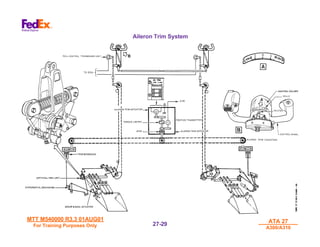
Aileron Trim
Trim control is electrically signaled. An electrical actuator installed in the
main gear W/W (center fuselage) drives two trim screwjacks via
sprockets, chains and cables. The actuator is controlled from panel
408VU located at the rear part of the center pedestal. Two switches on
this panel allow the crew to select constant speed displacement in the
appropriate direction. Trim position is indicated on scales at the top of the
control columns when the wheels are released.
In each wing root, displacement of the trim screwjack drives the all speed
aileron servo control input linkage through the artificial feel unit, whose
spring rod remains at neutral. When the ailerons are drooped, the droop
signal drives a differential mechanism between the trim screwjack and
the artificial feel unit. The mechanism pivots the artificial feel unit, thus
allowing the spring rod to remain at neutral and the unit is held in this
position by the trim screwjack.
MTT M540000 R3.3 01AUG01
For Training Purposes Only
ATA 27
ATA 27
A300/A310
A300/A310
27-
27-29
29
Aileron Trim System
MTT M540000 R3.3 01AUG01
For Training Purposes Only
ATA 27
ATA 27
A300/A310
A300/A310
27-
27-30
30
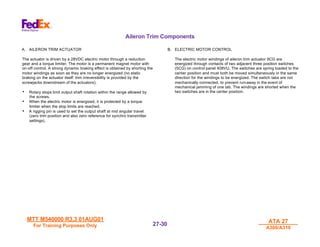
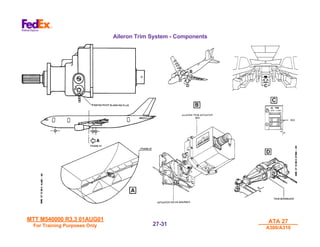
Aileron Trim Components
A. AILERON TRIM ACTUATOR
The actuator is driven by a 28VDC electric motor through a reduction
gear and a torque limiter. The motor is a permanent magnet motor with
on-off control. A strong dynamic braking effect is obtained by shorting the
motor windings as soon as they are no longer energized (no static
braking on the actuator itself: trim irreversibility is provided by the
screwjacks downstream of the actuators).
• Rotary stops limit output shaft rotation within the range allowed by
the screws.
• When the electric motor is energized, it is protected by a torque
limiter when the stop limits are reached.
• A rigging pin is used to set the output shaft at mid angular travel
(zero trim position and also zero reference for synchro transmitter
settings).
B. ELECTRIC MOTOR CONTROL
The electric motor windings of aileron trim actuator 9CG are
energized through contacts of two adjacent three position switches
(5CG) on control panel 408VU. The switches are spring loaded to the
center position and must both be moved simultaneously in the same
direction for the windings to be energized. The switch tabs are not
mechanically connected, to prevent run-away in the event of
mechanical jamming of one tab. The windings are shorted when the
two switches are in the center position.
MTT M540000 R3.3 01AUG01
For Training Purposes Only
ATA 27
ATA 27
A300/A310
A300/A310
27-
27-31
31
Aileron Trim System - Components
MTT M540000 R3.3 01AUG01
For Training Purposes Only
ATA 27
ATA 27
A300/A310
A300/A310
27-
27-32
32
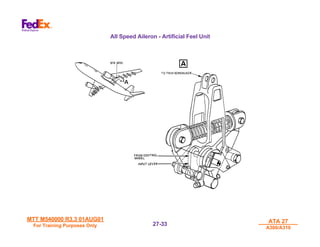
All Speed Aileron - Artificial Feel Unit
There are two identical artificial feel units, each installed immediately
downstream of the all speed aileron servo control actuating spring rods.
The units each include a spring rod and are held in position by the trim
screwjacks.
Their function is:
• To maintain servo control input linkage in trim position in the event of
disconnection of the control linkage upstream of the servo controls.
• To provide artificial feel loads proportional to control wheel
deflection.
• To provide accurate return of the surfaces to neutral.
MTT M540000 R3.3 01AUG01
For Training Purposes Only
ATA 27
ATA 27
A300/A310
A300/A310
27-
27-33
33
All Speed Aileron - Artificial Feel Unit
MTT M540000 R3.3 01AUG01
For Training Purposes Only
ATA 27
ATA 27
A300/A310
A300/A310
27-
27-34
34
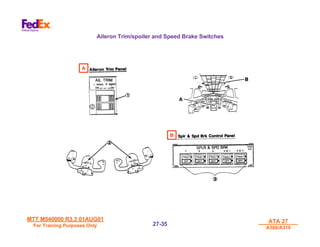
Aileron Trim/spoiler and Speed Brake Switches
1. AIL TRIM SWITCHES
Ailerons trim control is electrically powered. For safety purposes,
both switches must be moved and held in the same direction (L
WING or R WING) to energize the system. This action selects a
constant speed displacement in the corresponding direction. Full
travel of about 7° of aileron in each direction is achieved at a speed
of 0.4° per second.
2. AILERON TRIM SCALES
A scale representing 14° of aileron movement (7° in each direction)
is engraved and painted on the top of each control column opposite
a pointer painted on the control wheel. With the control wheels
released, the crew can thus read the actual aileron trim value.
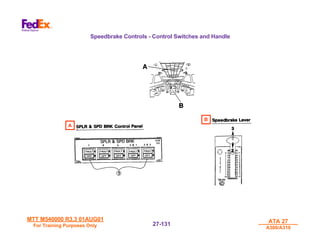
3. SPLR & SPD BRK PUSHBUTTON SWITCHES
Each P/B switch is associated with one or two pairs of symmetrical
upper wing surfaces.
• ON (P/B switch pressed-in):
Corresponding control system is activated. Each time a system is
activated, or corresponding hydraulic system on, or the aircraft
electrical network is energized, a 2 second safety BITE test is
triggered for the corresponding EFCU units (control and monitor).
• OFF/R (P/B switch released-out):
The OFF/R light comes on White and the corresponding control
system is deactivated. If hydraulic pressure is available, the
actuators are automatically held in the retracted position. The
monitoring circuits are reset by ECAM activation. This action is
accompanied by ECAM activation.
• FAULT:
When a P/B switch is pressed-in, the associated FAULT light
comes on Amber if a failure is detected by the monitoring
circuits, which then deactivate the control system. Illumination of
the FAULT light is accompanied by ECAM activation.
MTT M540000 R3.3 01AUG01
For Training Purposes Only
ATA 27
ATA 27
A300/A310
A300/A310
27-
27-35
35
Aileron Trim/spoiler and Speed Brake Switches
A
B
MTT M540000 R3.3 01AUG01
For Training Purposes Only
ATA 27
ATA 27
A300/A310
A300/A310
27-
27-36
36
THIS PAGE INTENTIONALLY
LEFT BLANK
MTT M540000 R3.3 01AUG01
For Training Purposes Only
ATA 27
ATA 27
A300/A310
A300/A310
27-
27-37
37
RUDDER CONTROL
SECTION
MTT M540000 R3.3 01AUG01
For Training Purposes Only
ATA 27
ATA 27
A300/A310
A300/A310
27-
27-38
38
Rudder System - Yaw Control
The rudder, operated by 3 mechanically controlled servo controls,
receives pilot's inputs by a single cable run to a spring loaded artificial
feel unit connected to the trim screwjack. From this point up to the servo
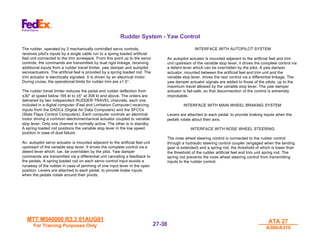
controls, the commands are transmitted by dual rigid linkage, receiving
additional inputs from a rudder travel limiter, yaw damper and autopilot
servoactuators. The artificial feel is provided by a spring loaded rod. The
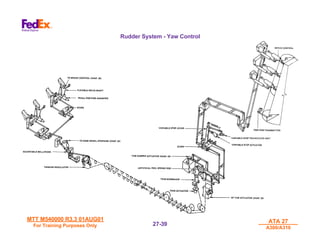
trim actuator is electrically signaled. It is driven by an electrical motor.
During cruise, the operational limits for rudder trim are ±1.5°.
The rudder travel limiter reduces the pedal and rudder deflection from
±30° at speed below 165 kt to ±5° at 308 kt and above. The orders are
delivered by two independent RUDDER TRAVEL channels, each one
included in a digital computer (Feel and Limitation Computer) receiving
inputs from the DADCs (Digital Air Data Computers) and the SFCCs
(Slats Flaps Control Computers). Each computer controls an electrical
motor driving a common electromechanical actuator coupled to variable
stop lever. Only one channel is normally active. The other is in standby.
A spring loaded rod positions the variable stop lever in the low speed
position in case of dual failure.
An. autopilot servo actuator is mounted adjacent to the artificial feel unit
upstream of the variable stop lever. It drives the complete control via a
detent lever which: car. be overridden by the pilot. Yaw damper
commands are transmitted via a differential unit canceling a feedback to
the pedals. A spring loaded rod on each servo control input avoids a
runaway of the rudder in case of jamming of one input lever in the open
position. Levers are attached to each pedal, to provide brake inputs
when the pedals rotate around their pivots.
INTERFACE WITH AUTOPILOT SYSTEM
An autopilot actuator is mounted adjacent to the artificial feel and trim
unit upstream of the variable stop lever; it drives the complete control via
a detent lever which can be overridden by the pilot. A yaw damper
actuator, mounted between the artificial feel and trim unit and the
variable stop lever, drives the rear control via a differential linkage. The
yaw damper actuator signals are added to those of the pilots, up to the
maximum travel allowed by the variable stop lever. The yaw damper
actuator is fail-safe, so that disconnection of the control is extremely
improbable.
INTERFACE WITH MAIN WHEEL BRAKING SYSTEM
Levers are attached to each pedal, to provide braking inputs when the
pedals rotate about their axis.
INTERFACE WITH NOSE WHEEL STEERING
The nose wheel steering control is connected to the rudder control
through a hydraulic steering control coupler (engaged when the landing
gear is extended) and a spring rod, the threshold of which is lower than
the threshold of the rudder artificial feel and trim unit spring rod. The
spring rod prevents the nose wheel steering control from transmitting
inputs to the rudder control.
MTT M540000 R3.3 01AUG01
For Training Purposes Only
ATA 27
ATA 27
A300/A310
A300/A310
27-
27-39
39
Rudder System - Yaw Control
MTT M540000 R3.3 01AUG01
For Training Purposes Only
ATA 27
ATA 27
A300/A310
A300/A310
27-
27-40
40
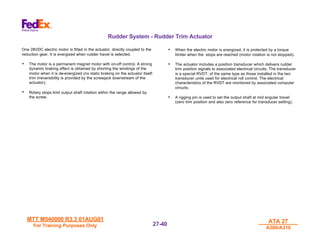
Rudder System - Rudder Trim Actuator
One 28VDC electric motor is fitted in the actuator, directly coupled to the
reduction gear. It is energized when rudder travel is selected.
• The motor is a permanent magnet motor with on-off control. A strong
dynamic braking effect is obtained by shorting the windings of the
motor when it is de-energized (no static braking on the actuator itself:
trim irreversibility is provided by the screwjack downstream of the
actuator).
• Rotary stops limit output shaft rotation within the range allowed by
the screw.
• When the electric motor is energized, it is protected by a torque
limiter when the stops are reached (motor rotation is not stopped).
• The actuator includes a position transducer which delivers rudder
trim position signals to associated electrical circuits. The transducer
is a special RVDT, of the same type as those installed in the two
transducer units used for electrical roll control. The electrical
characteristics of the RVDT are monitored by associated computer
circuits.
• A rigging pin is used to set the output shaft at mid angular travel
(zero trim position and also zero reference for transducer setting).
MTT M540000 R3.3 01AUG01
For Training Purposes Only
ATA 27
ATA 27
A300/A310
A300/A310
27-
27-41
41
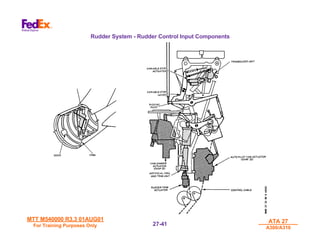
Rudder System - Rudder Control Input Components
MTT M540000 R3.3 01AUG01
For Training Purposes Only
ATA 27
ATA 27
A300/A310
A300/A310
27-
27-42
42
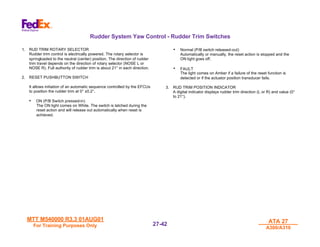
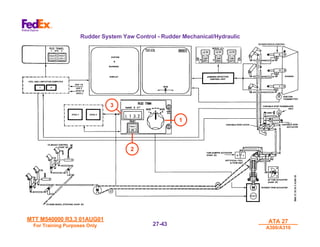
Rudder System Yaw Control - Rudder Trim Switches
1. RUD TRIM ROTARY SELECTOR
Rudder trim control is electrically powered. The rotary selector is
springloaded to the neutral (center) position. The direction of rudder
trim travel depends on the direction of rotary selector (NOSE L or
NOSE R). Full authority of rudder trim is about 21° in each direction.
2. RESET PUSHBUTTON SWITCH
It allows initiation of an automatic sequence controlled by the EFCUs
to position the rudder trim at 0° ±0.2°.
• ON (P/B Switch pressed-in)
The ON light comes on White. The switch is latched during the
reset action and will release out automatically when reset is
achieved.
• Normal (P/B switch released-out)
Automatically or manually, the reset action is stopped and the
ON light goes off.
• FAULT
The light comes on Amber if a failure of the reset function is
detected or if the actuator position transducer fails.
3. RUD TRIM POSITION INDICATOR
A digital indicator displays rudder trim direction (L or R) and value (0°
to 21°).
MTT M540000 R3.3 01AUG01
For Training Purposes Only
ATA 27
ATA 27
A300/A310
A300/A310
27-
27-43
43
Rudder System Yaw Control - Rudder Mechanical/Hydraulic
1
3
2
MTT M540000 R3.3 01AUG01
For Training Purposes Only
ATA 27
ATA 27
A300/A310
A300/A310
27-
27-44
44
Rudder System - Rudder Artificial Feel
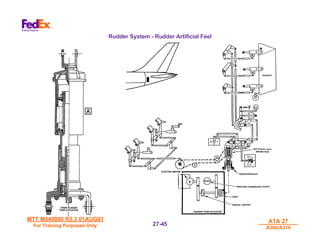
A spring assembly located in the artificial feel and trim unit restores a
resistance to pedal depression which is proportional to rudder
movement. A variable stop lever installed downstream of the servo
controls on the control linkage serves to reduce rudder deflection with
respect to pedal movement as the airspeed increases.
RUDDER ARTIFICIAL FEEL
An artificial feel and trim unit is installed adjacent to the rear cable
quadrant. It consists of a trim screwjack and a fail-safe constant resisting
load spring rod, held in neutral position by the trim screwjack.
Spring function is:
• To maintain the downstream linkage and the input lever of the servo
controls at neutral in the event of disconnection of the control linkage
upstream of the artificial feel and trim unit
• To provide artificial feel loads
• proportional to rudder deflection
• To provide accurate centering of the surface at neutral in the
absence of a control input
• To maintain the upstream controls at neutral, when signals are
provided to the servo controls by the yaw damper actuator.
MTT M540000 R3.3 01AUG01
For Training Purposes Only
ATA 27
ATA 27
A300/A310
A300/A310
27-
27-45
45
Rudder System - Rudder Artificial Feel
MTT M540000 R3.3 01AUG01
For Training Purposes Only
ATA 27
ATA 27
A300/A310
A300/A310
27-
27-46
46
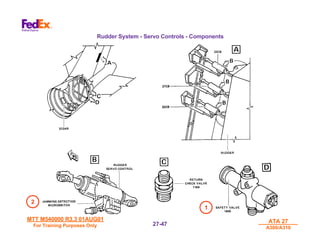
Servo Controls
1. SAFETY VALVES
To preserve the Green system, safety valves are installed upstream of
the following components:
• Krueger selector solenoid valve (in case of engine failure)
• Rudder servo control (in case of inflight collision)
2. SERVO CONTROLS JAMMING DETECTION
There is one jamming detection circuit for each hydraulic system. If
jamming occurs the electronic circuitry inside the jamming detection
control unit receives 28V directly from the jamming detection microswitch
if a servo control is involved and from an intermediate logic if a THS
actuator hydraulic motor is involved.
Jamming detection is associated with the mechanically driven control
valves of the left and right all speed aileron, and left and right elevator
and rudder servo controls. It is also associated with the THS actuator
hydraulic motor control valves (for the Green and Yellow systems only).
NOTE: When a hydraulic system is selected OFF, the + 28V sent to the
corresponding jamming detection microswitches is cut off.
MTT M540000 R3.3 01AUG01
For Training Purposes Only
ATA 27
ATA 27
A300/A310
A300/A310
27-
27-47
47
Rudder System - Servo Controls - Components
1
2
MTT M540000 R3.3 01AUG01
For Training Purposes Only
ATA 27
ATA 27
A300/A310
A300/A310
27-
27-48
48
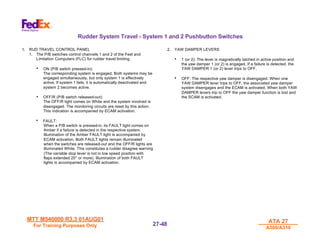
Rudder System Travel - System 1 and 2 Pushbutton Switches
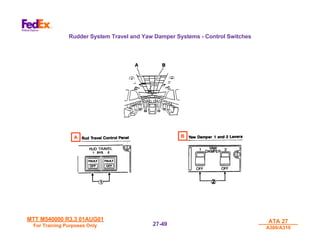
1. RUD TRAVEL CONTROL PANEL
1. The P/B switches control channels 1 and 2 of the Feel and
Limitation Computers (FLC) for rudder travel limiting.
• ON (P/B switch pressed-in):
The corresponding system is engaged. Both systems may be
engaged simultaneously, but only system 1 is effectively
active. If system 1 fails, it is automatically deactivated and
system 2 becomes active.
• OFF/R (P/B switch released-out):
The OFF/R light comes on White and the system involved is
disengaged. The monitoring circuits are reset by this action.
This indication is accompanied by ECAM activation.
• FAULT:
When a P/B switch is pressed-in, its FAULT light comes on
Amber if a failure is detected in the respective system.
Illumination of the Amber FAULT light is accompanied by
ECAM activation. Both FAULT lights remain illuminated
when the switches are released-out and the OFF/R lights are
illuminated White. This constitutes a rudder disagree warning
(The variable stop lever is not in low speed position with
flaps extended 20° or more). Illumination of both FAULT
lights is accompanied by ECAM activation.
2. YAW DAMPER LEVERS
• 1 (or 2): The lever is magnetically latched in active position and
the yaw damper 1 (or 2) is engaged. If a failure is detected, the
YAW DAMPER 1 (or 2) lever trips to OFF.
• OFF: The respective yaw damper is disengaged. When one
YAW DAMPER lever trips to OFF, the associated yaw damper
system disengages and the ECAM is activated. When both YAW
DAMPER levers trip to OFF the yaw damper function is lost and
the SCAM is activated.
MTT M540000 R3.3 01AUG01
For Training Purposes Only
ATA 27
ATA 27
A300/A310
A300/A310
27-
27-49
49
Rudder System Travel and Yaw Damper Systems - Control Switches
A B
MTT M540000 R3.3 01AUG01
For Training Purposes Only
ATA 27
ATA 27
A300/A310
A300/A310
27-
27-50
50
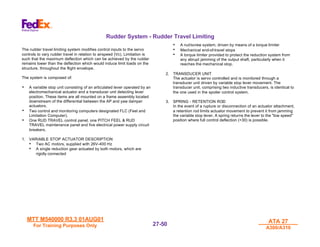
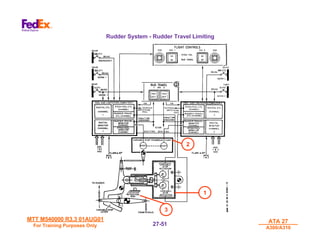
Rudder System - Rudder Travel Limiting
The rudder travel limiting system modifies control inputs to the servo
controls to vary rudder travel in relation to airspeed (Vc). Limitation is
such that the maximum deflection which can be achieved by the rudder
remains lower than the deflection which would induce limit loads on the
structure, throughout the flight envelope.
The system is composed of:
• A variable stop unit consisting of an articulated lever operated by an
electromechanical actuator and a transducer unit detecting lever
position. These items are all mounted on a frame assembly located
downstream of the differential between the AP and yaw damper
actuators.
• Two control and monitoring computers designated FLC (Feel and
Limitation Computer).
• One RUD TRAVEL control panel, one PITCH FEEL & RUD
TRAVEL maintenance panel and five electrical power supply circuit
breakers.
1. VARIABLE STOP ACTUATOR DESCRIPTION
• Two AC motors, supplied with 26V-400 Hz
• A single reduction gear actuated by both motors, which are
rigidly connected
• A nut/screw system, driven by means of a torque limiter
• Mechanical end-of-travel stops
• A torque limiter provided to protect the reduction system from
any abrupt jamming of the output shaft, particularly when it
reaches the mechanical stop.
2. TRANSDUCER UNIT
The actuator is servo controlled and is monitored through a
transducer unit driven by variable stop lever movement. The
transducer unit, comprising two inductive transducers, is identical to
the one used in the spoiler control system.
3. SPRING - RETENTION ROD
In the event of a rupture or disconnection of an actuator attachment,
a retention rod limits actuator movement to prevent it from jamming
the variable stop lever. A spring returns the lever to the "low speed"
position where full control deflection (+30) is possible.
MTT M540000 R3.3 01AUG01
For Training Purposes Only
ATA 27
ATA 27
A300/A310
A300/A310
27-
27-51
51
Rudder System - Rudder Travel Limiting
1
3
2
MTT M540000 R3.3 01AUG01
For Training Purposes Only
ATA 27
ATA 27
A300/A310
A300/A310
27-
27-52
52
Rudder Travel and Pitch Feel Systems - Feel and Limitation Computer (FLC) - General
This computer contains the circuitry required for two functions: rudder
travel limiting and pitch feel. The FLC is a digital computer comprising
two different computation channels:
• Rudder travel limiting/pitch feel control channel
• Rudder travel limiting/pitch feel monitor channel
Safety of the systems is ensured by:
• control and monitor channel programs which are intentionally
different
• monitoring of digital computations which are performed by control
and monitor channels with the same input data, achieved by
comparison between the results of both channels, by means of
analog comparators
• power loop monitoring achieved by software means in each digital
channel.
If any indicator is on, the test of either RUDDER TRAVEL LIMITING
system or PITCH ARTIFICIAL FEEL system will not operate.
MTT M540000 R3.3 01AUG01
For Training Purposes Only
ATA 27
ATA 27
A300/A310
A300/A310
27-
27-53
53
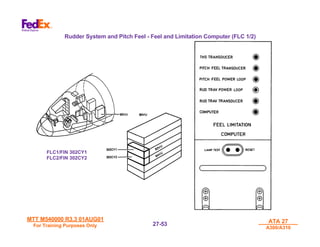
Rudder System and Pitch Feel - Feel and Limitation Computer (FLC 1/2)
FLC1/FIN 302CY1
FLC1/FIN 302CY1
FLC2/FIN 302CY2
FLC2/FIN 302CY2
MTT M540000 R3.3 01AUG01
For Training Purposes Only
ATA 27
ATA 27
A300/A310
A300/A310
27-
27-54
54
THIS PAGE INTENTIONALLY
LEFT BLANK
MTT M540000 R3.3 01AUG01
For Training Purposes Only
ATA 27
ATA 27
A300/A310
A300/A310
27-
27-55
55
ELEVATOR SYSTEM
PITCH CONTROL
SECTION
MTT M540000 R3.3 01AUG01
For Training Purposes Only
ATA 27
ATA 27
A300/A310
A300/A310
27-
27-56
56
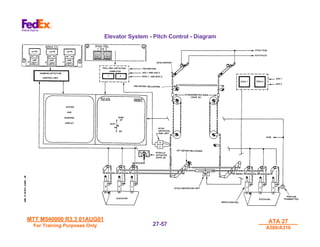
Elevator System - Pitch Control
Pitch control is achieved by two elevators hinged on the horizontal
stabilizer, each actuated by three servo controls controlled by a dual
mechanical linkage through dynamometric rods, cable runs, an artificial
feel system linked to the cable run of the LH control column, and load
limiting rods. In normal operation the two elevators are controlled
together. In case of jamming in one control linkage during flight (take off
excluded), pitch control is provided by THS (Trimmable Horizontal
Stabilizer). If jamming occurs at take off, two uncoupling bellcranks
enable the elevator on the other side to be controlled by one or both
pilots.
A pitch uncoupling unit (locking rod plus solenoid) prevents accidental
asymmetrical deflection of the elevators during flight and allows
uncoupling of the RH and LH control systems during take off (locked at
speeds lower than 30 kt or higher than 195 kt). Artificial feel is provided
by the associated action of:
• a double action spring loaded rod
• a torsion bar driven by a variable gain mechanism which generates a
variable stiffness in the control. The variable gain mechanism is
actuated by either of two electrohydraulic actuators. Each actuator is
controlled by an independent PITCH FEEL channel, each one
included in a FLC (Feel and Limitation Computer).
PITCH FEEL systems are operative above 165 kt. Inputs are a function
of stabilizer position, airspeed and Mach number. In case of failure of two
systems, the mechanism returns to the sow speed position In each run,
downstream of the artificial feel system, a load limiting spring rod limits
the efforts in the elevators control linkage. A spring loaded rod on each
servo control input avoids a runaway of the elevator in case of jamming
of one input lever in the open position. An autopilot actuator is mounted
adjacent to the LH elevator. It drives the control via a detent lever which
can be overridden by the pilots.
Pitch trim is provided by adjustment of the horizontal stabilizer from +3°
(nose down) to -14° (nose up). It is actuated by a fail safe ball screw jack
driven by two independent hydraulic motors supplied respectively by
Green and Yellow systems and coupled by a differential gear through
pressure-off brakes. Horizontal stabilizer adjustment may be initiated:
• manually (AP disengaged) by trim wheels operation (mechanical
mode) or by action of the control wheel rocking levers (electrical
mode).
• automatically by AP trim, mach trim or alpha (angle of attack) trim
function.
Electrical and automatic trim signals are processed in two FAC (Flight
Augmentation Computers) and control two electrical motors. Trim speed
and trim authority depend on trim mode and aircraft configuration. The
motors drive the control linkage to the hydraulic valves which control the
hydraulic motors. The manual trim wheel run is connected to the same
linkage. Stall warning is provided by a stick shaker (electrical motor)
which is installed on each control column, and controlled by the FWC
(Flight Warning Computer)
MTT M540000 R3.3 01AUG01
For Training Purposes Only
ATA 27
ATA 27
A300/A310
A300/A310
27-
27-57
57
Elevator System - Pitch Control - Diagram
MTT M540000 R3.3 01AUG01
For Training Purposes Only
ATA 27
ATA 27
A300/A310
A300/A310
27-
27-58
58
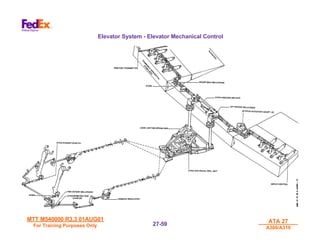
Elevator System - Elevator Mechanical Control System - General and Components
A. GENERAL
Each elevator is operated by three mechanically controlled servo
controls. The inputs from the control columns are transmitted to the
elevators by dual control systems. Each system is routed along one side
of the fuselage. The left and right systems are interconnected at two
points by detent bellcranks, one beneath the flight compartment floor, the
other between the two elevators.
B. COMPONENT DESCRIPTION
1. Cable tension regulators maintain a constant tension on the cables
(49.50 ±9.23 lbf).
2. The servo control actuating spring rods:
• Provide flexibility in the control for any asymmetrical deflection of
the elevators in ground gusts
• Prevent runaway of the control system if an input lever jams on
its servo control body.
3. A load limiting spring rod in each system, downstream of the artificial
feel unit, limits the design loads.
4. Rods: Identical to those used in the aileron control system
5. Cables: Identical to those used in the aileron control system
6. Control column stops: Control column travel is limited in both
directions by non adjustable stops.
Elevator operational stops: Maximum input to the servo controls is
limited by adjustable stops located at a lever, close to each elevator.
Elevator travel stops: These are the stroke end stops
(non-adjustable) of the servo controls, never reached in normal
operation.
Elevator structural stops, when the servo controls are not installed:
The elevators rest on structural down stops, designed for that
purpose, which are not able to withstand any load other than the
weight of the elevators.
Adjustable levers: The length of a lever close to each elevator is
adjustable in order to maintain maximum travel of the elevators
within the design limits.
NOTE: Rigging pin holes are provided at convenient places to facilitate
rigging.
MTT M540000 R3.3 01AUG01
For Training Purposes Only
ATA 27
ATA 27
A300/A310
A300/A310
27-
27-59
59
Elevator System - Elevator Mechanical Control
MTT M540000 R3.3 01AUG01
For Training Purposes Only
ATA 27
ATA 27
A300/A310
A300/A310
27-
27-60
60
ARTIFICIAL FEEL (ELEVATOR)
The pitch artificial feel system creates load feel at the control column
which is variable with flight conditions, in order to reduce the variation of
force per g throughout the whole flight envelope. At high angle of attack,
the system causes an increase in the load feel at the control column
resulting in aircraft return to permissible angle of attack configuration.
1. Pitch Artificial Feel Unit
The artificial feel unit is composed of:
• spring box providing a force threshold
• A torsion bar driven by a variable gain mechanism which
generates variable load feel.
• Two electrohydraulic actuators, displacement of which produces
the kinematic gain variation.
• One return spring box used to retract the two actuators to the
position corresponding to "low speed" load feel, in the event of
double hydraulic failure.
Pitch Artificial Feel Unit - Operation
The actuators act on the gain variation mechanism by means of
levers. Gain is imposed by the actuator having extended the furthest.
In the event of jamming of the mechanism, a microswitch transmits a
pitch disagree warning signal. The artificial feel unit includes a "fail
safe" part to avoid loss of the force threshold and feel load at the
same time.
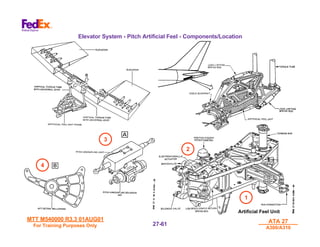
2. Pitch Artificial Feel Actuator
Each actuator includes:
• A biased servovalve which modulates pressure in the actuator
large chamber, the small chamber being permanently supplied
with high pressure. In the event of an electrical failure, servo-
valve current is nulled and its control valve is displaced so that
the actuator is retracted.
• A solenoid valve, energized in normal operation
• A bypass which connects the large chamber to return in order to
retract the actuator when the solenoid valve is de-energized. It is
therefore redundant with respect to the servovalve bias.
• A position pickoff potentiometer.
3. Pitch Upcoupling Unit
Provides connection of LH and RH elevators from 0-30 knots
airspeed during takeoff roll.
Above 30-195 knots, the LH and RH elevators are disconnected by
ADC 1/2 to allow either pilot to control the elevator (pitch) function. In
case of a jam in the elevator control system on the captain’s or first
officer’s control panels
Above 192 knots, both elevators will reconnect for full control of the
LH and RH elevator system runs.
During landing conditions, this process is repeated in the same
airspeed conditions.
4. Aft Detent Bellcrank
In the event of an elevator jam on the LH or RH elevators, the aft
detent bellcrack will release on the jammed side to prevent lockout of
the elevator system.
MTT M540000 R3.3 01AUG01
For Training Purposes Only
ATA 27
ATA 27
A300/A310
A300/A310
27-
27-61
61
Elevator System - Pitch Artificial Feel - Components/Location
1
3
2
4
Artificial Feel Unit
MTT M540000 R3.3 01AUG01
For Training Purposes Only
ATA 27
ATA 27
A300/A310
A300/A310
27-
27-62
62
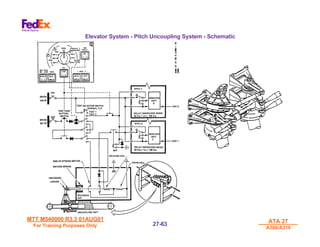
Elevator System - Pitch Uncoupling System - General and Components
The two elevator control channels can be uncoupled during the takeoff
phase in the event of jamming at any point on the control systems, by
means of two detent bellcranks; one installed between the control
columns, the other between the two elevators. A pitch uncoupling unit,
comprising a solenoid and rod, prevents any inadvertent uncoupling of
the two elevators after the takeoff phase in order to prevent asymmetrical
loads being applied to the structural attachments of the trimmable
horizontal stabilizer. The uncoupling unit solenoid is energized if airspeed
Vc is higher than 30 kts and lower than 195 kts.
COMPONENT DESCRIPTION
1. Solenoid
The solenoid includes the following components:
• A low resistance draw coil, allowing high intensity current to
provide a high draw force when the coil is energized.
• A high resistance holding coil allowing low intensity current to
provide permanent operation capability of the solenoid.
• Two end of stroke switches, one for direct draw coil energization,
one for test purposes.
• A return spring, to lock the rod when the solenoid is
de-energized.
NOTE: The lower limit of 30 kts (minimum speed for which a Vc value
can be obtained from ADCs) has been introduced to prevent permanent
energization of the solenoid and power contactor coil when the aircraft
electrical network is energized on the ground.
MTT M540000 R3.3 01AUG01
For Training Purposes Only
ATA 27
ATA 27
A300/A310
A300/A310
27-
27-63
63
Elevator System - Pitch Uncoupling System - Schematic
MTT M540000 R3.3 01AUG01
For Training Purposes Only
ATA 27
ATA 27
A300/A310
A300/A310
27-
27-64
64
Trimmable Horizontal Stabilizer System - Pitch Controls
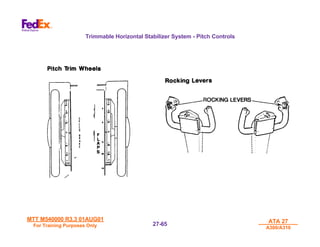
Both pitch trim wheels provide mechanical control of the Trimmable
Horizontal Stabilizer (THS). When a pitch trim control wheel is used to
override the electrical command, it disengages the electric actuators and
the PITCH TRIM levers trip to OFF. The trim range is from 14° nose up
to 3° nose down. Trim position is indicated in degrees on a scale
adjacent to each trim wheel which is painted Green over the normal take
off range (2° DN. 2.5° UP).
On each control wheel a rocking lever for pitch trim control is installed.
Up or down movement of the rocking levers activates the two electric
actuators which control the hydraulic motors for horizontal stabilizer
adjustment providing that at least one PITCH TRIM system is engaged
and AP is OFF or in CWS mode. The rocking levers are spring loaded to
neutral position. If both rocking levers are operated simultaneously, but in
opposite position, trimming action stops. If trimming by means of the
rocking levers lasts for more than 1 sec., an aural warning is activated.
NOTE: The pitch trim rate is:
• 0 . 9 ° /s when the speed is below 200 kts.
• 0.17°/s when the speed is above 240 kts. It varies
linearly from 0.9°/s to 0.17°/s when the speed is between
200 and 240 kts.
MTT M540000 R3.3 01AUG01
For Training Purposes Only
ATA 27
ATA 27
A300/A310
A300/A310
27-
27-65
65
Trimmable Horizontal Stabilizer System - Pitch Controls
MTT M540000 R3.3 01AUG01
For Training Purposes Only
ATA 27
ATA 27
A300/A310
A300/A310
27-
27-66
66
Elevator System - Elevator Surface Position Indicating
Position of the right elevator is indicated on the right SCAM display unit,
with the hydraulic systems available for the servo controls. There is no
special reference mark painted on the elevators, but on each side of the
APU tailcone, there is:
• an engraved reference plate which indicates the neutral position of
the corresponding elevator.
• an engraved placard with the following inscription:
VALID STABILIZER IN NEUTRAL POSITION.
1. ELEV AND STAB POSITION INDICATION
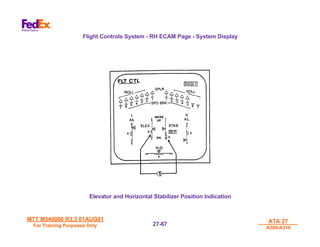
A White scale covering the full travel range is provided for elevator
and trimmable horizontal stabilizer position. An index indicating the
actual position of the surfaces moves along each scale. In addition,
each available hydraulic system on the THS is indicated by a Green
symbol (G,Y). In case of servo control low pressure detection, the
corresponding symbol becomes Amber.
MTT M540000 R3.3 01AUG01
For Training Purposes Only
ATA 27
ATA 27
A300/A310
A300/A310
27-
27-67
67
Flight Controls System - RH ECAM Page - System Display
Elevator and Horizontal Stabilizer Position Indication
MTT M540000 R3.3 01AUG01
For Training Purposes Only
ATA 27
ATA 27
A300/A310
A300/A310
27-
27-68
68
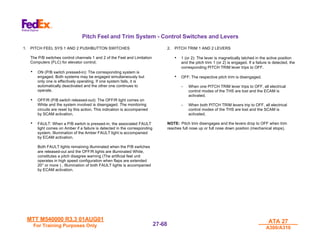
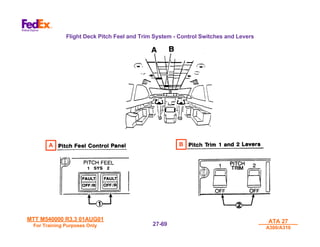
Pitch Feel and Trim System - Control Switches and Levers
1. PITCH FEEL SYS 1 AND 2 PUSHBUTTON SWITCHES
The P/B switches control channels 1 and 2 of the Feel and Limitation
Computers (FLC) for elevator control.
• ON (P/B switch pressed-in): The corresponding system is
engaged. Both systems may be engaged simultaneously but
only one is effectively operating. If one system fails, it is
automatically deactivated and the other one continues to
operate.
• OFF/R (P/B switch released-out): The OFF/R light comes on
White and the system involved is disengaged. The monitoring
circuits are reset by this action. This indication is accompanied
by SCAM activation.
• FAULT: When a P/B switch is pressed-in, the associated FAULT
light comes on Amber if a failure is detected in the corresponding
system. Illumination of the Amber FAULT light is accompanied
by ECAM activation.
Both FAULT lights remaining illuminated when the P/B switches
are released-out and the OFF/R lights are illuminated White,
constitutes a pitch disagree warning (The artificial feel unit
operates in high speed configuration when flaps are extended
20° or more ) . Illumination of both FAULT lights is accompanied
by ECAM activation.
2. PITCH TRIM 1 AND 2 LEVERS
• 1 (or 2): The lever is magnetically latched in the active position
and the pitch trim 1 (or 2) is engaged. If a failure is detected, the
corresponding PITCH TRIM lever trips to OFF.
• OFF: The respective pitch trim is disengaged.
- When one PITCH TRIM lever trips to OFF, all electrical
control modes of the THS are lost and the ECAM is
activated.
- When both PITCH TRIM levers trip to OFF, all electrical
control modes of the THS are lost and the SCAM is
activated.
NOTE: Pitch trim disengages and the levers drop to OFF when trim
reaches full nose up or full nose down position (mechanical stops).
MTT M540000 R3.3 01AUG01
For Training Purposes Only
ATA 27
ATA 27
A300/A310
A300/A310
27-
27-69
69
Flight Deck Pitch Feel and Trim System - Control Switches and Levers
B
A
MTT M540000 R3.3 01AUG01
For Training Purposes Only
ATA 27
ATA 27
A300/A310
A300/A310
27-
27-70
70
THIS PAGE INTENTIONALLY
LEFT BLANK
MTT M540000 R3.3 01AUG01
For Training Purposes Only
ATA 27
ATA 27
A300/A310
A300/A310
27-
27-71
71
TRIMMABLE HORIZONTAL
STABILIZER (THS) -
SECTION
MTT M540000 R3.3 01AUG01
For Training Purposes Only
ATA 27
ATA 27
A300/A310
A300/A310
27-
27-72
72
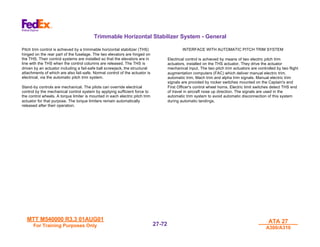
Trimmable Horizontal Stabilizer System - General
Pitch trim control is achieved by a trimmable horizontal stabilizer (THS)
hinged on the rear part of the fuselage. The two elevators are hinged on
the THS. Their control systems are installed so that the elevators are in
line with the THS when the control columns are released. The THS is
driven by an actuator including a fail-safe ball screwjack, the structural
attachments of which are also fail-safe. Normal control of the actuator is
electrical, via the automatic pitch trim system.
Stand-by controls are mechanical. The pilots can override electrical
control by the mechanical control system by applying sufficient force to
the control wheels. A torque limiter is mounted in each electric pitch trim
actuator for that purpose. The torque limiters remain automatically
released after their operation.
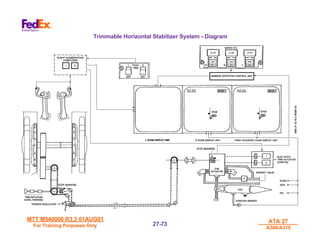
INTERFACE WITH AUTOMATIC PITCH TRIM SYSTEM
Electrical control is achieved by means of two electric pitch trim
actuators, installed on the THS actuator. They drive the actuator
mechanical input. The two pitch trim actuators are controlled by two flight
augmentation computers (FAC) which deliver manual electric trim,
automatic trim, Mach trim and alpha trim signals. Manual electric trim
signals are provided by rocker switches mounted on the Captain's and
First Officer's control wheel horns. Electric limit switches detect THS end
of travel in aircraft nose up direction. The signals are used in the
automatic trim system to avoid automatic disconnection of this system
during automatic landings.
MTT M540000 R3.3 01AUG01
For Training Purposes Only
ATA 27
ATA 27
A300/A310
A300/A310
27-
27-73
73
Trimmable Horizontal Stabilizer System - Diagram
MTT M540000 R3.3 01AUG01
For Training Purposes Only
ATA 27
ATA 27
A300/A310
A300/A310
27-
27-74
74
Trimmable Horizontal Stabilizer System - Hydraulic Actuation - Components/Location
The trimmable horizontal stabilizer is driven by an actuator which
includes two hydraulic motors, each powered by a different hydraulic
system.
MTT M540000 R3.3 01AUG01
For Training Purposes Only
ATA 27
ATA 27
A300/A310
A300/A310
27-
27-75
75
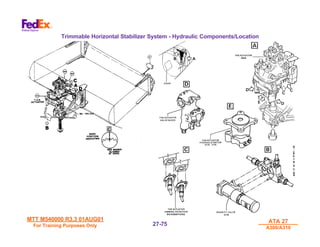
Trimmable Horizontal Stabilizer System - Hydraulic Components/Location
MTT M540000 R3.3 01AUG01
For Training Purposes Only
ATA 27
ATA 27
A300/A310
A300/A310
27-
27-76
76
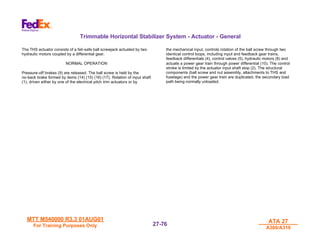
Trimmable Horizontal Stabilizer System - Actuator - General
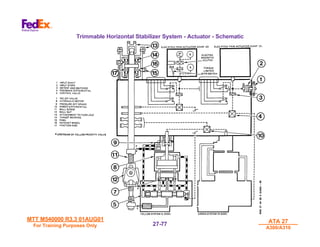
The THS actuator consists of a fail-safe ball screwjack actuated by two
hydraulic motors coupled by a differential gear.
NORMAL OPERATION
Pressure-off brakes (9) are released. The ball screw is held by the
no-back brake formed by items (14) (15) (16) (17). Rotation of input shaft
(1), driven either by one of the electrical pitch trim actuators or by
the mechanical input, controls rotation of the ball screw through two
identical control loops, including input and feedback gear trains,
feedback differentials (4), control valves (5), hydraulic motors (8) and
actuate a power gear train through power differential (10). The control
stroke is limited by the actuator input shaft stop (2). The structural
components (ball screw and nut assembly, attachments to THS and
fuselage) and the power gear train are duplicated, the secondary load
path being normally unloaded.
MTT M540000 R3.3 01AUG01
For Training Purposes Only
ATA 27
ATA 27
A300/A310
A300/A310
27-
27-77
77
Trimmable Horizontal Stabilizer System - Actuator - Schematic
MTT M540000 R3.3 01AUG01
For Training Purposes Only
ATA 27
ATA 27
A300/A310
A300/A310
27-
27-78
78
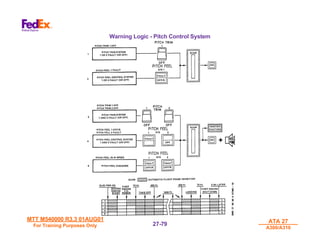
WARNING LOGIC PITCH CONTROL SYSTEM
Depicted below are the various warnings displayed in the Flight Compartment in the
event the fault shown occurs in the Pitch Control System of the aircraft. Also
graphically shown are the Flight Phases at which the warnings will or will not be
displayed.
MTT M540000 R3.3 01AUG01
For Training Purposes Only
ATA 27
ATA 27
A300/A310
A300/A310
27-
27-79
79
Warning Logic - Pitch Control System
MTT M540000 R3.3 01AUG01
For Training Purposes Only
ATA 27
ATA 27
A300/A310
A300/A310
27-
27-80
80
Alpha Probes System - Stall Warning - General
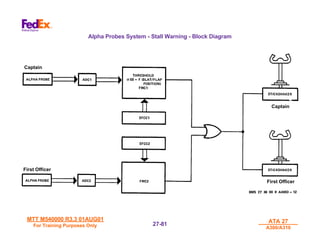
• The dual stall warning system provides audio (cricket) and vibrating
(stick shaker) warning in case of impending stall.
• The angle of attack is the governing parameter for stall warning,
together with slat extension.
• The angle of attack is given by two alpha probes (one on each side
of the forward fuselage) which are electrically heated. Slat position is
transmitted by two synchro-transmitters, one for each FWC.
• On each control column, a stick shaker is installed and controlled by
the stall warning generator included in FWC 1 or 2.
• Stall warnings are activated when angle of attack exceeds a
predetermined value.
• slat retraction is inhibited.
• turn coordination of yaw damper is inhibited.
Stall warning is inhibited on the ground except during ALPHA PROBES
test.
MTT M540000 R3.3 01AUG01
For Training Purposes Only
ATA 27
ATA 27
A300/A310
A300/A310
27-
27-81
81
Alpha Probes System - Stall Warning - Block Diagram
Captain
Captain
First Officer
First Officer
MTT M540000 R3.3 01AUG01
For Training Purposes Only
ATA 27
ATA 27
A300/A310
A300/A310
27-
27-82
82
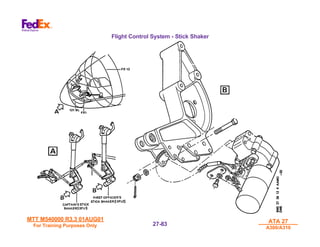
Flight Control System - Stick Shaker - General
One stick shaker is installed on each control column, and is controlled by
the Flight Warning Computers 1/2.
MTT M540000 R3.3 01AUG01
For Training Purposes Only
ATA 27
ATA 27
A300/A310
A300/A310
27-
27-83
83
Flight Control System - Stick Shaker
MTT M540000 R3.3 01AUG01
For Training Purposes Only
ATA 27
ATA 27
A300/A310
A300/A310
27-
27-84
84
THIS PAGE INTENTIONALLY
LEFT BLANK
MTT M540000 R3.3 01AUG01
For Training Purposes Only
ATA 27
ATA 27
A300/A310
A300/A310
27-
27-85
85
LEADING EDGE LIFT DEVICES
SECTION
MTT M540000 R3.3 01AUG01
For Training Purposes Only
ATA 27
ATA 27
A300/A310
A300/A310
27-
27-86
86
Wing Leading Edge - Slat System - General
SLAT SYSTEM
There are three slat surfaces in each wing, the inboard, center and
outboard slats. They are guided on curved support tracks. The inboard
slat has three tracks and the center and outboard have four each. A
folding nose on each inner slat folds to clear the engine pylon when the
slats extend. The slats are actuated by ballscrew jacks, two for each
surface. Two friction brakes, one at each end of the wing transmission
system provide system irreversibility. Attached to each friction brake is a
position pick-off unit (PPU) for asymmetry and system monitoring.
KRUEGER FLAP AND NOTCH FLAP
The Krueger flap and notch flap are provided to complete the wing
leading edge profile when the slats are extended. The Krueger flap and
notch flap are operated by individual hydraulic actuators. Both are
controlled by the SFCC and move to the extend and retract position
when the SFCC commands slat extension or retraction.
Slats and spoilers are numbered from inboard to outboard, each side
separately.
MTT M540000 R3.3 01AUG01
For Training Purposes Only
ATA 27
ATA 27
A300/A310
A300/A310
27-
27-87
87
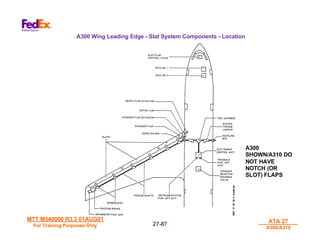
A300 Wing Leading Edge - Slat System Components - Location
A300
SHOWN/A310 DO
NOT HAVE
NOTCH (OR
SLOT) FLAPS
MTT M540000 R3.3 01AUG01
For Training Purposes Only
ATA 27
ATA 27
A300/A310
A300/A310
27-
27-88
88
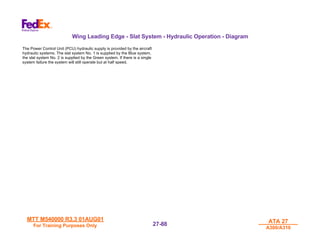
Wing Leading Edge - Slat System - Hydraulic Operation - Diagram
The Power Control Unit (PCU) hydraulic supply is provided by the aircraft
hydraulic systems. The slat system No. 1 is supplied by the Blue system,
the slat system No. 2 is supplied by the Green system. If there is a single
system failure the system will still operate but at half speed.
MTT M540000 R3.3 01AUG01
For Training Purposes Only
ATA 27
ATA 27
A300/A310
A300/A310
27-
27-89
89
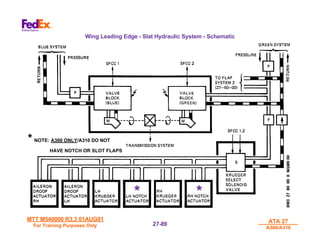
Wing Leading Edge - Slat Hydraulic System - Schematic
*
* *
*
* NOTE: A300 ONLY/A310 DO NOT
HAVE NOTCH OR SLOT FLAPS
MTT M540000 R3.3 01AUG01
For Training Purposes Only
ATA 27
ATA 27
A300/A310
A300/A310
27-
27-90
90
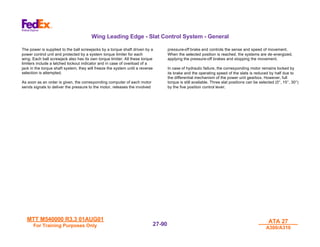
Wing Leading Edge - Slat Control System - General
The power is supplied to the ball screwjacks by a torque shaft driven by a
power control unit and protected by a system torque limiter for each
wing. Each ball screwjack also has its own torque limiter. All these torque
limiters include a latched lockout indicator and in case of overload of a
jack in the torque shaft system, they will freeze the system until a reverse
selection is attempted.
As soon as an order is given, the corresponding computer of each motor
sends signals to deliver the pressure to the motor, releases the involved
pressure-off brake and controls the sense and speed of movement.
When the selected position is reached, the systems are de-energized,
applying the pressure-off brakes and stopping the movement.
In case of hydraulic failure, the corresponding motor remains locked by
its brake and the operating speed of the slats is reduced by half due to
the differential mechanism of the power unit gearbox. However, full
torque is still available. Three slat positions can be selected (0°, 15°, 30°)
by the five position control lever.
MTT M540000 R3.3 01AUG01
For Training Purposes Only
ATA 27
ATA 27
A300/A310
A300/A310
27-
27-91
91
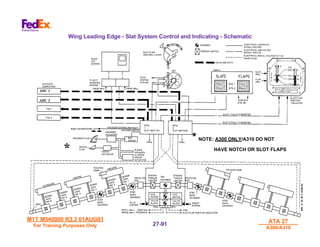
Wing Leading Edge - Slat System Control and Indicating - Schematic
* NOTE: A300 ONLY/A310 DO NOT
HAVE NOTCH OR SLOT FLAPS
*
ADC 1
ADC 2
MTT M540000 R3.3 01AUG01
For Training Purposes Only
ATA 27
ATA 27
A300/A310
A300/A310
27-
27-92
92
Wing Leading Edge - Slat - Hydraulic Power Drive System - General
The slat drive system comprises the power control unit (PCU), a
transverse torque shaft system and the screwjacks. In the PCU two
independent hydraulic motors, one controlled by the Blue valve block and
one controlled by the Green valve block, drive a summing gear. The
output is passed through torque shafts to a tee-gearbox which rotates the
motor drive direction by 90°. A pressure-off brake is provided between
each motor and the summing gear to lock the transmission system when
the slat system is static.
The two transverse outputs drive the ballscrew jacks through torque
limiters, a series of torque shafts, steady bearings and gearboxes. One
unidirectional friction brake is installed at each wing tip to provide system
irreversibility under compressive screwjack loads.
MTT M540000 R3.3 01AUG01
For Training Purposes Only
ATA 27
ATA 27
A300/A310
A300/A310
27-
27-93
93
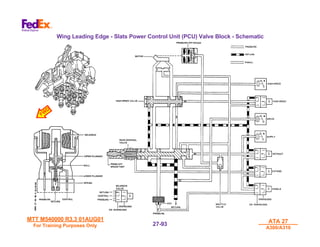
Wing Leading Edge - Slats Power Control Unit (PCU) Valve Block - Schematic
FW
D
FW
D
MTT M540000 R3.3 01AUG01
For Training Purposes Only
ATA 27
ATA 27
A300/A310
A300/A310
27-
27-94
94
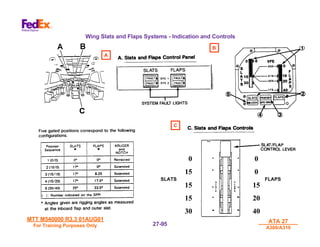
Wing Slats and Flaps Systems - Indicating and Control - Description
A single control lever located on the center pedestal permits slat and flap
control. The lever has five gated positions. It is not possible to select an
intermediate position (if the lever is held in between gates the system
drives to the last demanded position and after 10 sec. all the slat and flap
FAULT warnings illuminate). The slats and flaps are electrically signaled
by two identical digital computers (Slats Flaps Control Computers). Each
one is composed of one slat control channel and one flap control
channel.
SLATS (OR FLAPS) SYS 1 AND 2 FAULT LIGHTS
Each light comes on Amber when the associated hydraulic motor is
inoperable. Both slats (or flaps) stop due to a system jam. In both cases,
a reverse selection is possible. If system jam is released, the system will
move to the commanded position.
Both SLAT (or FLAP) FAULT lights and the associated Amber SLAT (or
FLAP) lights on the Slat/Flap Position Indicator will come on
simultaneously if a mechanical failure is detected. In this case, the
system is locked by the pressure-off brakes and there is no possibility of
recovery in flight.
NOTE: If a SFCC is not installed, the two associated FAULT light (one
SLAT FAULT light and one FLAP FAULT light) will come on.
Illumination of these lights is associated with ECAM activation.
1. SLAT/FLAP POSITION INDICATOR STRIPS
Slat and flap positions are shown by White strips moving up and
down associated scales. The corresponding VFE (speed limit) is
placarded opposite each normal position (indicated by a round
number).
2. SLAT AND FLAP LIGHTS
Come on Amber when the associated system is blocked.
3. KRUEGER LIGHT
Comes on Amber if either KRUEGER flap is not in correct position
10 sec. after a movement command. Illumination of KRUEGER light
is accompanied by ECAM activation.
4. SPD BRK LIGHT
The light comes on Blue when the speed brake control lever is not in
RET position.
5. Flashes Blue when the slat lock function is activated (inhibition of
complete slat and KRUEGER flap retraction at high angle of attack).
Before selection of any position, the slat/flap control lever must be pulled
up. A block is provided for positions 2 and 4 to prevent the lever moving
straight through.
NOTE: All slat and flap FAULT lights will illuminate if the control lever
remains between two gated positions (after 10 sec.).
NOTE: All Slat and Flap FAULT lights will remain illuminated if Slat/Flap
Control Computer (SFCC) number 1 and 2 are removed from Electronic
Rack 90VU. The 28 Volt DC Interlock Relay in the system prevents
accidental dispatch of the aircraft if both SFCC 1/2 are removed from the
electronic rack or aircraft.
MTT M540000 R3.3 01AUG01
For Training Purposes Only
ATA 27
ATA 27
A300/A310
A300/A310
27-
27-95
95
Wing Slats and Flaps Systems - Indication and Controls
A
B
C
0
15
15
15
30
0
0
15
20
40
FLAPS
SLATS
MTT M540000 R3.3 01AUG01
For Training Purposes Only
ATA 27
ATA 27
A300/A310
A300/A310
27-
27-96
96
A300/A310 Wing Leading Edge - Slat - Asymmetry Monitoring
Slat position is indicated to the flight crew by the SLATS vertical bar
display on the slat/flap position indicator. The display is driven by inputs
from the instrumentation Position Pick-off Unit (PPU) which also provides
independent slat position information for other systems.
Slat position discrete and digital data are provided for other systems by
the SFCCs.
ASYMMETRY AND POWER TRANSMISSION MONITORING
( SLATS)
The Asymmetry PPUs enable the SFCCs to monitor the transmission for
asymmetry and runaway conditions.
If an asymmetry or runaway condition is detected, the PCU operation is
inhibited, preventing further movement of the transmission system.
MTT M540000 R3.3 01AUG01
For Training Purposes Only
ATA 27
ATA 27
A300/A310
A300/A310
27-
27-97
97
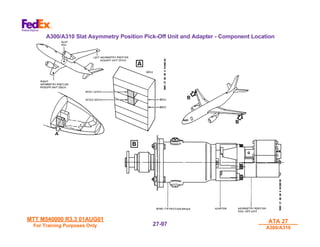
A300/A310 Slat Asymmetry Position Pick-Off Unit and Adapter - Component Location
B
B
B
MTT M540000 R3.3 01AUG01
For Training Purposes Only
ATA 27
ATA 27
A300/A310
A300/A310
27-
27-98
98
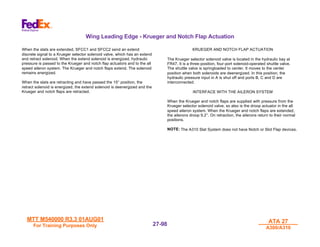
Wing Leading Edge - Krueger and Notch Flap Actuation
When the slats are extended, SFCC1 and SFCC2 send an extend
discrete signal to a Krueger selector solenoid valve, which has an extend
and retract solenoid. When the extend solenoid is energized, hydraulic
pressure is passed to the Krueger and notch flap actuators and to the all
speed aileron system. The Krueger and notch flaps extend. The solenoid
remains energized.
When the slats are retracting and have passed the 15° position, the
retract solenoid is energized, the extend solenoid is deenergized and the
Krueger and notch flaps are retracted.
KRUEGER AND NOTCH FLAP ACTUATION
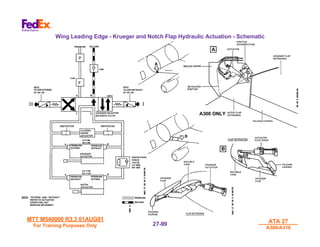
The Krueger selector solenoid valve is located in the hydraulic bay at
FR47. It is a three-position, four-port solenoid-operated shuttle valve.
The shuttle valve is springloaded to center. It moves to the center
position when both solenoids are deenergized. In this position, the
hydraulic pressure input in A is shut off and ports B, C and D are
interconnected.
INTERFACE WITH THE AILERON SYSTEM
When the Krueger and notch flaps are supplied with pressure from the
Krueger selector solenoid valve, so also is the droop actuator in the all
speed aileron system. When the Krueger and notch flaps are extended,
the ailerons droop 9.2°. On retraction, the ailerons return to their normal
positions.
NOTE: The A310 Slat System does not have Notch or Slot Flap devices.
MTT M540000 R3.3 01AUG01
For Training Purposes Only
ATA 27
ATA 27
A300/A310
A300/A310
27-
27-99
99
Wing Leading Edge - Krueger and Notch Flap Hydraulic Actuation - Schematic
A300 ONLY
MTT M540000 R3.3 01AUG01
For Training Purposes Only
ATA 27
ATA 27
A300/A310
A300/A310
27-
27-100
100
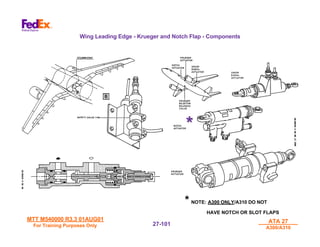
Wing Leading Edge - Krueger and Notch Flap - Components
KRUEGER FLAP ACTUATOR
The Krueger flap actuator is a double-acting actuator with mechanical
locking of the piston assembly in the extended position (flap retracted)
and hydraulic locking in the retracted position (flap extended). The piston
end is connected to the Krueger flap by a reverse link. The cylinder head
is mounted to the structure by two mounting blocks which allow the
actuator to pivot on the mounting during the operating cycle. The
actuator consists of a cylinder:. f head a cylinder and a valve block.
*NOTCH FLAP ACTUATOR / A300 ONLY
The notch flap actuator is a double-acting actuator and is hydraulically
locked in the retracted position. The piston rod is connected by an
eye-end to the notch flap and the cylinder is attached to the structure by
a shaft hinge to allow some pivoting during the retraction and extension
cycle.
SAFETY VALVE
The safety valve is located in the pressure line from the Green hydraulic
system to the solenoid selector valve. Its function is to prevent loss of
hydraulic fluid from the Green system should there be a major rupture in
the Krueger and notch flap actuating system.
*NOTE: The A310 Slat System does not have Notch or Slot Flap
devices.
MTT M540000 R3.3 01AUG01
For Training Purposes Only
ATA 27
ATA 27
A300/A310
A300/A310
27-
27-101
101
Wing Leading Edge - Krueger and Notch Flap - Components
*
*
* NOTE: A300 ONLY/A310 DO NOT
HAVE NOTCH OR SLOT FLAPS
MTT M540000 R3.3 01AUG01
For Training Purposes Only
ATA 27
ATA 27
A300/A310
A300/A310
27-
27-102
102
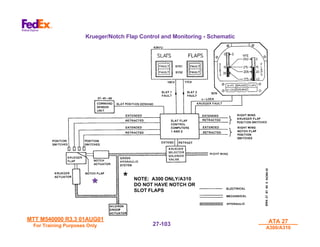
Wing Leading Edge - Krueger and Notch Flap Control and Monitoring - General
In addition, to obtain better aerodynamic characteristics, a KRUEGER
flap and a NOTCH flap are provided on each wing and are located
between the inner slat and the fuselage.
The KRUEGER and NOTCH flaps are extended when the slat/flap
control lever is moved from position 1 to 2 and remain extended for all
other selected positions. When slats 0° position is selected, the
KRUEGER flaps fold up under the leading edge and the NOTCH flap
retracts into the fuselage.
Each KRUEGER flap and AIL droop actuator and each NOTCH actuator
are supplied from a KRUEGER selector solenoid valve supplied by the
Green circuit and controlled by the slats control system.
The KRUEGER jacks are mechanically locked in retracted position and
hydraulically locked in extended position.
MTT M540000 R3.3 01AUG01
For Training Purposes Only
ATA 27
ATA 27
A300/A310
A300/A310
27-
27-103
103
Krueger/Notch Flap Control and Monitoring - Schematic
*
*
* NOTE: A300 ONLY/A310
DO NOT HAVE NOTCH OR
SLOT FLAPS
MTT M540000 R3.3 01AUG01
For Training Purposes Only
ATA 27
ATA 27
A300/A310
A300/A310
27-
27-104
104
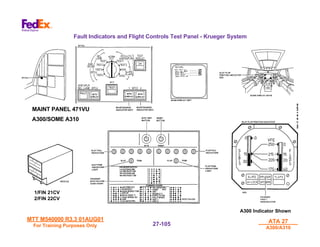
Wing Leading Edge - Slats/Krueger Flap Monitoring and Fault Warning System
The SFCC provides continuous monitoring of the slat system and the
Krueger and notch position. Fault warnings are generated for those faults
requiring pilot action or flight crew awareness. The faults are stored in
the SFCC including those which are purely maintenance data. The
warnings are displayed on one or more of the following:
• SLATS SYS 1 FAULT or SLATS SYS 2 FAULT annunciator (19CV)
on the overhead panel
• BITE DISPLAY/SFCC1 or SFCC2 annunciators (52CV and 53CV) on
the FLIGHT CONTROL section panel 471VU
• Left electronic centralized aircraft monitor (ECAM)
• Fault indicator on the SFCC front panel.
SELF TEST
Self test facilities are provided to:
• detect and indicate failure in redundant and dormant circuits
• identify a failed line replaceable unit (LRU)
The self test can be initiated from the flight deck maintenance panel or by
using the BITE pushbutton switch on the SFCC front panel.
MTT M540000 R3.3 01AUG01
For Training Purposes Only
ATA 27
ATA 27
A300/A310
A300/A310
27-
27-105
105
Fault Indicators and Flight Controls Test Panel - Krueger System
A300 Indicator Shown
1/FIN 21CV
2/FIN 22CV
MAINT PANEL 471VU
A300/SOME A310
MTT M540000 R3.3 01AUG01
For Training Purposes Only
ATA 27
ATA 27
A300/A310
A300/A310
27-
27-106
106
Warning Logic Slat System
Depicted below are the various warnings displayed in the Flight Compartment in the event the fault
shown occurs in the Slat System of the aircraft. So shown graphically are the flight phases at which
the warnings will or will not be displayed.
MTT M540000 R3.3 01AUG01
For Training Purposes Only
ATA 27
ATA 27
A300/A310
A300/A310
27-
27-107
107
A300/A310 Slats System - Warning Logic
MTT M540000 R3.3 01AUG01
For Training Purposes Only
ATA 27
ATA 27
A300/A310
A300/A310
27-
27-108
108
THIS PAGE INTENTIONALLY
LEFT BLANK
MTT M540000 R3.3 01AUG01
For Training Purposes Only
ATA 27
ATA 27
A300/A310
A300/A310
27-
27-109
109
WING FLAPS
SECTION
MTT M540000 R3.3 01AUG01
For Training Purposes Only
ATA 27
ATA 27
A300/A310
A300/A310
27-
27-110
110
A300 Wing Flap System - Description
Each wing has three flap sections. The three flaps are single slotted
fowler type and are guided by two tracks fitted with ball screwjacks. The
power is supplied to the ball screwjacks by a torque shaft driven by a
power control unit and protected by a system torque limiter for each
wing. Each ball screwjack has its own torque limiter.
All these torque limiters include a latched lock-out indicator and, in case
of overload of a jack in the torque shaft system, they will freeze the
system until a reverse selection is attempted. The Power Control Unit
(PCU) consists of two independent hydraulic motors coupled to a
differential mechanical system through pressure-off brakes that insure
the system irreversibility. The two motors are supplied by different
hydraulic circuits (Green and Yellow).
As soon as an order is given, the corresponding computer of each motor
sends signals to deliver the pressure to the motor, release the involved
pressure-off brakes and control the direction and speed of movement.
When the selected position is reached, the systems are de-energized,
applying the pressure-off brakes and stopping the movement.
In case of hydraulic leakage, the corresponding motor remains locked
and the operating speed of the slats is reduced by half due to the
differential mechanism of the power unit gear box. However, full torque is
still available. Four flap positions can be selected (0°,15°,20°,40°) by
moving the slat flap control lever from position 2 to 5. Furthermore,
between the inboard and center flaps, there is an aileron droop signal
unit which commands the aileron to droop 9.2° maximum with slats
extension to 15°.
A load relief system is provided to minimize the design loads on the flap
support structure and the flap jacks. Load relief function can only engage
when the slat flap control lever is in gate 5. Load relief is activated within
the flap channels of the two SFCCs by using Calibrated Air Speed (CAS)
received from the two ADCs. Load relief logic is the following:
• if CAS >178 kt, Flaps retract from 33.5° to 24°
• if CAS <173 kt, Flaps extend from 24° to 33.5°
MTT M540000 R3.3 01AUG01
For Training Purposes Only
ATA 27
ATA 27
A300/A310
A300/A310
27-
27-111
111
A300 Wing Flap System - Components/Location
MTT M540000 R3.3 01AUG01
For Training Purposes Only
ATA 27
ATA 27
A300/A310
A300/A310
27-
27-112
112
Wing Flap System Hydraulics
The PCU hydraulic supply is provided by the aircraft hydraulic systems.
One motor is supplied from the Green system and one is supplied from
the Yellow system. If there is a single-system failure, one of the motors
will drive the system at half speed.
MTT M540000 R3.3 01AUG01
For Training Purposes Only
ATA 27
ATA 27
A300/A310
A300/A310
27-
27-113
113
Wing Flaps Hydraulic System - Schematic
POWER CONTROL UNIT (PCU)
INSTALLATION LOCATION -
FUSELAGE FRAME (FR) 54
MTT M540000 R3.3 01AUG01
For Training Purposes Only
ATA 27
ATA 27
A300/A310
A300/A310
27-
27-114
114
Wing Flap System - Power Control Unit (PCU)
The flap drive system consists of two identical hydromechanical systems,
comprising two hydraulic motors, a differential gear and pressure-off
brakes, contained within a power control unit, (PCU) and a transverse
torque shaft system driving the ballscrew jacks. Static and dynamic
system irreversibility is provided by no-back friction brakes within
screwjacks 2, 4, 5 and 6. Screwjack 3 incorporates only one no-back
which operates only during flap extension under tensile loads. Screwjack
1 is not provided with no-back friction brakes.
MTT M540000 R3.3 01AUG01
For Training Purposes Only
ATA 27
ATA 27
A300/A310
A300/A310
27-
27-115
115
Wing Flap System PCU - Schematic
FWD
FWD
MTT M540000 R3.3 01AUG01
For Training Purposes Only
ATA 27
ATA 27
A300/A310
A300/A310
27-
27-116
116
Wing Flap PCU Components
The PCU is located in the hydraulic compartment and provides the
driving power to the flap system.
It consists of the following subassemblies:
• Acceleration control valve
• Valve blocks
• Transfer tubes
• Hydraulic motors
• Pressure-off brakes
• Differential gearbox
• Intermediate gearbox
• Position pickoff units (PPU)
MTT M540000 R3.3 01AUG01
For Training Purposes Only
ATA 27
ATA 27
A300/A310
A300/A310
27-
27-117
117
Wing Flap PCU - Components and Valve Block
FWD
FWD
MTT M540000 R3.3 01AUG01
For Training Purposes Only
ATA 27
ATA 27
A300/A310
A300/A310
27-
27-118
118
Wing Flap Controls
The flap system is controlled by two identical slat flap control computers
(SFCC1 and SFCC2). The SFCCs provide, in addition, monitoring and
test facilities.
Included in the monitoring is a flap relief function in which the flaps are
automatically retracted from a fully extended position should the aircraft
exceed the maximum flap extended speed (VFE) limitation for the flap
configuration. If the control lever setting has not been altered, the flaps
will automatically extend when the aircraft speed has been reduced
sufficiently. The air speed data is provided by the air data computer
(ADC).
MTT M540000 R3.3 01AUG01
For Training Purposes Only
ATA 27
ATA 27
A300/A310
A300/A310
27-
27-119
119
A300 Wing Flaps - Control System - Schematic
MTT M540000 R3.3 01AUG01
For Training Purposes Only
ATA 27
ATA 27
A300/A310
A300/A310
27-
27-120
120
Wing Flap Controls
The flap system is controlled by two identical slat flap control computers
(SFCC1 and SFCC2). The SFCCs provide, in addition, monitoring and
test facilities.
Included in the monitoring is a flap relief function in which the flaps are
automatically retracted from a fully extended position should the aircraft
exceed the maximum flap extended speed (VFE) limitation for the flap
configuration. If the control lever setting has not been altered, the flaps
will automatically extend when the aircraft speed has been reduced
sufficiently. The air speed data is provided by the air data computer
(ADC).
MTT M540000 R3.3 01AUG01
For Training Purposes Only
ATA 27
ATA 27
A300/A310
A300/A310
27-
27-121
121
A310 Wing Flaps - Control System - Schematic
MTT M540000 R3.3 01AUG01
For Training Purposes Only
ATA 27
ATA 27
A300/A310
A300/A310
27-
27-122
122
Warning Logic Flap System
Depicted below are the various warnings displayed in the Flight Compartment in the event the fault
shown occurs in the Flap Control System of the aircraft. Also graphically shown are the Flight Phases
at which the warnings will or will not be displayed.
MTT M540000 R3.3 01AUG01
For Training Purposes Only
ATA 27
ATA 27
A300/A310
A300/A310
27-
27-123
123
A300 Flap System - Warning Logic
MTT M540000 R3.3 01AUG01
For Training Purposes Only
ATA 27
ATA 27
A300/A310
A300/A310
27-
27-124
124
THIS PAGE INTENTIONALLY
LEFT BLANK
MTT M540000 R3.3 01AUG01
For Training Purposes Only
ATA 27
ATA 27
A300/A310
A300/A310
27-
27-125
125
SPEEDBRAKES AND SPOILERS
SECTION
MTT M540000 R3.3 01AUG01
For Training Purposes Only
ATA 27
ATA 27
A300/A310
A300/A310
27-
27-126
126
Speed Brakes and Ground Spoilers
SPEEDBRAKES
There are two inner and three outer speedbrakes located on the upper
surface of each wing. The outer speedbrakes are also used as roll
spoilers. They are selected by a lever situated on the center pedestal.
Eleven positions can be selected from RET (retracted) to FULL (fully
extended) position.
Each speedbrake element is powered by one servo control which
receives pressure from an electrohydraulic valve group controlled by the
corresponding units of the EFCUs (Electrical Flight Control Units) and
also used for roll spoilers control.
"SPEED BRAKES EXTENDED" indication is given on the ECAM MEMO
page.
GROUND SPOILERS
Speedbrakes and roll spoiler surfaces are used on the ground as ground
spoilers. Deflection angles become 50° for all surfaces. They are
automatically extended when:
• they are selected.
• the aircraft is on the ground.
The ground spoilers are selected when the two following conditions are
fulfilled:
• SPEED BRAKE control lever pulled upwards (when it is in RET
position) or thrust reverser selected on one engine.
• both engine throttle levers in idle position.
The "aircraft on ground signal" is sent:
• during takeoff or landing when the two main landing gear aft wheel
speed is higher than 85 kt
• at landing, only if the ground spoiler preselection has been made by
speedbrake control lever selection, when:
- main gear bogie beam is in the ground position.
- radio altitude is lower that 5 ft.
These signals are inhibited 3 seconds after first shock absorber
compression.
Automatic extension is also achieved for an aborted take off when these
conditions are fulfilled. Ground spoilers will remain extended during
bounces as long as both throttles are in the idle position and the SPEED
BRAKE control lever is pulled up.
Ground spoiler retraction after landing is achieved:
• Either by pressing the SPEED BRAKE control lever down
(preselection cancellation)
• or by moving one throttle lever out of the idle position.
MTT M540000 R3.3 01AUG01
For Training Purposes Only
ATA 27
ATA 27
A300/A310
A300/A310
27-
27-127
127
A300/A310 Speed Brakes and Ground Spoilers - Schematic
MTT M540000 R3.3 01AUG01
For Training Purposes Only
ATA 27
ATA 27
A300/A310
A300/A310
27-
27-128
128
Speed Brake Control Lever - Description
A control lever assembly located in the center pedestal enables the crew
to select the position of the speed brake surfaces arid to preselect the
ground spoiler function.
The control assembly is composed of:
• A control lever which drives the speed brake control transducer unit
via mechanical linkage.
• A fixed quadrant with eleven notches which lock the SPEED BRAKE
control lever in the selected position.
Lever motion is guided by a slot. True slot prevents ground spoiler
preselection if the control lever is not in the RET position.
• A spring device which holds the control lever extended when the
ground spoiler function is preselected.
• A cam which drives the ground spoiler preselection microswitches.
• A spring which holds the cam in the "ground spoiler not preselected"
position when the control lever is not pulled upwards.
MTT M540000 R3.3 01AUG01
For Training Purposes Only
ATA 27
ATA 27
A300/A310
A300/A310
27-
27-129
129
Speedbrake Control Lever - Selection Positions
Speedbrake
Spoilers
Retracted
Speedbrake
Spoilers
Extended
CAM
MIROSWITCHES
CONTROL
LEVER
FIXED
QUADRANT
GUIDE
SLOT
MTT M540000 R3.3 01AUG01
For Training Purposes Only
ATA 27
ATA 27
A300/A310
A300/A310
27-
27-130
130
Speedbrake Controls
A. SPLR & SPD BRK PUSHBUTTON SWITCHES
1. Each P/B switch is associated with one or two pairs of
symmetrical upper wing surfaces.
• ON (P/B switch pressed-in): The corresponding control
system is activated. Each time a system is activated, or
corresponding hydraulic system on, or the aircraft electrical
network is energized, a 2 sec. safety BITE test is triggered
for the corresponding EFCU units (control and monitor).
• OFF/R (P/B switch released-out): The OFF/R light comes on
White and the corresponding control system is deactivated. If
hydraulic pressure is available, the actuators are
automatically held in the retracted position. The monitoring
circuits are reset by this action. This indication is
accompanied by ECAM activation.
• FAULT: When a P/B switch is pressed-in, the associated
FAULT light comes on Amber if a failure is detected by the
monitoring circuits which then deactivate the control system.
Illumination of the FAULT light is accompanied by SCAM
activation. The lever controls:
- the position of the speedbrake eleven surface positions
from retracted (RET) to fully extended (FULL).
- manual preselection of the ground spoiler function.
B. SPEEDBRAKE CONTROL LEVER
2. SPEEDBRAKE SELECTION
To select the speedbrake surfaces to the required position, the
pilot must press on the top of the lever and move it to the
corresponding notch. The control lever cannot be moved as long
as the ground spoiler function is preselected.
3. GROUND SPOILER OPERATION
To arm the ground spoiler function, the control lever must be
lifted when in retracted position (RET).
MTT M540000 R3.3 01AUG01
For Training Purposes Only
ATA 27
ATA 27
A300/A310
A300/A310
27-
27-131
131
Speedbrake Controls - Control Switches and Handle
A
B
MTT M540000 R3.3 01AUG01
For Training Purposes Only
ATA 27
ATA 27
A300/A310
A300/A310
27-
27-132
132
THIS PAGE INTENTIONALLY
LEFT BLANK
MTT M540000 R3.3 01AUG01
For Training Purposes Only
ATA 27
ATA 27
A300/A310
A300/A310
27-
27-133
133
MISCELLANEOUS FLIGHT
CONTROL AREAS
SECTION
MTT M540000 R3.3 01AUG01
For Training Purposes Only
ATA 27
ATA 27
A300/A310
A300/A310
27-
27-134
134
Flight Control Surface Position Indicating - FLT CTL Page
The flight control page of the system display (right SCAM display unit) is
called either by manual selection, or automatically when a warning
occurs on a system covered by this page.
1. B,G,Y SYMBOLS
Each available system on the flight controls and trimmable horizontal
stabilizer is indicated by a Green symbol. In case of servo control low
pressure detection, the corresponding symbols become Amber.
2. PRIMARY FLIGHT CONTROLS SURFACE POSITION DISPLAY
A white scale covering the full travel range is provided for each
surface (elevators, rudder, all speed ailerons and trimmable
horizontal stabilizer). An index indicating the actual position of the
surfaces moves along each scale.
3. ROLL SPOILER AND SPEEDBRAKE SURFACE POSITION
DISPLAY
Each roll spoiler and speedbrake surface is represented as follows:
When the surface is completely retracted, it is symbolized by a small
dash.
When the surface is deflected more than 2°, a small arrow appears
above the dash.
In normal conditions, these indications are Green. in case of failure
detected for a group of surface in the EFCUs, the numbers
identifying the surfaces involved appear below the dash.
In case of hydraulic failure when a surface is extended, the color of
the corresponding symbol changes from Green to Amber and the
number appears below the symbol.
On the ground, after landing, the arrow of any surface extended
flashes as long as speedbrake surfaces No. 1 and 2 are not fully
retracted.
MTT M540000 R3.3 01AUG01
For Training Purposes Only
ATA 27
ATA 27
A300/A310
A300/A310
27-
27-135
135
Flight Control Surface Position Indicating - FLT CTL Page
Aircraft banking to right
MTT M540000 R3.3 01AUG01
For Training Purposes Only
ATA 27
ATA 27
A300/A310
A300/A310
27-
27-136
136
Flight Control Surface Position Indicating - WHEEL Page
The RH ECAM WHEEL Page called up automatically at landing
providing that the Spoiler Preselection Conditions are valid on aircraft
touchdown on the runway (Spoiler display on bottom of WHEEL Page).
Each spoiler is represented in the same manner as on the FTL CTL
(Fight Control) Page.
On the ground, the arrow corresponding to any spoiler extended after
landing and the control system has not failed, flashes as long as Spoilers
1 and 2 are not fully retracted.
MTT M540000 R3.3 01AUG01
For Training Purposes Only
ATA 27
ATA 27
A300/A310
A300/A310
27-
27-137
137
Flight Control Surface Position Indicating - WHEEL Page
MTT M540000 R3.3 01AUG01
For Training Purposes Only
ATA 27
ATA 27
A300/A310
A300/A310
27-
27-138
138
Description Of Control Surface Position Indicating For The Three Axes
On all three axes synchro transmitters send control surface position
signals to the right ECAM display unit:
• Right all speed aileron: 6CT
• Left all speed aileron : 7CT
• Rudder: 10CT
• Trimmable horizontal stabilizer: synchro in position sensor: 11CT
• Elevator (right): 12CT
Travel of the above surfaces is indicated by displacement of an index,
symmetrically in the case of the ailerons. For the spoilers, pulses from
the EFCU are displayed on the right ECAM display unit by illumination of
the relevant spoiler arrows.
MTT M540000 R3.3 01AUG01
For Training Purposes Only
ATA 27
ATA 27
A300/A310
A300/A310
27-
27-139
139
Flight Control System - Control Surface Position Indicating Sensors - Location
• ASA (LH/RH Side) (2)
• Rudder (1)
• Elevators (1)
MTT M540000 R3.3 01AUG01
For Training Purposes Only
ATA 27
ATA 27
A300/A310
A300/A310
27-
27-140
140
A300/A310 Aircraft Takeoff (T/O) Configuration Test
When T/0 CONFIG TEST pushbutton is pressed and held, T/O power
application is simulated. This test will activate the appropriate warnings if
the aircraft is not at take-off configuration.
The warnings are canceled when the pushbutton is released. Flight
Controls conditions for warning and resultant warnings are:
• HORIZONTAL STABILIZER is not in Take Off Configuration (>3°UP
± 0.4 or > 2.3°DN ± 0.4). The Red T.O. CONFIG light comes on
WLDP with associated CRC and ECAM activation.
• SLATS OR FLAPS are not in Take Of f Configuration. The Red T/O
CONFIG light comes on WLDP with associated CRC and ECAM
activation.
• SPEEDBRAKES OR GROUND SPOILERS are extended. In this
case, illumination of the Blue SPD BRK light on SFPI is accompanied
by the Red T/O CONFIG light on WLDP with associated CRC and
ECAM activation.
Pressing T/O CONFIG TEST pushbutton also monitors the following
systems:
• DOORS (when not closed)
• LANDING GEAR (parking brake, brake temperature)
• PROBE HEAT (Standby or CAPT or F/O probes heat off).
MTT M540000 R3.3 01AUG01
For Training Purposes Only
ATA 27
ATA 27
A300/A310
A300/A310
27-
27-141
141
A300/A310 Aircraft Takeoff Configuration Test
MTT M540000 R3.3 01AUG01
For Training Purposes Only
ATA 27
ATA 27
A300/A310
A300/A310
27-
27-142
142
Maintenance Panel - Flight Controls Test Panel Pushbuttons
Only used on the ground to test the jamming detection microswitches,
with pressure for the respective circuit shut off.
1. B,G,Y TEST PUSHBUTTON SWITCHES
After selecting the related SERVO CTL P/B switch to OFF (on
overhead panel), the TEST P/B switch for the respective circuit is
magnetically latched when pressed-in and the TEST light comes on
White.
For jamming detection test, the controls involved must be moved
rapidly. Successful test is indicated by flashing of the JAM light in the
related SERVO CTL P/B switch. If not successful, the fault isolation
procedure must be done on the face of the jamming detection control
box.
After selecting the SERVO CTL P/B switch to normal, the TEST P/B
switch is automatically released-out and the TEST light goes off.
2. TEST PUSHBUTTONS
The pushbuttons control the test of PITCH FEEL and RUD TRAVEL
electrical systems and warning systems continuity. The test is
possible only if PITCH FEEL and RUD TRAVEL systems are
engaged on the control panel (overhead panel).
Left pushbutton tests pitch feel and rudder travel system 1. Right
pushbutton tests pitch feel and rudder travel system 2. When a TEST
pushbutton is pressed and held, the associated system must
disengage and its FAULT light comes on Amber.
Successful test is indicated by White OK lights illumination.
• upper lights for PITCH FEEL SYS 1 and 2
• lower lights for RUD TRAVEL SYS 1 and 2.
3. OK LIGHTS
These lights illuminate White as long as the TEST pushbutton is
pressed and held, to indicate a successful test.
MTT M540000 R3.3 01AUG01
For Training Purposes Only
ATA 27
ATA 27
A300/A310
A300/A310
27-
27-143
143
Maintenance Panel - Flight Controls Test Panel Pushbuttons
1
1
3
3
2
2
MTT M540000 R3.3 01AUG01
For Training Purposes Only
ATA 27
ATA 27
A300/A310
A300/A310
27-
27-144
144
Maintenance Panel - Flight Controls Test Panel - Controls and Indications
1. TEST SELECTOR
• NORM FLT: Normal operating position, test circuits
disconnected, warnings canceled.
• GND SPLR: Checks that no undue condition is permanently
achieved in the ground spoilers logic for the EFCU involved when
the TEST P/B switch is pressed-in.
- SEL LANE TEST 1 and 2 positions check the integrity of
selection lanes aircraft wirings.
- EFCU TEST 3 and 4 positions check the integrity of each
EFCU logic. The corresponding FAULT lights on the SPLR &
SPD BRK panel will go off. This test requires all hydraulic
power to be cut off to all flight controls to have the FAULT
lights illuminated before test.
• PITCH CTL UNCOUPLING: Tests periodically, on ground, the
electrical circuits of the pitch uncoupling unit.
- TEST 1 checks that the uncoupling unit rod is in the locked
position.
- TEST 2 checks that the uncoupling unit moves to the
unlocking position, when the control solenoid is energized.
• SLATS/FLAPS: Commands a BITE sequence for the relevant
SFCC (SYS 1 or SYS 2) when the TEST P/B switch is pressed
in.
2. GND SPLR SEL LANE FAULT LIGHT
This light comes on White when a fault has been detected in TEST 1
or TEST 2 positions of the test selector.
3. EFCU BITE DISPLAY LIGHT
This light comes on White when a fault has been detected by the
continuous monitoring of each EFCU. More details of the failure are
displayed of the face of the EFCUs.
4. PTT PUSHBUTTON SWITCH
This P/B switch activates the test of the system selected by the test
selector. A TEST indication is integrated into the P/B switch.
• PTT: When pressed-in and held, the selected system is tested.
• TEST: The light comes on White when the test selector is set to a
system test position. It is extinguished when the test selector is in
NORM FLT position.
5. SFCC 1 AND 2 BITE DISPLAY LIGHTS
These lights come on White when a fault has been detected by the
continuous monitoring of the SFCCs even if the failure does not
require crew action (no FAULT indication on the overhead panel).
More details of the failure are displayed on the face of the SFCC's.
6. TEST RESULT OK LIGHT
This light comes on White when the test is successful.
NOTE: These lights (OK, FAULT, BITE, DISPLAY) will illuminate
providing that the ANN LTS switch is in READ position during the test.
MTT M540000 R3.3 01AUG01
For Training Purposes Only
ATA 27
ATA 27
A300/A310
A300/A310
27-
27-145
145
Maintenance Panel - Flight Controls Test Panel - Controls and Indications
1
1
6
6
5
5
4
4
3
3
2
2
MTT M540000 R3.3 01AUG01
For Training Purposes Only
ATA 27
ATA 27
A300/A310
A300/A310
27-
27-146
146
THIS PAGE INTENTIONALLY
LEFT BLANK
ATA 27 - END
COURSE CODE - M540000

ATA 27.pdf

  • 1.
    MTT M540000 R3.301AUG01 MTT M540000 R3.3 01AUG01 For Training Purposes Only For Training Purposes Only ATA 27 ATA 27 A300/A310 A300/A310 27- 27-1 1 ATA 27 ATA 27 Flight Controls Flight Controls
  • 2.
    MTT M540000 R3.301AUG01 MTT M540000 R3.3 01AUG01 For Training Purposes Only For Training Purposes Only ATA 27 ATA 27 A300/A310 A300/A310 27- 27-2 2 THIS PAGE INTENTIONALLY LEFT BLANK
  • 3.
    MTT M540000 R3.301AUG01 MTT M540000 R3.3 01AUG01 For Training Purposes Only For Training Purposes Only ATA 27 ATA 27 A300/A310 A300/A310 27- 27-3 3 FLIGHT CONTROL SURFACES - GENERAL
  • 4.
    MTT M540000 R3.301AUG01 MTT M540000 R3.3 01AUG01 For Training Purposes Only For Training Purposes Only ATA 27 ATA 27 A300/A310 A300/A310 27- 27-4 4 A300/A310 FLIGHT CONTROL SURFACES The control of the aircraft is achieved by: • the primary flight controls • the secondary flight controls The primary flight controls ensure: • ROLL CONTROL achieved on each wing by: - one aileron - five roll spoilers, upper wing surfaces No. 3 through No. 7. • PITCH CONTROL achieved by two elevators hinged on the trimmable horizontal stabilizer. • PITCH TRIM CONTROL achieved by the trimmable horizontal stabilizer hinged on the aircraft structure. • YAW CONTROL achieved by one rudder. The secondary flight controls are the: • FLAPS - three single slotted flaps on each wing • LIFT AUGMENTATION devices on each wing - three slats - one Krueger flap - one notch flap—not applicable to A310 • SPEEDBRAKES No. 1 through No. 5 on the upper surface of each wing • GROUND SPOILERS No. 1 through No. 7 on the upper surface of each wing
  • 5.
    MTT M540000 R3.301AUG01 MTT M540000 R3.3 01AUG01 For Training Purposes Only For Training Purposes Only ATA 27 ATA 27 A300/A310 A300/A310 27- 27-5 5 A300 Flight Control Surfaces
  • 6.
    MTT M540000 R3.301AUG01 MTT M540000 R3.3 01AUG01 For Training Purposes Only For Training Purposes Only ATA 27 ATA 27 A300/A310 A300/A310 27- 27-6 6 Flight Compartment Controls and Indications This illustration depicts all the controls and indications for the flight surfaces located in the cockpit. A. Servo Control Panel B. Slats and Flaps Position Indicator C. Pitch Trim and Yaw Damper Switch Panel D. Flight Control Maintenance Test Panel E. Right ECAM Display Unit F. Pitch Trim Wheel G. Speed Brake Control Panel H. ECAM Display Control Panel I. Aileron and Rudder Trim Switches J. Left ECAM Display Unit K. Master Warning and Caution Lights L/H L. Master Warning and Caution Lights R/H
  • 7.
    MTT M540000 R3.301AUG01 MTT M540000 R3.3 01AUG01 For Training Purposes Only For Training Purposes Only ATA 27 ATA 27 A300/A310 A300/A310 27- 27-7 7 Flight Compartment Controls and Indicating
  • 8.
    MTT M540000 R3.301AUG01 MTT M540000 R3.3 01AUG01 For Training Purposes Only For Training Purposes Only ATA 27 ATA 27 A300/A310 A300/A310 27- 27-8 8 FLIGHT CONTROLS HYDRAULIC POWER SUPPLY The flight controls are powered by the three independent hydraulic systems; redundancy is such that with two hydraulic systems failed, the remaining system can operate the aircraft within an acceptable range of the flight envelope.
  • 9.
    MTT M540000 R3.301AUG01 MTT M540000 R3.3 01AUG01 For Training Purposes Only For Training Purposes Only ATA 27 ATA 27 A300/A310 A300/A310 27- 27-9 9 Flight Controls Hydraulic Power Supply
  • 10.
    MTT M540000 R3.301AUG01 MTT M540000 R3.3 01AUG01 For Training Purposes Only For Training Purposes Only ATA 27 ATA 27 A300/A310 A300/A310 27- 27-10 10 THIS PAGE INTENTIONALLY LEFT BLANK
  • 11.
    MTT M540000 R3.301AUG01 MTT M540000 R3.3 01AUG01 For Training Purposes Only For Training Purposes Only ATA 27 ATA 27 A300/A310 A300/A310 27- 27-11 11 FLIGHT CONTROLS - GREEN HYDRAULIC POWER SUPPLY
  • 12.
    MTT M540000 R3.301AUG01 MTT M540000 R3.3 01AUG01 For Training Purposes Only For Training Purposes Only ATA 27 ATA 27 A300/A310 A300/A310 27- 27-12 12 Flight Controls - Green Hydraulic Power Supply
  • 13.
    MTT M540000 R3.301AUG01 MTT M540000 R3.3 01AUG01 For Training Purposes Only For Training Purposes Only ATA 27 ATA 27 A300/A310 A300/A310 27- 27-13 13 FLIGHT CONTROLS - BLUE HYDRAULIC POWER SUPPLY
  • 14.
    MTT M540000 R3.301AUG01 MTT M540000 R3.3 01AUG01 For Training Purposes Only For Training Purposes Only ATA 27 ATA 27 A300/A310 A300/A310 27- 27-14 14 Flight Controls - Blue Hydraulic Power Supply
  • 15.
    MTT M540000 R3.301AUG01 MTT M540000 R3.3 01AUG01 For Training Purposes Only For Training Purposes Only ATA 27 ATA 27 A300/A310 A300/A310 27- 27-15 15 FLIGHT CONTROLS - YELLOW HYDRAULIC POWER SUPPLY
  • 16.
    MTT M540000 R3.301AUG01 MTT M540000 R3.3 01AUG01 For Training Purposes Only For Training Purposes Only ATA 27 ATA 27 A300/A310 A300/A310 27- 27-16 16 Flight Controls - Yellow Hydraulic Power Supply
  • 17.
    MTT M540000 R3.301AUG01 MTT M540000 R3.3 01AUG01 For Training Purposes Only For Training Purposes Only ATA 27 ATA 27 A300/A310 A300/A310 27- 27-17 17 THIS PAGE INTENTIONALLY LEFT BLANK
  • 18.
    MTT M540000 R3.301AUG01 MTT M540000 R3.3 01AUG01 For Training Purposes Only For Training Purposes Only ATA 27 ATA 27 A300/A310 A300/A310 27- 27-18 18 SERVO CONTROL P/B SWITCHES 1. SERVO CTL PUSHBUTTON SWITCHES All these P/B switches are guarded. These P/B switches control the servo shut-off valves for the individual hydraulic circuits Blue, Green and Yellow. • NORMAL (P/B SWITCH PRESSED-IN) Hydraulic power is supplied to the corresponding users as soon as pressure is available in the corresponding hydraulic system. • OFF (P/B SWITCH RELEASED-OUT) The OFF light comes on White and the hydraulic power supply to the corresponding users is shut off. The associated JAM warning is inhibited and LO PR Amber illumination confirms the OFF selection. • JAM When a P/B switch is pressed-in, the associated JAM light comes on Amber when a jamming is detected in the related hydraulic control valves of rudder, elevator, ailerons or trimmable horizontal stabilizer. Illumination of a JAM light is accompanied by ECAM activation. The jammed control is identified on the Warning Display (left CRT). 2. B, G, Y LO PR LIGHTS A light comes on Amber when the flight control supply pressure in the corres ponding hydraulic system has dropped (below 1450 PSI) downstream of the servo control valve, or when the hydraulic supply has been shut off. Illumination of an Amber LO PR light is accompanied by ECAM activation. NOTE: The SERVO CTL P/B switch positions and associated warnings are repeated on the ECAM hydraulic system page. - To prevent inadvertent complete deactivation of servo controls, only two systems can be deactivated at a time by selection of SERVO CTL P/B switches to OFF. When the third P/B switch is selected to OFF all three systems are reactivated regardless of P/B switch setting.
  • 19.
    MTT M540000 R3.301AUG01 MTT M540000 R3.3 01AUG01 For Training Purposes Only For Training Purposes Only ATA 27 ATA 27 A300/A310 A300/A310 27- 27-19 19 SERVO CTL (Servo Control) Panel
  • 20.
    MTT M540000 R3.301AUG01 MTT M540000 R3.3 01AUG01 For Training Purposes Only For Training Purposes Only ATA 27 ATA 27 A300/A310 A300/A310 27- 27-20 20 THIS PAGE INTENTIONALLY LEFT BLANK
  • 21.
    MTT M540000 R3.301AUG01 MTT M540000 R3.3 01AUG01 For Training Purposes Only For Training Purposes Only ATA 27 ATA 27 A300/A310 A300/A310 27- 27-21 21 ROLL CONTROL SECTION
  • 22.
    MTT M540000 R3.301AUG01 MTT M540000 R3.3 01AUG01 For Training Purposes Only For Training Purposes Only ATA 27 ATA 27 A300/A310 A300/A310 27- 27-22 22 ROLL CONTROL The roll control surfaces on each wing are: • One (1) aileron powered by 3 servo controls • 5 roll spoilers, each one powered by one (1) servo control. The spoiler system is supplied from two normal bus bars (28 V DC and 26 V AC). If the normal buses have been cut off before landing, power is supplied again to three spoiler groups by pressing the LAND RECOVERY P/B switch on the overhead panel. From the two interconnected control wheels, the roll inputs are transmitted to the ailerons by dual cables providing fail safe operation. In each wing the inputs are transmitted to a differential unit receiving additional inputs from: • artificial feel unit • aileron droop unit • trim screw jack In case of jamming in one control run, the interconnected spring strut can be compressed to permit operation of the other control run to the other wing. The pilot effort required on the wheel is between 34 lbs. and 90 lbs. Spoiler control is still available but downgraded. Each servo control linkage on the aileron includes a spring rod to protect it against a runaway if an input lever on one jack remains in the open position. The artificial feel is provided by a spring loaded rod. The, trim actuator is electrically signaled by a control on the center pedestal. In order to improve the aerodynamic characteristics, a droop signal coming from the slats control system moves the ailerons down 9.2° maximum when the slats are extended. During cruise, the operational limits for aileron trim are ±2°. The roll spoilers and speedbrakes are electrically signaled by two identical computers (EFCU-Electrical Flight Control Units) that elaborate the roll orders by processing the signals coming from the control wheel position transducers units. Each computer is composed of two control units and two monitoring units. Each unit controls or monitors one group of surfaces. Each group is made of one or two pairs of servo controls: spoilers 2-3, spoilers 4-1, spoilers 5-7, spoilers 6. Thus, for a group of servo controls, the corresponding control unit is in one computer and the monitoring unit is in the other one. For the roll spoilers the control laws are such that they are not usually used unless the control wheel is moved enough. An autopilot servo actuator is mounted adjacent to the RH wing rear cable quadrant. It drives the complete control via a detent lever which can be overridden by the pilots. INTERFACE WITH AUTOPILOT SYSTEM An autopilot actuator is mounted adjacent to the right wing rear cable quadrant; it drives the complete control via a detent lever which can be overridden by the pilots. Dynamometric rods are installed upstream of the cable tension regulators, they provide control signals to the control wheel steering system.
  • 23.
    MTT M540000 R3.301AUG01 MTT M540000 R3.3 01AUG01 For Training Purposes Only For Training Purposes Only ATA 27 ATA 27 A300/A310 A300/A310 27- 27-23 23 Roll Control - Mechanical Aileron Control
  • 24.
    MTT M540000 R3.301AUG01 MTT M540000 R3.3 01AUG01 For Training Purposes Only For Training Purposes Only ATA 27 ATA 27 A300/A310 A300/A310 27- 27-24 24 AILERON SYSTEM - COMPONENTS DESCRIPTION 1. CABLE TENSION REGULATORS Two tension regulators maintain a constant tension on the cables of 28.13 ± 5.30 lbf. They are identical apart from the input lever position. They incorporate provision for installation of a special tool used for installing the regulator on the aircraft. 2. SERVO CONTROL ACTUATING SPRING ROD The three ASA servo control actuating spring rods prevent runaway of the control system if an input lever jams on its servo control body. 3. CONTROL WHEEL INTERCONNECTING SPRING ROD The two control wheels are interconnected by a spring rod in order to allow one of the crew members to control half the surfaces in the event of any single item jamming in the mechanical control system. 4. RODS Push-pull rods are adjustable or nonadjustable length, fitted with replaceable ends. 5. CABLES The flexible cables (Dia. 3.2 mm/0.126 in.) are made of zinc-coated carbon steel. The cable end fittings are equipped with barrels for quick installation and fool proofing; turnbuckles are cliplocked. Fairleads are of the roller type, for low friction purposes. The fairlead supports allow passage of the cable end fittings. At bulkheads, cables are fed through pressure seals. 6. DYNAMOMETRIC RODS The Flight Control Computer uses signals from the dynamometric rods to detect the Captain's and First Officer's loads on the control wheels. There are two rods for the pitch axis and two for the roll axis. There is no rod in the yaw axis. The rods are placed in series in the Flight Control linkages.
  • 25.
    MTT M540000 R3.301AUG01 MTT M540000 R3.3 01AUG01 For Training Purposes Only For Training Purposes Only ATA 27 ATA 27 A300/A310 A300/A310 27- 27-25 25 Aileron System - Components 1 4 6 3 5 2 1
  • 26.
    MTT M540000 R3.301AUG01 MTT M540000 R3.3 01AUG01 For Training Purposes Only For Training Purposes Only ATA 27 ATA 27 A300/A310 A300/A310 27- 27-26 26 All Speed Aileron (ASA) - Mechanical Control Each all speed aileron (ASA) is operated by three mechanically controlled servo controls. The two interconnected control wheels drive two symmetrical control systems composed of levers, rods, cables and tension regulators routed along each side of the fuselage up to the input levers of the servo controls. A differential and droop unit is installed in the control linkage upstream of the servo controls. The unit receives two inputs. One is from the control wheels (pilots input), the other is a droop signal from the slat control system which droops the all speed ailerons 9.2° when the slats are extended in order to optimize aerodynamic efficiency of the wing. When the droop signal is applied, all speed aileron deflection is not simply modified by 9.2° throughout the travel range. Instead, response of the all speed ailerons to control wheel motion is modified so that the maximum up and down deflections remain close to those without droop input. The droop signal also drives a differential mechanism between the trim screwjack and the artificial feel unit. The mechanism pivots the artificial feel unit, thus allowing the spring rod to remain at neutral.
  • 27.
    MTT M540000 R3.301AUG01 MTT M540000 R3.3 01AUG01 For Training Purposes Only For Training Purposes Only ATA 27 ATA 27 A300/A310 A300/A310 27- 27-27 27 All Speed Aileron - Mechanical Control
  • 28.
    MTT M540000 R3.301AUG01 MTT M540000 R3.3 01AUG01 For Training Purposes Only For Training Purposes Only ATA 27 ATA 27 A300/A310 A300/A310 27- 27-28 28 Aileron Trim Trim control is electrically signaled. An electrical actuator installed in the main gear W/W (center fuselage) drives two trim screwjacks via sprockets, chains and cables. The actuator is controlled from panel 408VU located at the rear part of the center pedestal. Two switches on this panel allow the crew to select constant speed displacement in the appropriate direction. Trim position is indicated on scales at the top of the control columns when the wheels are released. In each wing root, displacement of the trim screwjack drives the all speed aileron servo control input linkage through the artificial feel unit, whose spring rod remains at neutral. When the ailerons are drooped, the droop signal drives a differential mechanism between the trim screwjack and the artificial feel unit. The mechanism pivots the artificial feel unit, thus allowing the spring rod to remain at neutral and the unit is held in this position by the trim screwjack.
  • 29.
    MTT M540000 R3.301AUG01 MTT M540000 R3.3 01AUG01 For Training Purposes Only For Training Purposes Only ATA 27 ATA 27 A300/A310 A300/A310 27- 27-29 29 Aileron Trim System
  • 30.
    MTT M540000 R3.301AUG01 MTT M540000 R3.3 01AUG01 For Training Purposes Only For Training Purposes Only ATA 27 ATA 27 A300/A310 A300/A310 27- 27-30 30 Aileron Trim Components A. AILERON TRIM ACTUATOR The actuator is driven by a 28VDC electric motor through a reduction gear and a torque limiter. The motor is a permanent magnet motor with on-off control. A strong dynamic braking effect is obtained by shorting the motor windings as soon as they are no longer energized (no static braking on the actuator itself: trim irreversibility is provided by the screwjacks downstream of the actuators). • Rotary stops limit output shaft rotation within the range allowed by the screws. • When the electric motor is energized, it is protected by a torque limiter when the stop limits are reached. • A rigging pin is used to set the output shaft at mid angular travel (zero trim position and also zero reference for synchro transmitter settings). B. ELECTRIC MOTOR CONTROL The electric motor windings of aileron trim actuator 9CG are energized through contacts of two adjacent three position switches (5CG) on control panel 408VU. The switches are spring loaded to the center position and must both be moved simultaneously in the same direction for the windings to be energized. The switch tabs are not mechanically connected, to prevent run-away in the event of mechanical jamming of one tab. The windings are shorted when the two switches are in the center position.
  • 31.
    MTT M540000 R3.301AUG01 MTT M540000 R3.3 01AUG01 For Training Purposes Only For Training Purposes Only ATA 27 ATA 27 A300/A310 A300/A310 27- 27-31 31 Aileron Trim System - Components
  • 32.
    MTT M540000 R3.301AUG01 MTT M540000 R3.3 01AUG01 For Training Purposes Only For Training Purposes Only ATA 27 ATA 27 A300/A310 A300/A310 27- 27-32 32 All Speed Aileron - Artificial Feel Unit There are two identical artificial feel units, each installed immediately downstream of the all speed aileron servo control actuating spring rods. The units each include a spring rod and are held in position by the trim screwjacks. Their function is: • To maintain servo control input linkage in trim position in the event of disconnection of the control linkage upstream of the servo controls. • To provide artificial feel loads proportional to control wheel deflection. • To provide accurate return of the surfaces to neutral.
  • 33.
    MTT M540000 R3.301AUG01 MTT M540000 R3.3 01AUG01 For Training Purposes Only For Training Purposes Only ATA 27 ATA 27 A300/A310 A300/A310 27- 27-33 33 All Speed Aileron - Artificial Feel Unit
  • 34.
    MTT M540000 R3.301AUG01 MTT M540000 R3.3 01AUG01 For Training Purposes Only For Training Purposes Only ATA 27 ATA 27 A300/A310 A300/A310 27- 27-34 34 Aileron Trim/spoiler and Speed Brake Switches 1. AIL TRIM SWITCHES Ailerons trim control is electrically powered. For safety purposes, both switches must be moved and held in the same direction (L WING or R WING) to energize the system. This action selects a constant speed displacement in the corresponding direction. Full travel of about 7° of aileron in each direction is achieved at a speed of 0.4° per second. 2. AILERON TRIM SCALES A scale representing 14° of aileron movement (7° in each direction) is engraved and painted on the top of each control column opposite a pointer painted on the control wheel. With the control wheels released, the crew can thus read the actual aileron trim value. 3. SPLR & SPD BRK PUSHBUTTON SWITCHES Each P/B switch is associated with one or two pairs of symmetrical upper wing surfaces. • ON (P/B switch pressed-in): Corresponding control system is activated. Each time a system is activated, or corresponding hydraulic system on, or the aircraft electrical network is energized, a 2 second safety BITE test is triggered for the corresponding EFCU units (control and monitor). • OFF/R (P/B switch released-out): The OFF/R light comes on White and the corresponding control system is deactivated. If hydraulic pressure is available, the actuators are automatically held in the retracted position. The monitoring circuits are reset by ECAM activation. This action is accompanied by ECAM activation. • FAULT: When a P/B switch is pressed-in, the associated FAULT light comes on Amber if a failure is detected by the monitoring circuits, which then deactivate the control system. Illumination of the FAULT light is accompanied by ECAM activation.
  • 35.
    MTT M540000 R3.301AUG01 MTT M540000 R3.3 01AUG01 For Training Purposes Only For Training Purposes Only ATA 27 ATA 27 A300/A310 A300/A310 27- 27-35 35 Aileron Trim/spoiler and Speed Brake Switches A B
  • 36.
    MTT M540000 R3.301AUG01 MTT M540000 R3.3 01AUG01 For Training Purposes Only For Training Purposes Only ATA 27 ATA 27 A300/A310 A300/A310 27- 27-36 36 THIS PAGE INTENTIONALLY LEFT BLANK
  • 37.
    MTT M540000 R3.301AUG01 MTT M540000 R3.3 01AUG01 For Training Purposes Only For Training Purposes Only ATA 27 ATA 27 A300/A310 A300/A310 27- 27-37 37 RUDDER CONTROL SECTION
  • 38.
    MTT M540000 R3.301AUG01 MTT M540000 R3.3 01AUG01 For Training Purposes Only For Training Purposes Only ATA 27 ATA 27 A300/A310 A300/A310 27- 27-38 38 Rudder System - Yaw Control The rudder, operated by 3 mechanically controlled servo controls, receives pilot's inputs by a single cable run to a spring loaded artificial feel unit connected to the trim screwjack. From this point up to the servo controls, the commands are transmitted by dual rigid linkage, receiving additional inputs from a rudder travel limiter, yaw damper and autopilot servoactuators. The artificial feel is provided by a spring loaded rod. The trim actuator is electrically signaled. It is driven by an electrical motor. During cruise, the operational limits for rudder trim are ±1.5°. The rudder travel limiter reduces the pedal and rudder deflection from ±30° at speed below 165 kt to ±5° at 308 kt and above. The orders are delivered by two independent RUDDER TRAVEL channels, each one included in a digital computer (Feel and Limitation Computer) receiving inputs from the DADCs (Digital Air Data Computers) and the SFCCs (Slats Flaps Control Computers). Each computer controls an electrical motor driving a common electromechanical actuator coupled to variable stop lever. Only one channel is normally active. The other is in standby. A spring loaded rod positions the variable stop lever in the low speed position in case of dual failure. An. autopilot servo actuator is mounted adjacent to the artificial feel unit upstream of the variable stop lever. It drives the complete control via a detent lever which: car. be overridden by the pilot. Yaw damper commands are transmitted via a differential unit canceling a feedback to the pedals. A spring loaded rod on each servo control input avoids a runaway of the rudder in case of jamming of one input lever in the open position. Levers are attached to each pedal, to provide brake inputs when the pedals rotate around their pivots. INTERFACE WITH AUTOPILOT SYSTEM An autopilot actuator is mounted adjacent to the artificial feel and trim unit upstream of the variable stop lever; it drives the complete control via a detent lever which can be overridden by the pilot. A yaw damper actuator, mounted between the artificial feel and trim unit and the variable stop lever, drives the rear control via a differential linkage. The yaw damper actuator signals are added to those of the pilots, up to the maximum travel allowed by the variable stop lever. The yaw damper actuator is fail-safe, so that disconnection of the control is extremely improbable. INTERFACE WITH MAIN WHEEL BRAKING SYSTEM Levers are attached to each pedal, to provide braking inputs when the pedals rotate about their axis. INTERFACE WITH NOSE WHEEL STEERING The nose wheel steering control is connected to the rudder control through a hydraulic steering control coupler (engaged when the landing gear is extended) and a spring rod, the threshold of which is lower than the threshold of the rudder artificial feel and trim unit spring rod. The spring rod prevents the nose wheel steering control from transmitting inputs to the rudder control.
  • 39.
    MTT M540000 R3.301AUG01 MTT M540000 R3.3 01AUG01 For Training Purposes Only For Training Purposes Only ATA 27 ATA 27 A300/A310 A300/A310 27- 27-39 39 Rudder System - Yaw Control
  • 40.
    MTT M540000 R3.301AUG01 MTT M540000 R3.3 01AUG01 For Training Purposes Only For Training Purposes Only ATA 27 ATA 27 A300/A310 A300/A310 27- 27-40 40 Rudder System - Rudder Trim Actuator One 28VDC electric motor is fitted in the actuator, directly coupled to the reduction gear. It is energized when rudder travel is selected. • The motor is a permanent magnet motor with on-off control. A strong dynamic braking effect is obtained by shorting the windings of the motor when it is de-energized (no static braking on the actuator itself: trim irreversibility is provided by the screwjack downstream of the actuator). • Rotary stops limit output shaft rotation within the range allowed by the screw. • When the electric motor is energized, it is protected by a torque limiter when the stops are reached (motor rotation is not stopped). • The actuator includes a position transducer which delivers rudder trim position signals to associated electrical circuits. The transducer is a special RVDT, of the same type as those installed in the two transducer units used for electrical roll control. The electrical characteristics of the RVDT are monitored by associated computer circuits. • A rigging pin is used to set the output shaft at mid angular travel (zero trim position and also zero reference for transducer setting).
  • 41.
    MTT M540000 R3.301AUG01 MTT M540000 R3.3 01AUG01 For Training Purposes Only For Training Purposes Only ATA 27 ATA 27 A300/A310 A300/A310 27- 27-41 41 Rudder System - Rudder Control Input Components
  • 42.
    MTT M540000 R3.301AUG01 MTT M540000 R3.3 01AUG01 For Training Purposes Only For Training Purposes Only ATA 27 ATA 27 A300/A310 A300/A310 27- 27-42 42 Rudder System Yaw Control - Rudder Trim Switches 1. RUD TRIM ROTARY SELECTOR Rudder trim control is electrically powered. The rotary selector is springloaded to the neutral (center) position. The direction of rudder trim travel depends on the direction of rotary selector (NOSE L or NOSE R). Full authority of rudder trim is about 21° in each direction. 2. RESET PUSHBUTTON SWITCH It allows initiation of an automatic sequence controlled by the EFCUs to position the rudder trim at 0° ±0.2°. • ON (P/B Switch pressed-in) The ON light comes on White. The switch is latched during the reset action and will release out automatically when reset is achieved. • Normal (P/B switch released-out) Automatically or manually, the reset action is stopped and the ON light goes off. • FAULT The light comes on Amber if a failure of the reset function is detected or if the actuator position transducer fails. 3. RUD TRIM POSITION INDICATOR A digital indicator displays rudder trim direction (L or R) and value (0° to 21°).
  • 43.
    MTT M540000 R3.301AUG01 MTT M540000 R3.3 01AUG01 For Training Purposes Only For Training Purposes Only ATA 27 ATA 27 A300/A310 A300/A310 27- 27-43 43 Rudder System Yaw Control - Rudder Mechanical/Hydraulic 1 3 2
  • 44.
    MTT M540000 R3.301AUG01 MTT M540000 R3.3 01AUG01 For Training Purposes Only For Training Purposes Only ATA 27 ATA 27 A300/A310 A300/A310 27- 27-44 44 Rudder System - Rudder Artificial Feel A spring assembly located in the artificial feel and trim unit restores a resistance to pedal depression which is proportional to rudder movement. A variable stop lever installed downstream of the servo controls on the control linkage serves to reduce rudder deflection with respect to pedal movement as the airspeed increases. RUDDER ARTIFICIAL FEEL An artificial feel and trim unit is installed adjacent to the rear cable quadrant. It consists of a trim screwjack and a fail-safe constant resisting load spring rod, held in neutral position by the trim screwjack. Spring function is: • To maintain the downstream linkage and the input lever of the servo controls at neutral in the event of disconnection of the control linkage upstream of the artificial feel and trim unit • To provide artificial feel loads • proportional to rudder deflection • To provide accurate centering of the surface at neutral in the absence of a control input • To maintain the upstream controls at neutral, when signals are provided to the servo controls by the yaw damper actuator.
  • 45.
    MTT M540000 R3.301AUG01 MTT M540000 R3.3 01AUG01 For Training Purposes Only For Training Purposes Only ATA 27 ATA 27 A300/A310 A300/A310 27- 27-45 45 Rudder System - Rudder Artificial Feel
  • 46.
    MTT M540000 R3.301AUG01 MTT M540000 R3.3 01AUG01 For Training Purposes Only For Training Purposes Only ATA 27 ATA 27 A300/A310 A300/A310 27- 27-46 46 Servo Controls 1. SAFETY VALVES To preserve the Green system, safety valves are installed upstream of the following components: • Krueger selector solenoid valve (in case of engine failure) • Rudder servo control (in case of inflight collision) 2. SERVO CONTROLS JAMMING DETECTION There is one jamming detection circuit for each hydraulic system. If jamming occurs the electronic circuitry inside the jamming detection control unit receives 28V directly from the jamming detection microswitch if a servo control is involved and from an intermediate logic if a THS actuator hydraulic motor is involved. Jamming detection is associated with the mechanically driven control valves of the left and right all speed aileron, and left and right elevator and rudder servo controls. It is also associated with the THS actuator hydraulic motor control valves (for the Green and Yellow systems only). NOTE: When a hydraulic system is selected OFF, the + 28V sent to the corresponding jamming detection microswitches is cut off.
  • 47.
    MTT M540000 R3.301AUG01 MTT M540000 R3.3 01AUG01 For Training Purposes Only For Training Purposes Only ATA 27 ATA 27 A300/A310 A300/A310 27- 27-47 47 Rudder System - Servo Controls - Components 1 2
  • 48.
    MTT M540000 R3.301AUG01 MTT M540000 R3.3 01AUG01 For Training Purposes Only For Training Purposes Only ATA 27 ATA 27 A300/A310 A300/A310 27- 27-48 48 Rudder System Travel - System 1 and 2 Pushbutton Switches 1. RUD TRAVEL CONTROL PANEL 1. The P/B switches control channels 1 and 2 of the Feel and Limitation Computers (FLC) for rudder travel limiting. • ON (P/B switch pressed-in): The corresponding system is engaged. Both systems may be engaged simultaneously, but only system 1 is effectively active. If system 1 fails, it is automatically deactivated and system 2 becomes active. • OFF/R (P/B switch released-out): The OFF/R light comes on White and the system involved is disengaged. The monitoring circuits are reset by this action. This indication is accompanied by ECAM activation. • FAULT: When a P/B switch is pressed-in, its FAULT light comes on Amber if a failure is detected in the respective system. Illumination of the Amber FAULT light is accompanied by ECAM activation. Both FAULT lights remain illuminated when the switches are released-out and the OFF/R lights are illuminated White. This constitutes a rudder disagree warning (The variable stop lever is not in low speed position with flaps extended 20° or more). Illumination of both FAULT lights is accompanied by ECAM activation. 2. YAW DAMPER LEVERS • 1 (or 2): The lever is magnetically latched in active position and the yaw damper 1 (or 2) is engaged. If a failure is detected, the YAW DAMPER 1 (or 2) lever trips to OFF. • OFF: The respective yaw damper is disengaged. When one YAW DAMPER lever trips to OFF, the associated yaw damper system disengages and the ECAM is activated. When both YAW DAMPER levers trip to OFF the yaw damper function is lost and the SCAM is activated.
  • 49.
    MTT M540000 R3.301AUG01 MTT M540000 R3.3 01AUG01 For Training Purposes Only For Training Purposes Only ATA 27 ATA 27 A300/A310 A300/A310 27- 27-49 49 Rudder System Travel and Yaw Damper Systems - Control Switches A B
  • 50.
    MTT M540000 R3.301AUG01 MTT M540000 R3.3 01AUG01 For Training Purposes Only For Training Purposes Only ATA 27 ATA 27 A300/A310 A300/A310 27- 27-50 50 Rudder System - Rudder Travel Limiting The rudder travel limiting system modifies control inputs to the servo controls to vary rudder travel in relation to airspeed (Vc). Limitation is such that the maximum deflection which can be achieved by the rudder remains lower than the deflection which would induce limit loads on the structure, throughout the flight envelope. The system is composed of: • A variable stop unit consisting of an articulated lever operated by an electromechanical actuator and a transducer unit detecting lever position. These items are all mounted on a frame assembly located downstream of the differential between the AP and yaw damper actuators. • Two control and monitoring computers designated FLC (Feel and Limitation Computer). • One RUD TRAVEL control panel, one PITCH FEEL & RUD TRAVEL maintenance panel and five electrical power supply circuit breakers. 1. VARIABLE STOP ACTUATOR DESCRIPTION • Two AC motors, supplied with 26V-400 Hz • A single reduction gear actuated by both motors, which are rigidly connected • A nut/screw system, driven by means of a torque limiter • Mechanical end-of-travel stops • A torque limiter provided to protect the reduction system from any abrupt jamming of the output shaft, particularly when it reaches the mechanical stop. 2. TRANSDUCER UNIT The actuator is servo controlled and is monitored through a transducer unit driven by variable stop lever movement. The transducer unit, comprising two inductive transducers, is identical to the one used in the spoiler control system. 3. SPRING - RETENTION ROD In the event of a rupture or disconnection of an actuator attachment, a retention rod limits actuator movement to prevent it from jamming the variable stop lever. A spring returns the lever to the "low speed" position where full control deflection (+30) is possible.
  • 51.
    MTT M540000 R3.301AUG01 MTT M540000 R3.3 01AUG01 For Training Purposes Only For Training Purposes Only ATA 27 ATA 27 A300/A310 A300/A310 27- 27-51 51 Rudder System - Rudder Travel Limiting 1 3 2
  • 52.
    MTT M540000 R3.301AUG01 MTT M540000 R3.3 01AUG01 For Training Purposes Only For Training Purposes Only ATA 27 ATA 27 A300/A310 A300/A310 27- 27-52 52 Rudder Travel and Pitch Feel Systems - Feel and Limitation Computer (FLC) - General This computer contains the circuitry required for two functions: rudder travel limiting and pitch feel. The FLC is a digital computer comprising two different computation channels: • Rudder travel limiting/pitch feel control channel • Rudder travel limiting/pitch feel monitor channel Safety of the systems is ensured by: • control and monitor channel programs which are intentionally different • monitoring of digital computations which are performed by control and monitor channels with the same input data, achieved by comparison between the results of both channels, by means of analog comparators • power loop monitoring achieved by software means in each digital channel. If any indicator is on, the test of either RUDDER TRAVEL LIMITING system or PITCH ARTIFICIAL FEEL system will not operate.
  • 53.
    MTT M540000 R3.301AUG01 MTT M540000 R3.3 01AUG01 For Training Purposes Only For Training Purposes Only ATA 27 ATA 27 A300/A310 A300/A310 27- 27-53 53 Rudder System and Pitch Feel - Feel and Limitation Computer (FLC 1/2) FLC1/FIN 302CY1 FLC1/FIN 302CY1 FLC2/FIN 302CY2 FLC2/FIN 302CY2
  • 54.
    MTT M540000 R3.301AUG01 MTT M540000 R3.3 01AUG01 For Training Purposes Only For Training Purposes Only ATA 27 ATA 27 A300/A310 A300/A310 27- 27-54 54 THIS PAGE INTENTIONALLY LEFT BLANK
  • 55.
    MTT M540000 R3.301AUG01 MTT M540000 R3.3 01AUG01 For Training Purposes Only For Training Purposes Only ATA 27 ATA 27 A300/A310 A300/A310 27- 27-55 55 ELEVATOR SYSTEM PITCH CONTROL SECTION
  • 56.
    MTT M540000 R3.301AUG01 MTT M540000 R3.3 01AUG01 For Training Purposes Only For Training Purposes Only ATA 27 ATA 27 A300/A310 A300/A310 27- 27-56 56 Elevator System - Pitch Control Pitch control is achieved by two elevators hinged on the horizontal stabilizer, each actuated by three servo controls controlled by a dual mechanical linkage through dynamometric rods, cable runs, an artificial feel system linked to the cable run of the LH control column, and load limiting rods. In normal operation the two elevators are controlled together. In case of jamming in one control linkage during flight (take off excluded), pitch control is provided by THS (Trimmable Horizontal Stabilizer). If jamming occurs at take off, two uncoupling bellcranks enable the elevator on the other side to be controlled by one or both pilots. A pitch uncoupling unit (locking rod plus solenoid) prevents accidental asymmetrical deflection of the elevators during flight and allows uncoupling of the RH and LH control systems during take off (locked at speeds lower than 30 kt or higher than 195 kt). Artificial feel is provided by the associated action of: • a double action spring loaded rod • a torsion bar driven by a variable gain mechanism which generates a variable stiffness in the control. The variable gain mechanism is actuated by either of two electrohydraulic actuators. Each actuator is controlled by an independent PITCH FEEL channel, each one included in a FLC (Feel and Limitation Computer). PITCH FEEL systems are operative above 165 kt. Inputs are a function of stabilizer position, airspeed and Mach number. In case of failure of two systems, the mechanism returns to the sow speed position In each run, downstream of the artificial feel system, a load limiting spring rod limits the efforts in the elevators control linkage. A spring loaded rod on each servo control input avoids a runaway of the elevator in case of jamming of one input lever in the open position. An autopilot actuator is mounted adjacent to the LH elevator. It drives the control via a detent lever which can be overridden by the pilots. Pitch trim is provided by adjustment of the horizontal stabilizer from +3° (nose down) to -14° (nose up). It is actuated by a fail safe ball screw jack driven by two independent hydraulic motors supplied respectively by Green and Yellow systems and coupled by a differential gear through pressure-off brakes. Horizontal stabilizer adjustment may be initiated: • manually (AP disengaged) by trim wheels operation (mechanical mode) or by action of the control wheel rocking levers (electrical mode). • automatically by AP trim, mach trim or alpha (angle of attack) trim function. Electrical and automatic trim signals are processed in two FAC (Flight Augmentation Computers) and control two electrical motors. Trim speed and trim authority depend on trim mode and aircraft configuration. The motors drive the control linkage to the hydraulic valves which control the hydraulic motors. The manual trim wheel run is connected to the same linkage. Stall warning is provided by a stick shaker (electrical motor) which is installed on each control column, and controlled by the FWC (Flight Warning Computer)
  • 57.
    MTT M540000 R3.301AUG01 MTT M540000 R3.3 01AUG01 For Training Purposes Only For Training Purposes Only ATA 27 ATA 27 A300/A310 A300/A310 27- 27-57 57 Elevator System - Pitch Control - Diagram
  • 58.
    MTT M540000 R3.301AUG01 MTT M540000 R3.3 01AUG01 For Training Purposes Only For Training Purposes Only ATA 27 ATA 27 A300/A310 A300/A310 27- 27-58 58 Elevator System - Elevator Mechanical Control System - General and Components A. GENERAL Each elevator is operated by three mechanically controlled servo controls. The inputs from the control columns are transmitted to the elevators by dual control systems. Each system is routed along one side of the fuselage. The left and right systems are interconnected at two points by detent bellcranks, one beneath the flight compartment floor, the other between the two elevators. B. COMPONENT DESCRIPTION 1. Cable tension regulators maintain a constant tension on the cables (49.50 ±9.23 lbf). 2. The servo control actuating spring rods: • Provide flexibility in the control for any asymmetrical deflection of the elevators in ground gusts • Prevent runaway of the control system if an input lever jams on its servo control body. 3. A load limiting spring rod in each system, downstream of the artificial feel unit, limits the design loads. 4. Rods: Identical to those used in the aileron control system 5. Cables: Identical to those used in the aileron control system 6. Control column stops: Control column travel is limited in both directions by non adjustable stops. Elevator operational stops: Maximum input to the servo controls is limited by adjustable stops located at a lever, close to each elevator. Elevator travel stops: These are the stroke end stops (non-adjustable) of the servo controls, never reached in normal operation. Elevator structural stops, when the servo controls are not installed: The elevators rest on structural down stops, designed for that purpose, which are not able to withstand any load other than the weight of the elevators. Adjustable levers: The length of a lever close to each elevator is adjustable in order to maintain maximum travel of the elevators within the design limits. NOTE: Rigging pin holes are provided at convenient places to facilitate rigging.
  • 59.
    MTT M540000 R3.301AUG01 MTT M540000 R3.3 01AUG01 For Training Purposes Only For Training Purposes Only ATA 27 ATA 27 A300/A310 A300/A310 27- 27-59 59 Elevator System - Elevator Mechanical Control
  • 60.
    MTT M540000 R3.301AUG01 MTT M540000 R3.3 01AUG01 For Training Purposes Only For Training Purposes Only ATA 27 ATA 27 A300/A310 A300/A310 27- 27-60 60 ARTIFICIAL FEEL (ELEVATOR) The pitch artificial feel system creates load feel at the control column which is variable with flight conditions, in order to reduce the variation of force per g throughout the whole flight envelope. At high angle of attack, the system causes an increase in the load feel at the control column resulting in aircraft return to permissible angle of attack configuration. 1. Pitch Artificial Feel Unit The artificial feel unit is composed of: • spring box providing a force threshold • A torsion bar driven by a variable gain mechanism which generates variable load feel. • Two electrohydraulic actuators, displacement of which produces the kinematic gain variation. • One return spring box used to retract the two actuators to the position corresponding to "low speed" load feel, in the event of double hydraulic failure. Pitch Artificial Feel Unit - Operation The actuators act on the gain variation mechanism by means of levers. Gain is imposed by the actuator having extended the furthest. In the event of jamming of the mechanism, a microswitch transmits a pitch disagree warning signal. The artificial feel unit includes a "fail safe" part to avoid loss of the force threshold and feel load at the same time. 2. Pitch Artificial Feel Actuator Each actuator includes: • A biased servovalve which modulates pressure in the actuator large chamber, the small chamber being permanently supplied with high pressure. In the event of an electrical failure, servo- valve current is nulled and its control valve is displaced so that the actuator is retracted. • A solenoid valve, energized in normal operation • A bypass which connects the large chamber to return in order to retract the actuator when the solenoid valve is de-energized. It is therefore redundant with respect to the servovalve bias. • A position pickoff potentiometer. 3. Pitch Upcoupling Unit Provides connection of LH and RH elevators from 0-30 knots airspeed during takeoff roll. Above 30-195 knots, the LH and RH elevators are disconnected by ADC 1/2 to allow either pilot to control the elevator (pitch) function. In case of a jam in the elevator control system on the captain’s or first officer’s control panels Above 192 knots, both elevators will reconnect for full control of the LH and RH elevator system runs. During landing conditions, this process is repeated in the same airspeed conditions. 4. Aft Detent Bellcrank In the event of an elevator jam on the LH or RH elevators, the aft detent bellcrack will release on the jammed side to prevent lockout of the elevator system.
  • 61.
    MTT M540000 R3.301AUG01 MTT M540000 R3.3 01AUG01 For Training Purposes Only For Training Purposes Only ATA 27 ATA 27 A300/A310 A300/A310 27- 27-61 61 Elevator System - Pitch Artificial Feel - Components/Location 1 3 2 4 Artificial Feel Unit
  • 62.
    MTT M540000 R3.301AUG01 MTT M540000 R3.3 01AUG01 For Training Purposes Only For Training Purposes Only ATA 27 ATA 27 A300/A310 A300/A310 27- 27-62 62 Elevator System - Pitch Uncoupling System - General and Components The two elevator control channels can be uncoupled during the takeoff phase in the event of jamming at any point on the control systems, by means of two detent bellcranks; one installed between the control columns, the other between the two elevators. A pitch uncoupling unit, comprising a solenoid and rod, prevents any inadvertent uncoupling of the two elevators after the takeoff phase in order to prevent asymmetrical loads being applied to the structural attachments of the trimmable horizontal stabilizer. The uncoupling unit solenoid is energized if airspeed Vc is higher than 30 kts and lower than 195 kts. COMPONENT DESCRIPTION 1. Solenoid The solenoid includes the following components: • A low resistance draw coil, allowing high intensity current to provide a high draw force when the coil is energized. • A high resistance holding coil allowing low intensity current to provide permanent operation capability of the solenoid. • Two end of stroke switches, one for direct draw coil energization, one for test purposes. • A return spring, to lock the rod when the solenoid is de-energized. NOTE: The lower limit of 30 kts (minimum speed for which a Vc value can be obtained from ADCs) has been introduced to prevent permanent energization of the solenoid and power contactor coil when the aircraft electrical network is energized on the ground.
  • 63.
    MTT M540000 R3.301AUG01 MTT M540000 R3.3 01AUG01 For Training Purposes Only For Training Purposes Only ATA 27 ATA 27 A300/A310 A300/A310 27- 27-63 63 Elevator System - Pitch Uncoupling System - Schematic
  • 64.
    MTT M540000 R3.301AUG01 MTT M540000 R3.3 01AUG01 For Training Purposes Only For Training Purposes Only ATA 27 ATA 27 A300/A310 A300/A310 27- 27-64 64 Trimmable Horizontal Stabilizer System - Pitch Controls Both pitch trim wheels provide mechanical control of the Trimmable Horizontal Stabilizer (THS). When a pitch trim control wheel is used to override the electrical command, it disengages the electric actuators and the PITCH TRIM levers trip to OFF. The trim range is from 14° nose up to 3° nose down. Trim position is indicated in degrees on a scale adjacent to each trim wheel which is painted Green over the normal take off range (2° DN. 2.5° UP). On each control wheel a rocking lever for pitch trim control is installed. Up or down movement of the rocking levers activates the two electric actuators which control the hydraulic motors for horizontal stabilizer adjustment providing that at least one PITCH TRIM system is engaged and AP is OFF or in CWS mode. The rocking levers are spring loaded to neutral position. If both rocking levers are operated simultaneously, but in opposite position, trimming action stops. If trimming by means of the rocking levers lasts for more than 1 sec., an aural warning is activated. NOTE: The pitch trim rate is: • 0 . 9 ° /s when the speed is below 200 kts. • 0.17°/s when the speed is above 240 kts. It varies linearly from 0.9°/s to 0.17°/s when the speed is between 200 and 240 kts.
  • 65.
    MTT M540000 R3.301AUG01 MTT M540000 R3.3 01AUG01 For Training Purposes Only For Training Purposes Only ATA 27 ATA 27 A300/A310 A300/A310 27- 27-65 65 Trimmable Horizontal Stabilizer System - Pitch Controls
  • 66.
    MTT M540000 R3.301AUG01 MTT M540000 R3.3 01AUG01 For Training Purposes Only For Training Purposes Only ATA 27 ATA 27 A300/A310 A300/A310 27- 27-66 66 Elevator System - Elevator Surface Position Indicating Position of the right elevator is indicated on the right SCAM display unit, with the hydraulic systems available for the servo controls. There is no special reference mark painted on the elevators, but on each side of the APU tailcone, there is: • an engraved reference plate which indicates the neutral position of the corresponding elevator. • an engraved placard with the following inscription: VALID STABILIZER IN NEUTRAL POSITION. 1. ELEV AND STAB POSITION INDICATION A White scale covering the full travel range is provided for elevator and trimmable horizontal stabilizer position. An index indicating the actual position of the surfaces moves along each scale. In addition, each available hydraulic system on the THS is indicated by a Green symbol (G,Y). In case of servo control low pressure detection, the corresponding symbol becomes Amber.
  • 67.
    MTT M540000 R3.301AUG01 MTT M540000 R3.3 01AUG01 For Training Purposes Only For Training Purposes Only ATA 27 ATA 27 A300/A310 A300/A310 27- 27-67 67 Flight Controls System - RH ECAM Page - System Display Elevator and Horizontal Stabilizer Position Indication Elevator and Horizontal Stabilizer Position Indication
  • 68.
    MTT M540000 R3.301AUG01 MTT M540000 R3.3 01AUG01 For Training Purposes Only For Training Purposes Only ATA 27 ATA 27 A300/A310 A300/A310 27- 27-68 68 Pitch Feel and Trim System - Control Switches and Levers 1. PITCH FEEL SYS 1 AND 2 PUSHBUTTON SWITCHES The P/B switches control channels 1 and 2 of the Feel and Limitation Computers (FLC) for elevator control. • ON (P/B switch pressed-in): The corresponding system is engaged. Both systems may be engaged simultaneously but only one is effectively operating. If one system fails, it is automatically deactivated and the other one continues to operate. • OFF/R (P/B switch released-out): The OFF/R light comes on White and the system involved is disengaged. The monitoring circuits are reset by this action. This indication is accompanied by SCAM activation. • FAULT: When a P/B switch is pressed-in, the associated FAULT light comes on Amber if a failure is detected in the corresponding system. Illumination of the Amber FAULT light is accompanied by ECAM activation. Both FAULT lights remaining illuminated when the P/B switches are released-out and the OFF/R lights are illuminated White, constitutes a pitch disagree warning (The artificial feel unit operates in high speed configuration when flaps are extended 20° or more ) . Illumination of both FAULT lights is accompanied by ECAM activation. 2. PITCH TRIM 1 AND 2 LEVERS • 1 (or 2): The lever is magnetically latched in the active position and the pitch trim 1 (or 2) is engaged. If a failure is detected, the corresponding PITCH TRIM lever trips to OFF. • OFF: The respective pitch trim is disengaged. - When one PITCH TRIM lever trips to OFF, all electrical control modes of the THS are lost and the ECAM is activated. - When both PITCH TRIM levers trip to OFF, all electrical control modes of the THS are lost and the SCAM is activated. NOTE: Pitch trim disengages and the levers drop to OFF when trim reaches full nose up or full nose down position (mechanical stops).
  • 69.
    MTT M540000 R3.301AUG01 MTT M540000 R3.3 01AUG01 For Training Purposes Only For Training Purposes Only ATA 27 ATA 27 A300/A310 A300/A310 27- 27-69 69 Flight Deck Pitch Feel and Trim System - Control Switches and Levers B A
  • 70.
    MTT M540000 R3.301AUG01 MTT M540000 R3.3 01AUG01 For Training Purposes Only For Training Purposes Only ATA 27 ATA 27 A300/A310 A300/A310 27- 27-70 70 THIS PAGE INTENTIONALLY LEFT BLANK
  • 71.
    MTT M540000 R3.301AUG01 MTT M540000 R3.3 01AUG01 For Training Purposes Only For Training Purposes Only ATA 27 ATA 27 A300/A310 A300/A310 27- 27-71 71 TRIMMABLE HORIZONTAL STABILIZER (THS) - SECTION
  • 72.
    MTT M540000 R3.301AUG01 MTT M540000 R3.3 01AUG01 For Training Purposes Only For Training Purposes Only ATA 27 ATA 27 A300/A310 A300/A310 27- 27-72 72 Trimmable Horizontal Stabilizer System - General Pitch trim control is achieved by a trimmable horizontal stabilizer (THS) hinged on the rear part of the fuselage. The two elevators are hinged on the THS. Their control systems are installed so that the elevators are in line with the THS when the control columns are released. The THS is driven by an actuator including a fail-safe ball screwjack, the structural attachments of which are also fail-safe. Normal control of the actuator is electrical, via the automatic pitch trim system. Stand-by controls are mechanical. The pilots can override electrical control by the mechanical control system by applying sufficient force to the control wheels. A torque limiter is mounted in each electric pitch trim actuator for that purpose. The torque limiters remain automatically released after their operation. INTERFACE WITH AUTOMATIC PITCH TRIM SYSTEM Electrical control is achieved by means of two electric pitch trim actuators, installed on the THS actuator. They drive the actuator mechanical input. The two pitch trim actuators are controlled by two flight augmentation computers (FAC) which deliver manual electric trim, automatic trim, Mach trim and alpha trim signals. Manual electric trim signals are provided by rocker switches mounted on the Captain's and First Officer's control wheel horns. Electric limit switches detect THS end of travel in aircraft nose up direction. The signals are used in the automatic trim system to avoid automatic disconnection of this system during automatic landings.
  • 73.
    MTT M540000 R3.301AUG01 MTT M540000 R3.3 01AUG01 For Training Purposes Only For Training Purposes Only ATA 27 ATA 27 A300/A310 A300/A310 27- 27-73 73 Trimmable Horizontal Stabilizer System - Diagram
  • 74.
    MTT M540000 R3.301AUG01 MTT M540000 R3.3 01AUG01 For Training Purposes Only For Training Purposes Only ATA 27 ATA 27 A300/A310 A300/A310 27- 27-74 74 Trimmable Horizontal Stabilizer System - Hydraulic Actuation - Components/Location The trimmable horizontal stabilizer is driven by an actuator which includes two hydraulic motors, each powered by a different hydraulic system.
  • 75.
    MTT M540000 R3.301AUG01 MTT M540000 R3.3 01AUG01 For Training Purposes Only For Training Purposes Only ATA 27 ATA 27 A300/A310 A300/A310 27- 27-75 75 Trimmable Horizontal Stabilizer System - Hydraulic Components/Location
  • 76.
    MTT M540000 R3.301AUG01 MTT M540000 R3.3 01AUG01 For Training Purposes Only For Training Purposes Only ATA 27 ATA 27 A300/A310 A300/A310 27- 27-76 76 Trimmable Horizontal Stabilizer System - Actuator - General The THS actuator consists of a fail-safe ball screwjack actuated by two hydraulic motors coupled by a differential gear. NORMAL OPERATION Pressure-off brakes (9) are released. The ball screw is held by the no-back brake formed by items (14) (15) (16) (17). Rotation of input shaft (1), driven either by one of the electrical pitch trim actuators or by the mechanical input, controls rotation of the ball screw through two identical control loops, including input and feedback gear trains, feedback differentials (4), control valves (5), hydraulic motors (8) and actuate a power gear train through power differential (10). The control stroke is limited by the actuator input shaft stop (2). The structural components (ball screw and nut assembly, attachments to THS and fuselage) and the power gear train are duplicated, the secondary load path being normally unloaded.
  • 77.
    MTT M540000 R3.301AUG01 MTT M540000 R3.3 01AUG01 For Training Purposes Only For Training Purposes Only ATA 27 ATA 27 A300/A310 A300/A310 27- 27-77 77 Trimmable Horizontal Stabilizer System - Actuator - Schematic
  • 78.
    MTT M540000 R3.301AUG01 MTT M540000 R3.3 01AUG01 For Training Purposes Only For Training Purposes Only ATA 27 ATA 27 A300/A310 A300/A310 27- 27-78 78 WARNING LOGIC PITCH CONTROL SYSTEM Depicted below are the various warnings displayed in the Flight Compartment in the event the fault shown occurs in the Pitch Control System of the aircraft. Also graphically shown are the Flight Phases at which the warnings will or will not be displayed.
  • 79.
    MTT M540000 R3.301AUG01 MTT M540000 R3.3 01AUG01 For Training Purposes Only For Training Purposes Only ATA 27 ATA 27 A300/A310 A300/A310 27- 27-79 79 Warning Logic - Pitch Control System
  • 80.
    MTT M540000 R3.301AUG01 MTT M540000 R3.3 01AUG01 For Training Purposes Only For Training Purposes Only ATA 27 ATA 27 A300/A310 A300/A310 27- 27-80 80 Alpha Probes System - Stall Warning - General • The dual stall warning system provides audio (cricket) and vibrating (stick shaker) warning in case of impending stall. • The angle of attack is the governing parameter for stall warning, together with slat extension. • The angle of attack is given by two alpha probes (one on each side of the forward fuselage) which are electrically heated. Slat position is transmitted by two synchro-transmitters, one for each FWC. • On each control column, a stick shaker is installed and controlled by the stall warning generator included in FWC 1 or 2. • Stall warnings are activated when angle of attack exceeds a predetermined value. • slat retraction is inhibited. • turn coordination of yaw damper is inhibited. Stall warning is inhibited on the ground except during ALPHA PROBES test.
  • 81.
    MTT M540000 R3.301AUG01 MTT M540000 R3.3 01AUG01 For Training Purposes Only For Training Purposes Only ATA 27 ATA 27 A300/A310 A300/A310 27- 27-81 81 Alpha Probes System - Stall Warning - Block Diagram Captain Captain First Officer First Officer
  • 82.
    MTT M540000 R3.301AUG01 MTT M540000 R3.3 01AUG01 For Training Purposes Only For Training Purposes Only ATA 27 ATA 27 A300/A310 A300/A310 27- 27-82 82 Flight Control System - Stick Shaker - General One stick shaker is installed on each control column, and is controlled by the Flight Warning Computers 1/2.
  • 83.
    MTT M540000 R3.301AUG01 MTT M540000 R3.3 01AUG01 For Training Purposes Only For Training Purposes Only ATA 27 ATA 27 A300/A310 A300/A310 27- 27-83 83 Flight Control System - Stick Shaker
  • 84.
    MTT M540000 R3.301AUG01 MTT M540000 R3.3 01AUG01 For Training Purposes Only For Training Purposes Only ATA 27 ATA 27 A300/A310 A300/A310 27- 27-84 84 THIS PAGE INTENTIONALLY LEFT BLANK
  • 85.
    MTT M540000 R3.301AUG01 MTT M540000 R3.3 01AUG01 For Training Purposes Only For Training Purposes Only ATA 27 ATA 27 A300/A310 A300/A310 27- 27-85 85 LEADING EDGE LIFT DEVICES SECTION
  • 86.
    MTT M540000 R3.301AUG01 MTT M540000 R3.3 01AUG01 For Training Purposes Only For Training Purposes Only ATA 27 ATA 27 A300/A310 A300/A310 27- 27-86 86 Wing Leading Edge - Slat System - General SLAT SYSTEM There are three slat surfaces in each wing, the inboard, center and outboard slats. They are guided on curved support tracks. The inboard slat has three tracks and the center and outboard have four each. A folding nose on each inner slat folds to clear the engine pylon when the slats extend. The slats are actuated by ballscrew jacks, two for each surface. Two friction brakes, one at each end of the wing transmission system provide system irreversibility. Attached to each friction brake is a position pick-off unit (PPU) for asymmetry and system monitoring. KRUEGER FLAP AND NOTCH FLAP The Krueger flap and notch flap are provided to complete the wing leading edge profile when the slats are extended. The Krueger flap and notch flap are operated by individual hydraulic actuators. Both are controlled by the SFCC and move to the extend and retract position when the SFCC commands slat extension or retraction. Slats and spoilers are numbered from inboard to outboard, each side separately.
  • 87.
    MTT M540000 R3.301AUG01 MTT M540000 R3.3 01AUG01 For Training Purposes Only For Training Purposes Only ATA 27 ATA 27 A300/A310 A300/A310 27- 27-87 87 A300 Wing Leading Edge - Slat System Components - Location A300 SHOWN/A310 DO NOT HAVE NOTCH (OR SLOT) FLAPS
  • 88.
    MTT M540000 R3.301AUG01 MTT M540000 R3.3 01AUG01 For Training Purposes Only For Training Purposes Only ATA 27 ATA 27 A300/A310 A300/A310 27- 27-88 88 Wing Leading Edge - Slat System - Hydraulic Operation - Diagram The Power Control Unit (PCU) hydraulic supply is provided by the aircraft hydraulic systems. The slat system No. 1 is supplied by the Blue system, the slat system No. 2 is supplied by the Green system. If there is a single system failure the system will still operate but at half speed.
  • 89.
    MTT M540000 R3.301AUG01 MTT M540000 R3.3 01AUG01 For Training Purposes Only For Training Purposes Only ATA 27 ATA 27 A300/A310 A300/A310 27- 27-89 89 Wing Leading Edge - Slat Hydraulic System - Schematic * * * * * NOTE: A300 ONLY/A310 DO NOT HAVE NOTCH OR SLOT FLAPS
  • 90.
    MTT M540000 R3.301AUG01 MTT M540000 R3.3 01AUG01 For Training Purposes Only For Training Purposes Only ATA 27 ATA 27 A300/A310 A300/A310 27- 27-90 90 Wing Leading Edge - Slat Control System - General The power is supplied to the ball screwjacks by a torque shaft driven by a power control unit and protected by a system torque limiter for each wing. Each ball screwjack also has its own torque limiter. All these torque limiters include a latched lockout indicator and in case of overload of a jack in the torque shaft system, they will freeze the system until a reverse selection is attempted. As soon as an order is given, the corresponding computer of each motor sends signals to deliver the pressure to the motor, releases the involved pressure-off brake and controls the sense and speed of movement. When the selected position is reached, the systems are de-energized, applying the pressure-off brakes and stopping the movement. In case of hydraulic failure, the corresponding motor remains locked by its brake and the operating speed of the slats is reduced by half due to the differential mechanism of the power unit gearbox. However, full torque is still available. Three slat positions can be selected (0°, 15°, 30°) by the five position control lever.
  • 91.
    MTT M540000 R3.301AUG01 MTT M540000 R3.3 01AUG01 For Training Purposes Only For Training Purposes Only ATA 27 ATA 27 A300/A310 A300/A310 27- 27-91 91 Wing Leading Edge - Slat System Control and Indicating - Schematic * NOTE: A300 ONLY/A310 DO NOT HAVE NOTCH OR SLOT FLAPS * ADC 1 ADC 2
  • 92.
    MTT M540000 R3.301AUG01 MTT M540000 R3.3 01AUG01 For Training Purposes Only For Training Purposes Only ATA 27 ATA 27 A300/A310 A300/A310 27- 27-92 92 Wing Leading Edge - Slat - Hydraulic Power Drive System - General The slat drive system comprises the power control unit (PCU), a transverse torque shaft system and the screwjacks. In the PCU two independent hydraulic motors, one controlled by the Blue valve block and one controlled by the Green valve block, drive a summing gear. The output is passed through torque shafts to a tee-gearbox which rotates the motor drive direction by 90°. A pressure-off brake is provided between each motor and the summing gear to lock the transmission system when the slat system is static. The two transverse outputs drive the ballscrew jacks through torque limiters, a series of torque shafts, steady bearings and gearboxes. One unidirectional friction brake is installed at each wing tip to provide system irreversibility under compressive screwjack loads.
  • 93.
    MTT M540000 R3.301AUG01 MTT M540000 R3.3 01AUG01 For Training Purposes Only For Training Purposes Only ATA 27 ATA 27 A300/A310 A300/A310 27- 27-93 93 Wing Leading Edge - Slats Power Control Unit (PCU) Valve Block - Schematic FW D FW D
  • 94.
    MTT M540000 R3.301AUG01 MTT M540000 R3.3 01AUG01 For Training Purposes Only For Training Purposes Only ATA 27 ATA 27 A300/A310 A300/A310 27- 27-94 94 Wing Slats and Flaps Systems - Indicating and Control - Description A single control lever located on the center pedestal permits slat and flap control. The lever has five gated positions. It is not possible to select an intermediate position (if the lever is held in between gates the system drives to the last demanded position and after 10 sec. all the slat and flap FAULT warnings illuminate). The slats and flaps are electrically signaled by two identical digital computers (Slats Flaps Control Computers). Each one is composed of one slat control channel and one flap control channel. SLATS (OR FLAPS) SYS 1 AND 2 FAULT LIGHTS Each light comes on Amber when the associated hydraulic motor is inoperable. Both slats (or flaps) stop due to a system jam. In both cases, a reverse selection is possible. If system jam is released, the system will move to the commanded position. Both SLAT (or FLAP) FAULT lights and the associated Amber SLAT (or FLAP) lights on the Slat/Flap Position Indicator will come on simultaneously if a mechanical failure is detected. In this case, the system is locked by the pressure-off brakes and there is no possibility of recovery in flight. NOTE: If a SFCC is not installed, the two associated FAULT light (one SLAT FAULT light and one FLAP FAULT light) will come on. Illumination of these lights is associated with ECAM activation. 1. SLAT/FLAP POSITION INDICATOR STRIPS Slat and flap positions are shown by White strips moving up and down associated scales. The corresponding VFE (speed limit) is placarded opposite each normal position (indicated by a round number). 2. SLAT AND FLAP LIGHTS Come on Amber when the associated system is blocked. 3. KRUEGER LIGHT Comes on Amber if either KRUEGER flap is not in correct position 10 sec. after a movement command. Illumination of KRUEGER light is accompanied by ECAM activation. 4. SPD BRK LIGHT The light comes on Blue when the speed brake control lever is not in RET position. 5. Flashes Blue when the slat lock function is activated (inhibition of complete slat and KRUEGER flap retraction at high angle of attack). Before selection of any position, the slat/flap control lever must be pulled up. A block is provided for positions 2 and 4 to prevent the lever moving straight through. NOTE: All slat and flap FAULT lights will illuminate if the control lever remains between two gated positions (after 10 sec.). NOTE: All Slat and Flap FAULT lights will remain illuminated if Slat/Flap Control Computer (SFCC) number 1 and 2 are removed from Electronic Rack 90VU. The 28 Volt DC Interlock Relay in the system prevents accidental dispatch of the aircraft if both SFCC 1/2 are removed from the electronic rack or aircraft.
  • 95.
    MTT M540000 R3.301AUG01 MTT M540000 R3.3 01AUG01 For Training Purposes Only For Training Purposes Only ATA 27 ATA 27 A300/A310 A300/A310 27- 27-95 95 Wing Slats and Flaps Systems - Indication and Controls A B C 0 15 15 15 30 0 0 15 20 40 FLAPS SLATS
  • 96.
    MTT M540000 R3.301AUG01 MTT M540000 R3.3 01AUG01 For Training Purposes Only For Training Purposes Only ATA 27 ATA 27 A300/A310 A300/A310 27- 27-96 96 A300/A310 Wing Leading Edge - Slat - Asymmetry Monitoring Slat position is indicated to the flight crew by the SLATS vertical bar display on the slat/flap position indicator. The display is driven by inputs from the instrumentation Position Pick-off Unit (PPU) which also provides independent slat position information for other systems. Slat position discrete and digital data are provided for other systems by the SFCCs. ASYMMETRY AND POWER TRANSMISSION MONITORING ( SLATS) The Asymmetry PPUs enable the SFCCs to monitor the transmission for asymmetry and runaway conditions. If an asymmetry or runaway condition is detected, the PCU operation is inhibited, preventing further movement of the transmission system.
  • 97.
    MTT M540000 R3.301AUG01 MTT M540000 R3.3 01AUG01 For Training Purposes Only For Training Purposes Only ATA 27 ATA 27 A300/A310 A300/A310 27- 27-97 97 A300/A310 Slat Asymmetry Position Pick-Off Unit and Adapter - Component Location B B B
  • 98.
    MTT M540000 R3.301AUG01 MTT M540000 R3.3 01AUG01 For Training Purposes Only For Training Purposes Only ATA 27 ATA 27 A300/A310 A300/A310 27- 27-98 98 Wing Leading Edge - Krueger and Notch Flap Actuation When the slats are extended, SFCC1 and SFCC2 send an extend discrete signal to a Krueger selector solenoid valve, which has an extend and retract solenoid. When the extend solenoid is energized, hydraulic pressure is passed to the Krueger and notch flap actuators and to the all speed aileron system. The Krueger and notch flaps extend. The solenoid remains energized. When the slats are retracting and have passed the 15° position, the retract solenoid is energized, the extend solenoid is deenergized and the Krueger and notch flaps are retracted. KRUEGER AND NOTCH FLAP ACTUATION The Krueger selector solenoid valve is located in the hydraulic bay at FR47. It is a three-position, four-port solenoid-operated shuttle valve. The shuttle valve is springloaded to center. It moves to the center position when both solenoids are deenergized. In this position, the hydraulic pressure input in A is shut off and ports B, C and D are interconnected. INTERFACE WITH THE AILERON SYSTEM When the Krueger and notch flaps are supplied with pressure from the Krueger selector solenoid valve, so also is the droop actuator in the all speed aileron system. When the Krueger and notch flaps are extended, the ailerons droop 9.2°. On retraction, the ailerons return to their normal positions. NOTE: The A310 Slat System does not have Notch or Slot Flap devices.
  • 99.
    MTT M540000 R3.301AUG01 MTT M540000 R3.3 01AUG01 For Training Purposes Only For Training Purposes Only ATA 27 ATA 27 A300/A310 A300/A310 27- 27-99 99 Wing Leading Edge - Krueger and Notch Flap Hydraulic Actuation - Schematic A300 ONLY
  • 100.
    MTT M540000 R3.301AUG01 MTT M540000 R3.3 01AUG01 For Training Purposes Only For Training Purposes Only ATA 27 ATA 27 A300/A310 A300/A310 27- 27-100 100 Wing Leading Edge - Krueger and Notch Flap - Components KRUEGER FLAP ACTUATOR The Krueger flap actuator is a double-acting actuator with mechanical locking of the piston assembly in the extended position (flap retracted) and hydraulic locking in the retracted position (flap extended). The piston end is connected to the Krueger flap by a reverse link. The cylinder head is mounted to the structure by two mounting blocks which allow the actuator to pivot on the mounting during the operating cycle. The actuator consists of a cylinder:. f head a cylinder and a valve block. *NOTCH FLAP ACTUATOR / A300 ONLY The notch flap actuator is a double-acting actuator and is hydraulically locked in the retracted position. The piston rod is connected by an eye-end to the notch flap and the cylinder is attached to the structure by a shaft hinge to allow some pivoting during the retraction and extension cycle. SAFETY VALVE The safety valve is located in the pressure line from the Green hydraulic system to the solenoid selector valve. Its function is to prevent loss of hydraulic fluid from the Green system should there be a major rupture in the Krueger and notch flap actuating system. *NOTE: The A310 Slat System does not have Notch or Slot Flap devices.
  • 101.
    MTT M540000 R3.301AUG01 MTT M540000 R3.3 01AUG01 For Training Purposes Only For Training Purposes Only ATA 27 ATA 27 A300/A310 A300/A310 27- 27-101 101 Wing Leading Edge - Krueger and Notch Flap - Components * * * NOTE: A300 ONLY/A310 DO NOT HAVE NOTCH OR SLOT FLAPS
  • 102.
    MTT M540000 R3.301AUG01 MTT M540000 R3.3 01AUG01 For Training Purposes Only For Training Purposes Only ATA 27 ATA 27 A300/A310 A300/A310 27- 27-102 102 Wing Leading Edge - Krueger and Notch Flap Control and Monitoring - General In addition, to obtain better aerodynamic characteristics, a KRUEGER flap and a NOTCH flap are provided on each wing and are located between the inner slat and the fuselage. The KRUEGER and NOTCH flaps are extended when the slat/flap control lever is moved from position 1 to 2 and remain extended for all other selected positions. When slats 0° position is selected, the KRUEGER flaps fold up under the leading edge and the NOTCH flap retracts into the fuselage. Each KRUEGER flap and AIL droop actuator and each NOTCH actuator are supplied from a KRUEGER selector solenoid valve supplied by the Green circuit and controlled by the slats control system. The KRUEGER jacks are mechanically locked in retracted position and hydraulically locked in extended position.
  • 103.
    MTT M540000 R3.301AUG01 MTT M540000 R3.3 01AUG01 For Training Purposes Only For Training Purposes Only ATA 27 ATA 27 A300/A310 A300/A310 27- 27-103 103 Krueger/Notch Flap Control and Monitoring - Schematic * * * NOTE: A300 ONLY/A310 DO NOT HAVE NOTCH OR SLOT FLAPS
  • 104.
    MTT M540000 R3.301AUG01 MTT M540000 R3.3 01AUG01 For Training Purposes Only For Training Purposes Only ATA 27 ATA 27 A300/A310 A300/A310 27- 27-104 104 Wing Leading Edge - Slats/Krueger Flap Monitoring and Fault Warning System The SFCC provides continuous monitoring of the slat system and the Krueger and notch position. Fault warnings are generated for those faults requiring pilot action or flight crew awareness. The faults are stored in the SFCC including those which are purely maintenance data. The warnings are displayed on one or more of the following: • SLATS SYS 1 FAULT or SLATS SYS 2 FAULT annunciator (19CV) on the overhead panel • BITE DISPLAY/SFCC1 or SFCC2 annunciators (52CV and 53CV) on the FLIGHT CONTROL section panel 471VU • Left electronic centralized aircraft monitor (ECAM) • Fault indicator on the SFCC front panel. SELF TEST Self test facilities are provided to: • detect and indicate failure in redundant and dormant circuits • identify a failed line replaceable unit (LRU) The self test can be initiated from the flight deck maintenance panel or by using the BITE pushbutton switch on the SFCC front panel.
  • 105.
    MTT M540000 R3.301AUG01 MTT M540000 R3.3 01AUG01 For Training Purposes Only For Training Purposes Only ATA 27 ATA 27 A300/A310 A300/A310 27- 27-105 105 Fault Indicators and Flight Controls Test Panel - Krueger System A300 Indicator Shown 1/FIN 21CV 2/FIN 22CV MAINT PANEL 471VU A300/SOME A310
  • 106.
    MTT M540000 R3.301AUG01 MTT M540000 R3.3 01AUG01 For Training Purposes Only For Training Purposes Only ATA 27 ATA 27 A300/A310 A300/A310 27- 27-106 106 Warning Logic Slat System Depicted below are the various warnings displayed in the Flight Compartment in the event the fault shown occurs in the Slat System of the aircraft. So shown graphically are the flight phases at which the warnings will or will not be displayed.
  • 107.
    MTT M540000 R3.301AUG01 MTT M540000 R3.3 01AUG01 For Training Purposes Only For Training Purposes Only ATA 27 ATA 27 A300/A310 A300/A310 27- 27-107 107 A300/A310 Slats System - Warning Logic
  • 108.
    MTT M540000 R3.301AUG01 MTT M540000 R3.3 01AUG01 For Training Purposes Only For Training Purposes Only ATA 27 ATA 27 A300/A310 A300/A310 27- 27-108 108 THIS PAGE INTENTIONALLY LEFT BLANK
  • 109.
    MTT M540000 R3.301AUG01 MTT M540000 R3.3 01AUG01 For Training Purposes Only For Training Purposes Only ATA 27 ATA 27 A300/A310 A300/A310 27- 27-109 109 WING FLAPS SECTION
  • 110.
    MTT M540000 R3.301AUG01 MTT M540000 R3.3 01AUG01 For Training Purposes Only For Training Purposes Only ATA 27 ATA 27 A300/A310 A300/A310 27- 27-110 110 A300 Wing Flap System - Description Each wing has three flap sections. The three flaps are single slotted fowler type and are guided by two tracks fitted with ball screwjacks. The power is supplied to the ball screwjacks by a torque shaft driven by a power control unit and protected by a system torque limiter for each wing. Each ball screwjack has its own torque limiter. All these torque limiters include a latched lock-out indicator and, in case of overload of a jack in the torque shaft system, they will freeze the system until a reverse selection is attempted. The Power Control Unit (PCU) consists of two independent hydraulic motors coupled to a differential mechanical system through pressure-off brakes that insure the system irreversibility. The two motors are supplied by different hydraulic circuits (Green and Yellow). As soon as an order is given, the corresponding computer of each motor sends signals to deliver the pressure to the motor, release the involved pressure-off brakes and control the direction and speed of movement. When the selected position is reached, the systems are de-energized, applying the pressure-off brakes and stopping the movement. In case of hydraulic leakage, the corresponding motor remains locked and the operating speed of the slats is reduced by half due to the differential mechanism of the power unit gear box. However, full torque is still available. Four flap positions can be selected (0°,15°,20°,40°) by moving the slat flap control lever from position 2 to 5. Furthermore, between the inboard and center flaps, there is an aileron droop signal unit which commands the aileron to droop 9.2° maximum with slats extension to 15°. A load relief system is provided to minimize the design loads on the flap support structure and the flap jacks. Load relief function can only engage when the slat flap control lever is in gate 5. Load relief is activated within the flap channels of the two SFCCs by using Calibrated Air Speed (CAS) received from the two ADCs. Load relief logic is the following: • if CAS >178 kt, Flaps retract from 33.5° to 24° • if CAS <173 kt, Flaps extend from 24° to 33.5°
  • 111.
    MTT M540000 R3.301AUG01 MTT M540000 R3.3 01AUG01 For Training Purposes Only For Training Purposes Only ATA 27 ATA 27 A300/A310 A300/A310 27- 27-111 111 A300 Wing Flap System - Components/Location
  • 112.
    MTT M540000 R3.301AUG01 MTT M540000 R3.3 01AUG01 For Training Purposes Only For Training Purposes Only ATA 27 ATA 27 A300/A310 A300/A310 27- 27-112 112 Wing Flap System Hydraulics The PCU hydraulic supply is provided by the aircraft hydraulic systems. One motor is supplied from the Green system and one is supplied from the Yellow system. If there is a single-system failure, one of the motors will drive the system at half speed.
  • 113.
    MTT M540000 R3.301AUG01 MTT M540000 R3.3 01AUG01 For Training Purposes Only For Training Purposes Only ATA 27 ATA 27 A300/A310 A300/A310 27- 27-113 113 Wing Flaps Hydraulic System - Schematic POWER CONTROL UNIT (PCU) INSTALLATION LOCATION - FUSELAGE FRAME (FR) 54
  • 114.
    MTT M540000 R3.301AUG01 MTT M540000 R3.3 01AUG01 For Training Purposes Only For Training Purposes Only ATA 27 ATA 27 A300/A310 A300/A310 27- 27-114 114 Wing Flap System - Power Control Unit (PCU) The flap drive system consists of two identical hydromechanical systems, comprising two hydraulic motors, a differential gear and pressure-off brakes, contained within a power control unit, (PCU) and a transverse torque shaft system driving the ballscrew jacks. Static and dynamic system irreversibility is provided by no-back friction brakes within screwjacks 2, 4, 5 and 6. Screwjack 3 incorporates only one no-back which operates only during flap extension under tensile loads. Screwjack 1 is not provided with no-back friction brakes.
  • 115.
    MTT M540000 R3.301AUG01 MTT M540000 R3.3 01AUG01 For Training Purposes Only For Training Purposes Only ATA 27 ATA 27 A300/A310 A300/A310 27- 27-115 115 Wing Flap System PCU - Schematic FWD FWD
  • 116.
    MTT M540000 R3.301AUG01 MTT M540000 R3.3 01AUG01 For Training Purposes Only For Training Purposes Only ATA 27 ATA 27 A300/A310 A300/A310 27- 27-116 116 Wing Flap PCU Components The PCU is located in the hydraulic compartment and provides the driving power to the flap system. It consists of the following subassemblies: • Acceleration control valve • Valve blocks • Transfer tubes • Hydraulic motors • Pressure-off brakes • Differential gearbox • Intermediate gearbox • Position pickoff units (PPU)
  • 117.
    MTT M540000 R3.301AUG01 MTT M540000 R3.3 01AUG01 For Training Purposes Only For Training Purposes Only ATA 27 ATA 27 A300/A310 A300/A310 27- 27-117 117 Wing Flap PCU - Components and Valve Block FWD FWD
  • 118.
    MTT M540000 R3.301AUG01 MTT M540000 R3.3 01AUG01 For Training Purposes Only For Training Purposes Only ATA 27 ATA 27 A300/A310 A300/A310 27- 27-118 118 Wing Flap Controls The flap system is controlled by two identical slat flap control computers (SFCC1 and SFCC2). The SFCCs provide, in addition, monitoring and test facilities. Included in the monitoring is a flap relief function in which the flaps are automatically retracted from a fully extended position should the aircraft exceed the maximum flap extended speed (VFE) limitation for the flap configuration. If the control lever setting has not been altered, the flaps will automatically extend when the aircraft speed has been reduced sufficiently. The air speed data is provided by the air data computer (ADC).
  • 119.
    MTT M540000 R3.301AUG01 MTT M540000 R3.3 01AUG01 For Training Purposes Only For Training Purposes Only ATA 27 ATA 27 A300/A310 A300/A310 27- 27-119 119 A300 Wing Flaps - Control System - Schematic
  • 120.
    MTT M540000 R3.301AUG01 MTT M540000 R3.3 01AUG01 For Training Purposes Only For Training Purposes Only ATA 27 ATA 27 A300/A310 A300/A310 27- 27-120 120 Wing Flap Controls The flap system is controlled by two identical slat flap control computers (SFCC1 and SFCC2). The SFCCs provide, in addition, monitoring and test facilities. Included in the monitoring is a flap relief function in which the flaps are automatically retracted from a fully extended position should the aircraft exceed the maximum flap extended speed (VFE) limitation for the flap configuration. If the control lever setting has not been altered, the flaps will automatically extend when the aircraft speed has been reduced sufficiently. The air speed data is provided by the air data computer (ADC).
  • 121.
    MTT M540000 R3.301AUG01 MTT M540000 R3.3 01AUG01 For Training Purposes Only For Training Purposes Only ATA 27 ATA 27 A300/A310 A300/A310 27- 27-121 121 A310 Wing Flaps - Control System - Schematic
  • 122.
    MTT M540000 R3.301AUG01 MTT M540000 R3.3 01AUG01 For Training Purposes Only For Training Purposes Only ATA 27 ATA 27 A300/A310 A300/A310 27- 27-122 122 Warning Logic Flap System Depicted below are the various warnings displayed in the Flight Compartment in the event the fault shown occurs in the Flap Control System of the aircraft. Also graphically shown are the Flight Phases at which the warnings will or will not be displayed.
  • 123.
    MTT M540000 R3.301AUG01 MTT M540000 R3.3 01AUG01 For Training Purposes Only For Training Purposes Only ATA 27 ATA 27 A300/A310 A300/A310 27- 27-123 123 A300 Flap System - Warning Logic
  • 124.
    MTT M540000 R3.301AUG01 MTT M540000 R3.3 01AUG01 For Training Purposes Only For Training Purposes Only ATA 27 ATA 27 A300/A310 A300/A310 27- 27-124 124 THIS PAGE INTENTIONALLY LEFT BLANK
  • 125.
    MTT M540000 R3.301AUG01 MTT M540000 R3.3 01AUG01 For Training Purposes Only For Training Purposes Only ATA 27 ATA 27 A300/A310 A300/A310 27- 27-125 125 SPEEDBRAKES AND SPOILERS SECTION
  • 126.
    MTT M540000 R3.301AUG01 MTT M540000 R3.3 01AUG01 For Training Purposes Only For Training Purposes Only ATA 27 ATA 27 A300/A310 A300/A310 27- 27-126 126 Speed Brakes and Ground Spoilers SPEEDBRAKES There are two inner and three outer speedbrakes located on the upper surface of each wing. The outer speedbrakes are also used as roll spoilers. They are selected by a lever situated on the center pedestal. Eleven positions can be selected from RET (retracted) to FULL (fully extended) position. Each speedbrake element is powered by one servo control which receives pressure from an electrohydraulic valve group controlled by the corresponding units of the EFCUs (Electrical Flight Control Units) and also used for roll spoilers control. "SPEED BRAKES EXTENDED" indication is given on the ECAM MEMO page. GROUND SPOILERS Speedbrakes and roll spoiler surfaces are used on the ground as ground spoilers. Deflection angles become 50° for all surfaces. They are automatically extended when: • they are selected. • the aircraft is on the ground. The ground spoilers are selected when the two following conditions are fulfilled: • SPEED BRAKE control lever pulled upwards (when it is in RET position) or thrust reverser selected on one engine. • both engine throttle levers in idle position. The "aircraft on ground signal" is sent: • during takeoff or landing when the two main landing gear aft wheel speed is higher than 85 kt • at landing, only if the ground spoiler preselection has been made by speedbrake control lever selection, when: - main gear bogie beam is in the ground position. - radio altitude is lower that 5 ft. These signals are inhibited 3 seconds after first shock absorber compression. Automatic extension is also achieved for an aborted take off when these conditions are fulfilled. Ground spoilers will remain extended during bounces as long as both throttles are in the idle position and the SPEED BRAKE control lever is pulled up. Ground spoiler retraction after landing is achieved: • Either by pressing the SPEED BRAKE control lever down (preselection cancellation) • or by moving one throttle lever out of the idle position.
  • 127.
    MTT M540000 R3.301AUG01 MTT M540000 R3.3 01AUG01 For Training Purposes Only For Training Purposes Only ATA 27 ATA 27 A300/A310 A300/A310 27- 27-127 127 A300/A310 Speed Brakes and Ground Spoilers - Schematic
  • 128.
    MTT M540000 R3.301AUG01 MTT M540000 R3.3 01AUG01 For Training Purposes Only For Training Purposes Only ATA 27 ATA 27 A300/A310 A300/A310 27- 27-128 128 Speed Brake Control Lever - Description A control lever assembly located in the center pedestal enables the crew to select the position of the speed brake surfaces arid to preselect the ground spoiler function. The control assembly is composed of: • A control lever which drives the speed brake control transducer unit via mechanical linkage. • A fixed quadrant with eleven notches which lock the SPEED BRAKE control lever in the selected position. Lever motion is guided by a slot. True slot prevents ground spoiler preselection if the control lever is not in the RET position. • A spring device which holds the control lever extended when the ground spoiler function is preselected. • A cam which drives the ground spoiler preselection microswitches. • A spring which holds the cam in the "ground spoiler not preselected" position when the control lever is not pulled upwards.
  • 129.
    MTT M540000 R3.301AUG01 MTT M540000 R3.3 01AUG01 For Training Purposes Only For Training Purposes Only ATA 27 ATA 27 A300/A310 A300/A310 27- 27-129 129 Speedbrake Control Lever - Selection Positions Speedbrake Spoilers Retracted Speedbrake Spoilers Extended CAM MIROSWITCHES CONTROL LEVER FIXED QUADRANT GUIDE SLOT
  • 130.
    MTT M540000 R3.301AUG01 MTT M540000 R3.3 01AUG01 For Training Purposes Only For Training Purposes Only ATA 27 ATA 27 A300/A310 A300/A310 27- 27-130 130 Speedbrake Controls A. SPLR & SPD BRK PUSHBUTTON SWITCHES 1. Each P/B switch is associated with one or two pairs of symmetrical upper wing surfaces. • ON (P/B switch pressed-in): The corresponding control system is activated. Each time a system is activated, or corresponding hydraulic system on, or the aircraft electrical network is energized, a 2 sec. safety BITE test is triggered for the corresponding EFCU units (control and monitor). • OFF/R (P/B switch released-out): The OFF/R light comes on White and the corresponding control system is deactivated. If hydraulic pressure is available, the actuators are automatically held in the retracted position. The monitoring circuits are reset by this action. This indication is accompanied by ECAM activation. • FAULT: When a P/B switch is pressed-in, the associated FAULT light comes on Amber if a failure is detected by the monitoring circuits which then deactivate the control system. Illumination of the FAULT light is accompanied by SCAM activation. The lever controls: - the position of the speedbrake eleven surface positions from retracted (RET) to fully extended (FULL). - manual preselection of the ground spoiler function. B. SPEEDBRAKE CONTROL LEVER 2. SPEEDBRAKE SELECTION To select the speedbrake surfaces to the required position, the pilot must press on the top of the lever and move it to the corresponding notch. The control lever cannot be moved as long as the ground spoiler function is preselected. 3. GROUND SPOILER OPERATION To arm the ground spoiler function, the control lever must be lifted when in retracted position (RET).
  • 131.
    MTT M540000 R3.301AUG01 MTT M540000 R3.3 01AUG01 For Training Purposes Only For Training Purposes Only ATA 27 ATA 27 A300/A310 A300/A310 27- 27-131 131 Speedbrake Controls - Control Switches and Handle A B
  • 132.
    MTT M540000 R3.301AUG01 MTT M540000 R3.3 01AUG01 For Training Purposes Only For Training Purposes Only ATA 27 ATA 27 A300/A310 A300/A310 27- 27-132 132 THIS PAGE INTENTIONALLY LEFT BLANK
  • 133.
    MTT M540000 R3.301AUG01 MTT M540000 R3.3 01AUG01 For Training Purposes Only For Training Purposes Only ATA 27 ATA 27 A300/A310 A300/A310 27- 27-133 133 MISCELLANEOUS FLIGHT CONTROL AREAS SECTION
  • 134.
    MTT M540000 R3.301AUG01 MTT M540000 R3.3 01AUG01 For Training Purposes Only For Training Purposes Only ATA 27 ATA 27 A300/A310 A300/A310 27- 27-134 134 Flight Control Surface Position Indicating - FLT CTL Page The flight control page of the system display (right SCAM display unit) is called either by manual selection, or automatically when a warning occurs on a system covered by this page. 1. B,G,Y SYMBOLS Each available system on the flight controls and trimmable horizontal stabilizer is indicated by a Green symbol. In case of servo control low pressure detection, the corresponding symbols become Amber. 2. PRIMARY FLIGHT CONTROLS SURFACE POSITION DISPLAY A white scale covering the full travel range is provided for each surface (elevators, rudder, all speed ailerons and trimmable horizontal stabilizer). An index indicating the actual position of the surfaces moves along each scale. 3. ROLL SPOILER AND SPEEDBRAKE SURFACE POSITION DISPLAY Each roll spoiler and speedbrake surface is represented as follows: When the surface is completely retracted, it is symbolized by a small dash. When the surface is deflected more than 2°, a small arrow appears above the dash. In normal conditions, these indications are Green. in case of failure detected for a group of surface in the EFCUs, the numbers identifying the surfaces involved appear below the dash. In case of hydraulic failure when a surface is extended, the color of the corresponding symbol changes from Green to Amber and the number appears below the symbol. On the ground, after landing, the arrow of any surface extended flashes as long as speedbrake surfaces No. 1 and 2 are not fully retracted.
  • 135.
    MTT M540000 R3.301AUG01 MTT M540000 R3.3 01AUG01 For Training Purposes Only For Training Purposes Only ATA 27 ATA 27 A300/A310 A300/A310 27- 27-135 135 Flight Control Surface Position Indicating - FLT CTL Page Aircraft banking to right
  • 136.
    MTT M540000 R3.301AUG01 MTT M540000 R3.3 01AUG01 For Training Purposes Only For Training Purposes Only ATA 27 ATA 27 A300/A310 A300/A310 27- 27-136 136 Flight Control Surface Position Indicating - WHEEL Page The RH ECAM WHEEL Page called up automatically at landing providing that the Spoiler Preselection Conditions are valid on aircraft touchdown on the runway (Spoiler display on bottom of WHEEL Page). Each spoiler is represented in the same manner as on the FTL CTL (Fight Control) Page. On the ground, the arrow corresponding to any spoiler extended after landing and the control system has not failed, flashes as long as Spoilers 1 and 2 are not fully retracted.
  • 137.
    MTT M540000 R3.301AUG01 MTT M540000 R3.3 01AUG01 For Training Purposes Only For Training Purposes Only ATA 27 ATA 27 A300/A310 A300/A310 27- 27-137 137 Flight Control Surface Position Indicating - WHEEL Page
  • 138.
    MTT M540000 R3.301AUG01 MTT M540000 R3.3 01AUG01 For Training Purposes Only For Training Purposes Only ATA 27 ATA 27 A300/A310 A300/A310 27- 27-138 138 Description Of Control Surface Position Indicating For The Three Axes On all three axes synchro transmitters send control surface position signals to the right ECAM display unit: • Right all speed aileron: 6CT • Left all speed aileron : 7CT • Rudder: 10CT • Trimmable horizontal stabilizer: synchro in position sensor: 11CT • Elevator (right): 12CT Travel of the above surfaces is indicated by displacement of an index, symmetrically in the case of the ailerons. For the spoilers, pulses from the EFCU are displayed on the right ECAM display unit by illumination of the relevant spoiler arrows.
  • 139.
    MTT M540000 R3.301AUG01 MTT M540000 R3.3 01AUG01 For Training Purposes Only For Training Purposes Only ATA 27 ATA 27 A300/A310 A300/A310 27- 27-139 139 Flight Control System - Control Surface Position Indicating Sensors - Location • ASA (LH/RH Side) (2) • Rudder (1) • Elevators (1)
  • 140.
    MTT M540000 R3.301AUG01 MTT M540000 R3.3 01AUG01 For Training Purposes Only For Training Purposes Only ATA 27 ATA 27 A300/A310 A300/A310 27- 27-140 140 A300/A310 Aircraft Takeoff (T/O) Configuration Test When T/0 CONFIG TEST pushbutton is pressed and held, T/O power application is simulated. This test will activate the appropriate warnings if the aircraft is not at take-off configuration. The warnings are canceled when the pushbutton is released. Flight Controls conditions for warning and resultant warnings are: • HORIZONTAL STABILIZER is not in Take Off Configuration (>3°UP ± 0.4 or > 2.3°DN ± 0.4). The Red T.O. CONFIG light comes on WLDP with associated CRC and ECAM activation. • SLATS OR FLAPS are not in Take Of f Configuration. The Red T/O CONFIG light comes on WLDP with associated CRC and ECAM activation. • SPEEDBRAKES OR GROUND SPOILERS are extended. In this case, illumination of the Blue SPD BRK light on SFPI is accompanied by the Red T/O CONFIG light on WLDP with associated CRC and ECAM activation. Pressing T/O CONFIG TEST pushbutton also monitors the following systems: • DOORS (when not closed) • LANDING GEAR (parking brake, brake temperature) • PROBE HEAT (Standby or CAPT or F/O probes heat off).
  • 141.
    MTT M540000 R3.301AUG01 MTT M540000 R3.3 01AUG01 For Training Purposes Only For Training Purposes Only ATA 27 ATA 27 A300/A310 A300/A310 27- 27-141 141 A300/A310 Aircraft Takeoff Configuration Test
  • 142.
    MTT M540000 R3.301AUG01 MTT M540000 R3.3 01AUG01 For Training Purposes Only For Training Purposes Only ATA 27 ATA 27 A300/A310 A300/A310 27- 27-142 142 Maintenance Panel - Flight Controls Test Panel Pushbuttons Only used on the ground to test the jamming detection microswitches, with pressure for the respective circuit shut off. 1. B,G,Y TEST PUSHBUTTON SWITCHES After selecting the related SERVO CTL P/B switch to OFF (on overhead panel), the TEST P/B switch for the respective circuit is magnetically latched when pressed-in and the TEST light comes on White. For jamming detection test, the controls involved must be moved rapidly. Successful test is indicated by flashing of the JAM light in the related SERVO CTL P/B switch. If not successful, the fault isolation procedure must be done on the face of the jamming detection control box. After selecting the SERVO CTL P/B switch to normal, the TEST P/B switch is automatically released-out and the TEST light goes off. 2. TEST PUSHBUTTONS The pushbuttons control the test of PITCH FEEL and RUD TRAVEL electrical systems and warning systems continuity. The test is possible only if PITCH FEEL and RUD TRAVEL systems are engaged on the control panel (overhead panel). Left pushbutton tests pitch feel and rudder travel system 1. Right pushbutton tests pitch feel and rudder travel system 2. When a TEST pushbutton is pressed and held, the associated system must disengage and its FAULT light comes on Amber. Successful test is indicated by White OK lights illumination. • upper lights for PITCH FEEL SYS 1 and 2 • lower lights for RUD TRAVEL SYS 1 and 2. 3. OK LIGHTS These lights illuminate White as long as the TEST pushbutton is pressed and held, to indicate a successful test.
  • 143.
    MTT M540000 R3.301AUG01 MTT M540000 R3.3 01AUG01 For Training Purposes Only For Training Purposes Only ATA 27 ATA 27 A300/A310 A300/A310 27- 27-143 143 Maintenance Panel - Flight Controls Test Panel Pushbuttons 1 1 3 3 2 2
  • 144.
    MTT M540000 R3.301AUG01 MTT M540000 R3.3 01AUG01 For Training Purposes Only For Training Purposes Only ATA 27 ATA 27 A300/A310 A300/A310 27- 27-144 144 Maintenance Panel - Flight Controls Test Panel - Controls and Indications 1. TEST SELECTOR • NORM FLT: Normal operating position, test circuits disconnected, warnings canceled. • GND SPLR: Checks that no undue condition is permanently achieved in the ground spoilers logic for the EFCU involved when the TEST P/B switch is pressed-in. - SEL LANE TEST 1 and 2 positions check the integrity of selection lanes aircraft wirings. - EFCU TEST 3 and 4 positions check the integrity of each EFCU logic. The corresponding FAULT lights on the SPLR & SPD BRK panel will go off. This test requires all hydraulic power to be cut off to all flight controls to have the FAULT lights illuminated before test. • PITCH CTL UNCOUPLING: Tests periodically, on ground, the electrical circuits of the pitch uncoupling unit. - TEST 1 checks that the uncoupling unit rod is in the locked position. - TEST 2 checks that the uncoupling unit moves to the unlocking position, when the control solenoid is energized. • SLATS/FLAPS: Commands a BITE sequence for the relevant SFCC (SYS 1 or SYS 2) when the TEST P/B switch is pressed in. 2. GND SPLR SEL LANE FAULT LIGHT This light comes on White when a fault has been detected in TEST 1 or TEST 2 positions of the test selector. 3. EFCU BITE DISPLAY LIGHT This light comes on White when a fault has been detected by the continuous monitoring of each EFCU. More details of the failure are displayed of the face of the EFCUs. 4. PTT PUSHBUTTON SWITCH This P/B switch activates the test of the system selected by the test selector. A TEST indication is integrated into the P/B switch. • PTT: When pressed-in and held, the selected system is tested. • TEST: The light comes on White when the test selector is set to a system test position. It is extinguished when the test selector is in NORM FLT position. 5. SFCC 1 AND 2 BITE DISPLAY LIGHTS These lights come on White when a fault has been detected by the continuous monitoring of the SFCCs even if the failure does not require crew action (no FAULT indication on the overhead panel). More details of the failure are displayed on the face of the SFCC's. 6. TEST RESULT OK LIGHT This light comes on White when the test is successful. NOTE: These lights (OK, FAULT, BITE, DISPLAY) will illuminate providing that the ANN LTS switch is in READ position during the test.
  • 145.
    MTT M540000 R3.301AUG01 MTT M540000 R3.3 01AUG01 For Training Purposes Only For Training Purposes Only ATA 27 ATA 27 A300/A310 A300/A310 27- 27-145 145 Maintenance Panel - Flight Controls Test Panel - Controls and Indications 1 1 6 6 5 5 4 4 3 3 2 2
  • 146.
    MTT M540000 R3.301AUG01 MTT M540000 R3.3 01AUG01 For Training Purposes Only For Training Purposes Only ATA 27 ATA 27 A300/A310 A300/A310 27- 27-146 146 THIS PAGE INTENTIONALLY LEFT BLANK ATA 27 - END COURSE CODE - M540000