Inadequate stability
Loss of binding action
Loss of base course material
Inadequate wearing course
 Typical failure encountered in flexible
pavements are as follow.
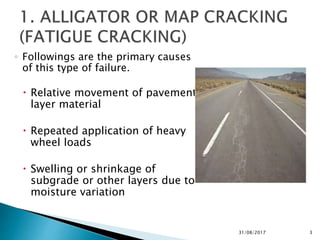
◦ 1.Alligator cracking or Map cracking (Fatigue)
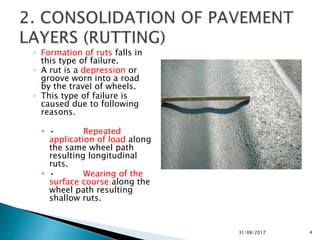
◦ 2.Consolidation of pavement layers (Rutting)
◦ 3.Shear failure cracking
◦ 4.Longitudinal cracking
◦ 5.Frost heaving
◦ 6.Lack of binding to the lower course
◦ 7.Reflection cracking
◦ 8.Formation of waves and corrugation
◦ 9.Bleeding
◦ 10.Pumping
31/08/2017 2
◦ Followings are the primary causes
of this type of failure.
 Relative movement of pavement
layer material
 Repeated application of heavy
wheel loads
 Swelling or shrinkage of
subgrade or other layers due to
moisture variation
31/08/2017 3
◦ Formation of ruts falls in
this type of failure.
◦ A rut is a depression or
groove worn into a road
by the travel of wheels.
◦ This type of failure is
caused due to following
reasons.
 • Repeated
application of load along
the same wheel path
resulting longitudinal
ruts.
 • Wearing of the
surface course along the
wheel path resulting
shallow ruts.
31/08/2017 4
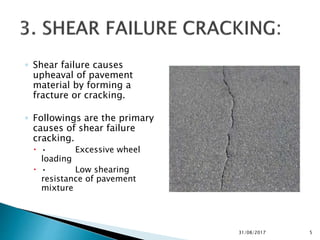
◦ Shear failure causes
upheaval of pavement
material by forming a
fracture or cracking.
◦ Followings are the primary
causes of shear failure
cracking.
 • Excessive wheel
loading
 • Low shearing
resistance of pavement
mixture
31/08/2017 5
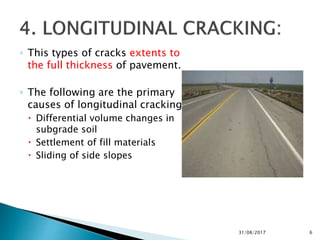
◦ This types of cracks extents to
the full thickness of pavement.
◦ The following are the primary
causes of longitudinal cracking.
 Differential volume changes in
subgrade soil
 Settlement of fill materials
 Sliding of side slopes
31/08/2017 6
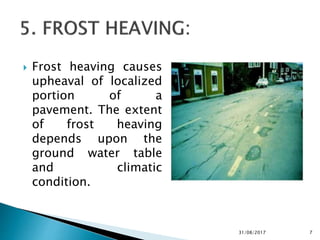
 Frost heaving causes
upheaval of localized
portion of a
pavement. The extent
of frost heaving
depends upon the
ground water table
and climatic
condition.
31/08/2017 7
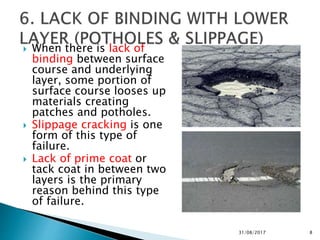
 When there is lack of
binding between surface
course and underlying
layer, some portion of
surface course looses up
materials creating
patches and potholes.
 Slippage cracking is one
form of this type of
failure.
 Lack of prime coat or
tack coat in between two
layers is the primary
reason behind this type
of failure.
31/08/2017 8
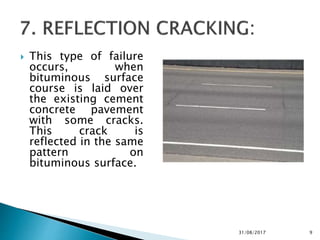
 This type of failure
occurs, when
bituminous surface
course is laid over
the existing cement
concrete pavement
with some cracks.
This crack is
reflected in the same
pattern on
bituminous surface.
31/08/2017 9
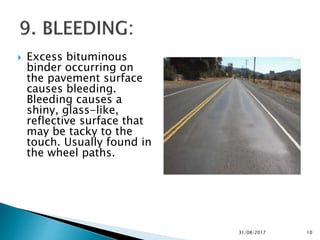
 Excess bituminous
binder occurring on
the pavement surface
causes bleeding.
Bleeding causes a
shiny, glass-like,
reflective surface that
may be tacky to the
touch. Usually found in
the wheel paths.
31/08/2017 10
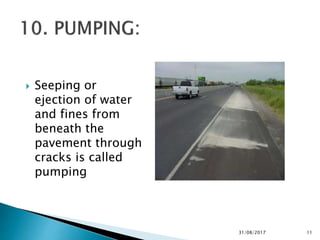
 Seeping or
ejection of water
and fines from
beneath the
pavement through
cracks is called
pumping
31/08/2017 11
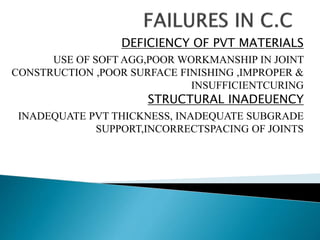
DEFICIENCY OF PVT MATERIALS
USE OF SOFT AGG,POOR WORKMANSHIP IN JOINT
CONSTRUCTION ,POOR SURFACE FINISHING ,IMPROPER &
INSUFFICIENTCURING
STRUCTURAL INADEUENCY
INADEQUATE PVT THICKNESS, INADEQUATE SUBGRADE
SUPPORT,INCORRECTSPACING OF JOINTS
Scaling of c.c
Shrinkage cracks
Spalling of joints
Warping of joints
Mud pumping
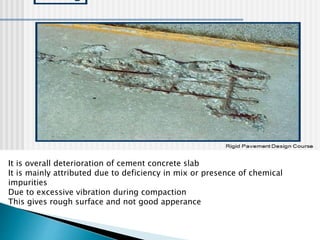
It is overall deterioration of cement concrete slab
It is mainly attributed due to deficiency in mix or presence of chemical
impurities
Due to excessive vibration during compaction
This gives rough surface and not good apperance
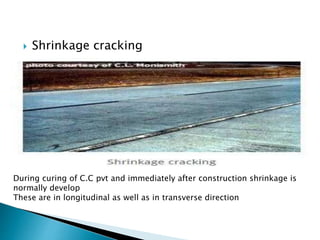
 Shrinkage cracking
During curing of C.C pvt and immediately after construction shrinkage is
normally develop
These are in longitudinal as well as in transverse direction
 Joint spalling
Break down of slab near edges of joints
It occurs due to incompressible material below concrete slab
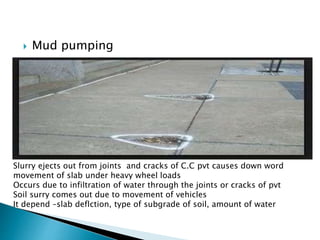
 Mud pumping
Slurry ejects out from joints and cracks of C.C pvt causes down word
movement of slab under heavy wheel loads
Occurs due to infiltration of water through the joints or cracks of pvt
Soil surry comes out due to movement of vehicles
It depend –slab deflction, type of subgrade of soil, amount of water
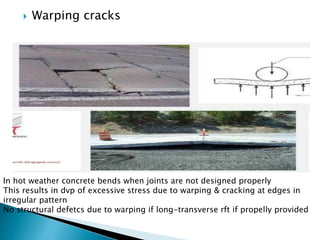
 Warping cracks
In hot weather concrete bends when joints are not designed properly
This results in dvp of excessive stress due to warping & cracking at edges in
irregular pattern
No structural defetcs due to warping if long-transverse rft if propelly provided

flexiblepavementpresentation (2).pptx

  • 1.
    Inadequate stability Loss ofbinding action Loss of base course material Inadequate wearing course
  • 2.
     Typical failureencountered in flexible pavements are as follow. ◦ 1.Alligator cracking or Map cracking (Fatigue) ◦ 2.Consolidation of pavement layers (Rutting) ◦ 3.Shear failure cracking ◦ 4.Longitudinal cracking ◦ 5.Frost heaving ◦ 6.Lack of binding to the lower course ◦ 7.Reflection cracking ◦ 8.Formation of waves and corrugation ◦ 9.Bleeding ◦ 10.Pumping 31/08/2017 2
  • 3.
    ◦ Followings arethe primary causes of this type of failure.  Relative movement of pavement layer material  Repeated application of heavy wheel loads  Swelling or shrinkage of subgrade or other layers due to moisture variation 31/08/2017 3
  • 4.
    ◦ Formation ofruts falls in this type of failure. ◦ A rut is a depression or groove worn into a road by the travel of wheels. ◦ This type of failure is caused due to following reasons.  • Repeated application of load along the same wheel path resulting longitudinal ruts.  • Wearing of the surface course along the wheel path resulting shallow ruts. 31/08/2017 4
  • 5.
    ◦ Shear failurecauses upheaval of pavement material by forming a fracture or cracking. ◦ Followings are the primary causes of shear failure cracking.  • Excessive wheel loading  • Low shearing resistance of pavement mixture 31/08/2017 5
  • 6.
    ◦ This typesof cracks extents to the full thickness of pavement. ◦ The following are the primary causes of longitudinal cracking.  Differential volume changes in subgrade soil  Settlement of fill materials  Sliding of side slopes 31/08/2017 6
  • 7.
     Frost heavingcauses upheaval of localized portion of a pavement. The extent of frost heaving depends upon the ground water table and climatic condition. 31/08/2017 7
  • 8.
     When thereis lack of binding between surface course and underlying layer, some portion of surface course looses up materials creating patches and potholes.  Slippage cracking is one form of this type of failure.  Lack of prime coat or tack coat in between two layers is the primary reason behind this type of failure. 31/08/2017 8
  • 9.
     This typeof failure occurs, when bituminous surface course is laid over the existing cement concrete pavement with some cracks. This crack is reflected in the same pattern on bituminous surface. 31/08/2017 9
  • 10.
     Excess bituminous binderoccurring on the pavement surface causes bleeding. Bleeding causes a shiny, glass-like, reflective surface that may be tacky to the touch. Usually found in the wheel paths. 31/08/2017 10
  • 11.
     Seeping or ejectionof water and fines from beneath the pavement through cracks is called pumping 31/08/2017 11
  • 12.
    DEFICIENCY OF PVTMATERIALS USE OF SOFT AGG,POOR WORKMANSHIP IN JOINT CONSTRUCTION ,POOR SURFACE FINISHING ,IMPROPER & INSUFFICIENTCURING STRUCTURAL INADEUENCY INADEQUATE PVT THICKNESS, INADEQUATE SUBGRADE SUPPORT,INCORRECTSPACING OF JOINTS
  • 13.
    Scaling of c.c Shrinkagecracks Spalling of joints Warping of joints Mud pumping
  • 14.
    It is overalldeterioration of cement concrete slab It is mainly attributed due to deficiency in mix or presence of chemical impurities Due to excessive vibration during compaction This gives rough surface and not good apperance
  • 15.
     Shrinkage cracking Duringcuring of C.C pvt and immediately after construction shrinkage is normally develop These are in longitudinal as well as in transverse direction
  • 16.
     Joint spalling Breakdown of slab near edges of joints It occurs due to incompressible material below concrete slab
  • 17.
     Mud pumping Slurryejects out from joints and cracks of C.C pvt causes down word movement of slab under heavy wheel loads Occurs due to infiltration of water through the joints or cracks of pvt Soil surry comes out due to movement of vehicles It depend –slab deflction, type of subgrade of soil, amount of water
  • 18.
     Warping cracks Inhot weather concrete bends when joints are not designed properly This results in dvp of excessive stress due to warping & cracking at edges in irregular pattern No structural defetcs due to warping if long-transverse rft if propelly provided

Editor's Notes

  • #15 It is overall deterioration of cement concrete slab
  • #16 During curing of C.C pvt and immediately after construction shrinkage is normally develop These are in longitudinal as well as in transverse direction
  • #17 Break down of slab near edges of joints It occurs due to incompressible material below concrete slab
  • #18 Slurry ejects out from joints and cracks of C.C pvt causes down word movement of slab under heavy wheel loads Occurs due to infiltration of water through the joints or cracks of pvt Soil surry comes out due to movement of vehicles
  • #19 In hot weather concrete bends when joints are not designed properly This results in dvp of excessive stressdue to warping