FLEXIBLE PRODUCT DEVELOPMENT
PROCESS
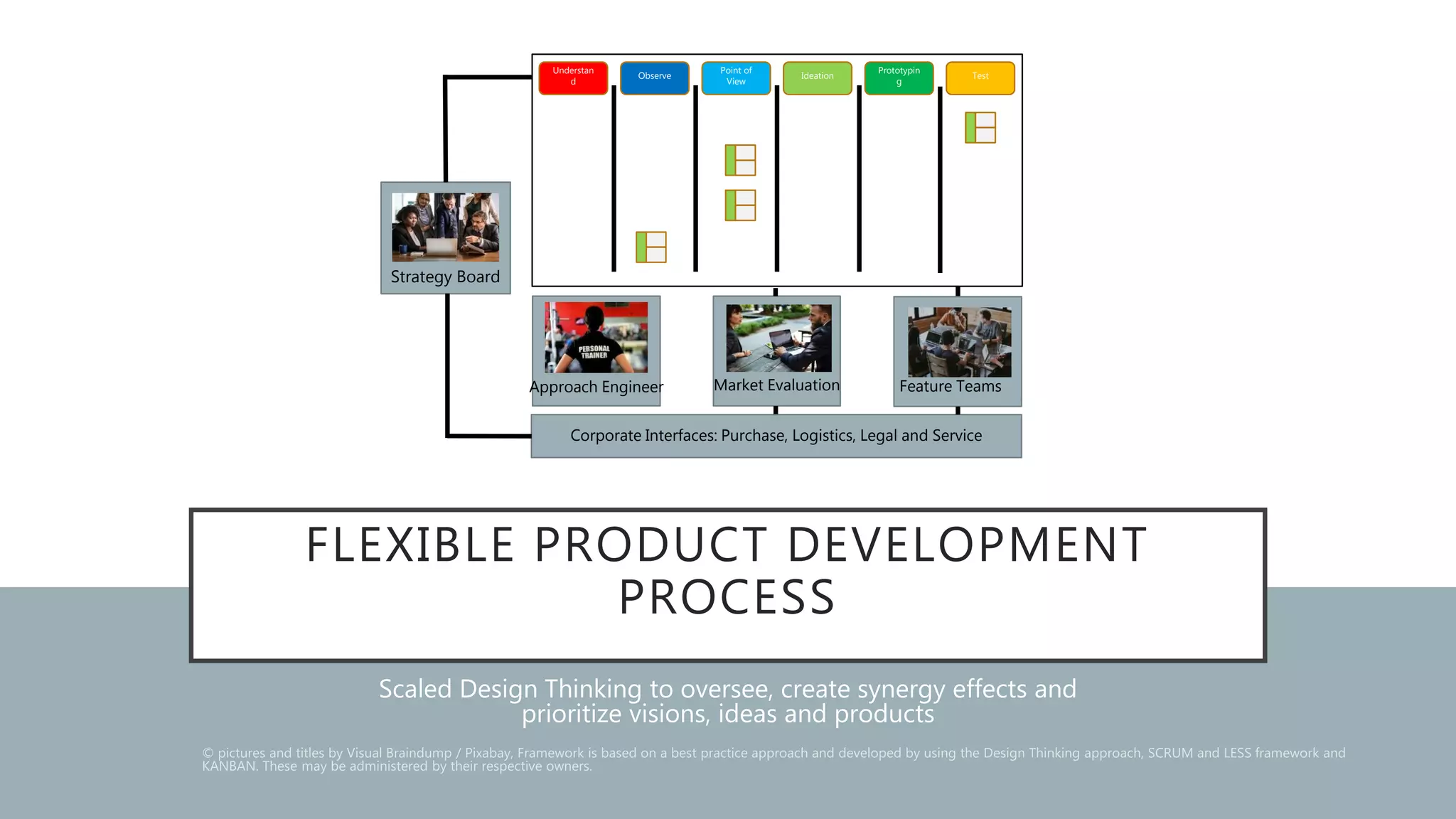
Scaled Design Thinking to oversee, create synergy effects and
prioritize visions, ideas and products
Strategy Board
Market Evaluation Feature TeamsApproach Engineer
Understan
d
Observe Ideation
Prototypin
g
Test
Point of
View
Corporate Interfaces: Purchase, Logistics, Legal and Service
CONTENT
• About Visual Braindump
• About Design Thinking
• The concern about Design Thinking and
Scaling
• Organizational Requirements
• Scaling with the Flexible Product
Development Process (FPDP)
• VISUAL BRAINDUMP
Founded by former project and team
managers in 2015
• Practicing Agile before, in sum up to 30
years
• Main pillars are: Coaching, Consultation
and Training for
• Design Thinking, Business Visualization and
Agile
• Agile work for teams and visions in
enterprises
• Visual Thinking with regards to
communication, target visualization and
team work
ABOUT DESIGN THINKING
Design Thinking is more than a new way to
confuse companies and generate ideas in a
different way. Design Thinking:
• Actively sets a human centered approach as
foreground.
• Transfers the product responsibility regarding
the subject of the challenge to the team.
• Moreover lets the team identify the actual
requirements before any project or process
approach would be able to apply (where goals
can’t be set, yet).
• Is extremely flexible in meanings of time
frames, methodology and team setup.
• Changes the mindset of everyone involved. An
active way of acting is promoted. deep
understanding of the design thinking
approach
• Design Thinking is a complex approach to
work on really complex issues.
ABOUT DESIGN THINKING
As focused, as Design Thinking works.
As responsible as the Design Thinking
Team is working on a Design Thinking
Challenge.
So a team can work unchallenged in
selecting and testing the solution idea.
How do different design thinking teams
behave in a company that wants to realize
an overarching vision?
DESIGN THINKING IS COMPLEX BY
DESIGN
How do we want to set overarching KPI to individuals, specific ideas and contexts?
How do we want to oversee multiple Design Thinking approaches in an organization?
How do we want to motivate teams to discard solutions after intensive work and responsibility (for themselves)?
THE CONCERN ABOUT DESIGN
THINKING AND SCALING
• The different steps do not have a measurable
outcome without additional, individual defined
KPI.
• The different Design Thinking challenges vary
in complexity and duration.
• Multiple Design Thinking approaches are hard
to oversee because of their individual
status progress.
• Isolated think tanks do not take into account any overlaps in content between them.
• The open exchange and rejection of ideas across teams is a lie.
Team cohesion and definition support social differentiation.
ORGANIZATIONAL REQUIREMENTS
• Create most valuable products and services
for customers (b2b or b2c).
• Measure success and failure in an early
status to optimize invests.
• Further development of the company in
order to succeed on the market.
• Create synergy effects to optimize invests
regarding time and budget.
NOW: FLEXIBLE PRODUCT
DEVELOPMENT PROCESS APPLIES
• Keep all positive aspects of the Design
Thinking approach.
• Add the oversee factor, Kanban broadly
provided in the last couple of years.
• Apply the minimum of required roles given
in scaled agile approaches.
• Allow the new approach to fit in any
organization.
CORE ELEMENT – DESIGN THINKING
CHALLENGE (EXAMPLE TEMPLATE)
Challenge #
Formulated in user
perspecitive, open and
checked against the Invest
principle.
Forked by:
Is initial Challenge
Is forked from initial challenge
#
Subject information:
• Assigned Team
• Mentored by
• Design Thinking Room
• Information about digital storage locations
Status information:
• Product / Service version
• Design Thinking Process step
• Individual KPI
• Product version / service version
CORE ELEMENT – DESIGN THINKING
KANBAN BOARD
Understand Observe Ideation Prototyping Test
Point of
View
CORE ELEMENTS – CHALLENGE
EMBEDDED IN BOARD
Understand Observe Ideation Prototyping Test
Point of
View
Challenge
#1
Title
Forked by:
Is initial
Challenge
Is forked
from initial
challenge #
Subject information:
• Assigned Team
• Mentored by
• Design Thinking
Room
• Information about
digital storage
locations
Status information:
• Product / Service
• Design Thinking
Process
step
• Individual KPI
• Product version /
service version
Challenge
#1
Title
Forked by:
Is initial
Challenge
Is forked
from initial
challenge #
Subject information:
• Assigned Team
• Mentored by
• Design Thinking
Room
• Information about
digital storage
locations
Status information:
• Product / Service
• Design Thinking
Process
step
• Individual KPI
• Product version /
service version
Example
FLEXIBLE PRODUCT DEVELOPMENT
PROCESS AND KEY ROLES
Strategy Board
Market Evaluation Feature TeamsApproach Engineer
Understan
d
Observe Ideation
Prototypin
g
Test
Point of
View
Corporate Interfaces: Purchase, Logistics, Legal and Service
OKR COMPONENT
• OKR are set and adjusted in each DT iteration
• Initial OKR are set based on corporate vision in the very beginning of the DT process
(latest: first Prototype)
• OKR are defined by the team and negotiated with the Strategy Board
• OKR are defined by following the Smart Principle
• Key Results can be integrated in each DT process step (minimum: Test)
STRATEGY BOARD
• Acts as Jury for ideas – supported by DT-teams
• Start and stop approaches – together with DT-teams
• Check feasibility of target product / service from a corporate perspective
• Oversee approaches
• Indicate and support standardizing KPI*
for similar approaches
• Connect similar approaches to establish emergence by mentoring the DT-teams.
• Prioritizes product / service approaches
• Orchestrates tools an materials used by teams
(no progress stopping regulation - optimization of use)
*based on OKR, created by teams
MARKET EVALUATION
• Supports DT-Teams with a pool of customers, persona and test-scenarios based on the
corporate vision.
• Supports DT-Teams by organization approach specific test scenarios
(personnel, customers and setup)
• Provides and compares per approach-metrics and market metrics
• Helps Feature Teams to align their WPs, Stories or Issues with common metrics
• Provides all different numbers to the Strategy Board, DT-teams and Approach Engineer
• Consists of market experts plus DT-team members
APPROACH ENGINEER
• Trainer for Methodology
• Coach regarding individual requests
• Setup of DT-rooms, meetings, workshops around the DT-process
• Ensures awareness of the corporation
• Ensures a common toolset regarding communication and documentation
• Ensures the flow of all DT-approaches, KPI and follow-ups
• Empowers the DT-team in self organization
• Helps classic management roles to engage as servant leaders,
knowledge shares and coaches
FEATURE TEAM
• Continuously improves the common platform (e.g. eBusiness)
• Integrates new products and services
• Supports DT-teams by implementing agreed ready to market products and services
(prototype to release) in case the DT team needs broader support.
• Interacts with DT-team regarding improvements. Align technical improvements with
product and services.
• Owns the feature on from implementation after.
ABOUT TEAM MANAGERS
• A former team manager as personnel responsibility, doing deep measures in the team and
about the team is not required anymore.
Entrepreneurial thinking people using OKR will to the job.
• Required is a person, who leads a team based on the current situation.
Common principles, like
leading by example, focusing on team impediments and reflections are mainly requested in this
approach.
• A former manager acts as servant leader, as Coach and Storyteller with some methodical knowledge
and a good network within the cooperation willing to maximize the team spirit and outcome based on
their OKR.
• A former manager now pushes the team to exit the comfort zone and act ambitious
towards a early time to market for specific solutions.
INTERFACE TO COMMON TEAMS
Recommendations:
• Project Teams: DT replaces project teams since projects are long term per
definition and thus, not contemporary in the modern market
• Scrum Teams: DT team and Scrum Teams work hand in hand. But: Scrum Teams are seen
as translators for product ideas, if a DT team can’t fulfill a product prototype into a
market ready product. Transferring a DT team into a Scrum Team is a common approach.
• Kanban Teams: Equal to Scrum Teams, but in continuously close collaboration with a DT team.
• Standard departments: Transform to DT-teams
LEARN MORE
Check out additional information and contact for details
• Our Website: www.visual-braindump.de
• Youtube: Flexible Product Development Process
We are: Visual Braindump

Flexible Product Development Process

  • 1.
    FLEXIBLE PRODUCT DEVELOPMENT PROCESS ScaledDesign Thinking to oversee, create synergy effects and prioritize visions, ideas and products Strategy Board Market Evaluation Feature TeamsApproach Engineer Understan d Observe Ideation Prototypin g Test Point of View Corporate Interfaces: Purchase, Logistics, Legal and Service
  • 2.
    CONTENT • About VisualBraindump • About Design Thinking • The concern about Design Thinking and Scaling • Organizational Requirements • Scaling with the Flexible Product Development Process (FPDP)
  • 3.
    • VISUAL BRAINDUMP Foundedby former project and team managers in 2015 • Practicing Agile before, in sum up to 30 years • Main pillars are: Coaching, Consultation and Training for • Design Thinking, Business Visualization and Agile • Agile work for teams and visions in enterprises • Visual Thinking with regards to communication, target visualization and team work
  • 4.
    ABOUT DESIGN THINKING DesignThinking is more than a new way to confuse companies and generate ideas in a different way. Design Thinking: • Actively sets a human centered approach as foreground. • Transfers the product responsibility regarding the subject of the challenge to the team. • Moreover lets the team identify the actual requirements before any project or process approach would be able to apply (where goals can’t be set, yet). • Is extremely flexible in meanings of time frames, methodology and team setup. • Changes the mindset of everyone involved. An active way of acting is promoted. deep understanding of the design thinking approach • Design Thinking is a complex approach to work on really complex issues.
  • 5.
    ABOUT DESIGN THINKING Asfocused, as Design Thinking works. As responsible as the Design Thinking Team is working on a Design Thinking Challenge. So a team can work unchallenged in selecting and testing the solution idea. How do different design thinking teams behave in a company that wants to realize an overarching vision?
  • 6.
    DESIGN THINKING ISCOMPLEX BY DESIGN How do we want to set overarching KPI to individuals, specific ideas and contexts? How do we want to oversee multiple Design Thinking approaches in an organization? How do we want to motivate teams to discard solutions after intensive work and responsibility (for themselves)?
  • 7.
    THE CONCERN ABOUTDESIGN THINKING AND SCALING • The different steps do not have a measurable outcome without additional, individual defined KPI. • The different Design Thinking challenges vary in complexity and duration. • Multiple Design Thinking approaches are hard to oversee because of their individual status progress. • Isolated think tanks do not take into account any overlaps in content between them. • The open exchange and rejection of ideas across teams is a lie. Team cohesion and definition support social differentiation.
  • 8.
    ORGANIZATIONAL REQUIREMENTS • Createmost valuable products and services for customers (b2b or b2c). • Measure success and failure in an early status to optimize invests. • Further development of the company in order to succeed on the market. • Create synergy effects to optimize invests regarding time and budget.
  • 9.
    NOW: FLEXIBLE PRODUCT DEVELOPMENTPROCESS APPLIES • Keep all positive aspects of the Design Thinking approach. • Add the oversee factor, Kanban broadly provided in the last couple of years. • Apply the minimum of required roles given in scaled agile approaches. • Allow the new approach to fit in any organization.
  • 10.
    CORE ELEMENT –DESIGN THINKING CHALLENGE (EXAMPLE TEMPLATE) Challenge # Formulated in user perspecitive, open and checked against the Invest principle. Forked by: Is initial Challenge Is forked from initial challenge # Subject information: • Assigned Team • Mentored by • Design Thinking Room • Information about digital storage locations Status information: • Product / Service version • Design Thinking Process step • Individual KPI • Product version / service version
  • 11.
    CORE ELEMENT –DESIGN THINKING KANBAN BOARD Understand Observe Ideation Prototyping Test Point of View
  • 12.
    CORE ELEMENTS –CHALLENGE EMBEDDED IN BOARD Understand Observe Ideation Prototyping Test Point of View Challenge #1 Title Forked by: Is initial Challenge Is forked from initial challenge # Subject information: • Assigned Team • Mentored by • Design Thinking Room • Information about digital storage locations Status information: • Product / Service • Design Thinking Process step • Individual KPI • Product version / service version Challenge #1 Title Forked by: Is initial Challenge Is forked from initial challenge # Subject information: • Assigned Team • Mentored by • Design Thinking Room • Information about digital storage locations Status information: • Product / Service • Design Thinking Process step • Individual KPI • Product version / service version Example
  • 13.
    FLEXIBLE PRODUCT DEVELOPMENT PROCESSAND KEY ROLES Strategy Board Market Evaluation Feature TeamsApproach Engineer Understan d Observe Ideation Prototypin g Test Point of View Corporate Interfaces: Purchase, Logistics, Legal and Service
  • 14.
    OKR COMPONENT • OKRare set and adjusted in each DT iteration • Initial OKR are set based on corporate vision in the very beginning of the DT process (latest: first Prototype) • OKR are defined by the team and negotiated with the Strategy Board • OKR are defined by following the Smart Principle • Key Results can be integrated in each DT process step (minimum: Test)
  • 15.
    STRATEGY BOARD • Actsas Jury for ideas – supported by DT-teams • Start and stop approaches – together with DT-teams • Check feasibility of target product / service from a corporate perspective • Oversee approaches • Indicate and support standardizing KPI* for similar approaches • Connect similar approaches to establish emergence by mentoring the DT-teams. • Prioritizes product / service approaches • Orchestrates tools an materials used by teams (no progress stopping regulation - optimization of use) *based on OKR, created by teams
  • 16.
    MARKET EVALUATION • SupportsDT-Teams with a pool of customers, persona and test-scenarios based on the corporate vision. • Supports DT-Teams by organization approach specific test scenarios (personnel, customers and setup) • Provides and compares per approach-metrics and market metrics • Helps Feature Teams to align their WPs, Stories or Issues with common metrics • Provides all different numbers to the Strategy Board, DT-teams and Approach Engineer • Consists of market experts plus DT-team members
  • 17.
    APPROACH ENGINEER • Trainerfor Methodology • Coach regarding individual requests • Setup of DT-rooms, meetings, workshops around the DT-process • Ensures awareness of the corporation • Ensures a common toolset regarding communication and documentation • Ensures the flow of all DT-approaches, KPI and follow-ups • Empowers the DT-team in self organization • Helps classic management roles to engage as servant leaders, knowledge shares and coaches
  • 18.
    FEATURE TEAM • Continuouslyimproves the common platform (e.g. eBusiness) • Integrates new products and services • Supports DT-teams by implementing agreed ready to market products and services (prototype to release) in case the DT team needs broader support. • Interacts with DT-team regarding improvements. Align technical improvements with product and services. • Owns the feature on from implementation after.
  • 19.
    ABOUT TEAM MANAGERS •A former team manager as personnel responsibility, doing deep measures in the team and about the team is not required anymore. Entrepreneurial thinking people using OKR will to the job. • Required is a person, who leads a team based on the current situation. Common principles, like leading by example, focusing on team impediments and reflections are mainly requested in this approach. • A former manager acts as servant leader, as Coach and Storyteller with some methodical knowledge and a good network within the cooperation willing to maximize the team spirit and outcome based on their OKR. • A former manager now pushes the team to exit the comfort zone and act ambitious towards a early time to market for specific solutions.
  • 20.
    INTERFACE TO COMMONTEAMS Recommendations: • Project Teams: DT replaces project teams since projects are long term per definition and thus, not contemporary in the modern market • Scrum Teams: DT team and Scrum Teams work hand in hand. But: Scrum Teams are seen as translators for product ideas, if a DT team can’t fulfill a product prototype into a market ready product. Transferring a DT team into a Scrum Team is a common approach. • Kanban Teams: Equal to Scrum Teams, but in continuously close collaboration with a DT team. • Standard departments: Transform to DT-teams
  • 21.
    LEARN MORE Check outadditional information and contact for details • Our Website: www.visual-braindump.de • Youtube: Flexible Product Development Process We are: Visual Braindump