
Presented By
Peeyush Kamal (Research Scholar)
With
Dr. Dori Lal Chaudhary (Asstt. Professor)
Department - TT&NFE (IASE)
Faculty of Education,
Jamia Millia Islamia, New Delhi-25
Email - piyu170980@gmail.com
Phone No. - 09968434009
The long-term vision of Education for All in India is to ensure equal access
to quality basic education for all citizens and to prepare its citizens to play an
active role in reconstructing the country as well as integrating India to the
knowledge-based global community. Indeed, SSA and its goal of Universal
Elementary Education provide a sound basis for sustainable development.
However, this is not enough. The growing number of children in the elementary
school system is bringing pressure to bear on the need for further education.
Universalization of Secondary Education should now be our goal . It is, therefore,
time to consider the issue of Universalization of Secondary Education and the
achievement of that goal by 2020.
A Committee of Central Advisory Board of Education (CABE), the highest
deliberative body in secondary education, on “Universalization of Secondary
Education” was constituted in September 2004. Government approved the CABE
document on Universal Secondary Education in 2005. The Committee
recommended Universalization of secondary education as necessary, but higher
secondary as desirable. Ministry of HRD went one step further and included higher
secondary education within the ambit of Universalization of school education.
Government launched Rashtriya Madhyamik Shiksha Abhiyan in 2008 based on
the CABE report on Universalization of Secondary Education.
Objectives of Universalization of School Education:
The Central Government is committed to make secondary education of good
quality available, accessible and affordable to all young persons. A major initiative
for expanding secondary education will be taken up in the 11th Plan. The norm
would be to provide a secondary school within 5 KMs. and a higher secondary
school within a distance of 7-8 KM of every habitation by the end of 11th Five
Year Plan. The GER of secondary education is targeted to increase from 52% in
2004-05 to 75% in 2011-12. Similarly, GER for higher secondary level is targeted
from 28% to 45-50% during the 11th Plan. The general objective is to universalize
secondary education (up to class 10) by the end of the 12th Plan. During the 11th
Plan, while access to secondary education will be universalized, there will be
adequate focus on quality improvement. Not only universal enrolment, but also
universal retention and satisfactory quality of learning will be the priority and also
to achieve these goals by 2020.
In spite of the effort to expand access to quality secondary education, there
will be need to have high quality schools for talented rural children, who may not
be in a position to access quality schools in urban areas, without compromising
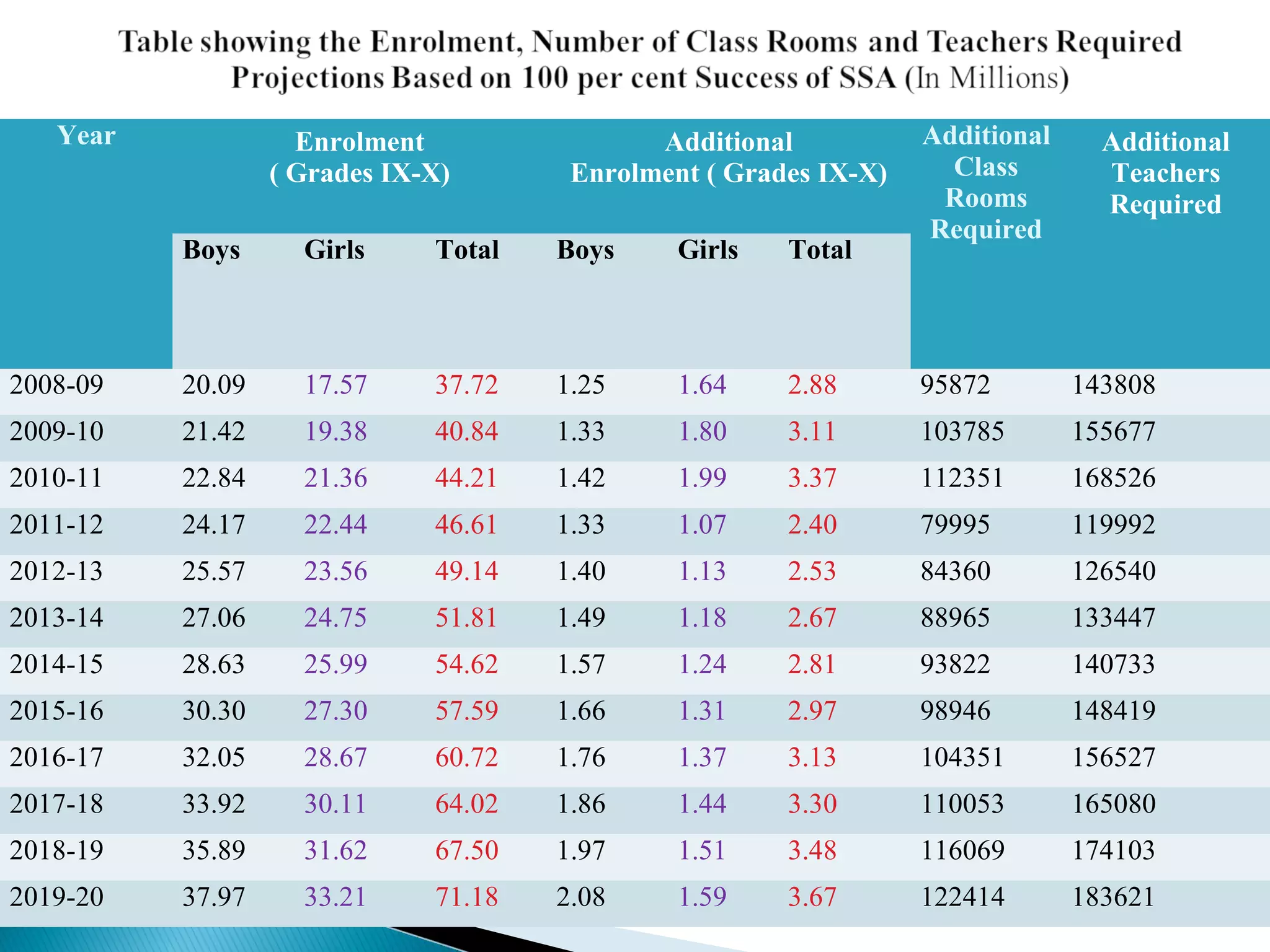
Government’s commitment to common school system. The projected enrolment by
2010 & 2015 are 31.15, 42.25 millions. Additional 326,176 classrooms will be
needed to accommodate the additional number of students, even if 75% of SSA
targets are achieved. It is estimated that 88,635 additional teachers would be
required by 2010, additional number of 5,20,305 teachers in 2015 over 2010.
Year Enrolment
( Grades IX-X)
Additional
Enrolment ( Grades IX-X)
Additional
Class
Rooms
Required
Additional
Teachers
Required
Boys Girls Total Boys Girls Total
2008-09 20.09 17.57 37.72 1.25 1.64 2.88 95872 143808
2009-10 21.42 19.38 40.84 1.33 1.80 3.11 103785 155677
2010-11 22.84 21.36 44.21 1.42 1.99 3.37 112351 168526
2011-12 24.17 22.44 46.61 1.33 1.07 2.40 79995 119992
2012-13 25.57 23.56 49.14 1.40 1.13 2.53 84360 126540
2013-14 27.06 24.75 51.81 1.49 1.18 2.67 88965 133447
2014-15 28.63 25.99 54.62 1.57 1.24 2.81 93822 140733
2015-16 30.30 27.30 57.59 1.66 1.31 2.97 98946 148419
2016-17 32.05 28.67 60.72 1.76 1.37 3.13 104351 156527
2017-18 33.92 30.11 64.02 1.86 1.44 3.30 110053 165080
2018-19 35.89 31.62 67.50 1.97 1.51 3.48 116069 174103
2019-20 37.97 33.21 71.18 2.08 1.59 3.67 122414 183621
 Projection of number of classrooms is based on pupil-teacher ratio of 30:1. Since, the Pupil teacher ratio at
the secondary level in 2001-02 is 34:1, the teacher pupil ratio shall be assumed to be 30:1.
 Additional requirement of teachers is based on the consideration of subject specialisation of teachers at the
secondary level. Hence, it has been assumed that the secondary schools shall be provided with 1.5 teachers per
additional classroom.
It is clear from the above table in the context of Universalization of
Secondary Education (USE), large-scale inputs in terms of additional schools
and teachers are to be needed to meet the challenge of numbers, credibility
and quality. Issue is serious. What would happen? Would we be ready and
capable of handling the situation?
Another important question is whether the twin challenge of number
and quality can be met by ‘more of the same’ – lateral expansion of otherwise
incompetent school system? or we need to find alternatives?
ICT as an alternative for Universalizing school Education:
Education, as we know is instrumental in ensuring that the future
generation is well informed and competent. Unfortunately, because the
quality and accessibility of education varies so greatly between regions, the
school system of our country often fail to deliver the level of education
necessary to ensure such competency. Many schools have limited resources
for buying books, stationery, furniture and other classroom materials.
Contd. ……
Teachers lack adequate qualification and training to engage
their students in learning. Their lesson plans are most often
outdated or irrelevant. These jeopardise the available quality of
education. ICT (Information and Communication Technology)
enabled education, to a great extent, can combat this problem.
The significant role of ICT in school education been also
highlighted in the NCERT, National Curriculum Framework
2005. ICT figured comprehensively in the norm of schooling
recommended by Central Advisory Board of Education (CABE),
also in its report on Universal Secondary Education, in 2005. As
the government is focusing on ensuring universalization of
education at all levels, reducing the dropout rate has become
equally important. The Ministry of Education, through different
departments like Mass Education Extension and Library
Services, School Education, and Technical Education and
Training is introducing various initiatives to facilitate greater
integration of ICT to improve the effectiveness of education at all
levels and to produce the technologically literate, productive and
critically thinking workforce for the country.
What can ICT do?
 ICT increase interest in school: A study of Singh (1995) tested and used
video-instructional package in three schools in Gujarat, U.P. and Rajasthan,
formed to be very effective and interesting. The study also reported that
students enjoy working through video package.
 ICT sustain interest in school: The findings of Pradhan (2001) on various
interventions for education of the tribal children found immense implication
for the use of ICTs & found initially provoke reactions ranging from
apprehension, to caution, to curiosity, to excitement and expectation.
 ICT enrich learning and enhance performance: Even a single computer in
classroom can bring effective results has been proved in the study of Scaplen
(1999).
Universalization of School Education with ICT
 Universalization with ICT Integration in Teacher Education :
Developments have affected education, including teacher education,
necessitating review and reform towards the larger constitutional goal of
achieving universalization of education, social change and development.
The NCTE is committed to facilitate improvement of school education by
preparing competent, committed and professionally qualified school
teachers because the face of classroom is changing. The teachers should
prepare to keep up with technology utility in the classroom.
 Universalization with open and distance learning :The developments in
distance teaching-learning have had a huge impact on access all over the
world. In our country, women make up 40% of distance students compared
with 28% in the conventional face-to-face mode. Due to rigidities of the
formal schooling system, quite a large number of school going – age
children drop out at various stages of school education. Besides the
National Institute of Open Schooling, several states have established open
schools providing comparable quality of education with that in the formal
schools.
 Universalization with Media Infrastructure: During the 11th Plan, the
efforts would be to develop complete audio-visual curriculum based
content. One approach is to consider which e-learning methods are
effective in universalization of education and do not require a computer
and connection to the Internet and can be delivered by CD-ROM, video,
television, radio and telephone or combinations as appropriate to the
students needs.
 Universalization with Space Technology: Satellite communications technology
offers unique capability of being able to simultaneously reach out to very large
numbers spread over large distances even in the most remote corners of the country.
The Indian Space Programme has always aimed to be second to none in the
applications of space technology to deal with education and development. ISRO has
initiated several projects/programmes to cater to the country’s need for education,
training, and general awareness among the rural poor. These efforts are- Satellite
Instruction Television Experiment (SITE) , Kheda Communication Project (KCP)
from 1975 to 1989, INSAT system, Gramsat Programme and EDUSAT.
 Universalization with ICT @ Schools (2004):The present scheme has essentially
four components:
1. Partnership with the State governments and union territories for providing
computer education and computer-aided education to Secondary & Higher
Secondary Government and Government aided Schools.
2. Establishment of SMART schools, which shall be the technology demonstrators.
3. Universalization of Computer Literacy through the networking of Kendriya
Vidyalayas and Navodaya Vidyalayas with neighboring schools.
4. Activities of State Institutes of Educational Training (SIETs) which are mandated
to produce educational content in the form of films, videos, audios, etc.
India has barely 15 million installed PCs, a little more than eight
telephones per hundred persons, about five million Internet
connections. In the midst of such digital paucity, the Indian IT services
sector stands out as an outstanding success against all odds.
In India, less than 10% of all schools have computers, and even
this is heavily in favour of urban areas (26.41%) while the rural areas
(6.66%) are marginalised. Amongst the urban areas, six Indian states of
Chandigarh (73.65%), Sikkim (55.56%), Delhi (55.40%), Kerala
(48.19%), Andhra Pradesh (43.48%), and Nagaland (39.41%) have
more than 35% penetration of computers in schools. On the other hand,
for the rural areas, only three states Delhi (51.18%), Chandigarh (40%)
and Kerala (36.87%), have more than 35% penetration of computers in
schools .Except for Delhi, there is a wide gap in computer penetration
in schools in rural and urban areas of each state indicating the rural-
urban digital divide.
Even when computers are available in schools, the emphasis is
largely on acquiring the skills for its usage. There is little deliberation
on the course content and the methodology best suited to teach it.
Private international schools have been the major frontrunners in
computer- assisted learning and other private and government schools
are slowly catching up.
Information and communication technologies (ICTs) play a
number of roles in education. These include providing a catalyst for
rethinking teaching practice (Flecknoe, 2002; McCormick &
Scrimshaw, 2001); developing the kind of graduates and citizens
required in an information society (Department of Education, 2001);
improving educational outcomes (especially pass rates) and
enhancing and improving the quality of teaching and learning
(Wagner, 2001; Garrison & Anderson, 2003). ICT has the potential
to transform learning in and beyond the classroom.
ICT is the most powerful weapon, which you can use to expose
the Education for all. Its potentiality cannot be bound within
boundaries. It has tremendous potentiality. It should be fully
exploited and utilized for the benefit of students and teachers.
Simultaneously, ICT is not a remedy for all ills in education and
needs its own hand and mind but it can be an effective tool in the
hands of the teachers for teaching and students for learning
Flagship of ICT in Universalization of School Education

Flagship of ICT in Universalization of School Education

  • 1.
    Presented By Peeyush Kamal(Research Scholar) With Dr. Dori Lal Chaudhary (Asstt. Professor) Department - TT&NFE (IASE) Faculty of Education, Jamia Millia Islamia, New Delhi-25 Email - piyu170980@gmail.com Phone No. - 09968434009
  • 2.
    The long-term visionof Education for All in India is to ensure equal access to quality basic education for all citizens and to prepare its citizens to play an active role in reconstructing the country as well as integrating India to the knowledge-based global community. Indeed, SSA and its goal of Universal Elementary Education provide a sound basis for sustainable development. However, this is not enough. The growing number of children in the elementary school system is bringing pressure to bear on the need for further education. Universalization of Secondary Education should now be our goal . It is, therefore, time to consider the issue of Universalization of Secondary Education and the achievement of that goal by 2020. A Committee of Central Advisory Board of Education (CABE), the highest deliberative body in secondary education, on “Universalization of Secondary Education” was constituted in September 2004. Government approved the CABE document on Universal Secondary Education in 2005. The Committee recommended Universalization of secondary education as necessary, but higher secondary as desirable. Ministry of HRD went one step further and included higher secondary education within the ambit of Universalization of school education. Government launched Rashtriya Madhyamik Shiksha Abhiyan in 2008 based on the CABE report on Universalization of Secondary Education.
  • 3.
    Objectives of Universalizationof School Education: The Central Government is committed to make secondary education of good quality available, accessible and affordable to all young persons. A major initiative for expanding secondary education will be taken up in the 11th Plan. The norm would be to provide a secondary school within 5 KMs. and a higher secondary school within a distance of 7-8 KM of every habitation by the end of 11th Five Year Plan. The GER of secondary education is targeted to increase from 52% in 2004-05 to 75% in 2011-12. Similarly, GER for higher secondary level is targeted from 28% to 45-50% during the 11th Plan. The general objective is to universalize secondary education (up to class 10) by the end of the 12th Plan. During the 11th Plan, while access to secondary education will be universalized, there will be adequate focus on quality improvement. Not only universal enrolment, but also universal retention and satisfactory quality of learning will be the priority and also to achieve these goals by 2020. In spite of the effort to expand access to quality secondary education, there will be need to have high quality schools for talented rural children, who may not be in a position to access quality schools in urban areas, without compromising Government’s commitment to common school system. The projected enrolment by 2010 & 2015 are 31.15, 42.25 millions. Additional 326,176 classrooms will be needed to accommodate the additional number of students, even if 75% of SSA targets are achieved. It is estimated that 88,635 additional teachers would be required by 2010, additional number of 5,20,305 teachers in 2015 over 2010.
  • 4.
    Year Enrolment ( GradesIX-X) Additional Enrolment ( Grades IX-X) Additional Class Rooms Required Additional Teachers Required Boys Girls Total Boys Girls Total 2008-09 20.09 17.57 37.72 1.25 1.64 2.88 95872 143808 2009-10 21.42 19.38 40.84 1.33 1.80 3.11 103785 155677 2010-11 22.84 21.36 44.21 1.42 1.99 3.37 112351 168526 2011-12 24.17 22.44 46.61 1.33 1.07 2.40 79995 119992 2012-13 25.57 23.56 49.14 1.40 1.13 2.53 84360 126540 2013-14 27.06 24.75 51.81 1.49 1.18 2.67 88965 133447 2014-15 28.63 25.99 54.62 1.57 1.24 2.81 93822 140733 2015-16 30.30 27.30 57.59 1.66 1.31 2.97 98946 148419 2016-17 32.05 28.67 60.72 1.76 1.37 3.13 104351 156527 2017-18 33.92 30.11 64.02 1.86 1.44 3.30 110053 165080 2018-19 35.89 31.62 67.50 1.97 1.51 3.48 116069 174103 2019-20 37.97 33.21 71.18 2.08 1.59 3.67 122414 183621
  • 5.
     Projection ofnumber of classrooms is based on pupil-teacher ratio of 30:1. Since, the Pupil teacher ratio at the secondary level in 2001-02 is 34:1, the teacher pupil ratio shall be assumed to be 30:1.  Additional requirement of teachers is based on the consideration of subject specialisation of teachers at the secondary level. Hence, it has been assumed that the secondary schools shall be provided with 1.5 teachers per additional classroom. It is clear from the above table in the context of Universalization of Secondary Education (USE), large-scale inputs in terms of additional schools and teachers are to be needed to meet the challenge of numbers, credibility and quality. Issue is serious. What would happen? Would we be ready and capable of handling the situation? Another important question is whether the twin challenge of number and quality can be met by ‘more of the same’ – lateral expansion of otherwise incompetent school system? or we need to find alternatives? ICT as an alternative for Universalizing school Education: Education, as we know is instrumental in ensuring that the future generation is well informed and competent. Unfortunately, because the quality and accessibility of education varies so greatly between regions, the school system of our country often fail to deliver the level of education necessary to ensure such competency. Many schools have limited resources for buying books, stationery, furniture and other classroom materials. Contd. ……
  • 6.
    Teachers lack adequatequalification and training to engage their students in learning. Their lesson plans are most often outdated or irrelevant. These jeopardise the available quality of education. ICT (Information and Communication Technology) enabled education, to a great extent, can combat this problem. The significant role of ICT in school education been also highlighted in the NCERT, National Curriculum Framework 2005. ICT figured comprehensively in the norm of schooling recommended by Central Advisory Board of Education (CABE), also in its report on Universal Secondary Education, in 2005. As the government is focusing on ensuring universalization of education at all levels, reducing the dropout rate has become equally important. The Ministry of Education, through different departments like Mass Education Extension and Library Services, School Education, and Technical Education and Training is introducing various initiatives to facilitate greater integration of ICT to improve the effectiveness of education at all levels and to produce the technologically literate, productive and critically thinking workforce for the country.
  • 7.
    What can ICTdo?  ICT increase interest in school: A study of Singh (1995) tested and used video-instructional package in three schools in Gujarat, U.P. and Rajasthan, formed to be very effective and interesting. The study also reported that students enjoy working through video package.  ICT sustain interest in school: The findings of Pradhan (2001) on various interventions for education of the tribal children found immense implication for the use of ICTs & found initially provoke reactions ranging from apprehension, to caution, to curiosity, to excitement and expectation.  ICT enrich learning and enhance performance: Even a single computer in classroom can bring effective results has been proved in the study of Scaplen (1999). Universalization of School Education with ICT  Universalization with ICT Integration in Teacher Education : Developments have affected education, including teacher education, necessitating review and reform towards the larger constitutional goal of achieving universalization of education, social change and development.
  • 8.
    The NCTE iscommitted to facilitate improvement of school education by preparing competent, committed and professionally qualified school teachers because the face of classroom is changing. The teachers should prepare to keep up with technology utility in the classroom.  Universalization with open and distance learning :The developments in distance teaching-learning have had a huge impact on access all over the world. In our country, women make up 40% of distance students compared with 28% in the conventional face-to-face mode. Due to rigidities of the formal schooling system, quite a large number of school going – age children drop out at various stages of school education. Besides the National Institute of Open Schooling, several states have established open schools providing comparable quality of education with that in the formal schools.  Universalization with Media Infrastructure: During the 11th Plan, the efforts would be to develop complete audio-visual curriculum based content. One approach is to consider which e-learning methods are effective in universalization of education and do not require a computer and connection to the Internet and can be delivered by CD-ROM, video, television, radio and telephone or combinations as appropriate to the students needs.
  • 9.
     Universalization withSpace Technology: Satellite communications technology offers unique capability of being able to simultaneously reach out to very large numbers spread over large distances even in the most remote corners of the country. The Indian Space Programme has always aimed to be second to none in the applications of space technology to deal with education and development. ISRO has initiated several projects/programmes to cater to the country’s need for education, training, and general awareness among the rural poor. These efforts are- Satellite Instruction Television Experiment (SITE) , Kheda Communication Project (KCP) from 1975 to 1989, INSAT system, Gramsat Programme and EDUSAT.  Universalization with ICT @ Schools (2004):The present scheme has essentially four components: 1. Partnership with the State governments and union territories for providing computer education and computer-aided education to Secondary & Higher Secondary Government and Government aided Schools. 2. Establishment of SMART schools, which shall be the technology demonstrators. 3. Universalization of Computer Literacy through the networking of Kendriya Vidyalayas and Navodaya Vidyalayas with neighboring schools. 4. Activities of State Institutes of Educational Training (SIETs) which are mandated to produce educational content in the form of films, videos, audios, etc.
  • 10.
    India has barely15 million installed PCs, a little more than eight telephones per hundred persons, about five million Internet connections. In the midst of such digital paucity, the Indian IT services sector stands out as an outstanding success against all odds. In India, less than 10% of all schools have computers, and even this is heavily in favour of urban areas (26.41%) while the rural areas (6.66%) are marginalised. Amongst the urban areas, six Indian states of Chandigarh (73.65%), Sikkim (55.56%), Delhi (55.40%), Kerala (48.19%), Andhra Pradesh (43.48%), and Nagaland (39.41%) have more than 35% penetration of computers in schools. On the other hand, for the rural areas, only three states Delhi (51.18%), Chandigarh (40%) and Kerala (36.87%), have more than 35% penetration of computers in schools .Except for Delhi, there is a wide gap in computer penetration in schools in rural and urban areas of each state indicating the rural- urban digital divide. Even when computers are available in schools, the emphasis is largely on acquiring the skills for its usage. There is little deliberation on the course content and the methodology best suited to teach it. Private international schools have been the major frontrunners in computer- assisted learning and other private and government schools are slowly catching up.
  • 11.
    Information and communicationtechnologies (ICTs) play a number of roles in education. These include providing a catalyst for rethinking teaching practice (Flecknoe, 2002; McCormick & Scrimshaw, 2001); developing the kind of graduates and citizens required in an information society (Department of Education, 2001); improving educational outcomes (especially pass rates) and enhancing and improving the quality of teaching and learning (Wagner, 2001; Garrison & Anderson, 2003). ICT has the potential to transform learning in and beyond the classroom. ICT is the most powerful weapon, which you can use to expose the Education for all. Its potentiality cannot be bound within boundaries. It has tremendous potentiality. It should be fully exploited and utilized for the benefit of students and teachers. Simultaneously, ICT is not a remedy for all ills in education and needs its own hand and mind but it can be an effective tool in the hands of the teachers for teaching and students for learning