September 2019
Market Update
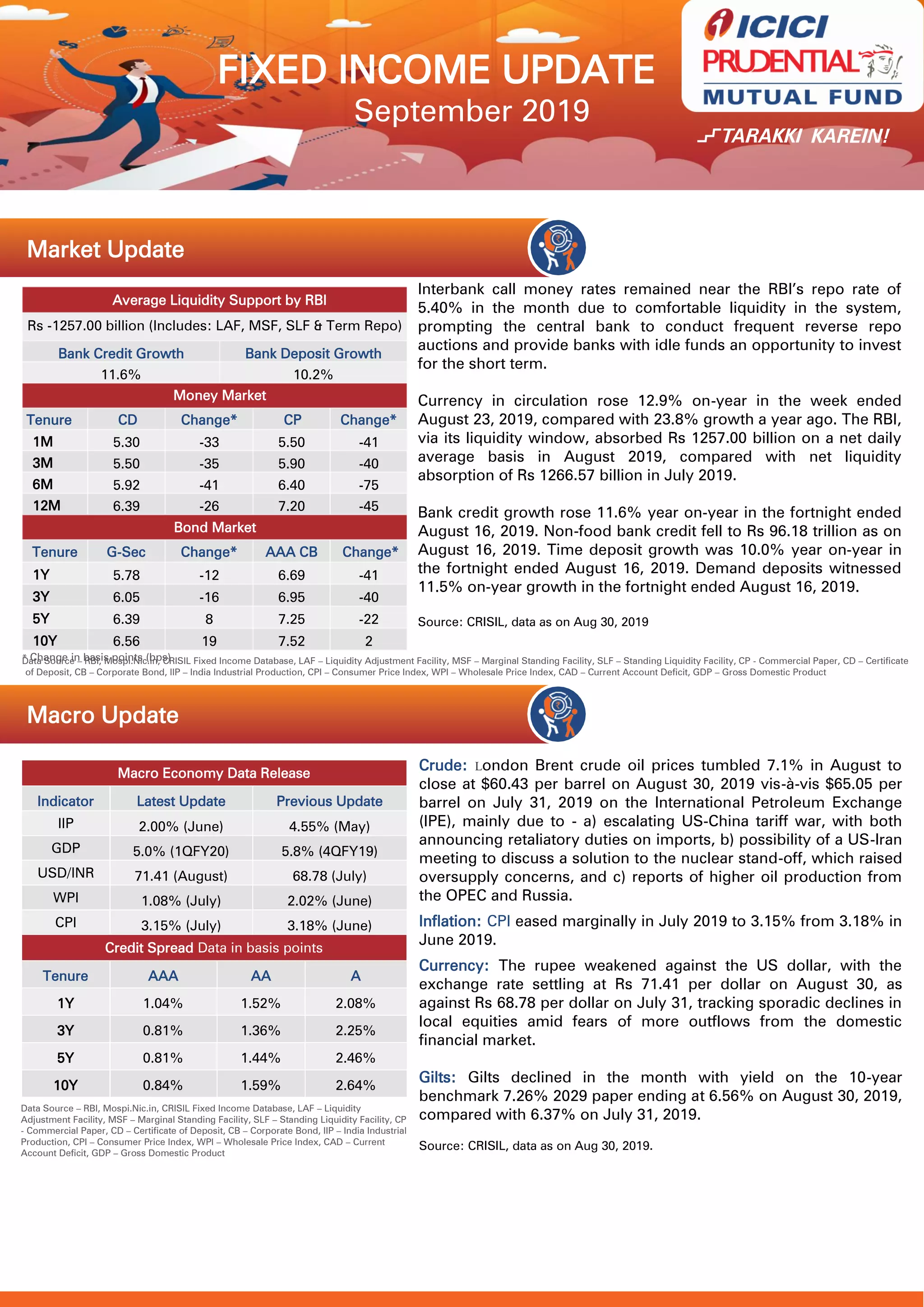
Interbank call money rates remained near the RBI’s repo rate of
5.40% in the month due to comfortable liquidity in the system,
prompting the central bank to conduct frequent reverse repo
auctions and provide banks with idle funds an opportunity to invest
for the short term.
Currency in circulation rose 12.9% on-year in the week ended
August 23, 2019, compared with 23.8% growth a year ago. The RBI,
via its liquidity window, absorbed Rs 1257.00 billion on a net daily
average basis in August 2019, compared with net liquidity
absorption of Rs 1266.57 billion in July 2019.
Bank credit growth rose 11.6% year on-year in the fortnight ended
August 16, 2019. Non-food bank credit fell to Rs 96.18 trillion as on
August 16, 2019. Time deposit growth was 10.0% year on-year in
the fortnight ended August 16, 2019. Demand deposits witnessed
11.5% on-year growth in the fortnight ended August 16, 2019.
Source: CRISIL, data as on Aug 30, 2019
Data Source – RBI, Mospi.Nic.in, CRISIL Fixed Income Database, LAF – Liquidity Adjustment Facility, MSF – Marginal Standing Facility, SLF – Standing Liquidity Facility, CP - Commercial Paper, CD – Certificate
of Deposit, CB – Corporate Bond, IIP – India Industrial Production, CPI – Consumer Price Index, WPI – Wholesale Price Index, CAD – Current Account Deficit, GDP – Gross Domestic Product
Macro Update
Macro Economy Data Release
Indicator Latest Update Previous Update
IIP 2.00% (June) 4.55% (May)
GDP 5.0% (1QFY20) 5.8% (4QFY19)
USD/INR 71.41 (August) 68.78 (July)
WPI 1.08% (July) 2.02% (June)
CPI 3.15% (July) 3.18% (June)
Credit Spread Data in basis points
Tenure AAA AA A
1Y 1.04% 1.52% 2.08%
3Y 0.81% 1.36% 2.25%
5Y 0.81% 1.44% 2.46%
10Y 0.84% 1.59% 2.64%
Average Liquidity Support by RBI
Rs -1257.00 billion (Includes: LAF, MSF, SLF & Term Repo)
Bank Credit Growth Bank Deposit Growth
11.6% 10.2%
Money Market
Tenure CD Change* CP Change*
1M 5.30 -33 5.50 -41
3M 5.50 -35 5.90 -40
6M 5.92 -41 6.40 -75
12M 6.39 -26 7.20 -45
Bond Market
Tenure G-Sec Change* AAA CB Change*
1Y 5.78 -12 6.69 -41
3Y 6.05 -16 6.95 -40
5Y 6.39 8 7.25 -22
10Y 6.56 19 7.52 2
* Change in basis points (bps)
Crude: London Brent crude oil prices tumbled 7.1% in August to
close at $60.43 per barrel on August 30, 2019 vis-à-vis $65.05 per
barrel on July 31, 2019 on the International Petroleum Exchange
(IPE), mainly due to - a) escalating US-China tariff war, with both
announcing retaliatory duties on imports, b) possibility of a US-Iran
meeting to discuss a solution to the nuclear stand-off, which raised
oversupply concerns, and c) reports of higher oil production from
the OPEC and Russia.
Inflation: CPI eased marginally in July 2019 to 3.15% from 3.18% in
June 2019.
Currency: The rupee weakened against the US dollar, with the
exchange rate settling at Rs 71.41 per dollar on August 30, as
against Rs 68.78 per dollar on July 31, tracking sporadic declines in
local equities amid fears of more outflows from the domestic
financial market.
Gilts: Gilts declined in the month with yield on the 10-year
benchmark 7.26% 2029 paper ending at 6.56% on August 30, 2019,
compared with 6.37% on July 31, 2019.
Source: CRISIL, data as on Aug 30, 2019.
Data Source – RBI, Mospi.Nic.in, CRISIL Fixed Income Database, LAF – Liquidity
Adjustment Facility, MSF – Marginal Standing Facility, SLF – Standing Liquidity Facility, CP
- Commercial Paper, CD – Certificate of Deposit, CB – Corporate Bond, IIP – India Industrial
Production, CPI – Consumer Price Index, WPI – Wholesale Price Index, CAD – Current
Account Deficit, GDP – Gross Domestic Product
FIXED INCOME UPDATE
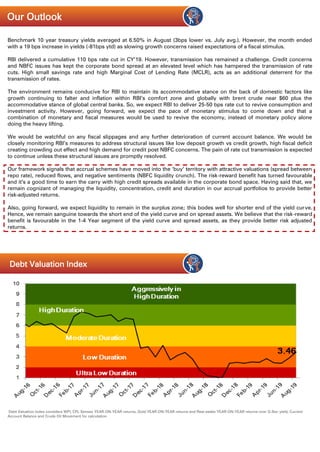
Benchmark 10 year treasury yields averaged at 6.50% in August (3bps lower vs. July avg.). However, the month ended
with a 19 bps increase in yields (-81bps ytd) as slowing growth concerns raised expectations of a fiscal stimulus.
RBI delivered a cumulative 110 bps rate cut in CY’19. However, transmission has remained a challenge. Credit concerns
and NBFC issues has kept the corporate bond spread at an elevated level which has hampered the transmission of rate
cuts. High small savings rate and high Marginal Cost of Lending Rate (MCLR), acts as an additional deterrent for the
transmission of rates.
The environment remains conducive for RBI to maintain its accommodative stance on the back of domestic factors like
growth continuing to falter and inflation within RBI’s comfort zone and globally with brent crude near $60 plus the
accommodative stance of global central banks. So, we expect RBI to deliver 25-50 bps rate cut to revive consumption and
investment activity. However, going forward, we expect the pace of monetary stimulus to come down and that a
combination of monetary and fiscal measures would be used to revive the economy, instead of monetary policy alone
doing the heavy lifting.
We would be watchful on any fiscal slippages and any further deterioration of current account balance. We would be
closely monitoring RBI’s measures to address structural issues like low deposit growth vs credit growth, high fiscal deficit
creating crowding out effect and high demand for credit post NBFC concerns. The pain of rate cut transmission is expected
to continue unless these structural issues are promptly resolved.
Our framework signals that accrual schemes have moved into the ‘buy’ territory with attractive valuations (spread between
repo rate), reduced flows, and negative sentiments (NBFC liquidity crunch). The risk-reward benefit has turned favourable
and it’s a good time to earn the carry with high credit spreads available in the corporate bond space. Having said that, we
remain cognizant of managing the liquidity, concentration, credit and duration in our accrual portfolios to provide better
risk-adjusted returns.
Also, going forward, we expect liquidity to remain in the surplus zone; this bodes well for shorter end of the yield curve.
Hence, we remain sanguine towards the short end of the yield curve and on spread assets. We believe that the risk-reward
benefit is favourable in the 1-4 Year segment of the yield curve and spread assets, as they provide better risk adjusted
returns.
Debt Valuation Index considers WPI, CPI, Sensex YEAR-ON-YEAR returns, Gold YEAR-ON-YEAR returns and Real estate YEAR-ON-YEAR returns over G-Sec yield, Current
Account Balance and Crude Oil Movement for calculation.
High Duration
Debt Valuation Index
Our Outlook
Our Recommendation
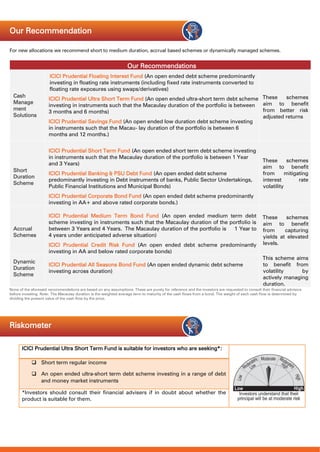
For new allocations we recommend short to medium duration, accrual based schemes or dynamically managed schemes.
Our Recommendations
Cash
Manage
ment
Solutions
ICICI Prudential Floating Interest Fund (An open ended debt scheme predominantly
investing in floating rate instruments (including fixed rate instruments converted to
floating rate exposures using swaps/derivatives)
ICICI Prudential Ultra Short Term Fund (An open ended ultra-short term debt scheme
investing in instruments such that the Macaulay duration of the portfolio is between
3 months and 6 months)
ICICI Prudential Savings Fund (An open ended low duration debt scheme investing
in instruments such that the Macau- lay duration of the portfolio is between 6
months and 12 months.)
These schemes
aim to benefit
from better risk
adjusted returns
Short
Duration
Scheme
ICICI Prudential Short Term Fund (An open ended short term debt scheme investing
in instruments such that the Macaulay duration of the portfolio is between 1 Year
and 3 Years)
ICICI Prudential Banking & PSU Debt Fund (An open ended debt scheme
predominantly investing in Debt instruments of banks, Public Sector Undertakings,
Public Financial Institutions and Municipal Bonds)
ICICI Prudential Corporate Bond Fund (An open ended debt scheme predominantly
investing in AA+ and above rated corporate bonds.)
These schemes
aim to benefit
from mitigating
interest rate
volatility
Accrual
Schemes
ICICI Prudential Medium Term Bond Fund (An open ended medium term debt
scheme investing in instruments such that the Macaulay duration of the portfolio is
between 3 Years and 4 Years. The Macaulay duration of the portfolio is 1 Year to
4 years under anticipated adverse situation)
ICICI Prudential Credit Risk Fund (An open ended debt scheme predominantly
investing in AA and below rated corporate bonds)
These schemes
aim to benefit
from capturing
yields at elevated
levels.
Dynamic
Duration
Scheme
ICICI Prudential All Seasons Bond Fund (An open ended dynamic debt scheme
investing across duration)
This scheme aims
to benefit from
volatility by
actively managing
duration.
None of the aforesaid recommendations are based on any assumptions. These are purely for reference and the investors are requested to consult their financial advisors
before investing. Note: The Macaulay duration is the weighted average term to maturity of the cash flows from a bond. The weight of each cash flow is determined by
dividing the present value of the cash flow by the price.
Riskometer
ICICI Prudential Ultra Short Term Fund is suitable for investors who are seeking*:
 Short term regular income
 An open ended ultra-short term debt scheme investing in a range of debt
and money market instruments
*Investors should consult their financial advisers if in doubt about whether the
product is suitable for them.
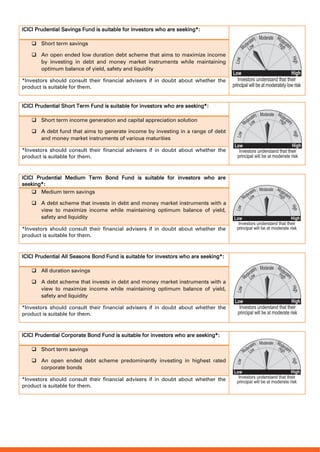
ICICI Prudential Savings Fund is suitable for investors who are seeking*:
 Short term savings
 An open ended low duration debt scheme that aims to maximize income
by investing in debt and money market instruments while maintaining
optimum balance of yield, safety and liquidity
*Investors should consult their financial advisers if in doubt about whether the
product is suitable for them.
ICICI Prudential Short Term Fund is suitable for investors who are seeking*:
 Short term income generation and capital appreciation solution
 A debt fund that aims to generate income by investing in a range of debt
and money market instruments of various maturities
*Investors should consult their financial advisers if in doubt about whether the
product is suitable for them.
ICICI Prudential Medium Term Bond Fund is suitable for investors who are
seeking*:
 Medium term savings
 A debt scheme that invests in debt and money market instruments with a
view to maximize income while maintaining optimum balance of yield,
safety and liquidity
*Investors should consult their financial advisers if in doubt about whether the
product is suitable for them.
ICICI Prudential All Seasons Bond Fund is suitable for investors who are seeking*:
 All duration savings
 A debt scheme that invests in debt and money market instruments with a
view to maximize income while maintaining optimum balance of yield,
safety and liquidity
*Investors should consult their financial advisers if in doubt about whether the
product is suitable for them.
ICICI Prudential Corporate Bond Fund is suitable for investors who are seeking*:
 Short term savings
 An open ended debt scheme predominantly investing in highest rated
corporate bonds
*Investors should consult their financial advisers if in doubt about whether the
product is suitable for them.
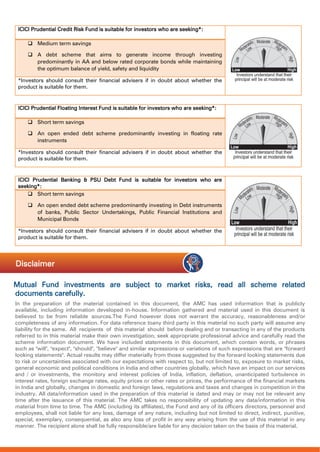
ICICI Prudential Credit Risk Fund is suitable for investors who are seeking*:
 Medium term savings
 A debt scheme that aims to generate income through investing
predominantly in AA and below rated corporate bonds while maintaining
the optimum balance of yield, safety and liquidity
*Investors should consult their financial advisers if in doubt about whether the
product is suitable for them.
ICICI Prudential Floating Interest Fund is suitable for investors who are seeking*:
 Short term savings
 An open ended debt scheme predominantly investing in floating rate
instruments
*Investors should consult their financial advisers if in doubt about whether the
product is suitable for them.
ICICI Prudential Banking & PSU Debt Fund is suitable for investors who are
seeking*:
 Short term savings
 An open ended debt scheme predominantly investing in Debt instruments
of banks, Public Sector Undertakings, Public Financial Institutions and
Municipal Bonds
*Investors should consult their financial advisers if in doubt about whether the
product is suitable for them.
Mutual Fund investments are subject to market risks, read all scheme related
documents carefully.
In the preparation of the material contained in this document, the AMC has used information that is publicly
available, including information developed in-house. Information gathered and material used in this document is
believed to be from reliable sources.The Fund however does not warrant the accuracy, reasonableness and/or
completeness of any information. For data reference toany third party in this material no such party will assume any
liability for the same. All recipients of this material should before dealing and or transacting in any of the products
referred to in this material make their own investigation, seek appropriate professional advice and carefully read the
scheme information document. We have included statements in this document, which contain words, or phrases
such as "will", "expect", "should", "believe" and similar expressions or variations of such expressions that are "forward
looking statements". Actual results may differ materially from those suggested by the forward looking statements due
to risk or uncertainties associated with our expectations with respect to, but not limited to, exposure to market risks,
general economic and political conditions in India and other countries globally, which have an impact on our services
and / or investments, the monitory and interest policies of India, inflation, deflation, unanticipated turbulence in
interest rates, foreign exchange rates, equity prices or other rates or prices, the performance of the financial markets
in India and globally, changes in domestic and foreign laws, regulations and taxes and changes in competition in the
industry. All data/information used in the preparation of this material is dated and may or may not be relevant any
time after the issuance of this material. The AMC takes no responsibility of updating any data/information in this
material from time to time. The AMC (including its affiliates), the Fund and any of its officers directors, personnel and
employees, shall not liable for any loss, damage of any nature, including but not limited to direct, indirect, punitive,
special, exemplary, consequential, as also any loss of profit in any way arising from the use of this material in any
manner. The recipient alone shall be fully responsible/are liable for any decision taken on the basis of this material.
Disclaimer

Fixed Income Update - September 2019

  • 1.
    September 2019 Market Update Interbankcall money rates remained near the RBI’s repo rate of 5.40% in the month due to comfortable liquidity in the system, prompting the central bank to conduct frequent reverse repo auctions and provide banks with idle funds an opportunity to invest for the short term. Currency in circulation rose 12.9% on-year in the week ended August 23, 2019, compared with 23.8% growth a year ago. The RBI, via its liquidity window, absorbed Rs 1257.00 billion on a net daily average basis in August 2019, compared with net liquidity absorption of Rs 1266.57 billion in July 2019. Bank credit growth rose 11.6% year on-year in the fortnight ended August 16, 2019. Non-food bank credit fell to Rs 96.18 trillion as on August 16, 2019. Time deposit growth was 10.0% year on-year in the fortnight ended August 16, 2019. Demand deposits witnessed 11.5% on-year growth in the fortnight ended August 16, 2019. Source: CRISIL, data as on Aug 30, 2019 Data Source – RBI, Mospi.Nic.in, CRISIL Fixed Income Database, LAF – Liquidity Adjustment Facility, MSF – Marginal Standing Facility, SLF – Standing Liquidity Facility, CP - Commercial Paper, CD – Certificate of Deposit, CB – Corporate Bond, IIP – India Industrial Production, CPI – Consumer Price Index, WPI – Wholesale Price Index, CAD – Current Account Deficit, GDP – Gross Domestic Product Macro Update Macro Economy Data Release Indicator Latest Update Previous Update IIP 2.00% (June) 4.55% (May) GDP 5.0% (1QFY20) 5.8% (4QFY19) USD/INR 71.41 (August) 68.78 (July) WPI 1.08% (July) 2.02% (June) CPI 3.15% (July) 3.18% (June) Credit Spread Data in basis points Tenure AAA AA A 1Y 1.04% 1.52% 2.08% 3Y 0.81% 1.36% 2.25% 5Y 0.81% 1.44% 2.46% 10Y 0.84% 1.59% 2.64% Average Liquidity Support by RBI Rs -1257.00 billion (Includes: LAF, MSF, SLF & Term Repo) Bank Credit Growth Bank Deposit Growth 11.6% 10.2% Money Market Tenure CD Change* CP Change* 1M 5.30 -33 5.50 -41 3M 5.50 -35 5.90 -40 6M 5.92 -41 6.40 -75 12M 6.39 -26 7.20 -45 Bond Market Tenure G-Sec Change* AAA CB Change* 1Y 5.78 -12 6.69 -41 3Y 6.05 -16 6.95 -40 5Y 6.39 8 7.25 -22 10Y 6.56 19 7.52 2 * Change in basis points (bps) Crude: London Brent crude oil prices tumbled 7.1% in August to close at $60.43 per barrel on August 30, 2019 vis-à-vis $65.05 per barrel on July 31, 2019 on the International Petroleum Exchange (IPE), mainly due to - a) escalating US-China tariff war, with both announcing retaliatory duties on imports, b) possibility of a US-Iran meeting to discuss a solution to the nuclear stand-off, which raised oversupply concerns, and c) reports of higher oil production from the OPEC and Russia. Inflation: CPI eased marginally in July 2019 to 3.15% from 3.18% in June 2019. Currency: The rupee weakened against the US dollar, with the exchange rate settling at Rs 71.41 per dollar on August 30, as against Rs 68.78 per dollar on July 31, tracking sporadic declines in local equities amid fears of more outflows from the domestic financial market. Gilts: Gilts declined in the month with yield on the 10-year benchmark 7.26% 2029 paper ending at 6.56% on August 30, 2019, compared with 6.37% on July 31, 2019. Source: CRISIL, data as on Aug 30, 2019. Data Source – RBI, Mospi.Nic.in, CRISIL Fixed Income Database, LAF – Liquidity Adjustment Facility, MSF – Marginal Standing Facility, SLF – Standing Liquidity Facility, CP - Commercial Paper, CD – Certificate of Deposit, CB – Corporate Bond, IIP – India Industrial Production, CPI – Consumer Price Index, WPI – Wholesale Price Index, CAD – Current Account Deficit, GDP – Gross Domestic Product FIXED INCOME UPDATE
  • 2.
    Benchmark 10 yeartreasury yields averaged at 6.50% in August (3bps lower vs. July avg.). However, the month ended with a 19 bps increase in yields (-81bps ytd) as slowing growth concerns raised expectations of a fiscal stimulus. RBI delivered a cumulative 110 bps rate cut in CY’19. However, transmission has remained a challenge. Credit concerns and NBFC issues has kept the corporate bond spread at an elevated level which has hampered the transmission of rate cuts. High small savings rate and high Marginal Cost of Lending Rate (MCLR), acts as an additional deterrent for the transmission of rates. The environment remains conducive for RBI to maintain its accommodative stance on the back of domestic factors like growth continuing to falter and inflation within RBI’s comfort zone and globally with brent crude near $60 plus the accommodative stance of global central banks. So, we expect RBI to deliver 25-50 bps rate cut to revive consumption and investment activity. However, going forward, we expect the pace of monetary stimulus to come down and that a combination of monetary and fiscal measures would be used to revive the economy, instead of monetary policy alone doing the heavy lifting. We would be watchful on any fiscal slippages and any further deterioration of current account balance. We would be closely monitoring RBI’s measures to address structural issues like low deposit growth vs credit growth, high fiscal deficit creating crowding out effect and high demand for credit post NBFC concerns. The pain of rate cut transmission is expected to continue unless these structural issues are promptly resolved. Our framework signals that accrual schemes have moved into the ‘buy’ territory with attractive valuations (spread between repo rate), reduced flows, and negative sentiments (NBFC liquidity crunch). The risk-reward benefit has turned favourable and it’s a good time to earn the carry with high credit spreads available in the corporate bond space. Having said that, we remain cognizant of managing the liquidity, concentration, credit and duration in our accrual portfolios to provide better risk-adjusted returns. Also, going forward, we expect liquidity to remain in the surplus zone; this bodes well for shorter end of the yield curve. Hence, we remain sanguine towards the short end of the yield curve and on spread assets. We believe that the risk-reward benefit is favourable in the 1-4 Year segment of the yield curve and spread assets, as they provide better risk adjusted returns. Debt Valuation Index considers WPI, CPI, Sensex YEAR-ON-YEAR returns, Gold YEAR-ON-YEAR returns and Real estate YEAR-ON-YEAR returns over G-Sec yield, Current Account Balance and Crude Oil Movement for calculation. High Duration Debt Valuation Index Our Outlook
  • 3.
    Our Recommendation For newallocations we recommend short to medium duration, accrual based schemes or dynamically managed schemes. Our Recommendations Cash Manage ment Solutions ICICI Prudential Floating Interest Fund (An open ended debt scheme predominantly investing in floating rate instruments (including fixed rate instruments converted to floating rate exposures using swaps/derivatives) ICICI Prudential Ultra Short Term Fund (An open ended ultra-short term debt scheme investing in instruments such that the Macaulay duration of the portfolio is between 3 months and 6 months) ICICI Prudential Savings Fund (An open ended low duration debt scheme investing in instruments such that the Macau- lay duration of the portfolio is between 6 months and 12 months.) These schemes aim to benefit from better risk adjusted returns Short Duration Scheme ICICI Prudential Short Term Fund (An open ended short term debt scheme investing in instruments such that the Macaulay duration of the portfolio is between 1 Year and 3 Years) ICICI Prudential Banking & PSU Debt Fund (An open ended debt scheme predominantly investing in Debt instruments of banks, Public Sector Undertakings, Public Financial Institutions and Municipal Bonds) ICICI Prudential Corporate Bond Fund (An open ended debt scheme predominantly investing in AA+ and above rated corporate bonds.) These schemes aim to benefit from mitigating interest rate volatility Accrual Schemes ICICI Prudential Medium Term Bond Fund (An open ended medium term debt scheme investing in instruments such that the Macaulay duration of the portfolio is between 3 Years and 4 Years. The Macaulay duration of the portfolio is 1 Year to 4 years under anticipated adverse situation) ICICI Prudential Credit Risk Fund (An open ended debt scheme predominantly investing in AA and below rated corporate bonds) These schemes aim to benefit from capturing yields at elevated levels. Dynamic Duration Scheme ICICI Prudential All Seasons Bond Fund (An open ended dynamic debt scheme investing across duration) This scheme aims to benefit from volatility by actively managing duration. None of the aforesaid recommendations are based on any assumptions. These are purely for reference and the investors are requested to consult their financial advisors before investing. Note: The Macaulay duration is the weighted average term to maturity of the cash flows from a bond. The weight of each cash flow is determined by dividing the present value of the cash flow by the price. Riskometer ICICI Prudential Ultra Short Term Fund is suitable for investors who are seeking*:  Short term regular income  An open ended ultra-short term debt scheme investing in a range of debt and money market instruments *Investors should consult their financial advisers if in doubt about whether the product is suitable for them.
  • 4.
    ICICI Prudential SavingsFund is suitable for investors who are seeking*:  Short term savings  An open ended low duration debt scheme that aims to maximize income by investing in debt and money market instruments while maintaining optimum balance of yield, safety and liquidity *Investors should consult their financial advisers if in doubt about whether the product is suitable for them. ICICI Prudential Short Term Fund is suitable for investors who are seeking*:  Short term income generation and capital appreciation solution  A debt fund that aims to generate income by investing in a range of debt and money market instruments of various maturities *Investors should consult their financial advisers if in doubt about whether the product is suitable for them. ICICI Prudential Medium Term Bond Fund is suitable for investors who are seeking*:  Medium term savings  A debt scheme that invests in debt and money market instruments with a view to maximize income while maintaining optimum balance of yield, safety and liquidity *Investors should consult their financial advisers if in doubt about whether the product is suitable for them. ICICI Prudential All Seasons Bond Fund is suitable for investors who are seeking*:  All duration savings  A debt scheme that invests in debt and money market instruments with a view to maximize income while maintaining optimum balance of yield, safety and liquidity *Investors should consult their financial advisers if in doubt about whether the product is suitable for them. ICICI Prudential Corporate Bond Fund is suitable for investors who are seeking*:  Short term savings  An open ended debt scheme predominantly investing in highest rated corporate bonds *Investors should consult their financial advisers if in doubt about whether the product is suitable for them.
  • 5.
    ICICI Prudential CreditRisk Fund is suitable for investors who are seeking*:  Medium term savings  A debt scheme that aims to generate income through investing predominantly in AA and below rated corporate bonds while maintaining the optimum balance of yield, safety and liquidity *Investors should consult their financial advisers if in doubt about whether the product is suitable for them. ICICI Prudential Floating Interest Fund is suitable for investors who are seeking*:  Short term savings  An open ended debt scheme predominantly investing in floating rate instruments *Investors should consult their financial advisers if in doubt about whether the product is suitable for them. ICICI Prudential Banking & PSU Debt Fund is suitable for investors who are seeking*:  Short term savings  An open ended debt scheme predominantly investing in Debt instruments of banks, Public Sector Undertakings, Public Financial Institutions and Municipal Bonds *Investors should consult their financial advisers if in doubt about whether the product is suitable for them. Mutual Fund investments are subject to market risks, read all scheme related documents carefully. In the preparation of the material contained in this document, the AMC has used information that is publicly available, including information developed in-house. Information gathered and material used in this document is believed to be from reliable sources.The Fund however does not warrant the accuracy, reasonableness and/or completeness of any information. For data reference toany third party in this material no such party will assume any liability for the same. All recipients of this material should before dealing and or transacting in any of the products referred to in this material make their own investigation, seek appropriate professional advice and carefully read the scheme information document. We have included statements in this document, which contain words, or phrases such as "will", "expect", "should", "believe" and similar expressions or variations of such expressions that are "forward looking statements". Actual results may differ materially from those suggested by the forward looking statements due to risk or uncertainties associated with our expectations with respect to, but not limited to, exposure to market risks, general economic and political conditions in India and other countries globally, which have an impact on our services and / or investments, the monitory and interest policies of India, inflation, deflation, unanticipated turbulence in interest rates, foreign exchange rates, equity prices or other rates or prices, the performance of the financial markets in India and globally, changes in domestic and foreign laws, regulations and taxes and changes in competition in the industry. All data/information used in the preparation of this material is dated and may or may not be relevant any time after the issuance of this material. The AMC takes no responsibility of updating any data/information in this material from time to time. The AMC (including its affiliates), the Fund and any of its officers directors, personnel and employees, shall not liable for any loss, damage of any nature, including but not limited to direct, indirect, punitive, special, exemplary, consequential, as also any loss of profit in any way arising from the use of this material in any manner. The recipient alone shall be fully responsible/are liable for any decision taken on the basis of this material. Disclaimer