Fixed Income Update
February 2019
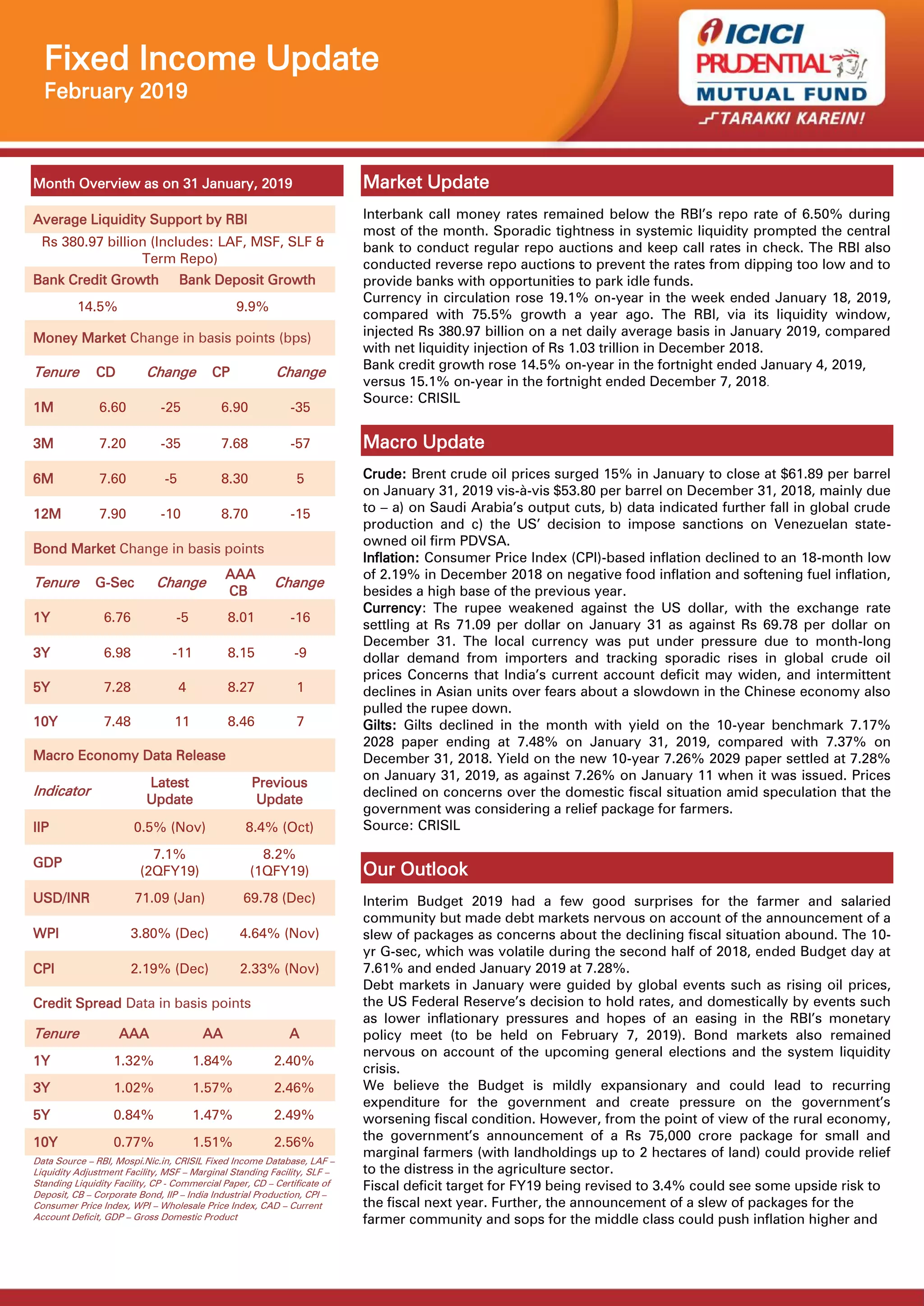
Month Overview as on 31 January, 2019
Average Liquidity Support by RBI
Rs 380.97 billion (Includes: LAF, MSF, SLF &
Term Repo)
Bank Credit Growth Bank Deposit Growth
14.5% 9.9%
Money Market Change in basis points (bps)
Tenure CD Change CP Change
1M 6.60 -25 6.90 -35
3M 7.20 -35 7.68 -57
6M 7.60 -5 8.30 5
12M 7.90 -10 8.70 -15
Bond Market Change in basis points
Tenure G-Sec Change
AAA
CB
Change
1Y 6.76 -5 8.01 -16
3Y 6.98 -11 8.15 -9
5Y 7.28 4 8.27 1
10Y 7.48 11 8.46 7
Macro Economy Data Release
Indicator
Latest
Update
Previous
Update
IIP 0.5% (Nov) 8.4% (Oct)
GDP
7.1%
(2QFY19)
8.2%
(1QFY19)
USD/INR 71.09 (Jan) 69.78 (Dec)
WPI 3.80% (Dec) 4.64% (Nov)
CPI 2.19% (Dec) 2.33% (Nov)
Credit Spread Data in basis points
Tenure AAA AA A
1Y 1.32% 1.84% 2.40%
3Y 1.02% 1.57% 2.46%
5Y 0.84% 1.47% 2.49%
10Y 0.77% 1.51% 2.56%
Data Source – RBI, Mospi.Nic.in, CRISIL Fixed Income Database, LAF –
Liquidity Adjustment Facility, MSF – Marginal Standing Facility, SLF –
Standing Liquidity Facility, CP - Commercial Paper, CD – Certificate of
Deposit, CB – Corporate Bond, IIP – India Industrial Production, CPI –
Consumer Price Index, WPI – Wholesale Price Index, CAD – Current
Account Deficit, GDP – Gross Domestic Product
Market Update
Interbank call money rates remained below the RBI’s repo rate of 6.50% during
most of the month. Sporadic tightness in systemic liquidity prompted the central
bank to conduct regular repo auctions and keep call rates in check. The RBI also
conducted reverse repo auctions to prevent the rates from dipping too low and to
provide banks with opportunities to park idle funds.
Currency in circulation rose 19.1% on-year in the week ended January 18, 2019,
compared with 75.5% growth a year ago. The RBI, via its liquidity window,
injected Rs 380.97 billion on a net daily average basis in January 2019, compared
with net liquidity injection of Rs 1.03 trillion in December 2018.
Bank credit growth rose 14.5% on-year in the fortnight ended January 4, 2019,
versus 15.1% on-year in the fortnight ended December 7, 2018.
Source: CRISIL
Macro Update
Crude: Brent crude oil prices surged 15% in January to close at $61.89 per barrel
on January 31, 2019 vis-à-vis $53.80 per barrel on December 31, 2018, mainly due
to – a) on Saudi Arabia’s output cuts, b) data indicated further fall in global crude
production and c) the US’ decision to impose sanctions on Venezuelan state-
owned oil firm PDVSA.
Inflation: Consumer Price Index (CPI)-based inflation declined to an 18-month low
of 2.19% in December 2018 on negative food inflation and softening fuel inflation,
besides a high base of the previous year.
Currency: The rupee weakened against the US dollar, with the exchange rate
settling at Rs 71.09 per dollar on January 31 as against Rs 69.78 per dollar on
December 31. The local currency was put under pressure due to month-long
dollar demand from importers and tracking sporadic rises in global crude oil
prices Concerns that India’s current account deficit may widen, and intermittent
declines in Asian units over fears about a slowdown in the Chinese economy also
pulled the rupee down.
Gilts: Gilts declined in the month with yield on the 10-year benchmark 7.17%
2028 paper ending at 7.48% on January 31, 2019, compared with 7.37% on
December 31, 2018. Yield on the new 10-year 7.26% 2029 paper settled at 7.28%
on January 31, 2019, as against 7.26% on January 11 when it was issued. Prices
declined on concerns over the domestic fiscal situation amid speculation that the
government was considering a relief package for farmers.
Source: CRISIL
Our Outlook
Interim Budget 2019 had a few good surprises for the farmer and salaried
community but made debt markets nervous on account of the announcement of a
slew of packages as concerns about the declining fiscal situation abound. The 10-
yr G-sec, which was volatile during the second half of 2018, ended Budget day at
7.61% and ended January 2019 at 7.28%.
Debt markets in January were guided by global events such as rising oil prices,
the US Federal Reserve’s decision to hold rates, and domestically by events such
as lower inflationary pressures and hopes of an easing in the RBI’s monetary
policy meet (to be held on February 7, 2019). Bond markets also remained
nervous on account of the upcoming general elections and the system liquidity
crisis.
We believe the Budget is mildly expansionary and could lead to recurring
expenditure for the government and create pressure on the government’s
worsening fiscal condition. However, from the point of view of the rural economy,
the government’s announcement of a Rs 75,000 crore package for small and
marginal farmers (with landholdings up to 2 hectares of land) could provide relief
to the distress in the agriculture sector.
Fiscal deficit target for FY19 being revised to 3.4% could see some upside risk to
the fiscal next year. Further, the announcement of a slew of packages for the
farmer community and sops for the middle class could push inflation higher and
Fixed Income Update
February 2019
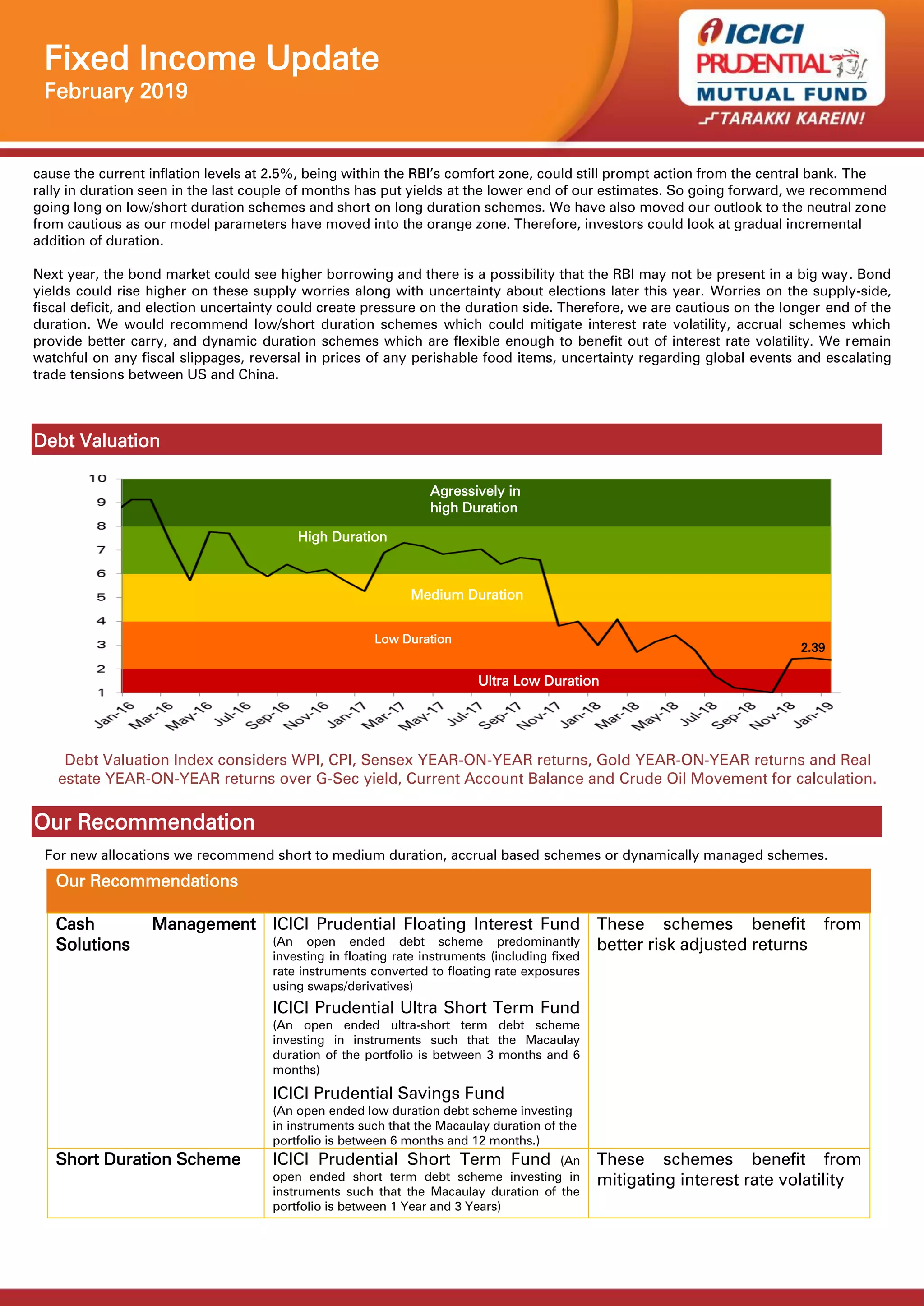
cause the current inflation levels at 2.5%, being within the RBI’s comfort zone, could still prompt action from the central bank. The
rally in duration seen in the last couple of months has put yields at the lower end of our estimates. So going forward, we recommend
going long on low/short duration schemes and short on long duration schemes. We have also moved our outlook to the neutral zone
from cautious as our model parameters have moved into the orange zone. Therefore, investors could look at gradual incremental
addition of duration.
Next year, the bond market could see higher borrowing and there is a possibility that the RBI may not be present in a big way. Bond
yields could rise higher on these supply worries along with uncertainty about elections later this year. Worries on the supply-side,
fiscal deficit, and election uncertainty could create pressure on the duration side. Therefore, we are cautious on the longer end of the
duration. We would recommend low/short duration schemes which could mitigate interest rate volatility, accrual schemes which
provide better carry, and dynamic duration schemes which are flexible enough to benefit out of interest rate volatility. We remain
watchful on any fiscal slippages, reversal in prices of any perishable food items, uncertainty regarding global events and escalating
trade tensions between US and China.
Debt Valuation
Debt Valuation Index considers WPI, CPI, Sensex YEAR-ON-YEAR returns, Gold YEAR-ON-YEAR returns and Real
estate YEAR-ON-YEAR returns over G-Sec yield, Current Account Balance and Crude Oil Movement for calculation.
Our Recommendation
For new allocations we recommend short to medium duration, accrual based schemes or dynamically managed schemes.
Our Recommendations
Cash Management
Solutions
ICICI Prudential Floating Interest Fund
(An open ended debt scheme predominantly
investing in floating rate instruments (including fixed
rate instruments converted to floating rate exposures
using swaps/derivatives)
ICICI Prudential Ultra Short Term Fund
(An open ended ultra-short term debt scheme
investing in instruments such that the Macaulay
duration of the portfolio is between 3 months and 6
months)
ICICI Prudential Savings Fund
(An open ended low duration debt scheme investing
in instruments such that the Macaulay duration of the
portfolio is between 6 months and 12 months.)
These schemes benefit from
better risk adjusted returns
Short Duration Scheme ICICI Prudential Short Term Fund (An
open ended short term debt scheme investing in
instruments such that the Macaulay duration of the
portfolio is between 1 Year and 3 Years)
These schemes benefit from
mitigating interest rate volatility
Agressively in
high Duration
High Duration
Medium Duration
Low Duration
Ultra Low Duration
2.39
Fixed Income Update
February 2019
ICICI Prudential Banking & PSU Debt
Fund (An open ended debt scheme predominantly
investing in Debt instruments of banks, Public Sector
Undertakings, Public Financial Institutions and
Municipal Bonds)
ICICI Prudential Corporate Bond Fund
(An open ended debt scheme predominantly
investing in AA+ and above rated corporate bonds.)
Accrual Schemes ICICI Prudential Medium Term Bond
Fund (An open ended medium term debt scheme
investing in instruments such that the Macaulay
duration of the portfolio is between 3 Years and 4
Years. The Macaulay duration of the portfolio is 1
Year to 4 years under anticipated adverse situation)
ICICI Prudential Credit Risk Fund (An
open ended debt scheme predominantly investing in
AA and below rated corporate bonds)
These schemes benefit from
capturing yields at elevated
levels.
Dynamic Duration
Scheme
ICICI Prudential All Seasons Bond
Fund (An open ended dynamic debt scheme
investing across duration)
This scheme benefits from
volatility by actively managing
duration.
None of the aforesaid recommendations are based on any assumptions. These are purely for reference and the investors are requested to consult their
financial advisors before investing.
Note: The Macaulay duration is the weighted average term to maturity of the cash flows from a bond. The weight of each cash flow is determined by dividing the
present value of the cash flow by the price.
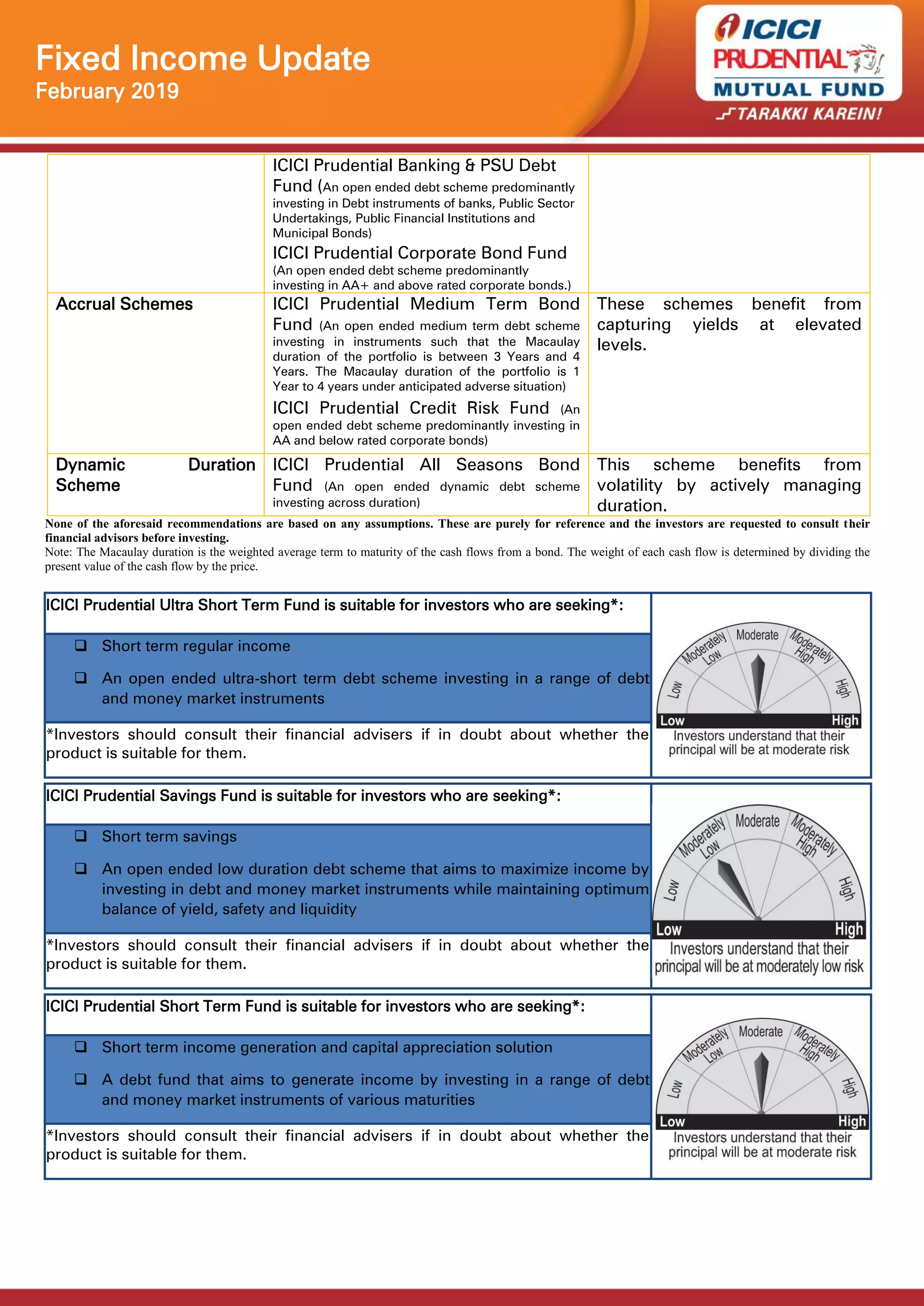
ICICI Prudential Ultra Short Term Fund is suitable for investors who are seeking*:
 Short term regular income
 An open ended ultra-short term debt scheme investing in a range of debt
and money market instruments
*Investors should consult their financial advisers if in doubt about whether the
product is suitable for them.
ICICI Prudential Savings Fund is suitable for investors who are seeking*:
 Short term savings
 An open ended low duration debt scheme that aims to maximize income by
investing in debt and money market instruments while maintaining optimum
balance of yield, safety and liquidity
*Investors should consult their financial advisers if in doubt about whether the
product is suitable for them.
ICICI Prudential Short Term Fund is suitable for investors who are seeking*:
 Short term income generation and capital appreciation solution
 A debt fund that aims to generate income by investing in a range of debt
and money market instruments of various maturities
*Investors should consult their financial advisers if in doubt about whether the
product is suitable for them.
Fixed Income Update
February 2019
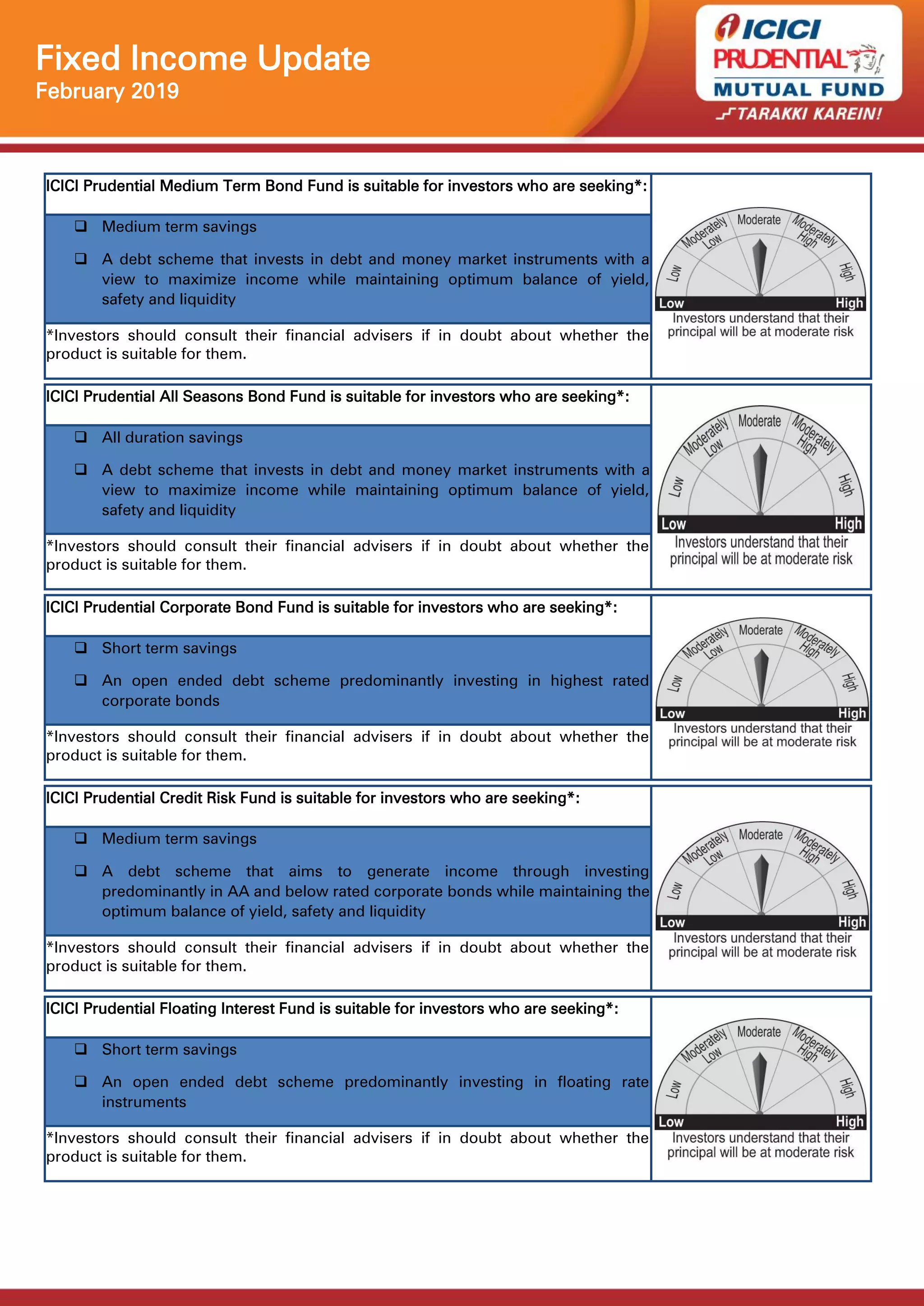
ICICI Prudential Medium Term Bond Fund is suitable for investors who are seeking*:
 Medium term savings
 A debt scheme that invests in debt and money market instruments with a
view to maximize income while maintaining optimum balance of yield,
safety and liquidity
*Investors should consult their financial advisers if in doubt about whether the
product is suitable for them.
ICICI Prudential All Seasons Bond Fund is suitable for investors who are seeking*:
 All duration savings
 A debt scheme that invests in debt and money market instruments with a
view to maximize income while maintaining optimum balance of yield,
safety and liquidity
*Investors should consult their financial advisers if in doubt about whether the
product is suitable for them.
ICICI Prudential Corporate Bond Fund is suitable for investors who are seeking*:
 Short term savings
 An open ended debt scheme predominantly investing in highest rated
corporate bonds
*Investors should consult their financial advisers if in doubt about whether the
product is suitable for them.
ICICI Prudential Credit Risk Fund is suitable for investors who are seeking*:
 Medium term savings
 A debt scheme that aims to generate income through investing
predominantly in AA and below rated corporate bonds while maintaining the
optimum balance of yield, safety and liquidity
*Investors should consult their financial advisers if in doubt about whether the
product is suitable for them.
ICICI Prudential Floating Interest Fund is suitable for investors who are seeking*:
 Short term savings
 An open ended debt scheme predominantly investing in floating rate
instruments
*Investors should consult their financial advisers if in doubt about whether the
product is suitable for them.
Fixed Income Update
February 2019
ICICI Prudential Banking & PSU Debt Fund is suitable for investors who are seeking*:
 Short term savings
 An open ended debt scheme predominantly investing in Debt instruments of
banks, Public Sector Undertakings, Public Financial Institutions and
Municipal Bonds
*Investors should consult their financial advisers if in doubt about whether the
product is suitable for them.
Disclaimer
Mutual Fund investments are subject to market risks, read all scheme related documents carefully.
In the preparation of the material contained in this document, the AMC has used information that is publicly available, including information
developed in-house. Information gathered and material used in this document is believed to be from reliable sources. The Fund however does
not warrant the accuracy, reasonableness and/or completeness of any information. For data reference to any third party in this material no such
party will assume any liability for the same. All recipients of this material should before dealing and or transacting in any of the products
referred to in this material make their own investigation, seek appropriate professional advice and carefully read the scheme information
document. We have included statements in this document, which contain words, or phrases such as "will", "expect", "should", "believe" and
similar expressions or variations of such expressions that are "forward looking statements". Actual results may differ materially from those
suggested by the forward looking statements due to risk or uncertainties associated with our expectations with respect to, but not limited to,
exposure to market risks, general economic and political conditions in India and other countries globally, which have an impact on our services
and / or investments, the monitory and interest policies of India, inflation, deflation, unanticipated turbulence in interest rates, foreign exchange
rates, equity prices or other rates or prices, the performance of the financial markets in India and globally, changes in domestic and foreign
laws, regulations and taxes and changes in competition in the industry. All data/information used in the preparation of this material is dated and
may or may not be relevant any time after the issuance of this material. The AMC takes no responsibility of updating any data/information in this
material from time to time. The AMC (including its affiliates), the Fund and any of its officers directors, personnel and employees, shall not liable
for any loss, damage of any nature, including but not limited to direct, indirect, punitive, special, exemplary, consequential, as also any loss of
profit in any way arising from the use of this material in any manner. The recipient alone shall be fully responsible/are liable for any decision
taken on the basis of this material.

Fixed Income Update - February 2019

  • 1.
    Fixed Income Update February2019 Month Overview as on 31 January, 2019 Average Liquidity Support by RBI Rs 380.97 billion (Includes: LAF, MSF, SLF & Term Repo) Bank Credit Growth Bank Deposit Growth 14.5% 9.9% Money Market Change in basis points (bps) Tenure CD Change CP Change 1M 6.60 -25 6.90 -35 3M 7.20 -35 7.68 -57 6M 7.60 -5 8.30 5 12M 7.90 -10 8.70 -15 Bond Market Change in basis points Tenure G-Sec Change AAA CB Change 1Y 6.76 -5 8.01 -16 3Y 6.98 -11 8.15 -9 5Y 7.28 4 8.27 1 10Y 7.48 11 8.46 7 Macro Economy Data Release Indicator Latest Update Previous Update IIP 0.5% (Nov) 8.4% (Oct) GDP 7.1% (2QFY19) 8.2% (1QFY19) USD/INR 71.09 (Jan) 69.78 (Dec) WPI 3.80% (Dec) 4.64% (Nov) CPI 2.19% (Dec) 2.33% (Nov) Credit Spread Data in basis points Tenure AAA AA A 1Y 1.32% 1.84% 2.40% 3Y 1.02% 1.57% 2.46% 5Y 0.84% 1.47% 2.49% 10Y 0.77% 1.51% 2.56% Data Source – RBI, Mospi.Nic.in, CRISIL Fixed Income Database, LAF – Liquidity Adjustment Facility, MSF – Marginal Standing Facility, SLF – Standing Liquidity Facility, CP - Commercial Paper, CD – Certificate of Deposit, CB – Corporate Bond, IIP – India Industrial Production, CPI – Consumer Price Index, WPI – Wholesale Price Index, CAD – Current Account Deficit, GDP – Gross Domestic Product Market Update Interbank call money rates remained below the RBI’s repo rate of 6.50% during most of the month. Sporadic tightness in systemic liquidity prompted the central bank to conduct regular repo auctions and keep call rates in check. The RBI also conducted reverse repo auctions to prevent the rates from dipping too low and to provide banks with opportunities to park idle funds. Currency in circulation rose 19.1% on-year in the week ended January 18, 2019, compared with 75.5% growth a year ago. The RBI, via its liquidity window, injected Rs 380.97 billion on a net daily average basis in January 2019, compared with net liquidity injection of Rs 1.03 trillion in December 2018. Bank credit growth rose 14.5% on-year in the fortnight ended January 4, 2019, versus 15.1% on-year in the fortnight ended December 7, 2018. Source: CRISIL Macro Update Crude: Brent crude oil prices surged 15% in January to close at $61.89 per barrel on January 31, 2019 vis-à-vis $53.80 per barrel on December 31, 2018, mainly due to – a) on Saudi Arabia’s output cuts, b) data indicated further fall in global crude production and c) the US’ decision to impose sanctions on Venezuelan state- owned oil firm PDVSA. Inflation: Consumer Price Index (CPI)-based inflation declined to an 18-month low of 2.19% in December 2018 on negative food inflation and softening fuel inflation, besides a high base of the previous year. Currency: The rupee weakened against the US dollar, with the exchange rate settling at Rs 71.09 per dollar on January 31 as against Rs 69.78 per dollar on December 31. The local currency was put under pressure due to month-long dollar demand from importers and tracking sporadic rises in global crude oil prices Concerns that India’s current account deficit may widen, and intermittent declines in Asian units over fears about a slowdown in the Chinese economy also pulled the rupee down. Gilts: Gilts declined in the month with yield on the 10-year benchmark 7.17% 2028 paper ending at 7.48% on January 31, 2019, compared with 7.37% on December 31, 2018. Yield on the new 10-year 7.26% 2029 paper settled at 7.28% on January 31, 2019, as against 7.26% on January 11 when it was issued. Prices declined on concerns over the domestic fiscal situation amid speculation that the government was considering a relief package for farmers. Source: CRISIL Our Outlook Interim Budget 2019 had a few good surprises for the farmer and salaried community but made debt markets nervous on account of the announcement of a slew of packages as concerns about the declining fiscal situation abound. The 10- yr G-sec, which was volatile during the second half of 2018, ended Budget day at 7.61% and ended January 2019 at 7.28%. Debt markets in January were guided by global events such as rising oil prices, the US Federal Reserve’s decision to hold rates, and domestically by events such as lower inflationary pressures and hopes of an easing in the RBI’s monetary policy meet (to be held on February 7, 2019). Bond markets also remained nervous on account of the upcoming general elections and the system liquidity crisis. We believe the Budget is mildly expansionary and could lead to recurring expenditure for the government and create pressure on the government’s worsening fiscal condition. However, from the point of view of the rural economy, the government’s announcement of a Rs 75,000 crore package for small and marginal farmers (with landholdings up to 2 hectares of land) could provide relief to the distress in the agriculture sector. Fiscal deficit target for FY19 being revised to 3.4% could see some upside risk to the fiscal next year. Further, the announcement of a slew of packages for the farmer community and sops for the middle class could push inflation higher and
  • 2.
    Fixed Income Update February2019 cause the current inflation levels at 2.5%, being within the RBI’s comfort zone, could still prompt action from the central bank. The rally in duration seen in the last couple of months has put yields at the lower end of our estimates. So going forward, we recommend going long on low/short duration schemes and short on long duration schemes. We have also moved our outlook to the neutral zone from cautious as our model parameters have moved into the orange zone. Therefore, investors could look at gradual incremental addition of duration. Next year, the bond market could see higher borrowing and there is a possibility that the RBI may not be present in a big way. Bond yields could rise higher on these supply worries along with uncertainty about elections later this year. Worries on the supply-side, fiscal deficit, and election uncertainty could create pressure on the duration side. Therefore, we are cautious on the longer end of the duration. We would recommend low/short duration schemes which could mitigate interest rate volatility, accrual schemes which provide better carry, and dynamic duration schemes which are flexible enough to benefit out of interest rate volatility. We remain watchful on any fiscal slippages, reversal in prices of any perishable food items, uncertainty regarding global events and escalating trade tensions between US and China. Debt Valuation Debt Valuation Index considers WPI, CPI, Sensex YEAR-ON-YEAR returns, Gold YEAR-ON-YEAR returns and Real estate YEAR-ON-YEAR returns over G-Sec yield, Current Account Balance and Crude Oil Movement for calculation. Our Recommendation For new allocations we recommend short to medium duration, accrual based schemes or dynamically managed schemes. Our Recommendations Cash Management Solutions ICICI Prudential Floating Interest Fund (An open ended debt scheme predominantly investing in floating rate instruments (including fixed rate instruments converted to floating rate exposures using swaps/derivatives) ICICI Prudential Ultra Short Term Fund (An open ended ultra-short term debt scheme investing in instruments such that the Macaulay duration of the portfolio is between 3 months and 6 months) ICICI Prudential Savings Fund (An open ended low duration debt scheme investing in instruments such that the Macaulay duration of the portfolio is between 6 months and 12 months.) These schemes benefit from better risk adjusted returns Short Duration Scheme ICICI Prudential Short Term Fund (An open ended short term debt scheme investing in instruments such that the Macaulay duration of the portfolio is between 1 Year and 3 Years) These schemes benefit from mitigating interest rate volatility Agressively in high Duration High Duration Medium Duration Low Duration Ultra Low Duration 2.39
  • 3.
    Fixed Income Update February2019 ICICI Prudential Banking & PSU Debt Fund (An open ended debt scheme predominantly investing in Debt instruments of banks, Public Sector Undertakings, Public Financial Institutions and Municipal Bonds) ICICI Prudential Corporate Bond Fund (An open ended debt scheme predominantly investing in AA+ and above rated corporate bonds.) Accrual Schemes ICICI Prudential Medium Term Bond Fund (An open ended medium term debt scheme investing in instruments such that the Macaulay duration of the portfolio is between 3 Years and 4 Years. The Macaulay duration of the portfolio is 1 Year to 4 years under anticipated adverse situation) ICICI Prudential Credit Risk Fund (An open ended debt scheme predominantly investing in AA and below rated corporate bonds) These schemes benefit from capturing yields at elevated levels. Dynamic Duration Scheme ICICI Prudential All Seasons Bond Fund (An open ended dynamic debt scheme investing across duration) This scheme benefits from volatility by actively managing duration. None of the aforesaid recommendations are based on any assumptions. These are purely for reference and the investors are requested to consult their financial advisors before investing. Note: The Macaulay duration is the weighted average term to maturity of the cash flows from a bond. The weight of each cash flow is determined by dividing the present value of the cash flow by the price. ICICI Prudential Ultra Short Term Fund is suitable for investors who are seeking*:  Short term regular income  An open ended ultra-short term debt scheme investing in a range of debt and money market instruments *Investors should consult their financial advisers if in doubt about whether the product is suitable for them. ICICI Prudential Savings Fund is suitable for investors who are seeking*:  Short term savings  An open ended low duration debt scheme that aims to maximize income by investing in debt and money market instruments while maintaining optimum balance of yield, safety and liquidity *Investors should consult their financial advisers if in doubt about whether the product is suitable for them. ICICI Prudential Short Term Fund is suitable for investors who are seeking*:  Short term income generation and capital appreciation solution  A debt fund that aims to generate income by investing in a range of debt and money market instruments of various maturities *Investors should consult their financial advisers if in doubt about whether the product is suitable for them.
  • 4.
    Fixed Income Update February2019 ICICI Prudential Medium Term Bond Fund is suitable for investors who are seeking*:  Medium term savings  A debt scheme that invests in debt and money market instruments with a view to maximize income while maintaining optimum balance of yield, safety and liquidity *Investors should consult their financial advisers if in doubt about whether the product is suitable for them. ICICI Prudential All Seasons Bond Fund is suitable for investors who are seeking*:  All duration savings  A debt scheme that invests in debt and money market instruments with a view to maximize income while maintaining optimum balance of yield, safety and liquidity *Investors should consult their financial advisers if in doubt about whether the product is suitable for them. ICICI Prudential Corporate Bond Fund is suitable for investors who are seeking*:  Short term savings  An open ended debt scheme predominantly investing in highest rated corporate bonds *Investors should consult their financial advisers if in doubt about whether the product is suitable for them. ICICI Prudential Credit Risk Fund is suitable for investors who are seeking*:  Medium term savings  A debt scheme that aims to generate income through investing predominantly in AA and below rated corporate bonds while maintaining the optimum balance of yield, safety and liquidity *Investors should consult their financial advisers if in doubt about whether the product is suitable for them. ICICI Prudential Floating Interest Fund is suitable for investors who are seeking*:  Short term savings  An open ended debt scheme predominantly investing in floating rate instruments *Investors should consult their financial advisers if in doubt about whether the product is suitable for them.
  • 5.
    Fixed Income Update February2019 ICICI Prudential Banking & PSU Debt Fund is suitable for investors who are seeking*:  Short term savings  An open ended debt scheme predominantly investing in Debt instruments of banks, Public Sector Undertakings, Public Financial Institutions and Municipal Bonds *Investors should consult their financial advisers if in doubt about whether the product is suitable for them. Disclaimer Mutual Fund investments are subject to market risks, read all scheme related documents carefully. In the preparation of the material contained in this document, the AMC has used information that is publicly available, including information developed in-house. Information gathered and material used in this document is believed to be from reliable sources. The Fund however does not warrant the accuracy, reasonableness and/or completeness of any information. For data reference to any third party in this material no such party will assume any liability for the same. All recipients of this material should before dealing and or transacting in any of the products referred to in this material make their own investigation, seek appropriate professional advice and carefully read the scheme information document. We have included statements in this document, which contain words, or phrases such as "will", "expect", "should", "believe" and similar expressions or variations of such expressions that are "forward looking statements". Actual results may differ materially from those suggested by the forward looking statements due to risk or uncertainties associated with our expectations with respect to, but not limited to, exposure to market risks, general economic and political conditions in India and other countries globally, which have an impact on our services and / or investments, the monitory and interest policies of India, inflation, deflation, unanticipated turbulence in interest rates, foreign exchange rates, equity prices or other rates or prices, the performance of the financial markets in India and globally, changes in domestic and foreign laws, regulations and taxes and changes in competition in the industry. All data/information used in the preparation of this material is dated and may or may not be relevant any time after the issuance of this material. The AMC takes no responsibility of updating any data/information in this material from time to time. The AMC (including its affiliates), the Fund and any of its officers directors, personnel and employees, shall not liable for any loss, damage of any nature, including but not limited to direct, indirect, punitive, special, exemplary, consequential, as also any loss of profit in any way arising from the use of this material in any manner. The recipient alone shall be fully responsible/are liable for any decision taken on the basis of this material.