Fixed Income Update
September 2018
Month Overview as on 31st
August, 2018
Average Liquidity Support by RBI
Rs -0.76 billion (Includes: LAF, MSF, SLF & Term
Repo)
Bank Credit Growth Bank Deposit Growth
12.9% 8.3%
Money Market Change in basis points (bps)
Tenure CD Change CP Change
1M 6.62 -28 7.15 -55
3M 7.19 3 7.78 -27
6M 7.50 3 8.30 -8
12M 8.05 9 8.55 5
Bond Market Change in basis points
Tenure G-Sec Change
AAA
CB
Change
1Y 7.34 9 8.20 5
3Y 7.79 13 8.54 17
5Y 8.01 11 8.66 7
10Y 7.95 18 8.64 10
Macro Economy Data Release
Indicator
Latest
Update
Previous
Update
IIP 7.0% (Jun) 3.9% (May)
GDP 8.2% (1QFY19) 7.7% (4QFY18)
USD/INR 70.99 (Aug) 68.54 (July)
WPI 5.09% (Jul) 5.77% (Jun)
CPI 4.17% (Jul) 4.93% (Jun)
Credit Spread Data in basis points
Tenure AAA AA A
1Y 1.04% 1.56% 2.12%
3Y 0.57% 1.19% 2.05%
5Y 0.46% 1.01% 2.07%
10Y 0.54% 1.29% 2.34%
Data Source – RBI, Mospi.Nic.in, CRISIL Fixed Income Database, LAF –
Liquidity Adjustment Facility, MSF – Marginal Standing Facility, SLF –
Standing Liquidity Facility, CP - Commercial Paper, CD – Certificate of
Deposit, CB – Corporate Bond, IIP – India Industrial Production, CPI –
Consumer Price Index, WPI – Wholesale Price Index, CAD – Current
Account Deficit, GDP – Gross Domestic Product
Market Update
Interbank call money rates remained below the repo rate for most of the month
owing to comfortable liquidity in the system. However, some stress was seen in
the rates owing to outflows related to indirect tax payments.
Currency in circulation rose 23.8% year on year in the week ended August 24, 2018
against 9.6% de-growth a year ago. The RBI, via its liquidity window, injected Rs
0.76 billion on a net daily average basis in August 2018 (till August 30) compared
with net liquidity injection of Rs 128.51 billion in July 2018.
There was slight improvement in the credit growth and was reported at 12.9% year-
on-year as against the bank deposit rate of 8.3% year-on-year as on 31st
August,
2018.
Source: CRISIL
Macro Update
Inflation: Price Index (CPI)-based inflation fell to a nine-month low of 4.17% in July
2018 compared with 4.93% in June 2018. Wholesale Price Index (WPI)-based
inflation eased to 5.09% in July 2018 from a four-year high of 5.77% in June 2018.
GDP: India’s gross domestic product (GDP) rose 8.2% in April-June 2018 due to
strong performance by manufacturing and construction sectors.
Currency: The rupee depreciated to a record low against the US dollar during the
month to end at Rs 70.99 per US dollar on August 31 compared with Rs 68.54 per
US dollar on July 31.
Crude: Global crude oil prices ended the month 4.3% high on speculation that the
US sanctions against Iran would disrupt global supply. Brent crude oil prices ended
at $77.42 per barrel on August 31 compared with $74.25 per barrel on July 31.
Fiscal Deficit: India’s fiscal deficit for April-July period stood at Rs 5.40 trillion or
86.5% of the budgeted target for the current fiscal year compared with 92.4% a
year ago.
Source: CRISIL
Our Outlook
We continue to remain in an upward interest rate cycle, where the 10-year
benchmark yield has touched a high of 7.95% as on 31st
August, 2018. Major reason
for rising yields are the following: continued downward trend in INR with an all-
time low of Rs 70.99 as on Aug 31, rising crude oil prices and liquidity tightening in
the system.
The most decisive event during the month was the RBI hiking the repo rate by 25
basis points (bps) to 6.50%. This is the first time since October 2013 that the central
bank has raised the repo rate at two consecutive policy meetings. However, the RBI
did not formally tighten its monetary policy stance from “neutral” to a “withdrawal
of accommodation” and has kept it open for the next policy.
Going into September, bond yields are expected to remain under stress due to
concerns around deteriorating macro-economic factors. This, along with even
strong GDP growth, could create a background for further rate hike. We expect RBI
to hike interest rates by 25-50 bps in the coming quarters.
We continue to maintain a cautious approach and be watchful about various
domestic and global factors. On the global front, we remain watchful on higher oil
prices, rising trade protectionism, and unwinding of quantitative easing by central
banks. Domestically, commitment towards fiscal discipline and consolidation, in an
election year, needs to be monitored closely given that the GST collections have
not been too buoyant. Further, upside risk on inflation exists, liquidity scenario
looks negative and the full impact of MSP price revision is yet to be seen. We
recommend investors to stick to low duration schemes which can mitigate interest
rate volatility, accrual schemes which can capture the current elevated yields and
dynamic duration schemes which can benefit from volatility.
Fixed Income Update
September 2018
.
Debt Valuation
Debt Valuation Index considers WPI, CPI, Credit Growth, Sensex YOY returns, Gold YOY returns and Real estate
YOY returns over G-Sec yield, Current Account Balance and Crude Oil Movement for calculation.
Our Recommendation
Our Recommendations
Accrual Schemes ICICI Prudential Medium Term Bond
Fund (An open ended medium term debt scheme
investing in instruments such that the Macaulay
duration of the portfolio is between 3 Years and 4
Years. The Macaulay duration of the portfolio is 1
Year to 4 years under anticipated adverse situation)
ICICI Prudential Credit Risk Fund (An
open ended debt scheme predominantly investing in
AA and below rated corporate bonds)
ICICI Prudential Floating Interest Fund
(An open ended debt scheme predominantly
investing in floating rate instruments (including fixed
rate instruments converted to floating rate exposures
using swaps/derivatives)
ICICI Prudential Ultra Short Term Fund
(An open ended ultra-short term debt scheme
investing in instruments such that the Macaulay
duration of the portfolio is between 3 months and 6
months)
These schemes are better suited for
investors looking for accrual
strategy.
Dynamic Duration
Schemes
ICICI Prudential All Seasons Bond
Fund (An open ended dynamic debt scheme
investing across duration)
This scheme can dynamically
change duration strategy based on
market conditions.
Short Duration Scheme ICICI Prudential Short Term Fund (An
open ended short term debt scheme investing in
instruments such that the Macaulay duration of the
portfolio is between 1 Year and 3 Years)
This scheme maintains short
duration maturity.
1.22
1
2
3
4
5
6
7
8
9
10
Ultra Low Duration
Low Duration
Moderate Duration
High Duration
Aggressively in
High Duration
Fixed Income Update
September 2018
None of the aforesaid recommendations are based on any assumptions. These are purely for reference and the investors are requested to consult their
financial advisors before investing.
Note: The Macaulay duration is the weighted average term to maturity of the cash flows from a bond. The weight of each cash flow is determined by dividing the
present value of the cash flow by the price.
ICICI Prudential Short Term Fund is suitable for investors who are
seeking*:
 Short term income generation and capital appreciation solution
 A debt fund that aims to generate income by investing in a range
of debt and money market instruments of various maturities
*Investors should consult their financial advisers if in doubt about whether
the product is suitable for them.
ICICI Prudential Medium Term Bond Fund is suitable for investors who are
seeking*:
 Medium term savings
 A debt scheme that invests in debt and money market instruments
with a view to maximize income while maintaining optimum
balance of yield, safety and liquidity
*Investors should consult their financial advisers if in doubt about whether
the product is suitable for them.
ICICI Prudential All Seasons Bond Fund is suitable for investors who are
seeking*:
 All duration savings
 A debt scheme that invests in debt and money market instruments
with a view to maximize income while maintaining optimum
balance of yield, safety and liquidity
*Investors should consult their financial advisers if in doubt about whether
the product is suitable for them.
ICICI Prudential Credit Risk Fund is suitable for investors who are seeking*:
 Medium term savings
 A debt scheme that aims to generate income through investing
predominantly in AA and below rated corporate bonds while
maintaining the optimum balance of yield, safety and liquidity
*Investors should consult their financial advisers if in doubt about whether
the product is suitable for them.
Fixed Income Update
September 2018
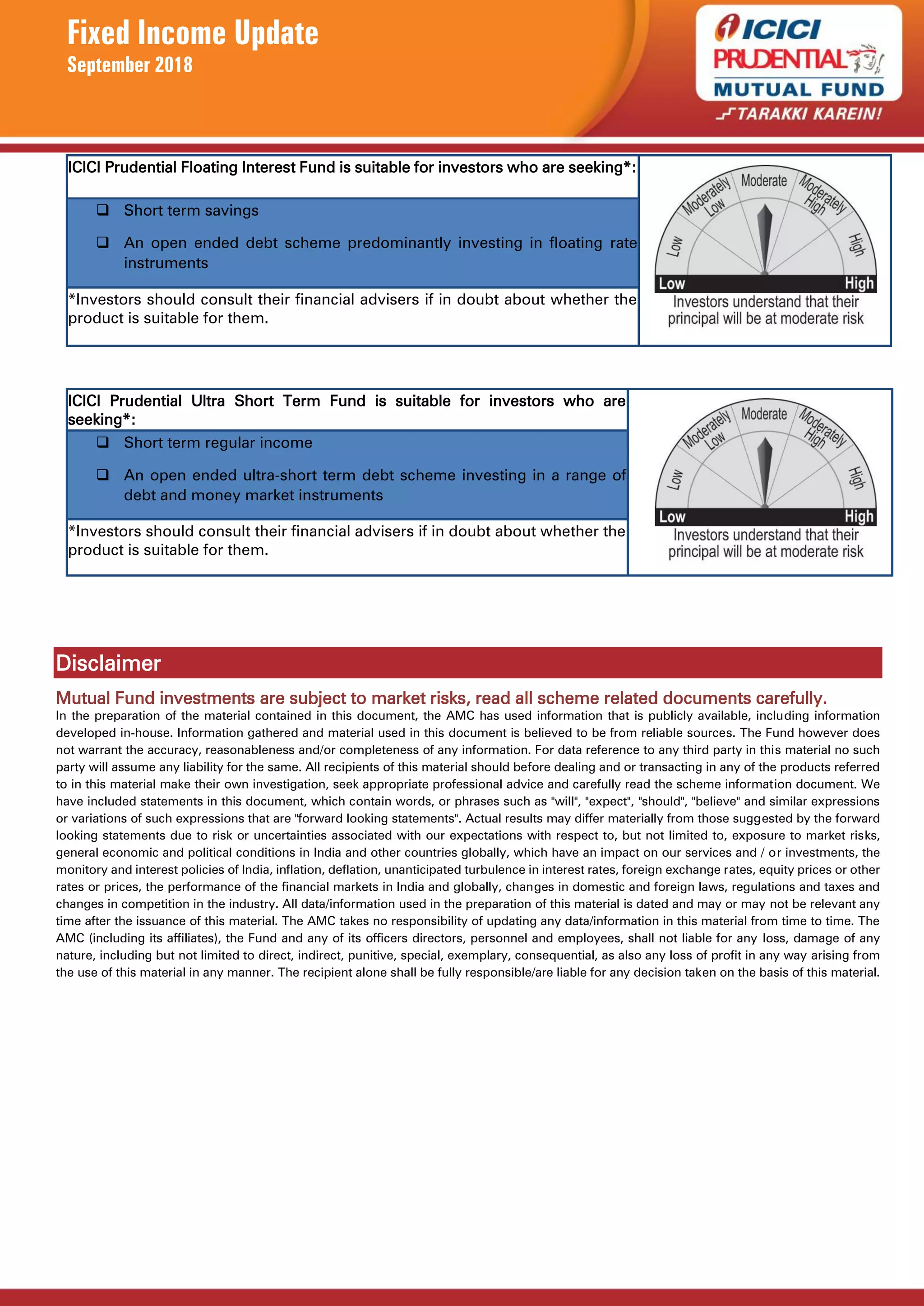
ICICI Prudential Floating Interest Fund is suitable for investors who are seeking*:
 Short term savings
 An open ended debt scheme predominantly investing in floating rate
instruments
*Investors should consult their financial advisers if in doubt about whether the
product is suitable for them.
ICICI Prudential Ultra Short Term Fund is suitable for investors who are
seeking*:
 Short term regular income
 An open ended ultra-short term debt scheme investing in a range of
debt and money market instruments
*Investors should consult their financial advisers if in doubt about whether the
product is suitable for them.
Disclaimer
Mutual Fund investments are subject to market risks, read all scheme related documents carefully.
In the preparation of the material contained in this document, the AMC has used information that is publicly available, including information
developed in-house. Information gathered and material used in this document is believed to be from reliable sources. The Fund however does
not warrant the accuracy, reasonableness and/or completeness of any information. For data reference to any third party in this material no such
party will assume any liability for the same. All recipients of this material should before dealing and or transacting in any of the products referred
to in this material make their own investigation, seek appropriate professional advice and carefully read the scheme information document. We
have included statements in this document, which contain words, or phrases such as "will", "expect", "should", "believe" and similar expressions
or variations of such expressions that are "forward looking statements". Actual results may differ materially from those suggested by the forward
looking statements due to risk or uncertainties associated with our expectations with respect to, but not limited to, exposure to market risks,
general economic and political conditions in India and other countries globally, which have an impact on our services and / or investments, the
monitory and interest policies of India, inflation, deflation, unanticipated turbulence in interest rates, foreign exchange rates, equity prices or other
rates or prices, the performance of the financial markets in India and globally, changes in domestic and foreign laws, regulations and taxes and
changes in competition in the industry. All data/information used in the preparation of this material is dated and may or may not be relevant any
time after the issuance of this material. The AMC takes no responsibility of updating any data/information in this material from time to time. The
AMC (including its affiliates), the Fund and any of its officers directors, personnel and employees, shall not liable for any loss, damage of any
nature, including but not limited to direct, indirect, punitive, special, exemplary, consequential, as also any loss of profit in any way arising from
the use of this material in any manner. The recipient alone shall be fully responsible/are liable for any decision taken on the basis of this material.

Fixed Income Update - September 2018

  • 1.
    Fixed Income Update September2018 Month Overview as on 31st August, 2018 Average Liquidity Support by RBI Rs -0.76 billion (Includes: LAF, MSF, SLF & Term Repo) Bank Credit Growth Bank Deposit Growth 12.9% 8.3% Money Market Change in basis points (bps) Tenure CD Change CP Change 1M 6.62 -28 7.15 -55 3M 7.19 3 7.78 -27 6M 7.50 3 8.30 -8 12M 8.05 9 8.55 5 Bond Market Change in basis points Tenure G-Sec Change AAA CB Change 1Y 7.34 9 8.20 5 3Y 7.79 13 8.54 17 5Y 8.01 11 8.66 7 10Y 7.95 18 8.64 10 Macro Economy Data Release Indicator Latest Update Previous Update IIP 7.0% (Jun) 3.9% (May) GDP 8.2% (1QFY19) 7.7% (4QFY18) USD/INR 70.99 (Aug) 68.54 (July) WPI 5.09% (Jul) 5.77% (Jun) CPI 4.17% (Jul) 4.93% (Jun) Credit Spread Data in basis points Tenure AAA AA A 1Y 1.04% 1.56% 2.12% 3Y 0.57% 1.19% 2.05% 5Y 0.46% 1.01% 2.07% 10Y 0.54% 1.29% 2.34% Data Source – RBI, Mospi.Nic.in, CRISIL Fixed Income Database, LAF – Liquidity Adjustment Facility, MSF – Marginal Standing Facility, SLF – Standing Liquidity Facility, CP - Commercial Paper, CD – Certificate of Deposit, CB – Corporate Bond, IIP – India Industrial Production, CPI – Consumer Price Index, WPI – Wholesale Price Index, CAD – Current Account Deficit, GDP – Gross Domestic Product Market Update Interbank call money rates remained below the repo rate for most of the month owing to comfortable liquidity in the system. However, some stress was seen in the rates owing to outflows related to indirect tax payments. Currency in circulation rose 23.8% year on year in the week ended August 24, 2018 against 9.6% de-growth a year ago. The RBI, via its liquidity window, injected Rs 0.76 billion on a net daily average basis in August 2018 (till August 30) compared with net liquidity injection of Rs 128.51 billion in July 2018. There was slight improvement in the credit growth and was reported at 12.9% year- on-year as against the bank deposit rate of 8.3% year-on-year as on 31st August, 2018. Source: CRISIL Macro Update Inflation: Price Index (CPI)-based inflation fell to a nine-month low of 4.17% in July 2018 compared with 4.93% in June 2018. Wholesale Price Index (WPI)-based inflation eased to 5.09% in July 2018 from a four-year high of 5.77% in June 2018. GDP: India’s gross domestic product (GDP) rose 8.2% in April-June 2018 due to strong performance by manufacturing and construction sectors. Currency: The rupee depreciated to a record low against the US dollar during the month to end at Rs 70.99 per US dollar on August 31 compared with Rs 68.54 per US dollar on July 31. Crude: Global crude oil prices ended the month 4.3% high on speculation that the US sanctions against Iran would disrupt global supply. Brent crude oil prices ended at $77.42 per barrel on August 31 compared with $74.25 per barrel on July 31. Fiscal Deficit: India’s fiscal deficit for April-July period stood at Rs 5.40 trillion or 86.5% of the budgeted target for the current fiscal year compared with 92.4% a year ago. Source: CRISIL Our Outlook We continue to remain in an upward interest rate cycle, where the 10-year benchmark yield has touched a high of 7.95% as on 31st August, 2018. Major reason for rising yields are the following: continued downward trend in INR with an all- time low of Rs 70.99 as on Aug 31, rising crude oil prices and liquidity tightening in the system. The most decisive event during the month was the RBI hiking the repo rate by 25 basis points (bps) to 6.50%. This is the first time since October 2013 that the central bank has raised the repo rate at two consecutive policy meetings. However, the RBI did not formally tighten its monetary policy stance from “neutral” to a “withdrawal of accommodation” and has kept it open for the next policy. Going into September, bond yields are expected to remain under stress due to concerns around deteriorating macro-economic factors. This, along with even strong GDP growth, could create a background for further rate hike. We expect RBI to hike interest rates by 25-50 bps in the coming quarters. We continue to maintain a cautious approach and be watchful about various domestic and global factors. On the global front, we remain watchful on higher oil prices, rising trade protectionism, and unwinding of quantitative easing by central banks. Domestically, commitment towards fiscal discipline and consolidation, in an election year, needs to be monitored closely given that the GST collections have not been too buoyant. Further, upside risk on inflation exists, liquidity scenario looks negative and the full impact of MSP price revision is yet to be seen. We recommend investors to stick to low duration schemes which can mitigate interest rate volatility, accrual schemes which can capture the current elevated yields and dynamic duration schemes which can benefit from volatility.
  • 2.
    Fixed Income Update September2018 . Debt Valuation Debt Valuation Index considers WPI, CPI, Credit Growth, Sensex YOY returns, Gold YOY returns and Real estate YOY returns over G-Sec yield, Current Account Balance and Crude Oil Movement for calculation. Our Recommendation Our Recommendations Accrual Schemes ICICI Prudential Medium Term Bond Fund (An open ended medium term debt scheme investing in instruments such that the Macaulay duration of the portfolio is between 3 Years and 4 Years. The Macaulay duration of the portfolio is 1 Year to 4 years under anticipated adverse situation) ICICI Prudential Credit Risk Fund (An open ended debt scheme predominantly investing in AA and below rated corporate bonds) ICICI Prudential Floating Interest Fund (An open ended debt scheme predominantly investing in floating rate instruments (including fixed rate instruments converted to floating rate exposures using swaps/derivatives) ICICI Prudential Ultra Short Term Fund (An open ended ultra-short term debt scheme investing in instruments such that the Macaulay duration of the portfolio is between 3 months and 6 months) These schemes are better suited for investors looking for accrual strategy. Dynamic Duration Schemes ICICI Prudential All Seasons Bond Fund (An open ended dynamic debt scheme investing across duration) This scheme can dynamically change duration strategy based on market conditions. Short Duration Scheme ICICI Prudential Short Term Fund (An open ended short term debt scheme investing in instruments such that the Macaulay duration of the portfolio is between 1 Year and 3 Years) This scheme maintains short duration maturity. 1.22 1 2 3 4 5 6 7 8 9 10 Ultra Low Duration Low Duration Moderate Duration High Duration Aggressively in High Duration
  • 3.
    Fixed Income Update September2018 None of the aforesaid recommendations are based on any assumptions. These are purely for reference and the investors are requested to consult their financial advisors before investing. Note: The Macaulay duration is the weighted average term to maturity of the cash flows from a bond. The weight of each cash flow is determined by dividing the present value of the cash flow by the price. ICICI Prudential Short Term Fund is suitable for investors who are seeking*:  Short term income generation and capital appreciation solution  A debt fund that aims to generate income by investing in a range of debt and money market instruments of various maturities *Investors should consult their financial advisers if in doubt about whether the product is suitable for them. ICICI Prudential Medium Term Bond Fund is suitable for investors who are seeking*:  Medium term savings  A debt scheme that invests in debt and money market instruments with a view to maximize income while maintaining optimum balance of yield, safety and liquidity *Investors should consult their financial advisers if in doubt about whether the product is suitable for them. ICICI Prudential All Seasons Bond Fund is suitable for investors who are seeking*:  All duration savings  A debt scheme that invests in debt and money market instruments with a view to maximize income while maintaining optimum balance of yield, safety and liquidity *Investors should consult their financial advisers if in doubt about whether the product is suitable for them. ICICI Prudential Credit Risk Fund is suitable for investors who are seeking*:  Medium term savings  A debt scheme that aims to generate income through investing predominantly in AA and below rated corporate bonds while maintaining the optimum balance of yield, safety and liquidity *Investors should consult their financial advisers if in doubt about whether the product is suitable for them.
  • 4.
    Fixed Income Update September2018 ICICI Prudential Floating Interest Fund is suitable for investors who are seeking*:  Short term savings  An open ended debt scheme predominantly investing in floating rate instruments *Investors should consult their financial advisers if in doubt about whether the product is suitable for them. ICICI Prudential Ultra Short Term Fund is suitable for investors who are seeking*:  Short term regular income  An open ended ultra-short term debt scheme investing in a range of debt and money market instruments *Investors should consult their financial advisers if in doubt about whether the product is suitable for them. Disclaimer Mutual Fund investments are subject to market risks, read all scheme related documents carefully. In the preparation of the material contained in this document, the AMC has used information that is publicly available, including information developed in-house. Information gathered and material used in this document is believed to be from reliable sources. The Fund however does not warrant the accuracy, reasonableness and/or completeness of any information. For data reference to any third party in this material no such party will assume any liability for the same. All recipients of this material should before dealing and or transacting in any of the products referred to in this material make their own investigation, seek appropriate professional advice and carefully read the scheme information document. We have included statements in this document, which contain words, or phrases such as "will", "expect", "should", "believe" and similar expressions or variations of such expressions that are "forward looking statements". Actual results may differ materially from those suggested by the forward looking statements due to risk or uncertainties associated with our expectations with respect to, but not limited to, exposure to market risks, general economic and political conditions in India and other countries globally, which have an impact on our services and / or investments, the monitory and interest policies of India, inflation, deflation, unanticipated turbulence in interest rates, foreign exchange rates, equity prices or other rates or prices, the performance of the financial markets in India and globally, changes in domestic and foreign laws, regulations and taxes and changes in competition in the industry. All data/information used in the preparation of this material is dated and may or may not be relevant any time after the issuance of this material. The AMC takes no responsibility of updating any data/information in this material from time to time. The AMC (including its affiliates), the Fund and any of its officers directors, personnel and employees, shall not liable for any loss, damage of any nature, including but not limited to direct, indirect, punitive, special, exemplary, consequential, as also any loss of profit in any way arising from the use of this material in any manner. The recipient alone shall be fully responsible/are liable for any decision taken on the basis of this material.