Impact Analysis
Fourth Bi-monthly Monetary Policy Statement, 2018-19
What is RBI’s Stance?
RBI policy highlights:
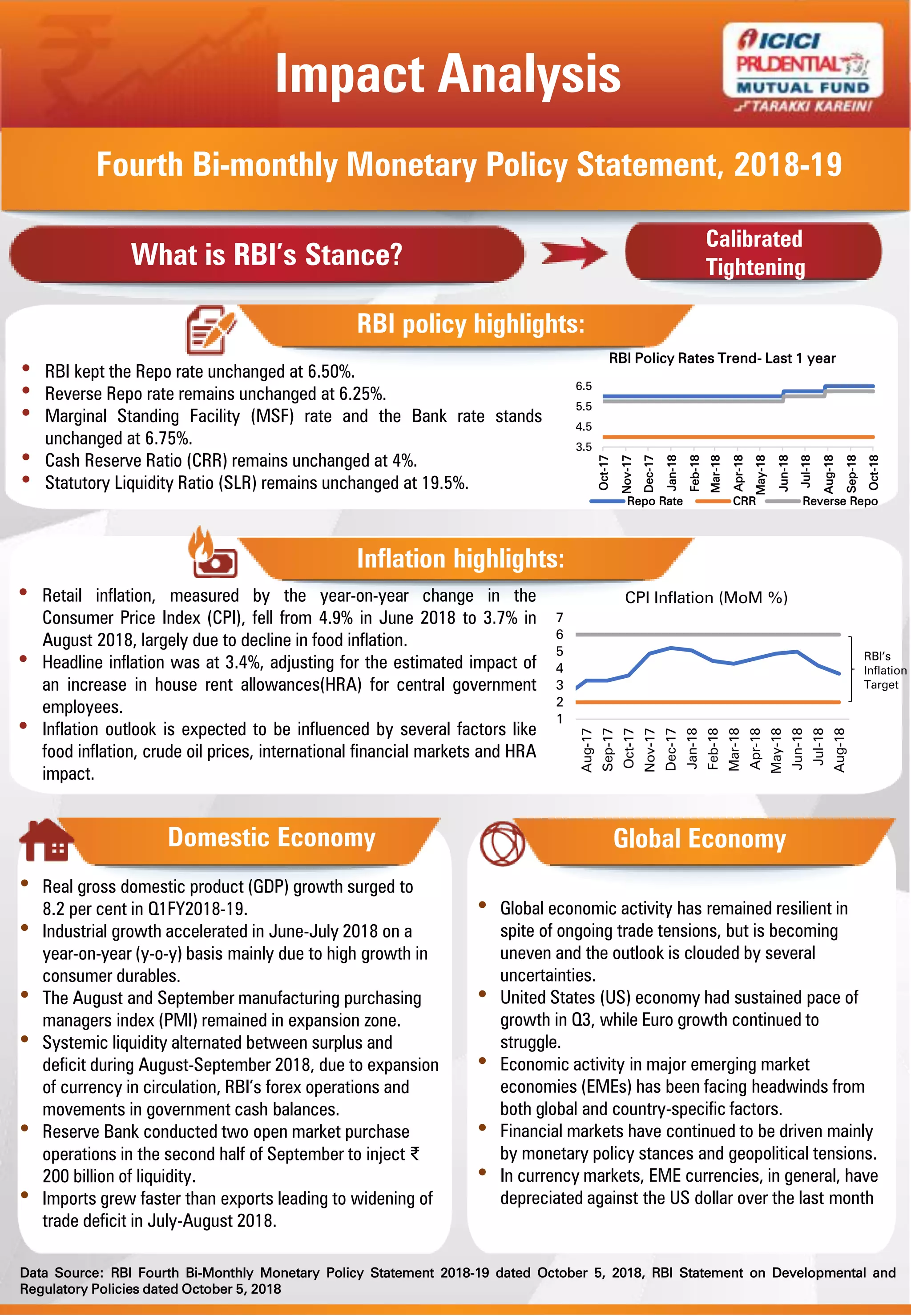
• RBI kept the Repo rate unchanged at 6.50%.
• Reverse Repo rate remains unchanged at 6.25%.
• Marginal Standing Facility (MSF) rate and the Bank rate stands
unchanged at 6.75%.
• Cash Reserve Ratio (CRR) remains unchanged at 4%.
• Statutory Liquidity Ratio (SLR) remains unchanged at 19.5%.
Inflation highlights:
• Retail inflation, measured by the year-on-year change in the
Consumer Price Index (CPI), fell from 4.9% in June 2018 to 3.7% in
August 2018, largely due to decline in food inflation.
• Headline inflation was at 3.4%, adjusting for the estimated impact of
an increase in house rent allowances(HRA) for central government
employees.
• Inflation outlook is expected to be influenced by several factors like
food inflation, crude oil prices, international financial markets and HRA
impact.
Domestic Economy
• Global economic activity has remained resilient in
spite of ongoing trade tensions, but is becoming
uneven and the outlook is clouded by several
uncertainties.
• United States (US) economy had sustained pace of
growth in Q3, while Euro growth continued to
struggle.
• Economic activity in major emerging market
economies (EMEs) has been facing headwinds from
both global and country-specific factors.
• Financial markets have continued to be driven mainly
by monetary policy stances and geopolitical tensions.
• In currency markets, EME currencies, in general, have
depreciated against the US dollar over the last month
Global Economy
Calibrated
Tightening
RBI’s
Inflation
Target
Data Source: RBI Fourth Bi-Monthly Monetary Policy Statement 2018-19 dated October 5, 2018, RBI Statement on Developmental and
Regulatory Policies dated October 5, 2018
• Real gross domestic product (GDP) growth surged to
8.2 per cent in Q1FY2018-19.
• Industrial growth accelerated in June-July 2018 on a
year-on-year (y-o-y) basis mainly due to high growth in
consumer durables.
• The August and September manufacturing purchasing
managers index (PMI) remained in expansion zone.
• Systemic liquidity alternated between surplus and
deficit during August-September 2018, due to expansion
of currency in circulation, RBI’s forex operations and
movements in government cash balances.
• Reserve Bank conducted two open market purchase
operations in the second half of September to inject ₹
200 billion of liquidity.
• Imports grew faster than exports leading to widening of
trade deficit in July-August 2018.
1
2
3
4
5
6
7
Aug-17
Sep-17
Oct-17
Nov-17
Dec-17
Jan-18
Feb-18
Mar-18
Apr-18
May-18
Jun-18
Jul-18
Aug-18
CPI Inflation (MoM %)
3.5
4.5
5.5
6.5
Oct-17
Nov-17
Dec-17
Jan-18
Feb-18
Mar-18
Apr-18
May-18
Jun-18
Jul-18
Aug-18
Sep-18
Oct-18
RBI Policy Rates Trend- Last 1 year
Repo Rate CRR Reverse Repo
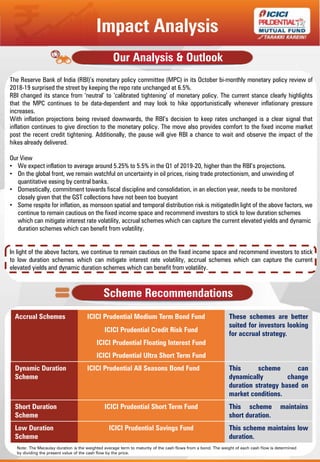
The Reserve Bank of India (RBI)’s monetary policy committee (MPC) in its October bi-monthly monetary policy review of
2018-19 surprised the street by keeping the repo rate unchanged at 6.5%.
RBI changed its stance from ‘neutral’ to ‘calibrated tightening’ of monetary policy. The current stance clearly highlights
that the MPC continues to be data-dependent and may look to hike opportunistically whenever inflationary pressure
increases.
With inflation projections being revised downwards, the RBI’s decision to keep rates unchanged is a clear signal that
inflation continues to give direction to the monetary policy. The move also provides comfort to the fixed income market
post the recent credit tightening. Additionally, the pause will give RBI a chance to wait and observe the impact of the
hikes already delivered.
Our View
• We expect inflation to average around 5.25% to 5.5% in the Q1 of 2019-20, higher than the RBI’s projections.
• On the global front, we remain watchful on uncertainty in oil prices, rising trade protectionism, and unwinding of
quantitative easing by central banks.
• Domestically, commitment towards fiscal discipline and consolidation, in an election year, needs to be monitored
closely given that the GST collections have not been too buoyant
• Some respite for inflation, as monsoon spatial and temporal distribution risk is mitigatedIn light of the above factors, we
continue to remain cautious on the fixed income space and recommend investors to stick to low duration schemes
which can mitigate interest rate volatility, accrual schemes which can capture the current elevated yields and dynamic
duration schemes which can benefit from volatility.
In light of the above factors, we continue to remain cautious on the fixed income space and recommend investors to stick
to low duration schemes which can mitigate interest rate volatility, accrual schemes which can capture the current
elevated yields and dynamic duration schemes which can benefit from volatility.
Our Analysis & Outlook
Scheme Recommendations
Accrual Schemes ICICI Prudential Medium Term Bond Fund These schemes are better
suited for investors looking
for accrual strategy.
ICICI Prudential Credit Risk Fund
ICICI Prudential Floating Interest Fund
ICICI Prudential Ultra Short Term Fund
Dynamic Duration
Scheme
ICICI Prudential All Seasons Bond Fund This scheme can
dynamically change
duration strategy based on
market conditions.
Short Duration
Scheme
ICICI Prudential Short Term Fund This scheme maintains
short duration.
Low Duration
Scheme
ICICI Prudential Savings Fund This scheme maintains low
duration.
Impact Analysis
Note: The Macaulay duration is the weighted average term to maturity of the cash flows from a bond. The weight of each cash flow is determined
by dividing the present value of the cash flow by the price.
Disclaimer
Scheme Risk-o-meters
Mutual Fund investments are subject to market risks, read all scheme related documents carefully.
None of the aforesaid recommendations are based on any assumptions. These are purely for reference and the investors are requested to consult
their financial advisors before investing. All data/information used in the preparation of this material is specific to a time and may or may not be
relevant in future post issuance of this material. ICICI Prudential Asset Management Company Limited (the AMC) takes no responsibility of
updating any data/information in this material from time to time. The AMC (including its affiliates), ICICI Prudential Mutual Fund (the Fund), ICICI
Prudential Trust Limited (the Trust) and any of its officers, directors, personnel and employees, shall not liable for any loss, damage of any nature,
including but not limited to direct, indirect, punitive, special, exemplary, consequential, as also any loss of profit in any way arising from the use of
this material in any manner. Nothing contained in this document shall be construed to be an investment advice or an assurance of the benefits of
investing in the any of the Schemes of the Fund. Sectors/stocks mentioned in the article do not constitute any recommendation and the Fund
through its schemes may or may not have any future position in these sectors/stocks. Recipient alone shall be fully responsible for any decision
taken on the basis of this document.
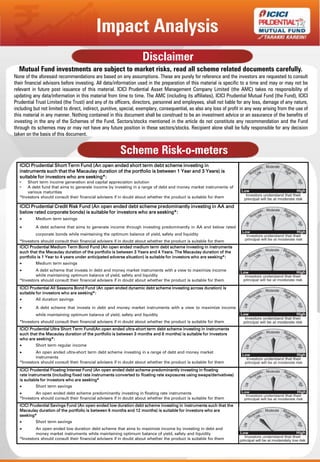
ICICI Prudential Short Term Fund (An open ended short term debt scheme investing in
instruments such that the Macaulay duration of the portfolio is between 1 Year and 3 Years) is
suitable for investors who are seeking*:
• Short term income generation and capital appreciation solution
• A debt fund that aims to generate income by investing in a range of debt and money market instruments of
various maturities
*Investors should consult their financial advisers if in doubt about whether the product is suitable for them
ICICI Prudential Credit Risk Fund (An open ended debt scheme predominantly investing in AA and
below rated corporate bonds) is suitable for investors who are seeking*:
 Medium term savings
 A debt scheme that aims to generate income through investing predominantly in AA and below rated
corporate bonds while maintaining the optimum balance of yield, safety and liquidity
*Investors should consult their financial advisers if in doubt about whether the product is suitable for them
ICICI Prudential Medium Term Bond Fund (An open ended medium term debt scheme investing in instruments
such that the Macaulay duration of the portfolio is between 3 Years and 4 Years. The Macaulay duration of the
portfolio is 1 Year to 4 years under anticipated adverse situation) is suitable for investors who are seeking*:
 Medium term savings
 A debt scheme that invests in debt and money market instruments with a view to maximize income
while maintaining optimum balance of yield, safety and liquidity
*Investors should consult their financial advisers if in doubt about whether the product is suitable for them
ICICI Prudential All Seasons Bond Fund (An open ended dynamic debt scheme investing across duration) is
suitable for investors who are seeking*:
 All duration savings
 A debt scheme that invests in debt and money market instruments with a view to maximize income
while maintaining optimum balance of yield, safety and liquidity
*Investors should consult their financial advisers if in doubt about whether the product is suitable for them
ICICI Prudential Ultra Short Term Fund(An open ended ultra-short term debt scheme investing in instruments
such that the Macaulay duration of the portfolio is between 3 months and 6 months) is suitable for investors
who are seeking*:
 Short term regular income
 An open ended ultra-short term debt scheme investing in a range of debt and money market
instruments
*Investors should consult their financial advisers if in doubt about whether the product is suitable for them
ICICI Prudential Floating Interest Fund (An open ended debt scheme predominantly investing in floating
rate instruments (including fixed rate instruments converted to floating rate exposures using swaps/derivatives)
is suitable for investors who are seeking*
 Short term savings
 An open ended debt scheme predominantly investing in floating rate instruments
*Investors should consult their financial advisers if in doubt about whether the product is suitable for them
ICICI Prudential Savings Fund (An open ended low duration debt scheme investing in instruments such that the
Macaulay duration of the portfolio is between 6 months and 12 months) is suitable for investors who are
seeking*
 Short term savings
 An open ended low duration debt scheme that aims to maximize income by investing in debt and
money market instruments while maintaining optimum balance of yield, safety and liquidity
*Investors should consult their financial advisers if in doubt about whether the product is suitable for them
Impact Analysis

RBI's 4th Bi-monthly Monetary Policy 2018-19

  • 1.
    Impact Analysis Fourth Bi-monthlyMonetary Policy Statement, 2018-19 What is RBI’s Stance? RBI policy highlights: • RBI kept the Repo rate unchanged at 6.50%. • Reverse Repo rate remains unchanged at 6.25%. • Marginal Standing Facility (MSF) rate and the Bank rate stands unchanged at 6.75%. • Cash Reserve Ratio (CRR) remains unchanged at 4%. • Statutory Liquidity Ratio (SLR) remains unchanged at 19.5%. Inflation highlights: • Retail inflation, measured by the year-on-year change in the Consumer Price Index (CPI), fell from 4.9% in June 2018 to 3.7% in August 2018, largely due to decline in food inflation. • Headline inflation was at 3.4%, adjusting for the estimated impact of an increase in house rent allowances(HRA) for central government employees. • Inflation outlook is expected to be influenced by several factors like food inflation, crude oil prices, international financial markets and HRA impact. Domestic Economy • Global economic activity has remained resilient in spite of ongoing trade tensions, but is becoming uneven and the outlook is clouded by several uncertainties. • United States (US) economy had sustained pace of growth in Q3, while Euro growth continued to struggle. • Economic activity in major emerging market economies (EMEs) has been facing headwinds from both global and country-specific factors. • Financial markets have continued to be driven mainly by monetary policy stances and geopolitical tensions. • In currency markets, EME currencies, in general, have depreciated against the US dollar over the last month Global Economy Calibrated Tightening RBI’s Inflation Target Data Source: RBI Fourth Bi-Monthly Monetary Policy Statement 2018-19 dated October 5, 2018, RBI Statement on Developmental and Regulatory Policies dated October 5, 2018 • Real gross domestic product (GDP) growth surged to 8.2 per cent in Q1FY2018-19. • Industrial growth accelerated in June-July 2018 on a year-on-year (y-o-y) basis mainly due to high growth in consumer durables. • The August and September manufacturing purchasing managers index (PMI) remained in expansion zone. • Systemic liquidity alternated between surplus and deficit during August-September 2018, due to expansion of currency in circulation, RBI’s forex operations and movements in government cash balances. • Reserve Bank conducted two open market purchase operations in the second half of September to inject ₹ 200 billion of liquidity. • Imports grew faster than exports leading to widening of trade deficit in July-August 2018. 1 2 3 4 5 6 7 Aug-17 Sep-17 Oct-17 Nov-17 Dec-17 Jan-18 Feb-18 Mar-18 Apr-18 May-18 Jun-18 Jul-18 Aug-18 CPI Inflation (MoM %) 3.5 4.5 5.5 6.5 Oct-17 Nov-17 Dec-17 Jan-18 Feb-18 Mar-18 Apr-18 May-18 Jun-18 Jul-18 Aug-18 Sep-18 Oct-18 RBI Policy Rates Trend- Last 1 year Repo Rate CRR Reverse Repo
  • 2.
    The Reserve Bankof India (RBI)’s monetary policy committee (MPC) in its October bi-monthly monetary policy review of 2018-19 surprised the street by keeping the repo rate unchanged at 6.5%. RBI changed its stance from ‘neutral’ to ‘calibrated tightening’ of monetary policy. The current stance clearly highlights that the MPC continues to be data-dependent and may look to hike opportunistically whenever inflationary pressure increases. With inflation projections being revised downwards, the RBI’s decision to keep rates unchanged is a clear signal that inflation continues to give direction to the monetary policy. The move also provides comfort to the fixed income market post the recent credit tightening. Additionally, the pause will give RBI a chance to wait and observe the impact of the hikes already delivered. Our View • We expect inflation to average around 5.25% to 5.5% in the Q1 of 2019-20, higher than the RBI’s projections. • On the global front, we remain watchful on uncertainty in oil prices, rising trade protectionism, and unwinding of quantitative easing by central banks. • Domestically, commitment towards fiscal discipline and consolidation, in an election year, needs to be monitored closely given that the GST collections have not been too buoyant • Some respite for inflation, as monsoon spatial and temporal distribution risk is mitigatedIn light of the above factors, we continue to remain cautious on the fixed income space and recommend investors to stick to low duration schemes which can mitigate interest rate volatility, accrual schemes which can capture the current elevated yields and dynamic duration schemes which can benefit from volatility. In light of the above factors, we continue to remain cautious on the fixed income space and recommend investors to stick to low duration schemes which can mitigate interest rate volatility, accrual schemes which can capture the current elevated yields and dynamic duration schemes which can benefit from volatility. Our Analysis & Outlook Scheme Recommendations Accrual Schemes ICICI Prudential Medium Term Bond Fund These schemes are better suited for investors looking for accrual strategy. ICICI Prudential Credit Risk Fund ICICI Prudential Floating Interest Fund ICICI Prudential Ultra Short Term Fund Dynamic Duration Scheme ICICI Prudential All Seasons Bond Fund This scheme can dynamically change duration strategy based on market conditions. Short Duration Scheme ICICI Prudential Short Term Fund This scheme maintains short duration. Low Duration Scheme ICICI Prudential Savings Fund This scheme maintains low duration. Impact Analysis Note: The Macaulay duration is the weighted average term to maturity of the cash flows from a bond. The weight of each cash flow is determined by dividing the present value of the cash flow by the price.
  • 3.
    Disclaimer Scheme Risk-o-meters Mutual Fundinvestments are subject to market risks, read all scheme related documents carefully. None of the aforesaid recommendations are based on any assumptions. These are purely for reference and the investors are requested to consult their financial advisors before investing. All data/information used in the preparation of this material is specific to a time and may or may not be relevant in future post issuance of this material. ICICI Prudential Asset Management Company Limited (the AMC) takes no responsibility of updating any data/information in this material from time to time. The AMC (including its affiliates), ICICI Prudential Mutual Fund (the Fund), ICICI Prudential Trust Limited (the Trust) and any of its officers, directors, personnel and employees, shall not liable for any loss, damage of any nature, including but not limited to direct, indirect, punitive, special, exemplary, consequential, as also any loss of profit in any way arising from the use of this material in any manner. Nothing contained in this document shall be construed to be an investment advice or an assurance of the benefits of investing in the any of the Schemes of the Fund. Sectors/stocks mentioned in the article do not constitute any recommendation and the Fund through its schemes may or may not have any future position in these sectors/stocks. Recipient alone shall be fully responsible for any decision taken on the basis of this document. ICICI Prudential Short Term Fund (An open ended short term debt scheme investing in instruments such that the Macaulay duration of the portfolio is between 1 Year and 3 Years) is suitable for investors who are seeking*: • Short term income generation and capital appreciation solution • A debt fund that aims to generate income by investing in a range of debt and money market instruments of various maturities *Investors should consult their financial advisers if in doubt about whether the product is suitable for them ICICI Prudential Credit Risk Fund (An open ended debt scheme predominantly investing in AA and below rated corporate bonds) is suitable for investors who are seeking*:  Medium term savings  A debt scheme that aims to generate income through investing predominantly in AA and below rated corporate bonds while maintaining the optimum balance of yield, safety and liquidity *Investors should consult their financial advisers if in doubt about whether the product is suitable for them ICICI Prudential Medium Term Bond Fund (An open ended medium term debt scheme investing in instruments such that the Macaulay duration of the portfolio is between 3 Years and 4 Years. The Macaulay duration of the portfolio is 1 Year to 4 years under anticipated adverse situation) is suitable for investors who are seeking*:  Medium term savings  A debt scheme that invests in debt and money market instruments with a view to maximize income while maintaining optimum balance of yield, safety and liquidity *Investors should consult their financial advisers if in doubt about whether the product is suitable for them ICICI Prudential All Seasons Bond Fund (An open ended dynamic debt scheme investing across duration) is suitable for investors who are seeking*:  All duration savings  A debt scheme that invests in debt and money market instruments with a view to maximize income while maintaining optimum balance of yield, safety and liquidity *Investors should consult their financial advisers if in doubt about whether the product is suitable for them ICICI Prudential Ultra Short Term Fund(An open ended ultra-short term debt scheme investing in instruments such that the Macaulay duration of the portfolio is between 3 months and 6 months) is suitable for investors who are seeking*:  Short term regular income  An open ended ultra-short term debt scheme investing in a range of debt and money market instruments *Investors should consult their financial advisers if in doubt about whether the product is suitable for them ICICI Prudential Floating Interest Fund (An open ended debt scheme predominantly investing in floating rate instruments (including fixed rate instruments converted to floating rate exposures using swaps/derivatives) is suitable for investors who are seeking*  Short term savings  An open ended debt scheme predominantly investing in floating rate instruments *Investors should consult their financial advisers if in doubt about whether the product is suitable for them ICICI Prudential Savings Fund (An open ended low duration debt scheme investing in instruments such that the Macaulay duration of the portfolio is between 6 months and 12 months) is suitable for investors who are seeking*  Short term savings  An open ended low duration debt scheme that aims to maximize income by investing in debt and money market instruments while maintaining optimum balance of yield, safety and liquidity *Investors should consult their financial advisers if in doubt about whether the product is suitable for them Impact Analysis